controls Hyundai Palisade 2020 Owner's Guide
[x] Cancel search | Manufacturer: HYUNDAI, Model Year: 2020, Model line: Palisade, Model: Hyundai Palisade 2020Pages: 611, PDF Size: 18.86 MB
Page 444 of 611
5-135
Driving your vehicle
5
To resume Smart Cruise Controlset speed
If any method other than the cruise
toggle switch was used to cancel
cruising speed and the system is still
activated, the cruising speed will
automatically resume when you
push the toggle switch up (RES+) or
down (SET-).
If you push the toggle switch up
(RES+), the speed will resume to the
recently set speed. However, if vehi-
cle speed drops below 20 mph (30
km/h), it will resume when there is a
vehicle in front of your vehicle.
To turn Cruise Control off
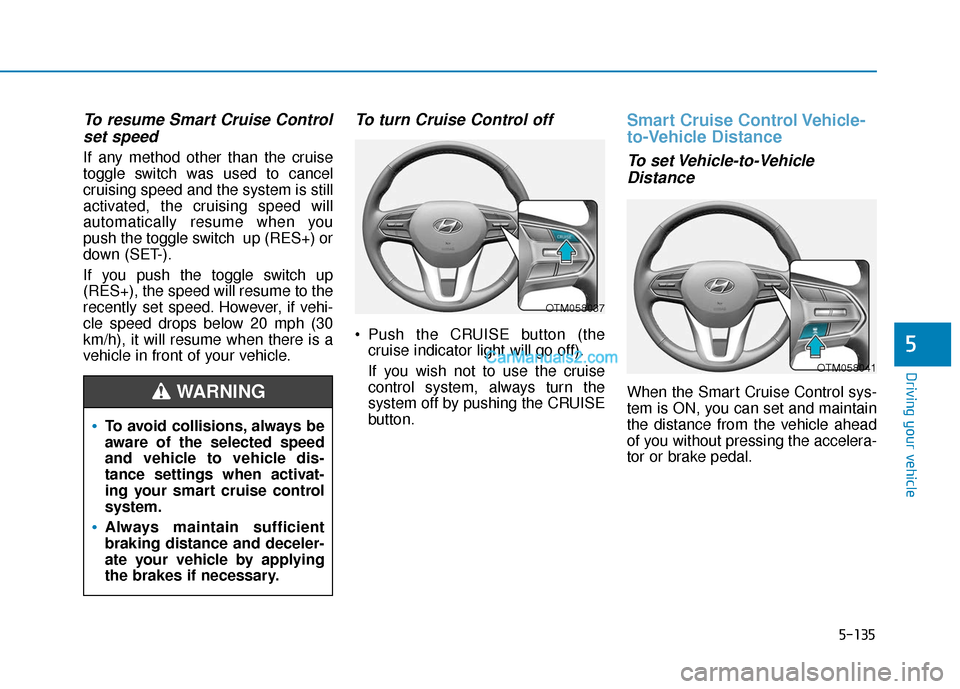
Push the CRUISE button (the
cruise indicator light will go off).
If you wish not to use the cruise
control system, always turn the
system off by pushing the CRUISE
button.
Smart Cruise Control Vehicle-
to-Vehicle Distance
To set Vehicle-to-VehicleDistance
When the Smart Cruise Control sys-
tem is ON, you can set and maintain
the distance from the vehicle ahead
of you without pressing the accelera-
tor or brake pedal.
To avoid collisions, always be
aware of the selected speed
and vehicle to vehicle dis-
tance settings when activat-
ing your smart cruise control
system.
Always maintain sufficient
braking distance and deceler-
ate your vehicle by applying
the brakes if necessary.
WARNING
OTM058037
OTM058041
Page 510 of 611
Check headlamp alignment.
Check muffler, exhaust pipes,shields and clamps.
Check seat belts for wear and function.
At least once a year:
Clean body and door drain holes.
Lubricate door hinges and hoodhinges.
Lubricate door and hood locks and latches.
Lubricate door rubber weather strips.
Lubricate door checker.
Check the air conditioning system.
Inspect and lubricate automatic transmission linkage and controls.
Clean the battery and terminals.
Check the brake fluid level. Follow Normal Maintenance
Schedule if the vehicle is usually
operated where none of the following
conditions apply. If any of the follow-
ing conditions apply, you must follow
the Maintenance Under Severe
Usage Conditions.
Repeatedly driving short distances
of less than 5 miles (8 km) in nor-
mal temperature or less than 10
miles (16 km) in freezing tempera-
ture
Extensive engine idling or low speed driving for long distances
Driving on rough, dusty, muddy, unpaved, graveled or salt- spread
roads
Driving in areas using salt or other corrosive materials or in very cold
weather
Driving in heavy dust conditions
Driving in heavy traffic area Driving on uphill, downhill, or
mountain road
Towing a trailer, or using a camper, or roof rack
Driving as a patrol car, taxi, other commercial use or vehicle towing
Driving over 106 mph (170 km/h)
Frequently driving in stop-and-go conditions
For additional information or assis-
tance see your authorized HYUNDAI
dealer.
S S C
C H
H E
ED
D U
U L
LE
E D
D
M
M A
AI
IN
N T
TE
EN
N A
AN
N C
CE
E
S
S E
E R
R V
V I
IC
C E
E S
S
Maintenance
7
7-7
Page 551 of 611
7-48
Maintenance
F
FU
U S
SE
E S
S
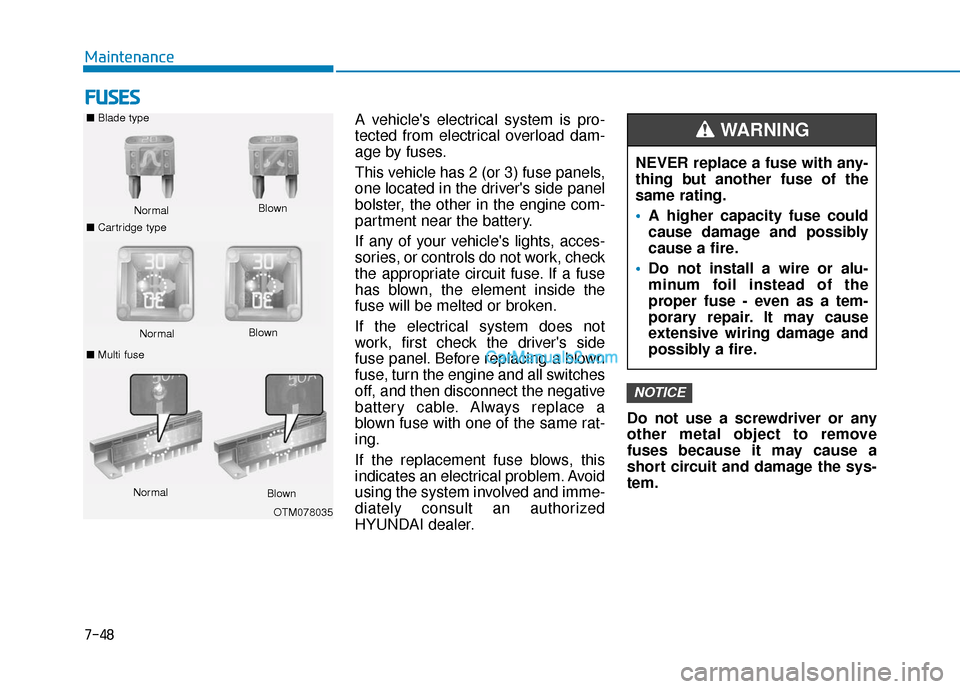
A vehicle's electrical system is pro-
tected from electrical overload dam-
age by fuses.
This vehicle has 2 (or 3) fuse panels,
one located in the driver's side panel
bolster, the other in the engine com-
partment near the battery.
If any of your vehicle's lights, acces-
sories, or controls do not work, check
the appropriate circuit fuse. If a fuse
has blown, the element inside the
fuse will be melted or broken.
If the electrical system does not
work, first check the driver's side
fuse panel. Before replacing a blown
fuse, turn the engine and all switches
off, and then disconnect the negative
battery cable. Always replace a
blown fuse with one of the same rat-
ing.
If the replacement fuse blows, this
indicates an electrical problem. Avoid
using the system involved and imme-
diately consult an authorized
HYUNDAI dealer. Do not use a screwdriver or any
other metal object to remove
fuses because it may cause a
short circuit and damage the sys-
tem.
NOTICE
NEVER replace a fuse with any-
thing but another fuse of the
same rating.
A higher capacity fuse could
cause damage and possibly
cause a fire.
Do not install a wire or alu-
minum foil instead of the
proper fuse - even as a tem-
porary repair. It may cause
extensive wiring damage and
possibly a fire.
WARNING ■ Blade type
Normal
■ Cartridge type Blown
Normal
Blown
■ Multi fuse
Normal Blown
OTM078035
Page 580 of 611
7-77
7
Maintenance
The emission control system of your
vehicle is covered by a written limited
warranty. Please see the warranty
information contained in the Owner’s
Handbook & Warranty Information
booklet in your vehicle.
Your vehicle is equipped with an
emission control system to meet all
applicable emission regulations.
There are three emission control
systems, as follows.
(1) Crankcase emission control sys-tem
(2) Evaporative emission control sys- tem
(3) Exhaust emission control system
In order to ensure the proper func-
tion of the emission control systems,
it is recommended that you have
your vehicle inspected and main-
tained by an authorized HYUNDAI
dealer in accordance with the main-
tenance schedule in this manual. For the Inspection and
Maintenance Test (with Electronic
Stability Control (ESC) system)
To prevent the vehicle from mis-
firing during dynamometer test-
ing, turn the Electronic Stability
Control (ESC) system off by
pressing the ESC switch (ESC
OFF light illuminated).
After dynamometer testing is completed, turn the ESC system
back on by pressing the ESC
switch again.1. Crankcase Emission Control System
The positive crankcase ventilation
system is employed to prevent air
pollution caused by blow-by gases
being emitted from the crankcase.
This system supplies fresh filtered air
to the crankcase through the air
intake hose. Inside the crankcase,
the fresh air mixes with blow-by
gases, which then pass through the
PCV valve into the induction system.
2. Evaporative Emission ControlSystem Including Onboard
Refueling Vapor Recovery
(ORVR)
The Evaporative Emission Control
System is designed to prevent fuel
vapors from escaping into the atmos-
phere. The ORVR system is
designed to allow the vapors from
the fuel tank to be loaded into a can-
ister while refueling at the gas sta-
tion, preventing the escape of fuel
vapors into the atmosphere.
NOTICE
E EM
M I
IS
S S
SI
IO
O N
N
C
C O
O N
NT
TR
R O
O L
L
S
S Y
Y S
ST
T E
EM
M
Page 581 of 611
7-78
Maintenance
Canister
Fuel vapors generated inside the fuel
tank are absorbed and stored in the
onboard canister. When the engine is
running, the fuel vapors absorbed in
the canister are drawn into the surge
tank through the purge control sole-
noid valve.
Purge Control Solenoid Valve(PCSV)
The purge control solenoid valve is
controlled by the Engine Control
Module (ECM); when the engine
coolant temperature is low during
idling, the PCSV closes so that evap-
orated fuel is not taken into the
engine. After the engine warms-up
during ordinary driving, the PCSV
opens to introduce evaporated fuel to
the engine.
3. Exhaust Emission Control System
The Exhaust Emission Control
System is a highly effective system
which controls exhaust emissions
while maintaining good vehicle per-
formance.
When the engine starts or fails to
start, excessive attempts to restart
the engine may cause damage to the
emission system.
Engine exhaust (carbon monox-
ide) precautions
Carbon monoxide can be present
with other exhaust fumes. If you
smell exhaust fumes of any kind in
your vehicle, drive with all the win-
dows fully open. Have your vehicle
checked and repaired immediately.
Engine exhaust gases contain
carbon monoxide (CO). Though
colorless and odorless, it is
dangerous and could be lethal if
inhaled. Follow the instructions
on this page to avoid CO poi-
soning.
WARNING
Page 604 of 611

I-7
Infotainment system..........................................................4-2Antenna ........................................................................\
4-2
Audio/Video/Navigation system ..................................4-4
Bluetooth
®Wireless Technology..................................4-4
Steering wheel audio controls ......................................4-3
USB port.......................................................................4\
-2
Inside rearview mirror ....................................................3-33
Instrument cluster ...........................................................3-69 Assist mode ................................................................3-98
Adjusting instrument cluster illumination..................3-69
Gauges and meters .....................................................3-71
LCD display control ...................................................3-96
LCD display messages ...............................................3-90
LCD display modes ....................................................3-97
Option menu .............................................................3-119
Transmission shift indicator .......................................3-76
Trip computer mode .................................................3-110
User settings mode ...................................................3-100
Warning and indicator lights ......................................3-76
Instrument panel fuse replacement .................................7-49
Instrument panel overview ...............................................1-5
Interior care .....................................................................7-7\
4
Interior features AC inverter ...............................................................3-198
Cargo security screen ...............................................3-205
Clock ........................................................................\
3-203
Coat hanger ..............................................................3-203
Conversation mirror .................................................3-196 Cup holder ................................................................3-194
Floor mat anchor(s) ..................................................3-204
Luggage net (holder) ................................................3-205
Power outlet..............................................................3-197
Side curtain...............................................................3-207
Sunvisor ....................................................................3-19\
6
USB charger .............................................................3-200
Wireless cellular phone charging system .................3-201
Interior lamp AUTO cut................................................3-139
Interior lights.................................................................3-139 Front lamps...............................................................3-139
Grove box lamp ........................................................3-141
Interior lamp AUTO cut ...........................................3-139
Luggage compartment lamp .....................................3-140
Puddle lamp ..............................................................3-141
Rear lamps ................................................................3-140
Vanity mirror lamp ...................................................3-141
Interior overview...............................................................1-4
Jump starting .....................................................................6-4\
Key ignition switch ...........................................................5-7
I
Index
J
K
Page 609 of 611
I-12
Smart liftgate...................................................................3-62
Smooth cornering..........................................................5-149
Snow tires .....................................................................5-1\
52
Spare tireUse of compact spare tires .........................................6-19
Special driving conditions Driving at night ........................................................5-149
Driving in flooded areas ...........................................5-150
Driving in the rain ....................................................5-149
Hazardous driving conditions ..................................5-148
Highway driving.......................................................5-150
Reducing the risk of a rollover.................................5-151
Rocking the vehicle ..................................................5-148
Smooth cornering .....................................................5-149
Speedometer....................................................................3-71\
Steering wheel Electric power steering (EPS) ....................................3-30
Heated steering wheel ................................................3-32
Horn ........................................................................\
....3-31
Tilt steering/telescopic steering ..................................3-31
Steering wheel audio controls...........................................4-3
Storage compartment ....................................................3-192 Center console storage .............................................3-192
Glove box .................................................................3-192
Luggage tray.............................................................3-193 Sunroof........................................................................\
....3-46
Dual wide sunroof ......................................................3-46
Resetting the sunroof..................................................3-50
Sliding the sunroof .....................................................3-48
Sunroof open warning ................................................3-52
Sunroof opening and closing......................................3-48
Sunshade.....................................................................3-4\
7
Tilting the sunroof ......................................................3-49
Sunroof inside air recirculation ....................................3-191
Sunshade ........................................................................\
.3-47 Resetting the rear sunshade ........................................3-51
Sunvisor ........................................................................\
3-196
Surround view monitoring ............................................3-149
Tachometer ......................................................................3-\
72
Theft-alarm system .........................................................3-26
Tire pressure monitoring system (TPMS) ........................6-8
Tire rotation ....................................................................7-35\
Tire specification and pressure label ..............................8-11
Tires and wheels ......................................................7-33, 8-5 Check tire inflation pressure ......................................7-35
Recommended cold tire inflation pressures ...............7-34
Tire care ......................................................................7-\
33
Tire maintenance ........................................................7-39
Tire replacement .........................................................7-37
Tire rotation ................................................................7-35
Tire sidewall labeling .................................................7-39
Index
T