check HYUNDAI PALISADE 2021 Owners Manual
[x] Cancel search | Manufacturer: HYUNDAI, Model Year: 2021, Model line: PALISADE, Model: HYUNDAI PALISADE 2021Pages: 612, PDF Size: 33.36 MB
Page 7 of 612
F7
Introduction
F FU
UE
EL
L
R
RE
EQ
QU
UI
IR
RE
EM
ME
EN
NT
TS
S
NOTICE indicates a situation
which, if not avoided, could result
in vehicle damage.Your new vehicle is designed to
obtain maximum performance with
UNLEADED FUEL, as well as mini-
mize exhaust emissions and spark
plug fouling.
Your new vehicle is designed to use
only unleaded fuel having an octane
number ((R+M)/2) of 87 (Research
Octane Number 91) or higher. (Do not
use methanol blended fuels)
To prevent damage to the engine
and engine components, never
add any fuel system cleaning
agents to the fuel tank other than
what has been specified.
Consult an authorized HYUNDAI
dealer for additional information.
Gasoline containing alcohol or
methanol
Gasohol, a mixture of gasoline and
ethanol (also known as grain alco-
hol) are being marketed along with or
instead of leaded or unleaded gaso-
line. For example, "E15" is a gasohol
comprised of 15% ethanol and 85%
gasoline.
Do not use gasohol containing more
than 15% ethanol, and do not use
gasoline or gasohol containing any
methanol. Either of these fuels may
cause drivability problems and dam-
age to the fuel system, engine con-
trol system and emission control sys-
tem.
Discontinue using gasohol of any
kind if drivability problems occur.
NOTICE
NOTICE
CAUTION indicates a hazardous
situation which, if not avoided,
could result in minor or moder-
ate injury.
CAUTION
•Do not "top off" after the noz-
zle automatically shuts off
when refueling.
Always check that the fuel cap
is installed securely to pre-
vent fuel spillage in the event
of an accident.
WARNING
Page 20 of 612
2-3
Safety system of your vehicle
ONLY use your mobile device
when allowed by laws and when
conditions permit safe use.
NEVER text or email while driving.
Most states have laws prohibiting
drivers from texting. Some states
and cities also prohibit drivers
from using handheld phones.
NEVER let the use of a mobile
device distract you from driving.
You have a responsibility to your
passengers and others on the
road to always drive safely, with
your hands on the wheel as well
as your eyes and attention on the
road.Control Your Speed
Excessive speed is a major factor in
crash injuries and deaths. Generally,
the higher the speed, the greater the
risk, but serious injuries can also
occur at lower speeds. Never drive
faster than is safe for current condi-
tions, regardless of the maximum
speed posted.
Keep Your Vehicle in Safe
Condition
Having a tire blowout or a mechani-
cal failure can be extremely haz-
ardous. To reduce the possibility of
such problems, check your tire pres-
sures and condition frequently, and
perform all regularly scheduled
maintenance.
2
Page 36 of 612
2-19
Safety system of your vehicle
2
Detection of object caught
While folding or unfolding the 3rd row
seat, when a consistent force is
detected, the seat returns to its orig-
inal position or stops operation.
However, this function may not work
when the detected resistance is
below a specific level or the seat is
almost folded or unfolded. When a
strong impact is applied to the seat,
the object detection function may be
activated even if no obstacle is pres-
ent.
When any object caught is detected
multiple times while operating the
seat once, folding and unfolding are
repeated consecutively and then the
operation may stop. In this case,
check that any object is caught and
then operate the switch again to
check for abnormality.
When the object detection is
enabled, the angle of the seat back
may be changed. When you operate
the seat once by pressing the folding
button, the angle of the seat back is
reset.Do not place any part of your
body or anything in the operat-
ing area to intentionally check
the detection of any object
caught.
For safety, when folding or
unfolding the 3rd row seat,
make sure that there is no part
of body or object. To prevent
damage to the seatbelt, insert it
into its holder and store it in the
retractor inside a seat.
When the child restraint system
(CRS) is installed on the 3rd row
seat, remove the CRS and then
operate the seat.
When there is any object on the
cushion of the 3rd row seat,
remove it and then operate the
seat.
To avoid interference with a
front seat, keep the backrest of
the front seat straight and move
it forward for smooth operation.WARNING
Without starting the engine, the
3rd row seat can be folded or
unfolded. When this is attempt-
ed more than 10 times, the bat-
tery may discharge premature-
ly.
Do not apply excessive force to
the 3rd row seat while in opera-
tion. It may damage the seat.
When you operate the seat over
5 times with no rest, the electric
motor may be overloaded. In
this case, the seat changes to
overheat prevention mode.
Then you cannot operate the
seat by pressing the switch.
Leave the seat for over 1 minute
for later operation.
CAUTION
Page 37 of 612
2-20
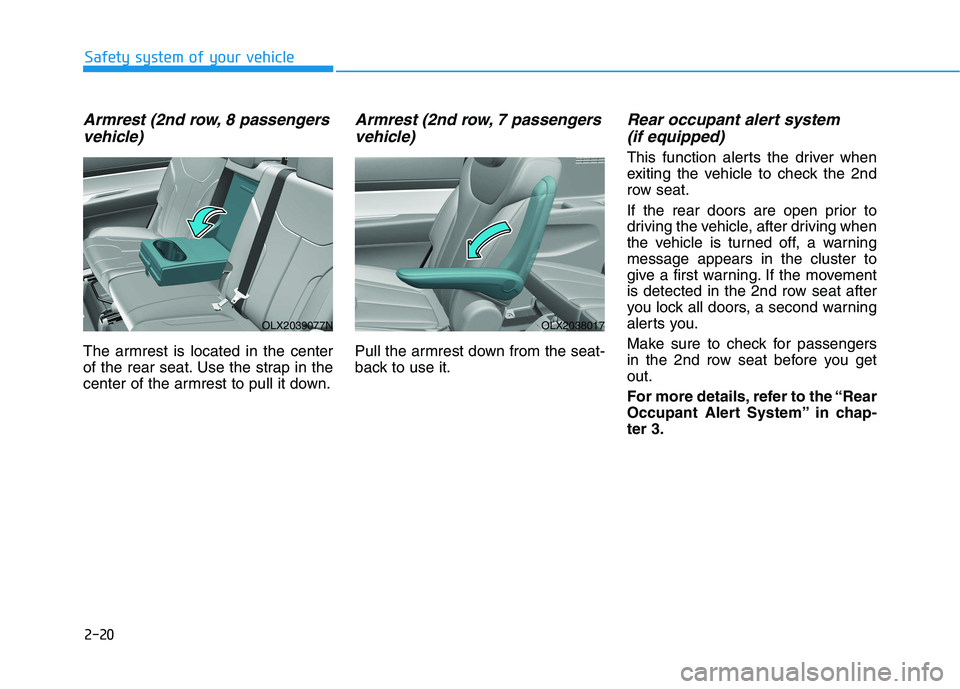
Armrest (2nd row, 8 passengers
vehicle)
The armrest is located in the center
of the rear seat. Use the strap in the
center of the armrest to pull it down.
Armrest (2nd row, 7 passengers
vehicle)
Pull the armrest down from the seat-
back to use it.
Rear occupant alert system
(if equipped)
This function alerts the driver when
exiting the vehicle to check the 2nd
row seat.
If the rear doors are open prior to
driving the vehicle, after driving when
the vehicle is turned off, a warning
message appears in the cluster to
give a first warning. If the movement
is detected in the 2nd row seat after
you lock all doors, a second warning
alerts you.
Make sure to check for passengers
in the 2nd row seat before you get
out.
For more details, refer to the “Rear
Occupant Alert System” in chap-
ter 3.
Safety system of your vehicle
OLX2039077NOLX2038017
Page 51 of 612
2-34
Safety system of your vehicle
If you are not able to smoothly pull
enough of the seat belt out from
the retractor, firmly pull the seat
belt out and release it. After
release, you will be able to pull the
belt out smoothly.
Height adjustment
You can adjust the height of the
shoulder belt anchor to one of the
three different positions for maximum
comfort and safety.
The shoulder portion should be
adjusted so it lies across your chest
and midway over your shoulder near-
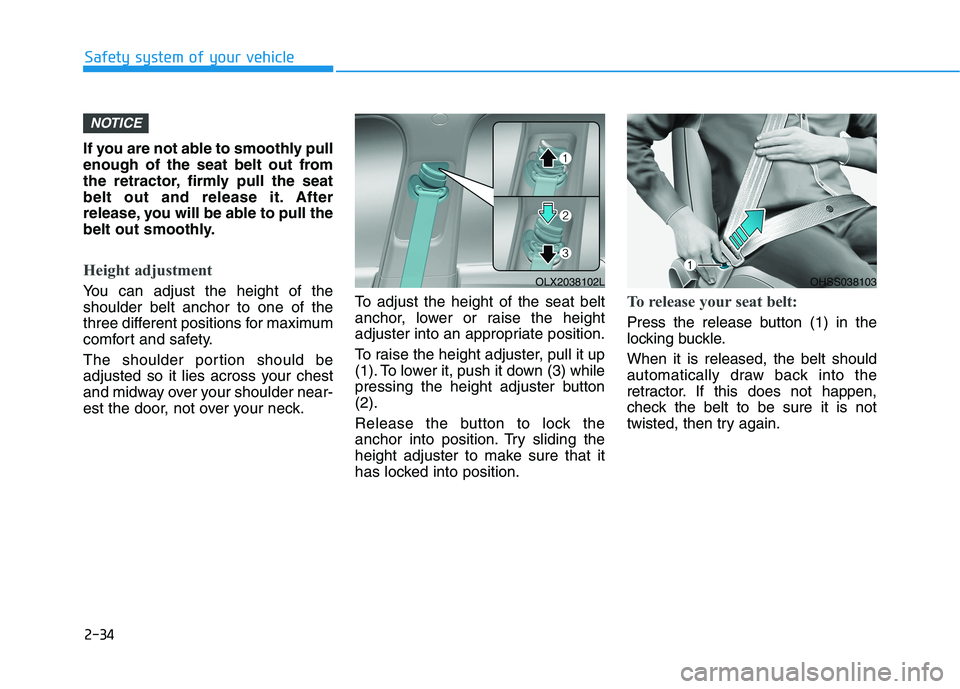
est the door, not over your neck.To adjust the height of the seat belt
anchor, lower or raise the height
adjuster into an appropriate position.
To raise the height adjuster, pull it up
(1). To lower it, push it down (3) while
pressing the height adjuster button
(2).
Release the button to lock the
anchor into position. Try sliding the
height adjuster to make sure that it
has locked into position.To release your seat belt:
Press the release button (1) in the
locking buckle.
When it is released, the belt should
automatically draw back into the
retractor. If this does not happen,
check the belt to be sure it is not
twisted, then try again.
NOTICE
OLX2038102LOHSS038103
Page 53 of 612
2-36
Safety system of your vehicle
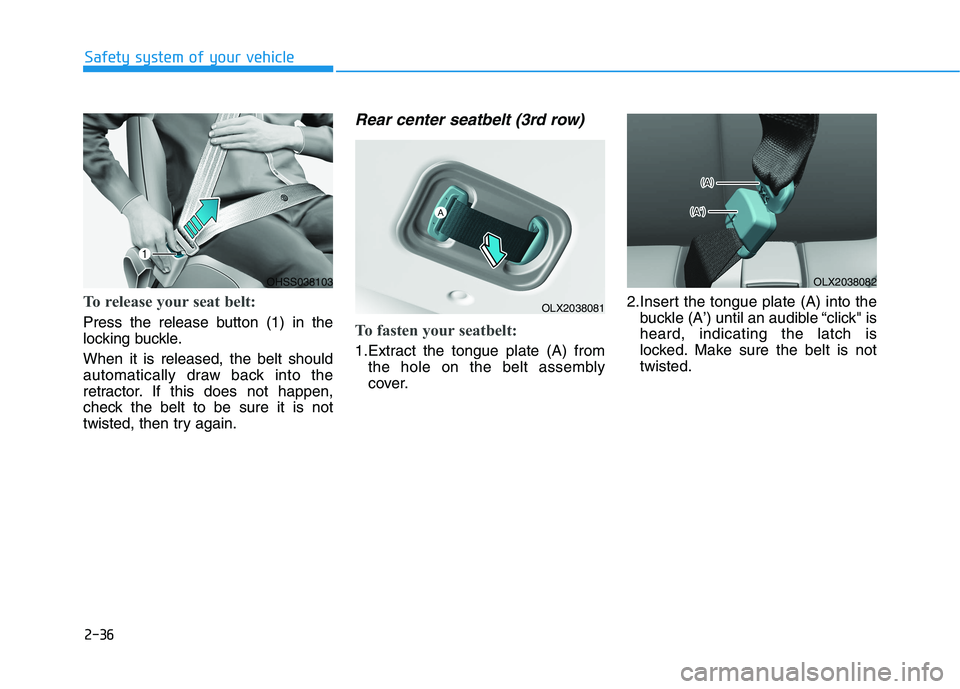
To release your seat belt:
Press the release button (1) in the
locking buckle.
When it is released, the belt should
automatically draw back into the
retractor. If this does not happen,
check the belt to be sure it is not
twisted, then try again.
Rear center seatbelt (3rd row)
To fasten your seatbelt:
1.Extract the tongue plate (A) from
the hole on the belt assembly
cover.2.Insert the tongue plate (A) into the
buckle (A’) until an audible “click" is
heard, indicating the latch is
locked. Make sure the belt is not
twisted.
OHSS038103
OLX2038081
OLX2038082
Page 59 of 612
2-42
Safety system of your vehicle
Seat belt use and children
Infant and small children
All 50 states have child restraint laws
which require children to travel in
approved child restraint devices,
including booster seats. The age at
which seat belts can be used instead
of child restraints differs among
states, so you should be aware of the
specific requirements in your state,
and where you are travelling. Infant
and child restraints must be properly
placed and installed in a rear seat.
For more information refer to the
"Child Restraint Systems" section in
this chapter.Small children are best protected
from injury in an accident when prop-
erly restrained in the rear seat by a
child restraint system that meets the
requirements of the Federal Motor
Vehicle Safety Standards. Before
buying any child restraint system,
make sure that it has a label certify-
ing that it meets Federal Motor
Vehicle Safety Standard FMVSS 213.
The restraint must be appropriate for
your child’s height and weight. Check
the label on the child restraint for this
information. Refer to the "Child
Restraint Systems" section in this
chapter. ALWAYS properly restrain infants
and small children in a child
restraint appropriate for the
child's height and weight.
To reduce the risk of serious
injury or death to a child and
other passengers, NEVER hold a
child in your lap or arms when
the vehicle is moving. The violent
forces created during an acci-
dent will tear the child from your
arms and throw the child against
the interior of the vehicle.
WARNING
Page 60 of 612
2-43
Safety system of your vehicle
2
Larger children
Children under age 13 and who are
too large for a booster seat must
always occupy the rear seat and use
the available lap/shoulder belts. A
seat belt should lie across the upper
thighs and be snug across the shoul-
der and chest to restrain the child
safely. Check belt fit periodically.
Children are afforded the most safe-
ty in the event of an accident when
they are restrained by a proper
restraint system and/or seat belts in
the rear seat. Always have the
LATCH system inspected by your
authorized HYUNDAI dealer after an
accident. An accident can damage
the LATCH system and may not
properly secure the child restraint.
If a larger child over age 13 must be
seated in the front seat, the child
must be securely restrained by the
available lap/shoulder belt and the
seat should be placed in the rear-
most position.If the shoulder belt portion slightly
touches the child's neck or face, try
placing the child closer to the center
of the vehicle. If the shoulder belt still
touches their face or neck they need
to be returned to an appropriate
booster seat in the rear seat.
Transporting an injured person
A seat belt should be used when an
injured person is being transported.
Consult a physician for specific rec-
ommendations.
One person per belt
Two people (including children) should
never attempt to use a single seat belt.
This could increase the severity of
injuries in case of an accident.
Do not lie down
Sitting in a reclined position when
the vehicle is in motion can be dan-
gerous. Even when buckled up, the
protections of your restraint system
(seat belts and air bags) is greatly
reduced by reclining your seatback.
To reduce the chance of injuries in the
event of an accident and to achieve
the maximum effectiveness of the
restraint system, all passengers
should be sitting up and the front and
rear seats should be in an upright
position when the car is moving.
A seat belt cannot provide proper
protection if the person is lying down
in the rear seat or if the front or rear
seats are in a reclined position.
Always make sure children
are wearing their seat belts
and that they are properly
adjusted before driving.
NEVER allow the shoulder
belt to contact the child’s
neck or face.
Do not allow more than one
child to use a single seat belt.
WARNING
Page 63 of 612
2-46
Safety system of your vehicle
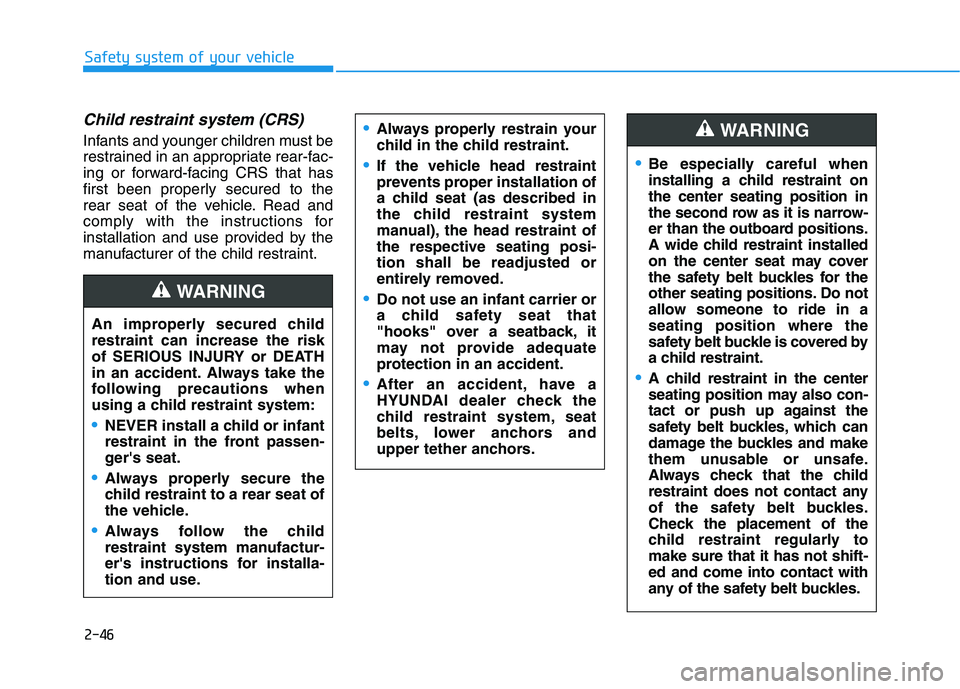
Child restraint system (CRS)
Infants and younger children must be
restrained in an appropriate rear-fac-
ing or forward-facing CRS that has
first been properly secured to the
rear seat of the vehicle. Read and
comply with the instructions for
installation and use provided by the
manufacturer of the child restraint.Always properly restrain your
child in the child restraint.
If the vehicle head restraint
prevents proper installation of
a child seat (as described in
the child restraint system
manual), the head restraint of
the respective seating posi-
tion shall be readjusted or
entirely removed.
Do not use an infant carrier or
a child safety seat that
"hooks" over a seatback, it
may not provide adequate
protection in an accident.
After an accident, have a
HYUNDAI dealer check the
child restraint system, seat
belts, lower anchors and
upper tether anchors.
An improperly secured child
restraint can increase the risk
of SERIOUS INJURY or DEATH
in an accident. Always take the
following precautions when
using a child restraint system:
NEVER install a child or infant
restraint in the front passen-
ger's seat.
Always properly secure the
child restraint to a rear seat of
the vehicle.
Always follow the child
restraint system manufactur-
er's instructions for installa-
tion and use.
WARNING
Be especially careful when
installing a child restraint on
the center seating position in
the second row as it is narrow-
er than the outboard positions.
A wide child restraint installed
on the center seat may cover
the safety belt buckles for the
other seating positions. Do not
allow someone to ride in a
seating position where the
safety belt buckle is covered by
a child restraint.
A child restraint in the center
seating position may also con-
tact or push up against the
safety belt buckles, which can
damage the buckles and make
them unusable or unsafe.
Always check that the child
restraint does not contact any
of the safety belt buckles.
Check the placement of the
child restraint regularly to
make sure that it has not shift-
ed and come into contact with
any of the safety belt buckles.
WARNING
Page 66 of 612
2-49
Safety system of your vehicle
2
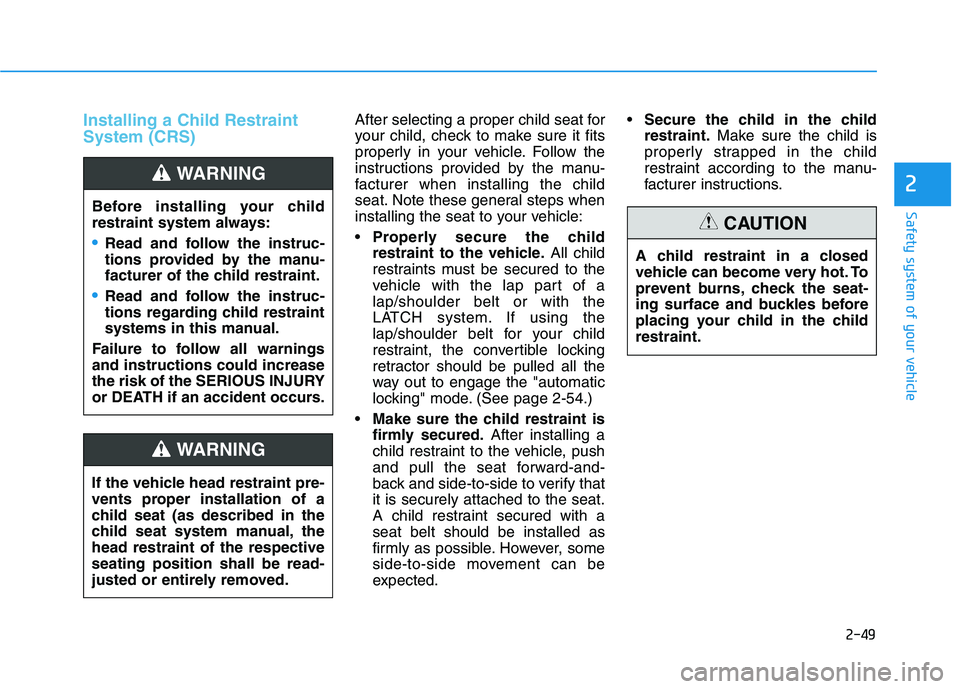
Installing a Child Restraint
System (CRS)After selecting a proper child seat for
your child, check to make sure it fits
properly in your vehicle. Follow the
instructions provided by the manu-
facturer when installing the child
seat. Note these general steps when
installing the seat to your vehicle:
Properly secure the child
restraint to the vehicle.All child
restraints must be secured to the
vehicle with the lap part of a
lap/shoulder belt or with the
LATCH system. If using the
lap/shoulder belt for your child
restraint, the convertible locking
retractor should be pulled all the
way out to engage the "automatic
locking" mode. (See page 2-54.)
Make sure the child restraint is
firmly secured.After installing a
child restraint to the vehicle, push
and pull the seat forward-and-
back and side-to-side to verify that
it is securely attached to the seat.
A child restraint secured with a
seat belt should be installed as
firmly as possible. However, some
side-to-side movement can be
expected.Secure the child in the child
restraint.Make sure the child is
properly strapped in the child
restraint according to the manu-
facturer instructions.
Before installing your child
restraint system always:
Read and follow the instruc-
tions provided by the manu-
facturer of the child restraint.
Read and follow the instruc-
tions regarding child restraint
systems in this manual.
Failure to follow all warnings
and instructions could increase
the risk of the SERIOUS INJURY
or DEATH if an accident occurs.
WARNING
If the vehicle head restraint pre-
vents proper installation of a
child seat (as described in the
child seat system manual, the
head restraint of the respective
seating position shall be read-
justed or entirely removed.
WARNING
A child restraint in a closed
vehicle can become very hot. To
prevent burns, check the seat-
ing surface and buckles before
placing your child in the child
restraint.
CAUTION