efi HYUNDAI PALISADE 2022 User Guide
[x] Cancel search | Manufacturer: HYUNDAI, Model Year: 2022, Model line: PALISADE, Model: HYUNDAI PALISADE 2022Pages: 663, PDF Size: 15.74 MB
Page 593 of 663
7-34
Maintenance
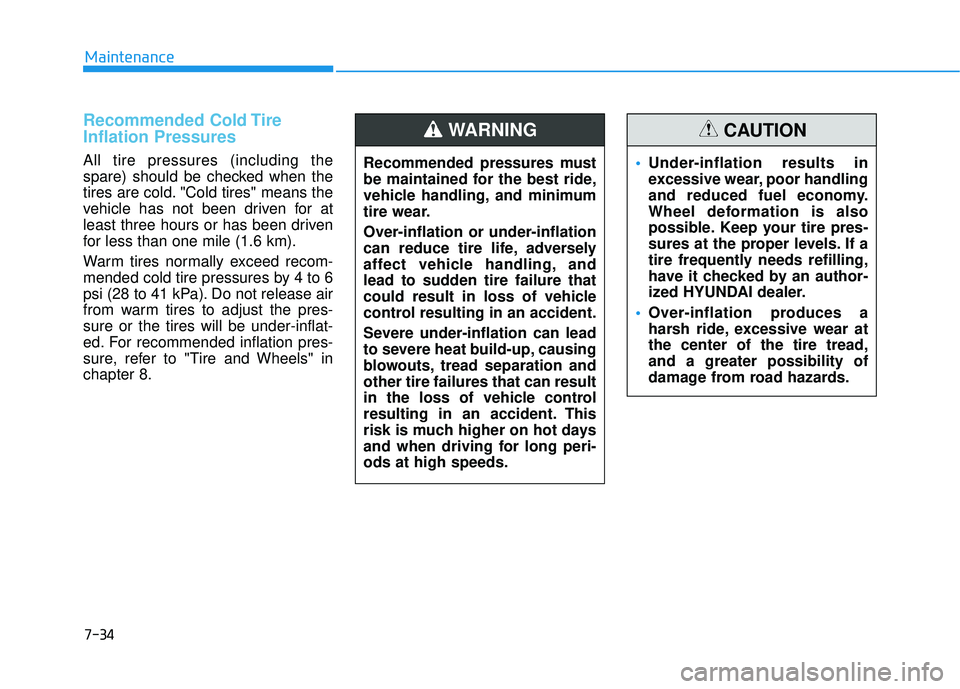
Recommended Cold Tire
Inflation Pressures
All tire pressures (including the
spare) should be checked when the
tires are cold. "Cold tires" means the
vehicle has not been driven for at
least three hours or has been driven
for less than one mile (1.6 km).
Warm tires normally exceed recom-
mended cold tire pressures by 4 to 6
psi (28 to 41 kPa). Do not release air
from warm tires to adjust the pres-
sure or the tires will be under-inflat-
ed. For recommended inflation pres-
sure, refer to "Tire and Wheels" in
chapter 8.Recommended pressures must
be maintained for the best ride,
vehicle handling, and minimum
tire wear.
Over-inflation or under-inflation
can reduce tire life, adversely
affect vehicle handling, and
lead to sudden tire failure that
could result in loss of vehicle
control resulting in an accident.
Severe under-inflation can lead
to severe heat build-up, causing
blowouts, tread separation and
other tire failures that can result
in the loss of vehicle control
resulting in an accident. This
risk is much higher on hot days
and when driving for long peri-
ods at high speeds.
WARNING
Under-inflation results in
excessive wear, poor handling
and reduced fuel economy.
Wheel deformation is also
possible. Keep your tire pres-
sures at the proper levels. If a
tire frequently needs refilling,
have it checked by an author-
ized HYUNDAI dealer.
Over-inflation produces a
harsh ride, excessive wear at
the center of the tire tread,
and a greater possibility of
damage from road hazards.
CAUTION
Page 602 of 663
7-43
7
Maintenance
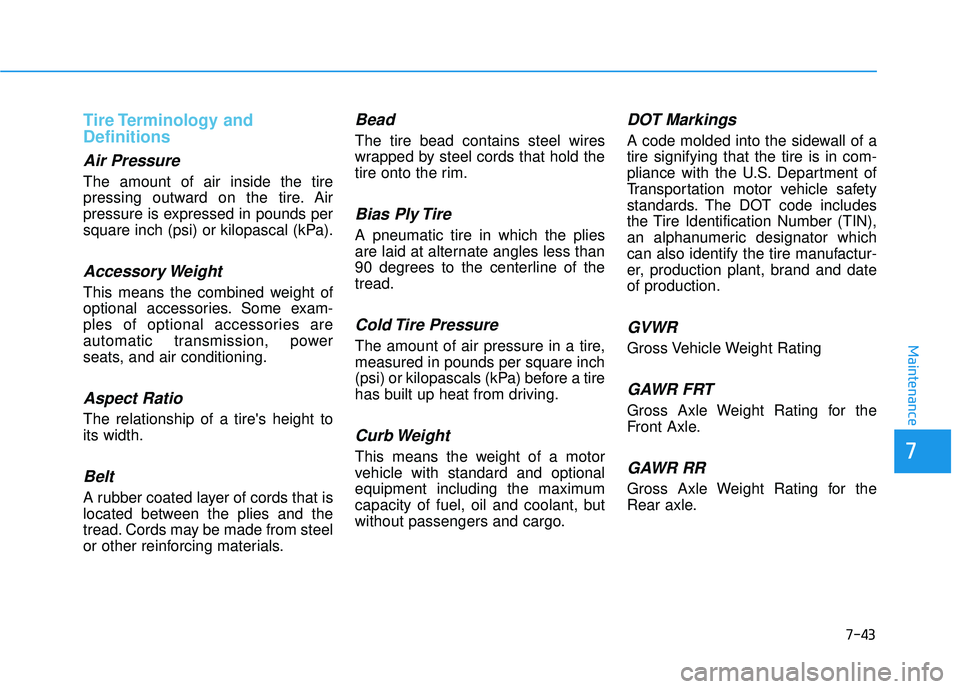
Tire Terminology and
Definitions
Air Pressure
The amount of air inside the tire
pressing outward on the tire. Air
pressure is expressed in pounds per
square inch (psi) or kilopascal (kPa).
Accessory Weight
This means the combined weight of
optional accessories. Some exam-
ples of optional accessories are
automatic transmission, power
seats, and air conditioning.
Aspect Ratio
The relationship of a tire's height to
its width.
Belt
A rubber coated layer of cords that is
located between the plies and the
tread. Cords may be made from steel
or other reinforcing materials.
Bead
The tire bead contains steel wires
wrapped by steel cords that hold the
tire onto the rim.
Bias Ply Tire
A pneumatic tire in which the plies
are laid at alternate angles less than
90 degrees to the centerline of the
tread.
Cold Tire Pressure
The amount of air pressure in a tire,
measured in pounds per square inch
(psi) or kilopascals (kPa) before a tire
has built up heat from driving.
Curb Weight
This means the weight of a motor
vehicle with standard and optional
equipment including the maximum
capacity of fuel, oil and coolant, but
without passengers and cargo.
DOT Markings
A code molded into the sidewall of a
tire signifying that the tire is in com-
pliance with the U.S. Department of
Transportation motor vehicle safety
standards. The DOT code includes
the Tire Identification Number (TIN),
an alphanumeric designator which
can also identify the tire manufactur-
er, production plant, brand and date
of production.
GVWR
Gross Vehicle Weight Rating
GAWR FRT
Gross Axle Weight Rating for the
Front Axle.
GAWR RR
Gross Axle Weight Rating for the
Rear axle.
Page 647 of 663
8-7
88
Specifications, Consumer information and Reporting safety defects
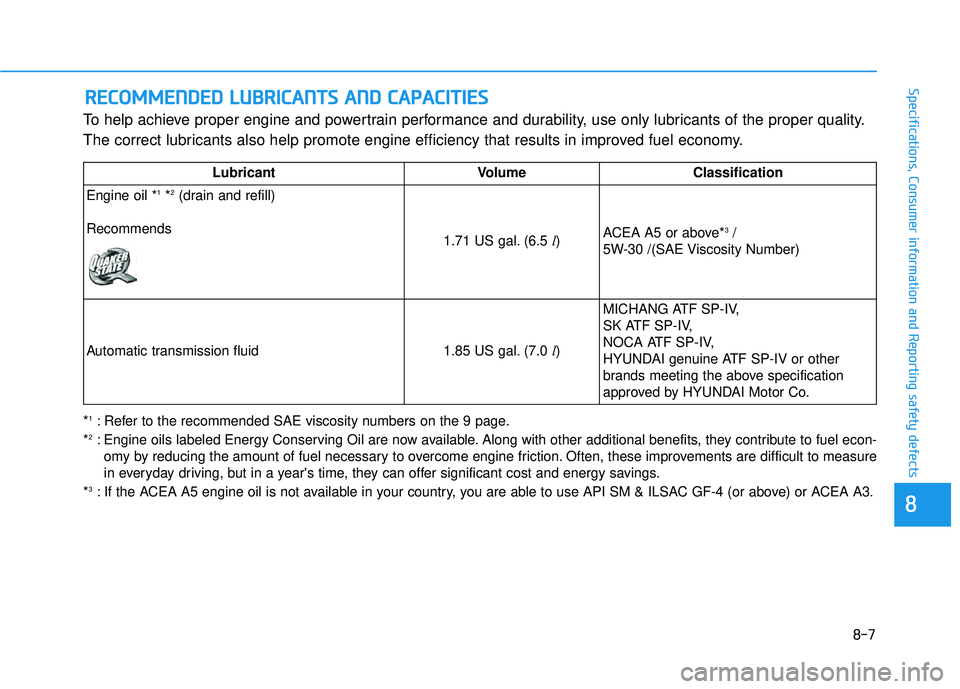
To help achieve proper engine and powertrain performance and durability, use only lubricants of the proper quality.
The correct lubricants also help promote engine efficiency that results in improved fuel economy.
R RE EC CO O M M M ME EN N D DE ED D L L U U B BR RI IC C A A N N T TS S A A N N D D C C A A P PA A C CI IT T I IE E S S
LubricantVolume Classification
Engine oil *
1*2(drain and refill)
Recommends
1.71 US gal. (6.5 l) ACEA A5 or above*3/
5W-30 /(SAE Viscosity Number)
Automatic transmission fluid1.85 US gal. (7.0 l)
MICHANG ATF SP-IV,
SK ATF SP-IV,
NOCA ATF SP-IV,
HYUNDAI genuine ATF SP-IV or other
brands meeting the above specification
approved by HYUNDAI Motor Co.
*1: Refer to the recommended SAE viscosity numbers on the 9 page.
*2: Engine oils labeled Energy Conserving Oil are now available. Along with other additional benefits, they contribute to fuel econ -
omy by reducing the amount of fuel necessary to overcome engine friction. Often, these improvements are difficult to measure
in everyday driving, but in a year's time, they can offer significant cost and energy savings.
*
3: If the ACEA A5 engine oil is not available in your country, you are able to use API SM & ILSAC GF-4 (or above) or ACEA A3.
Page 662 of 663
I-9
Surround View Monitor (SVM)....................................3-176Surround View Monitor malfunction and limitations ...............................................................3-180
Surround View Monitor operation ...........................3-178
Surround View Monitor settings ..............................3-176
Theft-alarm System.........................................................3-31
Tire Pressure Monitoring System (TPMS) .......................6-8 Changing a Tire with TPMS ......................................6-12
Check Tire Pressure......................................................6-8
Low Tire Pressure LCD Display with Position Indicator ...................................................................6-10
Low Tire Pressure Telltale..........................................6-10
Tire Pressure Monitoring System.................................6-9
TPMS Malfunction Indicator .....................................6-11
Tire Specification and Pressure Label ............................8-11
Tires and wheels .............................................................7-33 All Season Tires .........................................................7-46
Check Tire Inflation Pressure .....................................7-35
Radial-Ply Tires ..........................................................7-46
Recommended Cold Tire Inflation Pressures.............7-34
Snow Tires ..................................................................7-46
Tire Care .....................................................................7-3\
3
Tire Maintenance ........................................................7-39
Tire Replacement ......................................................7-37
Tire Rotation...............................................................7-35
Tire Sidewall Labeling ...............................................7-39 Tire Terminology and Definitions ..............................7-43
Tire Traction ...............................................................7-38
Wheel Alignment and Tire Balance ...........................7-36
Wheel Replacement....................................................7-38
Tires and Wheels...............................................................8-5
Towing ........................................................................\
....6-22 Emergency Towing.....................................................6-24
Removable Towing Hook...........................................6-23
Towing Service ...........................................................6-22
Trailer towing................................................................5-186 Driving with a trailer ................................................5-189
If you decide to pull a trailer....................................5-186
Maintenance when trailer towing ............................5-192
Trailer towing equipment .........................................5-188
Trip Computer (Cluster type A and type B) .................3-123 Trip modes ................................................................3-123
I
Index
T