maintenance schedule HYUNDAI PALISADE 2022 User Guide
[x] Cancel search | Manufacturer: HYUNDAI, Model Year: 2022, Model line: PALISADE, Model: HYUNDAI PALISADE 2022Pages: 663, PDF Size: 15.74 MB
Page 569 of 663
Maintenance
7-10
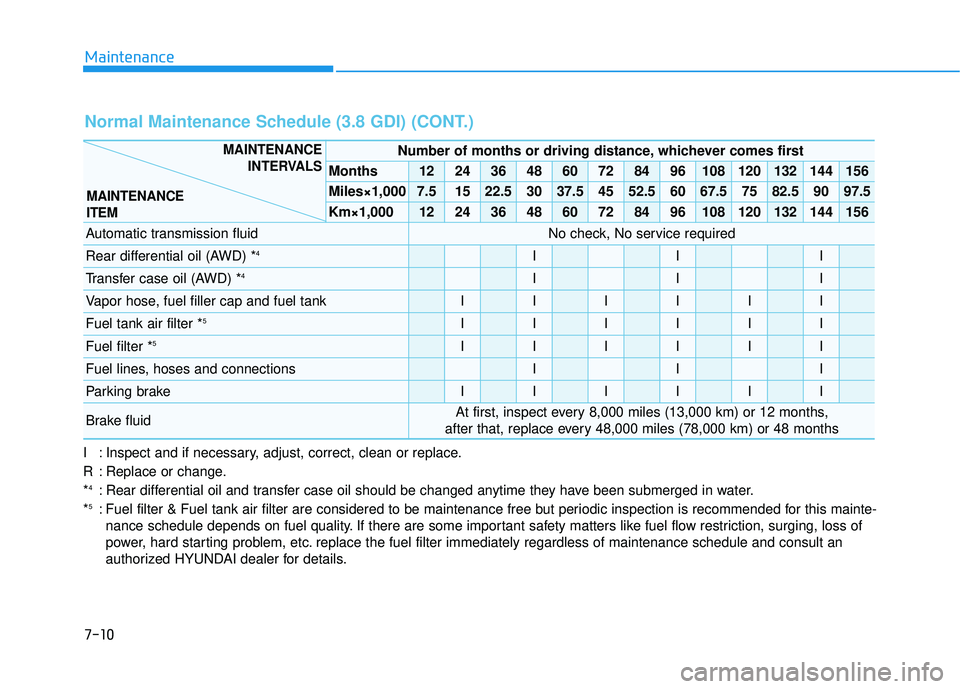
I : Inspect and if necessary, adjust, correct, clean or replace.
R : Replace or change.
*
4: Rear differential oil and transfer case oil should be changed anytime they have been submerged in water.
*5: Fuel filter & Fuel tank air filter are considered to be maintenance free\
but periodic inspection is recommended for this mainte- nance schedule depends on fuel quality. If there are some important safety matters like fuel flow restriction, surging, loss of
power, hard starting problem, etc. replace the fuel filter immediately regardless of maintenance schedule a\
nd consult an
authorized HYUNDAI dealer for details.
Number of months or driving distance, whichever comes first
Months1224364860728496108120132144156
Miles×1,0007.51522.53037.54552.56067.57582.59097.5
Km×1,0001224364860728496108120132144156
Automatic transmission fluidNo check, No service required
Rear differential oil (AWD) *4III
Transfer case oil (AWD) *4III
Vapor hose, fuel filler cap and fuel tankIIIIII
Fuel tank air filter *5IIIIII
Fuel filter *5IIIIII
Fuel lines, hoses and connectionsIII
Parking brakeIIIIII
Brake fluidAt first, inspect every 8,000 miles (13,000 km) or 12 months,
after that, replace every 48,000 miles (78,000 km) or 48 months
MAINTENANCE INTERVALS
MAINTENANCE
ITEM
Normal Maintenance Schedule (3.8 GDI) (CONT.)
Page 572 of 663
7-13
7
Maintenance
E EX X P PL LA A N N A AT TI IO O N N O O F F S S C C H H E ED D U U L LE E D D M M A AI IN N T TE EN N A AN N C CE E I IT T E EM M S S
Engine Oil and Filter
The engine oil and filter should be
changed at the intervals specified in
the maintenance schedule. If the
vehicle is being driven in severe con-
ditions, more frequent oil and filter
changes are required.
Drive Belts
Inspect all drive belts for evidence of
cuts, cracks, excessive wear or oil
saturation and replace if necessary.
Drive belts should be checked peri-
odically for proper tension and
adjusted as necessary.
Fuel Filter
A clogged-up fuel filter may limit the
vehicle driving speed, damage the
emission system, and cause the
hard starting. When a considerable
amount of foreign substances are
accumulated in the fuel tank, the fuel
filter should be replaced.
Upon installing a new fuel filter, oper-
ate the engine for several minutes,
and check the connections for any
leakages. Fuel filters should be
installed by an authorized HYUNDAI
dealer.
Fuel Lines, Fuel Hoses and
Connections
Check the fuel lines, fuel hoses and
connections for leakage and dam-
age. Have an authorized HYUNDAI
dealer replace any damaged or leak-
ing parts immediately.
Vapor Hose and Fuel Filler
Cap
The vapor hose and fuel filler cap
should be inspected at those inter-
vals specified in the maintenance
schedule. Make sure a new vapor
hose or fuel filler cap is correctly
replaced.
Vacuum Crankcase Ventilation
Hoses
Inspect the surface of hoses for evi-
dence of heat and/or mechanical
damage. Hard and brittle rubber,
cracking, tears, cuts, abrasions, and
excessive swelling indicate deterio-
ration. Particular attention should be
paid to examine those hose surfaces
nearest to high heat sources, such
as the exhaust manifold.
Inspect the hose routing to ensure
that the hoses do not come in con-
tact with any heat source, sharp
edges or moving component which
might cause heat damage or
mechanical wear. Inspect all hose
connections, such as clamps and
couplings, to make sure they are
secure, and that no leaks are pres-
ent. Hoses should be replaced
immediately if there is any evidence
of deterioration or damage.
Page 573 of 663
7-14
Maintenance
Air Cleaner Filter
A genuine HYUNDAI air cleaner filter
is recommended when the filter is
replaced.
Spark Plugs
Make sure to install new spark plugs
of the correct heat range.
When assembling parts, be sure to
wipe out foreign substances inside
and outside of the boot bottom of the
ignition coil and the insulator of the
spark plug with a soft cloth to prevent
contamination of the spark plug insu-
lator.
Cooling System
Check cooling system components,
such as radiator, coolant reservoir,
hoses and connections for leakage
and damage. Replace any damaged
parts.
Engine Coolant
The coolant should be changed at
the intervals specified in the mainte-
nance schedule.
Automatic Transmission Fluid
Automatic transmission fluid should
not be checked under normal usage
conditions. But in severe conditions,
the fluid should be changed at an
authorized HYUNDAI dealer in
accordance to the scheduled mainte-
nance at the beginning of this chap-
ter.
Information
Automatic transmission fluid color is
red when new.
As the vehicle is driven, the automatic
transmission fluid will begin to look
darker. This is a normal condition and
you should not judge the need to
replace the fluid based upon the
changed color.The use of a non-specified fluid
could result in transmission mal-
function and failure. Use only the
specified automatic transmission
fluid (refer to "Recommended
Lubricants and Capacities" in
chapter 8).
NOTICE
i
Page 575 of 663
7-16
Maintenance
Checking the Engine Oil Level
Engine oil is used for lubricating,
cooling, and operating various
hydraulic components in the engine.
Engine oil consumption while driving
is normal, and it is necessary to
check and refill the engine oil regu-
larly. Also, check and refill the oil
level within the recommended main-
tenance schedule to prevent deterio-
ration of oil performance.
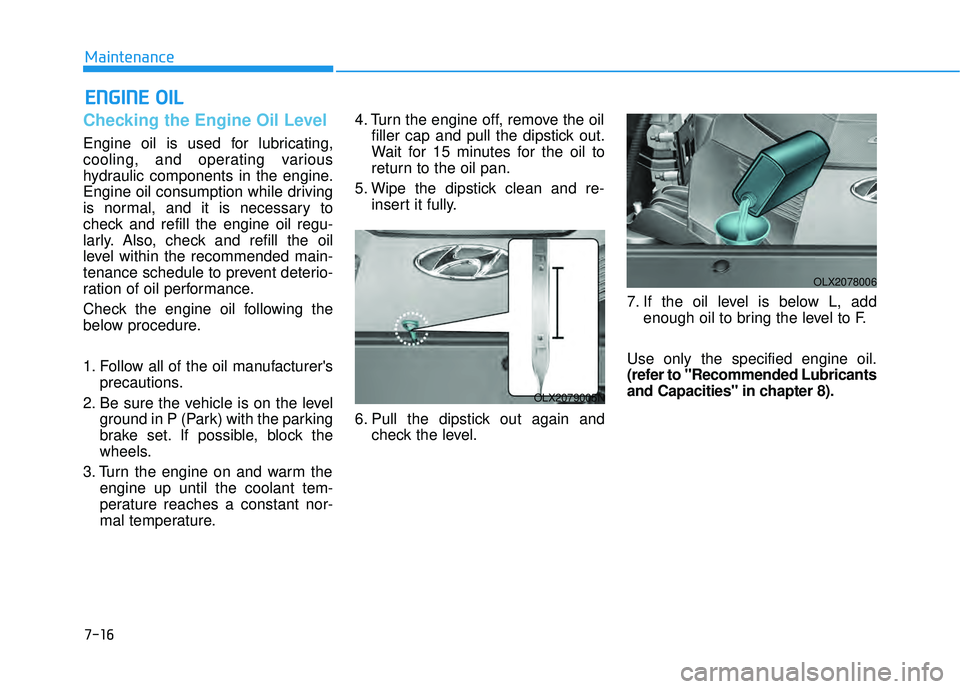
Check the engine oil following the
below procedure.
1. Follow all of the oil manufacturer'sprecautions.
2. Be sure the vehicle is on the level ground in P (Park) with the parking
brake set. If possible, block the
wheels.
3. Turn the engine on and warm the engine up until the coolant tem-
perature reaches a constant nor-
mal temperature. 4. Turn the engine off, remove the oil
filler cap and pull the dipstick out.
Wait for 15 minutes for the oil to
return to the oil pan.
5. Wipe the dipstick clean and re- insert it fully.
6. Pull the dipstick out again and check the level. 7. If the oil level is below L, add
enough oil to bring the level to F.
Use only the specified engine oil.
(refer to "Recommended Lubricants
and Capacities" in chapter 8).
OLX2079005N
OLX2078006
E E N N G GI IN N E E O O I IL L
Page 576 of 663
7-17
7
Maintenance
To prevent damage to your engine:
Do not spill engine oil whenadding or changing engine oil.
Wipe off spilled oil immediately.
The engine oil consumption may increase while you break in a
new vehicle and it will be stabi-
lized after driving 4,000 miles
(6,000 km).
The engine oil consumption can be affected by driving habits, cli-
mate conditions, traffic condi-
tions, oil quality, etc. Therefore, it
is recommended that you
inspect the engine oil level regu-
larly and refill it if necessary.
Checking the Engine Oil and
Filter
Have engine oil and filter changed
by an authorized HYUNDAI dealer
according to the Maintenance
Schedule at the beginning of this
chapter.
If the maintenance schedule to
replace engine oil is exceeded, the
engine oil performance may deteri-
orate, and the engine condition
may be affected. Therefore,
replace the engine oil according to
the maintenance schedule.
To keep the engine in optimal con-
dition, use the recommended
engine oil and filter. If the recom-
mended engine oil and filter are
not used, replace it according to
the maintenance schedule under
severe usage conditions.
The purpose of the maintenance
schedule for engine oil replace-
ment is to prevent oil deterioration
and it is irrelevant to oil consump-
tion. Check and refill engine oil reg-
ularly.
NOTICE
The engine oil is very hot imme-
diately after the vehicle has
been driven and can cause
burns during replacement.
Replace the engine oil after the
engine oil has cooled down.
CAUTION
Page 579 of 663
7-20
Maintenance
Changing Engine Coolant
Have coolant changed by an author-
ized HYUNDAI dealer according to
the Maintenance Schedule at the
beginning of this chapter.To prevent damage to engine
parts, put a thick towel around the
radiator cap before refilling the
coolant to prevent the coolant
from overflowing into engine
parts, such as the alternator.
NOTICE
Do not use engine coolant or
antifreeze in the washer fluid
reservoir.
Engine coolant can severely
obscure visibility when sprayed
on the windshield and may
cause loss of vehicle control
resulting in an accident.
Engine coolant may also cause
damage to paint and body trim.
WARNING
The electric motor for
the cooling fan may
continue to operate
or start up when the
engine is not running
and can cause serious injury.
Keep hands, clothing and tools
away from the rotating fan
blades of the cooling fan.
Always turn off the engine
unless the vehicle has to be
inspected with the engine on.
Be cautious as the cooling fan
may operate if the negative (-)
battery terminal is not discon-
nected.
WARNING
Step back while the pressure is
released from the cooling sys-
tem. When you are sure all the
pressure has been released,
press down on the cap, using a
thick towel, and continue turn-
ing counterclockwise to remove
it.
Page 581 of 663
7-22
Maintenance
W WA AS SH H E ER R F F L LU U I ID D
Checking the Washer Fluid
Level
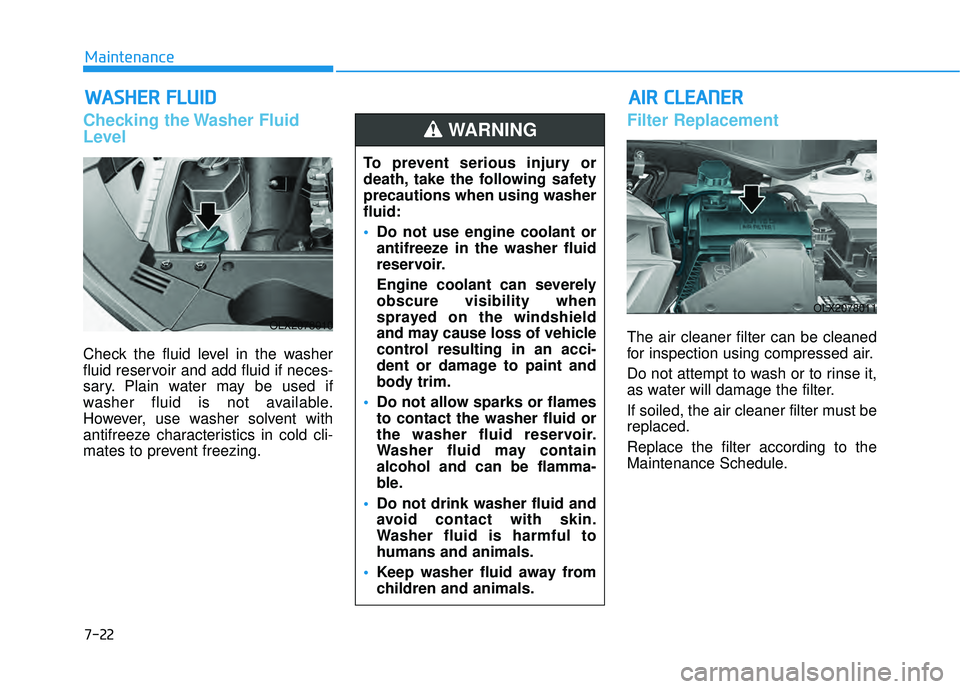
Check the fluid level in the washer
fluid reservoir and add fluid if neces-
sary. Plain water may be used if
washer fluid is not available.
However, use washer solvent with
antifreeze characteristics in cold cli-
mates to prevent freezing.
Filter Replacement
The air cleaner filter can be cleaned
for inspection using compressed air.
Do not attempt to wash or to rinse it,
as water will damage the filter.
If soiled, the air cleaner filter must be
replaced.
Replace the filter according to the
Maintenance Schedule.
A A I IR R C C L LE E A A N N E ER R
To prevent serious injury or
death, take the following safety
precautions when using washer
fluid:
Do not use engine coolant or
antifreeze in the washer fluid
reservoir.
Engine coolant can severely
obscure visibility when
sprayed on the windshield
and may cause loss of vehicle
control resulting in an acci-
dent or damage to paint and
body trim.
Do not allow sparks or flames
to contact the washer fluid or
the washer fluid reservoir.
Washer fluid may contain
alcohol and can be flamma-
ble.
Do not drink washer fluid and
avoid contact with skin.
Washer fluid is harmful to
humans and animals.
Keep washer fluid away from
children and animals.
WARNING
OLX2078010
OLX2078011
Page 583 of 663
7-24
Maintenance
Information
If the vehicle is operated in extremely
dusty or sandy areas, replace the air
cleaner filter more often than the
usual recommended intervals (refer to
"Maintenance Under Severe Usage
Conditions" in this chapter).
Do not drive with the air cleanerfilter removed. This will result in
excessive engine wear.
When removing the air cleaner filter, be careful that dust or dirt
does not enter the air intake, or
damage may result.
Use HYUNDAI genuine parts. Use of non-genuine parts could
damage the air flow sensor.
Filter Inspection
The climate control air filter should
be replaced according to the
Maintenance Schedule. If the vehicle
is operated in severely air-polluted
cities or on dusty rough roads for a
long period and/or if transporting
pets or occupants smoke inside the
vehicle, then it should be inspected
more frequently and replaced soon-
er. Replace the climate control air fil-
ter by following the procedure below
and be careful to avoid damaging
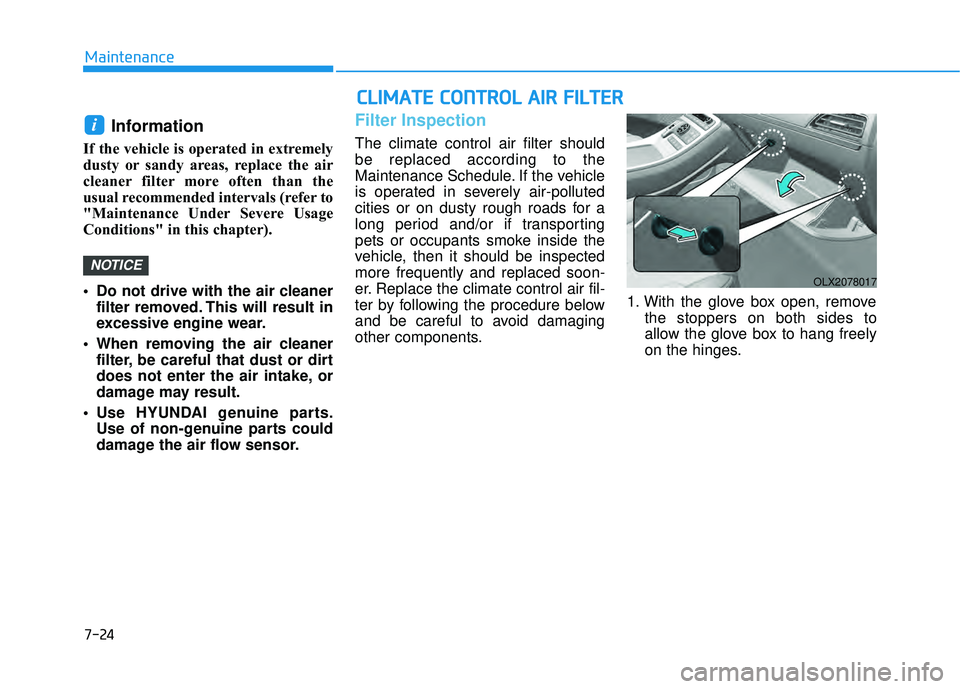
other components. 1. With the glove box open, remove
the stoppers on both sides to
allow the glove box to hang freely
on the hinges.
NOTICE
i
C CL LI IM M A AT TE E C C O O N NT TR R O O L L A A I IR R F F I IL L T T E ER R
OLX2078017
Page 636 of 663
7-77
7
Maintenance
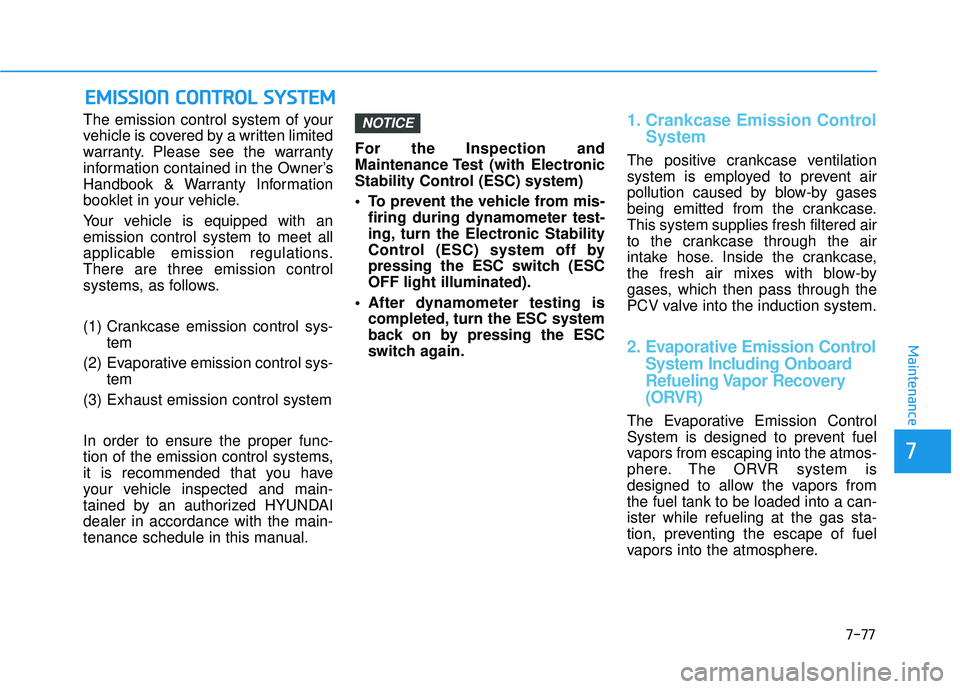
The emission control system of your
vehicle is covered by a written limited
warranty. Please see the warranty
information contained in the Owner’s
Handbook & Warranty Information
booklet in your vehicle.
Your vehicle is equipped with an
emission control system to meet all
applicable emission regulations.
There are three emission control
systems, as follows.
(1) Crankcase emission control sys-tem
(2) Evaporative emission control sys- tem
(3) Exhaust emission control system
In order to ensure the proper func-
tion of the emission control systems,
it is recommended that you have
your vehicle inspected and main-
tained by an authorized HYUNDAI
dealer in accordance with the main-
tenance schedule in this manual. For the Inspection and
Maintenance Test (with Electronic
Stability Control (ESC) system)
To prevent the vehicle from mis-
firing during dynamometer test-
ing, turn the Electronic Stability
Control (ESC) system off by
pressing the ESC switch (ESC
OFF light illuminated).
After dynamometer testing is completed, turn the ESC system
back on by pressing the ESC
switch again.1. Crankcase Emission Control System
The positive crankcase ventilation
system is employed to prevent air
pollution caused by blow-by gases
being emitted from the crankcase.
This system supplies fresh filtered air
to the crankcase through the air
intake hose. Inside the crankcase,
the fresh air mixes with blow-by
gases, which then pass through the
PCV valve into the induction system.
2. Evaporative Emission ControlSystem Including Onboard
Refueling Vapor Recovery
(ORVR)
The Evaporative Emission Control
System is designed to prevent fuel
vapors from escaping into the atmos-
phere. The ORVR system is
designed to allow the vapors from
the fuel tank to be loaded into a can-
ister while refueling at the gas sta-
tion, preventing the escape of fuel
vapors into the atmosphere.
NOTICE
E EM M I IS S S SI IO O N N C C O O N NT TR R O O L L S S Y Y S ST T E EM M
Page 657 of 663
I-4
Drive Mode Integrated Control System (2WD) .............5-55Drive Mode ................................................................5-55
Drive Mode Integrated Control System(AWD)..............5-59 Drive Mode ................................................................5-59
Driver Attention Warning (DAW) ................................5-136 Driver Attention Warning malfunction and limitations ........................................................5-140
Driver Attention Warning operation.........................5-138
Driver Attention Warning settings ..........................5-137
Driver position memory system ....................................3-32 Easy Access Function .................................................3-34
Recalling Positions from Memory .............................3-33
Resetting the Driver's Seat Memory System .............3-33
Storing Positions into Memory .................................3-32
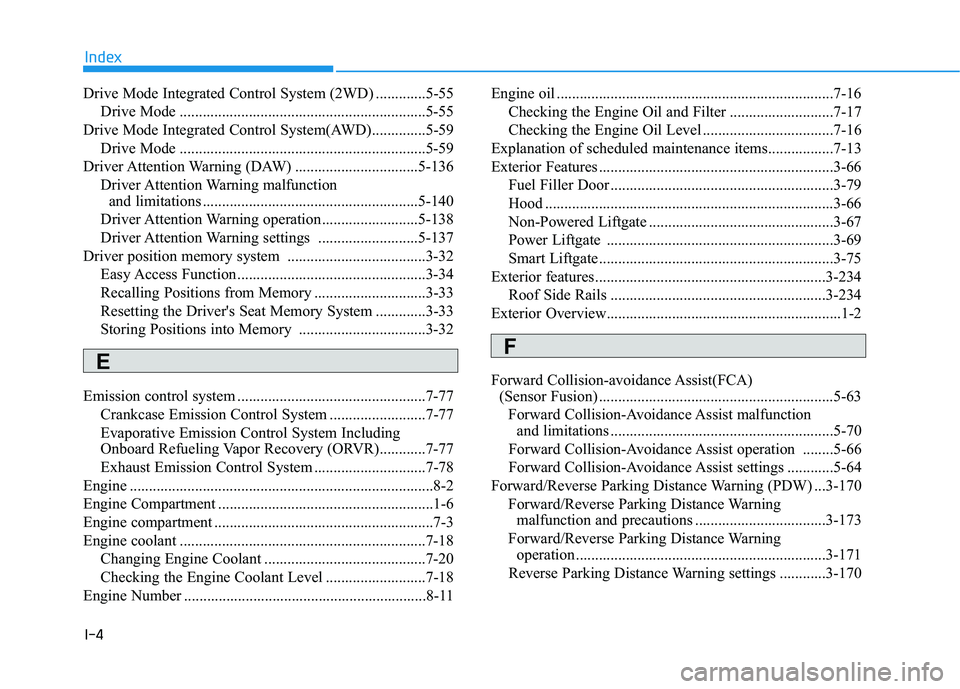
Emission control system .................................................7-77 Crankcase Emission Control System .........................7-77
Evaporative Emission Control System Including
Onboard Refueling Vapor Recovery (ORVR)............7-77 Exhaust Emission Control System .............................7-78
Engine ........................................................................\
.......8-2
Engine Compartment ........................................................1-6
Engine compartment .........................................................7-3
Engine coolant ................................................................7-18 Changing Engine Coolant ..........................................7-20
Checking the Engine Coolant Level ..........................7-18
Engine Number ...............................................................8-11 Engine oil ........................................................................\
7-16
Checking the Engine Oil and Filter ...........................7-17
Checking the Engine Oil Level ..................................7-16
Explanation of scheduled maintenance items.................7-13
Exterior Features .............................................................3-66 Fuel Filler Door ..........................................................3-79
Hood ........................................................................\
...3-66
Non-Powered Liftgate ................................................3-67
Power Liftgate ...........................................................3-69
Smart Liftgate.............................................................3-75
Exterior features............................................................3-234 Roof Side Rails ........................................................3-234
Exterior Overview.............................................................1-2
Forward Collision-avoidance Assist(FCA) (Sensor Fusion) .............................................................5-63
Forward Collision-Avoidance Assist malfunction and limitations ..........................................................5-70
Forward Collision-Avoidance Assist operation ........5-66
Forward Collision-Avoidance Assist settings ............5-64
Forward/Reverse Parking Distance Warning (PDW) ...3-170 Forward/Reverse Parking Distance Warning malfunction and precautions ..................................3-173
Forward/Reverse Parking Distance Warning operation .................................................................3-171
Reverse Parking Distance Warning settings ............3-170
Index
EF