height HYUNDAI PALISADE 2022 Owner's Guide
[x] Cancel search | Manufacturer: HYUNDAI, Model Year: 2022, Model line: PALISADE, Model: HYUNDAI PALISADE 2022Pages: 663, PDF Size: 15.74 MB
Page 407 of 663
5-73
Driving your vehicle
5
The pedestrian or cyclist is wear-ing clothing that easily blends into
the background, making it difficult
to detect
The pedestrian or cyclist is difficult to distinguish from the similar
shaped structure in the surround-
ings
You are driving by a pedestrian, cyclist, traffic sign, structure, etc.,
near the intersection
Driving in a parking lot
Driving through a tollgate, con- struction area, unpaved road, par-
tial paved road, uneven road,
speed bumps, etc.
Driving on an incline road, curved road, etc.
Driving on a roadside with trees or streetlights
The adverse road conditions cause excessive vehicle vibrations while
driving
Your vehicle height is low or high due to heavy loads, abnormal tyre
pressure, etc. Driving on a narrow road where
trees or grass are overgrown
There is interference from electro- magnetic waves, such as driving in
an area with strong radio waves or
electrical noise
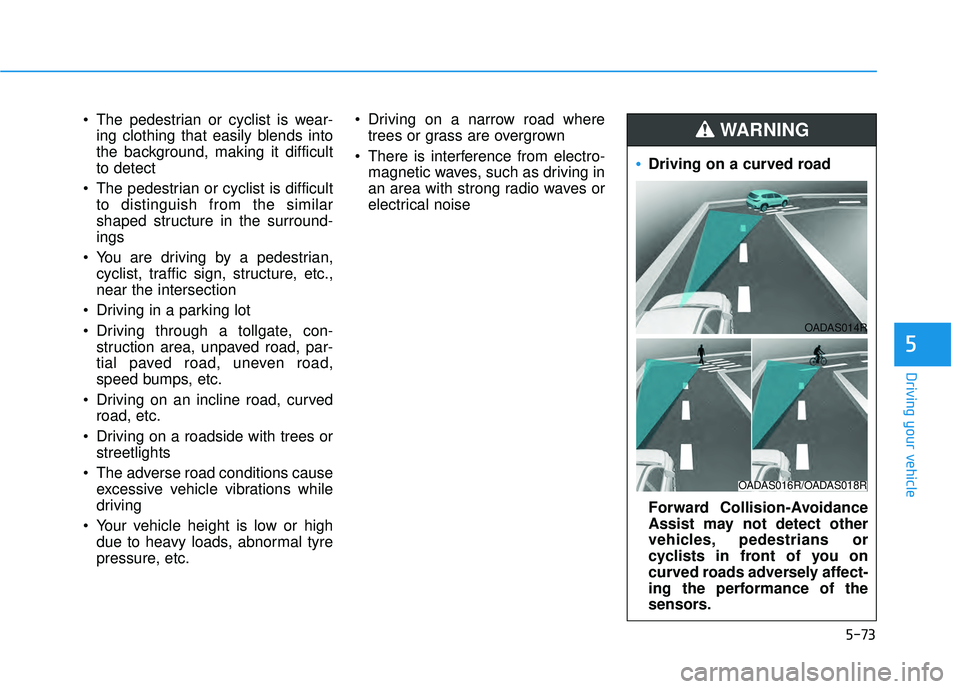
Driving on a curved road
Forward Collision-Avoidance
Assist may not detect other
vehicles, pedestrians or
cyclists in front of you on
curved roads adversely affect-
ing the performance of the
sensors.
WARNING
OADAS016R/OADAS018R
OADAS014R
Page 426 of 663
5-92
Driving your vehicle
Limitations of Blind-SpotCollision Warning
Blind-Spot Collision Warning may not
operate normally, or the function may
operate unexpectedly under the fol-
lowing circumstances:
There is inclement weather, such
as heavy snow, heavy rain, etc.
The rear corner radar is covered with snow, rain, dirt, etc.
The temperature around the rear corner radar is high or low
Driving on a highway (or motor- way) ramp
The road pavement (or the periph- eral ground) abnormally contains
metallic components (i.e. possibly
due to subway construction)
There is a fixed object near the vehicle, such as sound barriers,
guardrails, central dividers, entry
barriers, street lamps, signs, tun-
nels, walls, etc. (including double
structures)
Driving in large areas where there are few vehicles or structures (i.e.
desert, meadow, suburb, etc.) Driving through a narrow road
where trees or grass are over-
grown
Driving on a wet road surface, such as a puddle on the road
The other vehicle drives very close behind your vehicle, or the other
vehicle passes by your vehicle in
close proximity
The speed of the other vehicle is very fast that it passes by your
vehicle in a short time
Your vehicle passes by the other vehicle
Your vehicle changes lane
Your vehicle has started at the same time as the vehicle next to
you and has accelerated
The vehicle in the next lane moves two lanes away from you, or when
the vehicle two lanes away moves
to the next lane from you
A trailer or carrier is installed around the rear corner radar
The bumper around the rear cor- ner radar is covered with objects,
such as a bumper sticker, bumper
guard, bike rack, etc. The bumper around the rear cor-
ner radar is impacted, damaged or
the radar is out of position
Your vehicle height is low or high due to heavy loads, abnormal tire
pressure, etc.
Page 427 of 663
5-93
Driving your vehicle
5
Blind-Spot Collision Warning may not
operate normally, or the function may
operate unexpectedly when the fol-
lowing objects are detected:
A motorcycle or bicycle is detected
A vehicle such as a flat trailer isdetected
A big vehicle such as a bus or truck is detected
A moving obstacle such as a pedestrian, animal, shopping cart
or a baby stroller is detected
A vehicle with low height such as a sports car is detected
For more details on the limita-
tions of the front view camera,
refer to “Forward Collision-
Avoidance Assist (FCA)” and
“Lane Keeping Assist (LKA)
section in chapter 5.
CAUTION
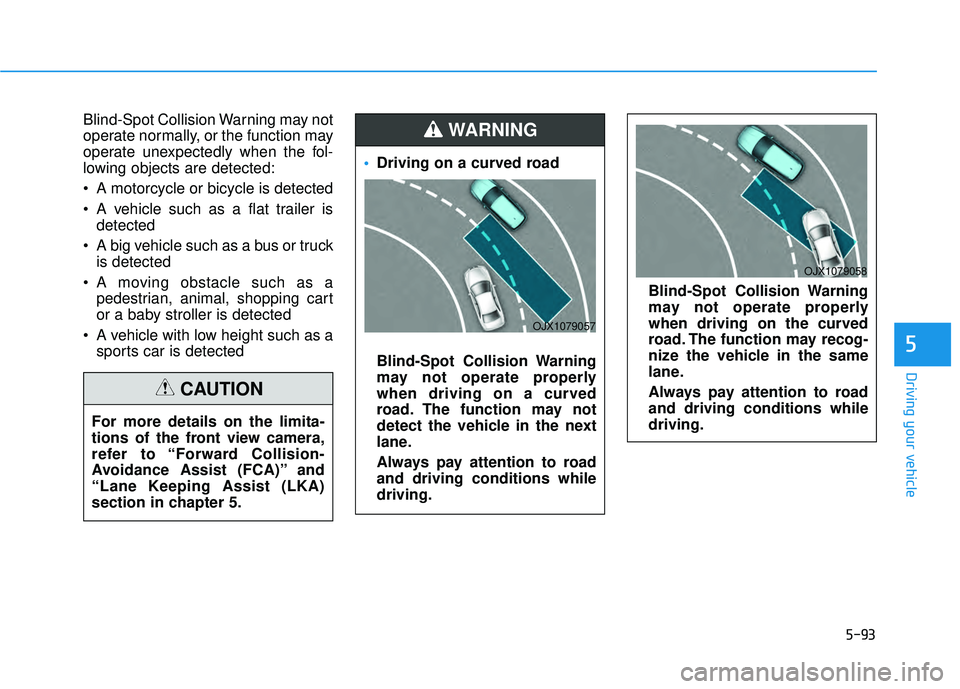
Driving on a curved road
Blind-Spot Collision Warning
may not operate properly
when driving on a curved
road. The function may not
detect the vehicle in the next
lane.
Always pay attention to road
and driving conditions while
driving.
Blind-Spot Collision Warning
may not operate properly
when driving on the curved
road. The function may recog-
nize the vehicle in the same
lane.
Always pay attention to road
and driving conditions while
driving.
WARNING
OJX1079057
OJX1079058
Page 428 of 663
5-94
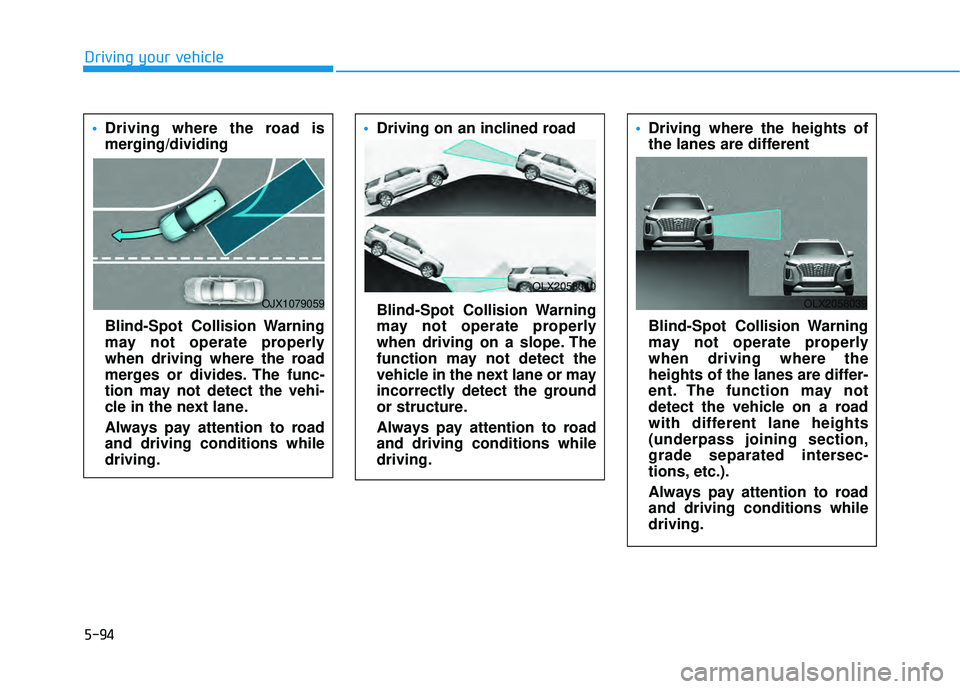
Driving your vehicle Driving where the road is
merging/dividing
Blind-Spot Collision Warning
may not operate properly
when driving where the road
merges or divides. The func-
tion may not detect the vehi-
cle in the next lane.
Always pay attention to road
and driving conditions while
driving.
Driving on an inclined road
Blind-Spot Collision Warning
may not operate properly
when driving on a slope. The
function may not detect the
vehicle in the next lane or may
incorrectly detect the ground
or structure.
Always pay attention to road
and driving conditions while
driving.Driving where the heights of
the lanes are different
Blind-Spot Collision Warning
may not operate properly
when driving where the
heights of the lanes are differ-
ent. The function may not
detect the vehicle on a road
with different lane heights
(underpass joining section,
grade separated intersec-
tions, etc.).
Always pay attention to road
and driving conditions while
driving.
OJX1079059
OLX2058040
OLX2058039
Page 441 of 663
5-107
Driving your vehicle
5
Driving through a narrow roadwhere trees or grass are over-
grown
Driving on a wet road surface, such as a puddle on the road
The other vehicle drives very close behind your vehicle, or the other
vehicle passes by your vehicle in
close proximity
The speed of the other vehicle is very fast that it passes by your
vehicle in a short time
Your vehicle passes by the other vehicle
Your vehicle changes lane
Your vehicle has started at the same time as the vehicle next to
you and has accelerated
The vehicle in the next lane moves two lanes away from you, or when
the vehicle two lanes away moves
to the next lane from you
A trailer or carrier is installed around the rear corner radar The bumper around the rear cor-
ner radar is covered with objects,
such as a bumper sticker, bumper
guard, bike rack, etc.
The bumper around the rear cor- ner radar is impacted, damaged or
the radar is out of position
Your vehicle height is low or high due to heavy loads, abnormal tire
pressure, etc. Blind-Spot Safety system may not
operate normally, or the function may
operate unexpectedly when the fol-
lowing objects are detected:
A motorcycle or bicycle is detected
A vehicle such as a flat trailer is
detected
A big vehicle such as a bus or truck is detected
A moving obstacle such as a pedestrian, animal, shopping cart
or a baby stroller is detected
A vehicle with low height such as a sports car is detected
Braking control may not work, dri-
ver’s attention is required in the fol-
lowing circumstances:
The vehicle severely vibrates while driving over a bumpy road, uneven
road or concrete patch
Driving on a slippery surface due to snow, water puddle, ice, etc.
The tire pressure is low or a tire is damaged
The brake is reworked
The vehicle makes abrupt lane changes
Page 443 of 663
5-109
Driving your vehicle
5
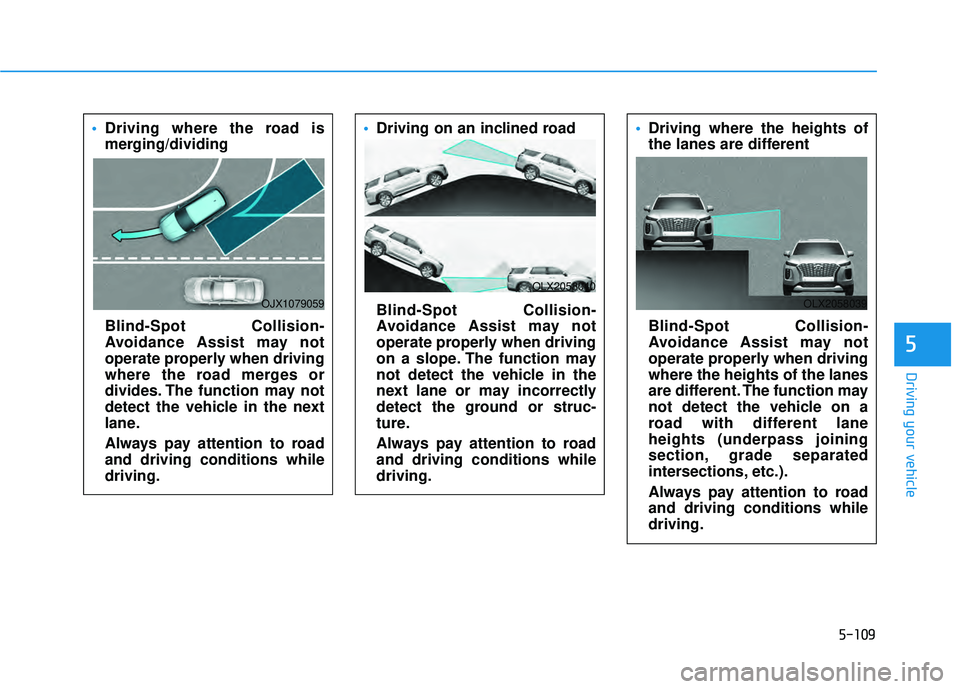
Driving where the road is
merging/dividing
Blind-Spot Collision-
Avoidance Assist may not
operate properly when driving
where the road merges or
divides. The function may not
detect the vehicle in the next
lane.
Always pay attention to road
and driving conditions while
driving.Driving on an inclined road
Blind-Spot Collision-
Avoidance Assist may not
operate properly when driving
on a slope. The function may
not detect the vehicle in the
next lane or may incorrectly
detect the ground or struc-
ture.
Always pay attention to road
and driving conditions while
driving.Driving where the heights of
the lanes are different
Blind-Spot Collision-
Avoidance Assist may not
operate properly when driving
where the heights of the lanes
are different. The function may
not detect the vehicle on a
road with different lane
heights (underpass joining
section, grade separated
intersections, etc.).
Always pay attention to road
and driving conditions while
driving.
OJX1079059
OLX2058040
OLX2058039
Page 499 of 663
5-165
Driving your vehicle
5
A vehicle suddenly cuts in front
Your vehicle is being towed
Driving through a tunnel or ironbridge
Driving near areas containing metal substances, such as a con-
struction zone, railroad, etc.
A material is near that reflects very well on the front radar, such as a
guardrail, nearby vehicle, etc.
The bumper around the front radar is impacted, damaged or the front
radar is out of position
The temperature around the front radar is high or low
Driving in large areas where there are few vehicles or structures (for
example, desert, meadow, suburb,
etc.)
The vehicle in front is made of material that does not reflect on
the front radar
Driving near a highway (or motor- way) interchange or tollgate
Driving on a slippery surface due to snow, water puddle, ice, etc.
Driving on a curved road The vehicle in front is detected late
The vehicle in front is suddenly
blocked by a obstacle
The vehicle in front suddenly changes lane or suddenly reduces
speed
The vehicle in front is bent out of shape
The front vehicle’s speed is fast or slow
With a vehicle in front, your vehicle changes lane at low speed
The vehicle in front is covered with snow
Unstable driving
You are on a roundabout and the vehicle in front is not detected
You are continuously driving in a circle
Driving in a parking lot
Driving through a construction area, unpaved road, partial paved
road, uneven road, speed bumps,
etc. Driving on an incline road, curved
road, etc.
Driving through a roadside with trees or streetlights
The adverse road conditions cause excessive vehicle vibrations while
driving
Your vehicle height is low or high due to heavy loads, abnormal tire
pressure, etc.
Driving through a narrow road where trees or grass are over-
grown
There is interference by electro- magnetic waves, such as driving in
an area with strong radio waves or
electrical noise
Page 598 of 663
7-39
7
Maintenance
Tire Maintenance
In addition to proper inflation, correct
wheel alignment helps to decrease
tire wear. If you find a tire is worn
unevenly, have your dealer check the
wheel alignment.
When you have new tires installed,
make sure they are balanced. This
will increase vehicle ride comfort and
tire life. Additionally, a tire should
always be rebalanced if it is removed
from the wheel.
Tire Sidewall Labeling
This information identifies and
describes the fundamental charac-
teristics of the tire and also provides
the tire identification number (TIN)
for safety standard certification. The
TIN can be used to identify the tire in
case of a recall.
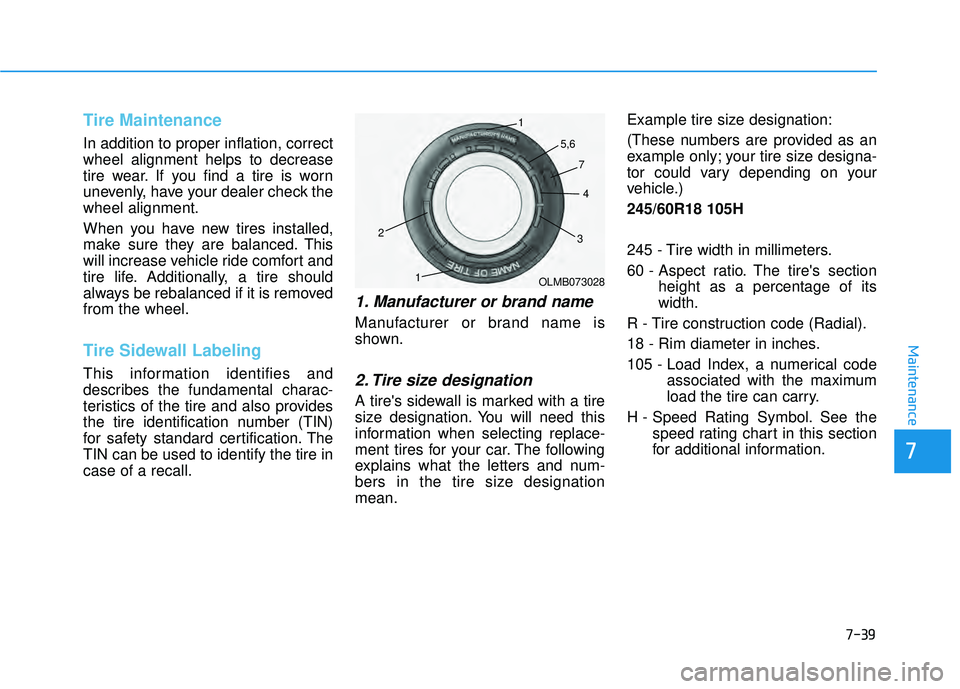
1. Manufacturer or brand name
Manufacturer or brand name is
shown.
2. Tire size designation
A tire's sidewall is marked with a tire
size designation. You will need this
information when selecting replace-
ment tires for your car. The following
explains what the letters and num-
bers in the tire size designation
mean.Example tire size designation:
(These numbers are provided as an
example only; your tire size designa-
tor could vary depending on your
vehicle.)
245/60R18 105H
245 - Tire width in millimeters.
60 - Aspect ratio. The tire's section
height as a percentage of its
width.
R - Tire construction code (Radial).
18 - Rim diameter in inches.
105 - Load Index, a numerical code associated with the maximum
load the tire can carry.
H - Speed Rating Symbol. See the speed rating chart in this section
for additional information.
OLMB073028
1
1
2
34
5,6
7
Page 602 of 663
7-43
7
Maintenance
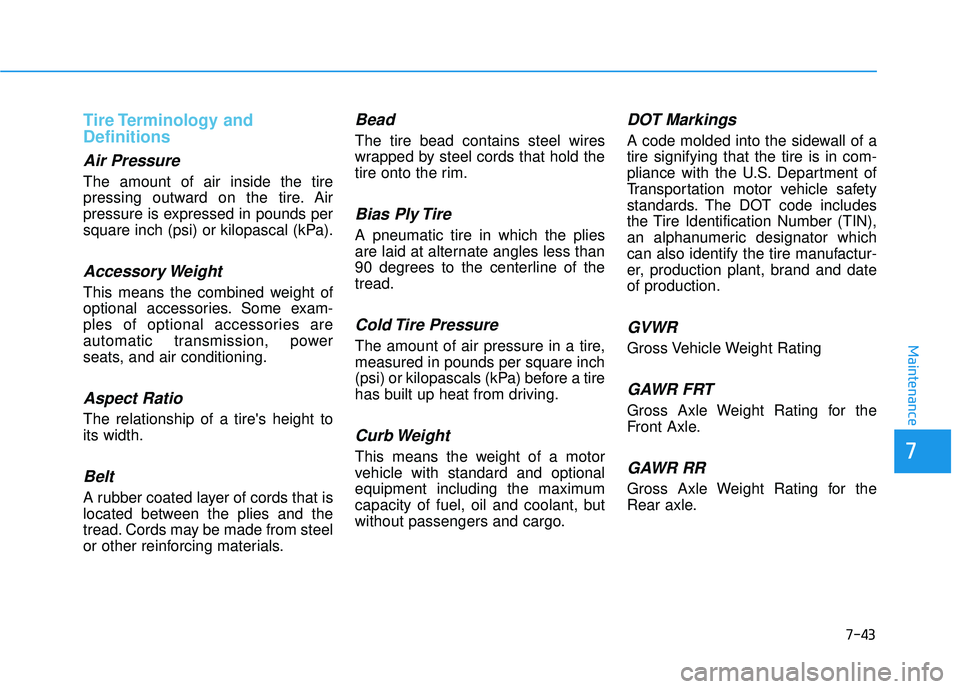
Tire Terminology and
Definitions
Air Pressure
The amount of air inside the tire
pressing outward on the tire. Air
pressure is expressed in pounds per
square inch (psi) or kilopascal (kPa).
Accessory Weight
This means the combined weight of
optional accessories. Some exam-
ples of optional accessories are
automatic transmission, power
seats, and air conditioning.
Aspect Ratio
The relationship of a tire's height to
its width.
Belt
A rubber coated layer of cords that is
located between the plies and the
tread. Cords may be made from steel
or other reinforcing materials.
Bead
The tire bead contains steel wires
wrapped by steel cords that hold the
tire onto the rim.
Bias Ply Tire
A pneumatic tire in which the plies
are laid at alternate angles less than
90 degrees to the centerline of the
tread.
Cold Tire Pressure
The amount of air pressure in a tire,
measured in pounds per square inch
(psi) or kilopascals (kPa) before a tire
has built up heat from driving.
Curb Weight
This means the weight of a motor
vehicle with standard and optional
equipment including the maximum
capacity of fuel, oil and coolant, but
without passengers and cargo.
DOT Markings
A code molded into the sidewall of a
tire signifying that the tire is in com-
pliance with the U.S. Department of
Transportation motor vehicle safety
standards. The DOT code includes
the Tire Identification Number (TIN),
an alphanumeric designator which
can also identify the tire manufactur-
er, production plant, brand and date
of production.
GVWR
Gross Vehicle Weight Rating
GAWR FRT
Gross Axle Weight Rating for the
Front Axle.
GAWR RR
Gross Axle Weight Rating for the
Rear axle.
Page 642 of 663
8-2
Specifications, Consumer information and Reporting safety defects
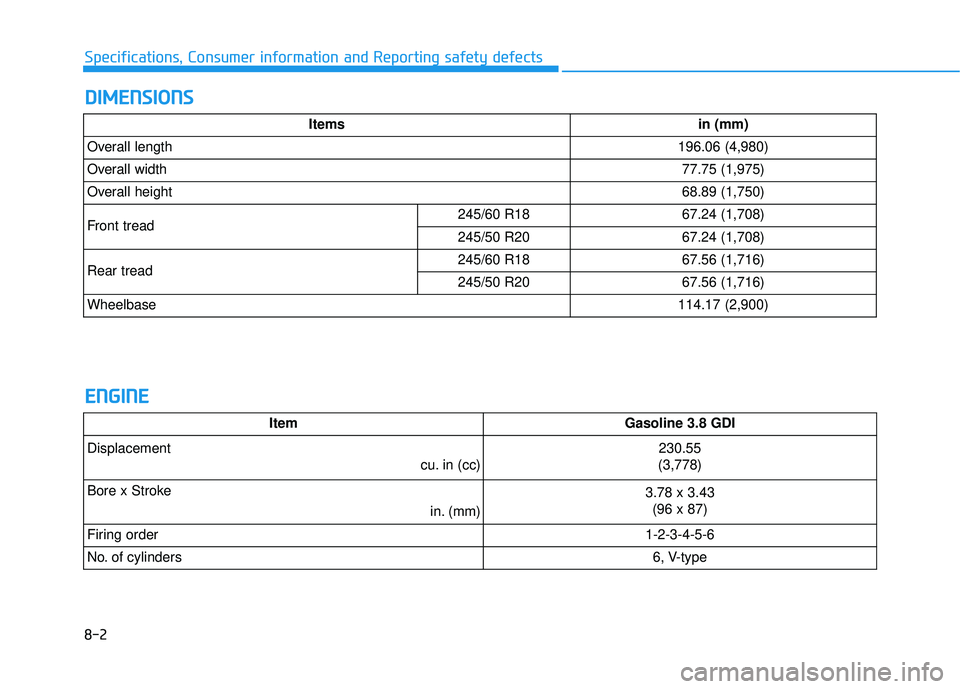
D DI IM M E EN N S SI IO O N NS S
E E N N G GI IN N E E
Itemsin (mm)
Overall length196.06 (4,980)
Overall width77.75 (1,975)
Overall height68.89 (1,750)
Front tread245/60 R1867.24 (1,708)
245/50 R2067.24 (1,708)
Rear tread245/60 R1867.56 (1,716)
245/50 R2067.56 (1,716)
Wheelbase114.17 (2,900)
ItemGasoline 3.8 GDI
Displacement cu. in (cc)
230.55
(3,778)
Bore x Stroke in. (mm)
3.78 x 3.43 (96 x 87)
Firing order
1-2-3-4-5-6
No. of cylinders
6, V-type