maintenance Hyundai Santa Fe 2003 Service Manual
[x] Cancel search | Manufacturer: HYUNDAI, Model Year: 2003, Model line: Santa Fe, Model: Hyundai Santa Fe 2003Pages: 221, PDF Size: 15.98 MB
Page 193 of 221
DO-IT-YOURSELF MAINTENANCE 6- 23
!
G250A01A-AATFOR MORE INFORMATION ABOUT
YOUR HYUNDAI
If you desire additional information about main-
taining and servicing your Hyundai, you may
purchase a factory Shop Manual at your Hyundai
dealer's parts department. This is the same
manual used by dealership technicians and
while it is highly technical it can be useful in
obtaining a better understanding of your car and
how it works.
G240A01A-AATPOWER STEERING HOSES
It is suggested that you check the power steer-
ing hose connections for fluid leakage at regular
intervals. The power steering hoses should be
replaced if there is severe surface cracking,
scuffing or worn spots. Deterioration of the hose
could cause premature failure. Recommended Fluid
Use PSF-3 type fluid
NOTE:Do not start the engine when the power
steering oil reservoir is empty.
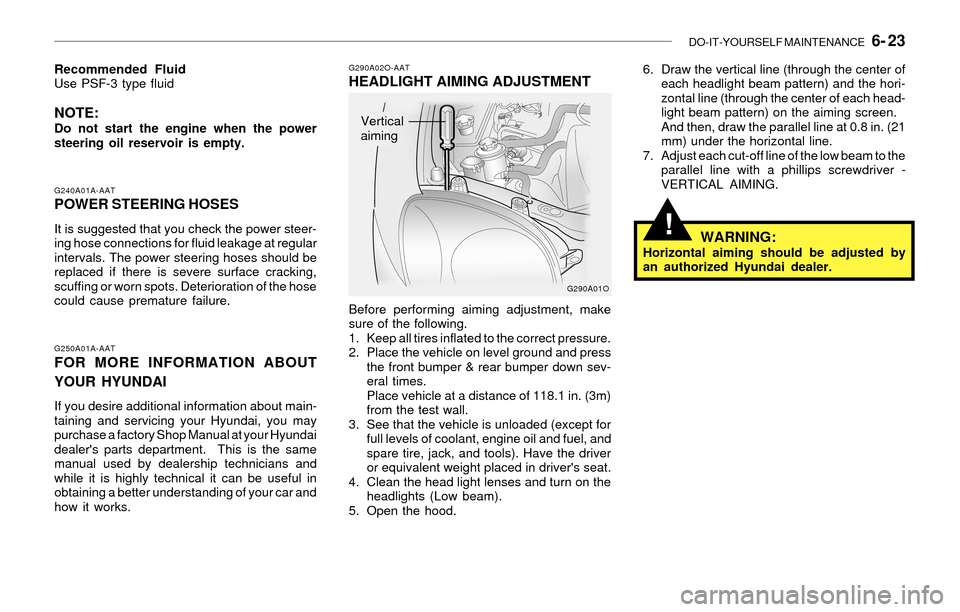
G290A02O-AATHEADLIGHT AIMING ADJUSTMENT
Before performing aiming adjustment, make
sure of the following.
1. Keep all tires inflated to the correct pressure.
2. Place the vehicle on level ground and press
the front bumper & rear bumper down sev-
eral times.
Place vehicle at a distance of 118.1 in. (3m)
from the test wall.
3. See that the vehicle is unloaded (except for
full levels of coolant, engine oil and fuel, and
spare tire, jack, and tools). Have the driver
or equivalent weight placed in driver's seat.
4. Clean the head light lenses and turn on the
headlights (Low beam).
5. Open the hood.6. Draw the vertical line (through the center of
each headlight beam pattern) and the hori-
zontal line (through the center of each head-
light beam pattern) on the aiming screen.
And then, draw the parallel line at 0.8 in. (21
mm) under the horizontal line.
7. Adjust each cut-off line of the low beam to the
parallel line with a phillips screwdriver -
VERTICAL AIMING.
WARNING:Horizontal aiming should be adjusted by
an authorized Hyundai dealer.
G290A01O
Vertical
aiming
Page 194 of 221
6- 24 DO-IT-YOURSELF MAINTENANCE
!
G260A01L-AATREPLACEMENT OF LIGHT BULBS
Before attempting to replace a light bulb, be sure
the switch is turned to the "OFF" position.
The next paragraph shows how to reach the
light bulbs so they may be changed. Be sure to
replace the burned-out bulb with one of the
same number and wattage rating.
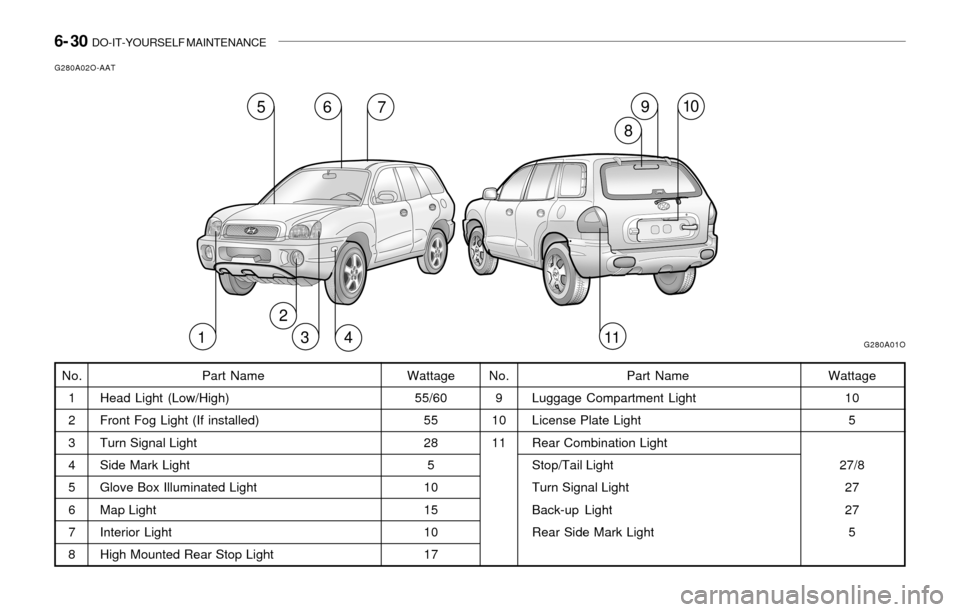
See page 6-30 for the wattage description.
CAUTION:Keep the lamps out of contact with petro-
leum products, such as oil, gasoline, etc.
G270A01O-AATHeadlight and Front Turn Signal Light
1. Allow the bulb to cool. Wear eye protection.
2. Open the engine hood.
3. Always grasp the bulb by its plastic base,
avoid touching the glass.
4. Using a socket wrench of the correct size,
remove the headlight assembly mounting
bolts.
HSM353
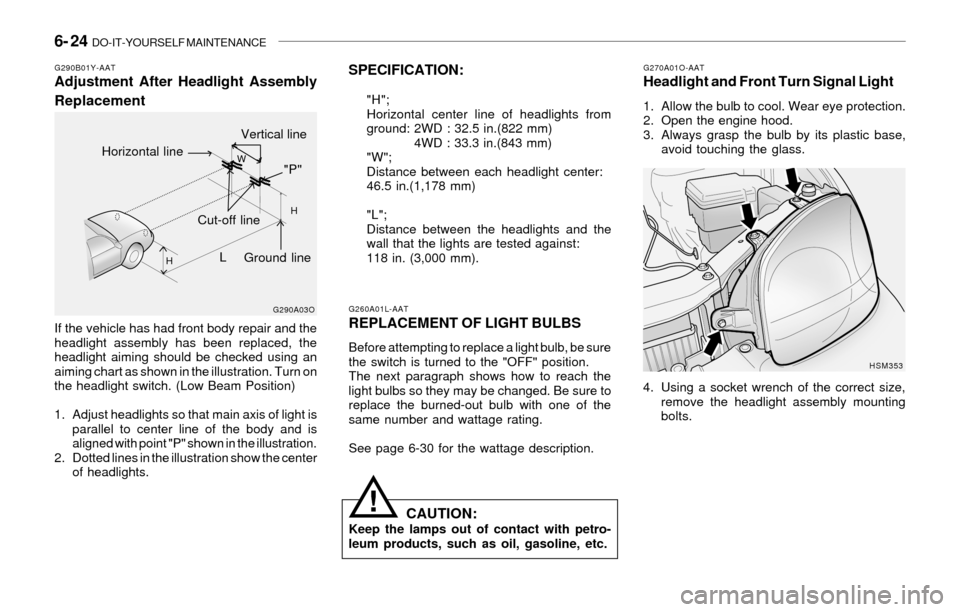
SPECIFICATION:
"H";
Horizontal center line of headlights from
ground: 2WD : 32.5 in.(822 mm)
4WD : 33.3 in.(843 mm)
"W";
Distance between each headlight center:
46.5 in.(1,178 mm)
"L";
Distance between the headlights and the
wall that the lights are tested against:
118 in. (3,000 mm).
G290B01Y-AATAdjustment After Headlight Assembly
Replacement
If the vehicle has had front body repair and the
headlight assembly has been replaced, the
headlight aiming should be checked using an
aiming chart as shown in the illustration. Turn on
the headlight switch. (Low Beam Position)
1. Adjust headlights so that main axis of light is
parallel to center line of the body and is
aligned with point "P" shown in the illustration.
2. Dotted lines in the illustration show the center
of headlights.
G290A03O
L
W
H
H
Cut-off line
Ground line
"P"
Horizontal line
Vertical line
Page 195 of 221
DO-IT-YOURSELF MAINTENANCE 6- 25
G270A01O
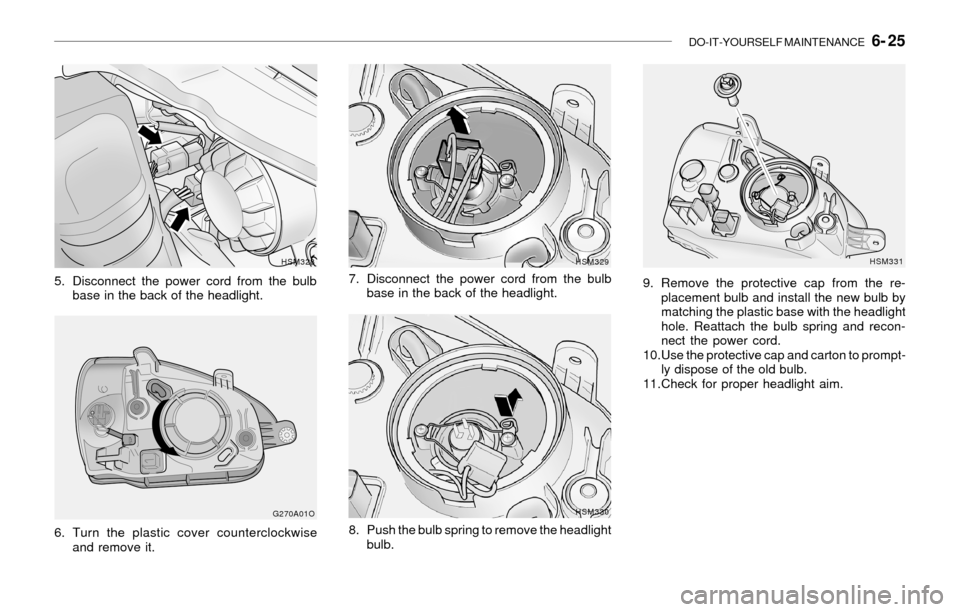
6. Turn the plastic cover counterclockwise
and remove it.
5. Disconnect the power cord from the bulb
base in the back of the headlight.
HSM328HSM329
7. Disconnect the power cord from the bulb
base in the back of the headlight.
HSM330
8. Push the bulb spring to remove the headlight
bulb.9. Remove the protective cap from the re-
placement bulb and install the new bulb by
matching the plastic base with the headlight
hole. Reattach the bulb spring and recon-
nect the power cord.
10.Use the protective cap and carton to prompt-
ly dispose of the old bulb.
11.Check for proper headlight aim.
HSM331
Page 196 of 221
6- 26 DO-IT-YOURSELF MAINTENANCE
!WARNING:This halogen bulb contains gas under pres-
sure and if impacted could shatter, result-
ing in flying fragments. Always wear eye
protection when servicing the bulb. Protect
the bulb against abrasions or scratches
and against liquids when lighted. Turn the
bulb on only when installing in a headlight.
Replace the headlight if damaged or cracked.
Keep the bulb out of the reach of children
and dispose of the used bulb with care.
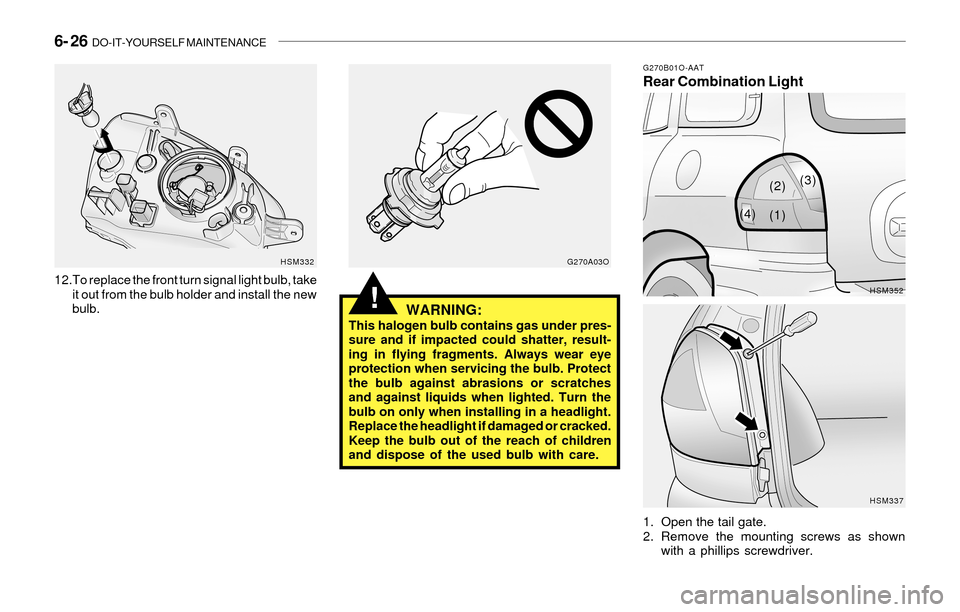
HSM337 G270B01O-AAT
Rear Combination Light
1. Open the tail gate.
2. Remove the mounting screws as shown
with a phillips screwdriver.
HSM352
(1) (2)(3)
(4)
G270A03O
12.To replace the front turn signal light bulb, take
it out from the bulb holder and install the new
bulb.
HSM332
Page 197 of 221
DO-IT-YOURSELF MAINTENANCE 6- 27
HSM423
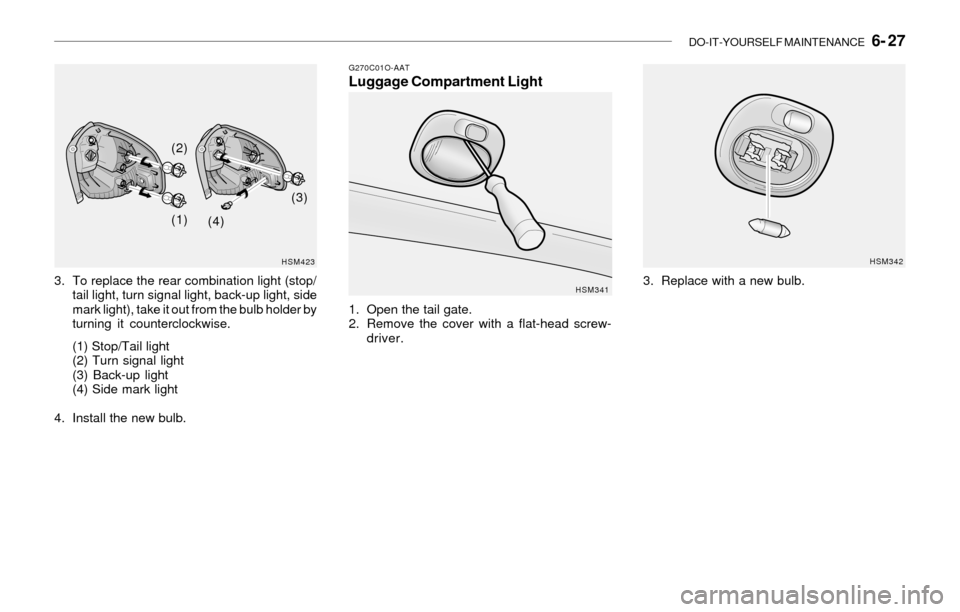
3. To replace the rear combination light (stop/
tail light, turn signal light, back-up light, side
mark light), take it out from the bulb holder by
turning it counterclockwise.
(1) Stop/Tail light
(2) Turn signal light
(3) Back-up light
(4) Side mark light
4. Install the new bulb.
HSM342
G270C01O-AATLuggage Compartment Light
1. Open the tail gate.
2. Remove the cover with a flat-head screw-
driver.
HSM3413. Replace with a new bulb. (1) (2)
(3)
(4)
Page 198 of 221
6- 28 DO-IT-YOURSELF MAINTENANCE
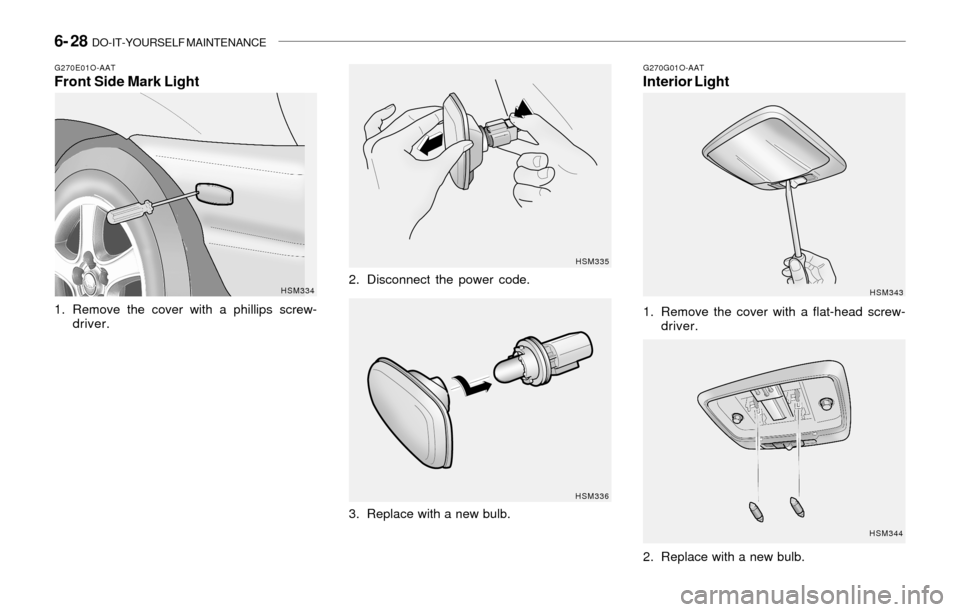
G270E01O-AATFront Side Mark Light
1. Remove the cover with a phillips screw-
driver.
HSM334HSM335
HSM3362. Disconnect the power code.
3. Replace with a new bulb.
G270G01O-AATInterior Light
HSM343
1. Remove the cover with a flat-head screw-
driver.
HSM344
2. Replace with a new bulb.
Page 199 of 221
DO-IT-YOURSELF MAINTENANCE 6- 29
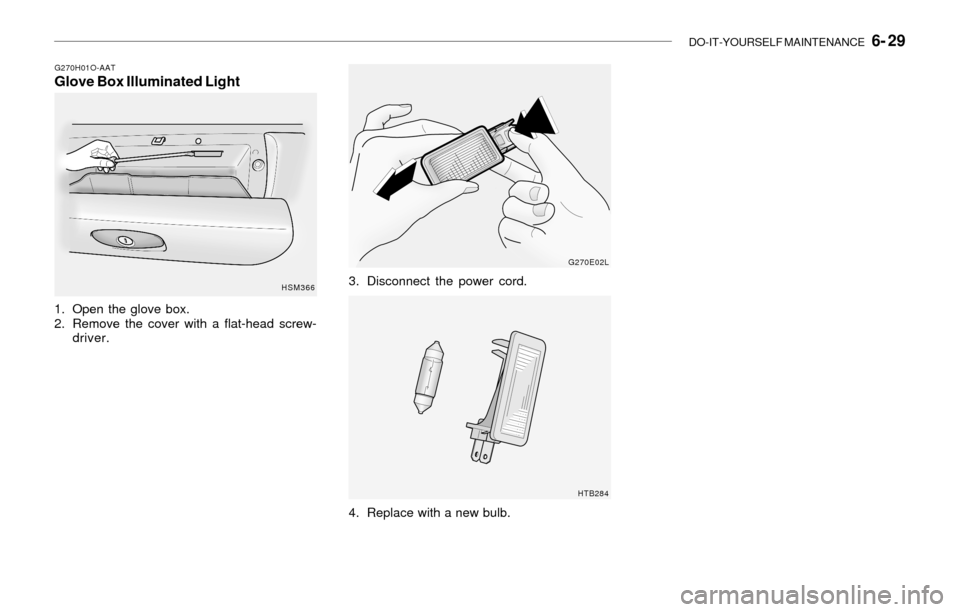
G270H01O-AATGlove Box Illuminated Light
1. Open the glove box.
2. Remove the cover with a flat-head screw-
driver.
HSM366
G270E02L
HTB284
3. Disconnect the power cord.
4. Replace with a new bulb.
Page 200 of 221
6- 30 DO-IT-YOURSELF MAINTENANCE
G280A02O-AAT
No.
1
2
3
4
5
6
7
8Part Name
Head Light (Low/High)
Front Fog Light (If installed)
Turn Signal Light
Side Mark Light
Glove Box Illuminated Light
Map Light
Interior Light
High Mounted Rear Stop LightWattage
55/60
55
28
5
10
15
10
17No.
9
10
11Wattage
10
5
27/8
27
27
5 Part Name
Luggage Compartment Light
License Plate Light
Rear Combination Light
Stop/Tail Light
Turn Signal Light
Back-up Light
Rear Side Mark Light
12
34 56
7
89
11G280A01O
10
Page 202 of 221
7- 2 EMISSION CONTROL SYSTEMS
H010E01Y-AATEGR SYSTEM (If installed)
This system helps reduce nitrogen oxides by
recirculating a part of the exhaust gas into the
engine, thereby reducing cylinder combustion
temperature, which results in lower output of
oxides of nitrogen.
H010D01A-AAT3. Exhaust Emission Control System
The Exhaust Emission Control System is a
highly effective system which controls exhaust
emissions while maintaining good vehicle
performace.
H010B01A-AAT1. Crankcase Emission Control
System
The positive crankcase ventilation system is
employed to prevent air pollution caused by
blow-by gases being emitted from the crank-
case. This system supplies filtered air to the
crankcase through the air intake hose. Inside
the crankcase, the fresh air mixes with blow-by
gases, which then pass through the PCV valve
and into the induction system.
H010A02O-AATEMISSION CONTROL SYSTEM
Your Hyundai is equipped with an emission
control system to meet all requirements of the
U.S. Environmental Protection Agency or Cali-
fornia Air Resources Board.
There are three emission control systems which
are as follows.
(1) Crankcase emission control system
(2) Evaporative emission control system
(3) Exhaust emission control system
In order to assure the proper function of the
emission control systems, it is recommended
that you have your car inspected and main-
tained by an authorized Hyundai dealer in ac-
cordance with the maintenance schedule in this
manual.
Caution for Inspection and Maintenance
Test (V6 Vehicle with Traction Control Sys-
tem)
o To prevent the vehicle from misfiring
during dynamometer testing, discon-
nect the ABS connector in the engine
compartment. (2.7 V6 only)
o For more information, see shop manual
(Wheel Speed Sensor).
o After the dynamometer testing is com-
pleted, erase the ABS/TCS DTC
(Diagnotic Trouble Code) with a GST
(Generic Scan Tool) or Hi-Scan Pro.
Purge Control Solenoid Valve (PCSV)
The purge control solenoid valve is controlled
by the Engine Control Module (ECM); when the
engine coolant temperature is low during idling,
the PCSV closes so that evaporated fuel is not
taken into the engine. After the engine warms-
up during ordinary driving, the PCSV opens to
introduce evaporated fuel to the engine.
H010C01S-AAT
2. Evaporative Emission Control (Includ-
ing ORVR: Onboard Refueling Vapor
Recovery) System
The Evaporative Emission Control System is
designed to prevent fuel vapors from escaping
into the atmosphere.
(The ORVR system is designed to allow the
vapors from of the fuel tank to be loaded into a
canister while refueling at the gas station, pre-
venting the escape of fuel vapors into the
atmosphere.)
Canister
Fuel vapors generated inside the fuel tank are
absorbed and stored in the
canister. When the engine is running, the fuel
vapors absorbed in the canister are drawn into
the induction system through the purge control
solenoid valve.
Page 219 of 221
10- 4 INDEX
Hood Release ....................................................................................1-63
Horn.................................................................................................1-65
I
Ignition Switch ...................................................................................... 2-3
Instrument Cluster and Indicator Lights ...........................................1-36
Instrument Panel Light Control (Rheostat) .......................................1-48
J
Jump Starting ...................................................................................... 3-2
K
Key ................................................................................................... 1-3
If you lose your keys ...................................................................3-11
Positions......................................................................................... 2-4
L
Light Bulbs Replacement ..................................................................6-24
Limited-Slip Differential ......................................................................2-15
Luggage Net ......................................................................................1-60
M
Maintenance Intervals
Explanation of scheduled maintenance items ............................... 5-7
Maintenance under severe usage conditions ............................... 5-6
Scheduled maintenance ................................................................ 5-4
Service requirements .................................................................... 5-2
Mirrors
Day-night inside rearview mirror .................................................1-55
Outside rear view mirror ..............................................................1-53O
Odometer / Trip Odometer ...............................................................1-42
P
Parking Brake ....................................................................................1-59
Power Driver's Seat ..........................................................................1-13
Power Outlet ......................................................................................1-48
Power Steering Fluid Level ...............................................................6-22
R
Rear Seat
Adjusting seatback angle .............................................................1-15
Folding rear seatback and seat cushion ....................................1-16
Rear Window Defroster Switch ........................................................1-47
Reporting Safety Defects ................................................................... 8-7
Roof Rack .........................................................................................1-61
S
Seat
Front.............................................................................................1-10
Rear..............................................................................................1-15
Seat warmer .................................................................................1-15
Seat Belts
3-point system .............................................................................1-20
2-point static type .........................................................................1-22
Pretensioner seat belt ..................................................................1-28
Adjusting your seat belt ..................................................... 1-21, 1-22
Care of seat belts .........................................................................1-19
Precautions..................................................................................1-17