traction control Hyundai Santa Fe 2004 User Guide
[x] Cancel search | Manufacturer: HYUNDAI, Model Year: 2004, Model line: Santa Fe, Model: Hyundai Santa Fe 2004Pages: 253, PDF Size: 22.41 MB
Page 153 of 253
2DRIVING YOUR HYUNDAI
16
C300D02O-AAT
Indicator and Warning
The TCS indicator should illuminate when the
ignition key is turned to ON or START but should
go out after three seconds.
If the indicator does not illuminate, have it checked
by an authorized dealer.
Should there be any unusual conditions in the
device while driving, TCS illuminates as a warn-
ing.
If TCS illuminates, pull your car to a safe place
and stop the engine. Then, start the engine
again to check if the TCS indicator goes out.
If the indicator remains lit even after the engine
has been started, have your car checked by an
authorized Hyundai dealer.
NOTE:When the TCS indicator illuminates, trac-
tion control is automatically deactivated
for safety.
C300B01O-AAT
TCS ON Mode
When the TCS is running, the TCS indicator in
the instrument cluster will blink.
NOTE:1) The TCS mode will automatically be
turned ON after the engine is turned off
and restarted.
2) When the traction control system is op-
erating properly, you can feel a slight
pulsation in the vehicle. This is only the
effect of brake control and indicates
nothing unusual.
3) When the engine starts, a click is heard
from the engine compartment; however,
this is only the sound of traction control
being checked.
4) When moving out of the mud or fresh
snow, pressing the accelerator pedal
may not cause the engine speed to in-
crease due to TCS operation.
!
!CAUTION:When the TCS indicator blinks, SLIP func-
tion has been activated. It also means that
the road is slippery or your car is accelerat-
ing excessively. In this situation, gently
release foot pressure from the accelerator
pedal and maintain moderate speed.
WARNING:Traction control is only a driving aid; all
normal precautions for driving in inclement
weather and on slippery road surfaces
should be observed.
Page 154 of 253
2DRIVING YOUR HYUNDAI
17
!
C310A01O-AAT
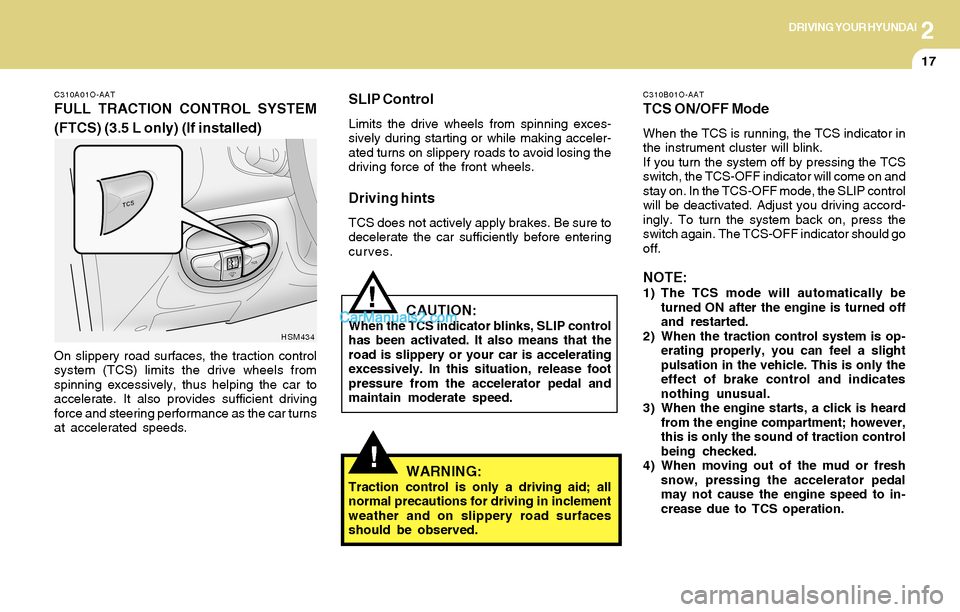
FULL TRACTION CONTROL SYSTEM
(FTCS) (3.5 L only) (If installed)
On slippery road surfaces, the traction control
system (TCS) limits the drive wheels from
spinning excessively, thus helping the car to
accelerate. It also provides sufficient driving
force and steering performance as the car turns
at accelerated speeds.
HSM434
SLIP Control
Limits the drive wheels from spinning exces-
sively during starting or while making acceler-
ated turns on slippery roads to avoid losing the
driving force of the front wheels.
Driving hints
TCS does not actively apply brakes. Be sure to
decelerate the car sufficiently before entering
curves.
CAUTION:When the TCS indicator blinks, SLIP control
has been activated. It also means that the
road is slippery or your car is accelerating
excessively. In this situation, release foot
pressure from the accelerator pedal and
maintain moderate speed.
WARNING:Traction control is only a driving aid; all
normal precautions for driving in inclement
weather and on slippery road surfaces
should be observed.
!
C310B01O-AAT
TCS ON/OFF Mode
When the TCS is running, the TCS indicator in
the instrument cluster will blink.
If you turn the system off by pressing the TCS
switch, the TCS-OFF indicator will come on and
stay on. In the TCS-OFF mode, the SLIP control
will be deactivated. Adjust you driving accord-
ingly. To turn the system back on, press the
switch again. The TCS-OFF indicator should go
off.
NOTE:1) The TCS mode will automatically be
turned ON after the engine is turned off
and restarted.
2) When the traction control system is op-
erating properly, you can feel a slight
pulsation in the vehicle. This is only the
effect of brake control and indicates
nothing unusual.
3) When the engine starts, a click is heard
from the engine compartment; however,
this is only the sound of traction control
being checked.
4) When moving out of the mud or fresh
snow, pressing the accelerator pedal
may not cause the engine speed to in-
crease due to TCS operation.
Page 155 of 253
2DRIVING YOUR HYUNDAI
18FULL-TIME 4WD OPERATION
!WARNING:This vehicle is designed primarily for on
road use. Driving the vehicle in challenging
off-road conditions for which it was not
designed may result in damage to the ve-
hicle. Driving in conditions that exceed the
vehicle's intended design or the driver's
experience level may result in severe injury
or death.
Driving 4WD Safely
(1) Be sure to wear the seat belt.
(2) Do not drive in challenging off-road condi-
tions or areas that exceed the vehicle's
basic design intent or the driver's experi-
ence level.
(3) Drive at lower speeds in strong crosswinds.
Because of your vehicle's high center of
gravity, its stability will be affected in cross-
winds. Slower speeds ensure better vehicle
control.
(4) Check the brake condition after driving in wet
or muddy conditions. Press the brake sev-
eral times as you move slowly until you feel
normal braking forces return.
(5) Do not drive the vehicle through water. (i.e.
streams, rivers, lakes, etc.)
C310D01O-AAT
Indicators and Warning
The indicators should illuminate when the igni-
tion key is turned to ON or START but should
go out after three seconds.
If the indicators do not illuminate, or the TCS or
TCS-OFF indicator does not go out after 3
seconds, have it checked by an authorized
dealer.
Should there be any unusual conditions in the
device while driving, TCS-OFF indicator illumi-
nates as a warning.
If TCS-OFF indicator illuminates, pull your car
to a safe place and stop the engine.
Then, start the engine again to check if the TCS-
OFF indicator goes out.
If the indicator remains lit even after the engine
has been started, have your car checked by an
authorized Hyundai dealer.
NOTE:1) When the TCS-OFF indicator illuminates,
traction control is automatically deacti-
vated for safety.
2) This warning function is not provided
when the driver selects the TCS-OFF
mode.
C350A02O-AAT
(If installed)
Engine power can be delivered to all front and
rear wheels for maximum power. Full-time 4WD
is useful when good traction is required, such
as, when driving on slippery, wet or snow-
covered roads and when moving out of mud.
These vehicles, however, are not designed for
challenging off-road use. Full-time 4WD ve-
hicles are designed primarily to improve traction
and performance on paved roads and high-
ways in wet and/or slippery conditions. Occa-
sional off-road use such as established un-
paved roads and trails is OK. It is always
important when traveling off-highway that the
driver carefully reduce their speed to a level that
does not exceed the safe operating speed for
those conditions. In general, off-road conditions
provide less traction and braking effectiveness
than on road conditions. These factors must be
carefully considered when driving off-road.
Keeping the vehicle in contact with the driving
surface and under control in these conditions is
always the driver's responsibility for the safety
of him/herself and his or her passengers.
Page 157 of 253
2DRIVING YOUR HYUNDAI
20LIMITED-SLIP DIFFERENTIAL
!CAUTION:o While the full-time 4WD vehicle is being
raised on a jack, never start the engine or
cause the tires to rotate.
There is the danger that rotating tires
touching the ground could cause the
vehicle to go off the jack and to jump
forward.
o If one of the front or rear wheels begins
to spin in mud, snow, etc., the vehicle
can sometimes be driven out by de-
pressing the accelerator pedal further;
however, avoid running the engine con-
tinuously at high rpm because doing so
could damage the 4WD system.
!
D190A01O-GAT
(If installed)
A limited-slip differential, if equipped, is for the
rear wheel differential only. The features of this
limited-slip differential are described below:
Just as with a conventional differential, the
wheel on one side is allowed to turn at a different
speed from the wheel on the other side when the
vehicle is cornering. The difference between
the limited-slip differential and a conventional
differential is that if the wheel on one side of the
vehicle loses traction, a greater amount of
torque is applied to the rear wheel on the other
side to improve traction.WARNING:o Avoid high cornering speeds.
o Do not make quick steering wheel move-
ments, such as sharp lane charges or
fast, sharp turns.
o The risk of rollover is greatly increased if
you lose control of your vehicle at high-
way speeds.
o In a collision crash, an unbelted person
is significantly more likely to die a per-
son weara seatbelt.
o Loss of control often occurs if two or
more wheels drop off the roadway and
the driver oversteers to reenter the road-
way.
o In the event your vehicle leaves the road-
way, do not steer sharply. Instead, slow
down before pulling back into the travel
lanes. (10)When using tire chains, always attach them
to the front wheels.
(11)If the front or rear wheels get stuck in the
mud, do not spin them recklessly. The 4WD
system could be damaged.
Page 231 of 253
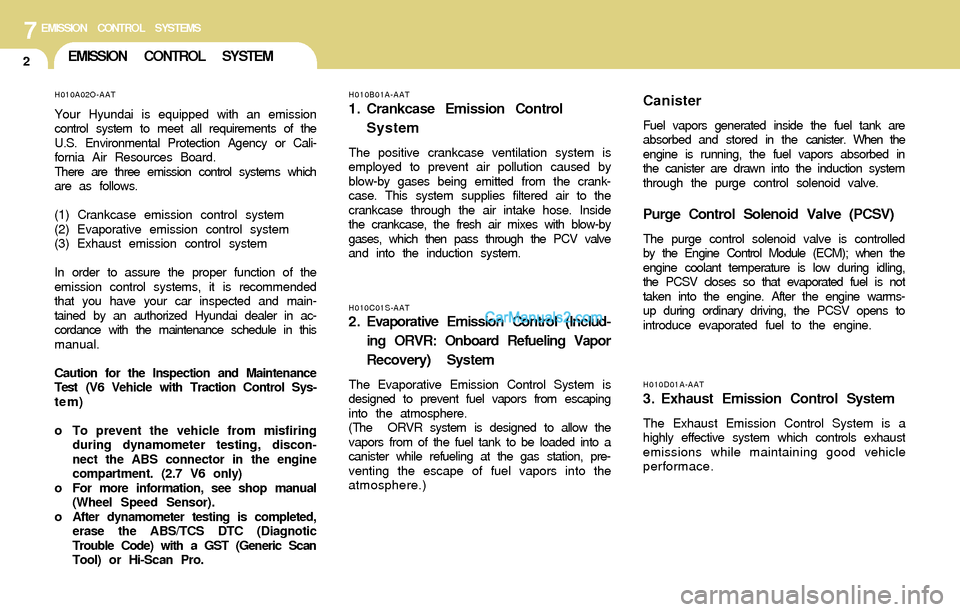
7EMISSION CONTROL SYSTEMS
2EMISSION CONTROL SYSTEM
H010D01A-AAT
3. Exhaust Emission Control System
The Exhaust Emission Control System is a
highly effective system which controls exhaust
emissions while maintaining good vehicle
performace.
H010B01A-AAT
1. Crankcase Emission Control
System
The positive crankcase ventilation system is
employed to prevent air pollution caused by
blow-by gases being emitted from the crank-
case. This system supplies filtered air to the
crankcase through the air intake hose. Inside
the crankcase, the fresh air mixes with blow-by
gases, which then pass through the PCV valve
and into the induction system.
H010A02O-AAT
Your Hyundai is equipped with an emission
control system to meet all requirements of the
U.S. Environmental Protection Agency or Cali-
fornia Air Resources Board.
There are three emission control systems which
are as follows.
(1) Crankcase emission control system
(2) Evaporative emission control system
(3) Exhaust emission control system
In order to assure the proper function of the
emission control systems, it is recommended
that you have your car inspected and main-
tained by an authorized Hyundai dealer in ac-
cordance with the maintenance schedule in this
manual.
Caution for the Inspection and Maintenance
Test (V6 Vehicle with Traction Control Sys-
tem)
o To prevent the vehicle from misfiring
during dynamometer testing, discon-
nect the ABS connector in the engine
compartment. (2.7 V6 only)
o For more information, see shop manual
(Wheel Speed Sensor).
o After dynamometer testing is completed,
erase the ABS/TCS DTC (Diagnotic
Trouble Code) with a GST (Generic Scan
Tool) or Hi-Scan Pro.Canister
Fuel vapors generated inside the fuel tank are
absorbed and stored in the canister. When the
engine is running, the fuel vapors absorbed in
the canister are drawn into the induction system
through the purge control solenoid valve.
Purge Control Solenoid Valve (PCSV)
The purge control solenoid valve is controlled
by the Engine Control Module (ECM); when the
engine coolant temperature is low during idling,
the PCSV closes so that evaporated fuel is not
taken into the engine. After the engine warms-
up during ordinary driving, the PCSV opens to
introduce evaporated fuel to the engine.
H010C01S-AAT2 . Evaporative Emission Control (Includ-
ing ORVR: Onboard Refueling Vapor
Recovery) System
The Evaporative Emission Control System is
designed to prevent fuel vapors from escaping
into the atmosphere.
(The ORVR system is designed to allow the
vapors from of the fuel tank to be loaded into a
canister while refueling at the gas station, pre-
venting the escape of fuel vapors into the
atmosphere.)
Page 237 of 253
8CONSUMER INFORMATION & REPORTING SAFETY DEFECTS
4
I080A01A-AAT
TIRE TRACTION
Tire traction can be reduced if you drive on worn
tires, tires that are improperly inflated or on
slippery road surfaces. Tires should be re-
placed when tread wear indicators appear. To
reduce the possibility of losing control, slow
down whenever there is rain, snow or ice on the
road.
I070A01A-AAT
TIRE BALANCING
A tire that is out of balance may affect handling
and tire wear. The tires on your Hyundai were
balanced before the car was delivered but may
need balancing again during the years you own
the car.
Whenever a tire is dismounted for repair, it
should be rebalanced before being reinstalled
on the car.
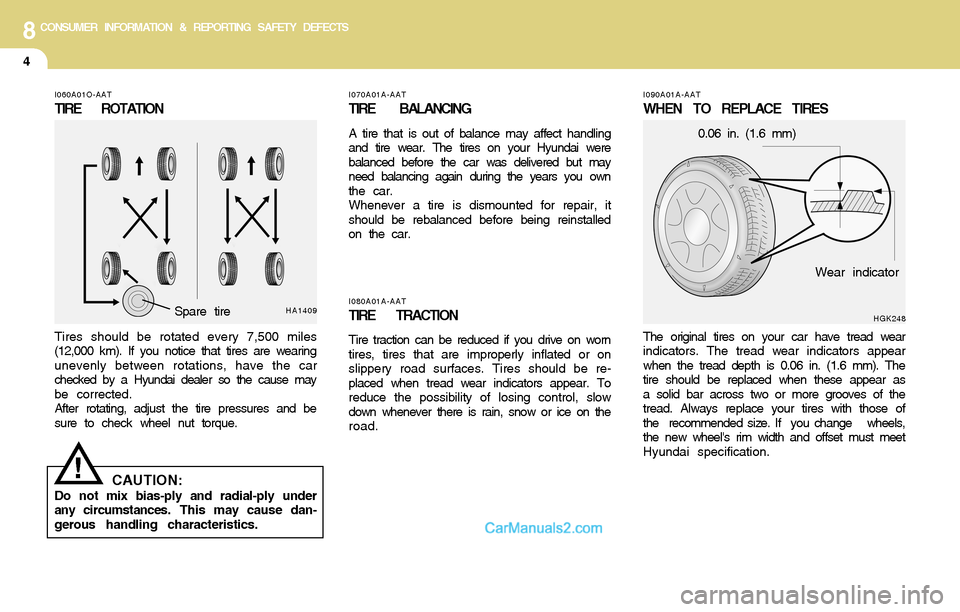
I090A01A-AAT
WHEN TO REPLACE TIRES
The original tires on your car have tread wear
indicators. The tread wear indicators appear
when the tread depth is 0.06 in. (1.6 mm). The
tire should be replaced when these appear as
a solid bar across two or more grooves of the
tread. Always replace your tires with those of
the recommended size. If you change wheels,
the new wheel's rim width and offset must meet
Hyundai specification.
HGK248
Wear indicator 0.06 in. (1.6 mm)
!
I060A01O-AAT
TIRE ROTATION
Tires should be rotated every 7,500 miles
(12,000 km). If you notice that tires are wearing
unevenly between rotations, have the car
checked by a Hyundai dealer so the cause may
be corrected.
After rotating, adjust the tire pressures and be
sure to check wheel nut torque.
CAUTION:Do not mix bias-ply and radial-ply under
any circumstances. This may cause dan-
gerous handling characteristics.
HA1409Spare tire
Page 239 of 253
8CONSUMER INFORMATION & REPORTING SAFETY DEFECTS
6CONSUMER INFORMATION
WARNING:The traction grade assigned to this tire is
based on straight-ahead braking traction
tests, and does not include acceleration,
cornering, hydroplaning, or peak traction
characteristics.
Temperature A, B, C - The temperature grades
are A (the highest), B, and C, representing the
tire's resistance to the generation of heat and
its ability to dissipate heat when tested under
controlled conditions on a specified indoor labo-
ratory test wheel. Sustained high temperature
can cause the material of the tire to degenerate
and reduce tire life, and excessive temperature
can lead to sudden tire failure. The grade C
corresponds to a level of performance which all
passenger car tires must meet under the Fed-
eral Motor Vehicle Safety Standard No. 109.
Grades B and A represent higher levels of
performance on the laboratory test wheel than
the minimum required by law.
I130A01A-AAT
This consumer information has been prepared
in accordance with regulations issued by the
National Highway Traffic Safety Administration
of the U.S. Department of Transportation. It
provides the purchasers and/or prospective
purchasers of Hyundai automobiles with infor-
mation on uniform tire quality grading. Your
Hyundai dealer will help answer any questions
you may have as you read this information.
I130B03A-AAT
Tire Quality Grading
Department of Transportation quality grades -
All passenger vehicle tires must conform to
Federal Safety Standards in addition to these
grades. These quality grades are molded on the
sidewall.
Treadwear - The treadwear grade is a com-
parative rating based on the wear rate of the tire
when tested under controlled conditions on a
specified government test course. For example,
a tire graded 150 would wear one and a half (1
- 1/2) times as well on the government course
as a tire graded 100. The relative performance
of tires depends upon the actual conditions of
their use, however, and may depart significantly
from the norm due to variations in driving habits,
service practices and differences in road char-
acteristics and climate.
Traction AA, A, B, C - The traction grades,
from highest to lowest, are AA, A, B, and C.
Those grades represent the tire's ability to stop
on wet pavement as measured under controlled
conditions on specified government test sur-
faces of asphalt and concrete. A tire marked C
may have poor traction performance.!
Page 248 of 253
10INDEX
2
A
Air bag ...............................................................................................1-31
Air Cleaner Filter ...............................................................................6-12
Air Conditioning
Care..............................................................................................6-18
Operation............................................................................ 1-85, 6-18
Switch...........................................................................................1-84
Antenna ..........................................................................................1-123
Ashtray..............................................................................................1-55
Audio System
Cassete tape player operation (D-285) ...................................1-106
Compact disc player operation (H260) .......................................1-99
Compact disc player operation (D-285) ...................................1-110
Compact disc player operation (D-295) ...................................1-116
Stereo radio operation (H260) .....................................................1-96
Stereo radio operation (D-285) ................................................1-103
Stereo radio operation (D-295) ................................................1-113
B
Battery..................................................................................... 2-23, 6-22
Brake
Anti-lock brake system ................................................................2-15
Brake traction control system (BTCS) ........................................2-15
Checking the brakes ....................................................................6-16
Fluid ..............................................................................................6-16
Pedal clearance ...........................................................................6-20
Pedal free-play .............................................................................6-19
Practices......................................................................................2-21
Breaking-In your New Hyundai .......................................................... 1-3C
Calendar ............................................................................................1-53
Care of Cassette Tapes ................................................................1-121
Care of Disc ...................................................................................1-121
Cargo Security Screen .....................................................................1-69
Catalytic Converter............................................................................. 7-3
Child-Protector Rear Door Lock ......................................................... 1-7
Child Restraint System .....................................................................1-24
Installing a Child Restraint Seat with the
"Tether Anchorage" System .....................................................1-26
Securing the Child Restraint Seat with the "ISOFIX" System ....1-27
Cigarette Lighter ................................................................................1-54
Clock.................................................................................................1-53
Clutch
Checking fluid ...............................................................................6-17
Pedal free-play .............................................................................6-19
Combination Light
Auto light .......................................................................................1-50
Headlight flasher ..........................................................................1-49
Headlight switch ...........................................................................1-49
High-beam switch ........................................................................1-49
Lane change signal ......................................................................1-49
Parking light auto off .....................................................................1-49
Turn signal operation ...................................................................1-48
Consumer Information ........................................................................ 8-6
Cooling Fans .....................................................................................6-23
Page 251 of 253
10INDEX
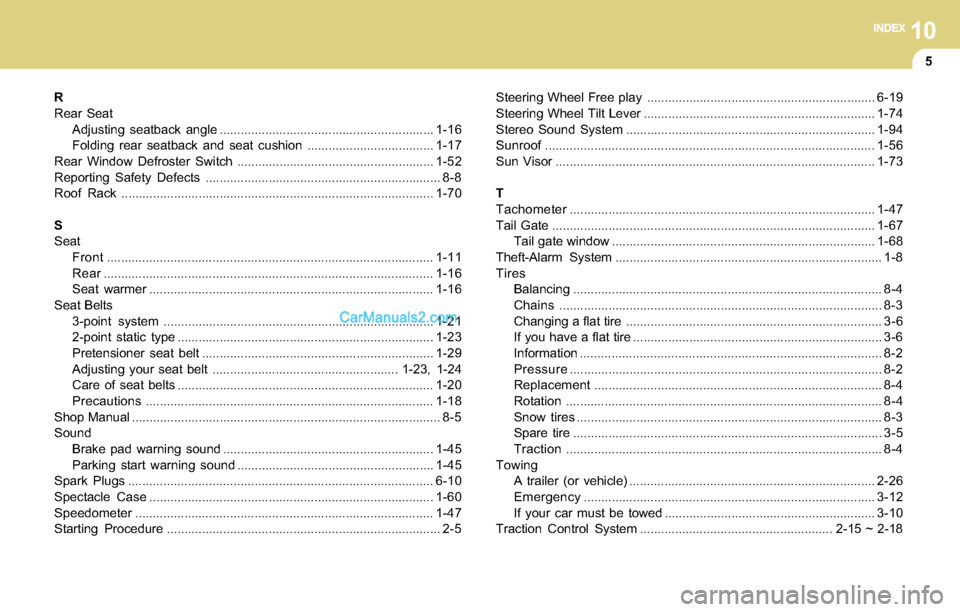
5
R
Rear Seat
Adjusting seatback angle .............................................................1-16
Folding rear seatback and seat cushion ....................................1-17
Rear Window Defroster Switch ........................................................1-52
Reporting Safety Defects................................................................... 8-8
Roof Rack .........................................................................................1-70
S
Seat
Front.............................................................................................1-11
Rear..............................................................................................1-16
Seat warmer.................................................................................1-16
Seat Belts
3-point system .............................................................................1-21
2-point static type .........................................................................1-23
Pretensioner seat belt ..................................................................1-29
Adjusting your seat belt..................................................... 1-23, 1-24
Care of seat belts .........................................................................1-20
Precautions..................................................................................1-18
Shop Manual ........................................................................................ 8-5
Sound
Brake pad warning sound ............................................................1-45
Parking start warning sound ........................................................1-45
Spark Plugs .......................................................................................6-10
Spectacle Case .................................................................................1-60
Speedometer.....................................................................................1-47
Starting Procedure .............................................................................. 2-5Steering Wheel Free play .................................................................6-19
Steering Wheel Tilt Lever ..................................................................1-74
Stereo Sound System .......................................................................1-94
Sunroof..............................................................................................1-56
Sun Visor ...........................................................................................1-73
T
Tachometer.......................................................................................1-47
Tail Gate ............................................................................................1-67
Tail gate window ...........................................................................1-68
Theft-Alarm System............................................................................ 1-8
Tires
Balancing ........................................................................................ 8-4
Chains ............................................................................................ 8-3
Changing a flat tire ......................................................................... 3-6
If you have a flat tire ....................................................................... 3-6
Information ...................................................................................... 8-2
Pressure......................................................................................... 8-2
Replacement.................................................................................. 8-4
Rotation .......................................................................................... 8-4
Snow tires ....................................................................................... 8-3
Spare tire ........................................................................................ 3-5
Traction.......................................................................................... 8-4
Towing
A trailer (or vehicle) ......................................................................2-26
Emergency...................................................................................3-12
If your car must be towed ............................................................3-10
Traction Control System ....................................................... 2-15 ~ 2-18