ECU Hyundai Santa Fe 2004 Owner's Guide
[x] Cancel search | Manufacturer: HYUNDAI, Model Year: 2004, Model line: Santa Fe, Model: Hyundai Santa Fe 2004Pages: 253, PDF Size: 22.41 MB
Page 168 of 253
3
2
WHAT TO DO IN AN EMERGENCY
IF THE ENGINE WILL NOT START
!
D010A01A-AAT D010B02A-AAT
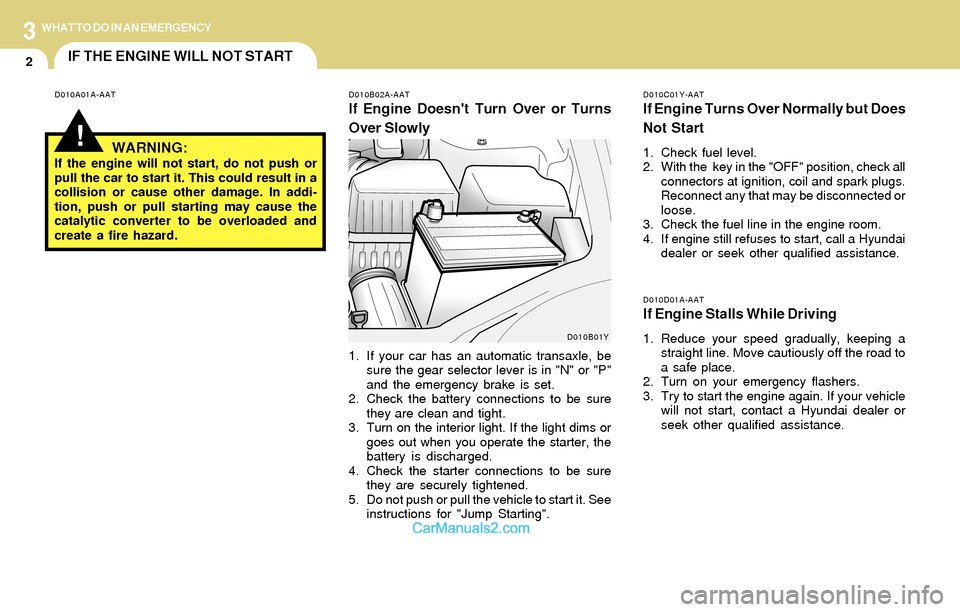
If Engine Doesn't Turn Over or Turns
Over Slowly
D010C01Y-AAT
If Engine Turns Over Normally but Does
Not Start
1. Check fuel level.
2. With the key in the "OFF" position, check all
connectors at ignition, coil and spark plugs.
Reconnect any that may be disconnected or
loose.
3. Check the fuel line in the engine room.
4. If engine still refuses to start, call a Hyundai
dealer or seek other qualified assistance.
D010D01A-AAT
If Engine Stalls While Driving
1. Reduce your speed gradually, keeping a
straight line. Move cautiously off the road to
a safe place.
2. Turn on your emergency flashers.
3. Try to start the engine again. If your vehicle
will not start, contact a Hyundai dealer or
seek other qualified assistance.
WARNING:If the engine will not start, do not push or
pull the car to start it. This could result in a
collision or cause other damage. In addi-
tion, push or pull starting may cause the
catalytic converter to be overloaded and
create a fire hazard.
1. If your car has an automatic transaxle, be
sure the gear selector lever is in "N" or "P"
and the emergency brake is set.
2. Check the battery connections to be sure
they are clean and tight.
3. Turn on the interior light. If the light dims or
goes out when you operate the starter, the
battery is discharged.
4. Check the starter connections to be sure
they are securely tightened.
5. Do not push or pull the vehicle to start it. See
instructions for "Jump Starting".
D010B01Y
Page 176 of 253
3
10
WHAT TO DO IN AN EMERGENCY
IF YOUR CAR MUST BE TOWED
!
D080A01A-AAT D060I01E-AAT
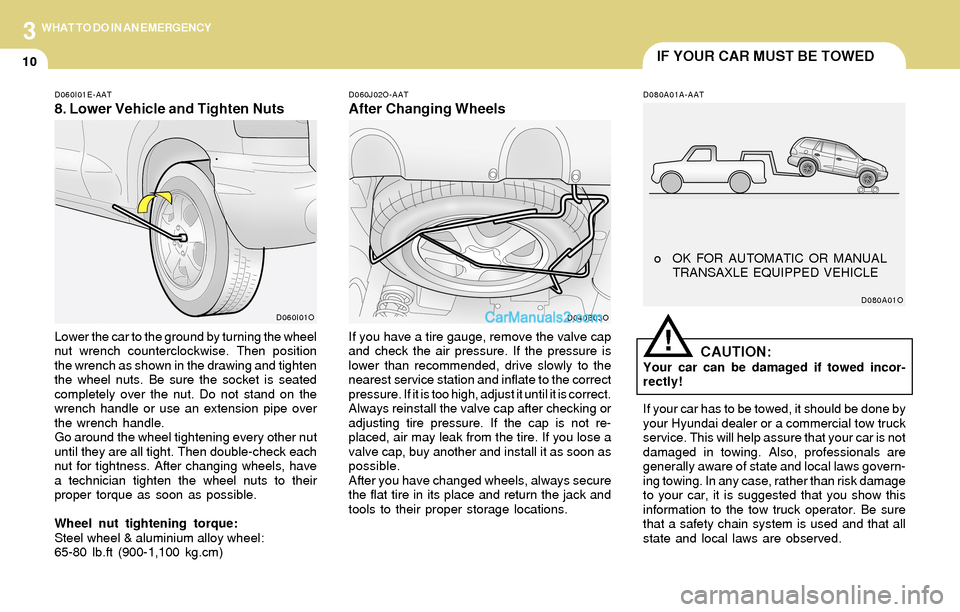
8. Lower Vehicle and Tighten Nuts
D060J02O-AAT
After Changing Wheels
Lower the car to the ground by turning the wheel
nut wrench counterclockwise. Then position
the wrench as shown in the drawing and tighten
the wheel nuts. Be sure the socket is seated
completely over the nut. Do not stand on the
wrench handle or use an extension pipe over
the wrench handle.
Go around the wheel tightening every other nut
until they are all tight. Then double-check each
nut for tightness. After changing wheels, have
a technician tighten the wheel nuts to their
proper torque as soon as possible.
Wheel nut tightening torque:
Steel wheel & aluminium alloy wheel:
65-80 lb.ft (900-1,100 kg.cm)If you have a tire gauge, remove the valve cap
and check the air pressure. If the pressure is
lower than recommended, drive slowly to the
nearest service station and inflate to the correct
pressure. If it is too high, adjust it until it is correct.
Always reinstall the valve cap after checking or
adjusting tire pressure. If the cap is not re-
placed, air may leak from the tire. If you lose a
valve cap, buy another and install it as soon as
possible.
After you have changed wheels, always secure
the flat tire in its place and return the jack and
tools to their proper storage locations.CAUTION:Your car can be damaged if towed incor-
rectly!
If your car has to be towed, it should be done by
your Hyundai dealer or a commercial tow truck
service. This will help assure that your car is not
damaged in towing. Also, professionals are
generally aware of state and local laws govern-
ing towing. In any case, rather than risk damage
to your car, it is suggested that you show this
information to the tow truck operator. Be sure
that a safety chain system is used and that all
state and local laws are observed.
D060I01O
D040B03OD080A01O
o OK FOR AUTOMATIC OR MANUAL
TRANSAXLE EQUIPPED VEHICLE
Page 192 of 253
5VEHICLE MAINTENANCE REQUIREMENTS
7
F060D01A-AATo Fuel Lines, Fuel Hoses and Connec-
tions
Check the fuel lines, fuel hoses and connec-
tions for leakage and damage. Have a trained
technician replace any damaged or leaking
parts immediately.
F060A01A-AAT F060B01A-AAT
o Drive Belts
Inspect all drive belts for evidence of cuts,
cracks, excessive wear or oil saturation and
replace if necessary. Drive belts should be
checked periodically for proper tension and
adjusted as necessary.F060M01A-AATo Engine Oil and Filter
The engine oil and filter should be changed at the
intervals specified in the maintenance sched-
ule. If the car is being driven in severe condi-
tions, more frequent oil and filter changes are
required.
F060C01A-AATo Fuel Filter
A clogged filter can limit the speed at which the
vehicle may be driven, damage the emission
system and cause hard starting. If an exces-
sive amount of foreign matter accumulates in
the fuel tank, the filter may require replacement
more frequently.
After installing a new filter, run the engine for
several minutes, and check for leaks at the
connections. Fuel filters should be installed by
trained technicians.
F060F01O-AAT
o Vacuum Hoses
Inspect the surface of hoses for evidence of
heat and/or mechanical damage. Hard and
brittle rubber, cracking, tears, cuts, abrasions,
and excessive swelling indicate deterioration.
Particular attention should be paid to examine
those hose surfaces nearest to high heat
sources, such as the exhaust manifold.
Inspect the hose routing to assure that the
hoses do not come in contact with any heat
source, sharp edges or moving component
which might cause heat damage or mechanical
wear. Inspect all hose connections, such as
clamps and couplings, to make sure they are
secure, and that no leaks are present. Hoses
should be replaced immediately if there is any
evidence of deterioration or damage.
EXPLANATION OF SCHEDULED MAINTENANCE ITEMS
Page 193 of 253
5VEHICLE MAINTENANCE REQUIREMENTS
8
F070D01A-AAT
o Manual Transaxle Oil
Inspect the manual transaxle oil according to
the maintenance schedule.
NOTE:If the oil level is low, check for possible leaks
before adding oil. Do not overfill.
F070F01A-AAT
o Brake Hoses and Lines
Visually check for proper installation, chafing,
cracks, deterioration and any leakage. Replace
any deteriorated or damaged parts immedi-
ately.
F070E03A-AATo Automatic Transaxle Fluid and Filter
The fluid level should be in the "HOT" range of
the dipstick, after the engine and transaxle are
at normal operating temperature. Check the
automatic transaxle fluid level with the engine
running and the transaxle in neutral, with the
parking brake properly applied. Use GENUINE
HYUNDAI ATF or DIAMOND ATF SP-III or SK
ATF SP-III when adding or changing fluid.
F070C01A-AATo Coolant
The coolant should be changed at the intervals
specified in the maintenance schedule.
F060E01A-AATo Timing Belt
Inspect all parts related to the timing belt for
damage and deformation. Replace any dam-
aged parts immediately.
F060J01A-AATo Spark Plugs
Make sure to install new spark plugs of the
correct heat range.
F060H01A-AAT
o Air Cleaner Filter
A Genuine Hyundai air cleaner filter is recom-
mended when the filter is replaced.
F060G01A-AAT
o Vapor Hose and Fuel Filler Cap
The vapor hose and fuel filler cap should be
inspected at those intervals specified in the
maintenance schedule. Make sure that a new
vapor hose or fuel filler cap is correctly re-
placed.
F065F01O-AAT
o Crankcase Ventilation Hose
Inspect the surface of hose for evidence of heat
and/or mechanical damage. Hard and brittle
rubber, cracking, tears, cuts, abrasions, and
excessive swelling indicate deterioration. Par-
ticular attention should be paid to examine that
hose surface nearest to high heat sources,
such as the exhaust manifold.
Inspect the hose routing to assure that the hose
does not come in contact with any heat source,
sharp edges or moving component which might
cause heat damage or mechanical wear. In-
spect all hose connections, such as clamps and
couplings, to make sure they are secure, and
that no leaks are present. Hose should be
replaced immediately if there is any evidence of
deterioration or damage.
Page 204 of 253
6DO-IT-YOURSELF MAINTENANCE
10SPARK PLUGS
!
G060A02Y-AAT
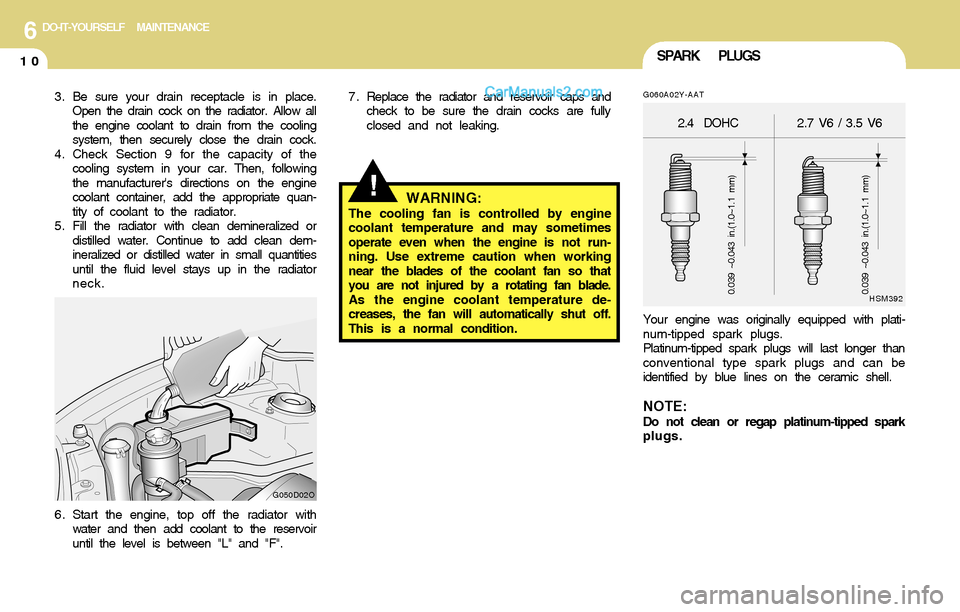
Your engine was originally equipped with plati-
num-tipped spark plugs.
Platinum-tipped spark plugs will last longer than
conventional type spark plugs and can be
identified by blue lines on the ceramic shell.
NOTE:Do not clean or regap platinum-tipped spark
plugs.
HSM392
2.4 DOHC2.7 V6 / 3.5 V6
0.039 ~0.043 in.(1.0~1.1 mm)
0.039 ~0.043 in.(1.0~1.1 mm)
6 . Start the engine, top off the radiator with
water and then add coolant to the reservoir
until the level is between "L" and "F".
WARNING:The cooling fan is controlled by engine
coolant temperature and may sometimes
operate even when the engine is not run-
ning. Use extreme caution when working
near the blades of the coolant fan so that
you are not injured by a rotating fan blade.
As the engine coolant temperature de-
creases, the fan will automatically shut off.
This is a normal condition.
G050D02O
3. Be sure your drain receptacle is in place.
Open the drain cock on the radiator. Allow all
the engine coolant to drain from the cooling
system, then securely close the drain cock.
4. Check Section 9 for the capacity of the
cooling system in your car. Then, following
the manufacturer's directions on the engine
coolant container, add the appropriate quan-
tity of coolant to the radiator.
5 . Fill the radiator with clean demineralized or
distilled water. Continue to add clean dem-
ineralized or distilled water in small quantities
until the fluid level stays up in the radiator
neck.7 . Replace the radiator and reservoir caps and
check to be sure the drain cocks are fully
closed and not leaking.
Page 208 of 253
6DO-IT-YOURSELF MAINTENANCE
14CHECKING THE TRANSAXLE
FLUID (AUTOMATIC)
G110A01E-AAT
Transaxle fluid in the automatic transaxle should
be checked at those intervals specified in the
vehicle maintenance schedule in Section 5.
NOTE:Automatic transaxle fluid is basically red
color. As driving distance increases, the
fluid color turns darkish red gradually. It is
a normal condition and you should not
judge the need to replace based upon the
changing color.
You must replace the automatic transaxle
fluid in accordance with intervals specified
in the vehicle maintenance schedule in
section 5.
!
G100B02A-AAT
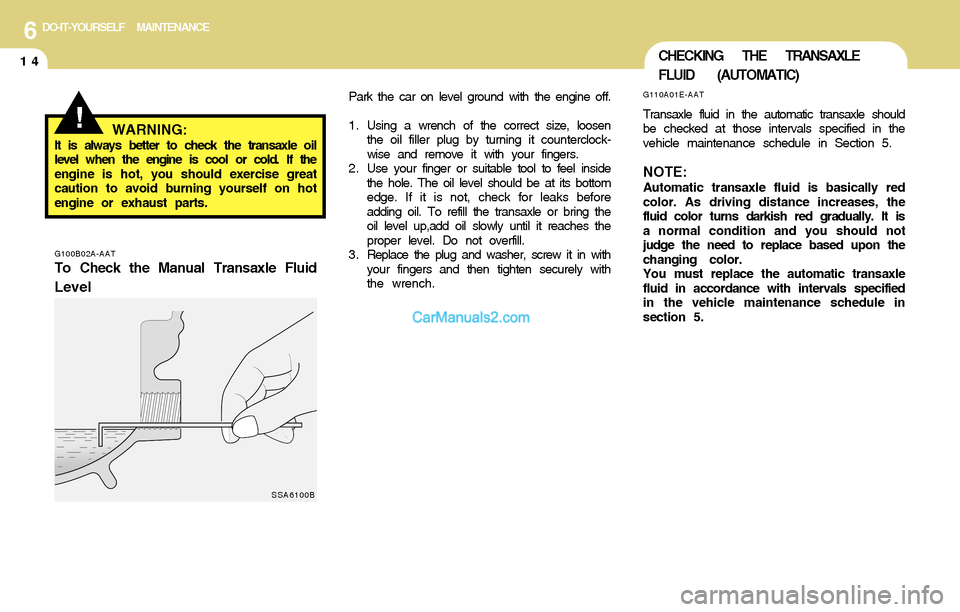
To Check the Manual Transaxle Fluid
LevelWARNING:
It is always better to check the transaxle oil
level when the engine is cool or cold. If the
engine is hot, you should exercise great
caution to avoid burning yourself on hot
engine or exhaust parts.Park the car on level ground with the engine off.
1 . Using a wrench of the correct size, loosen
the oil filler plug by turning it counterclock-
wise and remove it with your fingers.
2 . Use your finger or suitable tool to feel inside
the hole. The oil level should be at its bottom
edge. If it is not, check for leaks before
adding oil. To refill the transaxle or bring the
oil level up,add oil slowly until it reaches the
proper level. Do not overfill.
3 . Replace the plug and washer, screw it in with
your fingers and then tighten securely with
the wrench.
SSA6100B
Page 228 of 253
6DO-IT-YOURSELF MAINTENANCE
34FUSE PANEL DESCRIPTION
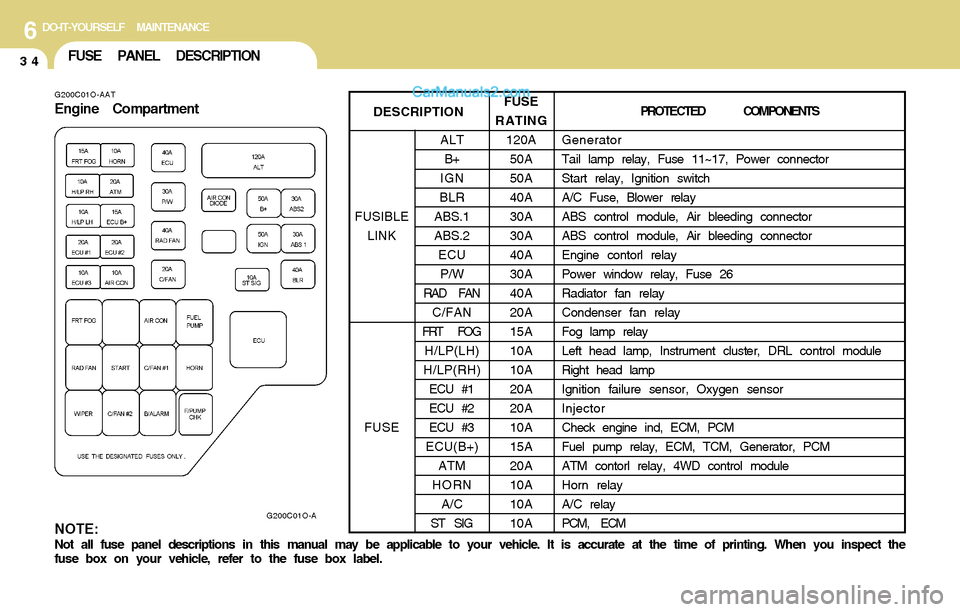
G200C01O-AAT
Engine Compartment
G200C01O-ANOTE:Not all fuse panel descriptions in this manual may be applicable to your vehicle. It is accurate at the time of printing. When you inspect the
fuse box on your vehicle, refer to the fuse box label.FUSE
RATING
120A
50A
50A
40A
30A
30A
40A
30A
40A
20A
15A
10A
10A
20A
20A
10A
15A
20A
10A
10A
10APROTECTED COMPONENTS
Generator
Tail lamp relay, Fuse 11~17, Power connector
Start relay, Ignition switch
A/C Fuse, Blower relay
ABS control module, Air bleeding connector
ABS control module, Air bleeding connector
Engine contorl relay
Power window relay, Fuse 26
Radiator fan relay
Condenser fan relay
Fog lamp relay
Left head lamp, Instrument cluster, DRL control module
Right head lamp
Ignition failure sensor, Oxygen sensor
Injector
Check engine ind, ECM, PCM
Fuel pump relay, ECM, TCM, Generator, PCM
ATM contorl relay, 4WD control module
Horn relay
A/C relay
PCM, ECM
ALT
B+
IGN
BLR
ABS.1
ABS.2
ECU
P/W
RAD FAN
C/FAN
FRT FOG
H/LP(LH)
H/LP(RH)
ECU #1
ECU #2
ECU #3
ECU(B+)
ATM
HORN
A/C
ST SIG FUSIBLE
LINK
FUSE
DESCRIPTION
Page 248 of 253
10INDEX
2
A
Air bag ...............................................................................................1-31
Air Cleaner Filter ...............................................................................6-12
Air Conditioning
Care..............................................................................................6-18
Operation............................................................................ 1-85, 6-18
Switch...........................................................................................1-84
Antenna ..........................................................................................1-123
Ashtray..............................................................................................1-55
Audio System
Cassete tape player operation (D-285) ...................................1-106
Compact disc player operation (H260) .......................................1-99
Compact disc player operation (D-285) ...................................1-110
Compact disc player operation (D-295) ...................................1-116
Stereo radio operation (H260) .....................................................1-96
Stereo radio operation (D-285) ................................................1-103
Stereo radio operation (D-295) ................................................1-113
B
Battery..................................................................................... 2-23, 6-22
Brake
Anti-lock brake system ................................................................2-15
Brake traction control system (BTCS) ........................................2-15
Checking the brakes ....................................................................6-16
Fluid ..............................................................................................6-16
Pedal clearance ...........................................................................6-20
Pedal free-play .............................................................................6-19
Practices......................................................................................2-21
Breaking-In your New Hyundai .......................................................... 1-3C
Calendar ............................................................................................1-53
Care of Cassette Tapes ................................................................1-121
Care of Disc ...................................................................................1-121
Cargo Security Screen .....................................................................1-69
Catalytic Converter............................................................................. 7-3
Child-Protector Rear Door Lock ......................................................... 1-7
Child Restraint System .....................................................................1-24
Installing a Child Restraint Seat with the
"Tether Anchorage" System .....................................................1-26
Securing the Child Restraint Seat with the "ISOFIX" System ....1-27
Cigarette Lighter ................................................................................1-54
Clock.................................................................................................1-53
Clutch
Checking fluid ...............................................................................6-17
Pedal free-play .............................................................................6-19
Combination Light
Auto light .......................................................................................1-50
Headlight flasher ..........................................................................1-49
Headlight switch ...........................................................................1-49
High-beam switch ........................................................................1-49
Lane change signal ......................................................................1-49
Parking light auto off .....................................................................1-49
Turn signal operation ...................................................................1-48
Consumer Information ........................................................................ 8-6
Cooling Fans .....................................................................................6-23