service Hyundai Santa Fe 2004 Owner's Guide
[x] Cancel search | Manufacturer: HYUNDAI, Model Year: 2004, Model line: Santa Fe, Model: Hyundai Santa Fe 2004Pages: 253, PDF Size: 22.41 MB
Page 194 of 253
5VEHICLE MAINTENANCE REQUIREMENTS
9
F070L01A-AATo Suspension Mounting Bolts
Check the suspension connections for loose-
ness or damage. Retighten to the specified
torque.
F070G02A-AAT
o Brake Fluid
Check brake fluid level in the brake fluid reser-
voir. The level should be between "MIN" and
"MAX" marks on the side of the reservoir. Use
only hydraulic brake fluid conforming to DOT 3
or DOT 4.
F070K01A-AAT
o Exhaust Pipe and Muffler
Visually inspect the exhaust pipes, muffler and
hangers for cracks, deterioration, or damage.
Start the engine and listen carefully for any
exhaust gas leakage. Tighten connections or
replace parts as necessary.
F070J01A-AATo Brake Pads, Calipers and Rotors
Check the pads for excessive wear, discs for
run out and wear, and calipers for fluid leakage.
F070H01O-AAT
o Rear Brake Discs and Linings/
Parking Brake
Check the rear brake discs and linings for
scoring, burning, leaking fluid, broken parts,
and excessive wear. Inspect the parking brake
system including the parking brake lever and
cables. For detailed service procedures, refer
to the Shop Manual.
F070M01A-AAT
o Steering Gear Box, Linkage & Boots/
Lower Arm Ball Joint
With the vehicle stopped and engine off, check
for excessive free-play in the steering wheel.
Check the linkage for bends or damage. Check
the dust boots and ball joints for deterioration,
cracks, or damage. Replace any damaged
parts.
F070Q01A-AATo Air Conditioning Refrigerant
Check the air conditioning lines and connec-
tions for leakage and damage. Check air con-
ditioning performance according to the relevant
shop manual if necessary.
F070P01A-AATo Driveshafts and Boots
Check the drive shafts, boots and clamps for
cracks, deterioration, or damage. Replace any
damaged parts and, if necessary, repack the
grease.
F070N01A-AAT
o Power Steering Pump, Belt and Hoses
Check the power steering pump and hoses for
leakage and damage. Replace any damaged or
leaking parts immediately. Inspect the power
steering belt for evidence of cuts, cracks, ex-
cessive wear, oiliness and proper tension.
Replace or adjust it if necessary.
Page 199 of 253
6DO-IT-YOURSELF MAINTENANCE
5GENERAL CHECKS
G020C01A-AAT
Vehicle Interior
The following should be checked each time
when the vehicle is driven:
o Lights operation
o Windshield wiper operation
o Horn operation
o Defroster, heating system operation (and air
conditioning, if installed)
o Steering operation and condition
o Mirror condition and operation
o Turn signal operation
o Accelerator pedal operation
o Brake operation, including parking brake
o Manual transaxle operation, including clutch
operation
o Automatic transaxle operation, including
"Park" mechanism operation
o Seat control condition and operation
o Seat belt condition and operation
o Sunvisor operation
If you notice anything that does not operate
correctly or appears to be functioning correctly,
inspect it carefully and seek assistance from
your Hyundai dealer if service is needed.
G020B01A-AAT
Vehicle Exterior
The following should be checked monthly:
o Overall appearance and condition
o Wheel condition and wheel nut torque
o Exhaust system condition
o Light condition and operation
o Windshield glass condition
o Wiper blade condition
o Paint condition and body corrosion
o Fluid leaks
o Door and hood lock condition
o Tire pressure and condition
(including spare tire)
G020A01A-AAT
Engine Compartment
The following should be checked regularly:
o Engine oil level and condition
o Transaxle fluid level and condition
o Brake fluid level
o Clutch fluid level
o Engine coolant level
o Windshield washer fluid level
o Accessory drive belt condition
o Engine coolant hose condition
o Fluid leaks (on or below components)
o Power steering fluid level
o Battery condition
o Air filter condition
Page 200 of 253
6DO-IT-YOURSELF MAINTENANCE
6CHECKING THE ENGINE OIL
G030A01A-AAT
Engine oil is essential to the performance and
service of the engine. It is suggested that you
check the oil level at least once a week in normal
use and more often if you are on a trip or driving
in severe conditions.
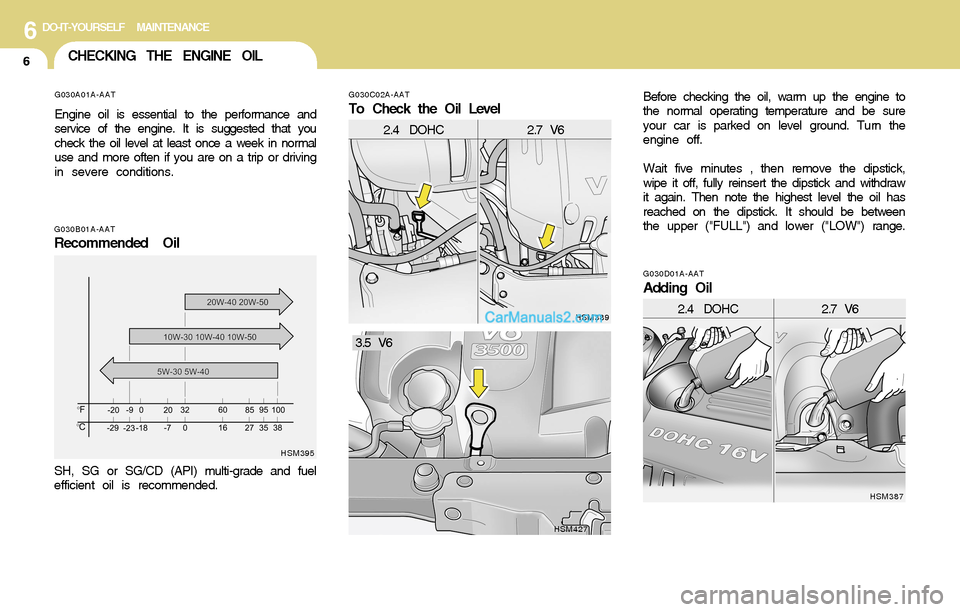
G030C02A-AAT
To Check the Oil Level
G030B01A-AATRecommended Oil
SH, SG or SG/CD (API) multi-grade and fuel
efficient oil is recommended.Before checking the oil, warm up the engine to
the normal operating temperature and be sure
your car is parked on level ground. Turn the
engine off.
Wait five minutes , then remove the dipstick,
wipe it off, fully reinsert the dipstick and withdraw
it again. Then note the highest level the oil has
reached on the dipstick. It should be between
the upper ("FULL") and lower ("LOW") range.
HSM395HSM389G030D01A-AAT
Adding Oil
HSM387
2.4 DOHC2.7 V6
2.4 DOHC2.7 V6
HSM427
3.5 V6
Page 202 of 253
6DO-IT-YOURSELF MAINTENANCE
8CHECKING AND CHANGING THE
ENGINE COOLANT
!
!
G050A01A-AAT
WARNING:Do not remove the radiator cap when the
engine is hot. When the engine is hot, the
engine coolant is under pressure and may
erupt through the opening if the cap is
removed. You could be seriously burned if
you do not observe this precaution. Do not
remove the radiator cap until the radiator is
cool to the touch. 4 . When the oil has stopped draining, replace
the drain plug using a new washer and
retighten by turning it clockwise.
Oil pan drain plug tightening torque:
3.5 ~ 4.5 kgf.m
5. Remove the oil filter by turning it counter-
clockwise with a oil filter wrench of the proper
size. A certain amount of oil will come out
when you remove the filter. So be sure to
have your drain pan in place underneath it.
6 . Install a new oil filter in accordance with the
instructions on the carton or on the filter itself.
Do not over-tighten. (Tightening torque :
1.2 ~ 1.6 kgf.m) Be sure that the mounting
surface on the engine is clean and that the
old gasket is removed completely. Lubricate
the new gasket on the filter with clean engine
oil before installation.
7 . Refill the crankcase with the recommended
engine oil. Refer to the specification in chap-
ter 9 for engine oil capacity.
8 . Start the engine and check to be sure no oil
is leaking from the drain plug or oil filter.
9 . Shut off the engine and recheck the oil level.
NOTE:Always dispose of used engine oil in an
environmentally acceptable manner. It is
suggested that it be placed in a sealed
container and taken to a service station for
reclamation. Do not pour the oil on the
ground or put it in with the household
trash.
WARNING:Used motor oil may cause irritation or can-
cer of the skin if left in contact with the skin
for prolonged periods of time. Wash your
hands thoroughly with soap and warm
water as soon as possible after handling
used oil.
!PROPOSITION 65 WARNING:Used engine oil may cause irritation or
cancer of the skin if left in contact with the
skin for prolonged periods of time. Used
engine oil contains chemicals that have
caused cancer in laboratory animals. Al-
ways protect your skin by washing your
hands thoroughly with soap and warm
water as soon as possible after handling
used oil.
Page 211 of 253
6DO-IT-YOURSELF MAINTENANCE
17
!
G120E02A-AAT
Adding Brake Fluid
WARNING:
Handle brake fluid carefully. It can damage
your vision if it gets into your eyes. Use only
DOT 3 or DOT 4 specification fluid from a
sealed container. Do not allow the fluid can
or reservoir to remain open any longer than
required. This will prevent entry of dirt and
moisture which can damage the brake sys-
tem and cause improper operation.
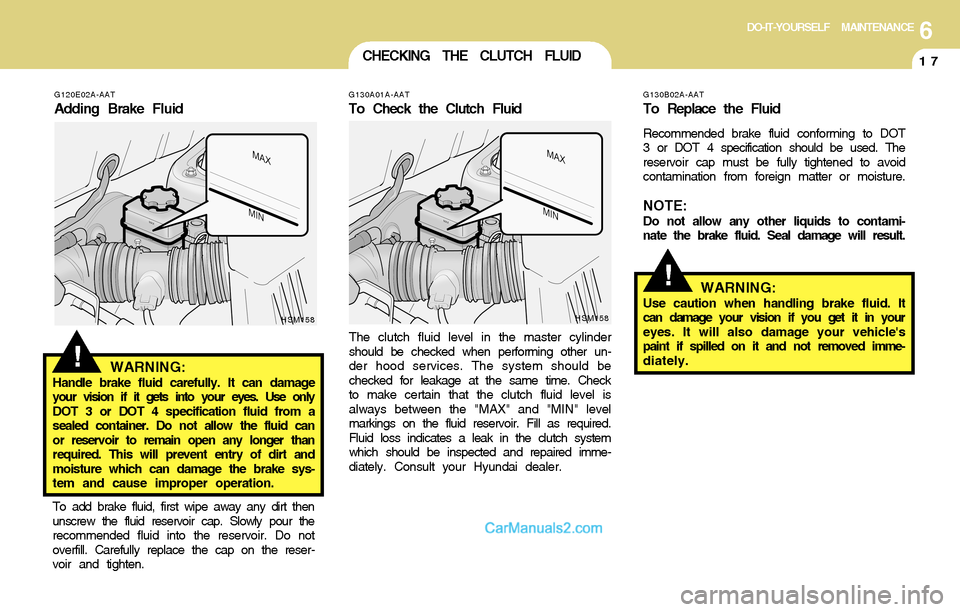
To add brake fluid, first wipe away any dirt then
unscrew the fluid reservoir cap. Slowly pour the
recommended fluid into the reservoir. Do not
overfill. Carefully replace the cap on the reser-
voir and tighten.
HSM158
CHECKING THE CLUTCH FLUID
G130A01A-AAT
To Check the Clutch Fluid
The clutch fluid level in the master cylinder
should be checked when performing other un-
der hood services. The system should be
checked for leakage at the same time. Check
to make certain that the clutch fluid level is
always between the "MAX" and "MIN" level
markings on the fluid reservoir. Fill as required.
Fluid loss indicates a leak in the clutch system
which should be inspected and repaired imme-
diately. Consult your Hyundai dealer.
HSM158
!
G130B02A-AAT
To Replace the Fluid
Recommended brake fluid conforming to DOT
3 or DOT 4 specification should be used. The
reservoir cap must be fully tightened to avoid
contamination from foreign matter or moisture.
NOTE:Do not allow any other liquids to contami-
nate the brake fluid. Seal damage will result.
WARNING:Use caution when handling brake fluid. It
can damage your vision if you get it in your
eyes. It will also damage your vehicle's
paint if spilled on it and not removed imme-
diately.
Page 239 of 253
8CONSUMER INFORMATION & REPORTING SAFETY DEFECTS
6CONSUMER INFORMATION
WARNING:The traction grade assigned to this tire is
based on straight-ahead braking traction
tests, and does not include acceleration,
cornering, hydroplaning, or peak traction
characteristics.
Temperature A, B, C - The temperature grades
are A (the highest), B, and C, representing the
tire's resistance to the generation of heat and
its ability to dissipate heat when tested under
controlled conditions on a specified indoor labo-
ratory test wheel. Sustained high temperature
can cause the material of the tire to degenerate
and reduce tire life, and excessive temperature
can lead to sudden tire failure. The grade C
corresponds to a level of performance which all
passenger car tires must meet under the Fed-
eral Motor Vehicle Safety Standard No. 109.
Grades B and A represent higher levels of
performance on the laboratory test wheel than
the minimum required by law.
I130A01A-AAT
This consumer information has been prepared
in accordance with regulations issued by the
National Highway Traffic Safety Administration
of the U.S. Department of Transportation. It
provides the purchasers and/or prospective
purchasers of Hyundai automobiles with infor-
mation on uniform tire quality grading. Your
Hyundai dealer will help answer any questions
you may have as you read this information.
I130B03A-AAT
Tire Quality Grading
Department of Transportation quality grades -
All passenger vehicle tires must conform to
Federal Safety Standards in addition to these
grades. These quality grades are molded on the
sidewall.
Treadwear - The treadwear grade is a com-
parative rating based on the wear rate of the tire
when tested under controlled conditions on a
specified government test course. For example,
a tire graded 150 would wear one and a half (1
- 1/2) times as well on the government course
as a tire graded 100. The relative performance
of tires depends upon the actual conditions of
their use, however, and may depart significantly
from the norm due to variations in driving habits,
service practices and differences in road char-
acteristics and climate.
Traction AA, A, B, C - The traction grades,
from highest to lowest, are AA, A, B, and C.
Those grades represent the tire's ability to stop
on wet pavement as measured under controlled
conditions on specified government test sur-
faces of asphalt and concrete. A tire marked C
may have poor traction performance.!
Page 250 of 253
10INDEX
4
H
Hazard Warning System ..................................................................1-52
Heating and Cooling Control .............................................................1-78
Heating and Ventilation
Air flow control ..............................................................................1-80
Air intake control switch ...............................................................1-79
Bi-level heating .............................................................................1-84
Defrosting / Defogging .................................................................1-87
Fan speed control (Blower control) .............................................1-79
Temperature control ....................................................................1-83
High-Mounted Rear Stop Light .........................................................1-71
Homelink Mirror .................................................................................1-64
Hood Release ....................................................................................1-72
Horn.................................................................................................1-75
I
Ignition Switch ...................................................................................... 2-4
Instrument Cluster and Indicator Lights ................................. 1-38, 1-40
Instrument Panel Light Control (Rheostat) .......................................1-54
Interior Light .......................................................................................1-59
J
Jump Starting ...................................................................................... 3-2
K
Keys................................................................................................... 1-3
If you lose your keys ...................................................................3-13
Positions......................................................................................... 2-4L
Light Bulbs Replacement ..................................................................6-26
Limited-Slip Differential ......................................................................2-20
Luggage Compartment Light ............................................................1-68
Luggage Net ......................................................................................1-69
M
Maintenance Intervals
Explanation of scheduled maintenance items ............................... 5-7
Maintenance under severe usage conditions ............................... 5-6
Scheduled maintenance ................................................................ 5-4
Service requirements .................................................................... 5-2
Mirrors
Day-night inside rearview mirror .................................................1-63
Outside rearview mirror ...............................................................1-61
O
Odometer / Trip Odometer ...............................................................1-47
P
Parking Brake ....................................................................................1-67
Power Driver's Seat ..........................................................................1-14
Power Outlet ......................................................................................1-54
Power Steering Fluid Level ...............................................................6-24
Page 253 of 253
Seoul KoreaPrinting: MAR. 16, 2004
Publication No.: A26O-EU43X
Printed in Korea
SERVICE STATION INFORMATION
FUEL:
UNLEADED gasoline only
Pump Octane Rating of 87 (Research Octane Number 91) or higher.
FUEL TANK CAPACITY
US.gal (Imp.gal., liter) 19 (15.8, 72)
TIRE PRESSURE:
See the label on the driver's side of the center pillar outer panel.
OTHER TIRE INFORMATION:
See pages 8-2 through 8-7.
HOOD RELEASE:
Pull handle under left side of dash.
ENGINE OIL:
API grade SH, SG or SG/CD multigrade and fuel efficient oil. Use SAE
10W-30, 10W-40 or 10W-50 if normal temperatures are above -10°F
(-23°C). For other viscosity recommendations, see page 6-6 or 9-4.
MANUAL TRANSAXLE:
HYUNDAI GENUINE PARTS MTF 75W/90 (API GL-4) Oil level
should be up to filler-bolt hole in housing beside differential.
AUTOMATIC TRANSAXLE:
Apply the parking brake, with the engine running, shift the selector lever
through all ranges and return to “N” (Neutral) position. Then check the
level of fluid on the dipstick. Use only HYUNDAI GENUINE ATF
available at your dealer or DIAMOND ATF SP-III or SK ATF SP-III.
QUICK INDEX
o Car will not start ....................................................................... 3-2
o Flat tire ..................................................................................... 3-6
o Warning light/chime comes on ................................... 1-42 ~ 1-45
o Engine overheats ...................................................................... 3-4
o Towing of your vehicle ........................................................... 3-10
o Starting the engine ................................................................... 2-5
o Driving tips for first 1,200 miles (2,000 km) .......................... 1-3
o Scheduled maintenance ............................................................ 5-4
o Reporting safety defects ........................................................... 8-8