temperature Hyundai Santa Fe 2004 Owner's Guide
[x] Cancel search | Manufacturer: HYUNDAI, Model Year: 2004, Model line: Santa Fe, Model: Hyundai Santa Fe 2004Pages: 253, PDF Size: 22.41 MB
Page 209 of 253
6DO-IT-YOURSELF MAINTENANCE
15
!
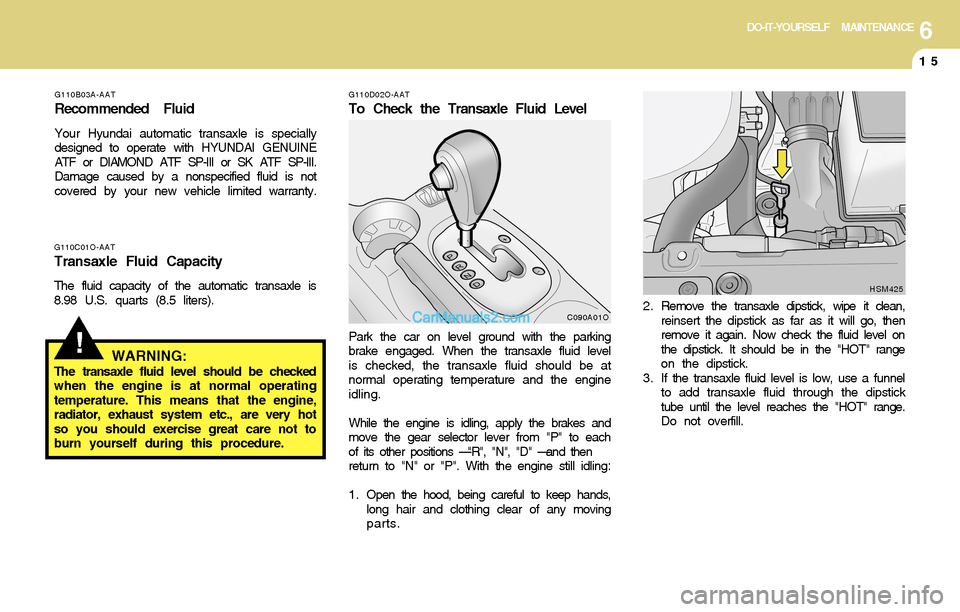
G110D02O-AAT
To Check the Transaxle Fluid Level
Park the car on level ground with the parking
brake engaged. When the transaxle fluid level
is checked, the transaxle fluid should be at
normal operating temperature and the engine
idling.
While the engine is idling, apply the brakes and
move the gear selector lever from "P" to each
of its other positions — "R", "N", "D" — and then
return to "N" or "P". With the engine still idling:
1 . Open the hood, being careful to keep hands,
long hair and clothing clear of any moving
parts.
C090A01O G110C01O-AAT
Transaxle Fluid Capacity
The fluid capacity of the automatic transaxle is
8.98 U.S. quarts (8.5 liters).
WARNING:The transaxle fluid level should be checked
when the engine is at normal operating
temperature. This means that the engine,
radiator, exhaust system etc., are very hot
so you should exercise great care not to
burn yourself during this procedure.
G110B03A-AAT
Recommended Fluid
Your Hyundai automatic transaxle is specially
designed to operate with HYUNDAI GENUINE
ATF or DIAMOND ATF SP-III or SK ATF SP-III.
Damage caused by a nonspecified fluid is not
covered by your new vehicle limited warranty.
HSM425
2 . Remove the transaxle dipstick, wipe it clean,
reinsert the dipstick as far as it will go, then
remove it again. Now check the fluid level on
the dipstick. It should be in the "HOT" range
on the dipstick.
3 . If the transaxle fluid level is low, use a funnel
to add transaxle fluid through the dipstick
tube until the level reaches the "HOT" range.
Do not overfill.
Page 210 of 253
6DO-IT-YOURSELF MAINTENANCE
16CHECKING THE BRAKES
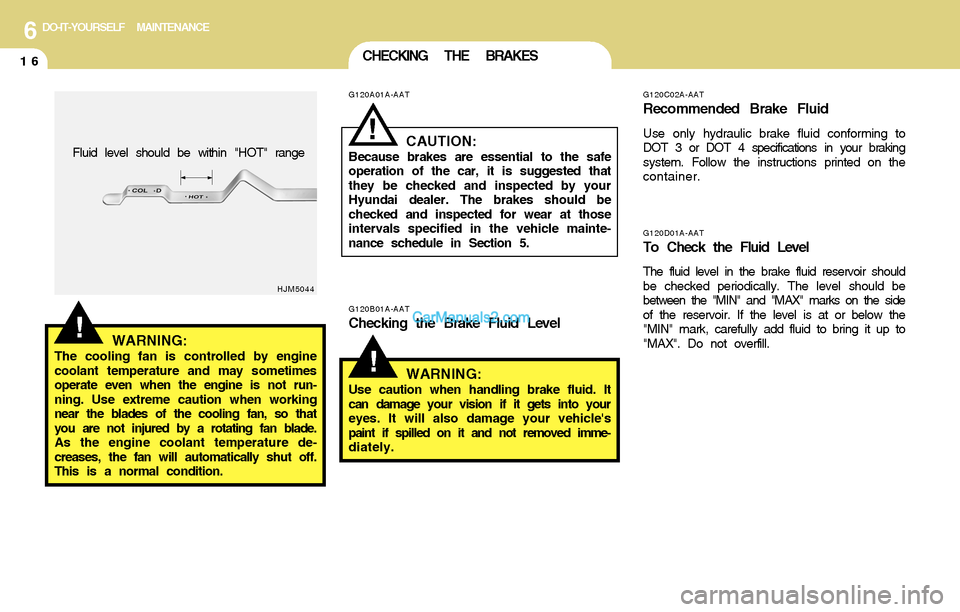
G120D01A-AATTo Check the Fluid Level
The fluid level in the brake fluid reservoir should
be checked periodically. The level should be
between the "MIN" and "MAX" marks on the side
of the reservoir. If the level is at or below the
"MIN" mark, carefully add fluid to bring it up to
"MAX". Do not overfill.
!
G120C02A-AAT
Recommended Brake Fluid
Use only hydraulic brake fluid conforming to
DOT 3 or DOT 4 specifications in your braking
system. Follow the instructions printed on the
container.
G120B01A-AATChecking the Brake Fluid Level
WARNING:
Use caution when handling brake fluid. It
can damage your vision if it gets into your
eyes. It will also damage your vehicle's
paint if spilled on it and not removed imme-
diately.
!WARNING:The cooling fan is controlled by engine
coolant temperature and may sometimes
operate even when the engine is not run-
ning. Use extreme caution when working
near the blades of the cooling fan, so that
you are not injured by a rotating fan blade.
As the engine coolant temperature de-
creases, the fan will automatically shut off.
This is a normal condition.
HJM5044
Fluid level should be within "HOT" range
G120A01A-AAT
CAUTION:Because brakes are essential to the safe
operation of the car, it is suggested that
they be checked and inspected by your
Hyundai dealer. The brakes should be
checked and inspected for wear at those
intervals specified in the vehicle mainte-
nance schedule in Section 5.
!
Page 217 of 253
6DO-IT-YOURSELF MAINTENANCE
23CHECKING ELECTRIC COOLING
FANS
!
!
G220A01A-AAT
WARNING:The cooling fan is controlled by engine
coolant temperature and may sometimes
operate even when the engine is not run-
ning. Use extreme caution when working
near the blades of the cooling fan, so that
you are not injured by a rotating fan blade.
As the engine coolant temperature de-
creases the fan will automatically shut off.
This is a normal condition.
G210B03A-AAT
Checking the Battery
Keep the battery clean. Any evidence of corro-
sion around the battery posts or terminals
should be removed using a solution of house-
hold baking soda and warm water. After the
battery terminals are dry, cover them with a light
coating of grease. o If battery fluid is on your skin, flush the
affected areas with water for at least 15
minutes and then seek medical assistance.
o If battery fluid is in your eyes, rinse out your
eyes with water and get medical assistance
as soon as possible. While you are being
driven to get medical assistance, continue to
rinse your eyes by using a sponge or soft
cloth saturated with water.
o If you swallow battery fluid, drink a large
quantity of water or milk followed by milk of
magnesia, eat a raw egg or drink vegetable
oil. Get medical assistance as soon as
possible.
While batteries are being charged (either by a
battery charger or by the vehicle's generator),
they produce explosive gases. Always ob-
serve these warnings to prevent injuries from
occurring:
o Charge batteries only in a well ventilated
area.
o Do not permit flames, sparks or smoking in
the area.
o Keep children away from the area.
PROPOSITION 65 WARNING:Battery posts, terminals, and related acces-
sories contain lead and lead compounds,
chemicals known to the State of California
to cause cancer and reproductive harm.
Batteries also contain other chemicals
known to the State of California to cause
cancer. Wash hands after handling.
Page 218 of 253
6DO-IT-YOURSELF MAINTENANCE
24POWER STEERING FLUID LEVEL
G230A03A-AAT
G220C01A-AAT
Checking Condenser Cooling Fan
The condenser cooling fan should come on
automatically whenever the air conditioning is in
operation.
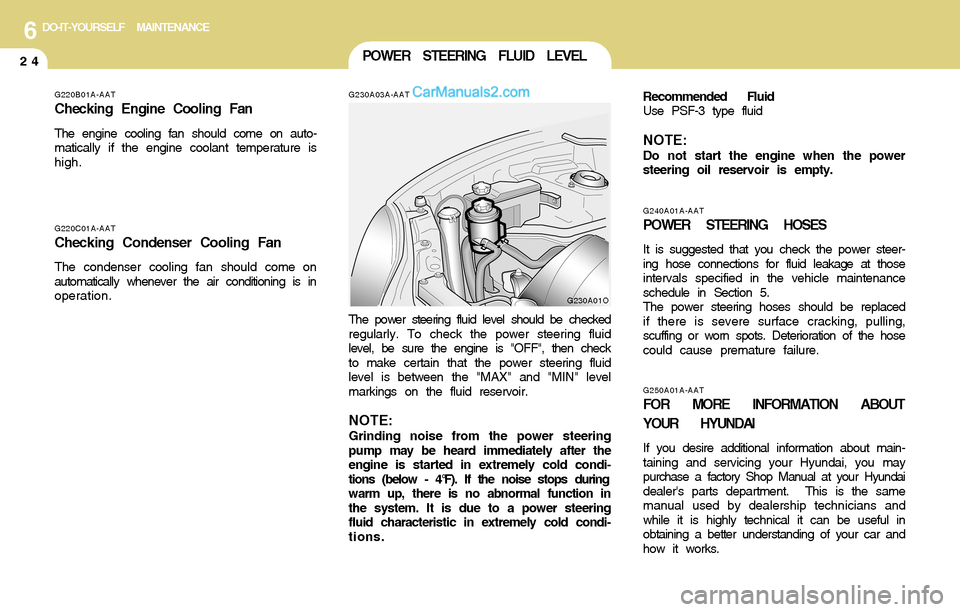
The power steering fluid level should be checked
regularly. To check the power steering fluid
level, be sure the engine is "OFF", then check
to make certain that the power steering fluid
level is between the "MAX" and "MIN" level
markings on the fluid reservoir.
NOTE:Grinding noise from the power steering
pump may be heard immediately after the
engine is started in extremely cold condi-
tions (below - 4°F). If the noise stops during
warm up, there is no abnormal function in
the system. It is due to a power steering
fluid characteristic in extremely cold condi-
tions.
G230A01O
G250A01A-AAT
FOR MORE INFORMATION ABOUT
YOUR HYUNDAI
If you desire additional information about main-
taining and servicing your Hyundai, you may
purchase a factory Shop Manual at your Hyundai
dealer's parts department. This is the same
manual used by dealership technicians and
while it is highly technical it can be useful in
obtaining a better understanding of your car and
how it works.
G240A01A-AAT
POWER STEERING HOSES
It is suggested that you check the power steer-
ing hose connections for fluid leakage at those
intervals specified in the vehicle maintenance
schedule in Section 5.
The power steering hoses should be replaced
if there is severe surface cracking, pulling,
scuffing or worn spots. Deterioration of the hose
could cause premature failure. Recommended Fluid
Use PSF-3 type fluid
NOTE:Do not start the engine when the power
steering oil reservoir is empty.
G220B01A-AAT
Checking Engine Cooling Fan
The engine cooling fan should come on auto-
matically if the engine coolant temperature is
high.
Page 231 of 253
7EMISSION CONTROL SYSTEMS
2EMISSION CONTROL SYSTEM
H010D01A-AAT
3. Exhaust Emission Control System
The Exhaust Emission Control System is a
highly effective system which controls exhaust
emissions while maintaining good vehicle
performace.
H010B01A-AAT
1. Crankcase Emission Control
System
The positive crankcase ventilation system is
employed to prevent air pollution caused by
blow-by gases being emitted from the crank-
case. This system supplies filtered air to the
crankcase through the air intake hose. Inside
the crankcase, the fresh air mixes with blow-by
gases, which then pass through the PCV valve
and into the induction system.
H010A02O-AAT
Your Hyundai is equipped with an emission
control system to meet all requirements of the
U.S. Environmental Protection Agency or Cali-
fornia Air Resources Board.
There are three emission control systems which
are as follows.
(1) Crankcase emission control system
(2) Evaporative emission control system
(3) Exhaust emission control system
In order to assure the proper function of the
emission control systems, it is recommended
that you have your car inspected and main-
tained by an authorized Hyundai dealer in ac-
cordance with the maintenance schedule in this
manual.
Caution for the Inspection and Maintenance
Test (V6 Vehicle with Traction Control Sys-
tem)
o To prevent the vehicle from misfiring
during dynamometer testing, discon-
nect the ABS connector in the engine
compartment. (2.7 V6 only)
o For more information, see shop manual
(Wheel Speed Sensor).
o After dynamometer testing is completed,
erase the ABS/TCS DTC (Diagnotic
Trouble Code) with a GST (Generic Scan
Tool) or Hi-Scan Pro.Canister
Fuel vapors generated inside the fuel tank are
absorbed and stored in the canister. When the
engine is running, the fuel vapors absorbed in
the canister are drawn into the induction system
through the purge control solenoid valve.
Purge Control Solenoid Valve (PCSV)
The purge control solenoid valve is controlled
by the Engine Control Module (ECM); when the
engine coolant temperature is low during idling,
the PCSV closes so that evaporated fuel is not
taken into the engine. After the engine warms-
up during ordinary driving, the PCSV opens to
introduce evaporated fuel to the engine.
H010C01S-AAT2 . Evaporative Emission Control (Includ-
ing ORVR: Onboard Refueling Vapor
Recovery) System
The Evaporative Emission Control System is
designed to prevent fuel vapors from escaping
into the atmosphere.
(The ORVR system is designed to allow the
vapors from of the fuel tank to be loaded into a
canister while refueling at the gas station, pre-
venting the escape of fuel vapors into the
atmosphere.)
Page 232 of 253
7EMISSION CONTROL SYSTEMS
3CATALYTIC CONVERTEREGR SYSTEM
!
H010E01Y-AAT
(If installed)
This system helps reduce nitrogen oxides by
recirculating a part of the exhaust gas into the
engine, thereby reducing cylinder combustion
temperature, which results in lower output of
oxides of nitrogen.WARNING:o Use unleaded fuel only.
o Maintain the engine in good operating
condition. Extremely high catalytic con-
verter temperatures can result from im-
proper operation of the electrical, igni-
tion or multiport electronic fuel injec-
tion.
o If your engine stalls, pings, knocks, or is
hard to start, have your Hyundai dealer
inspect and repair the problem as soon
as possible.
o Avoid driving with a very low fuel level.
Running out of gasoline may cause the
engine to misfire and result in damage to
the catalytic converter.
o Avoid idling the engine for periods
longer than 10 minutes.
o The vehicle should not be pushed or
pulled to get started. This may cause the
catalytic converter to overheat and cre-
ate a fire hazard.
o Do not touch the catalytic converter or
any other part of the exhaust system
while the catalytic converter is hot. Shut
off the engine, wait for at least one hour
before touching the catalytic converter
or any other part of the exhaust system.
o Remember that your Hyundai dealer is
your best source of assistance.
H020A01A-AAT
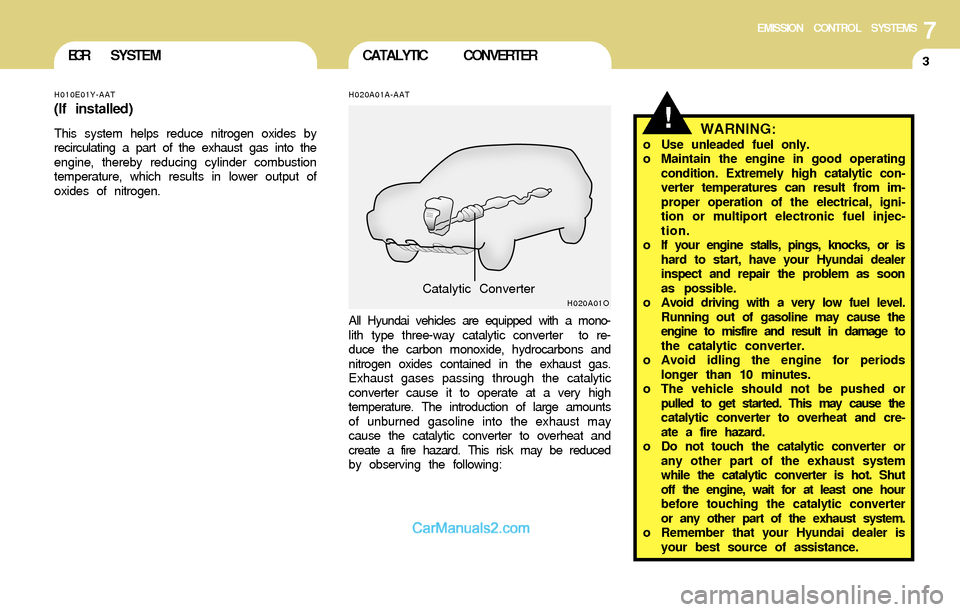
All Hyundai vehicles are equipped with a mono-
lith type three-way catalytic converter to re-
duce the carbon monoxide, hydrocarbons and
nitrogen oxides contained in the exhaust gas.
Exhaust gases passing through the catalytic
converter cause it to operate at a very high
temperature. The introduction of large amounts
of unburned gasoline into the exhaust may
cause the catalytic converter to overheat and
create a fire hazard. This risk may be reduced
by observing the following:
H020A01OCatalytic Converter
Page 239 of 253
8CONSUMER INFORMATION & REPORTING SAFETY DEFECTS
6CONSUMER INFORMATION
WARNING:The traction grade assigned to this tire is
based on straight-ahead braking traction
tests, and does not include acceleration,
cornering, hydroplaning, or peak traction
characteristics.
Temperature A, B, C - The temperature grades
are A (the highest), B, and C, representing the
tire's resistance to the generation of heat and
its ability to dissipate heat when tested under
controlled conditions on a specified indoor labo-
ratory test wheel. Sustained high temperature
can cause the material of the tire to degenerate
and reduce tire life, and excessive temperature
can lead to sudden tire failure. The grade C
corresponds to a level of performance which all
passenger car tires must meet under the Fed-
eral Motor Vehicle Safety Standard No. 109.
Grades B and A represent higher levels of
performance on the laboratory test wheel than
the minimum required by law.
I130A01A-AAT
This consumer information has been prepared
in accordance with regulations issued by the
National Highway Traffic Safety Administration
of the U.S. Department of Transportation. It
provides the purchasers and/or prospective
purchasers of Hyundai automobiles with infor-
mation on uniform tire quality grading. Your
Hyundai dealer will help answer any questions
you may have as you read this information.
I130B03A-AAT
Tire Quality Grading
Department of Transportation quality grades -
All passenger vehicle tires must conform to
Federal Safety Standards in addition to these
grades. These quality grades are molded on the
sidewall.
Treadwear - The treadwear grade is a com-
parative rating based on the wear rate of the tire
when tested under controlled conditions on a
specified government test course. For example,
a tire graded 150 would wear one and a half (1
- 1/2) times as well on the government course
as a tire graded 100. The relative performance
of tires depends upon the actual conditions of
their use, however, and may depart significantly
from the norm due to variations in driving habits,
service practices and differences in road char-
acteristics and climate.
Traction AA, A, B, C - The traction grades,
from highest to lowest, are AA, A, B, and C.
Those grades represent the tire's ability to stop
on wet pavement as measured under controlled
conditions on specified government test sur-
faces of asphalt and concrete. A tire marked C
may have poor traction performance.!
Page 240 of 253
8CONSUMER INFORMATION & REPORTING SAFETY DEFECTS
7
!
I130D03A-AATHyundai motor vehicles are designed and manu-
factured to meet or exceed all applicable safety
standards.
For your safety, however, we strongly urge you
to read and follow all directions in this Owner's
Manual, particularly the information under the
headings "NOTE", "CAUTION" and "WARN-
ING".
WARNING:The temperature grade for this tire is estab-
lished for a tire that is properly inflated and
not overloaded. Excessive speed,
underinflation, or excessive loading, either
separately or in combination, can cause
heat buildup and possible tire failure.
Uniform Tire Quality Grading - Quality grades
can be found on the tire sidewall between the
tread shoulder and the maximum section width.
For example :
Treadwear 200 Traction AA Temperature AIf, after reading this manual, you have any
questions regarding the operation of your ve-
hicle, please contact your nearest Hyundai
Motor America Regional Office as listed below:
Eastern Region : Connecticut, Delaware,
Maine, Maryland, Massachusetts, New Hamp-
shire, New Jersey, New York, Pennsylvanina,
Rhode Island, Vermont, Virginia, West Virginia.
Eastern Region
1100 Cranbury South River Road
Jamesburg, NJ 08831
(800) 633-5151
Southern Region: Alabama, Arkansas, Florida,
Georgia, Louisiana, Mississippi, North Caro-
lina, South Carolina, Oklahoma, Tennessee,
Texas.
Southern Region
270 Riverside Parkway, Suite A
Austell, GA 30168
(800) 633-5151Central Region: Illinois, Indiana, Missouri, lowa,
Kansas, Kentucky, Michigan, Minnesota, Ne-
braska, North Dakota, South Dakota, Ohio,
Wisconsin.
Central Region
1705 Sequoia Drive
Aurora, Illinois 60506
(800) 633-5151
Western Region: Alaska, Hawaii, Arizona, Cali-
fornia, Colorado, ldaho, Montana, Nevada, New
Mexico, Oregon, Texas, Utah, Washington,
Wyoming.
Western Region
10550 Talbert Avenue
P.O.Box 20850
Fountain Valley, California 92728-0850
(800) 633-5151
Page 249 of 253
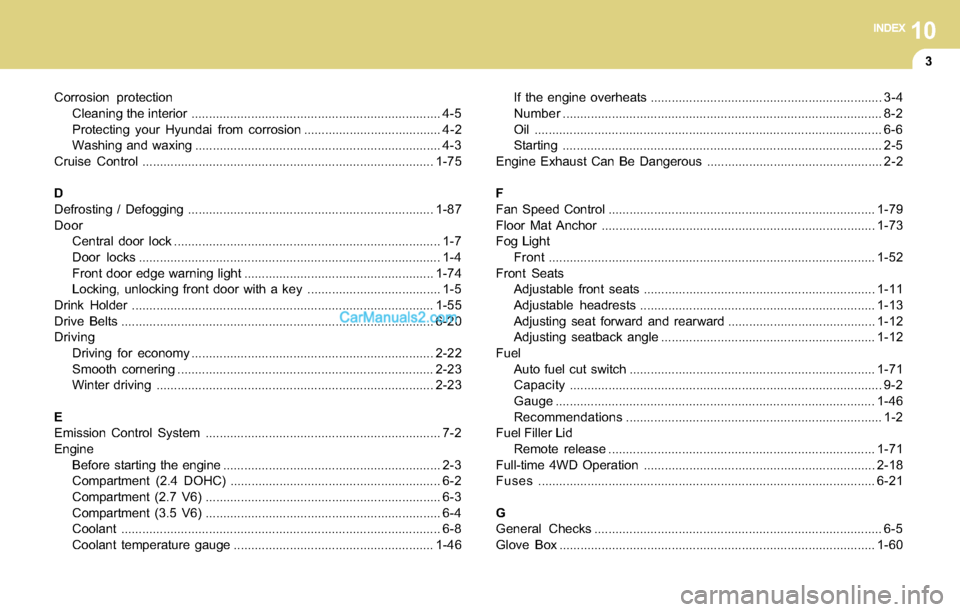
10INDEX
3
Corrosion protection
Cleaning the interior ....................................................................... 4-5
Protecting your Hyundai from corrosion ....................................... 4-2
Washing and waxing ...................................................................... 4-3
Cruise Control ...................................................................................1-75
D
Defrosting / Defogging ......................................................................1-87
Door
Central door lock ............................................................................ 1-7
Door locks ...................................................................................... 1-4
Front door edge warning light ......................................................1-74
Locking, unlocking front door with a key ...................................... 1-5
Drink Holder ......................................................................................1-55
Drive Belts .........................................................................................6-20
Driving
Driving for economy .....................................................................2-22
Smooth cornering.........................................................................2-23
Winter driving ...............................................................................2-23
E
Emission Control System................................................................... 7-2
Engine
Before starting the engine .............................................................. 2-3
Compartment (2.4 DOHC) ............................................................ 6-2
Compartment (2.7 V6) ................................................................... 6-3
Compartment (3.5 V6) ................................................................... 6-4
Coolant ........................................................................................... 6-8
Coolant temperature gauge .........................................................1-46If the engine overheats .................................................................. 3-4
Number........................................................................................... 8-2
Oil ................................................................................................... 6-6
Starting ........................................................................................... 2-5
Engine Exhaust Can Be Dangerous .................................................. 2-2
F
Fan Speed Control ............................................................................1-79
Floor Mat Anchor ..............................................................................1-73
Fog Light
Front.............................................................................................1-52
Front Seats
Adjustable front seats ..................................................................1-11
Adjustable headrests ...................................................................1-13
Adjusting seat forward and rearward ..........................................1-12
Adjusting seatback angle .............................................................1-12
Fuel
Auto fuel cut switch ......................................................................1-71
Capacity......................................................................................... 9-2
Gauge...........................................................................................1-46
Recommendations......................................................................... 1-2
Fuel Filler Lid
Remote release............................................................................1-71
Full-time 4WD Operation ..................................................................2-18
Fuses................................................................................................6-21
G
General Checks.................................................................................. 6-5
Glove Box ..........................................................................................1-60
Page 250 of 253
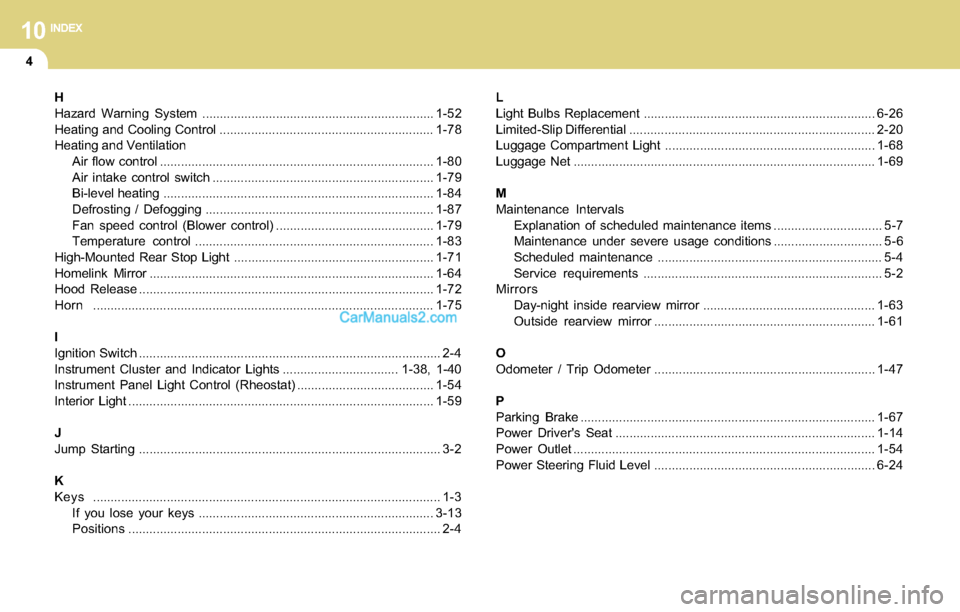
10INDEX
4
H
Hazard Warning System ..................................................................1-52
Heating and Cooling Control .............................................................1-78
Heating and Ventilation
Air flow control ..............................................................................1-80
Air intake control switch ...............................................................1-79
Bi-level heating .............................................................................1-84
Defrosting / Defogging .................................................................1-87
Fan speed control (Blower control) .............................................1-79
Temperature control ....................................................................1-83
High-Mounted Rear Stop Light .........................................................1-71
Homelink Mirror .................................................................................1-64
Hood Release ....................................................................................1-72
Horn.................................................................................................1-75
I
Ignition Switch ...................................................................................... 2-4
Instrument Cluster and Indicator Lights ................................. 1-38, 1-40
Instrument Panel Light Control (Rheostat) .......................................1-54
Interior Light .......................................................................................1-59
J
Jump Starting ...................................................................................... 3-2
K
Keys................................................................................................... 1-3
If you lose your keys ...................................................................3-13
Positions......................................................................................... 2-4L
Light Bulbs Replacement ..................................................................6-26
Limited-Slip Differential ......................................................................2-20
Luggage Compartment Light ............................................................1-68
Luggage Net ......................................................................................1-69
M
Maintenance Intervals
Explanation of scheduled maintenance items ............................... 5-7
Maintenance under severe usage conditions ............................... 5-6
Scheduled maintenance ................................................................ 5-4
Service requirements .................................................................... 5-2
Mirrors
Day-night inside rearview mirror .................................................1-63
Outside rearview mirror ...............................................................1-61
O
Odometer / Trip Odometer ...............................................................1-47
P
Parking Brake ....................................................................................1-67
Power Driver's Seat ..........................................................................1-14
Power Outlet ......................................................................................1-54
Power Steering Fluid Level ...............................................................6-24