disc Hyundai Santa Fe 2004 Owner's Manual
[x] Cancel search | Manufacturer: HYUNDAI, Model Year: 2004, Model line: Santa Fe, Model: Hyundai Santa Fe 2004Pages: 253, PDF Size: 22.41 MB
Page 6 of 253
A040A01A-AAT
FOREWORD
Thank you for choosing Hyundai. We are pleased to welcome you to the growing number of discriminating people who
drive Hyundais. The advanced engineering and high-quality construction of each Hyundai we build is something of which
we're very proud.
Your Owner's Manual will introduce you to the features and operation of your new Hyundai. It is suggested that you read
it carefully because the information it contains can contribute greatly to the satisfaction you receive from your new car.
The manufacturer also recommends that all service and maintenance on your car be performed by an authorized Hyundai
dealer. Hyundai dealers are prepared to provide high-quality service, maintenance and any other assistance that may
be required.
A050A04A-AATHYUNDAI MOTOR COMPANY
Note: Because future owners will also need the information included in this manual, if you sell this Hyundai, please leave
the manual in the vehicle for their use. Thank you.
CAUTION:Severe engine and transaxle damage may result from the use of poor quality fuels and lubricants that do not
meet Hyundai specifications. You must always use high quality fuels and lubricants that meet the specifica-
tions listed on Page 9-4 in the Vehicle Specifications section of the Owner's Manual and which also appear
in the Service Station Information on the back cover of the Owner's Manual.
Copyright 2004 Hyundai Motor Company. All rights reserved. No part of this publication may be reproduced, stored in
any retrieval system or transmitted in any form or by any means without the prior written permission of Hyundai Motor
Company.
!
Page 31 of 253
1FEATURES OF YOUR HYUNDAI
18SEAT BELTS
B150B03Y-AATInfant or Small Child
All 50 states have child restraint laws. You
should be aware of the specific requirements in
your state. Child and/or infant safety seats must
be properly placed and installed in the rear seat.
Information about the use of these restraints
begins on page 1-24.
!
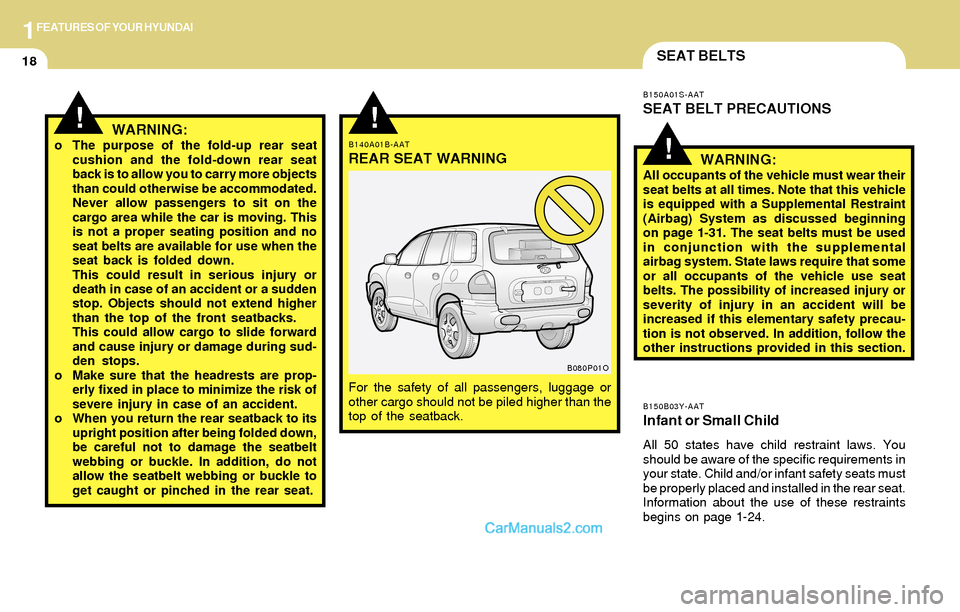
!B140A01B-AATREAR SEAT WARNING
For the safety of all passengers, luggage or
other cargo should not be piled higher than the
top of the seatback.
WARNING:o The purpose of the fold-up rear seat
cushion and the fold-down rear seat
back is to allow you to carry more objects
than could otherwise be accommodated.
Never allow passengers to sit on the
cargo area while the car is moving. This
is not a proper seating position and no
seat belts are available for use when the
seat back is folded down.
This could result in serious injury or
death in case of an accident or a sudden
stop. Objects should not extend higher
than the top of the front seatbacks.
This could allow cargo to slide forward
and cause injury or damage during sud-
den stops.
o Make sure that the headrests are prop-
erly fixed in place to minimize the risk of
severe injury in case of an accident.
o When you return the rear seatback to its
upright position after being folded down,
be careful not to damage the seatbelt
webbing or buckle. In addition, do not
allow the seatbelt webbing or buckle to
get caught or pinched in the rear seat.
B080P01OB150A01S-AAT
SEAT BELT PRECAUTIONS
WARNING:
All occupants of the vehicle must wear their
seat belts at all times. Note that this vehicle
is equipped with a Supplemental Restraint
(Airbag) System as discussed beginning
on page 1-31. The seat belts must be used
in conjunction with the supplemental
airbag system. State laws require that some
or all occupants of the vehicle use seat
belts. The possibility of increased injury or
severity of injury in an accident will be
increased if this elementary safety precau-
tion is not observed. In addition, follow the
other instructions provided in this section.
!
Page 45 of 253
1FEATURES OF YOUR HYUNDAI
32
WARNING:
o No objects should be placed over or near
the airbag modules on the steering wheel,
instrument panel, and the front
passenger's panel above the glove box,
because any such object could cause
harm if the vehicle is in a crash severe
enough to cause the airbags to deploy.
o If the airbags deploy, they must be re-
placed by an authorized Hyundai dealer.
o Do not tamper with or disconnect SRS
wiring, or other components of the SRS
system. Doing so could result in injury,
due to accidental firing of the airbags or
by rendering the SRS inoperative.
o Do not install a child restraint system in
the front passenger seat position. A
child restraint system must never be
placed in the front seat. The infant or
child could be severely injured or killed
by an airbag deployment in case of an
accident.
o Do not allow children to ride in the front
passanger seat. If older children (teen-
agers and older) must ride in the front
seat, make sure they are always propely
belted and that the seat is moved back as
far as possible.
B240D01O
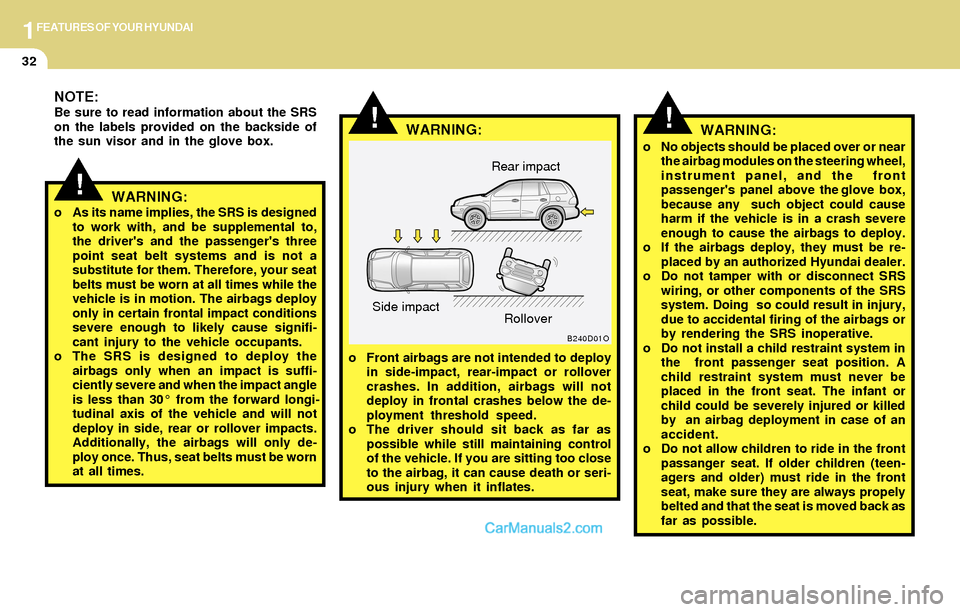
Side impactRear impact
Rollover
o Front airbags are not intended to deploy
in side-impact, rear-impact or rollover
crashes. In addition, airbags will not
deploy in frontal crashes below the de-
ployment threshold speed.
o The driver should sit back as far as
possible while still maintaining control
of the vehicle. If you are sitting too close
to the airbag, it can cause death or seri-
ous injury when it inflates.
!WARNING:
!
NOTE:Be sure to read information about the SRS
on the labels provided on the backside of
the sun visor and in the glove box.
WARNING:o As its name implies, the SRS is designed
to work with, and be supplemental to,
the driver's and the passenger's three
point seat belt systems and is not a
substitute for them. Therefore, your seat
belts must be worn at all times while the
vehicle is in motion. The airbags deploy
only in certain frontal impact conditions
severe enough to likely cause signifi-
cant injury to the vehicle occupants.
o The SRS is designed to deploy the
airbags only when an impact is suffi-
ciently severe and when the impact angle
is less than 30° from the forward longi-
tudinal axis of the vehicle and will not
deploy in side, rear or rollover impacts.
Additionally, the airbags will only de-
ploy once. Thus, seat belts must be worn
at all times.
!
Page 48 of 253
1FEATURES OF YOUR HYUNDAI
35
!
B990B04Y-AAT
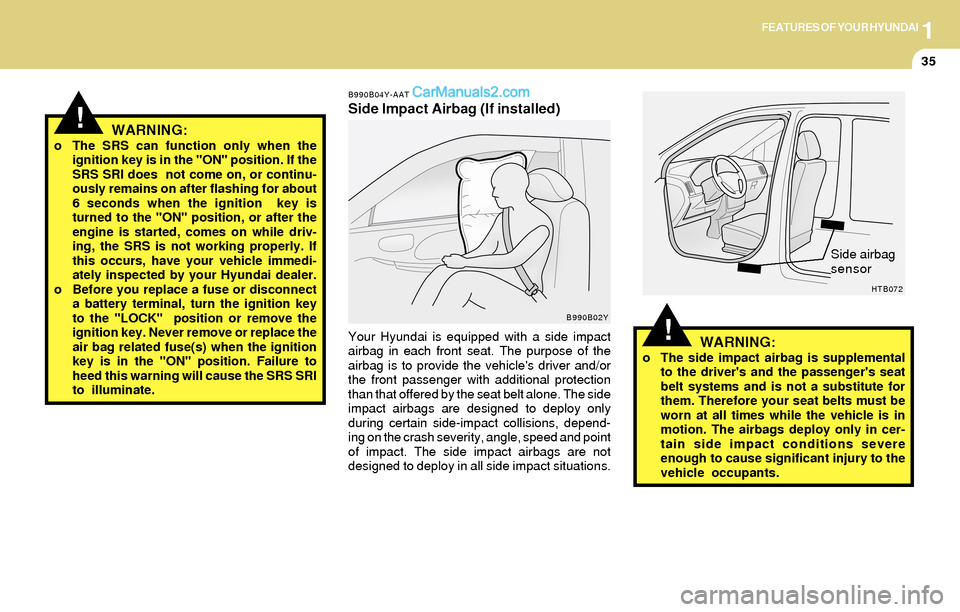
Side Impact Airbag (If installed)
WARNING:
o The side impact airbag is supplemental
to the driver's and the passenger's seat
belt systems and is not a substitute for
them. Therefore your seat belts must be
worn at all times while the vehicle is in
motion. The airbags deploy only in cer-
tain side impact conditions severe
enough to cause significant injury to the
vehicle occupants. Your Hyundai is equipped with a side impact
airbag in each front seat. The purpose of the
airbag is to provide the vehicle's driver and/or
the front passenger with additional protection
than that offered by the seat belt alone. The side
impact airbags are designed to deploy only
during certain side-impact collisions, depend-
ing on the crash severity, angle, speed and point
of impact. The side impact airbags are not
designed to deploy in all side impact situations.
B990B02Y
HTB072
Side airbag
sensor
!WARNING:o The SRS can function only when the
ignition key is in the "ON" position. If the
SRS SRI does not come on, or continu-
ously remains on after flashing for about
6 seconds when the ignition key is
turned to the "ON" position, or after the
engine is started, comes on while driv-
ing, the SRS is not working properly. If
this occurs, have your vehicle immedi-
ately inspected by your Hyundai dealer.
o Before you replace a fuse or disconnect
a battery terminal, turn the ignition key
to the "LOCK" position or remove the
ignition key. Never remove or replace the
air bag related fuse(s) when the ignition
key is in the "ON" position. Failure to
heed this warning will cause the SRS SRI
to illuminate.
Page 50 of 253
1FEATURES OF YOUR HYUNDAI
37
WARNING:o Do not tamper with or disconnect SRS
wiring, or other components of the SRS
system. Doing so could result in injury,
due to accidental firing of the airbags or
by rendering the SRS inoperative.
o If components of the airbag system must
be discarded, or if the vehicle must be
scrapped, certain safety precautions
must be observed. Your Hyundai dealer
knows these precautions and can give
you the necessary information. Failure
to follow these precautions and proce-
dures could increase the risk of personal
injury.
o If you sell your vehicle, make certain that
this manual is transferred to the new
owner.
o If your car was flooded and has soaked
carpeting or water on the floor, you
shouldn't try to start the engine; have
the car towed to an authorized Hyundai
dealer.
o Do not replace the bumper or the bumper
guard with the one other than the Hyundai
genuine parts. Otherwise, it can ad-
versely affect SRS performance and lead
to unexpected injury.
!
Page 58 of 253
1FEATURES OF YOUR HYUNDAI
45
B270A01O-AAT
BRAKE PAD WEAR WARNING SOUND
The front and rear disc brake pads have wear
indicators that should make a high-pitched
squealing or scraping noise when new pads are
needed. The sound may come and go or be
heard all the time when the vehicle is moving. It
may also be heard when the brake pedal is
pushed down firmly. Excessive rotor damage
will result if the worn pads are not replaced. See
your Hyundai dealer immediately.
B270B01O-AATPARKING START WARNING SOUND
If the vehicle driven at over 2mph(3km/h) more
2~3 seconds, the warning chime will sound
continuously when the parking brake engaged.
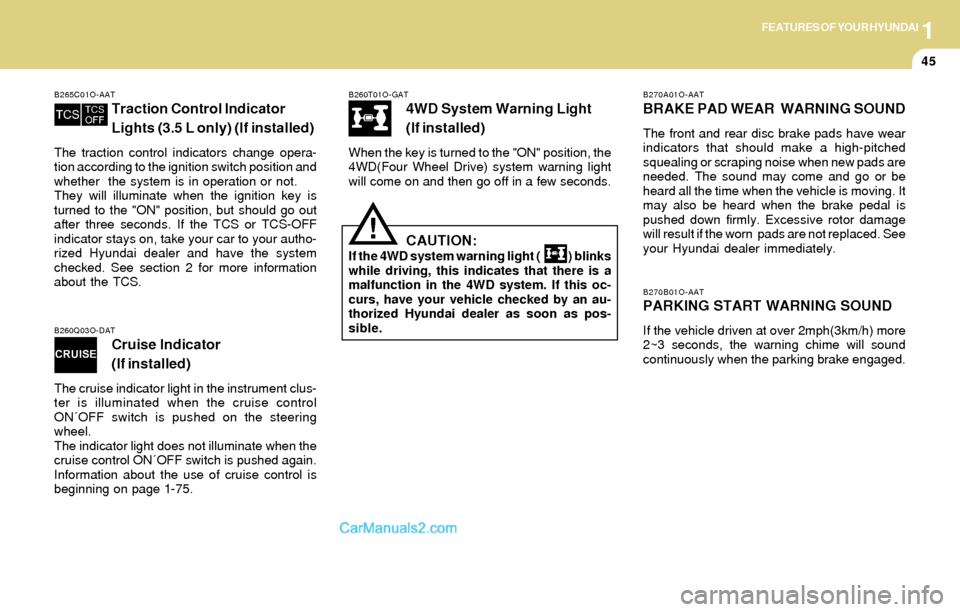
B260T01O-GAT
4WD System Warning Light
(If installed)
When the key is turned to the "ON" position, the
4WD(Four Wheel Drive) system warning light
will come on and then go off in a few seconds.
B260Q03O-DAT
Cruise Indicator
(If installed)
The cruise indicator light in the instrument clus-
ter is illuminated when the cruise control
ON´OFF switch is pushed on the steering
wheel.
The indicator light does not illuminate when the
cruise control ON´OFF switch is pushed again.
Information about the use of cruise control is
beginning on page 1-75.
B265C01O-AAT
Traction Control Indicator
Lights (3.5 L only) (If installed)
The traction control indicators change opera-
tion according to the ignition switch position and
whether the system is in operation or not.
They will illuminate when the ignition key is
turned to the "ON" position, but should go out
after three seconds. If the TCS or TCS-OFF
indicator stays on, take your car to your autho-
rized Hyundai dealer and have the system
checked. See section 2 for more information
about the TCS.
CAUTION:If the 4WD system warning light ( ) blinks
while driving, this indicates that there is a
malfunction in the 4WD system. If this oc-
curs, have your vehicle checked by an au-
thorized Hyundai dealer as soon as pos-
sible.
!
Page 93 of 253
1FEATURES OF YOUR HYUNDAI
80
B670D03O-AAT
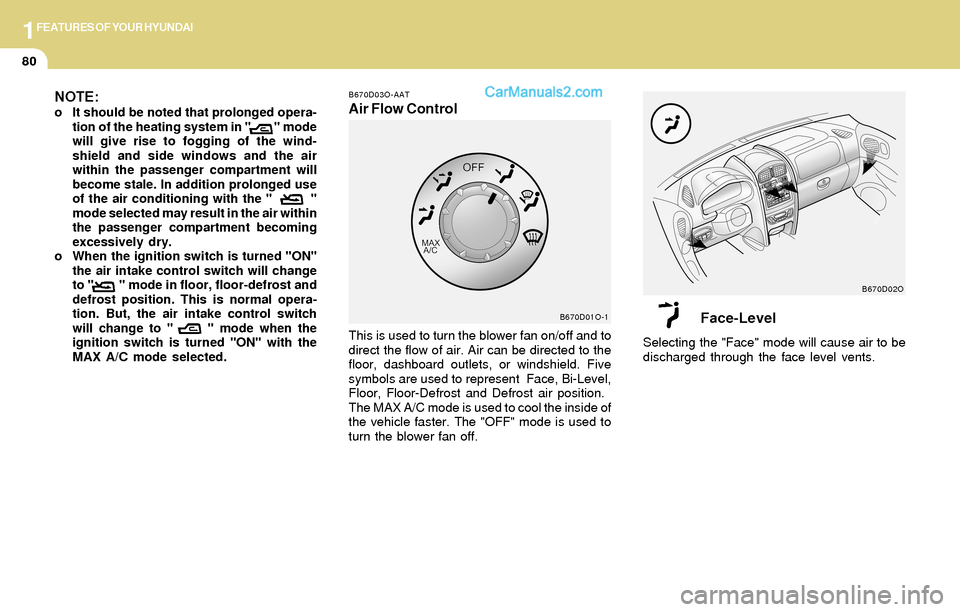
Air Flow Control
This is used to turn the blower fan on/off and to
direct the flow of air. Air can be directed to the
floor, dashboard outlets, or windshield. Five
symbols are used to represent Face, Bi-Level,
Floor, Floor-Defrost and Defrost air position.
The MAX A/C mode is used to cool the inside of
the vehicle faster. The "OFF" mode is used to
turn the blower fan off.
B670D01O-1B670D02O
NOTE:o It should be noted that prolonged opera-
tion of the heating system in " " mode
will give rise to fogging of the wind-
shield and side windows and the air
within the passenger compartment will
become stale. In addition prolonged use
of the air conditioning with the " "
mode selected may result in the air within
the passenger compartment becoming
excessively dry.
o When the ignition switch is turned "ON"
the air intake control switch will change
to " " mode in floor, floor-defrost and
defrost position. This is normal opera-
tion. But, the air intake control switch
will change to " " mode when the
ignition switch is turned "ON" with the
MAX A/C mode selected.
Face-Level
Selecting the "Face" mode will cause air to be
discharged through the face level vents.
Page 94 of 253
1FEATURES OF YOUR HYUNDAI
81
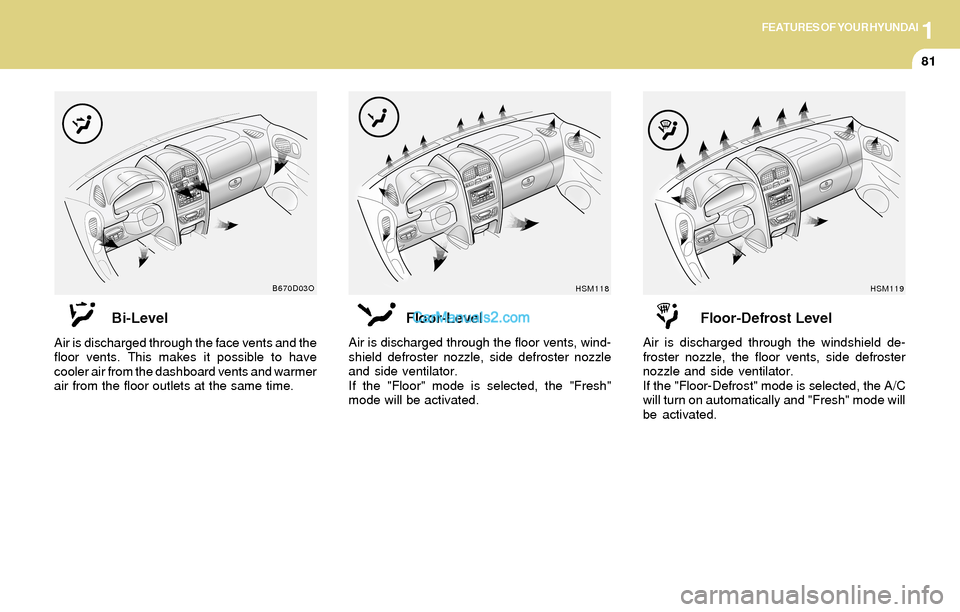
Bi-Level
Air is discharged through the face vents and the
floor vents. This makes it possible to have
cooler air from the dashboard vents and warmer
air from the floor outlets at the same time.
B670D03O
Floor-Defrost Level
Air is discharged through the windshield de-
froster nozzle, the floor vents, side defroster
nozzle and side ventilator.
If the "Floor-Defrost" mode is selected, the A/C
will turn on automatically and "Fresh" mode will
be activated.
Floor-Level
Air is discharged through the floor vents, wind-
shield defroster nozzle, side defroster nozzle
and side ventilator.
If the "Floor" mode is selected, the "Fresh"
mode will be activated.
HSM118HSM119
Page 95 of 253
1FEATURES OF YOUR HYUNDAI
82
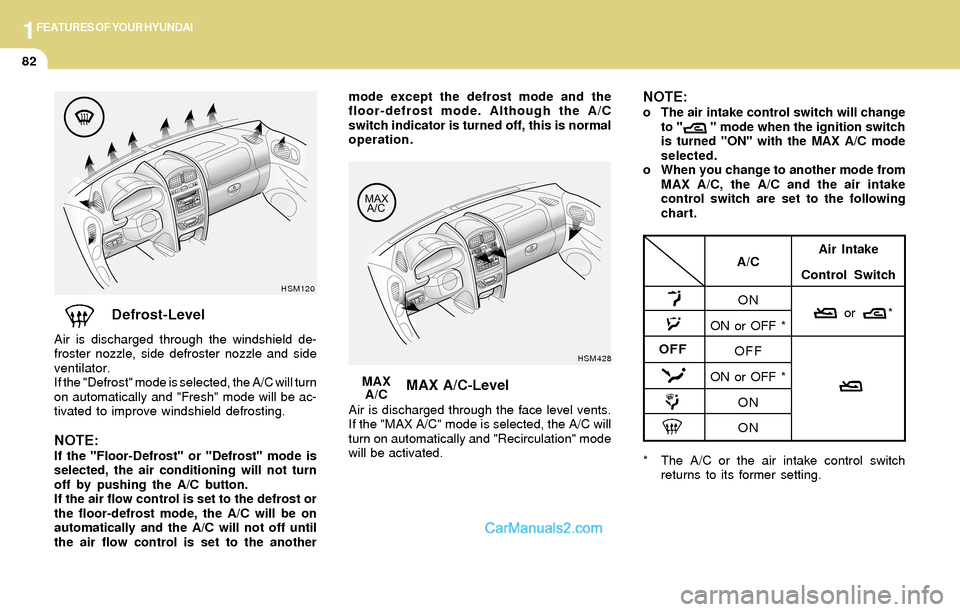
Defrost-Level
Air is discharged through the windshield de-
froster nozzle, side defroster nozzle and side
ventilator.
If the "Defrost" mode is selected, the A/C will turn
on automatically and "Fresh" mode will be ac-
tivated to improve windshield defrosting.
NOTE:If the "Floor-Defrost" or "Defrost" mode is
selected, the air conditioning will not turn
off by pushing the A/C button.
If the air flow control is set to the defrost or
the floor-defrost mode, the A/C will be on
automatically and the A/C will not off until
the air flow control is set to the another
HSM120
MAX A/C-Level
Air is discharged through the face level vents.
If the "MAX A/C" mode is selected, the A/C will
turn on automatically and "Recirculation" mode
will be activated.MAX
A/C
HSM428
* The A/C or the air intake control switch
returns to its former setting.
A/C
ON
ON or OFF *
OFF
ON or OFF *
ON
ONAir Intake
Control Switch
or *
OFF
mode except the defrost mode and the
floor-defrost mode. Although the A/C
switch indicator is turned off, this is normal
operation.NOTE:o The air intake control switch will change
to " " mode when the ignition switch
is turned "ON" with the MAX A/C mode
selected.
o When you change to another mode from
MAX A/C, the A/C and the air intake
control switch are set to the following
chart.
Page 96 of 253
1FEATURES OF YOUR HYUNDAI
83HEATING CONTROLS
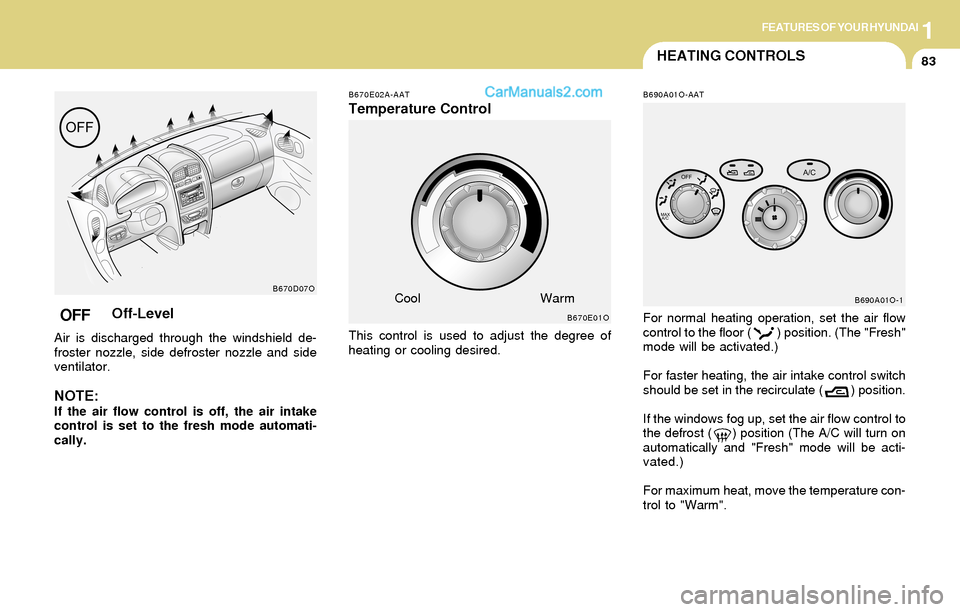
B690A01O-AAT
For normal heating operation, set the air flow
control to the floor ( ) position. (The "Fresh"
mode will be activated.)
For faster heating, the air intake control switch
should be set in the recirculate ( ) position.
If the windows fog up, set the air flow control to
the defrost ( ) position (The A/C will turn on
automatically and "Fresh" mode will be acti-
vated.)
For maximum heat, move the temperature con-
trol to "Warm".
B690A01O-1
B670E02A-AAT
Temperature Control
This control is used to adjust the degree of
heating or cooling desired.
B670E01O
CoolWarmB670D07O
OFFOff-Level
Air is discharged through the windshield de-
froster nozzle, side defroster nozzle and side
ventilator.
NOTE:If the air flow control is off, the air intake
control is set to the fresh mode automati-
cally.