inflation pressure Hyundai Santa Fe 2004 Owner's Manual
[x] Cancel search | Manufacturer: HYUNDAI, Model Year: 2004, Model line: Santa Fe, Model: Hyundai Santa Fe 2004Pages: 253, PDF Size: 22.41 MB
Page 159 of 253
2DRIVING YOUR HYUNDAI
22DRIVING FOR ECONOMY
o Be sure that the wheels are aligned cor-
rectly. Improper alignment can result from
hitting curbs or driving too fast over irregular
surfaces. Poor alignment causes faster tire
wear and may also result in other problems
as well as greater fuel consumption.
o Keep your car in good condition. For better
fuel economy and reduced maintenance
costs, maintain your car in accordance with
the maintenance schedule in Section 5. If
you drive your car in severe conditions,
more frequent maintenance is required (see
Section 5 for details).
o Keep your car clean. For maximum service,
your Hyundai should be kept clean and free
of corrosive materials. It is especially impor-
tant that mud, dirt, ice, etc. not be allowed to
accumulate on the underside of the car. This
extra weight can result in increased fuel
consumption and also contribute to corro-
sion.
o Travel lightly. Don't carry unnecessary
weight in your car. Weight reduces fuel
economy.
o Don't let the engine idle longer than neces-
sary. If you are waiting (and not in traffic),
turn off your engine and restart only when
you're ready to go.o Remember, your Hyundai does not require
extended warm-up. As soon as the engine
is running smoothly, you can drive away. In
very cold weather, however, give your en-
gine a slightly longer warm-up period.
o Don't "lug" or "over-rev" the engine. Lugging
is driving too slowly in too high a gear result-
ing in the engine bucking. If this happens,
shift to a lower gear. Over-revving is racing
the engine beyond its safe limit. This can be
avoided by shifting at the recommended
speeds.
o Use your air conditioning sparingly. The air
conditioning system is operated by engine
power so your fuel economy is reduced
when you use it.C140A01A-AAT
You can save fuel and get more miles from your
car if you follow these suggestions:
o Drive smoothly. Accelerate at a moderate
rate. Don't make "jack-rabbit" starts or full-
throttle shifts and maintain a steady cruising
speed. Don't race between stoplights. Try to
adjust your speed to that of the other traffic
so you don't have to change speeds unnec-
essarily. Avoid heavy traffic whenever pos-
sible. Always maintain a safe distance from
other vehicles so you can avoid unneces-
sary braking. This also reduces brake wear.
o Drive at a moderate speed. The faster you
drive, the more fuel your car uses. Driving at
a moderate speed, especially on the high-
way, is one of the most effective ways to
reduce fuel consumption.
o Don't "ride" the brake or clutch pedal. This
can increase fuel consumption and also
increase wear on these components. In
addition, driving with your foot resting on the
brake pedal may cause the brakes to over-
heat, which reduces their effectiveness and
may lead to more serious consequences.
o Take care of your tires. Keep them inflated
to the recommended pressure. Incorrect
inflation, either too much or too little, results
in unnecessary tire wear. Check the tire
pressures at least once a month.
Page 162 of 253
2DRIVING YOUR HYUNDAI
25HIGHER SPEED MOTORING
C170A01A-AAT
Pre-Trip Inspections
1. Tires:
Adjust the tire inflation pressures to specifica-
tion. Low tire inflation pressures will result in
overheating and possible failure of the tires.
Avoid using worn or damaged tires which may
result in reduced traction or tire failure.
NOTE:Never exceed the maximum tire inflation
pressure shown on the tires.
2. Fuel, engine coolant and engine oil:
High speed travel consumes more fuel than
urban motoring. Do not forget to check both
engine coolant and engine oil.
3. Drive belt:
A loose or damaged drive belt may result in
overheating of the engine.
C160K01A-AATCarry Emergency Equipment
Depending on the severity of the weather where
you drive your car, you should carry appropri-
ate emergency equipment. Some of the items
you may want to carry include tire chains, tow
straps or chains, flashlight, emergency flares,
sand, a shovel, jumper cables, a window scraper,
gloves, ground cloth, coveralls, a blanket, etc.
USE OF LIGHTS
C180A01A-AAT
Check your lights regularly for correct opera-
tion and always keep them clean. When driving
during the day in conditions of poor visibility, it
is helpful to drive with headlights on low beam.
This enables you to be seen as well as to see.
Page 171 of 253
3WHAT TO DO IN AN EMERGENCY
5SPARE TIRE
D040A01O-GAT
The following instructions for the FULL SIZE
spare tire should be observed:
Check inflation pressure as soon as practical
after installing the spare tire, and adjust to the
specified pressure. The tire pressure should be
periodically checked and maintained at the
specified pressure while the tire is stored.
Spare Tire Pressure
D040B02B-GAT
Handling the Spare Tire
Tire Size
Inflation PressureFull Size
30 psi (207 kPa)
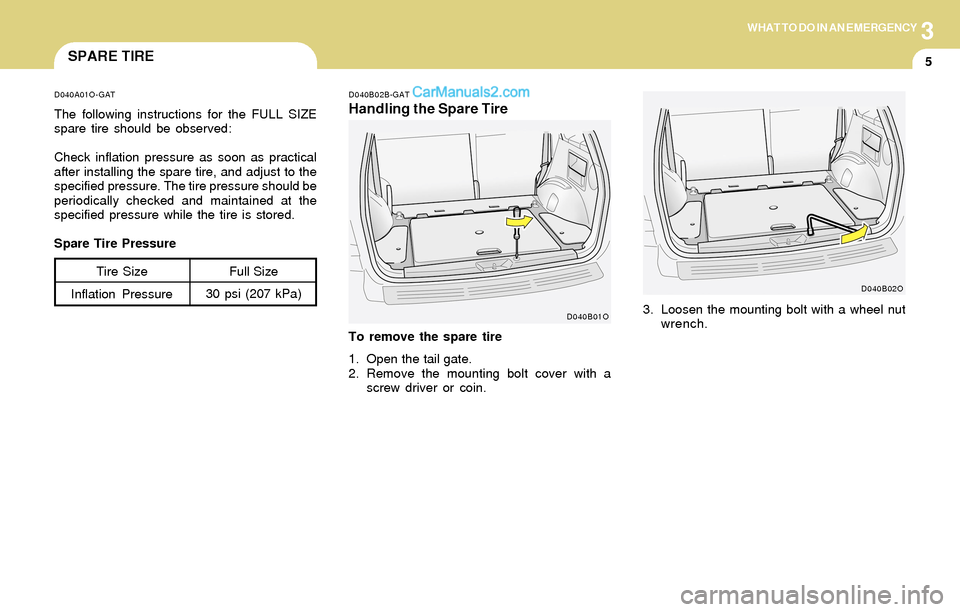
To remove the spare tire
1. Open the tail gate.
2. Remove the mounting bolt cover with a
screw driver or coin.
D040B01O3. Loosen the mounting bolt with a wheel nut
wrench.
D040B02O
Page 234 of 253
Vehicle Identification Number (VIN).................................... 8-2
Engine Number........................................................................ 8-2
Recommended Inflation Pressures..................................... 8-2
Snow Tires................................................................................ 8-3
Tire Chains................................................................................ 8-3
Tire Rotation.............................................................................. 8-4
Tire Balancing........................................................................... 8-4
Tire Traction .............................................................................. 8-4
When to Replace Tires........................................................... 8-4
Spare Tire and Tools.............................................................. 8-5
Warranties for Your Hyundai Vehicle ................................. 8-5
Consumer Information............................................................ 8-6
Reporting Safety Defects...................................................... 8-8
CONSUMER INFORMATION &
REPORTING SAFETY DEFECTS
8
8
Page 235 of 253
8CONSUMER INFORMATION & REPORTING SAFETY DEFECTS
2TIREENGINE NUMBERVEHICLE IDENTIFICATION
NUMBER (VIN)
I030A02S-AAT
RECOMMENDED INFLATION PRES-
SURES
I020A01A-AAT
TIRE INFORMATION
The tires supplied on your new Hyundai are
chosen to provide the best performance for
normal driving.
I010B01A-AAT I010A02A-AAT
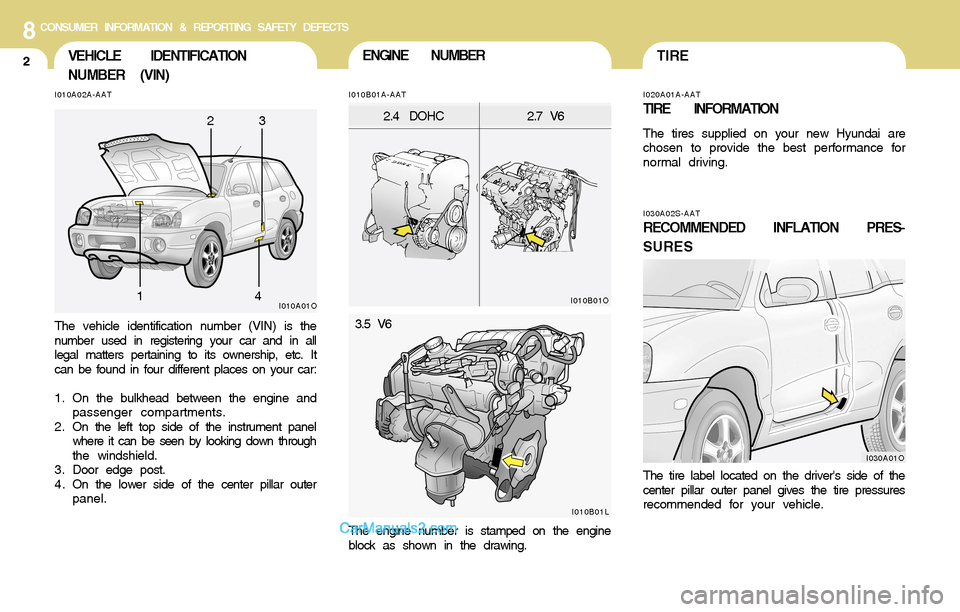
The vehicle identification number (VIN) is the
number used in registering your car and in all
legal matters pertaining to its ownership, etc. It
can be found in four different places on your car:
1. On the bulkhead between the engine and
passenger compartments.
2 . On the left top side of the instrument panel
where it can be seen by looking down through
the windshield.
3. Door edge post.
4 . On the lower side of the center pillar outer
panel.
The engine number is stamped on the engine
block as shown in the drawing.The tire label located on the driver's side of the
center pillar outer panel gives the tire pressures
recommended for your vehicle.
I010A01O
I030A01O I010B01O
2.4 DOHC2.7 V6
I010B01L
3.5 V6
23
14
Page 236 of 253
8CONSUMER INFORMATION & REPORTING SAFETY DEFECTS
3
!
I040A01O-AAT
SNOW TIRES
If you equip your car with snow tires, they should
be the same size and have the same load
capacity as the original tires. Snow tires should
be installed on all four wheels; otherwise, poor
handling may result.
Snow tires should carry 4 psi (28 kPa) more air
pressure than the pressure recommended for
the standard tires on the tire label on the driver's
side of the center pillar , or up to the maximum
pressure shown on the tire sidewall whichever
is less.
Do not drive faster than 75 mph (120 km/h)
when your car is equipped with snow tires.
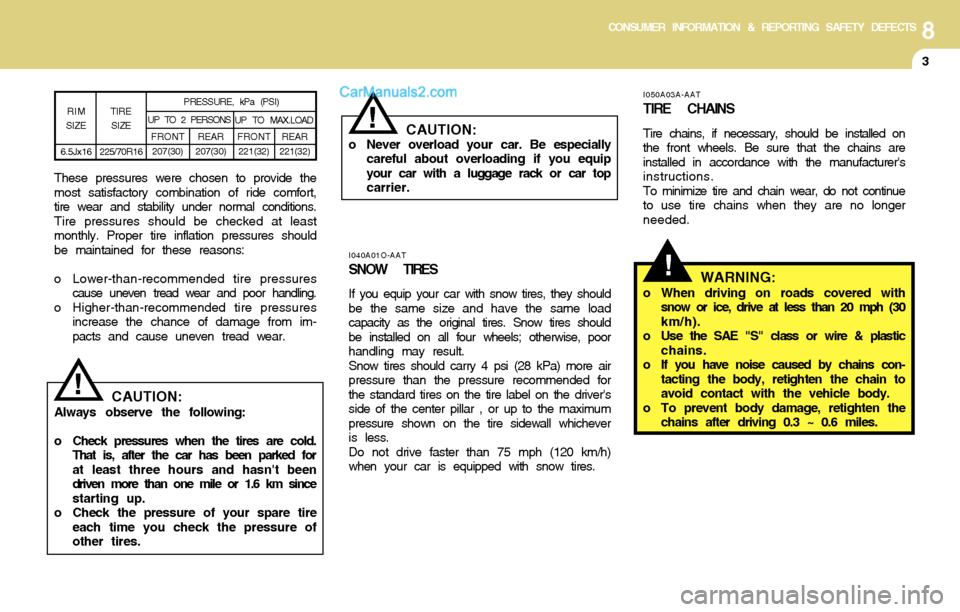
RIM
SIZETIRE
SIZEPRESSURE, kPa (PSI)
UP TO 2 PERSONS
UP TO MAX.LOAD
FRONT
207(30)REAR
207(30)FRONT
221(32)REAR
221(32)
225/70R16 6.5Jx16
These pressures were chosen to provide the
most satisfactory combination of ride comfort,
tire wear and stability under normal conditions.
Tire pressures should be checked at least
monthly. Proper tire inflation pressures should
be maintained for these reasons:
o Lower-than-recommended tire pressures
cause uneven tread wear and poor handling.
o Higher-than-recommended tire pressures
increase the chance of damage from im-
pacts and cause uneven tread wear.
CAUTION:Always observe the following:
o Check pressures when the tires are cold.
That is, after the car has been parked for
at least three hours and hasn't been
driven more than one mile or 1.6 km since
starting up.
o Check the pressure of your spare tire
each time you check the pressure of
other tires.o Never overload your car. Be especially
careful about overloading if you equip
your car with a luggage rack or car top
carrier.
CAUTION:!
!
I050A03A-AAT
TIRE CHAINS
Tire chains, if necessary, should be installed on
the front wheels. Be sure that the chains are
installed in accordance with the manufacturer's
instructions.
To minimize tire and chain wear, do not continue
to use tire chains when they are no longer
needed.
WARNING:o When driving on roads covered with
snow or ice, drive at less than 20 mph (30
km/h).
o Use the SAE "S" class or wire & plastic
chains.
o If you have noise caused by chains con-
tacting the body, retighten the chain to
avoid contact with the vehicle body.
o To prevent body damage, retighten the
chains after driving 0.3 ~ 0.6 miles.