tow Hyundai Santa Fe 2006 Owner's Manual
[x] Cancel search | Manufacturer: HYUNDAI, Model Year: 2006, Model line: Santa Fe, Model: Hyundai Santa Fe 2006Pages: 281, PDF Size: 8.94 MB
Page 15 of 281
1
FEATURES OF YOUR HYUNDAI
3
KEYS
BREAKING IN YOUR NEW HYUNDAI
B010F01A-AATOperation in Foreign CountriesIf you are going to drive your Hyundai in another
country, be sure to:
o Observe all regulations regarding registra-
tion and insurance.
o Determine that acceptable fuel is available.B010E01A-AATGasolines for Cleaner AirTo help contribute to cleaner air, Hyundai rec-
ommends that you use gasolines treated with
detergent additives, which help prevent deposit
formation in the engine. These gasolines will
help the engine run cleaner and enhance per-
formance of the Emission Control System.
B020A01S-AATDuring the First 1,200 Miles (2,000 Km)No formal "break-in" procedure is required with
your new Hyundai. However, you can contrib-
ute to the economical operation and durability of
your Hyundai by observing the following recom-
mendations during the first 1,200 miles (2,000
km).
o Don't drive faster than 55 MPH (88 km/h).
o While driving, keep your engine speed (rpm,
or revolutions per minute) between 2,000
rpm and 4,000 rpm.
o Use moderate acceleration. Don't start
quickly or depress the accelerator pedal
fully.
o For the first 200 miles (300 km), try to avoid
hard stops.
o Don't lug the engine (in other words, don't
drive so slowly in too high a gear that the
engine "bucks"-shift to a lower gear).
o Whether going fast or slow, vary your speed
from time to time.
o Don't let the engine idle longer than 3 minutes
at one time.
o Don't tow a trailer during the first 1,200 miles
(2,000 km) of operation.
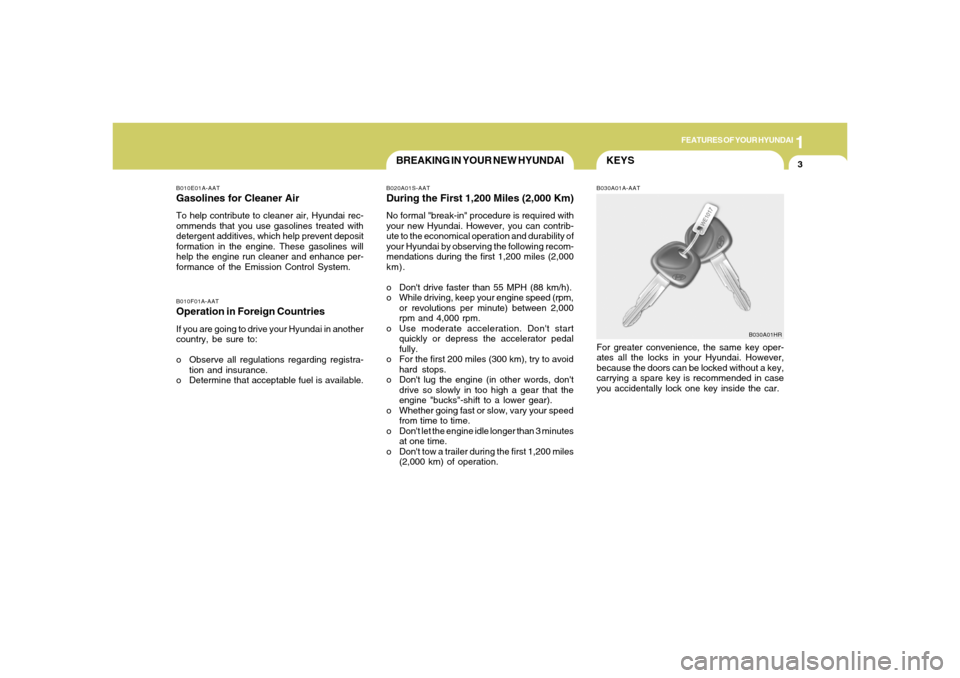
B030A01A-AAT
B030A01HRFor greater convenience, the same key oper-
ates all the locks in your Hyundai. However,
because the doors can be locked without a key,
carrying a spare key is recommended in case
you accidentally lock one key inside the car.
Page 17 of 281
1
FEATURES OF YOUR HYUNDAI
5
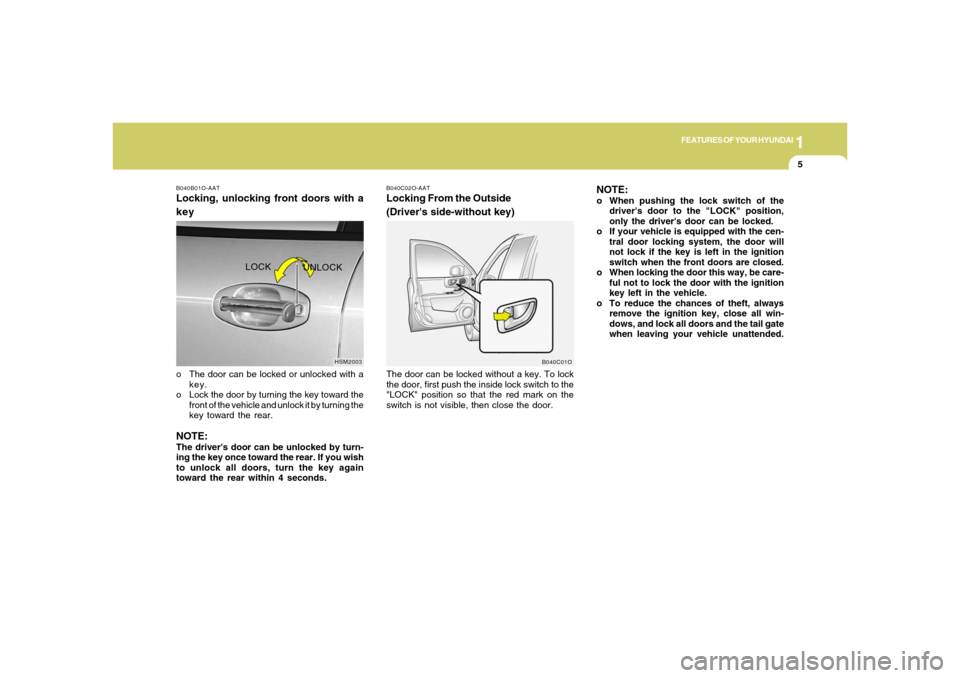
B040B01O-AATLocking, unlocking front doors with a
keyo The door can be locked or unlocked with a
key.
o Lock the door by turning the key toward the
front of the vehicle and unlock it by turning the
key toward the rear.NOTE:The driver's door can be unlocked by turn-
ing the key once toward the rear. If you wish
to unlock all doors, turn the key again
toward the rear within 4 seconds.
HSM2003
LOCK
UNLOCK
B040C02O-AATLocking From the Outside
(Driver's side-without key)The door can be locked without a key. To lock
the door, first push the inside lock switch to the
"LOCK" position so that the red mark on the
switch is not visible, then close the door.
NOTE:o When pushing the lock switch of the
driver's door to the "LOCK" position,
only the driver's door can be locked.
o If your vehicle is equipped with the cen-
tral door locking system, the door will
not lock if the key is left in the ignition
switch when the front doors are closed.
o When locking the door this way, be care-
ful not to lock the door with the ignition
key left in the vehicle.
o To reduce the chances of theft, always
remove the ignition key, close all win-
dows, and lock all doors and the tail gate
when leaving your vehicle unattended.
B040C01O
Page 24 of 281
1FEATURES OF YOUR HYUNDAI12
!
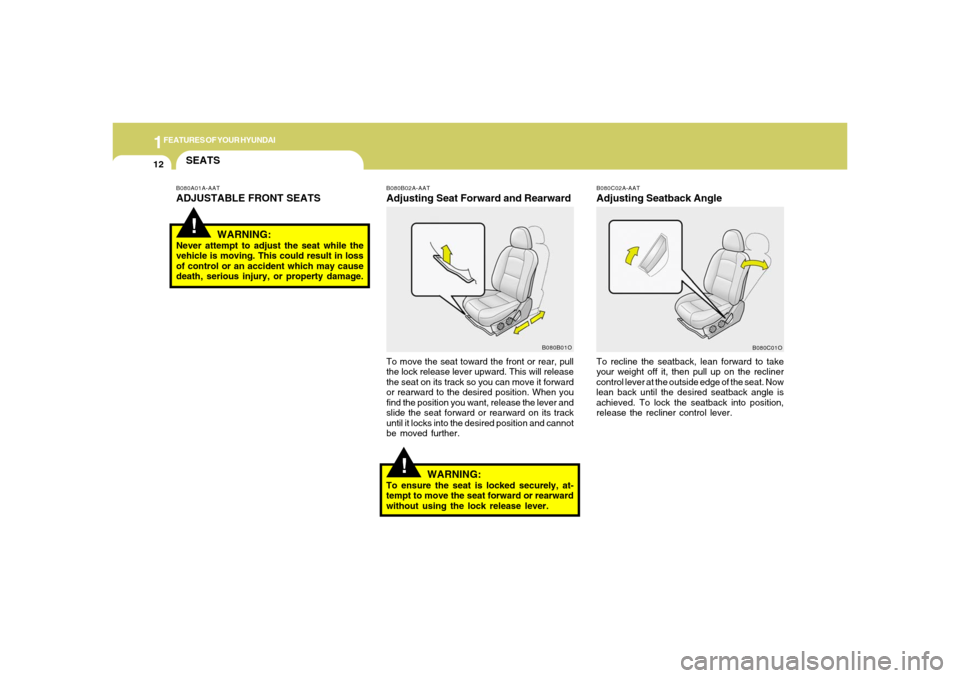
B080B02A-AATAdjusting Seat Forward and RearwardTo move the seat toward the front or rear, pull
the lock release lever upward. This will release
the seat on its track so you can move it forward
or rearward to the desired position. When you
find the position you want, release the lever and
slide the seat forward or rearward on its track
until it locks into the desired position and cannot
be moved further.
B080B01O
B080C02A-AATAdjusting Seatback AngleTo recline the seatback, lean forward to take
your weight off it, then pull up on the recliner
control lever at the outside edge of the seat. Now
lean back until the desired seatback angle is
achieved. To lock the seatback into position,
release the recliner control lever.
B080C01O
WARNING:
To ensure the seat is locked securely, at-
tempt to move the seat forward or rearward
without using the lock release lever.
SEATSB080A01A-AATADJUSTABLE FRONT SEATS
!
WARNING:
Never attempt to adjust the seat while the
vehicle is moving. This could result in loss
of control or an accident which may cause
death, serious injury, or property damage.
Page 26 of 281
1FEATURES OF YOUR HYUNDAI14
!
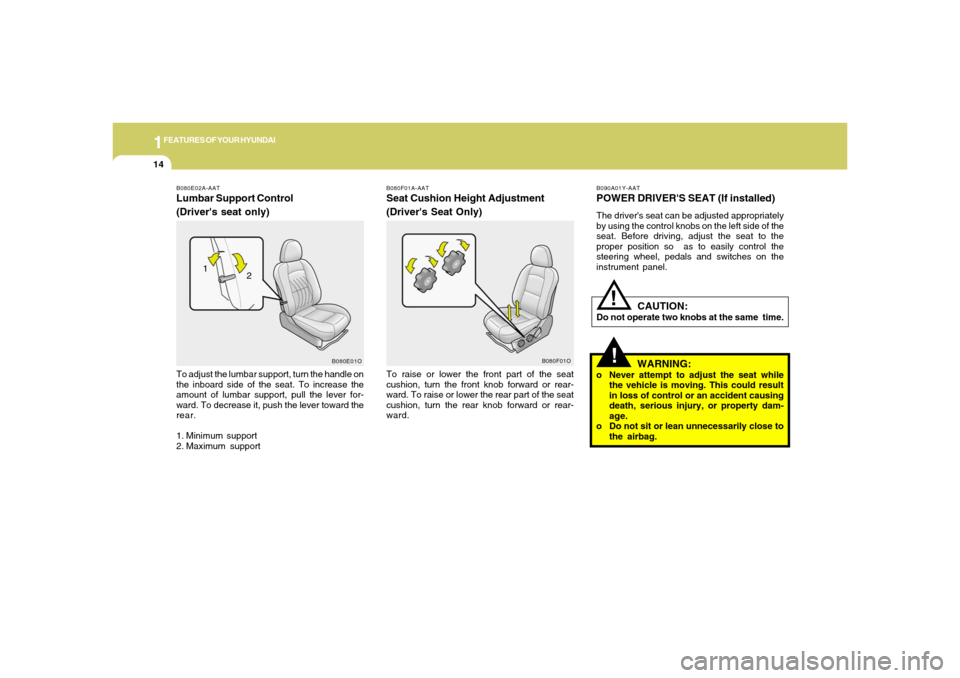
B080F01A-AATSeat Cushion Height Adjustment
(Driver's Seat Only)To raise or lower the front part of the seat
cushion, turn the front knob forward or rear-
ward. To raise or lower the rear part of the seat
cushion, turn the rear knob forward or rear-
ward.
B080F01OB090A01Y-AAT
POWER DRIVER'S SEAT (If installed)The driver's seat can be adjusted appropriately
by using the control knobs on the left side of the
seat. Before driving, adjust the seat to the
proper position so as to easily control the
steering wheel, pedals and switches on the
instrument panel.
CAUTION:
Do not operate two knobs at the same time.
WARNING:
o Never attempt to adjust the seat while
the vehicle is moving. This could result
in loss of control or an accident causing
death, serious injury, or property dam-
age.
o Do not sit or lean unnecessarily close to
the airbag.
!
B080E02A-AATLumbar Support Control
(Driver's seat only)To adjust the lumbar support, turn the handle on
the inboard side of the seat. To increase the
amount of lumbar support, pull the lever for-
ward. To decrease it, push the lever toward the
rear.
1. Minimum support
2. Maximum support
B080E01O
1
2
Page 29 of 281
1
FEATURES OF YOUR HYUNDAI
17
!
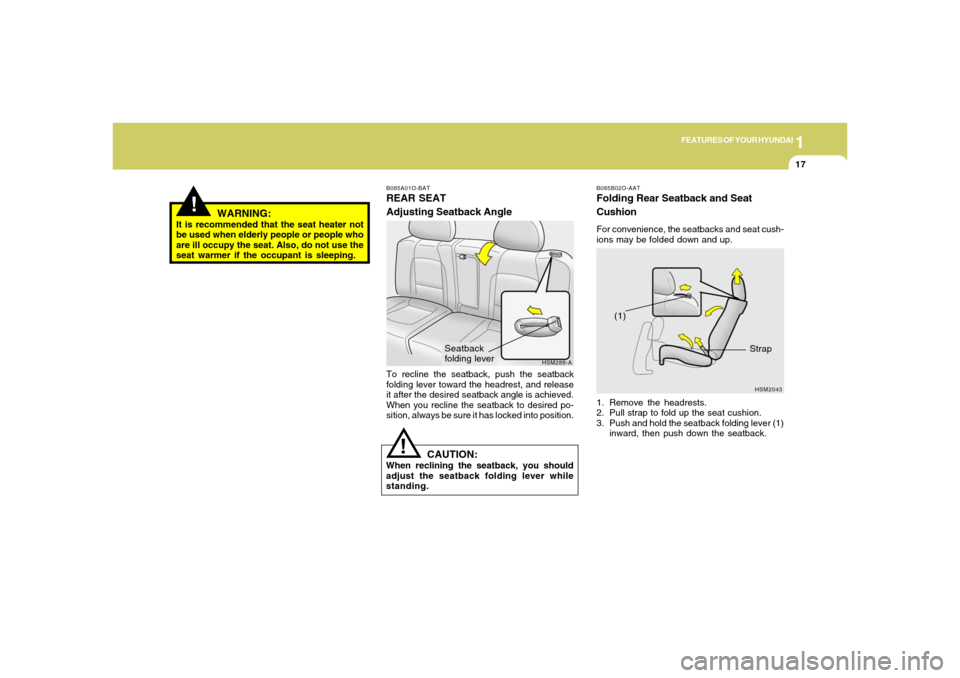
B085A01O-BATREAR SEAT
Adjusting Seatback AngleTo recline the seatback, push the seatback
folding lever toward the headrest, and release
it after the desired seatback angle is achieved.
When you recline the seatback to desired po-
sition, always be sure it has locked into position.
CAUTION:
When reclining the seatback, you should
adjust the seatback folding lever while
standing.
HSM288-A
!
Seatback
folding lever
B085B02O-AATFolding Rear Seatback and Seat
CushionFor convenience, the seatbacks and seat cush-
ions may be folded down and up.
1. Remove the headrests.
2. Pull strap to fold up the seat cushion.
3. Push and hold the seatback folding lever (1)
inward, then push down the seatback.
HSM2043
(1)
Strap
WARNING:
It is recommended that the seat heater not
be used when elderly people or people who
are ill occupy the seat. Also, do not use the
seat warmer if the occupant is sleeping.
Page 39 of 281
1
FEATURES OF YOUR HYUNDAI
27
!
WARNING:
o Always make sure that the shoulder belt
portion of the lap/shoulder belt is posi-
tioned midway over the shoulder and
never across the neck or behind the
back. Moving the child closer toward the
seat belt buckle may help provide a good
shoulder belt fit. The lap belt portion of
the lap/shoulder belt must always be
positioned as low as possible on the
child's hips, and as snug as possible.
o If the seat belt will not properly fit the
child, Hyundai recommends the use of
an approved booster seat in the rear seat
in order to raise the child's seating height
so that the seat belt will properly fit the
child.
Before purchasing a booster seat, make
sure that it meets applicable Federal
Motor Vehicle Safety Standards and that
it is satisfactory for use with this vehicle.
o Never allow a child to stand up or kneel
on the seat.
o Never use an infant carrier or a child
safety seat that "hooks" over a seatback;
it may not provide adequate security in
an accident.
WARNING:
o Never allow a child to be held in a person's
arms while they are in a moving vehicle,
as this could result in serious injury to
the child in the event of an accident or a
sudden stop. Holding a child in a moving
vehicle does not provide the child with
any means of protection during an acci-
dent, even if the person holding the child
is wearing a seat belt.
!
!
WARNING:
o A child restraint system must be placed
in the rear seat. Never install a child or
infant seat on the front passenger's seat.
Should an accident occur and cause the
passenger side airbag to deploy, it could
severely injure or kill an infant or child
seated in an infant or child seat. Thus
only use a child restraint in the rear seat
of your vehicle.
o A safety belt or child restraint system
can become very hot if it is left in a closed
vehicle on a sunny day, even if the out-
side temperature does not feel hot. Be
sure to check the seat cover and buckles
before placing a child there.
o When the child restraint system is not in
use, store it in the luggage compartment
or fasten it with a safety belt so that it will
not be thrown forward in the case of a
sudden stop or an accident.
o Children who are too large to be in a child
restraint should sit in the rear seat and be
restrained with the available lap/shoul-
der belts. Never allow children to ride in
the front passanger seat.
Page 44 of 281
1FEATURES OF YOUR HYUNDAI32
When the pre-tensioner activates, if the system
senses excessive seat belt tension on the
driver or passenger's seat belt, the load limiter
inside the pre-tensioner will release some of the
pressure on the affected seat belt.
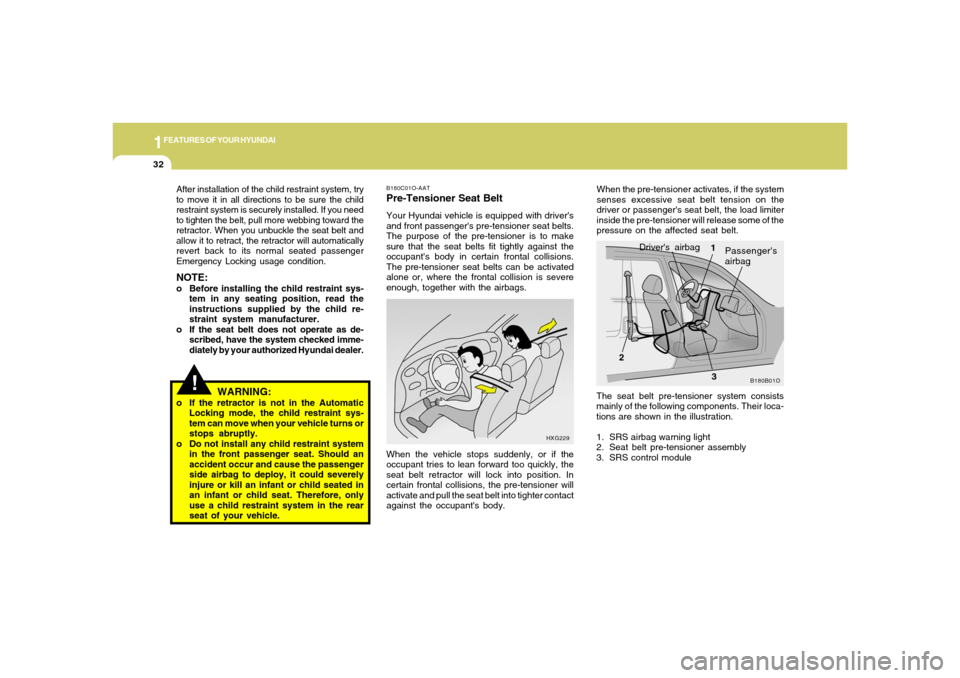
B180B01O
Driver's airbag
1
2
3
Passenger's
airbag
B180C01O-AATPre-Tensioner Seat BeltYour Hyundai vehicle is equipped with driver's
and front passenger's pre-tensioner seat belts.
The purpose of the pre-tensioner is to make
sure that the seat belts fit tightly against the
occupant's body in certain frontal collisions.
The pre-tensioner seat belts can be activated
alone or, where the frontal collision is severe
enough, together with the airbags.
When the vehicle stops suddenly, or if the
occupant tries to lean forward too quickly, the
seat belt retractor will lock into position. In
certain frontal collisions, the pre-tensioner will
activate and pull the seat belt into tighter contact
against the occupant's body.
HXG229
The seat belt pre-tensioner system consists
mainly of the following components. Their loca-
tions are shown in the illustration.
1. SRS airbag warning light
2. Seat belt pre-tensioner assembly
3. SRS control module
!
WARNING:
o If the retractor is not in the Automatic
Locking mode, the child restraint sys-
tem can move when your vehicle turns or
stops abruptly.
o Do not install any child restraint system
in the front passenger seat. Should an
accident occur and cause the passenger
side airbag to deploy, it could severely
injure or kill an infant or child seated in
an infant or child seat. Therefore, only
use a child restraint system in the rear
seat of your vehicle. After installation of the child restraint system, try
to move it in all directions to be sure the child
restraint system is securely installed. If you need
to tighten the belt, pull more webbing toward the
retractor. When you unbuckle the seat belt and
allow it to retract, the retractor will automatically
revert back to its normal seated passenger
Emergency Locking usage condition.NOTE:o Before installing the child restraint sys-
tem in any seating position, read the
instructions supplied by the child re-
straint system manufacturer.
o If the seat belt does not operate as de-
scribed, have the system checked imme-
diately by your authorized Hyundai dealer.
Page 52 of 281
1FEATURES OF YOUR HYUNDAI40
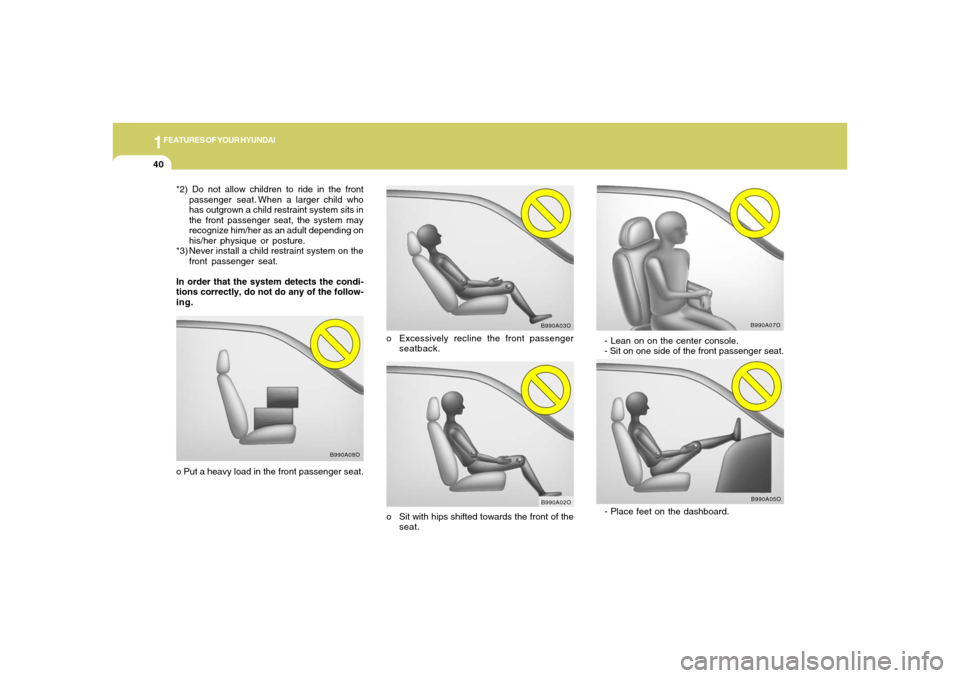
- Lean on on the center console.
- Sit on one side of the front passenger seat.
B990A07O
B990A05O
- Place feet on the dashboard.
o Excessively recline the front passenger
seatback.
o Sit with hips shifted towards the front of the
seat.
B990A03O
B990A02O
o Put a heavy load in the front passenger seat. *2) Do not allow children to ride in the front
passenger seat. When a larger child who
has outgrown a child restraint system sits in
the front passenger seat, the system may
recognize him/her as an adult depending on
his/her physique or posture.
*3) Never install a child restraint system on the
front passenger seat.
In order that the system detects the condi-
tions correctly, do not do any of the follow-
ing.
B990A08O
Page 56 of 281
1FEATURES OF YOUR HYUNDAI44
!
o For cleaning the airbag pad covers, use
only a soft, dry cloth or one which has
been moistened with plain water. Sol-
vents or cleaners could adversely affect
the airbag covers and proper deploy-
ment of the system.
o No objects should be placed over or near
the airbag modules on the steering
wheel, instrument panel, and the front
passenger's panel above the glove box,
because any such object could cause
harm if the vehicle is in a crash severe
enough to cause the airbags to inflate.
o If the airbags inflate, they must be re-
placed by an authorized Hyundai dealer.
o Do not tamper with or disconnect SRS
wiring, or other components of the SRS
system. Doing so could result in injury
due to accidental deployment of the
airbags or by rendering the SRS inopera-
tive.
!
WARNING:
o If components of the airbag system must
be discarded, or if the vehicle must be
scrapped, certain safety precautions
must be observed. Your Hyundai dealer
knows these precautions and can give
you the necessary information. Failure
to follow these precautions and proce-
dures could increase the risk of personal
injury.
o If you sell your vehicle, make certain that
this manual is transferred to the new
owner.
o If your vehicle has been flooded and has
soaked carpeting or water on the floor,
you shouldn't try to start the engine;
have the car towed to an authorized
Hyundai dealer.
o Do not replace the bumper or the bumper
guard with the one other than the Hyundai
genuine parts. Otherwise, it can ad-
versely affect SRS performance and lead
to unexpected injury.
WARNING:
WARNING:
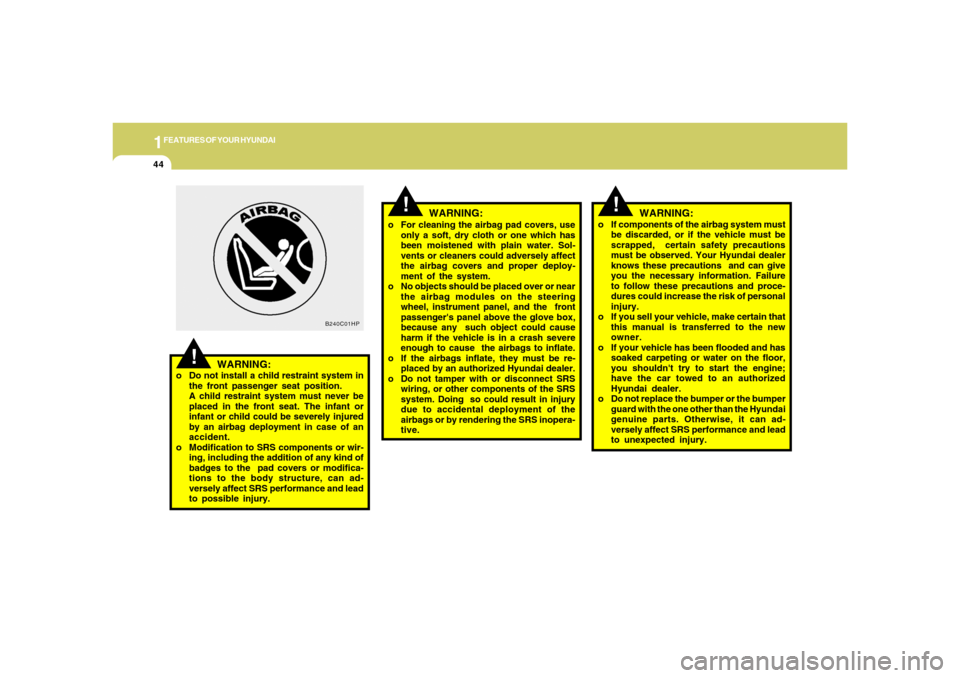
o Do not install a child restraint system in
the front passenger seat position.
A child restraint system must never be
placed in the front seat. The infant or
infant or child could be severely injured
by an airbag deployment in case of an
accident.
o Modification to SRS components or wir-
ing, including the addition of any kind of
badges to the pad covers or modifica-
tions to the body structure, can ad-
versely affect SRS performance and lead
to possible injury.
!
B240C01HP
Page 61 of 281
1
FEATURES OF YOUR HYUNDAI
49
!
B260H02A-AAT
Parking Brake/Low Brake Fluid
Level Warning Light
The brake fluid level warning light indicates that
the brake fluid level in the brake master cylinder
is low and hydraulic brake fluid conforming to
DOT 3 or DOT 4 specifications should be
added. After adding fluid, if no other trouble is
found, the car should be immediately and care-
fully driven to a Hyundai dealer for inspection.
If further trouble is experienced, the vehicle
should not be driven at all but taken to a dealer
by a professional towing service.
Your Hyundai is equipped with dual-diagonal
braking systems. This means you still have
braking on two wheels even if one of the dual
systems should fail. With only one of the dual
systems working, more than normal pedal travel
and greater pedal pressure are required to stop
the car. Also, the car will not stop in as short a
distance with only half of the brake system
working. If the brakes fail while you are driving,
shift to a lower gear for additional engine braking
and stop the car as soon as it is safe to do so.
WARNING:
If you suspect brake trouble, have your
brakes checked by a Hyundai dealer as
soon as possible. Driving your car with a
problem in either the brake electrical sys-
tem or brake hydraulic system is danger-
ous, and could result in a serious injury or
death.Warning Light OperationThe parking brake/brake fluid level warning light
should come on when the parking brake is
applied and the ignition switch is turned to "ON"
or "START". After the engine is started, the light
should go out when the parking brake is re-
leased.
If the parking brake is not applied, the warning
light should come on when the ignition switch is
turned to "ON" or "START", then go out when
the engine starts. If the light comes on at any
other time, you should slow the vehicle and bring
it to a complete stop in a safe location off the
roadway.
B260J02A-AAT
Charging System Warning Light
The charging system warning light should come
on when the ignition is turned on, then go out
when the engine is running. If the light stays on
while the engine is running, there is a malfunc-
tion in the electrical charging system. If the light
comes on while you are driving, stop, turn off the
engine and check under the hood. First, make
certain the generator drive belt is in place. If it is,
check the tension of the belt. Do this as shown
on page 6-19 by pushing down on the center of
the belt. Have the system checked by your
Hyundai dealer as soon as possible.B260B01O-AAT
Tail Gate Open Warning Light
This light remains on unless the tail gate or tail
gate window is completely closed and latched.