steering wheel Hyundai Santa Fe 2007 Owner's Guide
[x] Cancel search | Manufacturer: HYUNDAI, Model Year: 2007, Model line: Santa Fe, Model: Hyundai Santa Fe 2007Pages: 355, PDF Size: 13.03 MB
Page 266 of 355
318
WHAT TO DO IN AN EMERGENCY
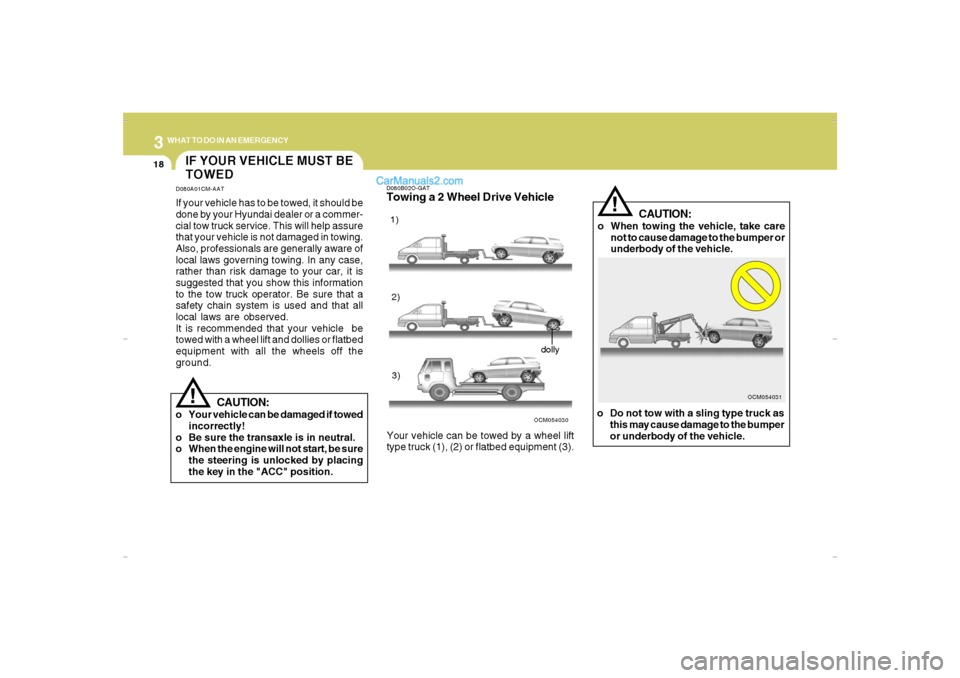
IF YOUR VEHICLE MUST BE
TOWEDD080A01CM-AATIf your vehicle has to be towed, it should be
done by your Hyundai dealer or a commer-
cial tow truck service. This will help assure
that your vehicle is not damaged in towing.
Also, professionals are generally aware of
local laws governing towing. In any case,
rather than risk damage to your car, it is
suggested that you show this information
to the tow truck operator. Be sure that a
safety chain system is used and that all
local laws are observed.
It is recommended that your vehicle be
towed with a wheel lift and dollies or flatbed
equipment with all the wheels off the
ground.
!
CAUTION:
o Your vehicle can be damaged if towed
incorrectly!
o Be sure the transaxle is in neutral.
o When the engine will not start, be sure
the steering is unlocked by placing
the key in the "ACC" position.
!
OCM054031
CAUTION:
o When towing the vehicle, take care
not to cause damage to the bumper or
underbody of the vehicle.
o Do not tow with a sling type truck as
this may cause damage to the bumper
or underbody of the vehicle.
D080B02O-GATTowing a 2 Wheel Drive Vehicle
OCM054030
Your vehicle can be towed by a wheel lift
type truck (1), (2) or flatbed equipment (3).1)
2)
3)
dolly
Cmhma-3.p653/20/2006, 5:03 PM 18
Page 268 of 355
320
WHAT TO DO IN AN EMERGENCY
CAUTION:
o The AWD vehicle should never be
towed with the wheels on the ground.
This can cause serious damage to the
transaxle or the AWD system.
o When towing the vehicle, take care
not to cause damage to the bumper or
underbody of the vehicle.
!
OCM054034
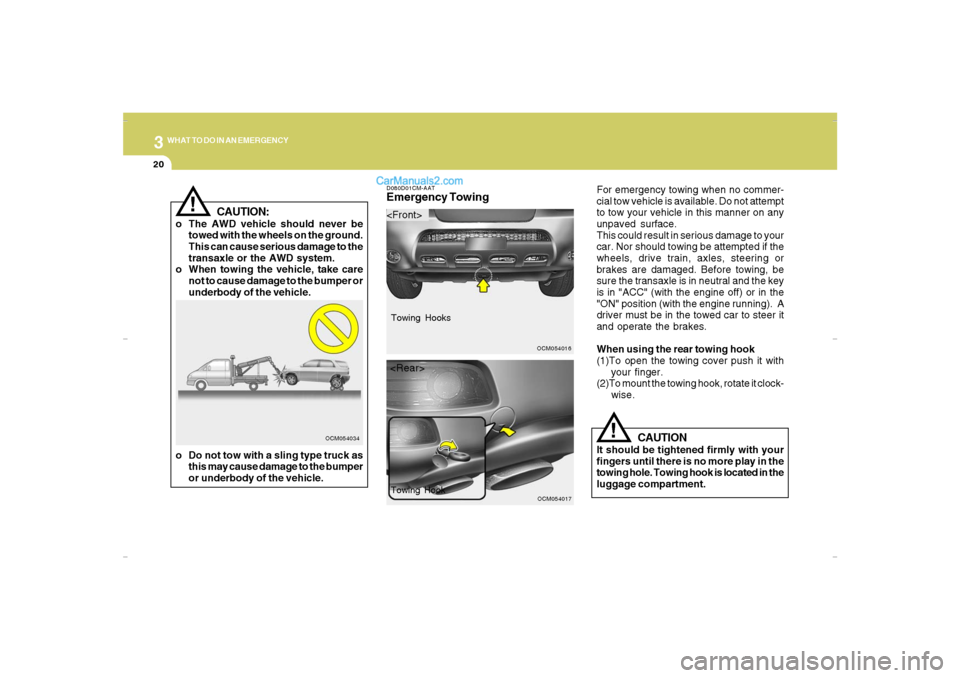
o Do not tow with a sling type truck as
this may cause damage to the bumper
or underbody of the vehicle.For emergency towing when no commer-
cial tow vehicle is available. Do not attempt
to tow your vehicle in this manner on any
unpaved surface.
This could result in serious damage to your
car. Nor should towing be attempted if the
wheels, drive train, axles, steering or
brakes are damaged. Before towing, be
sure the transaxle is in neutral and the key
is in "ACC" (with the engine off) or in the
"ON" position (with the engine running). A
driver must be in the towed car to steer it
and operate the brakes.
When using the rear towing hook
(1)To open the towing cover push it with
your finger.
(2)To mount the towing hook, rotate it clock-
wise.
D080D01CM-AATEmergency Towing
OCM054016
OCM054017
Towing Hook
CAUTION
It should be tightened firmly with your
fingers until there is no more play in the
towing hole. Towing hook is located in the
luggage compartment.
!
Cmhma-3.p653/20/2006, 5:03 PM 20
Page 269 of 355
3
WHAT TO DO IN AN EMERGENCY
21
IF YOU LOSE YOUR KEYSD120A01CM-AATIf you lose your keys, many Hyundai deal-
ers can make you a new key if you have
your key number. If you lock the keys inside
your car and you cannot obtain a new key,
many Hyundai dealers can use special
tools to open the door for you.
Information about immobilizer keys (if in-
stalled) will be found on page 1-4.
!
CAUTION:
If the car is being towed with all four
wheels on the ground, it can be towed
only from the front. Be sure that the
transaxle is in neutral. If your vehicle is
equipped with an automatic transaxle,
do not tow at speeds greater than 30 mph
(50 km/h) and for more than 15 miles (25
km).
Be sure the steering is unlocked by plac-
ing the key in the "ACC" position. A
driver must be in the towed vehicle to
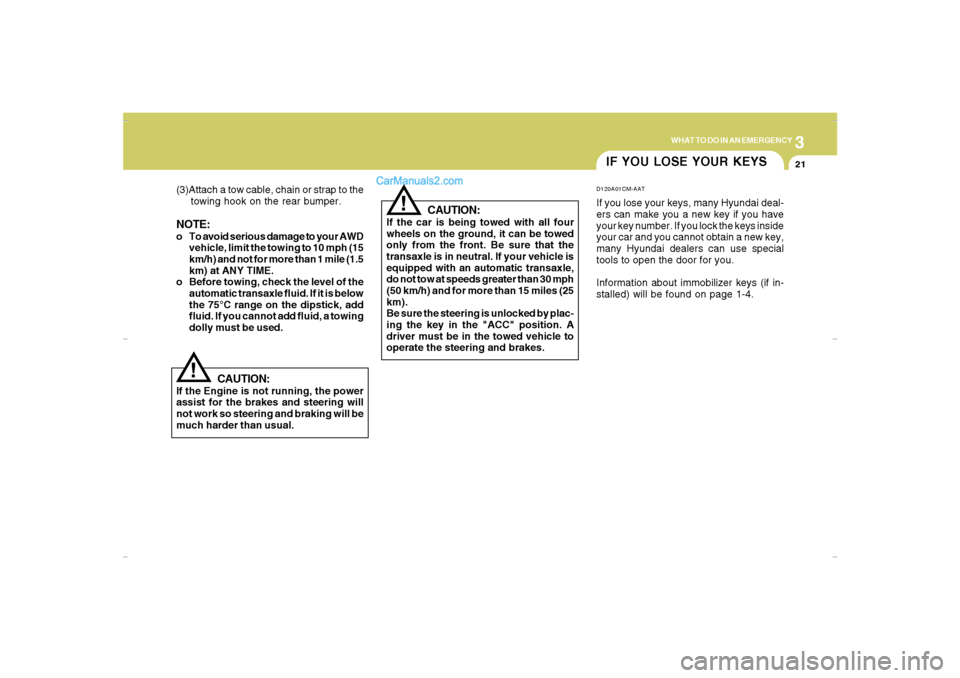
operate the steering and brakes. (3)Attach a tow cable, chain or strap to the
towing hook on the rear bumper.
NOTE:o To avoid serious damage to your AWD
vehicle, limit the towing to 10 mph (15
km/h) and not for more than 1 mile (1.5
km) at ANY TIME.
o Before towing, check the level of the
automatic transaxle fluid. If it is below
the 75°C range on the dipstick, add
fluid. If you cannot add fluid, a towing
dolly must be used.
CAUTION:
If the Engine is not running, the power
assist for the brakes and steering will
not work so steering and braking will be
much harder than usual.
!
Cmhma-3.p653/20/2006, 5:03 PM 21
Page 285 of 355
5
VEHICLE MAINTENANCE REQUIREMENTS
9
F070F01A-AATo Brake Hoses and LinesVisually check for proper installation, chaf-
ing, cracks, deterioration and any leak-
age. Replace any deteriorated or dam-
aged parts immediately.F070E06A-AATo Automatic Transaxle FluidThe fluid level should be in the “HOT”
range of the dipstick, after the engine and
transaxle are at normal operating tem-
perature. Check the automatic transaxle
fluid level with the engine running and the
transaxle in neutral, with the parking brake
properly applied. Use HYUNDAI GENU-
INE ATF SP III, DIAMOND ATF SP III, SK
ATF SP III or other brands meeting the SP
III specification approved by Hyundai Motor
Co. when adding or changing fluid. Using
the wrong ATF may result in damage to the
ATM.
F070L01A-AATo Suspension Mounting BoltsCheck the suspension connections for
looseness or damage. Retighten to the
specified torque.
F070G02A-AATo Brake FluidCheck brake fluid level in the brake fluid
reservoir. The level should be between
"MIN" and "MAX" marks on the side of the
reservoir. Use only hydraulic brake fluid
conforming to DOT 3 or DOT 4.
F070K01A-AATo Exhaust Pipe and MufflerVisually inspect the exhaust pipes, muffler
and hangers for cracks, deterioration, or
damage. Start the engine and listen care-
fully for any exhaust gas leakage. Tighten
connections or replace parts as neces-
sary.
F070J01A-AATo Brake Pads, Calipers and RotorsCheck the pads for excessive wear, discs
for run out and wear, and calipers for fluid
leakage.F070H01CM-AATo Parking BrakeInspect the parking brake system includ-
ing the parking brake lever (or the parking
brake pedal) and cables. For detailed ser-
vice procedures, refer to the Shop Manual.
F070M01A-AATo Steering Gear Box, Linkage &
Boots/Lower Arm Ball JointWith the vehicle stopped and engine off,
check for excessive free-play in the steer-
ing wheel.
Check the linkage for bends or damage.
Check the dust boots and ball joints for
deterioration, cracks, or damage. Replace
any damaged parts.
Page 290 of 355
6
DO-IT-YOURSELF MAINTENANCE
4
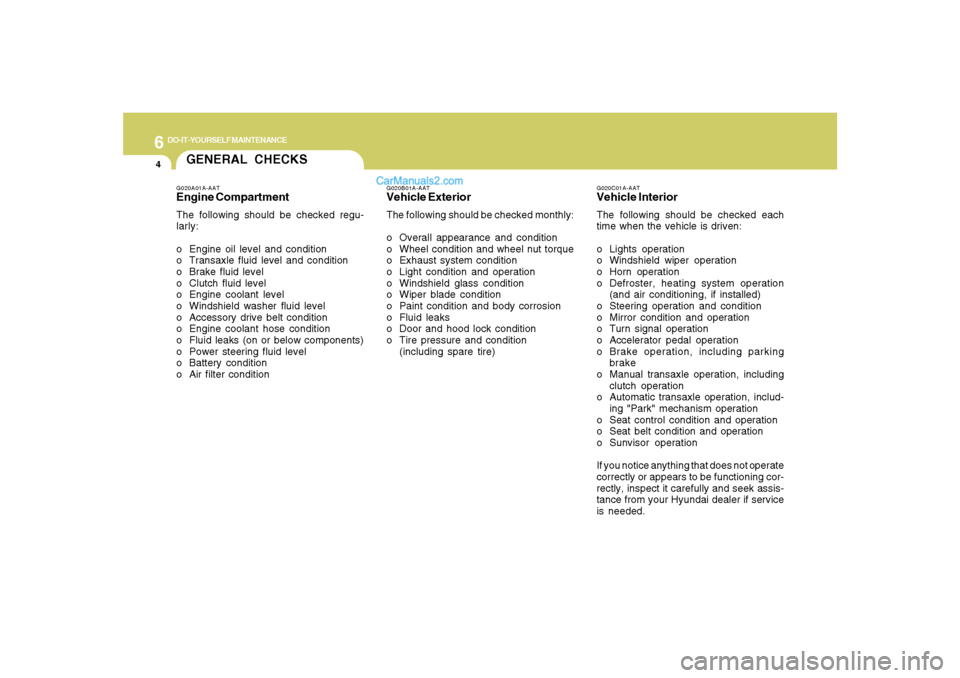
GENERAL CHECKS
G020C01A-AATVehicle InteriorThe following should be checked each
time when the vehicle is driven:
o Lights operation
o Windshield wiper operation
o Horn operation
o Defroster, heating system operation
(and air conditioning, if installed)
o Steering operation and condition
o Mirror condition and operation
o Turn signal operation
o Accelerator pedal operation
o Brake operation, including parking
brake
o Manual transaxle operation, including
clutch operation
o Automatic transaxle operation, includ-
ing "Park" mechanism operation
o Seat control condition and operation
o Seat belt condition and operation
o Sunvisor operation
If you notice anything that does not operate
correctly or appears to be functioning cor-
rectly, inspect it carefully and seek assis-
tance from your Hyundai dealer if service
is needed.
G020B01A-AATVehicle ExteriorThe following should be checked monthly:
o Overall appearance and condition
o Wheel condition and wheel nut torque
o Exhaust system condition
o Light condition and operation
o Windshield glass condition
o Wiper blade condition
o Paint condition and body corrosion
o Fluid leaks
o Door and hood lock condition
o Tire pressure and condition
(including spare tire)
G020A01A-AATEngine CompartmentThe following should be checked regu-
larly:
o Engine oil level and condition
o Transaxle fluid level and condition
o Brake fluid level
o Clutch fluid level
o Engine coolant level
o Windshield washer fluid level
o Accessory drive belt condition
o Engine coolant hose condition
o Fluid leaks (on or below components)
o Power steering fluid level
o Battery condition
o Air filter condition
Page 337 of 355
8
CONSUMER INFORMATION, REPORTING SAFETY DEFECTS & BINDING ARBITRATION OF WARRANTY CLAIMS
12
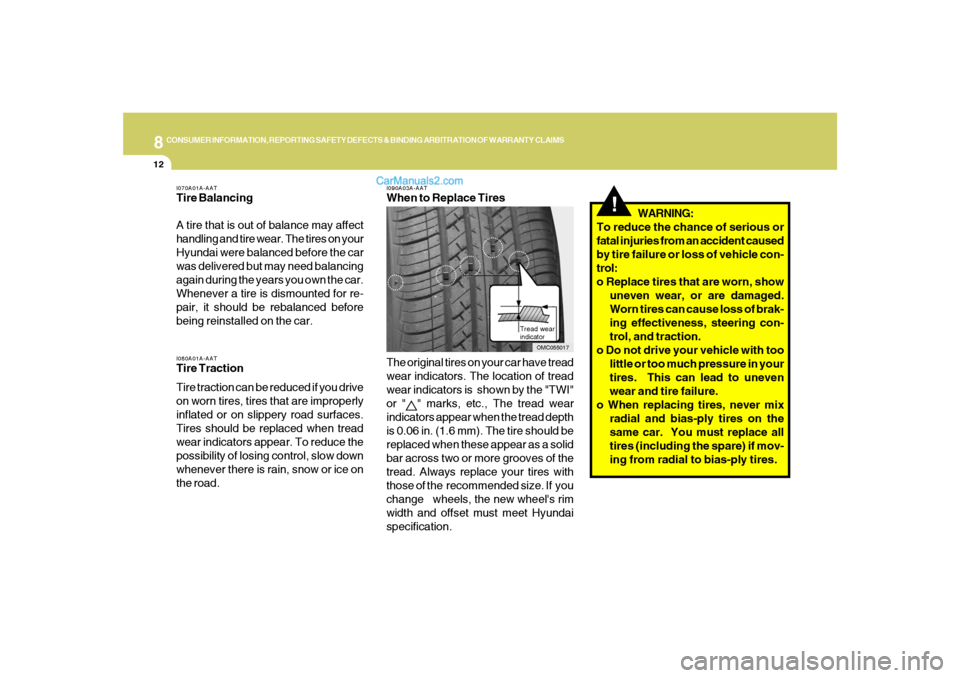
I090A03A-AATWhen to Replace Tires
Tread wear
indicator
The original tires on your car have tread
wear indicators. The location of tread
wear indicators is shown by the "TWI"
or "
" marks, etc., The tread wear
indicators appear when the tread depth
is 0.06 in. (1.6 mm). The tire should be
replaced when these appear as a solid
bar across two or more grooves of the
tread. Always replace your tires with
those of the recommended size. If you
change wheels, the new wheel's rim
width and offset must meet Hyundai
specification.
!
WARNING:
To reduce the chance of serious or
fatal injuries from an accident caused
by tire failure or loss of vehicle con-
trol:
o Replace tires that are worn, show
uneven wear, or are damaged.
Worn tires can cause loss of brak-
ing effectiveness, steering con-
trol, and traction.
o Do not drive your vehicle with too
little or too much pressure in your
tires. This can lead to uneven
wear and tire failure.
o When replacing tires, never mix
radial and bias-ply tires on the
same car. You must replace all
tires (including the spare) if mov-
ing from radial to bias-ply tires.
OMC055017 I070A01A-AAT
Tire Balancing
A tire that is out of balance may affect
handling and tire wear. The tires on your
Hyundai were balanced before the car
was delivered but may need balancing
again during the years you own the car.
Whenever a tire is dismounted for re-
pair, it should be rebalanced before
being reinstalled on the car.I080A01A-AATTire Traction
Tire traction can be reduced if you drive
on worn tires, tires that are improperly
inflated or on slippery road surfaces.
Tires should be replaced when tread
wear indicators appear. To reduce the
possibility of losing control, slow down
whenever there is rain, snow or ice on
the road.
Page 352 of 355
10
INDEX
5
S
Seat
Front.............................................................................................1-16
Rear..............................................................................................1-22
Seat warmer .................................................................................1-22
Seat Belts
3-point system.............................................................................1-31
Pretensioner seat belt ..................................................................1-41
Adjusting your seat belt ...............................................................1-30
Care of seat belts .........................................................................1-29
Precautions..................................................................................1-27
Shop Manual ......................................................................................8-14
Sound
Brake pad warning sound ............................................................1-70
Speedometer.....................................................................................1-72
Starting Procedure.............................................................................. 2-7
Steering Wheel Tilt Lever ...............................................................1-118
Stereo Sound System ....................................................................1-144
Sunglass Holder ................................................................................1-94
Sunroof..............................................................................................1-89
Sun Visor........................................................................................1-116
T
Tachometer.......................................................................................1-72
Tail Gate.........................................................................................1-109
Theft-Alarm System..........................................................................1-11
Ticket Holder..................................................................................1-118
Tires
Aging .............................................................................................8-13
Balancing......................................................................................8-12Chains..........................................................................................8-10
Changing a flat tire .......................................................................3-12
If you have a flat tire .....................................................................3-12
Information...................................................................................... 8-3
Maintenance.................................................................................8-13
Pressure......................................................................................... 8-3
Replacement................................................................................8-12
Rotation........................................................................................8-11
Sidewall Labeling............................................................................ 8-6
Snow tires.....................................................................................8-10
Spare tire......................................................................................3-10
Terminology and Definition ............................................................ 8-8
Tire Pressure Monitoring System (TPMS) ................................... 3-5
Traction........................................................................................8-12
Towing
A trailer (or vehicle)......................................................................2-27
Emergency...................................................................................3-20
If your car must be towed ............................................................3-18
Trailer Connector..............................................................................2-31
Transaxle
Automatic......................................................................................2-10
Automatic transaxle fluid checking ..............................................6-12
Manual............................................................................................ 2-7
Manual transaxle oil checking.....................................................6-11
Trip Computer...................................................................................1-74
V
Vehicle Identification Number............................................................. 8-2
Vechcle Load Limit ............................................................................2-32