Gear Hyundai Santa Fe 2007 Owner's Manual
[x] Cancel search | Manufacturer: HYUNDAI, Model Year: 2007, Model line: Santa Fe, Model: Hyundai Santa Fe 2007Pages: 355, PDF Size: 13.03 MB
Page 15 of 355
1
FEATURES OF YOUR HYUNDAI
3
BREAKING IN YOUR NEW
HYUNDAI
B010F01A-AATOperation in Foreign CountriesIf you are going to drive your Hyundai in
another country, be sure to:
o Observe all regulations regarding reg-
istration and insurance.
o Determine that acceptable fuel is avail-
able.B010E01A-AATGasolines for Cleaner AirTo help contribute to cleaner air, Hyundai
recommends that you use gasolines
treated with detergent additives, which
help prevent deposit formation in the en-
gine. These gasolines will help the engine
run cleaner and enhance performance of
the Emission Control System.
B020A01S-AATDuring the First 1,200 Miles (2,000
Km)No formal "break-in" procedure is required
with your new Hyundai. However, you can
contribute to the economical operation
and durability of your Hyundai by observ-
ing the following recommendations dur-
ing the first 1,200 miles (2,000 km).
o Don't drive faster than 55 MPH (88 km/
h).
o While driving, keep your engine speed
(rpm, or revolutions per minute) be-
tween 2,000 rpm and 4,000 rpm.
o Use moderate acceleration. Don't start
quickly or depress the accelerator pedal
fully.
o For the first 200 miles (300 km), try to
avoid hard stops.
o Don't lug the engine (in other words,
don't drive so slowly in too high a gear
that the engine "bucks"-shift to a lower
gear).
o Whether going fast or slow, vary your
speed from time to time.
o Don't let the engine idle longer than 3
minutes at one time.
o Don't tow a trailer during the first 1,200
miles (2,000 km) of operation.
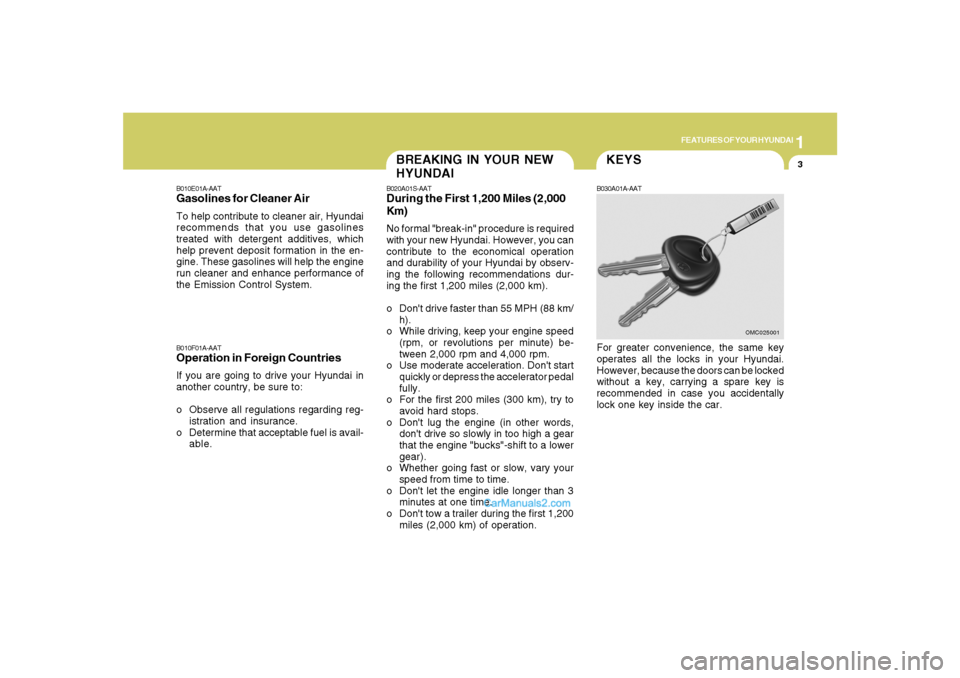
KEYSB030A01A-AATFor greater convenience, the same key
operates all the locks in your Hyundai.
However, because the doors can be locked
without a key, carrying a spare key is
recommended in case you accidentally
lock one key inside the car.
OMC025001
Page 79 of 355
1
FEATURES OF YOUR HYUNDAI
67
!
B260H03A-AAT
Parking Brake/Low Brake
Fluid Level Warning Light
The brake fluid level warning light indi-
cates that the brake fluid level in the brake
master cylinder is low and hydraulic brake
fluid conforming to DOT 3 or DOT 4 speci-
fications should be added. After adding
fluid, if no other trouble is found, the car
should be immediately and carefully driven
to a Hyundai dealer for inspection. If further
trouble is experienced, the vehicle should
not be driven at all but taken to a dealer by
a professional towing service.
Your Hyundai is equipped with dual-di-
agonal braking systems. This means you
still have braking on two wheels even if
one of the dual systems should malfunc-
tion. With only one of the dual systems
working, more than normal pedal travel
and greater pedal pressure are required to
stop the car. Also, the car will not stop in as
short a distance with only half of the brake
system working. If the brakes malfunction
while you are driving, shift to a lower gear
for additional engine braking and stop the
car as soon as it is safe to do so.
WARNING:
If you suspect brake trouble, have your
brakes checked by a Hyundai dealer as
soon as possible. Driving your car with
a problem in either the brake electrical
system or brake hydraulic system is
dangerous, and could result in a serious
injury or death.Warning Light OperationThe parking brake/brake fluid level warn-
ing light should illuminate when the park-
ing brake is applied and the ignition switch
is turned to "ON" or "START". After the
engine is started, the light should go out
when the parking brake is released.
If the parking brake is not applied, the
warning light should illuminate when the
ignition switch is turned to "ON" or "START",
then go out when the engine starts. If the
light illuminate at any other time, you
should slow the vehicle and bring it to a
complete stop in a safe location off the
roadway.
B260J02TG-AAT
Charging System Warning
Light
The charging system warning light should
illuminate when the ignition is turned on,
then go out when the engine is running. If
the light stays on while the engine is run-
ning, there is a malfunction in the electrical
charging system. If the light illuminates
while you are driving, have the system
checked by your Hyundai dealer as soon
as possible.Parking brake warning chime
(if installed)The parking brake warning chime sounds
to remind you that the parking brake is
applied when your are driving above
6mph(10km/h). Always release the park-
ing brake before you drive.
Page 121 of 355
1
FEATURES OF YOUR HYUNDAI
109
!
!TAIL GATEB540A01CM-AAT
WARNING:
The tail gate should always be kept com-
pletely closed while the vehicle is in
motion. If it is left open or ajar, poisonous
exhaust gases may enter the car result-
ing in serious illness or death to the
occupants. See additional warnings con-
cerning exhaust gases on page 2-2.
o The tail gate is opened by pulling the
outside handle up, raising the tail gate
manually.
o To close, lower the tail gate, then press
down on it until it is closed. To be sure
the tail gate is fully closed, always try to
pull it up again without using the outside
handle.
WARNING:
o Whenever leaving vehicle or parking
always set the parking brake as far as
possible and fully engage the vehicle's
transaxle into the park position. Ve-
hicles not fully engaged in park with
the parking brake set are at risk for
moving inadvertently and injuring
yourself or others.
o To prevent unintentional movement
when stopped and leaving the vehicle,
do not use the gearshift lever in place
of the parking brake. Set the parking
brake AND make sure the gearshift
lever is securely positioned in 1st
(First) gear or R (Reverse) for manual
transaxle equipped vehicles and in P
(Park) for automatic transaxle
equipped vehicles.
o Never allow a person who is unfamil-
iar with the vehicle or children to touch
the parking brake. If the parking brake
is released unintentionally, serious
injury may occur.
LUGGAGE COMPARTMENT
OCM052123L
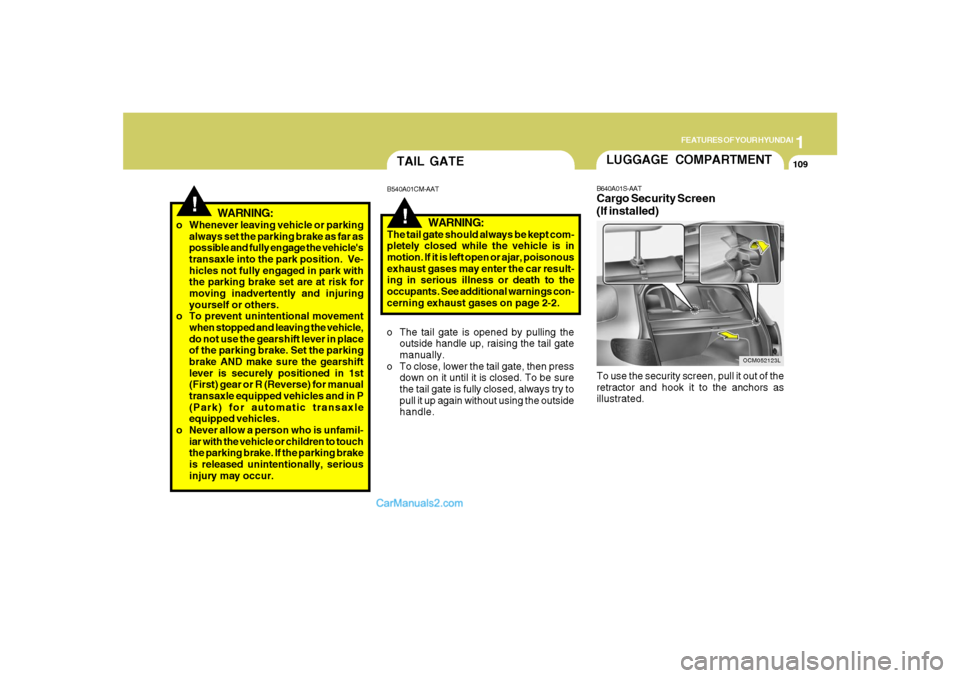
B640A01S-AATCargo Security Screen
(If installed)To use the security screen, pull it out of the
retractor and hook it to the anchors as
illustrated.
Page 143 of 355
1
FEATURES OF YOUR HYUNDAI
131
FEATURES OF YOUR HYUNDAI
131131131131
B730A01CM-AATOperation Tipso To keep dust or unpleasant fumes from
entering the car through the ventilation
system, temporarily set the air intake
control to (
).
Be sure to return the control to (
)
when the irritation has passed to keep
fresh air in the vehicle. This will help
keep the driver alert and comfortable.
o Air for the heating/cooling system is
drawn in through the grilles just ahead
of the windshield. Care should be taken
that these are not blocked by leaves,
snow, ice or other obstructions.
o To prevent interior fog on the wind-
shield, set the air intake control to the
fresh air (
) position, fan speed to the
desired position, turn on the air condi-
tioning system, and adjust temperature
control to desired temperature.
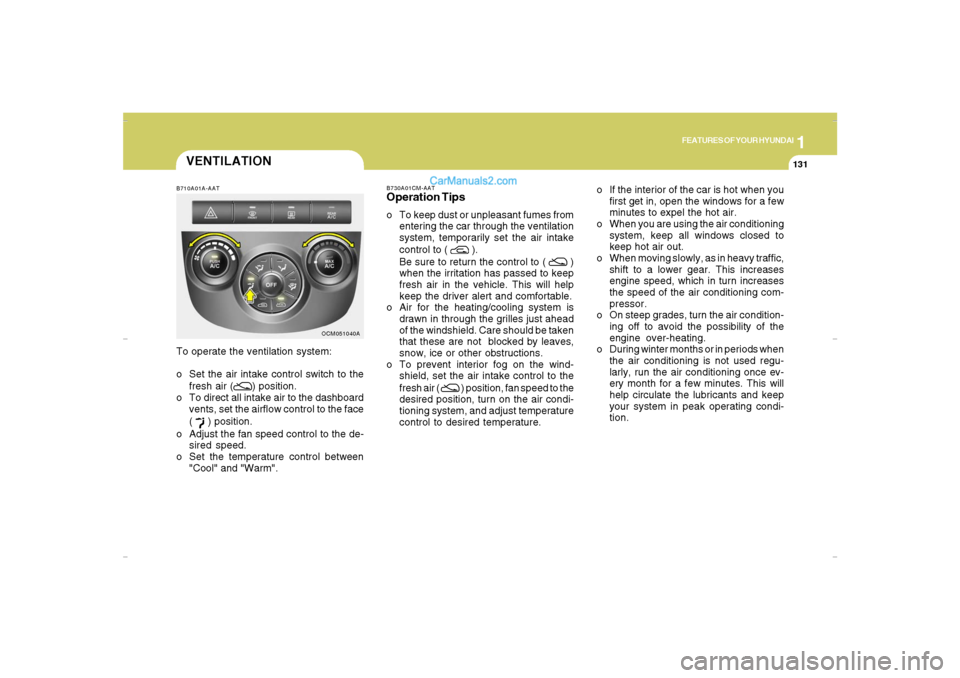
OCM051040A B710A01A-AAT
To operate the ventilation system:
o Set the air intake control switch to the
fresh air (
) position.
o To direct all intake air to the dashboard
vents, set the airflow control to the face
(
) position.
o Adjust the fan speed control to the de-
sired speed.
o Set the temperature control between
"Cool" and "Warm".
VENTILATION
o If the interior of the car is hot when you
first get in, open the windows for a few
minutes to expel the hot air.
o When you are using the air conditioning
system, keep all windows closed to
keep hot air out.
o When moving slowly, as in heavy traffic,
shift to a lower gear. This increases
engine speed, which in turn increases
the speed of the air conditioning com-
pressor.
o On steep grades, turn the air condition-
ing off to avoid the possibility of the
engine over-heating.
o During winter months or in periods when
the air conditioning is not used regu-
larly, run the air conditioning once ev-
ery month for a few minutes. This will
help circulate the lubricants and keep
your system in peak operating condi-
tion.
Cmhma-1b.p653/20/2006, 4:59 PM 131
Page 218 of 355
2
DRIVING YOUR HYUNDAI
7
C050B01A-AATNormal Conditions:The Starting Procedure:
1. Insert key, and fasten the seat belt.
2. Depress the clutch pedal fully and place
the gearshift lever (manual transaxle)
in neutral or the selector lever (auto-
matic transaxle) in "P" (park) position.
3. After turning the ignition key to the "ON"
position, make certain all warning lights
and gauges are functioning properly
before starting the engine.
WARNING:
Be sure that the clutch is fully depressed
when starting a manual transaxle ve-
hicle. Your manual transaxle equipped
vehicle will not start unless the clutch
pedal is fully depressed. On a manual
transaxle equipped vehicle that can be
started without depressing the clutch,
there is the potential to cause damage to
the vehicle or injury to someone inside
or outside the vehicle as a result of the
forward or backward movement of the
vehicle that will occur if the clutch is not
depressed when the vehicle is started.
!
4. Turn the ignition key to the "START"
position and release it when the engine
starts.
After the engine has started, allow the
engine to run for 10 to 20 seconds prior
to placing the vehicle in gear.
The starter should not be operated for
more than 15 seconds at a time. Wait
15-30 seconds between starting at-
tempts to protect the starter from over-
heating.
OPERATING THE MANUAL
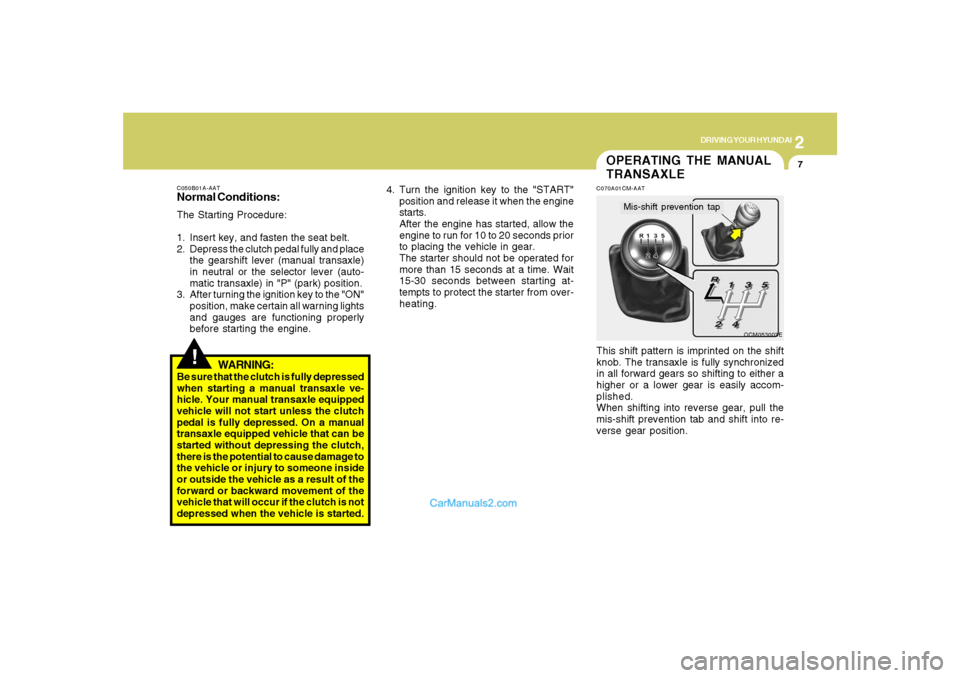
TRANSAXLEC070A01CM-AATThis shift pattern is imprinted on the shift
knob. The transaxle is fully synchronized
in all forward gears so shifting to either a
higher or a lower gear is easily accom-
plished.
When shifting into reverse gear, pull the
mis-shift prevention tab and shift into re-
verse gear position.
OCM053003E
Mis-shift prevention tap
Page 219 of 355
2
DRIVING YOUR HYUNDAI
8
C070B02A-AATUsing the ClutchThe clutch should be pressed all the way
to the floor before shifting, then released
slowly. The clutch pedal should always be
fully returned to the original position. Do
not rest your foot on the clutch pedal while
driving. This can cause unnecessary wear.
Do not partially engage the clutch to hold
the car on an incline. This causes unnec-
essary wear. Use the foot brake or parking
brake to hold the car on an incline. Do not
operate the clutch pedal rapidly and re-
peatedly.
CAUTION:
When downshifting from fifth gear to
fourth gear, caution should be taken not
to inadvertently press the gear shift le-
ver sideways in such a manner that
second gear is engaged. Such a drastic
downshift may cause the engine speed
to increase to the point that the tachom-
eter will enter the red-zone. Such over-
revving of the engine may possibly cause
engine damage.
!
CAUTION:
Do not downshift more than 2 gears or
downshift the gear when the engine is
running at high speed (5,000 RPM or
higher). Such downshifting may damage
the engine.
!
NOTE:o To shift into reverse, rest the lever in
neutral for at least 3 seconds after
your car is completely stopped. Then
move the lever into the reverse posi-
tion.
o During cold weather, shifting may be
difficult until the transaxle lubricant
has warmed up. This is normal and not
harmful to the transaxle.
o If you've come to a complete stop and
it's hard to shift into 1st or R(Reverse),
put the shift lever in N(Neutral) posi-
tion and release the clutch. Press the
clutch pedal back down, and then shift
into 1st or R(Reverse) gear position.
o Do not use the shift lever as a handrest
during driving, as this can result in
premature wear of the transaxle shift
forks.
Page 220 of 355
2
DRIVING YOUR HYUNDAI
9
C070D04O-AATGood Driving Practiceso Never take the car out of gear and coast
down a hill. This is extremely hazard-
ous. Always leave the car in gear.
o Don't "ride" the brakes. This can cause
them to overheat and malfunction. In-
stead, when you are driving down a
long hill, slow down and shift to a lower
gear. When you do this, engine braking
will help slow the car.
o Slow down before shifting to a lower
gear. This will help avoid over-revving
the engine, which can cause damage.
o Slow down when you encounter cross
winds. This gives you much better con-
trol of your car.
o Be sure the car is completely stopped
before you attempt to shift into reverse.
The transaxle can be damaged if you do
not. To shift into reverse, depress the
clutch, move the shift lever to neutral,
wait three seconds, then shift to the
reverse position.
o Exercise extreme caution when driving
on a slippery surface. Be especially
careful when braking, accelerating or
shifting gears. On a slippery surface, an
abrupt change in vehicle speed can
cause the drive wheels to lose traction
and the vehicle to go out of control. The shift points as shown above are rec-
ommended for optimum fuel economy and
performance.
C070E03A-AATRecommended Shift Points
Shift
from-toRecommended
mph(km/h)
15 (20)
25 (40)
35 (55)
45 (75) 1-2
2-3
3-4
4-5
!
WARNING:
o Always buckle-up! In a collision, an
unbelted occupant is significantly
more likely to be seriously injured or
killed than a properly belted occu-
pant.
o Avoid high speeds when cornering or
turning.
o Do not make quick steering wheel
movements, such as sharp lane
changes or fast, sharp turns.
o The risk of rollover is greatly in-
creased if you lose control of your
vehicle at highway speeds.
o Loss of control often occurs if two or
more wheels drop off the roadway
and the driver oversteers to reenter
the roadway.
o In the event your vehicle leaves the
roadway, do not steer sharply. In-
stead, slow down before pulling back
into the travel lanes.
o Never exceed posted speed limits.
Page 221 of 355
2
DRIVING YOUR HYUNDAI
10
CAUTION:
Never shift into "R" or "P" position while
the vehicle is moving.
!
The indicator lights in the instrument clus-
ter indicate the selector lever position when
the ignition is switched "ON". During sports
mode operation, the gear currently in use
displays in the numeral indicator.
AUTOMATIC TRANSAXLE
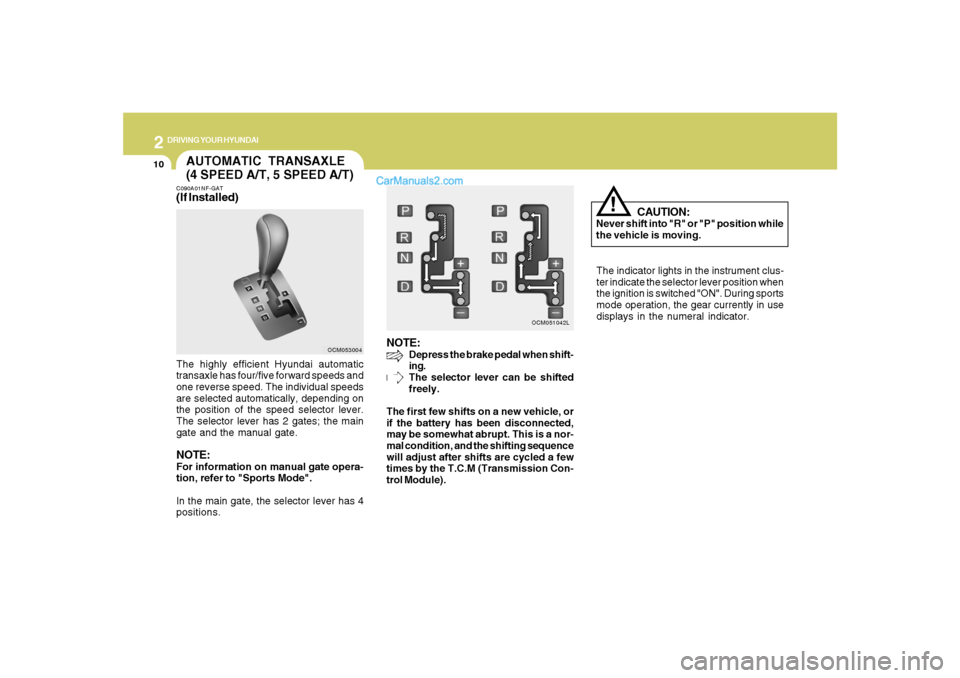
(4 SPEED A/T, 5 SPEED A/T)C090A01NF-GAT(If Installed)The highly efficient Hyundai automatic
transaxle has four/five forward speeds and
one reverse speed. The individual speeds
are selected automatically, depending on
the position of the speed selector lever.
The selector lever has 2 gates; the main
gate and the manual gate.NOTE:For information on manual gate opera-
tion, refer to "Sports Mode".
In the main gate, the selector lever has 4
positions.
NOTE:
Depress the brake pedal when shift-
ing.
The selector lever can be shifted
freely.
The first few shifts on a new vehicle, or
if the battery has been disconnected,
may be somewhat abrupt. This is a nor-
mal condition, and the shifting sequence
will adjust after shifts are cycled a few
times by the T.C.M (Transmission Con-
trol Module).
OCM053004OCM051042L
Page 222 of 355
2
DRIVING YOUR HYUNDAI
11
C090B02A-AATThe function of each position is as
follows:
o P (Park):Use to hold the vehicle in place when
parked or while starting the engine. When-
ever parking the car, apply the parking
brake and shift the selector lever to the "P"
(Park) position.
CAUTION:
Never place the selector lever in the "P"
(Park) position unless the vehicle is fully
stopped. Failure to observe this caution
will cause severe damage to the
transaxle.
!
C090D02A-AATo N (Neutral):In the "N" position, the transaxle is in neu-
tral, which means that no gears are en-
gaged. The engine can be started with the
shift lever in "N" position, although this is
not recommended except if the engine
stalls while the car is moving.C090E01NF-GATo D (Drive):Use for normal driving. The transaxle will
automatically shift through a four/five gear
sequence.C090C01A-AATo R (Reverse):Use for backing up the vehicle. Bring the
car to a complete stop before shifting the
selector lever to "R" position.
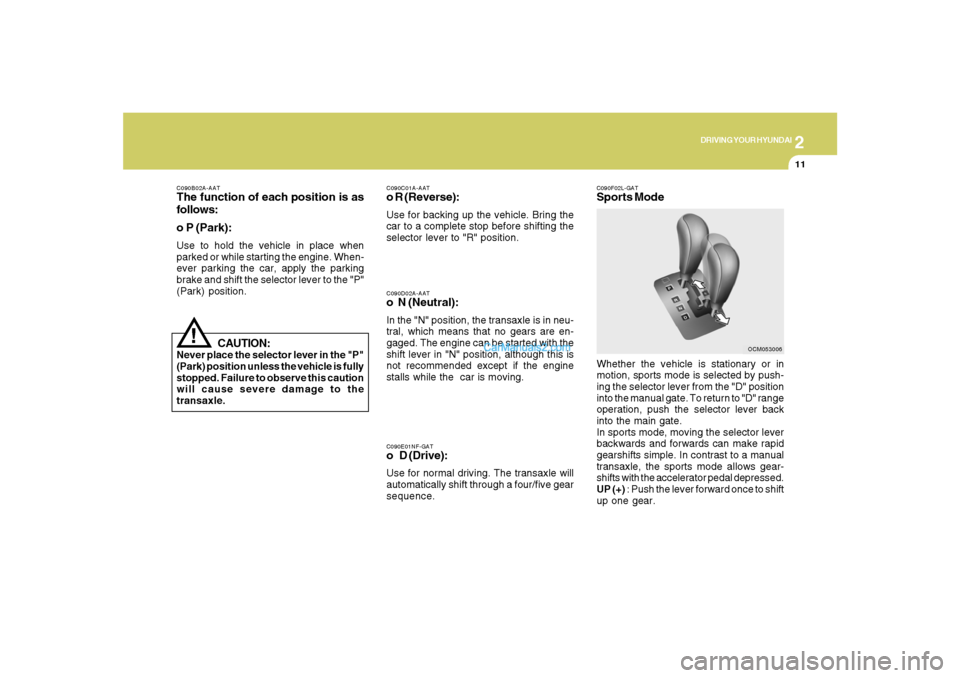
C090F02L-GATSports ModeWhether the vehicle is stationary or in
motion, sports mode is selected by push-
ing the selector lever from the "D" position
into the manual gate. To return to "D" range
operation, push the selector lever back
into the main gate.
In sports mode, moving the selector lever
backwards and forwards can make rapid
gearshifts simple. In contrast to a manual
transaxle, the sports mode allows gear-
shifts with the accelerator pedal depressed.
UP (+) : Push the lever forward once to shift
up one gear.
OCM053006
Page 223 of 355
2
DRIVING YOUR HYUNDAI
12
C090H01L-GATNOTE:o For smooth and safe operation, de-
press the brake pedal when shifting
from "Neutral" position or "Park"
position to a forward or reverse gear.
o The ignition key must be in the "ON"
position and the brake pedal fully de-
pressed in order to move the shift
lever from the "P" (Park) position to
any of the other positions.
o It is always possible to shift from "R",
"N", or "D" position to "P" position.
The vehicle must be fully stopped to
avoid transaxle damage. DOWN (-) : Pull the lever backwards once
to shift down one gear.
SKIP : By rapidly moving the selector for-
ward or backward twice, it is possible to
skip one gear, i.e. 1st to 3rd or 3rd to 1st .
CAUTION:
o In sports mode, the driver must ex-
ecute upward shifts in accordance
with prevailing road conditions, tak-
ing care to keep the engine speed
below the red zone.
o For engine protection, upward shifts
are made automatically when the
engine rpm reaches the red zone.
o By rapidly moving the selector lever
backwards (-) twice it is possible to
skip one gear, i.e., 3rd to 1st, 4th to 2nd
or 5th to 3rd. Since sudden engine
braking and/or rapid acceleration can
cause a loss of traction, however,
downshifts must be made carefully in
accordance with the vehicle's speed.
NOTE:o In sports mode, only the four/five for-
ward gears can be selected. To re-
verse or park the vehicle, move the
selector lever to the "R" or "P" posi-
tion as required.
o In sports mode, downward shifts are
made automatically when the vehicle
slows down. When the vehicle stops,
1st gear is automatically selected.
o To maintain the required levels of
vehicle performance and safety, the
system may not execute certain gear-
shifts when the selector lever is oper-
ated.
o Before driving away from a stop on a
slippery road, push the selector lever
forward into the +(UP) position. This
causes the transaxle to shift into 2nd
gear which is better for smooth driv-
ing away on a slippery road. Push the
selector lever to the -(DOWN) side to
shift back to 1st gear.
!