seat control Hyundai Santa Fe 2007 Owner's Manual
[x] Cancel search | Manufacturer: HYUNDAI, Model Year: 2007, Model line: Santa Fe, Model: Hyundai Santa Fe 2007Pages: 355, PDF Size: 13.03 MB
Page 6 of 355
F4
A110A01A-AAT
VEHICLE DATA COLLECTION AND EVENT DATA RECORDERS
Your Hyundai vehicle is equipped with many high technology, electronically controlled systems
that help to ensure your vehicle operates properly and provides the performance that you
expect. These systems utilize computers to monitor the operation of various systems and
components and help to control their operation. These computerized system operations are
wide-ranging and involve components to reduce emissions, to continuously evaluate the
readiness of the air bag and seat belt pretensioner systems, to determine when the air bag and
seat belt pre-tensioner systems should be deployed and then to activate the deployment, and
if equipped, to operate anti-lock braking, traction control and electrical stability control to assist
the driver to control the vehicle in difficult driving situations. These systems electronically store
information that is useful to service technicians when they need to diagnose and repair these
systems. Additional information is stored only when a crash occurs that results in the
deployment of the air bags or seat belt pre-tensioners. This type of data storage is done by
devices called event data recorders(EDR).
After a crash event, the air bag and seat belt pre-tensioner computer system, known as the
Supplemental Restraint System Control Module (SRSCM) or Air bag Control Unit (ACU), may
record some information about the condition of the vehicle and how it was being operated. This
information consists of data related to seat belt usage and if there was diagnostic information
in the air bag or seat belt systems at the time that a crash occurred, and if the ACU sensed that
a crash of sufficient severity occurred to require seat belt pre-tensioner or air bag deployment.
To retrieve this information, special equipment is needed and access to the vehicle or the device
that stores the data is required. Hyundai will not access information about a crash event or share
it with others except:
o in response to an official request of police or similar government office, or
o with the consent of the vehicle owner or, if the vehicle is leased, with the consent of the lessee,
or
o as part of Hyundai’s defense of litigation, or
o as required by law.
Page 12 of 355
YOUR VEHICLE AT A GLANCE
F10
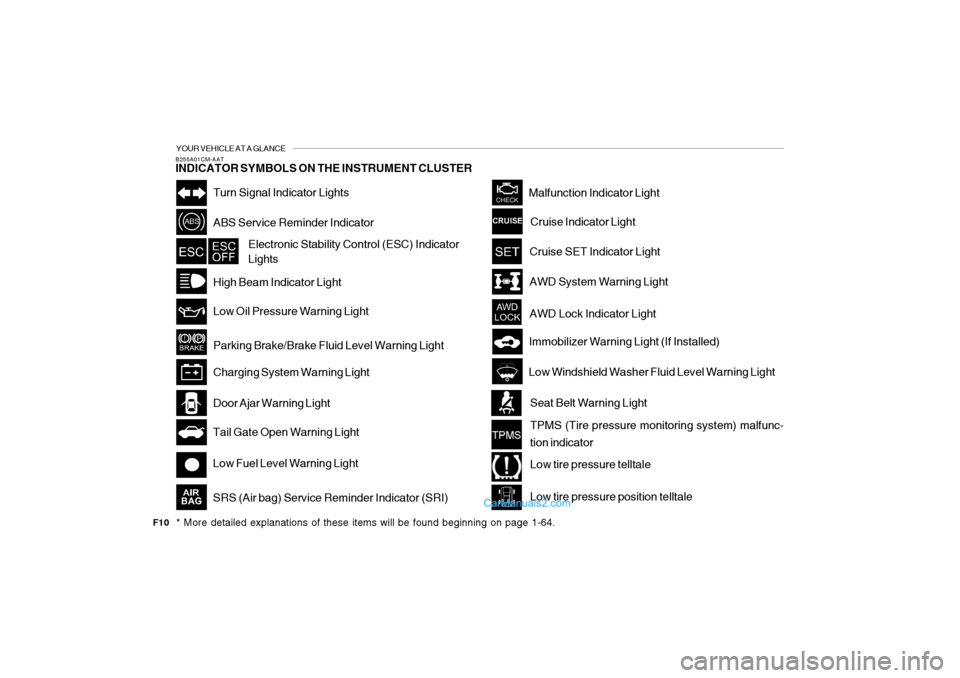
B255A01CM-AATINDICATOR SYMBOLS ON THE INSTRUMENT CLUSTER* More detailed explanations of these items will be found beginning on page 1-64.
AWD System Warning LightMalfunction Indicator Light
SRS (Air bag) Service Reminder Indicator (SRI) Tail Gate Open Warning LightLow Fuel Level Warning LightDoor Ajar Warning LightABS Service Reminder IndicatorTurn Signal Indicator LightsHigh Beam Indicator Light
Low Oil Pressure Warning Light
Parking Brake/Brake Fluid Level Warning Light
Charging System Warning LightImmobilizer Warning Light (If Installed)
AWD Lock Indicator LightCruise SET Indicator LightCruise Indicator LightLow Windshield Washer Fluid Level Warning Light
Seat Belt Warning Light
Electronic Stability Control (ESC) Indicator
Lights
TPMS (Tire pressure monitoring system) malfunc-
tion indicatorLow tire pressure telltale
Low tire pressure position telltale
Page 13 of 355
1
Fuel Recommendations ................................................ 1-2
Breaking in Your New Hyundai ..................................... 1-3
Keys.............................................................................. 1-3
Door .............................................................................. 1-7
Power Windows..........................................................1-14
Seats...........................................................................1-16
Seat Belts....................................................................1-27
Child Restraint System ...............................................1-33
Supplemental Restraint (AIR BAG) system ................1-44
Instrument Cluster and Indicator Lights...................... 1-62
Warning and Indicator Lights......................................1-64
Multi-Function Light Switch .........................................1-76
Windshield Wiper/Washer Switch...............................1-79
Sunroof.......................................................................1-89
Mirror...........................................................................1-97
Luggage Compartment ..............................................1-109
Hood Release ...........................................................1-115
Cruise Control...........................................................1-120
Heating and Cooling Control .....................................1-125
Antenna.....................................................................1-143
Stereo Sound System...............................................1-144
Audio System............................................................1-147
1
FEATURES OF YOUR HYUNDAI
Page 28 of 355
1FEATURES OF YOUR HYUNDAI16
!
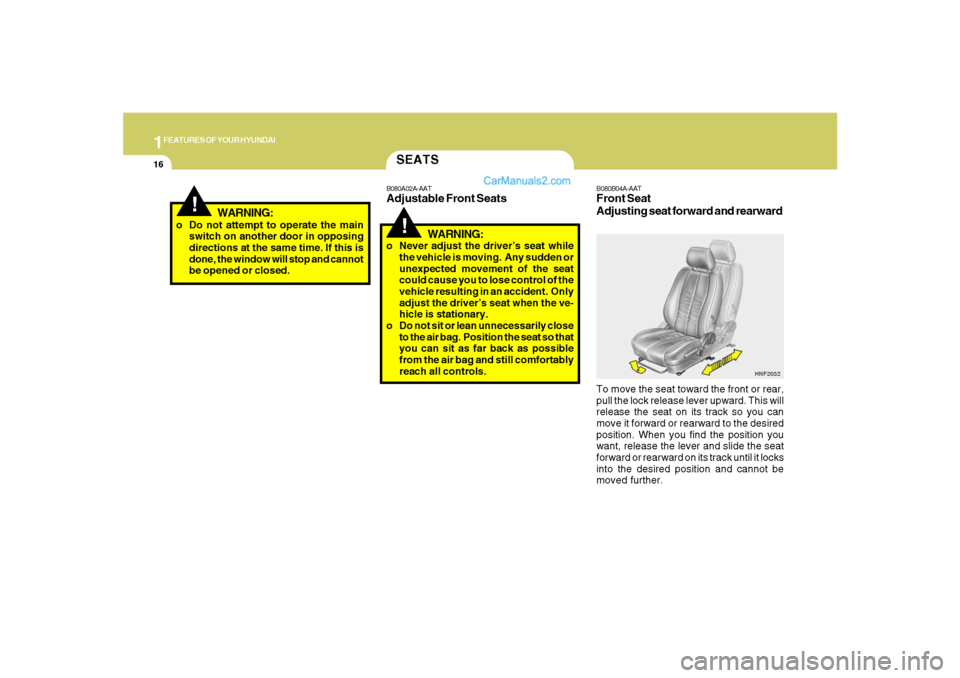
B080B04A-AATFront Seat
Adjusting seat forward and rearwardTo move the seat toward the front or rear,
pull the lock release lever upward. This will
release the seat on its track so you can
move it forward or rearward to the desired
position. When you find the position you
want, release the lever and slide the seat
forward or rearward on its track until it locks
into the desired position and cannot be
moved further.
HNF2032
SEATSB080A02A-AATAdjustable Front Seats
!
WARNING:
o Never adjust the driver’s seat while
the vehicle is moving. Any sudden or
unexpected movement of the seat
could cause you to lose control of the
vehicle resulting in an accident. Only
adjust the driver’s seat when the ve-
hicle is stationary.
o Do not sit or lean unnecessarily close
to the air bag. Position the seat so that
you can sit as far back as possible
from the air bag and still comfortably
reach all controls. o Do not attempt to operate the main
switch on another door in opposing
directions at the same time. If this is
done, the window will stop and cannot
be opened or closed.
WARNING:
Page 29 of 355
1
FEATURES OF YOUR HYUNDAI
17
HNF2033
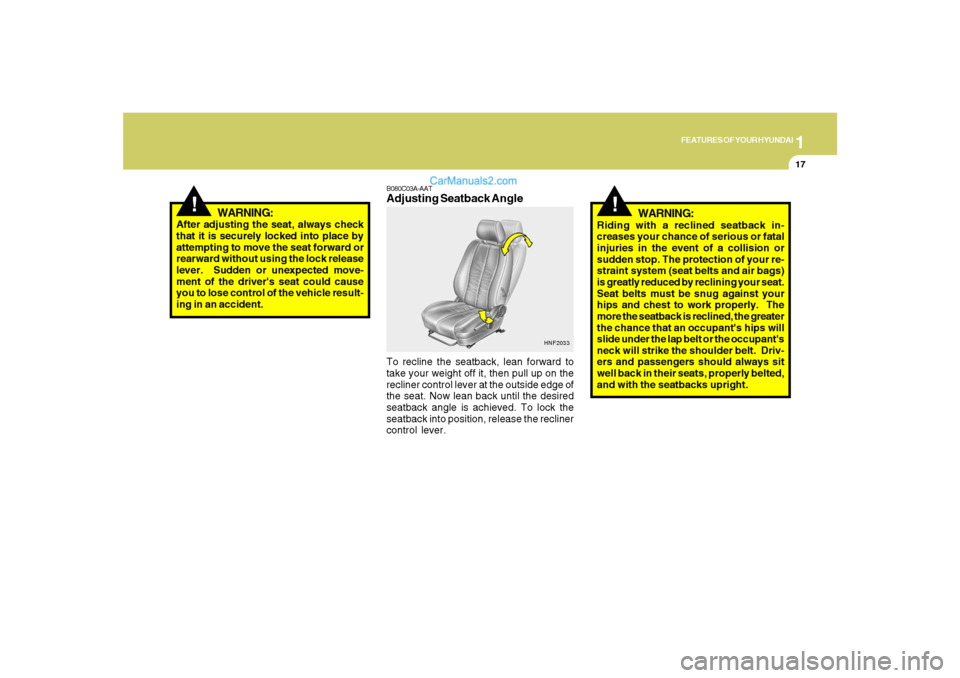
B080C03A-AATAdjusting Seatback AngleTo recline the seatback, lean forward to
take your weight off it, then pull up on the
recliner control lever at the outside edge of
the seat. Now lean back until the desired
seatback angle is achieved. To lock the
seatback into position, release the recliner
control lever.
!
WARNING:
Riding with a reclined seatback in-
creases your chance of serious or fatal
injuries in the event of a collision or
sudden stop. The protection of your re-
straint system (seat belts and air bags)
is greatly reduced by reclining your seat.
Seat belts must be snug against your
hips and chest to work properly. The
more the seatback is reclined, the greater
the chance that an occupant's hips will
slide under the lap belt or the occupant's
neck will strike the shoulder belt. Driv-
ers and passengers should always sit
well back in their seats, properly belted,
and with the seatbacks upright.
!
WARNING:
After adjusting the seat, always check
that it is securely locked into place by
attempting to move the seat forward or
rearward without using the lock release
lever. Sudden or unexpected move-
ment of the driver's seat could cause
you to lose control of the vehicle result-
ing in an accident.
Page 31 of 355
1
FEATURES OF YOUR HYUNDAI
19
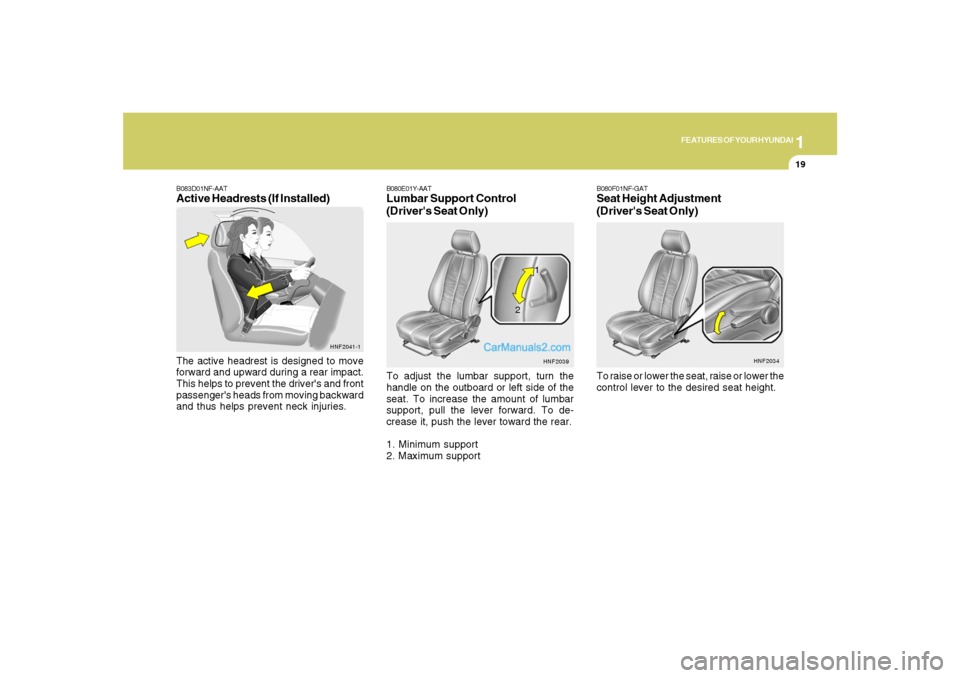
B083D01NF-AATActive Headrests (If Installed)The active headrest is designed to move
forward and upward during a rear impact.
This helps to prevent the driver's and front
passenger's heads from moving backward
and thus helps prevent neck injuries.
HNF2041-1
B080E01Y-AATLumbar Support Control
(Driver's Seat Only)To adjust the lumbar support, turn the
handle on the outboard or left side of the
seat. To increase the amount of lumbar
support, pull the lever forward. To de-
crease it, push the lever toward the rear.
1. Minimum support
2. Maximum support
HNF20391
2
B080F01NF-GATSeat Height Adjustment
(Driver's Seat Only)To raise or lower the seat, raise or lower the
control lever to the desired seat height.
HNF2034
Page 32 of 355
1FEATURES OF YOUR HYUNDAI20
!
B090A02TG-AATFront Power SeatsThe front seats can be adjusted appropri-
ately by using the control knob on the seat.
Before driving, adjust the seat to the proper
position so as to easily control the steering
wheel, pedals and switches on the instru-
ment panel.
CAUTION:
Do not operate two knobs at the same
time.
WARNING:
o Never adjust a driver’s seat while the
vehicle is moving. Any sudden or
unexpected movement of the seat
could cause you to lose control of the
vehicle resulting in an accident. Only
adjust the driver’s seat when the ve-
hicle is stationary.
o Do not sit or lean unnecessarily close
to the air bag. Position the seat so that
you can sit as far back as possible
from the air bag and still comfortably
reach all controls.
!
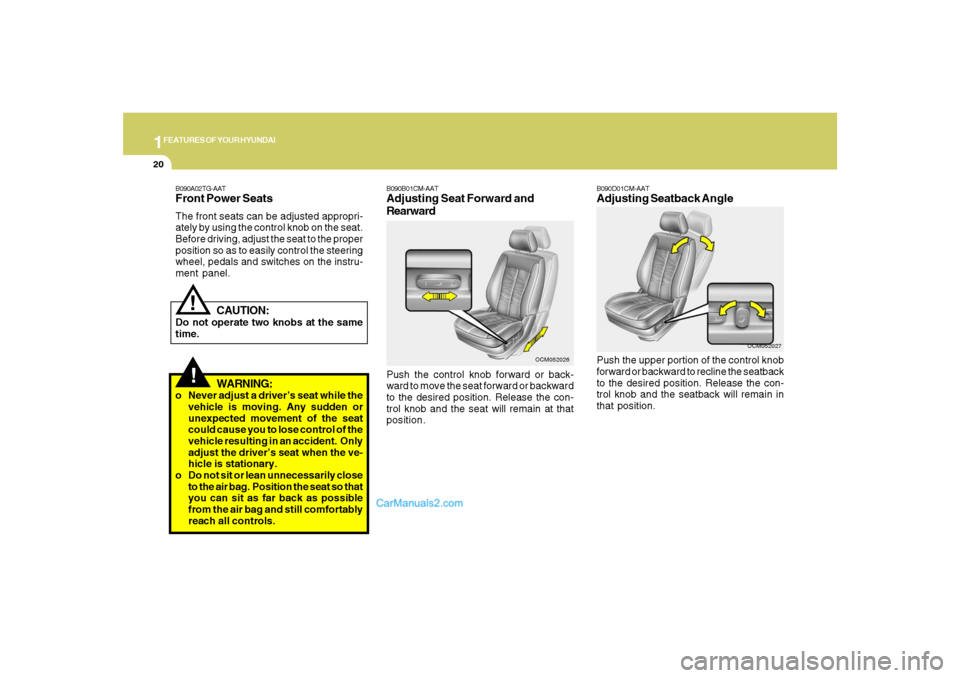
B090B01CM-AATAdjusting Seat Forward and
RearwardPush the control knob forward or back-
ward to move the seat forward or backward
to the desired position. Release the con-
trol knob and the seat will remain at that
position.
OCM052026
B090D01CM-AATAdjusting Seatback AnglePush the upper portion of the control knob
forward or backward to recline the seatback
to the desired position. Release the con-
trol knob and the seatback will remain in
that position.
OCM052027
Page 33 of 355
1
FEATURES OF YOUR HYUNDAI
21
!
WARNING:
Riding with a reclined seatback in-
creases your chance of serious or fatal
injuries in the event of a collision or
sudden stop. The protection of your
restraint system (seat belts and air
bags) is greatly reduced by reclining
your seat. Seat belts must be snug
against your hips and chest to work
properly. The more the seatback is re-
clined, the greater the chance that an
occupant's hips will slide under the lap
belt or the occupant's neck will strike the
shoulder belt. Drivers and passengers
should always sit well back in their seats,
properly belted, and with the seatbacks
upright.
B090C01Y-AATSeat Cushion Height Adjustment
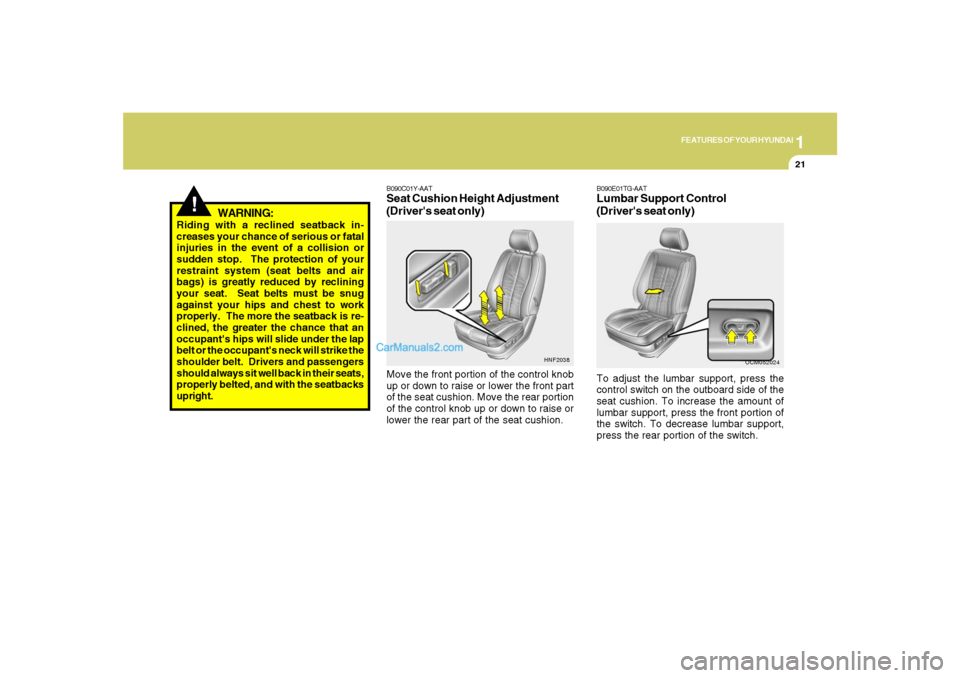
(Driver's seat only)Move the front portion of the control knob
up or down to raise or lower the front part
of the seat cushion. Move the rear portion
of the control knob up or down to raise or
lower the rear part of the seat cushion.
HNF2038
B090E01TG-AATLumbar Support Control
(Driver's seat only)To adjust the lumbar support, press the
control switch on the outboard side of the
seat cushion. To increase the amount of
lumbar support, press the front portion of
the switch. To decrease lumbar support,
press the rear portion of the switch.
OCM052024
Page 53 of 355
1
FEATURES OF YOUR HYUNDAI
41
OMG035300
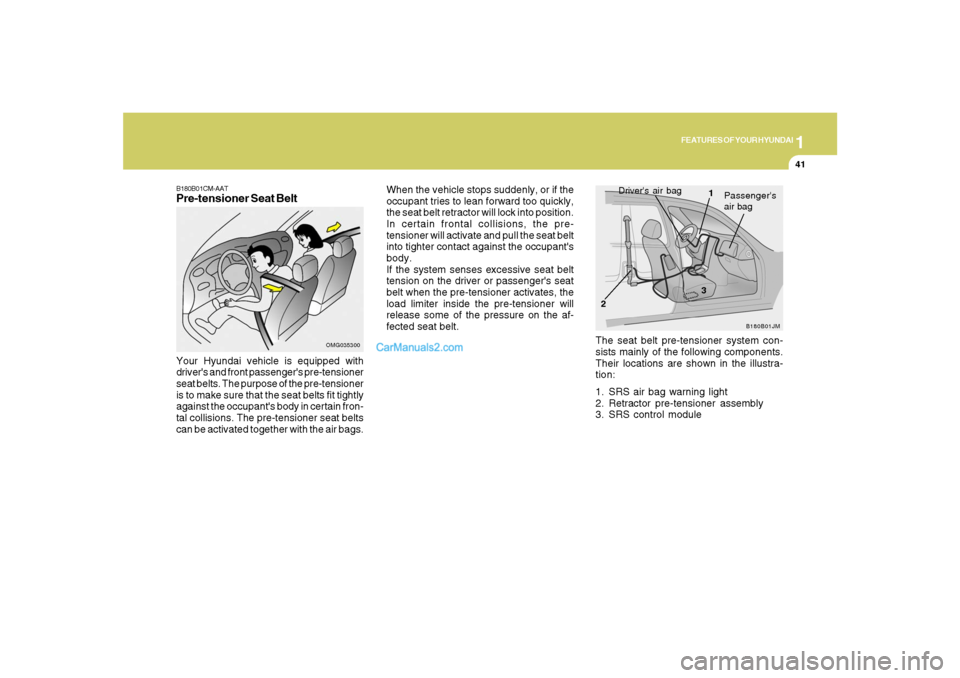
Your Hyundai vehicle is equipped with
driver's and front passenger's pre-tensioner
seat belts. The purpose of the pre-tensioner
is to make sure that the seat belts fit tightly
against the occupant's body in certain fron-
tal collisions. The pre-tensioner seat belts
can be activated together with the air bags.B180B01CM-AATPre-tensioner Seat Belt
The seat belt pre-tensioner system con-
sists mainly of the following components.
Their locations are shown in the illustra-
tion:
1. SRS air bag warning light
2. Retractor pre-tensioner assembly
3. SRS control module
B180B01JM
Driver's air bag
1
2
Passenger's
air bag
3
When the vehicle stops suddenly, or if the
occupant tries to lean forward too quickly,
the seat belt retractor will lock into position.
In certain frontal collisions, the pre-
tensioner will activate and pull the seat belt
into tighter contact against the occupant's
body.
If the system senses excessive seat belt
tension on the driver or passenger's seat
belt when the pre-tensioner activates, the
load limiter inside the pre-tensioner will
release some of the pressure on the af-
fected seat belt.
Page 57 of 355
1
FEATURES OF YOUR HYUNDAI
45
The SRS uses a collection of sensors to
gather information about the driver's and
front passenger's seat position, the driver's
and front passenger's seat belt usage and
impact severity.
The driver's seat position sensors, which
are installed on the seat track, determine
if the seats are fore or aft of a reference
position. Similarly, the seat belt usage
sensors determine if the driver and front
passenger's seat belts are fastened. These
sensors provide the ability to control the
SRS deployment based on how close the
driver's seat is to the steering wheel,
whether or not the seat belts are fastened,
and how severe the impact is.
The advanced SRS offers the ability to
control the air bag inflation with two levels.
A first stage level is provided for moderate-
severity impacts. A second stage level is
provided for more severe impacts.According to the impact severity, driver's
seating position, the SRSCM(SRS Con-
trol Module) controls the air bag inflation.
Failure to properly wear seat belts can
increase the risk or severity of injury in an
accident.
Additionally, your Hyundai is equipped
with an occupant classification system in
the front passenger's seat. The occupant
classification system detects the presence
of a passenger in the front passenger's
seat and will turn off the front passenger's
air bag under certain conditions. For more
detail, see "Occupant Classification Sys-
tem" later in this section.
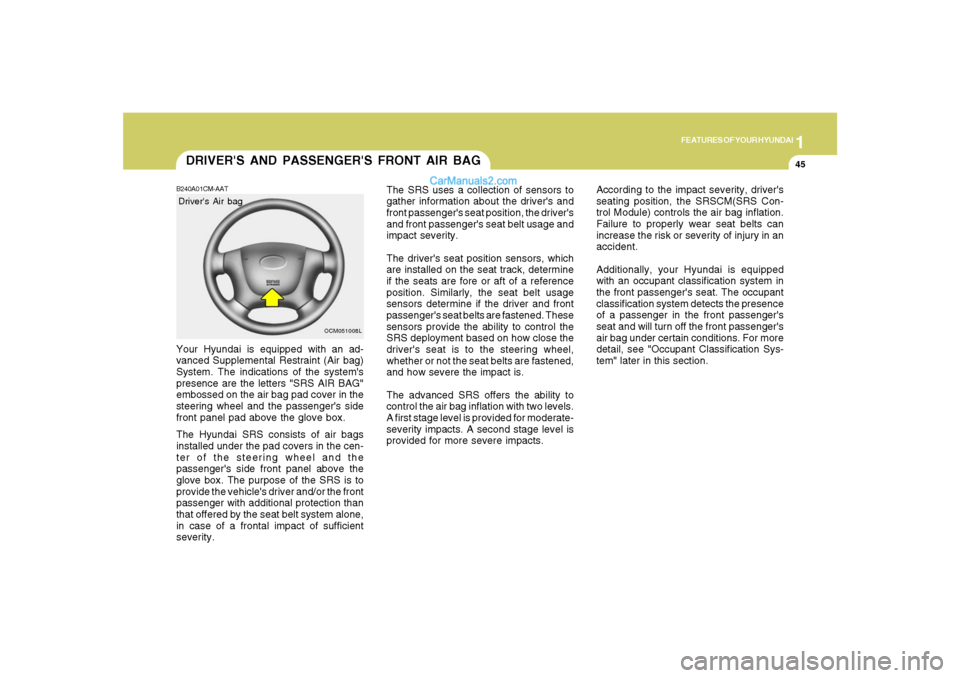
DRIVER'S AND PASSENGER'S FRONT AIR BAGB240A01CM-AATYour Hyundai is equipped with an ad-
vanced Supplemental Restraint (Air bag)
System. The indications of the system's
presence are the letters "SRS AIR BAG"
embossed on the air bag pad cover in the
steering wheel and the passenger's side
front panel pad above the glove box.
The Hyundai SRS consists of air bags
installed under the pad covers in the cen-
ter of the steering wheel and the
passenger's side front panel above the
glove box. The purpose of the SRS is to
provide the vehicle's driver and/or the front
passenger with additional protection than
that offered by the seat belt system alone,
in case of a frontal impact of sufficient
severity.
OCM051008L
Driver's Air bag