engine Hyundai Santa Fe 2008 Service Manual
[x] Cancel search | Manufacturer: HYUNDAI, Model Year: 2008, Model line: Santa Fe, Model: Hyundai Santa Fe 2008Pages: 355, PDF Size: 12.36 MB
Page 220 of 355
2
DRIVING YOUR HYUNDAI
9
C070D04O-AATGood Driving Practiceso Never take the car out of gear and coast
down a hill. This is extremely hazard-
ous. Always leave the car in gear.
o Don't "ride" the brakes. This can cause
them to overheat and malfunction. In-
stead, when you are driving down a
long hill, slow down and shift to a lower
gear. When you do this, engine braking
will help slow the car.
o Slow down before shifting to a lower
gear. This will help avoid over-revving
the engine, which can cause damage.
o Slow down when you encounter cross
winds. This gives you much better con-
trol of your car.
o Be sure the car is completely stopped
before you attempt to shift into reverse.
The transaxle can be damaged if you do
not. To shift into reverse, depress the
clutch, move the shift lever to neutral,
wait three seconds, then shift to the
reverse position.
o Exercise extreme caution when driving
on a slippery surface. Be especially
careful when braking, accelerating or
shifting gears. On a slippery surface, an
abrupt change in vehicle speed can
cause the drive wheels to lose traction
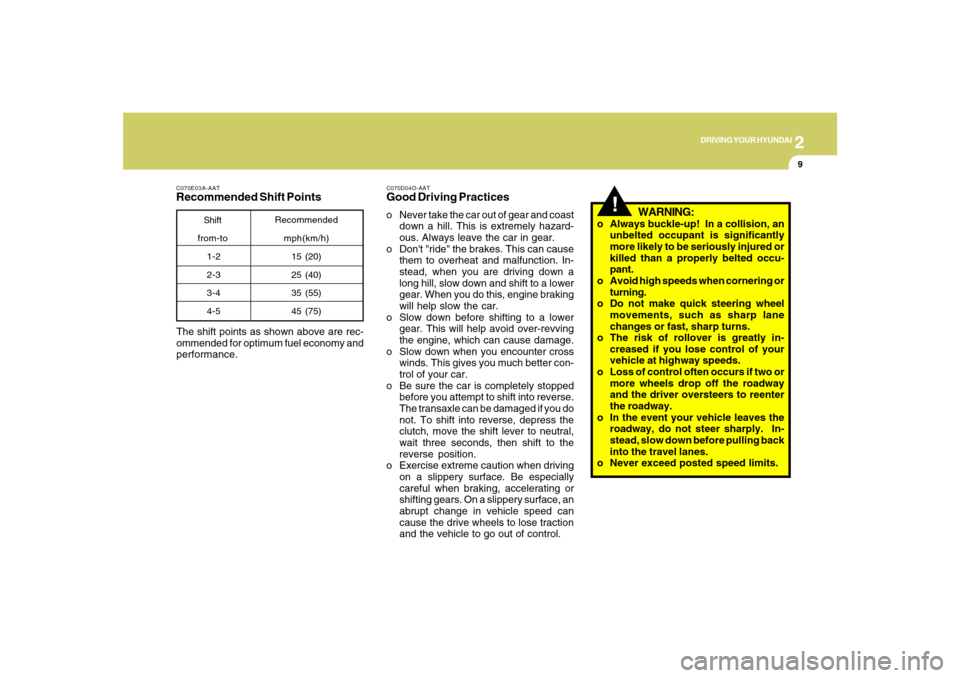
and the vehicle to go out of control. The shift points as shown above are rec-
ommended for optimum fuel economy and
performance.
C070E03A-AATRecommended Shift Points
Shift
from-toRecommended
mph(km/h)
15 (20)
25 (40)
35 (55)
45 (75) 1-2
2-3
3-4
4-5
!
WARNING:
o Always buckle-up! In a collision, an
unbelted occupant is significantly
more likely to be seriously injured or
killed than a properly belted occu-
pant.
o Avoid high speeds when cornering or
turning.
o Do not make quick steering wheel
movements, such as sharp lane
changes or fast, sharp turns.
o The risk of rollover is greatly in-
creased if you lose control of your
vehicle at highway speeds.
o Loss of control often occurs if two or
more wheels drop off the roadway
and the driver oversteers to reenter
the roadway.
o In the event your vehicle leaves the
roadway, do not steer sharply. In-
stead, slow down before pulling back
into the travel lanes.
o Never exceed posted speed limits.
Page 222 of 355
2
DRIVING YOUR HYUNDAI
11
C090B02A-AATThe function of each position is as
follows:
o P (Park):Use to hold the vehicle in place when
parked or while starting the engine. When-
ever parking the car, apply the parking
brake and shift the selector lever to the "P"
(Park) position.
CAUTION:
Never place the selector lever in the "P"
(Park) position unless the vehicle is fully
stopped. Failure to observe this caution
will cause severe damage to the
transaxle.
!
C090D02A-AATo N (Neutral):In the "N" position, the transaxle is in neu-
tral, which means that no gears are en-
gaged. The engine can be started with the
shift lever in "N" position, although this is
not recommended except if the engine
stalls while the car is moving.C090E01CM-GATo D (Drive):Use for normal driving. Bring the car to a
complete stop before shifting the selector
to "D" position. The transaxle will automati-
cally shift through a four/five gear se-
quence.C090C01A-AATo R (Reverse):Use for backing up the vehicle. Bring the
car to a complete stop before shifting the
selector lever to "R" position.
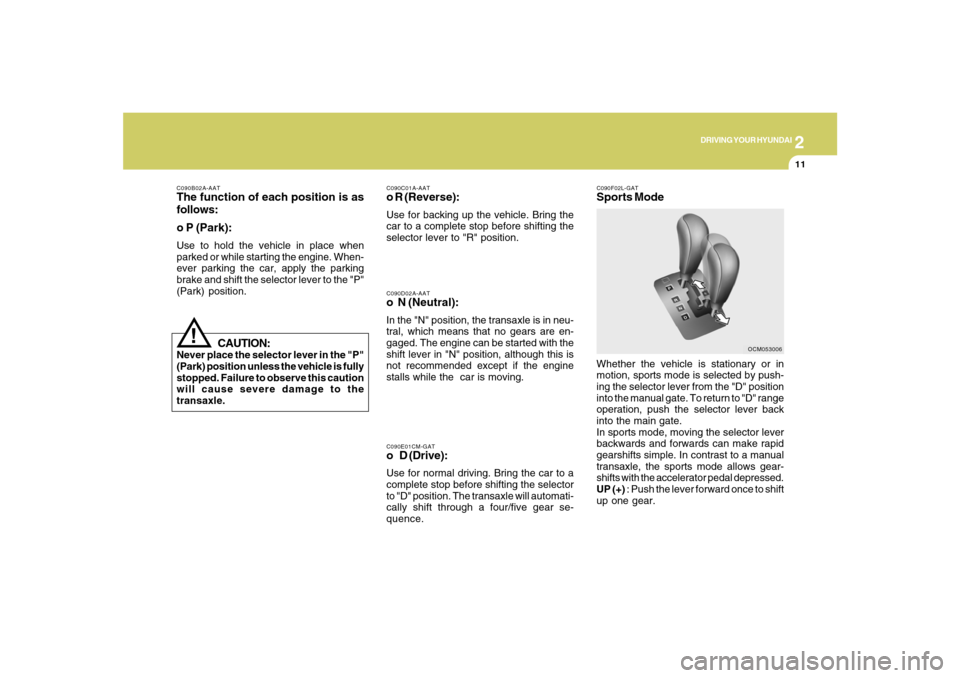
C090F02L-GATSports ModeWhether the vehicle is stationary or in
motion, sports mode is selected by push-
ing the selector lever from the "D" position
into the manual gate. To return to "D" range
operation, push the selector lever back
into the main gate.
In sports mode, moving the selector lever
backwards and forwards can make rapid
gearshifts simple. In contrast to a manual
transaxle, the sports mode allows gear-
shifts with the accelerator pedal depressed.
UP (+) : Push the lever forward once to shift
up one gear.
OCM053006
Page 223 of 355

2
DRIVING YOUR HYUNDAI
12
C090H01L-GATNOTE:o For smooth and safe operation, de-
press the brake pedal when shifting
from "Neutral" position or "Park"
position to a forward or reverse gear.
o The ignition key must be in the "ON"
position and the brake pedal fully de-
pressed in order to move the shift
lever from the "P" (Park) position to
any of the other positions.
o It is always possible to shift from "R",
"N", or "D" position to "P" position.
The vehicle must be fully stopped to
avoid transaxle damage. DOWN (-) : Pull the lever backwards once
to shift down one gear.
SKIP : By rapidly moving the selector for-
ward or backward twice, it is possible to
skip one gear, i.e. 1st to 3rd or 3rd to 1st .
CAUTION:
o In sports mode, the driver must ex-
ecute upward shifts in accordance
with prevailing road conditions, tak-
ing care to keep the engine speed
below the red zone.
o For engine protection, upward shifts
are made automatically when the
engine rpm reaches the red zone.
o By rapidly moving the selector lever
backwards (-) twice it is possible to
skip one gear, i.e., 3rd to 1st, 4th to 2nd
or 5th to 3rd. Since sudden engine
braking and/or rapid acceleration can
cause a loss of traction, however,
downshifts must be made carefully in
accordance with the vehicle's speed.
NOTE:o In sports mode, only the four/five for-
ward gears can be selected. To re-
verse or park the vehicle, move the
selector lever to the "R" or "P" posi-
tion as required.
o In sports mode, downward shifts are
made automatically when the vehicle
slows down. When the vehicle stops,
1st gear is automatically selected.
o To maintain the required levels of
vehicle performance and safety, the
system may not execute certain gear-
shifts when the selector lever is oper-
ated.
o Before driving away from a stop on a
slippery road, push the selector lever
forward into the +(UP) position. This
causes the transaxle to shift into 2nd
gear which is better for smooth driv-
ing away on a slippery road. Push the
selector lever to the -(DOWN) side to
shift back to 1st gear.
!
Page 224 of 355
2
DRIVING YOUR HYUNDAI
13
C090I01CM-GAT
CAUTION:
o Shift into "R", "D" and "P" position
only when the vehicle has completely
stopped.
o Do not accelerate the engine in re-
verse or any of the forward positions
with the brakes applied.
o Always apply the footbrake when
shifting from "P" or "N", to "R" or
"D"position.
o Do not use the "P" (Park) position in
place of the parking brake. Always
set the parking brake, shift the
transaxle into "P" (Park) position and
turn off the ignition when you leave the
vehicle, even momentarily. Never
leave the vehicle unattended while
the engine is running.
o Check the automatic transaxle fluid
level regularly, and add fluid as nec-
essary.
o See the maintenance schedule for
the proper fluid recommendation.
!
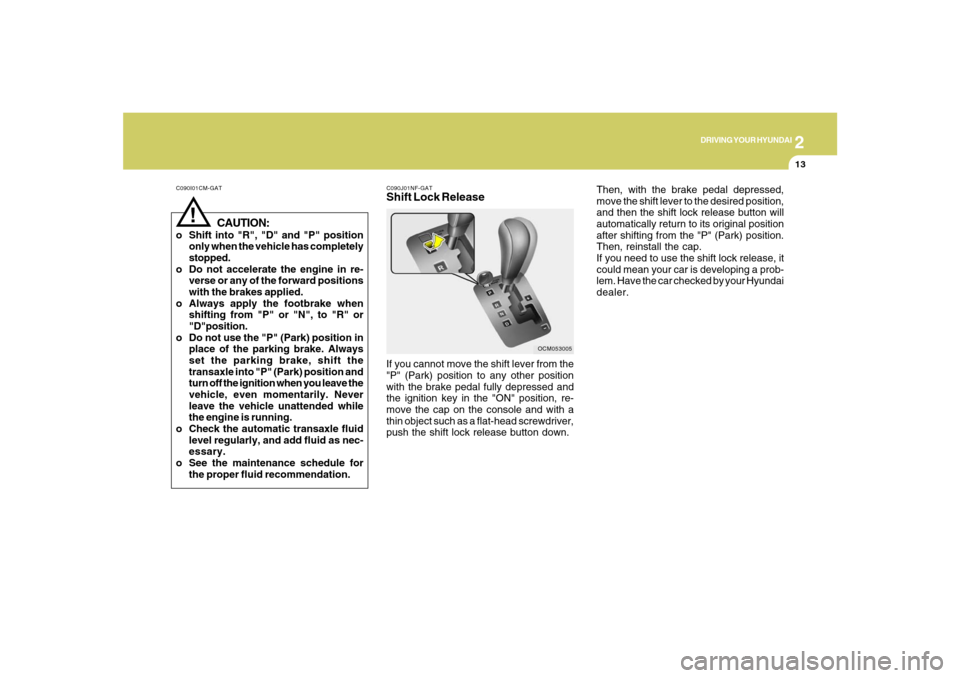
C090J01NF-GATShift Lock ReleaseIf you cannot move the shift lever from the
"P" (Park) position to any other position
with the brake pedal fully depressed and
the ignition key in the "ON" position, re-
move the cap on the console and with a
thin object such as a flat-head screwdriver,
push the shift lock release button down.
OCM053005
Then, with the brake pedal depressed,
move the shift lever to the desired position,
and then the shift lock release button will
automatically return to its original position
after shifting from the "P" (Park) position.
Then, reinstall the cap.
If you need to use the shift lock release, it
could mean your car is developing a prob-
lem. Have the car checked by your Hyundai
dealer.
Page 225 of 355
2
DRIVING YOUR HYUNDAI
14
!
WARNING:
o Always buckle-up! In a collision, an
unbelted occupant is significantly
more likely to be seriously injured or
killed than a properly belted occu-
pant.
o Avoid high speeds when cornering or
turning.
o Do not make quick steering wheel
movements, such as sharp lane
changes or fast, sharp turns.
o The risk of rollover is greatly in-
creased if you lose control of your
vehicle at highway speeds.
o Loss of control often occurs if two or
more wheels drop off the roadway
and the driver oversteers to reenter
the roadway.
o In the event your vehicle leaves the
roadway, do not steer sharply. In-
stead, slow down before pulling back
into the travel lanes.
o Never exceed posted speed limits. o Exercise extreme caution when driving
on a slippery surface. Be especially
careful when braking, accelerating or
shifting gears. On a slippery surface, an
abrupt change in vehicle speed can
cause the drive wheels to lose traction
and the vehicle to go out of control.
o Optimum vehicle performance and
economy is obtained by smoothly de-
pressing and releasing the accelerator
pedal.
C090N01CM-AATGood Driving Practiceso Never move the gear selector lever
from "P" or "N" to any other position with
the accelerator pedal depressed.
o Never move the gear selector lever into
"P" when the vehicle is in motion.
o Be sure the car is completely stopped
before you attempt to shift into "R" or "D".
o Never take the car out of gear and coast
down a hill. This may be extremely
hazardous. Always leave the car in gear
when moving.
o Do not "ride" the brakes. This can cause
them to overheat and malfunction. In-
stead, when you are driving down a
long hill, slow down and shift to a lower
gear. When you do this, engine braking
will help slow the car.
o Slow down before shifting to a lower
gear. Otherwise, the lower gear may not
be engaged.
o Always use the parking brake. Do not
depend on placing the transaxle in "P"
to keep the car from moving.
Page 226 of 355
2
DRIVING YOUR HYUNDAI
15
!
WARNING:
ABS (ESC) will not prevent accidents
due to improper or dangerous driving
maneuvers. Even though vehicle con-
trol is improved during emergency brak-
ing, always maintain a safe distance
between you and objects ahead. Vehicle
speeds should always be reduced dur-
ing extreme road conditions.
The braking distance for cars equipped
with an anti-lock braking system (Elec-
tronic Stability Control System) may be
longer than for those without it in the
following road conditions.
During these conditions the vehicle
should be driven at reduced speeds:
o Rough, gravel or snow-covered
roads.
o With tire chains installed.
o On roads where the road surface is
pitted or has different surface height.
The safety features of an ABS (ESC)
equipped vehicle should not be tested by
high speed driving or cornering. This
could endanger the safety of yourself or
others.
ANTI-LOCK BRAKE
SYSTEM (ABS)C120A01NF-AATThe Anti-Lock Brake System (ABS) is de-
signed to prevent wheel lock-up during
sudden braking or on hazardous road
surfaces. The ABS control module moni-
tors the wheel speed and controls the
pressure applied to each brake. Thus, in
emergency situations or on slick roads,
ABS will increase vehicle control during
braking.NOTE:o A click sound may be heard in the
engine compartment when the ve-
hicle begins to move after the engine
is started. These conditions are nor-
mal and indicate that the anti-lock
brake system (Electronic Stability
Control) is functioning properly.
o During ABS (ESC) operation, a pulsa-
tion may be felt in the brake pedal
when the brakes are applied. Also, a
noise may be heard in the engine
compartment while braking. These
conditions are normal and indicate
that the anti-lock brake system (Elec-
tronic Stability Control System) is
functioning properly.
ELECTRONIC STABILITY
CONTROL (ESC) SYSTEMC310A04JM-AAT(If installed)
!
WARNING:
Never drive too fast for the road condi-
tions or too quickly when cornering. Elec-
tronic stability control (ESC) will not pre-
vent accidents. Excessive speed in
turns, abrupt maneuvers and hydroplan-
ing on wet surfaces can still result in
serious accidents. Only a safe and at-
tentive driver can prevent accidents by
avoiding maneuvers that cause the ve-
hicle to lose traction. Even with ESC
installed, always follow all the normal
precautions for driving - including driv-
ing at safe speeds for the conditions.
Page 227 of 355
2
DRIVING YOUR HYUNDAI
16
!
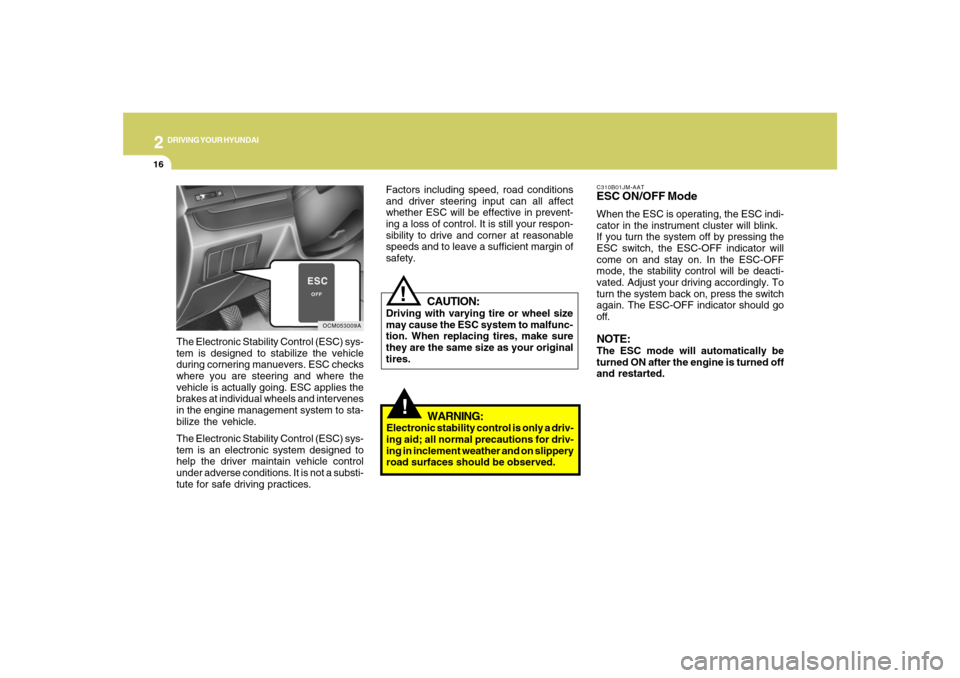
C310B01JM-AATESC ON/OFF ModeWhen the ESC is operating, the ESC indi-
cator in the instrument cluster will blink.
If you turn the system off by pressing the
ESC switch, the ESC-OFF indicator will
come on and stay on. In the ESC-OFF
mode, the stability control will be deacti-
vated. Adjust your driving accordingly. To
turn the system back on, press the switch
again. The ESC-OFF indicator should go
off.NOTE:The ESC mode will automatically be
turned ON after the engine is turned off
and restarted.
OCM053009A
The Electronic Stability Control (ESC) sys-
tem is designed to stabilize the vehicle
during cornering manuevers. ESC checks
where you are steering and where the
vehicle is actually going. ESC applies the
brakes at individual wheels and intervenes
in the engine management system to sta-
bilize the vehicle.
The Electronic Stability Control (ESC) sys-
tem is an electronic system designed to
help the driver maintain vehicle control
under adverse conditions. It is not a substi-
tute for safe driving practices.
CAUTION:
Driving with varying tire or wheel size
may cause the ESC system to malfunc-
tion. When replacing tires, make sure
they are the same size as your original
tires.
!
Factors including speed, road conditions
and driver steering input can all affect
whether ESC will be effective in prevent-
ing a loss of control. It is still your respon-
sibility to drive and corner at reasonable
speeds and to leave a sufficient margin of
safety.
WARNING:
Electronic stability control is only a driv-
ing aid; all normal precautions for driv-
ing in inclement weather and on slippery
road surfaces should be observed.
Page 228 of 355
2
DRIVING YOUR HYUNDAI
17
FULL-TIME AWD OPERATIONC350A01CM-AAT(If installed)Engine power can be delivered to all
wheels. Full-time AWD (All Wheel Drive) is
useful when good traction is required, such
as when driving on slippery, wet or snow-
covered roads and when moving out of
mud. Your vehicle is not designed for chal-
lenging off-road use. Full-time AWD ve-
hicles are designed primarily to improve
traction and performance on paved roads
and highways in wet and/or slippery con-
ditions. Occasional off-road use such as
established unpaved roads and trails is
considered normal use. It is always impor-
tant when traveling off-highway that the
driver carefully reduce their speed to a
level that does not exceed the safe oper-
ating speed for those conditions. In gen-
eral, off-road conditions provide less trac-
tion and braking effectiveness than on
road conditions. These factors must be
carefully considered when driving off-road.
Keeping the vehicle in contact with the
driving surface and under control in these
conditions is always the driver's responsi-
bility for the safety of him/herself and his or
her passengers.
C310D01JM-AATIndicators and WarningThe indicators should illuminate when the
ignition key is turned to ON or START but
should go out after three seconds.
If the indicators do not illuminate, or the
ESC or ESC-OFF indicator does not go out
after 3 seconds, have the vehicle checked
by an authorized dealer.
Should there be any unusual conditions in
the device while driving, ESC-OFF indica-
tor illuminates as a warning.
If ESC-OFF indicator illuminates, pull your
car to a safe place and stop the engine.
Then, start the engine again to check if the
ESC-OFF indicator goes out.
If the indicator remains lit even after the
engine has been started, have your car
checked by an authorized Hyundai dealer.
!
WARNING:
This vehicle is designed primarily for on
road use. Driving the vehicle in challeng-
ing off-road conditions may result in
damage to the vehicle. Driving in condi-
tions that exceed the vehicle's intended
design or the driver's experience level
may result in severe injury or death.
Page 231 of 355
2
DRIVING YOUR HYUNDAI
20
!
CAUTION:
If one of the front or rear wheels begins
to spin in mud, snow, etc., the vehicle can
sometimes be driven out by depressing
the accelerator pedal further; however,
avoid running the engine continuously at
high rpm because doing so could dam-
age the AWD system. (10)When using tire chains, always at-
tach them to the four wheels. In some
unavoidable circumstances, install
them on only the front wheels, not the
rear wheels.
(11) If the front or rear wheels get stuck in
the mud, do not spin them recklessly.
The AWD system could be damaged.
!
WARNING:
o Avoid high cornering speeds.
o Do not make quick steering wheel
movements, such as sharp lane
charges or fast, sharp turns.
o The risk of rollover is greatly in-
creased if you lose control of your
vehicle at highway speeds.
o While the full-time AWD vehicle is
being raised on a jack, never start the
engine or cause the tires to rotate.
There is danger that rotating tires
touching the ground could cause the
vehicle to go off the jack and to jump
forward.
o In a collision, an unbelted person is
signicantly more likely to be seriously
injured or killed than a person wearing
a seat belt.
o Loss of control may occurs if two or
more wheels drop off the roadway
and the driver oversteers to reenter
the roadway.
o In the event your vehicle leaves the
roadway, do not steer sharply. Instead,
slow down before pulling back into the
travel lanes.
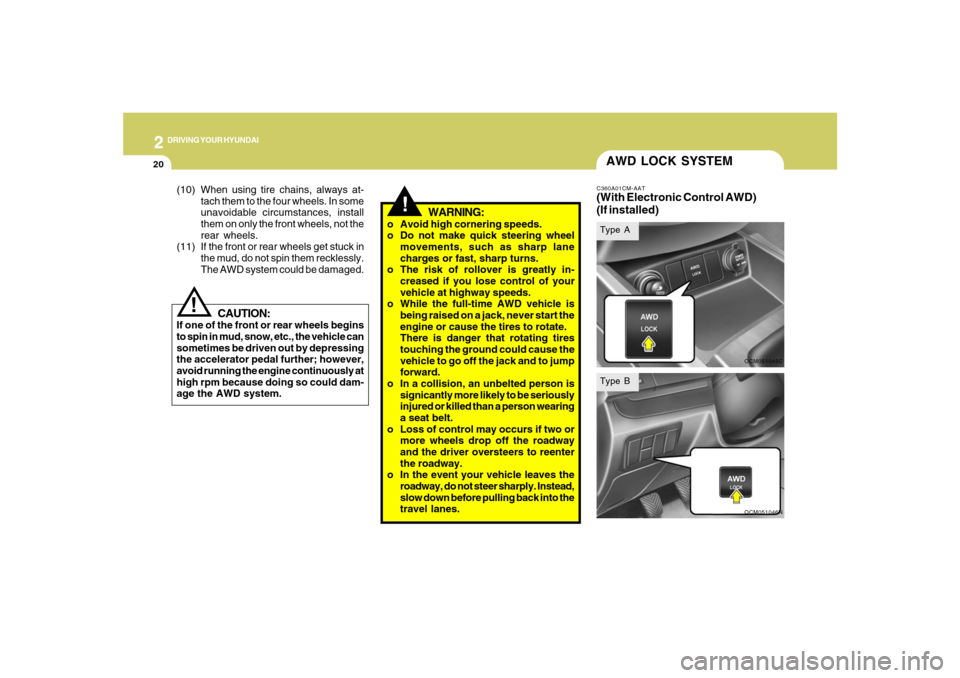
AWD LOCK SYSTEMC360A01CM-AAT(With Electronic Control AWD)
(If installed)
OCM051045COCM051046N
Type AType B
Page 233 of 355

2
DRIVING YOUR HYUNDAI
22
o If a tire goes flat while you are driving,
apply the brakes gently and keep the
car pointed straight ahead while you
slow down. When you are moving slowly
enough for it to be safe to do so, pull off
the road and stop in a safe place.
o If your car is equipped with an automatic
transaxle, don't let your car creep for-
ward. To avoid creeping forward, keep
your foot firmly on the brake pedal when
the car is stopped.
o Use caution when parking on a hill.
Firmly engage the parking brake and
place the gear selector lever in "P" (au-
tomatic transaxle) or in first or reverse
gear (manual transaxle). If your car is
facing downhill, turn the front wheels
into the curb to help keep the car from
rolling. If your car is facing uphill, turn
the front wheels away from the curb to
help keep the car from rolling. If there is
no curb or if it is required by other
conditions to keep the car from rolling,
block the wheels. o After being parked, check to be sure the
parking brake is not engaged and that
the parking brake indicator light is out
before driving away.
o Driving through water may get the
brakes wet. They can also get wet when
the car is washed. Wet brakes can be
dangerous! Your car will not stop as
quickly if the brakes are wet. Wet brakes
may cause the car to pull to one side. To
dry the brakes, apply the brakes lightly
while driving slowly until the braking
action returns to normal, taking care to
keep the car under control at all times.
If the braking action does not return to
normal, stop as soon as it is safe to do
so and call your Hyundai dealer for
assistance.
o Don't coast down hills with the car out of
gear. This is extremely hazardous. Keep
the car in gear at all times, use the
brakes to slow down, then shift to a
lower gear so that engine braking will
help you maintain a safe speed.
o Don't "ride" the brake pedal. Resting
your foot on the brake pedal while driv-
ing can be dangerous because it can
result in the brakes overheating and
losing their effectiveness. It also in-
creases the wear of the brake compo-
nents.o Under some conditions your parking
brake can freeze in the engaged posi-
tion. This is most likely to happen when
there is an accumulation of snow or ice
around or near the rear brakes or if the
brakes are wet. If there is a risk that the
parking brake may freeze, apply it only
temporarily while you put the gear se-
lector lever in "P" (automatic) or in first
or reverse gear (manual transaxle) and
block the rear wheels so the car cannot
roll. Then release the parking brake.
o Do not hold the vehicle on the upgrade
with the accelerator pedal. This can
cause the transaxle to overheat. Al-
ways use the brake pedal or parking
brake.