vent Hyundai Santa Fe 2008 Manual Online
[x] Cancel search | Manufacturer: HYUNDAI, Model Year: 2008, Model line: Santa Fe, Model: Hyundai Santa Fe 2008Pages: 355, PDF Size: 12.36 MB
Page 308 of 355
6
DO-IT-YOURSELF MAINTENANCE
22
If electrolyte gets on your skin,
thoroughly wash the contacted
area.
If you feel a pain or a burning
sensation, get medical atten-
tion immediately.
Wear eye protection when
charging or working near a bat-
tery.
Always provide ventilation
when working in an enclosed
space.
o When lifting a plastic-cased battery,
excessive pressure on the case may
cause battery acid to leak, resulting in
personal injury. Lift with a battery
carrier or with your hands on opposite
corners.
o Never attempt to charge the battery
when the battery cables are con-
nected.
o The electrical ignition system works
with high voltage.
Never touch these components with
the engine running or the ignition
switched on.
!
WARNING:
CHECKING ELECTRIC
COOLING FANS!
G220A01A-AAT
WARNING:
The cooling fan is controlled by engine
coolant temperature and may some-
times operate even when the engine is
not running. Use extreme caution when
working near the blades of the cooling
fan, so that you are not injured by a
rotating fan blade. As the engine coolant
temperature decreases the fan will au-
tomatically shut off. This is a normal
condition.
G220C01A-AATChecking Condenser Cooling FanThe condenser cooling fan should come
on automatically whenever the air condi-
tioning is in operation.G220B01A-AATChecking Engine Cooling FanThe engine cooling fan should come on
automatically if the engine coolant tem-
perature is high.
Page 323 of 355
7
EMISSION CONTROL SYSTEMS2
EMISSION CONTROL SYSTEM
H010B01A-AAT1. Crankcase Emission Control
SystemThe positive crankcase ventilation system
is employed to prevent air pollution caused
by blow-by gases being emitted from the
crankcase. This system supplies filtered
air to the crankcase through the air intake
hose. Inside the crankcase, the fresh air
mixes with blow-by gases, which then pass
through the PCV valve and into the induc-
tion system.
H010A01NF-AATYour Hyundai is equipped with an emis-
sion control system to meet all emission
regulations.
There are three emission control systems
which are as follows.
(1) Crankcase emission control system
(2) Evaporative emission control system
(3) Exhaust emission control system
In order to assure the proper function of the
emission control systems, it is recom-
mended that you have your car inspected
and maintained by an authorized Hyundai
dealer in accordance with the maintenance
schedule in this manual.
Caution for the Inspection and Mainte-
nance Test (With Electronic Stability
Control (ESC) system)
o To prevent the vehicle from misfiring
during dynamometer testing, turn the
Electronic Stability Control (ESC) sys-
tem off by pressing the ESC switch.
o After dynamometer testing is com-
pleted, turn the ESC system back on
by pressing the ESC switch again.
H010C01S-AAT2. Evaporative Emission Control (In-
cluding ORVR: Onboard Refuel-
ing Vapor Recovery) SystemThe Evaporative Emission Control Sys-
tem is designed to prevent fuel vapors from
escaping into the atmosphere.
(The ORVR system is designed to allow
the vapors from the fuel tank to be loaded
into a canister while refueling at the gas
station, preventing the escape of fuel va-
pors into the atmosphere.)CanisterFuel vapors generated inside the fuel tank
are absorbed and stored in the canister.
When the engine is running, the fuel va-
pors absorbed in the canister are drawn
into the induction system through the purge
control solenoid valve.
Cmhma-7.p653/17/2006, 10:29 AM 2
Page 331 of 355
8
CONSUMER INFORMATION, REPORTING SAFETY DEFECTS & BINDING ARBITRATION OF WARRANTY CLAIMS6
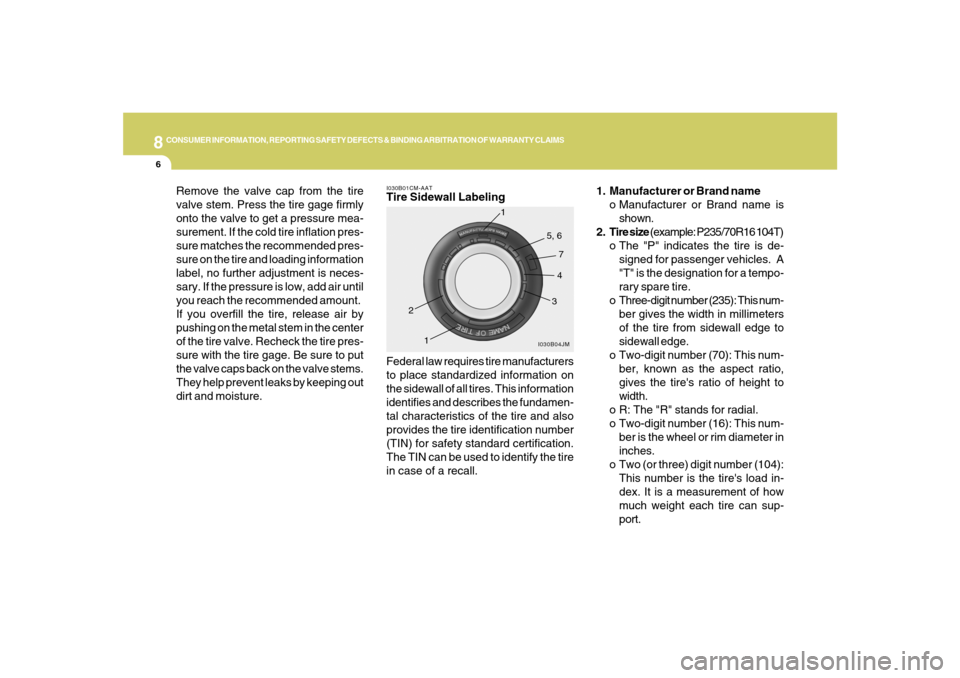
1. Manufacturer or Brand name
o Manufacturer or Brand name is
shown.
2. Tire size (example: P235/70R16 104T)
o The "P" indicates the tire is de-
signed for passenger vehicles. A
"T" is the designation for a tempo-
rary spare tire.
o Three-digit number (235): This num-
ber gives the width in millimeters
of the tire from sidewall edge to
sidewall edge.
o Two-digit number (70): This num-
ber, known as the aspect ratio,
gives the tire's ratio of height to
width.
o R: The "R" stands for radial.
o Two-digit number (16): This num-
ber is the wheel or rim diameter in
inches.
o Two (or three) digit number (104):
This number is the tire's load in-
dex. It is a measurement of how
much weight each tire can sup-
port.
Federal law requires tire manufacturers
to place standardized information on
the sidewall of all tires. This information
identifies and describes the fundamen-
tal characteristics of the tire and also
provides the tire identification number
(TIN) for safety standard certification.
The TIN can be used to identify the tire
in case of a recall.I030B01CM-AATTire Sidewall Labeling
I030B04JM
1
234 5, 6
7
1
Remove the valve cap from the tire
valve stem. Press the tire gage firmly
onto the valve to get a pressure mea-
surement. If the cold tire inflation pres-
sure matches the recommended pres-
sure on the tire and loading information
label, no further adjustment is neces-
sary. If the pressure is low, add air until
you reach the recommended amount.
If you overfill the tire, release air by
pushing on the metal stem in the center
of the tire valve. Recheck the tire pres-
sure with the tire gage. Be sure to put
the valve caps back on the valve stems.
They help prevent leaks by keeping out
dirt and moisture.
Page 336 of 355
8
CONSUMER INFORMATION, REPORTING SAFETY DEFECTS & BINDING ARBITRATION OF WARRANTY CLAIMS
11
!
WARNING:
o When driving on roads covered
with snow or ice, drive at less than
20 mph.
o Use the SAE "S" class or wire &
plastic chains.
o Don't use a tire chains on a vehicle
equipped with aluminium wheels
to prevent damage to the wheel
finish. If it is unavoidable, use
wire type chains.
o Use wire chains less than 15mm to
prevent damage to the chain's
connection.
o If you hear noise caused by chains
contacting the body, retighten the
chains to avoid contact with the
vehicle body.
o To prevent body damage, retighten
the chains after driving 0.3~0.6
miles.
!
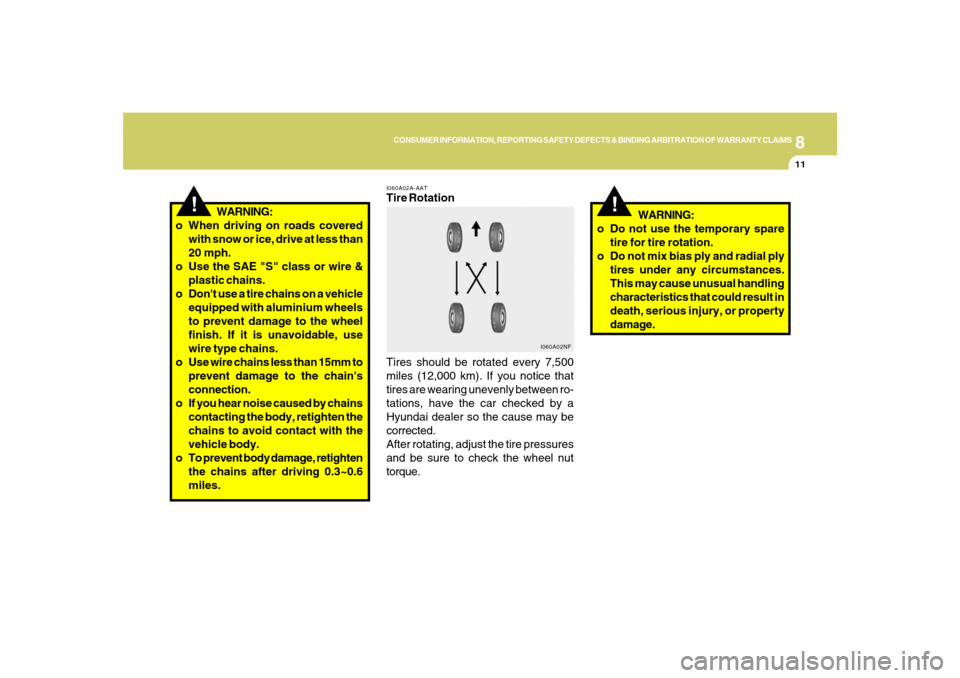
I060A02A-AATTire Rotation
Tires should be rotated every 7,500
miles (12,000 km). If you notice that
tires are wearing unevenly between ro-
tations, have the car checked by a
Hyundai dealer so the cause may be
corrected.
After rotating, adjust the tire pressures
and be sure to check the wheel nut
torque.WARNING:
o Do not use the temporary spare
tire for tire rotation.
o Do not mix bias ply and radial ply
tires under any circumstances.
This may cause unusual handling
characteristics that could result in
death, serious injury, or property
damage.
I060A02NF
Page 342 of 355
8
CONSUMER INFORMATION, REPORTING SAFETY DEFECTS & BINDING ARBITRATION OF WARRANTY CLAIMS
17
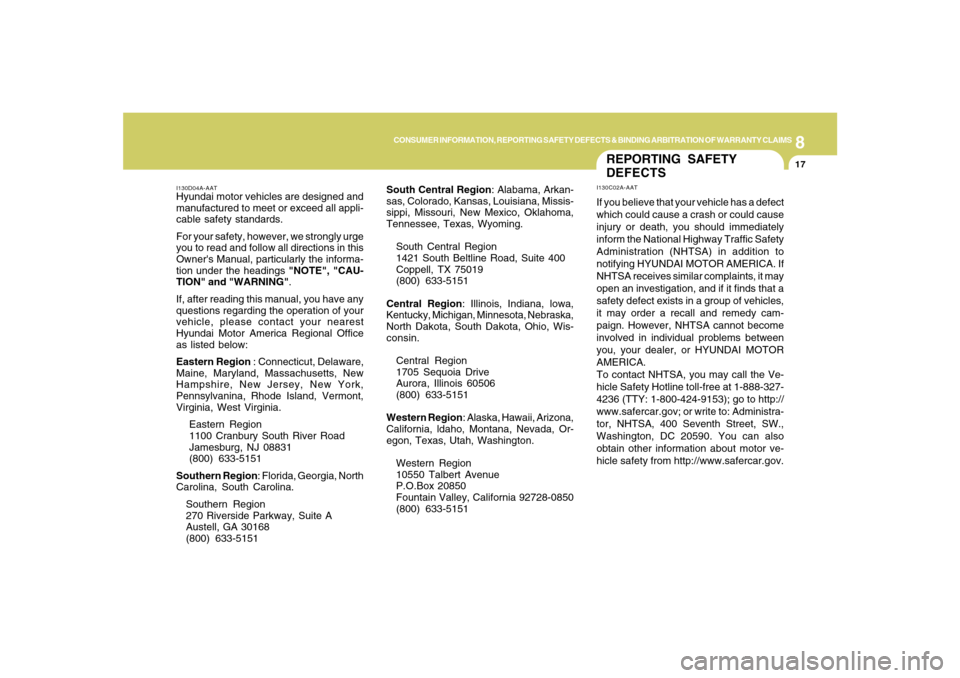
I130D04A-AATHyundai motor vehicles are designed and
manufactured to meet or exceed all appli-
cable safety standards.
For your safety, however, we strongly urge
you to read and follow all directions in this
Owner's Manual, particularly the informa-
tion under the headings "NOTE", "CAU-
TION" and "WARNING".
If, after reading this manual, you have any
questions regarding the operation of your
vehicle, please contact your nearest
Hyundai Motor America Regional Office
as listed below:
Eastern Region : Connecticut, Delaware,
Maine, Maryland, Massachusetts, New
Hampshire, New Jersey, New York,
Pennsylvanina, Rhode Island, Vermont,
Virginia, West Virginia.
Eastern Region
1100 Cranbury South River Road
Jamesburg, NJ 08831
(800) 633-5151
Southern Region: Florida, Georgia, North
Carolina, South Carolina.
Southern Region
270 Riverside Parkway, Suite A
Austell, GA 30168
(800) 633-5151South Central Region: Alabama, Arkan-
sas, Colorado, Kansas, Louisiana, Missis-
sippi, Missouri, New Mexico, Oklahoma,
Tennessee, Texas, Wyoming.
South Central Region
1421 South Beltline Road, Suite 400
Coppell, TX 75019
(800) 633-5151
Central Region: Illinois, Indiana, lowa,
Kentucky, Michigan, Minnesota, Nebraska,
North Dakota, South Dakota, Ohio, Wis-
consin.
Central Region
1705 Sequoia Drive
Aurora, Illinois 60506
(800) 633-5151
Western Region: Alaska, Hawaii, Arizona,
California, ldaho, Montana, Nevada, Or-
egon, Texas, Utah, Washington.
Western Region
10550 Talbert Avenue
P.O.Box 20850
Fountain Valley, California 92728-0850
(800) 633-5151
REPORTING SAFETY
DEFECTSI130C02A-AATIf you believe that your vehicle has a defect
which could cause a crash or could cause
injury or death, you should immediately
inform the National Highway Traffic Safety
Administration (NHTSA) in addition to
notifying HYUNDAI MOTOR AMERICA. If
NHTSA receives similar complaints, it may
open an investigation, and if it finds that a
safety defect exists in a group of vehicles,
it may order a recall and remedy cam-
paign. However, NHTSA cannot become
involved in individual problems between
you, your dealer, or HYUNDAI MOTOR
AMERICA.
To contact NHTSA, you may call the Ve-
hicle Safety Hotline toll-free at 1-888-327-
4236 (TTY: 1-800-424-9153); go to http://
www.safercar.gov; or write to: Administra-
tor, NHTSA, 400 Seventh Street, SW.,
Washington, DC 20590. You can also
obtain other information about motor ve-
hicle safety from http://www.safercar.gov.
Page 345 of 355
9
VEHICLE SPECIFICATIONS2
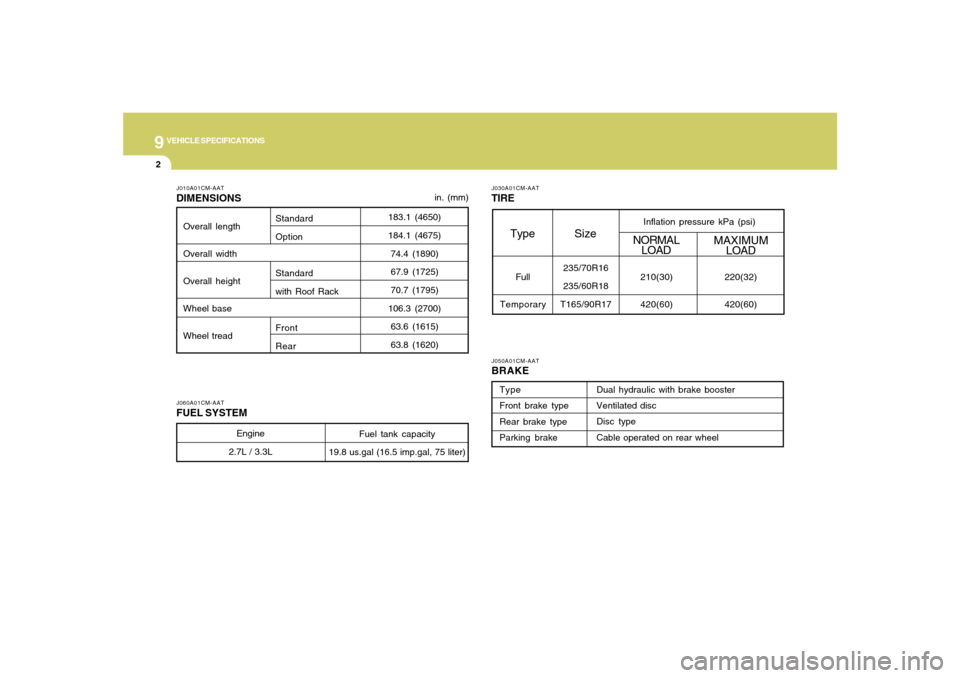
J050A01CM-AATBRAKE
Dual hydraulic with brake booster
Ventilated disc
Disc type
Cable operated on rear wheel Type
Front brake type
Rear brake type
Parking brake
183.1 (4650)
184.1 (4675)
74.4 (1890)
67.9 (1725)
70.7 (1795)
106.3 (2700)
63.6 (1615)
63.8 (1620)
J010A01CM-AATDIMENSIONSOverall length
Overall width
Overall height
Wheel base
Wheel tread
in. (mm)
Standard
Option
Standard
with Roof Rack
Front
Rear
J060A01CM-AATFUEL SYSTEM
Engine
2.7L / 3.3LFuel tank capacity
19.8 us.gal (16.5 imp.gal, 75 liter)
J030A01CM-AATTIRE
Full
Temporary
Size Type
Inflation pressure kPa (psi)
235/70R16
235/60R18
T165/90R17NORMAL
LOADMAXIMUM
LOAD
220(32)
420(60) 210(30)
420(60)
Page 350 of 355

10
INDEX
3
Corrosion protection
Cleaning the interior....................................................................... 4-5
Protecting your Hyundai from corrosion....................................... 4-2
Washing and waxing...................................................................... 4-4
Cruise Control................................................................................1-120
D
Defrosting / Defogging ...................................................................1-133
Door
Central door lock............................................................................ 1-9
Door locks...................................................................................... 1-7
Front door edge warning light ...................................................1-119
Drink Holder ......................................................................................1-88
Driving
Driving for economy .....................................................................2-23
Smooth cornering.........................................................................2-24
Winter driving...............................................................................2-24
E
Emission Control System ................................................................... 7-2
Engine
Before starting the engine .............................................................. 2-4
Compartment................................................................................. 6-2
Coolant........................................................................................... 6-7
Coolant temperature gauge .........................................................1-70
If the engine overheats .................................................................. 3-4
Number........................................................................................... 8-2
Oil ................................................................................................... 6-5
Starting........................................................................................... 2-6
Engine Exhaust Can Be Dangerous .................................................. 2-2F
Fan Speed Control.........................................................................1-126
Floor Mat Anchor ...........................................................................1-116
Fog Light
Front.............................................................................................1-83
Front Seats
Adjustable front seats ..................................................................1-16
Adjustable headrests...................................................................1-18
Adjusting seat forward and rearward ..........................................1-16
Adjusting seatback angle .............................................................1-17
Fuel
Capacity......................................................................................... 9-2
Gauge...........................................................................................1-70
Recommendations......................................................................... 1-2
Fuel Filler Lid
Remote release.........................................................................1-113
Full-time AWD Operation..................................................................
2-17
Fuses ................................................................................................6-17
Fuse panel description......................................................................6-32
G
General Checks.................................................................................. 6-4
Glove Box..........................................................................................1-95
H
Hazard Warning System ..................................................................1-83
Heating and Cooling Control..........................................................1-125
Heating and Ventilation
Air flow control...........................................................................1-127