vent Hyundai Santa Fe 2008 Owner's Manual
[x] Cancel search | Manufacturer: HYUNDAI, Model Year: 2008, Model line: Santa Fe, Model: Hyundai Santa Fe 2008Pages: 355, PDF Size: 12.36 MB
Page 6 of 355

F4
A110A01A-AAT
VEHICLE DATA COLLECTION AND EVENT DATA RECORDERS
Your Hyundai vehicle is equipped with many high technology, electronically controlled systems
that help to ensure your vehicle operates properly and provides the performance that you
expect. These systems utilize computers to monitor the operation of various systems and
components and help to control their operation. These computerized system operations are
wide-ranging and involve components to reduce emissions, to continuously evaluate the
readiness of the air bag and seat belt pretensioner systems, to determine when the air bag and
seat belt pre-tensioner systems should be deployed and then to activate the deployment, and
if equipped, to operate anti-lock braking, traction control and electrical stability control to assist
the driver to control the vehicle in difficult driving situations. These systems electronically store
information that is useful to service technicians when they need to diagnose and repair these
systems. Additional information is stored only when a crash occurs that results in the
deployment of the air bags or seat belt pre-tensioners. This type of data storage is done by
devices called event data recorders(EDR).
After a crash event, the air bag and seat belt pre-tensioner computer system, known as the
Supplemental Restraint System Control Module (SRSCM) or Air bag Control Unit (ACU), may
record some information about the condition of the vehicle and how it was being operated. This
information consists of data related to seat belt usage and if there was diagnostic information
in the air bag or seat belt systems at the time that a crash occurred, and if the ACU sensed that
a crash of sufficient severity occurred to require seat belt pre-tensioner or air bag deployment.
To retrieve this information, special equipment is needed and access to the vehicle or the device
that stores the data is required. Hyundai will not access information about a crash event or share
it with others except:
o in response to an official request of police or similar government office, or
o with the consent of the vehicle owner or, if the vehicle is leased, with the consent of the lessee,
or
o as part of Hyundai’s defense of litigation, or
o as required by law.
Page 9 of 355
F7
TABLE OF CONTENTS
SECTION
5 1
2
3
4
6
7
8
9
10
FEATURES OF YOUR HYUNDAI
DRIVING YOUR HYUNDAI
WHAT TO DO IN AN EMERGENCY
CORROSION PREVENTION & APPEARANCE CARE
VEHICLE MAINTENANCE REQUIREMENTS
DO-IT-YOURSELF MAINTENANCE
EMISSION CONTROL SYSTEMS
CONSUMER INFORMATION, REPORTING SAFETY DEFECTS &
BINDING ARBITRATION OF WARRANTY CLAIMS
VEHICLE SPECIFICATIONS
INDEX
Page 11 of 355
F9
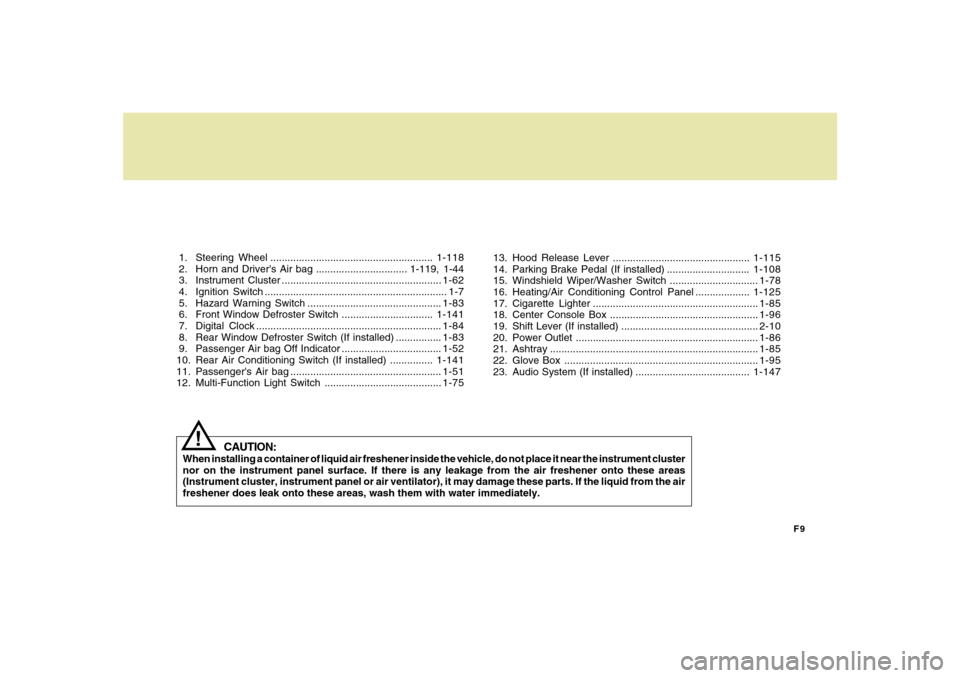
1. Steering Wheel .........................................................1-118
2. Horn and Driver's Air bag ................................ 1-119, 1-44
3. Instrument Cluster ........................................................1-62
4. Ignition Switch ................................................................ 1-7
5. Hazard Warning Switch ...............................................1-83
6. Front Window Defroster Switch ................................1-141
7. Digital Clock .................................................................1-84
8. Rear Window Defroster Switch (If installed) ................1-83
9. Passenger Air bag Off Indicator ...................................1-52
10. Rear Air Conditioning Switch (If installed) ...............1-141
11. Passenger's Air bag .....................................................1-51
12. Multi-Function Light Switch .........................................1-7513. Hood Release Lever ................................................1-115
14. Parking Brake Pedal (If installed) .............................1-108
15. Windshield Wiper/Washer Switch ...............................1-78
16. Heating/Air Conditioning Control Panel ...................1-125
17. Cigarette Lighter ..........................................................1-85
18. Center Console Box ....................................................1-96
19. Shift Lever (If installed) ................................................2-10
20. Power Outlet ................................................................1-86
21. Ashtray.........................................................................1-85
22. Glove Box ....................................................................1-95
23. Audio System (If installed) ........................................1-147
CAUTION:
When installing a container of liquid air freshener inside the vehicle, do not place it near the instrument cluster
nor on the instrument panel surface. If there is any leakage from the air freshener onto these areas
(Instrument cluster, instrument panel or air ventilator), it may damage these parts. If the liquid from the air
freshener does leak onto these areas, wash them with water immediately.
!
Page 14 of 355
1FEATURES OF YOUR HYUNDAI2
!
OCM051001R
FUEL RECOMMENDATIONS
CAUTION:
Your Hyundai's New Vehicle Limited War-
ranty may not cover damage to the fuel
system and any performance problems
that are caused by the use of fuels con-
taining methanol or fuels containing
MTBE (Methyl Tertiary Butyl Ether) over
15.0% vol. (Oxygen Content 2.7% weight.)
B010B01A-AATWhat About Gasohol?Gasohol (a mixture of 90% unleaded gaso-
line and 10% ethanol or grain alcohol)
may be used in your Hyundai. However, if
your engine develops driveability prob-
lems, the use of 100% unleaded gasoline
is recommended. Fuels with unspecified
quantities of alcohol, or alcohols other
than ethanol, should not be used.
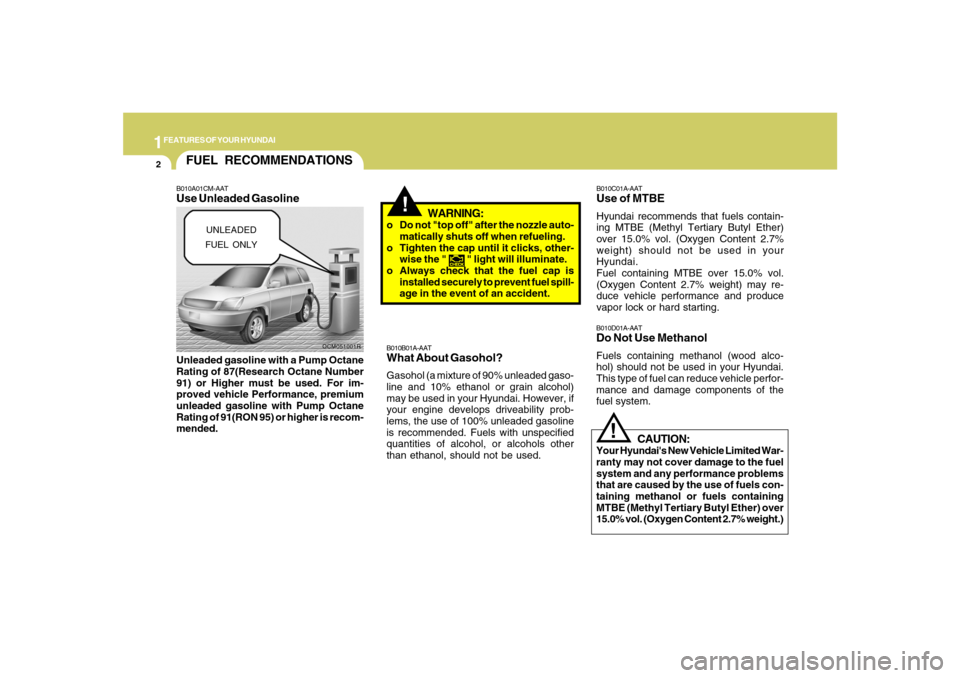
B010A01CM-AATUse Unleaded GasolineUnleaded gasoline with a Pump Octane
Rating of 87(Research Octane Number
91) or Higher must be used. For im-
proved vehicle Performance, premium
unleaded gasoline with Pump Octane
Rating of 91(RON 95) or higher is recom-
mended.
B010C01A-AATUse of MTBEHyundai recommends that fuels contain-
ing MTBE (Methyl Tertiary Butyl Ether)
over 15.0% vol. (Oxygen Content 2.7%
weight) should not be used in your
Hyundai.
Fuel containing MTBE over 15.0% vol.
(Oxygen Content 2.7% weight) may re-
duce vehicle performance and produce
vapor lock or hard starting.B010D01A-AATDo Not Use MethanolFuels containing methanol (wood alco-
hol) should not be used in your Hyundai.
This type of fuel can reduce vehicle perfor-
mance and damage components of the
fuel system.
!
UNLEADED
FUEL ONLY
WARNING:
o Do not "top off" after the nozzle auto-
matically shuts off when refueling.
o Tighten the cap until it clicks, other-
wise the "
" light will illuminate.
o Always check that the fuel cap is
installed securely to prevent fuel spill-
age in the event of an accident.
Page 15 of 355
1
FEATURES OF YOUR HYUNDAI
3
BREAKING IN YOUR NEW
HYUNDAI
B010F01A-AATOperation in Foreign CountriesIf you are going to drive your Hyundai in
another country, be sure to:
o Observe all regulations regarding reg-
istration and insurance.
o Determine that acceptable fuel is avail-
able.B010E01A-AATGasolines for Cleaner AirTo help contribute to cleaner air, Hyundai
recommends that you use gasolines
treated with detergent additives, which
help prevent deposit formation in the en-
gine. These gasolines will help the engine
run cleaner and enhance performance of
the Emission Control System.
B020A01S-AATDuring the First 1,200 Miles (2,000
Km)No formal "break-in" procedure is required
with your new Hyundai. However, you can
contribute to the economical operation
and durability of your Hyundai by observ-
ing the following recommendations dur-
ing the first 1,200 miles (2,000 km).
o Don't drive faster than 55 MPH (88 km/
h).
o While driving, keep your engine speed
(rpm, or revolutions per minute) be-
tween 2,000 rpm and 4,000 rpm.
o Use moderate acceleration. Don't start
quickly or depress the accelerator pedal
fully.
o For the first 200 miles (300 km), try to
avoid hard stops.
o Don't lug the engine (in other words,
don't drive so slowly in too high a gear
that the engine "bucks"-shift to a lower
gear).
o Whether going fast or slow, vary your
speed from time to time.
o Don't let the engine idle longer than 3
minutes at one time.
o Don't tow a trailer during the first 1,200
miles (2,000 km) of operation.
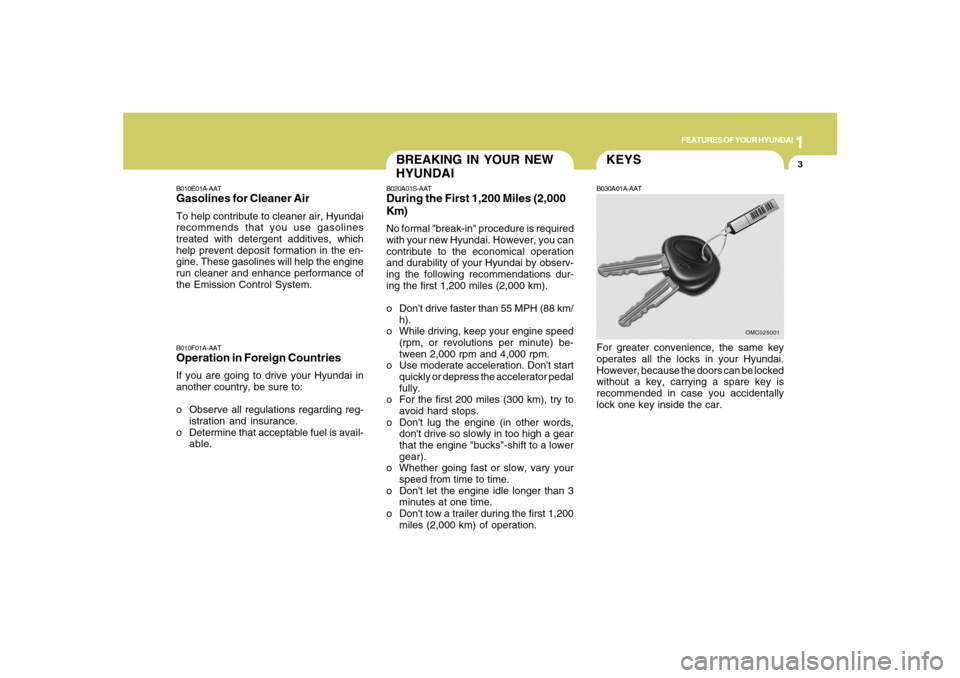
KEYSB030A01A-AATFor greater convenience, the same key
operates all the locks in your Hyundai.
However, because the doors can be locked
without a key, carrying a spare key is
recommended in case you accidentally
lock one key inside the car.
OMC025001
Page 17 of 355
1
FEATURES OF YOUR HYUNDAI
5
CAUTION:
o When starting the engine, do not use
the key with other immobilizer keys
around. Otherwise the engine may
not start or may stop soon after it
starts.
Keep each keys separately not to
have any malfunction after you re-
ceive your new vehicle.
o Do not install the metal accessories
near the key or ignition switch.
The engine may not start for the metal
accessories may interrupt the tran-
sponder signal from normally trans-
mitting.
!
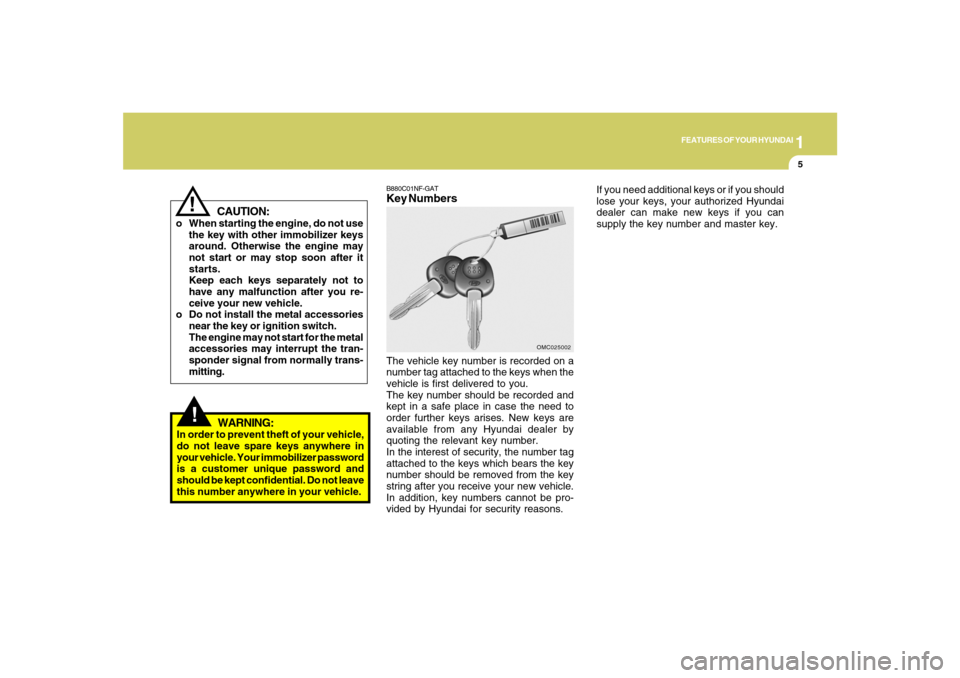
B880C01NF-GATKey NumbersThe vehicle key number is recorded on a
number tag attached to the keys when the
vehicle is first delivered to you.
The key number should be recorded and
kept in a safe place in case the need to
order further keys arises. New keys are
available from any Hyundai dealer by
quoting the relevant key number.
In the interest of security, the number tag
attached to the keys which bears the key
number should be removed from the key
string after you receive your new vehicle.
In addition, key numbers cannot be pro-
vided by Hyundai for security reasons.
OMC025002
If you need additional keys or if you should
lose your keys, your authorized Hyundai
dealer can make new keys if you can
supply the key number and master key.
!
WARNING:
In order to prevent theft of your vehicle,
do not leave spare keys anywhere in
your vehicle. Your immobilizer password
is a customer unique password and
should be kept confidential. Do not leave
this number anywhere in your vehicle.
Page 22 of 355
1FEATURES OF YOUR HYUNDAI10
B070F01CM-AATKeyless Entry System (If installed)
NOTE:This device complies with Part 15 of the
FCC rules. Operation is subject to the
following two conditions:
(1) This device may not cause harmful
interference, and (2) this device must
accept any interference received, in-
cluding interference that may cause
undesired operation.
Locking doors1. Close all doors.
2. Push the "LOCK (
)" button on the
transmitter.
3. At the same time all doors lock, the turn
signal lights will blink once to indicate
that the system is armed.
Unlocking doors1. Push the "UNLOCK (
)" button on
the transmitter.
2. At the same time the driver's door un-
locks, the turn signal lights will blink
twice to indicate that the system is dis-
armed.
NOTE:If you wish to unlock all doors, press the
"UNLOCK" button on the transmitter
again within 4 seconds.
CAUTION:
Changes or modifications not expressly
approved by the party responsible for
compliance could void the user's au-
thority to operate the equipment.
!
!
WARNING:
o Be careful not to pull the inside door
handle while driving. If you pull the
inside door handle, the door can be
opened and you may be ejected from
the vehicle and can be injured or killed.
o If the door is locked/unlocked multiple
times in rapid succession with either
the vehicle key or door lock switch,
the system may stop operating tem-
porarily in order to protect the circuit
and prevent damage to system com-
ponents. o The driver's and front passenger's
doors can be opened by pulling the
inside door handle even if the front
portion of the driver's or front
passenger's central door locking
switch has been depressed to lock
the doors.
Page 23 of 355
1
FEATURES OF YOUR HYUNDAI
11
HMR
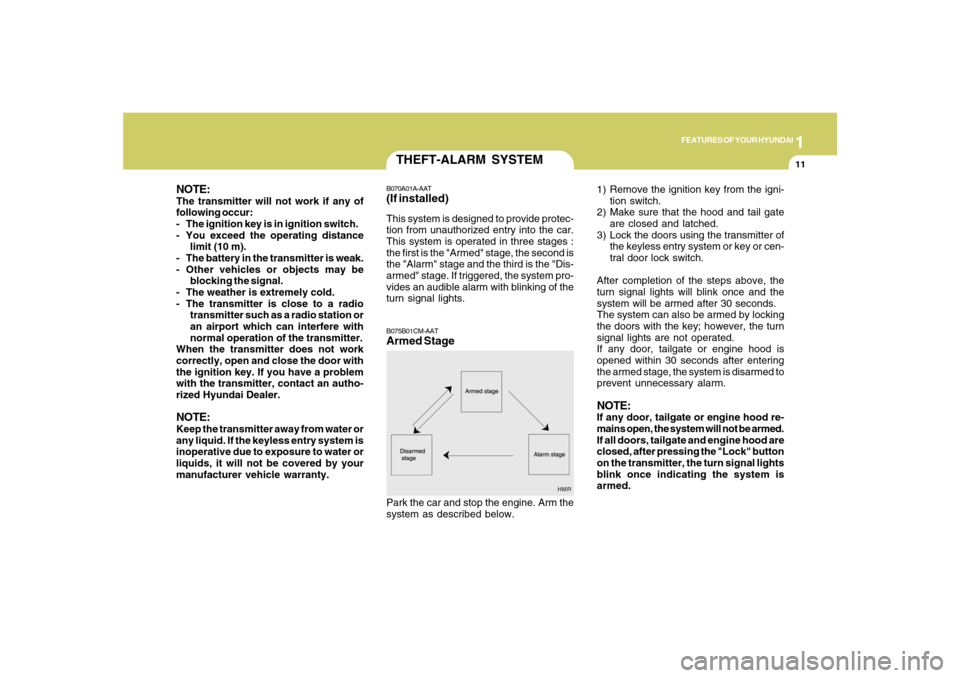
THEFT-ALARM SYSTEMB075B01CM-AATArmed StagePark the car and stop the engine. Arm the
system as described below.B070A01A-AAT(If installed)This system is designed to provide protec-
tion from unauthorized entry into the car.
This system is operated in three stages :
the first is the "Armed" stage, the second is
the "Alarm" stage and the third is the "Dis-
armed" stage. If triggered, the system pro-
vides an audible alarm with blinking of the
turn signal lights.
NOTE:The transmitter will not work if any of
following occur:
- The ignition key is in ignition switch.
- You exceed the operating distance
limit (10 m).
- The battery in the transmitter is weak.
- Other vehicles or objects may be
blocking the signal.
- The weather is extremely cold.
- The transmitter is close to a radio
transmitter such as a radio station or
an airport which can interfere with
normal operation of the transmitter.
When the transmitter does not work
correctly, open and close the door with
the ignition key. If you have a problem
with the transmitter, contact an autho-
rized Hyundai Dealer.NOTE:Keep the transmitter away from water or
any liquid. If the keyless entry system is
inoperative due to exposure to water or
liquids, it will not be covered by your
manufacturer vehicle warranty.1) Remove the ignition key from the igni-
tion switch.
2) Make sure that the hood and tail gate
are closed and latched.
3) Lock the doors using the transmitter of
the keyless entry system or key or cen-
tral door lock switch.
After completion of the steps above, the
turn signal lights will blink once and the
system will be armed after 30 seconds.
The system can also be armed by locking
the doors with the key; however, the turn
signal lights are not operated.
If any door, tailgate or engine hood is
opened within 30 seconds after entering
the armed stage, the system is disarmed to
prevent unnecessary alarm.
NOTE:If any door, tailgate or engine hood re-
mains open, the system will not be armed.
If all doors, tailgate and engine hood are
closed, after pressing the "Lock" button
on the transmitter, the turn signal lights
blink once indicating the system is
armed.
Page 27 of 355
1
FEATURES OF YOUR HYUNDAI
15
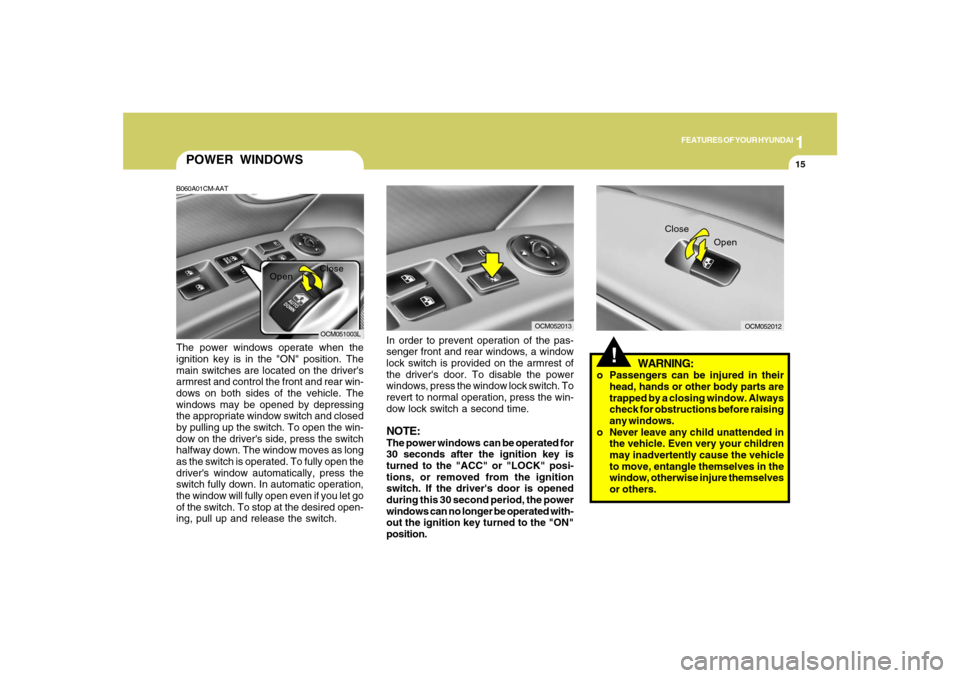
POWER WINDOWSB060A01CM-AATThe power windows operate when the
ignition key is in the "ON" position. The
main switches are located on the driver's
armrest and control the front and rear win-
dows on both sides of the vehicle. The
windows may be opened by depressing
the appropriate window switch and closed
by pulling up the switch. To open the win-
dow on the driver's side, press the switch
halfway down. The window moves as long
as the switch is operated. To fully open the
driver's window automatically, press the
switch fully down. In automatic operation,
the window will fully open even if you let go
of the switch. To stop at the desired open-
ing, pull up and release the switch.
OCM051003L
!
In order to prevent operation of the pas-
senger front and rear windows, a window
lock switch is provided on the armrest of
the driver's door. To disable the power
windows, press the window lock switch. To
revert to normal operation, press the win-
dow lock switch a second time.NOTE:The power windows can be operated for
30 seconds after the ignition key is
turned to the "ACC" or "LOCK" posi-
tions, or removed from the ignition
switch. If the driver's door is opened
during this 30 second period, the power
windows can no longer be operated with-
out the ignition key turned to the "ON"
position.
WARNING:
o Passengers can be injured in their
head, hands or other body parts are
trapped by a closing window. Always
check for obstructions before raising
any windows.
o Never leave any child unattended in
the vehicle. Even very your children
may inadvertently cause the vehicle
to move, entangle themselves in the
window, otherwise injure themselves
or others.
OCM052012
Close
Open
OCM052013
Close
Open
Page 29 of 355
1
FEATURES OF YOUR HYUNDAI
17
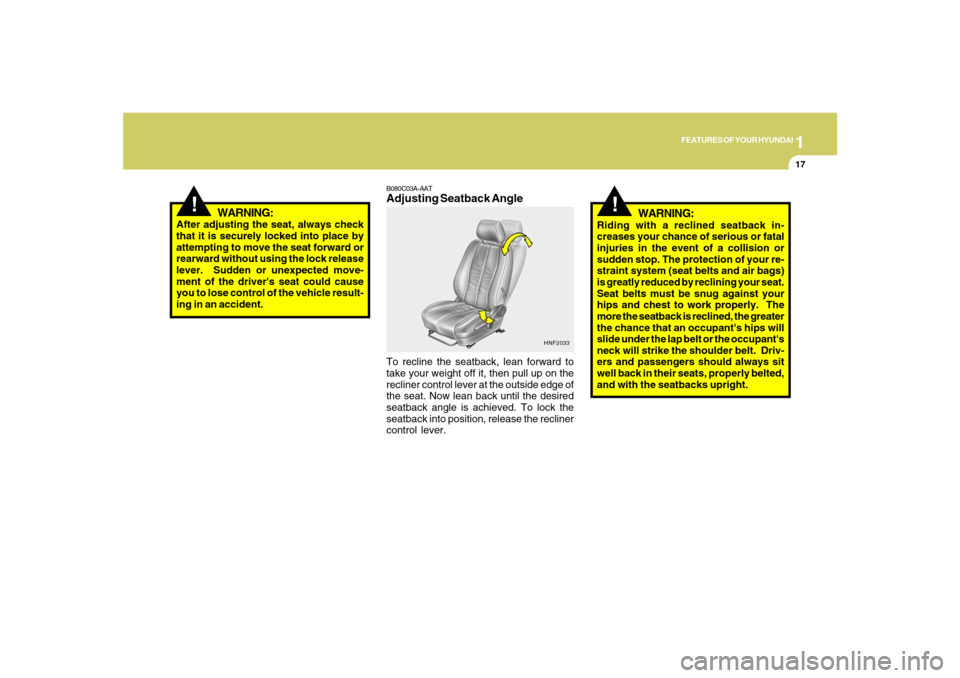
HNF2033
B080C03A-AATAdjusting Seatback AngleTo recline the seatback, lean forward to
take your weight off it, then pull up on the
recliner control lever at the outside edge of
the seat. Now lean back until the desired
seatback angle is achieved. To lock the
seatback into position, release the recliner
control lever.
!
WARNING:
Riding with a reclined seatback in-
creases your chance of serious or fatal
injuries in the event of a collision or
sudden stop. The protection of your re-
straint system (seat belts and air bags)
is greatly reduced by reclining your seat.
Seat belts must be snug against your
hips and chest to work properly. The
more the seatback is reclined, the greater
the chance that an occupant's hips will
slide under the lap belt or the occupant's
neck will strike the shoulder belt. Driv-
ers and passengers should always sit
well back in their seats, properly belted,
and with the seatbacks upright.
!
WARNING:
After adjusting the seat, always check
that it is securely locked into place by
attempting to move the seat forward or
rearward without using the lock release
lever. Sudden or unexpected move-
ment of the driver's seat could cause
you to lose control of the vehicle result-
ing in an accident.