fuel tank Hyundai Santa Fe 2009 Owner's Manual
[x] Cancel search | Manufacturer: HYUNDAI, Model Year: 2009, Model line: Santa Fe, Model: Hyundai Santa Fe 2009Pages: 353, PDF Size: 10.86 MB
Page 77 of 353
1FEATURES OF YOUR HYUNDAI66
!
B260H03A-AAT
Parking Brake/Low Brake
Fluid Level Warning Light
WARNING:
If you suspect brake trouble, have your
brakes checked by a Hyundai dealer as
soon as possible. Driving your car with
a problem in either the brake electrical
system or brake hydraulic system is
dangerous, and could result in a serious
injury or death.Warning Light OperationThe parking brake/brake fluid level warn-
ing light should illuminate when the park-
ing brake is applied and the ignition switch
is turned to "ON" or "START". After the
engine is started, the light should go out
when the parking brake is released.
If the parking brake is not applied, the
warning light should illuminate when the
ignition switch is turned to "ON" or "START",
then go out when the engine starts. If the
light illuminate at any other time, you
should slow the vehicle and bring it to a
complete stop in a safe location off the
roadway.
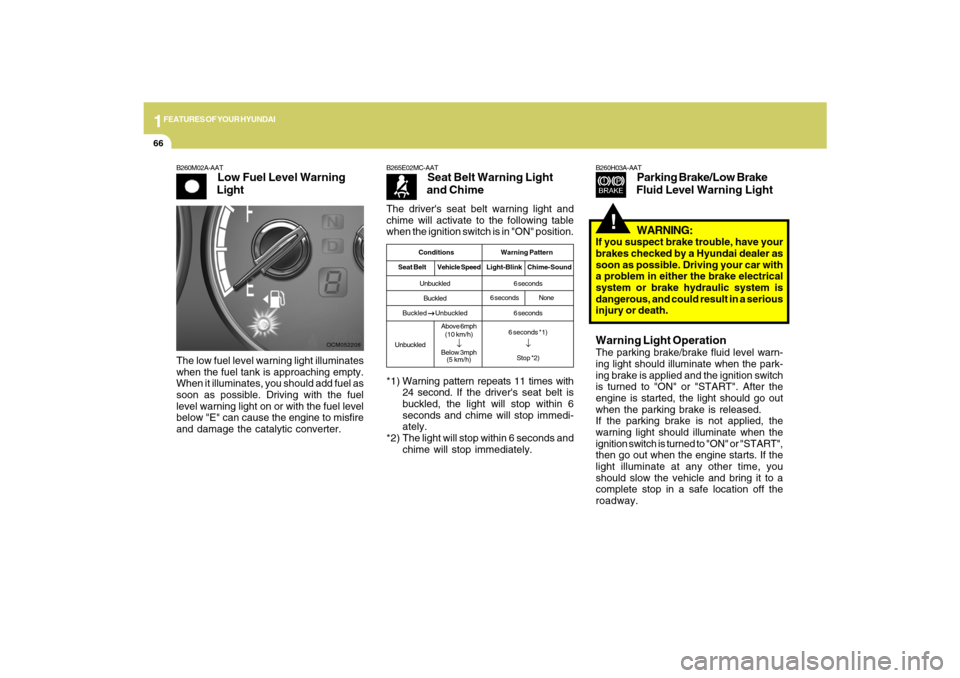
B260M02A-AAT
Low Fuel Level Warning
Light
OCM052208
The low fuel level warning light illuminates
when the fuel tank is approaching empty.
When it illuminates, you should add fuel as
soon as possible. Driving with the fuel
level warning light on or with the fuel level
below "E" can cause the engine to misfire
and damage the catalytic converter.The driver's seat belt warning light and
chime will activate to the following table
when the ignition switch is in "ON" position.
B265E02MC-AAT
Seat Belt Warning Light
and Chime
*1) Warning pattern repeats 11 times with
24 second. If the driver's seat belt is
buckled, the light will stop within 6
seconds and chime will stop immedi-
ately.
*2) The light will stop within 6 seconds and
chime will stop immediately.
Conditions Warning Pattern
Seat BeltVehicle SpeedLight-Blink Chime-SoundUnbuckled
Buckled
Buckled
→ →→ →
→ Unbuckled
UnbuckledAbove 6mph
(10 km/h)
↓
Below 3mph
(5 km/h)6 seconds
6 seconds
6 seconds *1)
↓Stop *2)
6 secondsNone
Page 81 of 353
1FEATURES OF YOUR HYUNDAI70
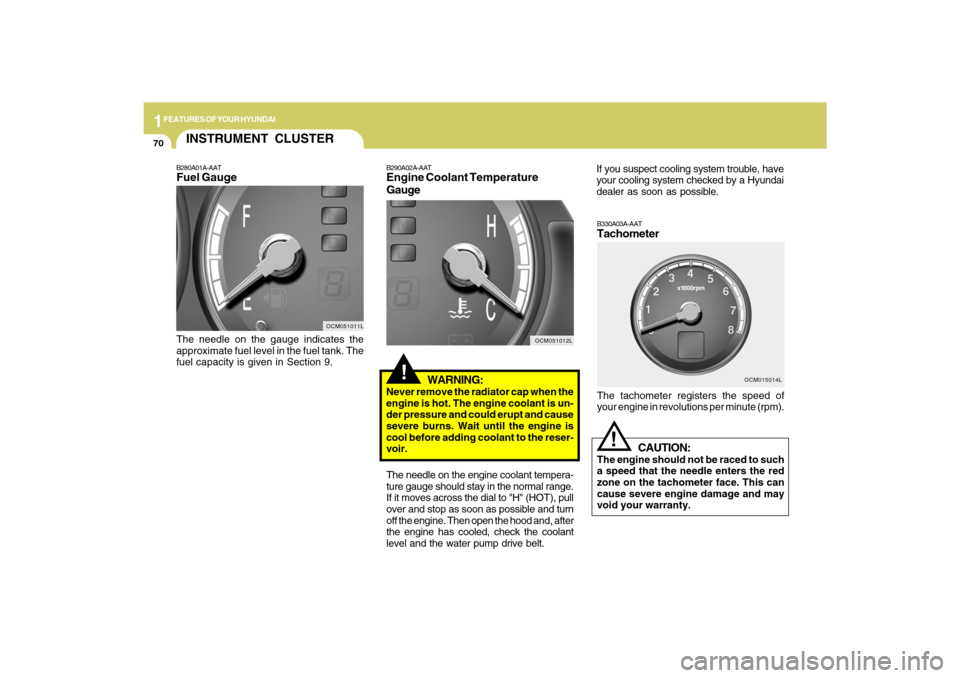
B330A03A-AATTachometerThe tachometer registers the speed of
your engine in revolutions per minute (rpm).
CAUTION:
The engine should not be raced to such
a speed that the needle enters the red
zone on the tachometer face. This can
cause severe engine damage and may
void your warranty.
!
OCM015014L
!
B290A02A-AATEngine Coolant Temperature
Gauge
WARNING:Never remove the radiator cap when the
engine is hot. The engine coolant is un-
der pressure and could erupt and cause
severe burns. Wait until the engine is
cool before adding coolant to the reser-
voir.
B280A01A-AATFuel GaugeThe needle on the gauge indicates the
approximate fuel level in the fuel tank. The
fuel capacity is given in Section 9.INSTRUMENT CLUSTER
OCM051012L OCM051011L
The needle on the engine coolant tempera-
ture gauge should stay in the normal range.
If it moves across the dial to "H" (HOT), pull
over and stop as soon as possible and turn
off the engine. Then open the hood and, after
the engine has cooled, check the coolant
level and the water pump drive belt.If you suspect cooling system trouble, have
your cooling system checked by a Hyundai
dealer as soon as possible.
Page 85 of 353
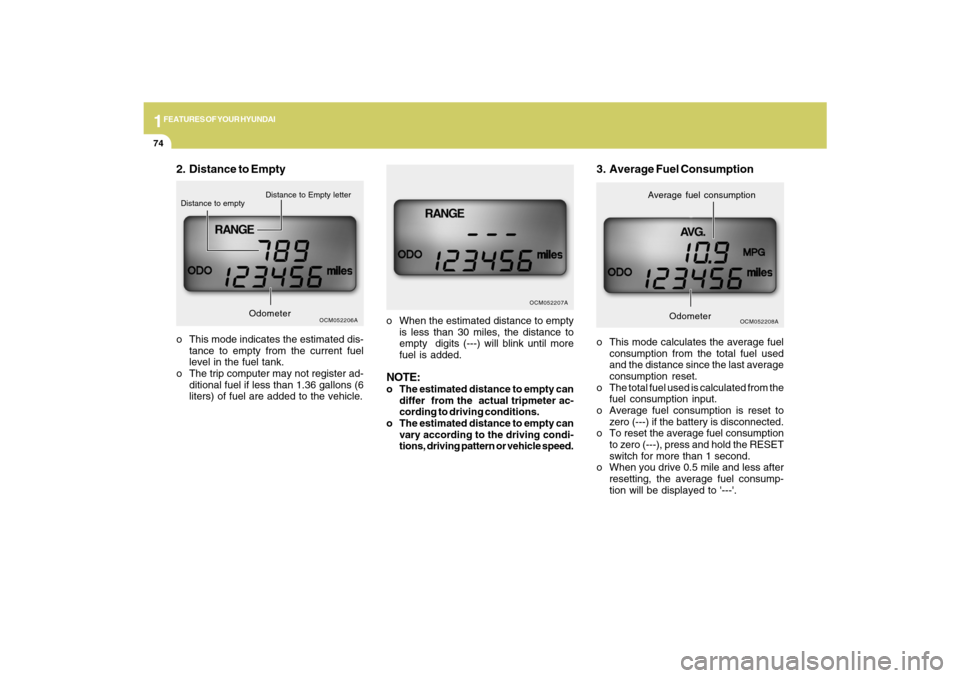
1FEATURES OF YOUR HYUNDAI74
o This mode calculates the average fuel
consumption from the total fuel used
and the distance since the last average
consumption reset.
o The total fuel used is calculated from the
fuel consumption input.
o Average fuel consumption is reset to
zero (---) if the battery is disconnected.
o To reset the average fuel consumption
to zero (---), press and hold the RESET
switch for more than 1 second.
o When you drive 0.5 mile and less after
resetting, the average fuel consump-
tion will be displayed to '---'.3. Average Fuel Consumption
OCM052208A
Average fuel consumption
Odometer
o When the estimated distance to empty
is less than 30 miles, the distance to
empty digits (---) will blink until more
fuel is added.NOTE:o The estimated distance to empty can
differ from the actual tripmeter ac-
cording to driving conditions.
o The estimated distance to empty can
vary according to the driving condi-
tions, driving pattern or vehicle speed.
2. Distance to Emptyo This mode indicates the estimated dis-
tance to empty from the current fuel
level in the fuel tank.
o The trip computer may not register ad-
ditional fuel if less than 1.36 gallons (6
liters) of fuel are added to the vehicle.
OCM052206A
Distance to Empty letter
Distance to empty
OCM052207A
Odometer
Page 278 of 353
5
VEHICLE MAINTENANCE REQUIREMENTS
3
SCHEDULED MAINTE-
NANCE REQUIREMENTSF020A02Y-AATo Inspection should be performed any
time a malfunction is experienced or
suspected.
o Receipts for all emission control system
services should be retained to demon-
strate compliance with conditions of the
emissions system warranty.
o After 120 months or 150,000 miles
(240,000 km), continue to follow the
prescribed maintenance intervals.
o For severe usage maintenance require-
ments, see page 5-6 of this section.
F010D02A-AATGeneral ChecksThese are the regular checks you should
perform when you drive your Hyundai or
you fill the fuel tank. A list of these items will
be found on page 6-5.F010E01A-AATDo-It-Yourself MaintenanceIf you are mechanically inclined, own a few
tools that are required and want to take the
time to do so, you can inspect and service
a number of items. For more information
about doing it yourself, see Section 6.
F010F01A-AATA Few Tipso Whenever you have your Hyundai ser-
viced, keep copies of the service records
in your glovebox. This will help ensure
that you can document that the required
procedures have been performed to
keep your warranties in effect. This is
especially important when service is
not performed by an authorized
Hyundai dealer.
o If you choose to do your own mainte-
nance and repairs, you may find it
helpful to have an official Hyundai Shop
Manual. A copy of this publication may
be purchased at your Hyundai dealer's
parts department.
Page 279 of 353
5
VEHICLE MAINTENANCE REQUIREMENTS4
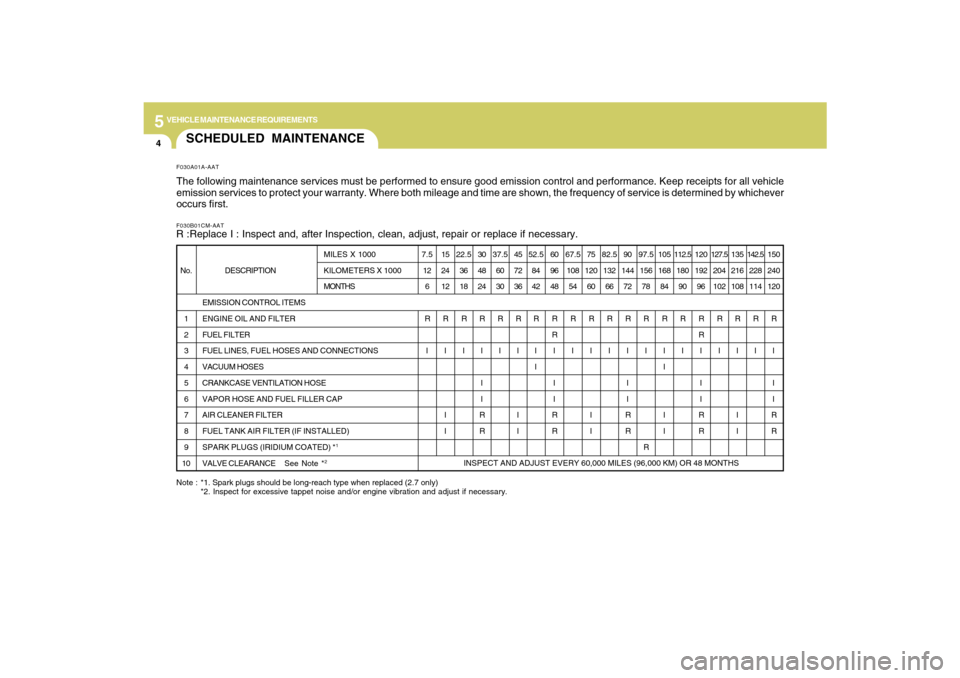
SCHEDULED MAINTENANCEF030B01CM-AATR :Replace I : Inspect and, after Inspection, clean, adjust, repair or replace if necessary.
DESCRIPTION
EMISSION CONTROL ITEMS
ENGINE OIL AND FILTER
FUEL FILTER
FUEL LINES, FUEL HOSES AND CONNECTIONS
VACUUM HOSES
CRANKCASE VENTILATION HOSE
VAPOR HOSE AND FUEL FILLER CAP
AIR CLEANER FILTER
FUEL TANK AIR FILTER (IF INSTALLED)
SPARK PLUGS (IRIDIUM COATED) *
1
VALVE CLEARANCESee Note *
2
No.
1
2
3
4
5
6
7
8
9
10MILES X 1000
KILOMETERS X 1000
MONTHS7.5
12
6
R
I15
24
12
R
I
I
I22.5
36
18
R
I30
48
24
R
I
I
I
R
R37.5
60
30
R
I45
72
36
R
I
I
I52.5
84
42
R
I
I60
96
48
R
R
I
I
I
R
R67.5
108
54
R
I75
120
60
R
I
I
I82.5
132
66
R
I90
144
72
R
I
I
I
R
R97.5
156
78
R
I
R105
168
84
R
I
I
I
I112.5
180
90
R
I120
192
96
R
R
I
I
I
R
R127.5
204
102
R
I135
216
108
R
I
I
I142.5
228
114
R
I150
240
120
R
I
I
I
R
R
F030A01A-AATThe following maintenance services must be performed to ensure good emission control and performance. Keep receipts for all vehicle
emission services to protect your warranty. Where both mileage and time are shown, the frequency of service is determined by whichever
occurs first.
INSPECT AND ADJUST EVERY 60,000 MILES (96,000 KM) OR 48 MONTHS
Note : *1. Spark plugs should be long-reach type when replaced (2.7 only)
*2. Inspect for excessive tappet noise and/or engine vibration and adjust if necessary.
Page 282 of 353
5
VEHICLE MAINTENANCE REQUIREMENTS
7
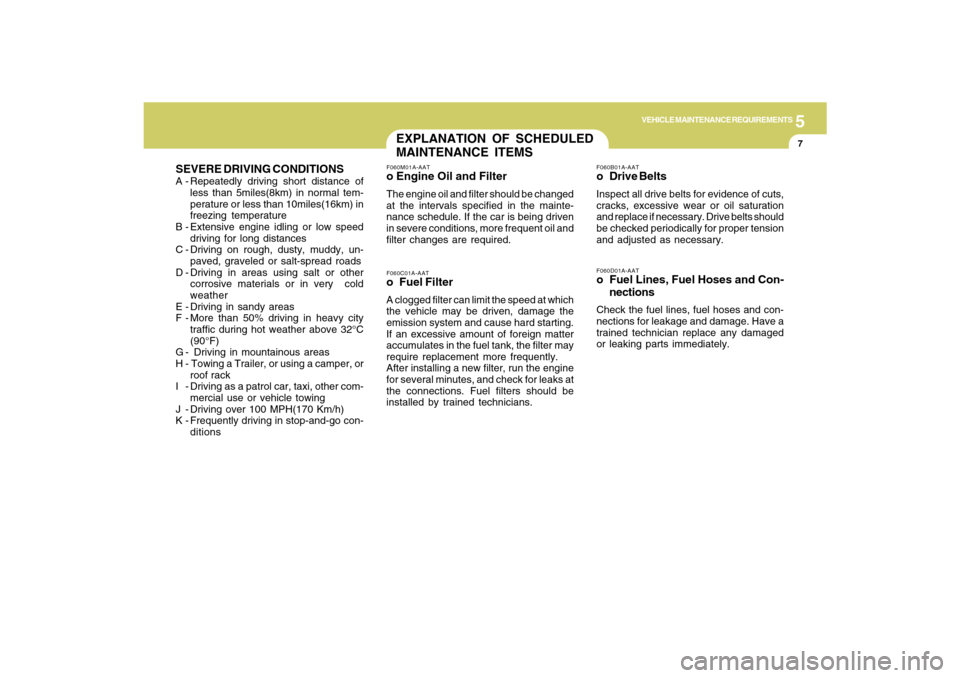
SEVERE DRIVING CONDITIONSA - Repeatedly driving short distance of
less than 5miles(8km) in normal tem-
perature or less than 10miles(16km) in
freezing temperature
B - Extensive engine idling or low speed
driving for long distances
C - Driving on rough, dusty, muddy, un-
paved, graveled or salt-spread roads
D - Driving in areas using salt or other
corrosive materials or in very cold
weather
E - Driving in sandy areas
F - More than 50% driving in heavy city
traffic during hot weather above 32°C
(90°F)
G - Driving in mountainous areas
H - Towing a Trailer, or using a camper, or
roof rack
I - Driving as a patrol car, taxi, other com-
mercial use or vehicle towing
J - Driving over 100 MPH(170 Km/h)
K - Frequently driving in stop-and-go con-
ditions
F060D01A-AATo Fuel Lines, Fuel Hoses and Con-
nectionsCheck the fuel lines, fuel hoses and con-
nections for leakage and damage. Have a
trained technician replace any damaged
or leaking parts immediately.F060B01A-AATo Drive BeltsInspect all drive belts for evidence of cuts,
cracks, excessive wear or oil saturation
and replace if necessary. Drive belts should
be checked periodically for proper tension
and adjusted as necessary.
F060M01A-AATo Engine Oil and FilterThe engine oil and filter should be changed
at the intervals specified in the mainte-
nance schedule. If the car is being driven
in severe conditions, more frequent oil and
filter changes are required.F060C01A-AATo Fuel FilterA clogged filter can limit the speed at which
the vehicle may be driven, damage the
emission system and cause hard starting.
If an excessive amount of foreign matter
accumulates in the fuel tank, the filter may
require replacement more frequently.
After installing a new filter, run the engine
for several minutes, and check for leaks at
the connections. Fuel filters should be
installed by trained technicians.EXPLANATION OF SCHEDULED
MAINTENANCE ITEMS
Page 322 of 353
7
EMISSION CONTROL SYSTEMS2
EMISSION CONTROL SYSTEM
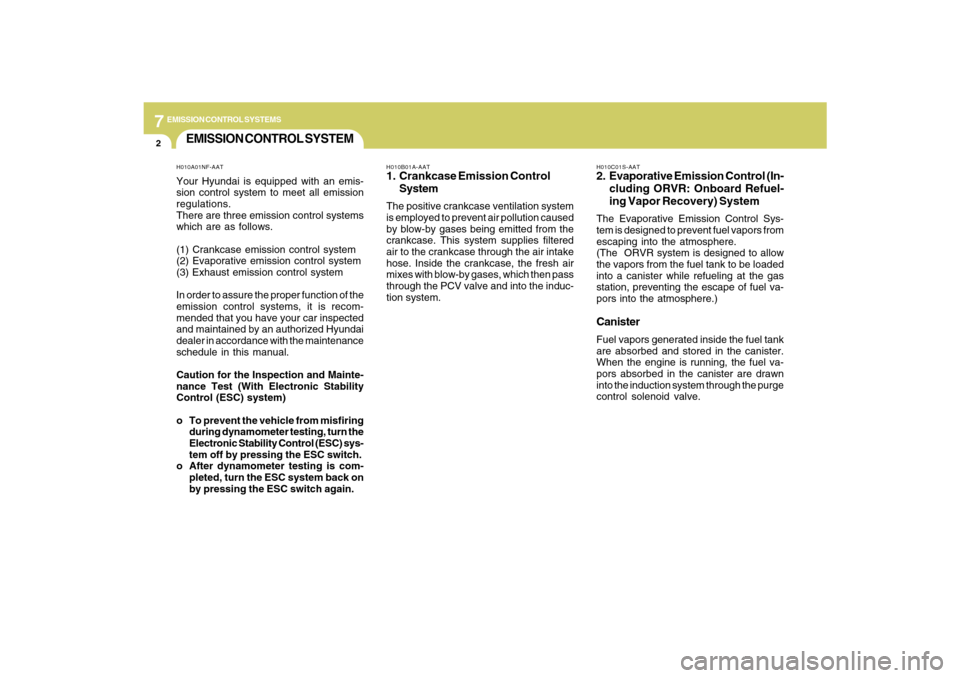
H010B01A-AAT1. Crankcase Emission Control
SystemThe positive crankcase ventilation system
is employed to prevent air pollution caused
by blow-by gases being emitted from the
crankcase. This system supplies filtered
air to the crankcase through the air intake
hose. Inside the crankcase, the fresh air
mixes with blow-by gases, which then pass
through the PCV valve and into the induc-
tion system.
H010A01NF-AATYour Hyundai is equipped with an emis-
sion control system to meet all emission
regulations.
There are three emission control systems
which are as follows.
(1) Crankcase emission control system
(2) Evaporative emission control system
(3) Exhaust emission control system
In order to assure the proper function of the
emission control systems, it is recom-
mended that you have your car inspected
and maintained by an authorized Hyundai
dealer in accordance with the maintenance
schedule in this manual.
Caution for the Inspection and Mainte-
nance Test (With Electronic Stability
Control (ESC) system)
o To prevent the vehicle from misfiring
during dynamometer testing, turn the
Electronic Stability Control (ESC) sys-
tem off by pressing the ESC switch.
o After dynamometer testing is com-
pleted, turn the ESC system back on
by pressing the ESC switch again.
H010C01S-AAT2. Evaporative Emission Control (In-
cluding ORVR: Onboard Refuel-
ing Vapor Recovery) SystemThe Evaporative Emission Control Sys-
tem is designed to prevent fuel vapors from
escaping into the atmosphere.
(The ORVR system is designed to allow
the vapors from the fuel tank to be loaded
into a canister while refueling at the gas
station, preventing the escape of fuel va-
pors into the atmosphere.)CanisterFuel vapors generated inside the fuel tank
are absorbed and stored in the canister.
When the engine is running, the fuel va-
pors absorbed in the canister are drawn
into the induction system through the purge
control solenoid valve.
Page 344 of 353
9
VEHICLE SPECIFICATIONS2
J050A01CM-AATBRAKE
Dual hydraulic with brake booster
Ventilated disc
Disc type
Cable operated on rear wheel Type
Front brake type
Rear brake type
Parking brake
183.1 (4650)
184.1 (4675)
74.4 (1890)
67.9 (1725)
70.7 (1795)
106.3 (2700)
63.6 (1615)
63.8 (1620)
J010A01CM-AATDIMENSIONSOverall length
Overall width
Overall height
Wheel base
Wheel tread
in. (mm)
Standard
Option
Standard
with Roof Rack
Front
Rear
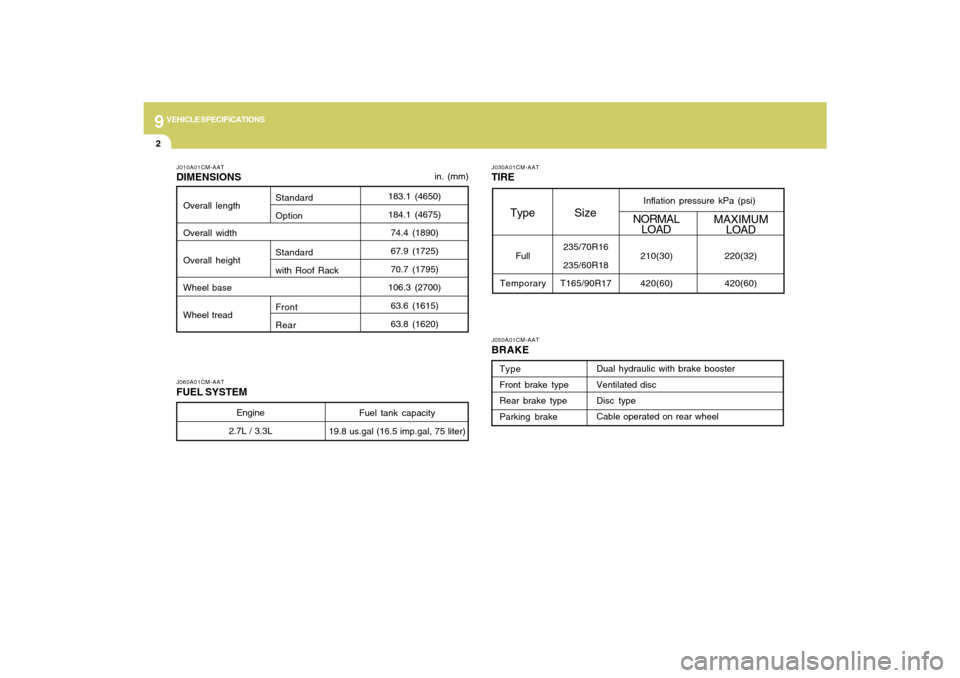
J060A01CM-AATFUEL SYSTEM
Engine
2.7L / 3.3LFuel tank capacity
19.8 us.gal (16.5 imp.gal, 75 liter)
J030A01CM-AATTIRE
Full
Temporary
Size Type
Inflation pressure kPa (psi)
235/70R16
235/60R18
T165/90R17NORMAL
LOADMAXIMUM
LOAD
220(32)
420(60) 210(30)
420(60)