roof Hyundai Santa Fe 2012 User Guide
[x] Cancel search | Manufacturer: HYUNDAI, Model Year: 2012, Model line: Santa Fe, Model: Hyundai Santa Fe 2012Pages: 419, PDF Size: 5.61 MB
Page 180 of 419
4101
Features of your vehicle
EXTERIOR FEATURES
D290100ACM
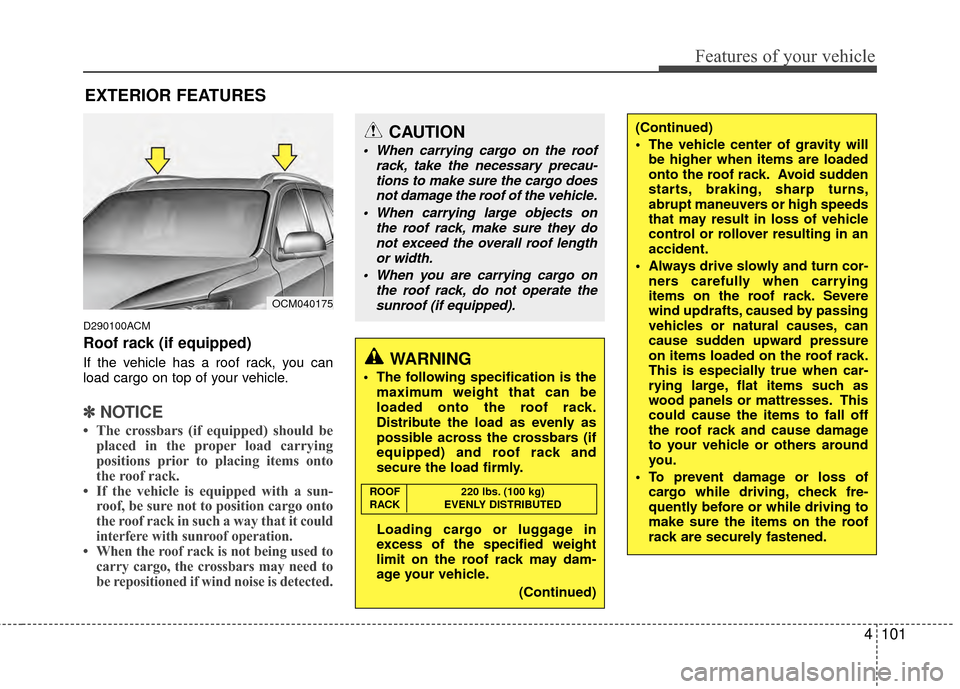
Roof rack (if equipped)
If the vehicle has a roof rack, you can
load cargo on top of your vehicle.
✽ ✽NOTICE
• The crossbars (if equipped) should be
placed in the proper load carrying
positions prior to placing items onto
the roof rack.
• If the vehicle is equipped with a sun- roof, be sure not to position cargo onto
the roof rack in such a way that it
could
interfere with sunroof operation.
• When the roof rack is not being used to carry cargo, the crossbars may need to
be repositioned if wind noise is detected.
OCM040175
CAUTION
When carrying cargo on the roof
rack, take the necessary precau-tions to make sure the cargo doesnot damage the roof of the vehicle.
When carrying large objects on the roof rack, make sure they donot exceed the overall roof length or width.
When you are carrying cargo on the roof rack, do not operate thesunroof (if equipped).
WARNING
The following specification is the maximum weight that can be
loaded onto the roof rack.
Distribute the load as evenly as
possible across the crossbars (if
equipped) and roof rack and
secure the load firmly.
Loading cargo or luggage in
excess of the specified weight
limit on the roof rack may dam-
age your vehicle.
(Continued)
(Continued)
The vehicle center of gravity willbe higher when items are loaded
onto the roof rack. Avoid sudden
starts, braking, sharp turns,
abrupt maneuvers or high speeds
that may result in loss of vehicle
control or rollover resulting in an
accident.
Always drive slowly and turn cor- ners carefully when carrying
items on the roof rack. Severe
wind updrafts, caused by passing
vehicles or natural causes, can
cause sudden upward pressure
on items loaded on the roof rack.
This is especially true when car-
rying large, flat items such as
wood panels or mattresses. This
could cause the items to fall off
the roof rack and cause damage
to your vehicle or others around
you.
To prevent damage or loss of cargo while driving, check fre-
quently before or while driving to
make sure the items on the roof
rack are securely fastened.
ROOF 220 lbs. (100 kg)
RACK EVENLY DISTRIBUTED
Page 181 of 419
Features of your vehicle
102
4
✽
✽
NOTICE
If you install an aftermarket HID head
lamp, your vehicle’s audio and electron-
ic device may malfunction.
Antenna
D300102AFD
Roof antenna
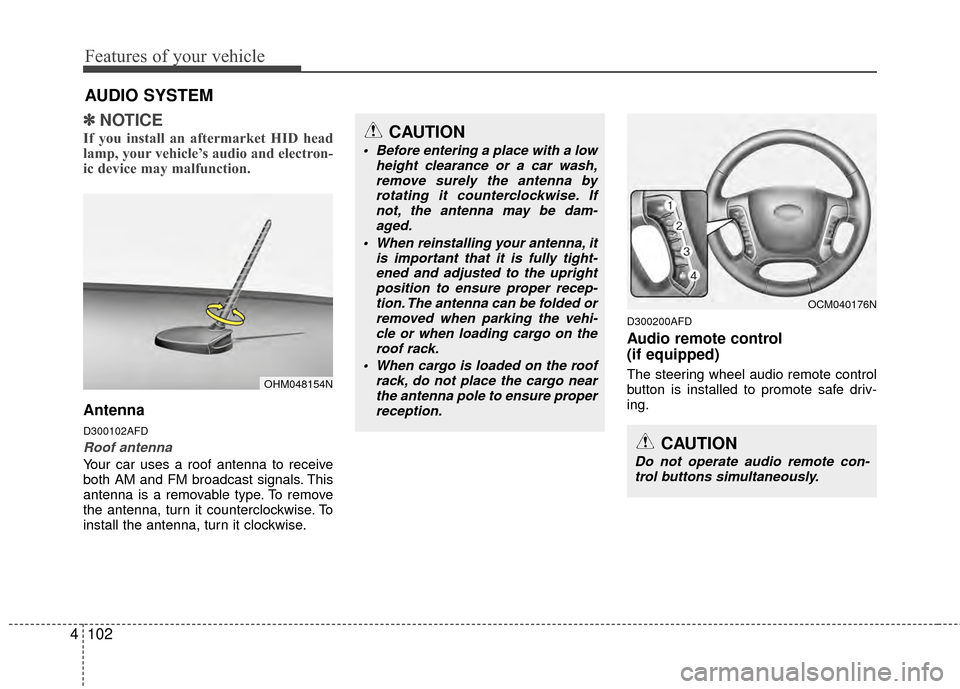
Your car uses a roof antenna to receive
both AM and FM broadcast signals. This
antenna is a removable type. To remove
the antenna, turn it counterclockwise. To
install the antenna, turn it clockwise.
D300200AFD
Audio remote control
(if equipped)
The steering wheel audio remote control
button is installed to promote safe driv-
ing.
AUDIO SYSTEM
CAUTION
• Before entering a place with a low
height clearance or a car wash,remove surely the antenna byrotating it counterclockwise. Ifnot, the antenna may be dam- aged.
When reinstalling your antenna, it is important that it is fully tight-ened and adjusted to the uprightposition to ensure proper recep-tion. The antenna can be folded orremoved when parking the vehi-cle or when loading cargo on theroof rack.
When cargo is loaded on the roof rack, do not place the cargo nearthe antenna pole to ensure properreception.
OHM048154N
CAUTION
Do not operate audio remote con-trol buttons simultaneously.
OCM040176N
Page 261 of 419
Driving your vehicle
20
5
✽
✽
NOTICE
• Do not drive in water if the level is
higher than the bottom of the vehicle.
• Check your brake condition once you are out of mud or water. Press the
brake pedal several times as you move
slowly until you feel normal braking
forces return.
• Shorten your scheduled maintenance interval if you drive in off-road condi-
tions such as sand, mud or water (see
“Maintenance under severe usage
conditions” in section 7). Always wash
your vehicle thoroughly after off road
use, especially cleaning the bottom of
the vehicle.
• Since the driving torque is always applied to the 4 wheels the perform-
ance of the AWD vehicle is greatly
affected by the condition of the tires.
Be sure to equip the vehicle with four
tires of the same size and type.
• A full time all wheel drive vehicle can- not be towed by an ordinary tow
truck. Make sure that the vehicle is
placed on a flat bed truck for moving.
Reducing the risk of a rollover
This multi-purpose passenger vehicle is
defined as a Sports Utility Vehicle (SUV).
SUV’s have higher ground clearance and
a narrower track to make them capable
of performing in a wide variety of off-road
applications. Specific design characteris-
tics give them a higher center of gravity
than ordinary vehicles. An advantage of
the higher ground clearance is a better
view of the road, which allows you to
anticipate problems. They are not
designed for cornering at the same
speeds as conventional passenger vehi-
cles, any more than low-slung sports
cars are designed to perform satisfactori-
ly in off-road conditions. Due to this risk,
driver and passengers are strongly rec-
ommended to buckle their seat belts. In
a rollover crash, an unbelted person is
more likely to die than a person wearing
a seat belt. There are steps that a driver
can make to reduce the risk of a rollover.
If at all possible, avoid sharp turns or
abrupt maneuvers, do not load your roof
rack with heavy cargo, and never modify
your vehicle in any way.
CAUTION - Mud or snow
If one of the front or rear wheels
begins to spin in mud, snow, etc.the vehicle can sometimes be driv-en out by depressing the accelera-tor pedal further; however avoidrunning the engine continuously athigh rpm because doing so coulddamage the AWD system.
WARNING - AWD driving
Avoid high cornering speed.
Do not make quick steering wheel movements, such as sharp
lane changes or fast, sharp turns.
The risk of rollover is greatly increased if you lose control of
your vehicle at high speed.
In a collision, an unbelted person is significantly more likely to die
compared to a person wearing a
seat belt.
Loss of control often occurs if two or more wheels drop off the
roadway and the driver over
steers to re-enter the roadway. In
the event your vehicle leaves the
roadway, do not steer sharply.
Instead, slow down before pulling
back into the travel lanes.
Page 337 of 419
Maintenance
10
7
G040200ACM-EU
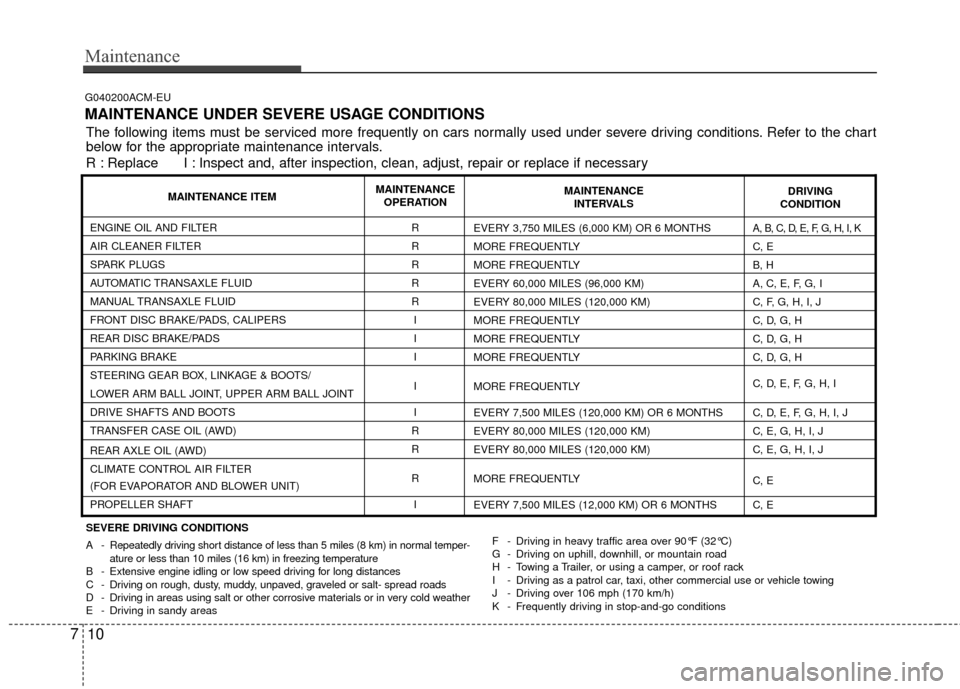
MAINTENANCE UNDER SEVERE USAGE CONDITIONS
SEVERE DRIVING CONDITIONS
A - Repeatedly driving short distance of less than 5 miles (8 km) in normal temper-
ature or less than 10 miles (16 km) in freezing temperature
B - Extensive engine idling or low speed driving for long distances
C - Driving on rough, dusty, muddy, unpaved, graveled or salt- spread roads
D - Driving in areas using salt or other corrosive materials or in very cold weather
E - Driving in sandy areas F - Driving in heavy traffic area over 90°F (32°C)
G - Driving on uphill, downhill, or mountain road
H - Towing a Trailer, or using a camper, or roof rack
I - Driving as a patrol car, taxi, other commercial use or vehicle towing
J - Driving over 106 mph (170 km/h)
K - Frequently driving in stop-and-go conditions
ENGINE OIL AND FILTER
AIR CLEANER FILTER
SPARK PLUGS
AUTOMATIC TRANSAXLE FLUID
MANUAL TRANSAXLE FLUID
FRONT DISC BRAKE/PADS, CALIPERS
REAR DISC BRAKE/PADS
PARKING BRAKE
STEERING GEAR BOX, LINKAGE & BOOTS/
LOWER ARM BALL JOINT, UPPER ARM BALL JOINT
DRIVE SHAFTS AND BOOTS
TRANSFER CASE OIL (AWD)
REAR AXLE OIL (AWD)
CLIMATE CONTROL AIR FILTER
(FOR EVAPORATOR AND BLOWER UNIT)
PROPELLER SHAFT
R
R
R
R
R
I
I
I
I
I
R
R
R
I EVERY 3,750 MILES (6,000 KM) OR 6 MONTHS
MORE FREQUENTLY
MORE FREQUENTLY
EVERY 60,000 MILES (96,000 KM)
EVERY 80,000 MILES (120,000 KM)
MORE FREQUENTLY
MORE FREQUENTLY
MORE FREQUENTLY
MORE FREQUENTLY
EVERY 7,500 MILES (120,000 KM) OR 6 MONTHS
EVERY 80,000 MILES (120,000 KM)
EVERY 80,000 MILES (120,000 KM)
MORE FREQUENTLY
EVERY 7,500 MILES (12,000 KM) OR 6 MONTHS
A, B, C, D, E, F, G, H, I, K
C, E
B, H
A, C, E, F, G, I
C, F, G, H, I, J
C, D, G, H
C, D, G, H
C, D, G, H
C, D, E, F, G, H, I
C, D, E, F, G, H, I, J
C, E, G, H, I, J
C, E, G, H, I, J
C, E
C, E
MAINTENANCE ITEM
MAINTENANCE
OPERATION MAINTENANCE
INTERVALS DRIVING
CONDITION
The following items must be serviced more frequently on cars normally used under severe driving conditions. Refer to the chart
below for the appropriate maintenance intervals.
R : Replace I : Inspect and, after inspection, clean, adjust, repair or replace if neces\
sary
Page 358 of 419
731
Maintenance
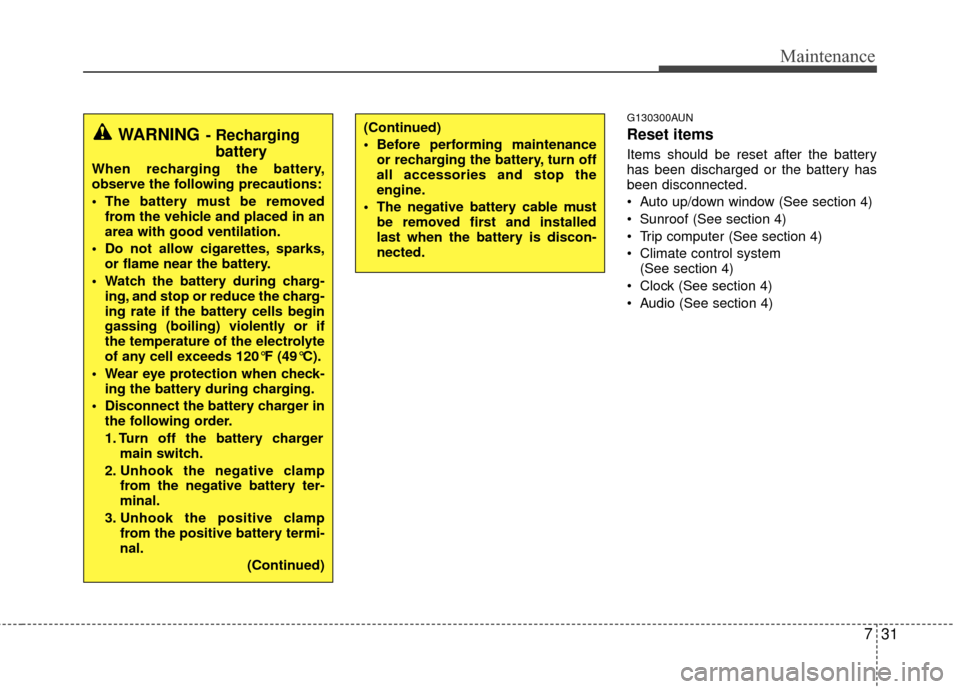
G130300AUN
Reset items
Items should be reset after the battery
has been discharged or the battery has
been disconnected.
Auto up/down window (See section 4)
Sunroof (See section 4)
Trip computer (See section 4)
Climate control system (See section 4)
Clock (See section 4)
Audio (See section 4)
(Continued)
Before performing maintenance or recharging the battery, turn off
all accessories and stop the
engine.
The negative battery cable must be removed first and installed
last when the battery is discon-
nected.WARNING- Rechargingbattery
When recharging the battery,
observe the following precautions:
The battery must be removed
from the vehicle and placed in an
area with good ventilation.
Do not allow cigarettes, sparks, or flame near the battery.
Watch the battery during charg- ing, and stop or reduce the charg-
ing rate if the battery cells begin
gassing (boiling) violently or if
the temperature of the electrolyte
of any cell exceeds 120°F (49°C).
Wear eye protection when check- ing the battery during charging.
Disconnect the battery charger in the following order.
1. Turn off the battery charger main switch.
2. Unhook the negative clamp from the negative battery ter-
minal.
3. Unhook the positive clamp from the positive battery termi-
nal.
(Continued)
Page 377 of 419
Maintenance
50
7
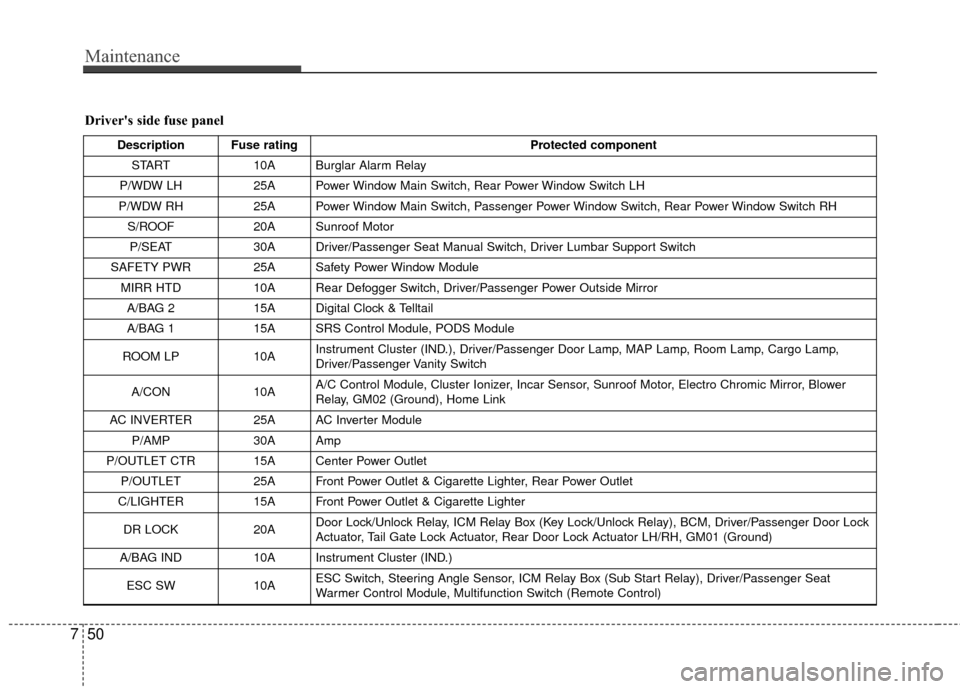
Driver's side fuse panel
Description Fuse rating Protected component
START 10A Burglar Alarm Relay
P/WDW LH 25A Power Window Main Switch, Rear Power Window Switch LH
P/WDW RH 25A Power Window Main Switch, Passenger Power Window Switch, Rear Power Window Switch RH
S/ROOF 20A Sunroof Motor
P/SEAT 30A Driver/Passenger Seat Manual Switch, Driver Lumbar Support Switch
SAFETY PWR 25A Safety Power Window Module
MIRR HTD 10A Rear Defogger Switch, Driver/Passenger Power Outside Mirror
A/BAG 2 15A Digital Clock & Telltail
A/BAG 1 15A SRS Control Module, PODS Module
ROOM LP 10AInstrument Cluster (IND.), Driver/Passenger Door Lamp, MAP Lamp, Room Lamp, Cargo Lamp,
Driver/Passenger Vanity Switch
A/CON 10AA/C Control Module, Cluster Ionizer, Incar Sensor, Sunroof Motor, Electro Chromic Mirror, Blower
Relay, GM02 (Ground), Home Link
AC INVERTER 25A AC Inverter Module P/AMP 30A Amp
P/OUTLET CTR 15A Center Power Outlet P/OUTLET 25A Front Power Outlet & Cigarette Lighter, Rear Power Outlet
C/LIGHTER 15A Front Power Outlet & Cigarette Lighter
DR LOCK 20ADoor Lock/Unlock Relay, ICM Relay Box (Key Lock/Unlock Relay), BCM, Driver/Passenger Door Lock
Actuator, Tail Gate Lock Actuator, Rear Door Lock Actuator LH/RH, GM01 (Ground)
A/BAG IND 10A Instrument Cluster (IND.)
ESC SW10AESC Switch, Steering Angle Sensor, ICM Relay Box (Sub Start Relay), Driver/Passenger Seat
Warmer Control Module, Multifunction Switch (Remote Control)
Page 379 of 419
Maintenance
52
7
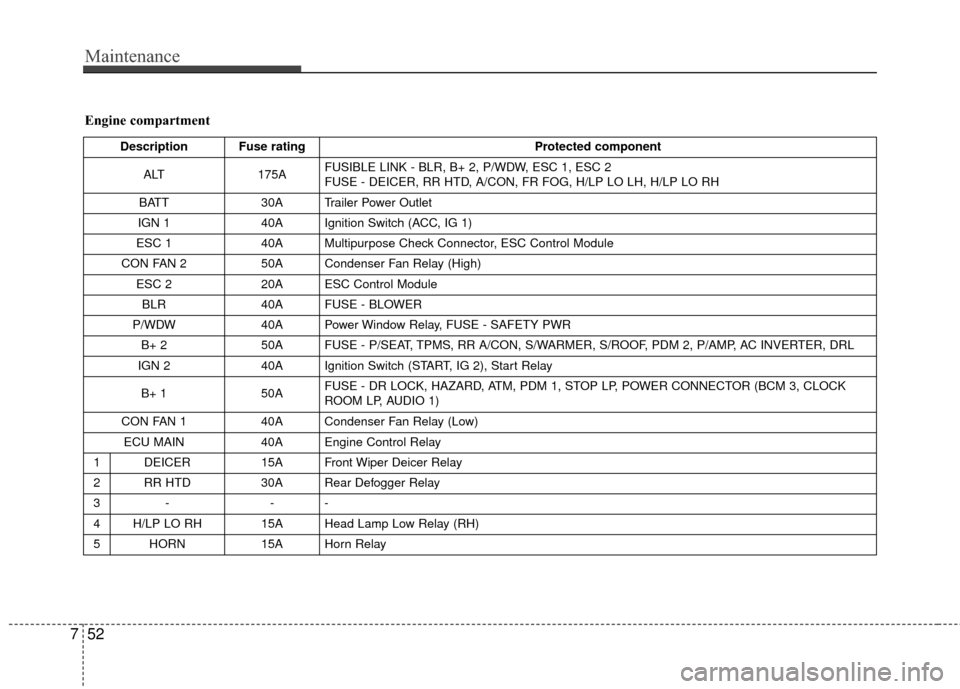
Engine compartment
Description Fuse rating Protected component
ALT 175AFUSIBLE LINK - BLR, B+ 2, P/WDW, ESC 1, ESC 2
FUSE - DEICER, RR HTD, A/CON, FR FOG, H/LP LO LH, H/LP LO RH
BATT 30A Trailer Power Outlet
IGN 1 40A Ignition Switch (ACC, IG 1)
ESC 1 40A Multipurpose Check Connector, ESC Control Module
CON FAN 2 50A Condenser Fan Relay (High)
ESC 2 20A ESC Control Module
BLR 40A FUSE - BLOWER
P/WDW 40A Power Window Relay, FUSE - SAFETY PWR
B+ 2 50A FUSE - P/SEAT, TPMS, RR A/CON, S/WARMER, S/ROOF, PDM 2, P/AMP, AC INVERTER, DRL
IGN 2 40A Ignition Switch (START, IG 2), Start Relay
B+ 1 50AFUSE - DR LOCK, HAZARD, ATM, PDM 1, STOP LP, POWER CONNECTOR (BCM 3, CLOCK
ROOM LP, AUDIO 1)
CON FAN 1 40A Condenser Fan Relay (Low)
ECU MAIN 40A Engine Control Relay
1 DEICER 15A Front Wiper Deicer Relay
2 RR HTD 30A Rear Defogger Relay
3- --
4 H/LP LO RH 15A Head Lamp Low Relay (RH)
5 HORN 15A Horn Relay
Page 402 of 419
Specifications, Consumer information, Reporting safety defects
28
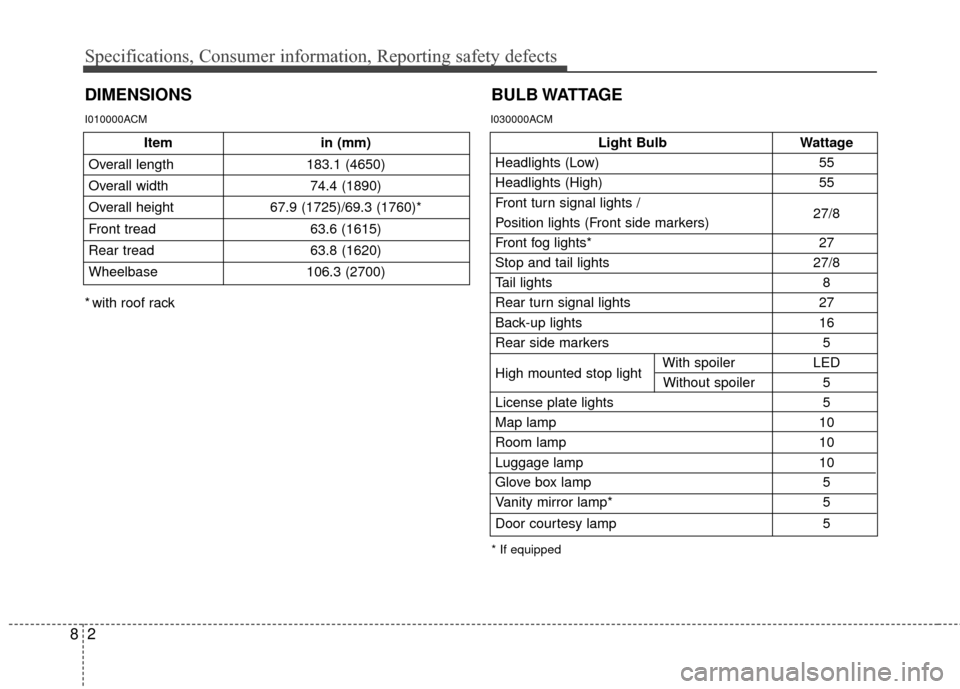
Itemin (mm)
Overall length 183.1 (4650)
Overall width 74.4 (1890)
Overall height 67.9 (1725)/69.3 (1760)*
Front tread 63.6 (1615)
Rear tread 63.8 (1620)
Wheelbase 106.3 (2700)
DIMENSIONS
Light BulbWattage
Headlights (Low) 55
Headlights (High) 55
Front turn signal lights / 27/8
Position lights (Front side markers)
Front fog lights* 27
Stop and tail lights 27/8
Tail lights 8
Rear turn signal lights 27
Back-up lights 16
Rear side markers 5
High mounted stop light With spoiler
LED
Without spoiler 5
License plate lights 5
Map lamp 10
Room lamp 10
Luggage lamp 10
Glove box lamp 5
Vanity mirror lamp* 5
Door courtesy lamp 5
BULB WATTAGE
* If equipped
* with roof rack
I010000ACM I030000ACM
Page 413 of 419

I3
Index
Defroster ··················\
··················\
··················\
··················\
4-66
Dimensions ··················\
··················\
··················\
················8-2
Door locks··················\
··················\
··················\
················4-14Central door lock switch ··················\
··················\
···········4-8
Child-protector rear door lock ··················\
··················\
·4-10
Economical operation ··················\
··················\
················5-38
Emergency starting ··················\
··················\
··················\
····6-4 Jump starting ··················\
··················\
··················\
···········6-4
Push starting ··················\
··················\
··················\
············6-5
Emission control system ··················\
··················\
············7-70 Crankcase emission control system··················\
···········7-70
Evaporative emission control (including ORVR:Onboard Refueling Vapor Recovery) System ···········7-70
Exhaust emission control system ··················\
··············7-71
Engine compartment ··················\
··················\
············2-4, 7-2
Engine coolant ··················\
··················\
··················\
·········7-15
Engine number ··················\
··················\
··················\
···········8-8
Engine oil ··················\
··················\
··················\
·················7-14\
Explanation of scheduled maintenance items ···············7-11
Exterior features··················\
··················\
··················\
·····4-101 Roof rack ··················\
··················\
··················\
·············4-101 Fuel filler lid ··················\
··················\
··················\
············4-19
Fuel requirements ··················\
··················\
··················\
······1-2
Fuses ··················\
··················\
··················\
··················\
······7-45
Fuse/relay panel description ··················\
··················\
····7-49
Main fuse ··················\
··················\
··················\
···············7-48
Memory fuse··················\
··················\
··················\
··········7-47
Hazard warning flasher ··················\
··················\
··············4-56
Hood··················\
··················\
··················\
··················\
·······4-17
How to use this manual ··················\
··················\
···············1-2
If the engine overheats··················\
··················\
·················6-6
If the engine will not start ··················\
··················\
···········6-3
If you have a flat tire ··················\
··················\
·················6-13\
Changing tires··················\
··················\
··················\
········6-16
Compact spare tire ··················\
··················\
··················\
·6-20
Jack and tools ··················\
··················\
··················\
········6-13
Removing and storing the spare tire···········\
·················6-13\
D
E
F
H
I
Page 416 of 419

Index
6I
Lumbar support ··················\
··················\
··················\
·······3-6
Rear seat adjustment··················\
··················\
················3-12
Seatback pocket ··················\
··················\
··················\
·····3-11
Seat warmer ··················\
··················\
··················\
···········3-10
Special driving conditions ··················\
··················\
·········5-40 Driving at night ··················\
··················\
··················\
·····5-41
Driving in flooded areas ··················\
··················\
··········5-42
Driving in the rain ··················\
··················\
··················\
·5-42
Hazardous driving conditions ··················\
··················\
··5-40
Highway driving ··················\
··················\
··················\
····5-43
Rocking the vehicle ··················\
··················\
·················5-40\
Smooth cornering ··················\
··················\
··················\
··5-41
Starting the engine ··················\
··················\
··················\
·····5-6
Steering wheel ··················\
··················\
··················\
·········4-26 Horn ··················\
··················\
··················\
··················\
·····4-27
Power steering ··················\
··················\
··················\
·······4-26
Tilt steering ··················\
··················\
··················\
············4-26
Storage compartment ··················\
··················\
·················4-89\
Center console storage·············\
··················\
··················\
4-89
Glove box ··················\
··················\
··················\
··············4-89
Multi box ··················\
··················\
··················\
···············4-90
Luggage box ··················\
··················\
··················\
··········4-91
Sunglass holder··················\
··················\
··················\
······4-90
Sunroof··················\
··················\
··················\
··················\
···4-22 Tailgate··················\
··················\
··················\
··················\
···4-11
Theft-alarm system ··················\
··················\
··················\
····4-5
Tires pressure monitoring system (TPMS)··················\
····6-7
Changing a tire with TPMS··················\
··················\
·····6-10
Low tire pressure telltale ··················\
··················\
···········6-8
TPMS (Tire pressure monitoring system) malfunction indicator ··················\
··················\
··············6-9
Tire specification and pressure label ··················\
·············8-8
Tires and wheels ··················\
··················\
·················7-32\
, 8-3 All season tires ··················\
··················\
··················\
······7-43
Checking tire inflation pressure ··················\
················7-34
Compact spare tire replacement ··················\
················7-36
Radial-ply tires ··················\
··················\
··················\
······7-44
Recommended cold tire inflation pressures ················7-32
Snow tires ··················\
··················\
··················\
··············7-43
Summer tires··················\
··················\
··················\
··········7-43
Tire care ··················\
··················\
··················\
·················7-32\
Tire chains ··················\
··················\
··················\
·············7-44
Tire maintenance ··················\
··················\
··················\
···7-38
Tire replacement ··················\
··················\
··················\
····7-36
Tire rotation ··················\
··················\
··················\
···········7-35
Tire sidewall labeling ··················\
··················\
··············7-38
Tire terminology and definitions ··················\
···············7-41
Tire traction ··················\
··················\
··················\
···········7-38
Wheel alignment and tire balance ··················\
·············7-36
Wheel replacement ··················\
··················\
··················\
7-36T