Brake pad Hyundai Santa Fe 2012 Owner's Manual
[x] Cancel search | Manufacturer: HYUNDAI, Model Year: 2012, Model line: Santa Fe, Model: Hyundai Santa Fe 2012Pages: 419, PDF Size: 5.61 MB
Page 264 of 419
523
Driving your vehicle
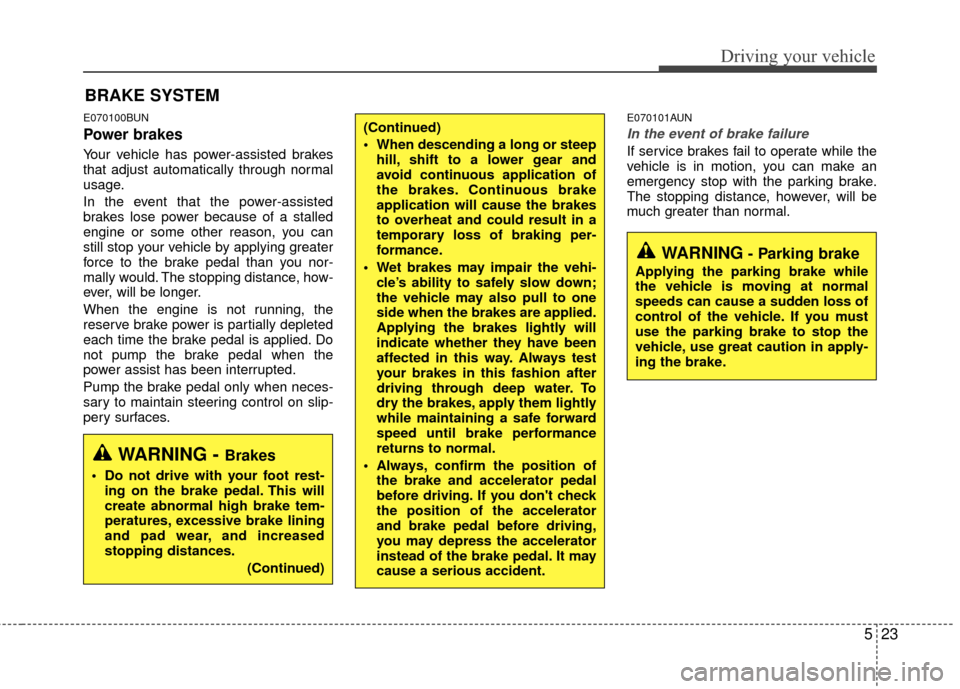
E070100BUN
Power brakes
Your vehicle has power-assisted brakes
that adjust automatically through normal
usage.
In the event that the power-assisted
brakes lose power because of a stalled
engine or some other reason, you can
still stop your vehicle by applying greater
force to the brake pedal than you nor-
mally would. The stopping distance, how-
ever, will be longer.
When the engine is not running, the
reserve brake power is partially depleted
each time the brake pedal is applied. Do
not pump the brake pedal when the
power assist has been interrupted.
Pump the brake pedal only when neces-
sary to maintain steering control on slip-
pery surfaces.
E070101AUN
In the event of brake failure
If service brakes fail to operate while the
vehicle is in motion, you can make an
emergency stop with the parking brake.
The stopping distance, however, will be
much greater than normal.
BRAKE SYSTEM
(Continued)
When descending a long or steephill, shift to a lower gear and
avoid continuous application of
the brakes. Continuous brake
application will cause the brakes
to overheat and could result in a
temporary loss of braking per-
formance.
Wet brakes may impair the vehi- cle’s ability to safely slow down;
the vehicle may also pull to one
side when the brakes are applied.
Applying the brakes lightly will
indicate whether they have been
affected in this way. Always test
your brakes in this fashion after
driving through deep water. To
dry the brakes, apply them lightly
while maintaining a safe forward
speed until brake performance
returns to normal.
Always, confirm the position of the brake and accelerator pedal
before driving. If you don't check
the position of the accelerator
and brake pedal before driving,
you may depress the accelerator
instead of the brake pedal. It may
cause a serious accident.
WARNING- Parking brake
Applying the parking brake while
the vehicle is moving at normal
speeds can cause a sudden loss of
control of the vehicle. If you must
use the parking brake to stop the
vehicle, use great caution in apply-
ing the brake.
WARNING - Brakes
Do not drive with your foot rest-ing on the brake pedal. This will
create abnormal high brake tem-
peratures, excessive brake lining
and pad wear, and increased
stopping distances.
(Continued)
Page 265 of 419
Driving your vehicle
24
5
E070102AUN
Disc brakes wear indicator
When your brake pads are worn and new
pads are required, you will hear a high-
pitched warning sound from your front
brakes or rear brakes (if equipped). You
may hear this sound come and go or it
may occur whenever you depress the
brake pedal.
Please remember that some driving con-
ditions or climates may cause a brake
squeal when you first apply (or lightly
apply) the brakes. This is normal and does
not indicate a problem with your brakes.
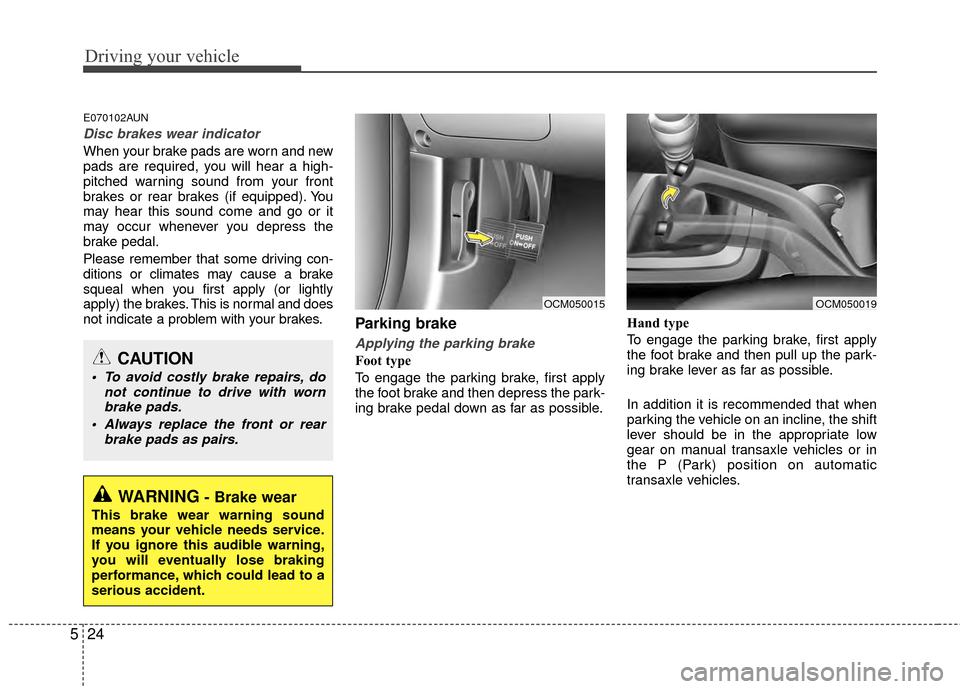
Parking brake
Applying the parking brake
Foot type
To engage the parking brake, first apply
the foot brake and then depress the park-
ing brake pedal down as far as possible. Hand type
To engage the parking brake, first apply
the foot brake and then pull up the park-
ing brake lever as far as possible.
In addition it is recommended that when
parking the vehicle on an incline, the shift
lever should be in the appropriate low
gear on manual transaxle vehicles or in
the P (Park) position on automatic
transaxle vehicles.
WARNING- Brake wear
This brake wear warning sound
means your vehicle needs service.
If you ignore this audible warning,
you will eventually lose braking
performance, which could lead to a
serious accident.
CAUTION
To avoid costly brake repairs, do
not continue to drive with wornbrake pads.
Always replace the front or rear brake pads as pairs.
OCM050015OCM050019
Page 266 of 419
525
Driving your vehicle
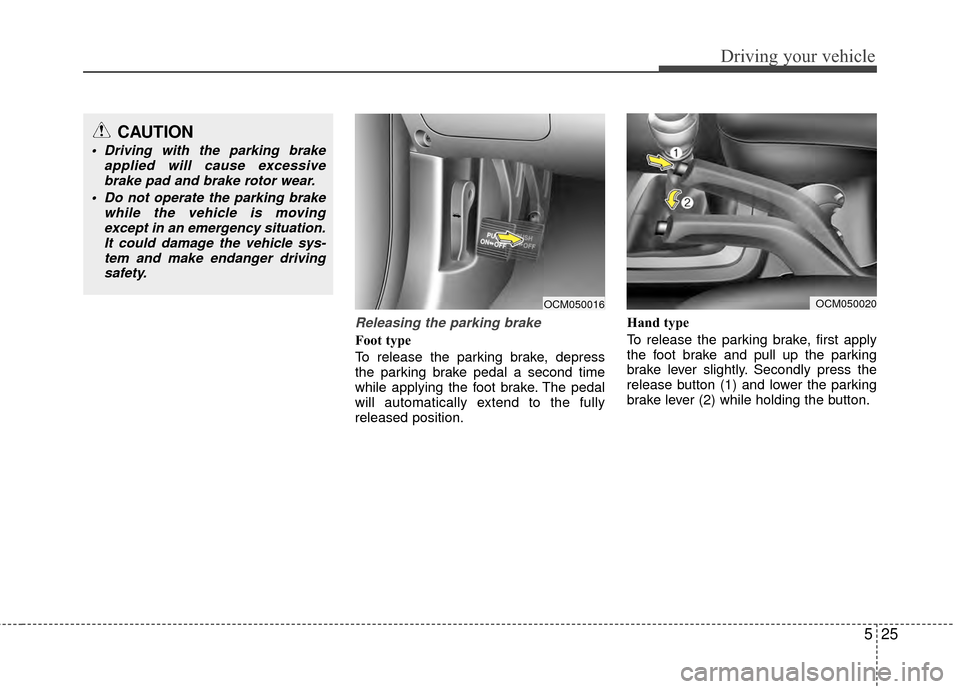
Releasing the parking brake
Foot type
To release the parking brake, depress
the parking brake pedal a second time
while applying the foot brake. The pedal
will automatically extend to the fully
released position.Hand type
To release the parking brake, first apply
the foot brake and pull up the parking
brake lever slightly. Secondly press the
release button (1) and lower the parking
brake lever (2) while holding the button.
OCM050016OCM050020
CAUTION
Driving with the parking brake
applied will cause excessivebrake pad and brake rotor wear.
Do not operate the parking brake while the vehicle is movingexcept in an emergency situation.It could damage the vehicle sys- tem and make endanger drivingsafety.
Page 335 of 419
Maintenance
87
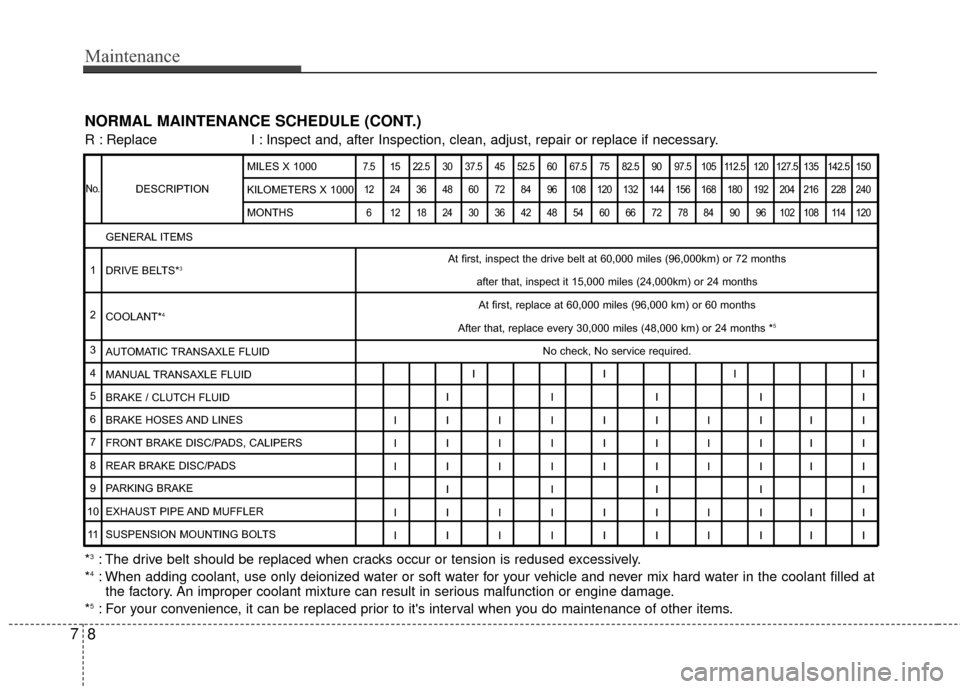
NORMAL MAINTENANCE SCHEDULE (CONT.)
DESCRIPTION
7.5 15 22.5 30 37.5 45 52.5 60 67.5 75 82.5 90 97.5 105 112.5 120 127.5 135 142.5 15012 24 36 48 60 72 84 96 108 120 132 144 156 168 180 192 204 216 228 240 6 121824303642485460667278849096102108114120
At first, inspect the drive belt at 60,000 miles (96,000km) or 72 mont\
hs after that, inspect it 15,000 miles (24,000km) or 24 monthsAt first, replace at 60,000 miles (96,000 km) or 60 months
After that, replace every 30,000 miles (48,000 km) or 24 months *
5
No check, No service required.
IIII
IIIII
IIIIIIIIII
IIIIIIIIII
IIIIIIIIII IIIII
IIIIIIIIII
IIIIIIIIII
GENERAL ITEMS
DRIVE BELTS*
3
COOLANT*4
AUTOMATIC TRANSAXLE FLUID
MANUAL TRANSAXLE FLUID
BRAKE / CLUTCH FLUID
BRAKE HOSES AND LINES
FRONT BRAKE DISC/PADS, CALIPERS
REAR BRAKE DISC/PADS
PARKING BRAKE
EXHAUST PIPE AND MUFFLER
SUSPENSION MOUNTING BOLTS MILES X 1000
KILOMETERS X 1000
MONTHS
R : Replace
I : Inspect and, after Inspection, clean, adjust, repair or replace if neces\
sary.
No.
1
2
3
4
5
6
7
8
9
10 11
*3: The drive belt should be replaced when cracks occur or tension is redused excessively.
*4: When adding coolant, use only deionized water or soft water for your vehicle and never mix hard water in the coolant filled at the factory. An improper coolant mixture can result in serious malfunction or engine damage.
*
5: For your convenience, it can be replaced prior to it's interval when you do maintenance of other items.
Page 337 of 419
Maintenance
10
7
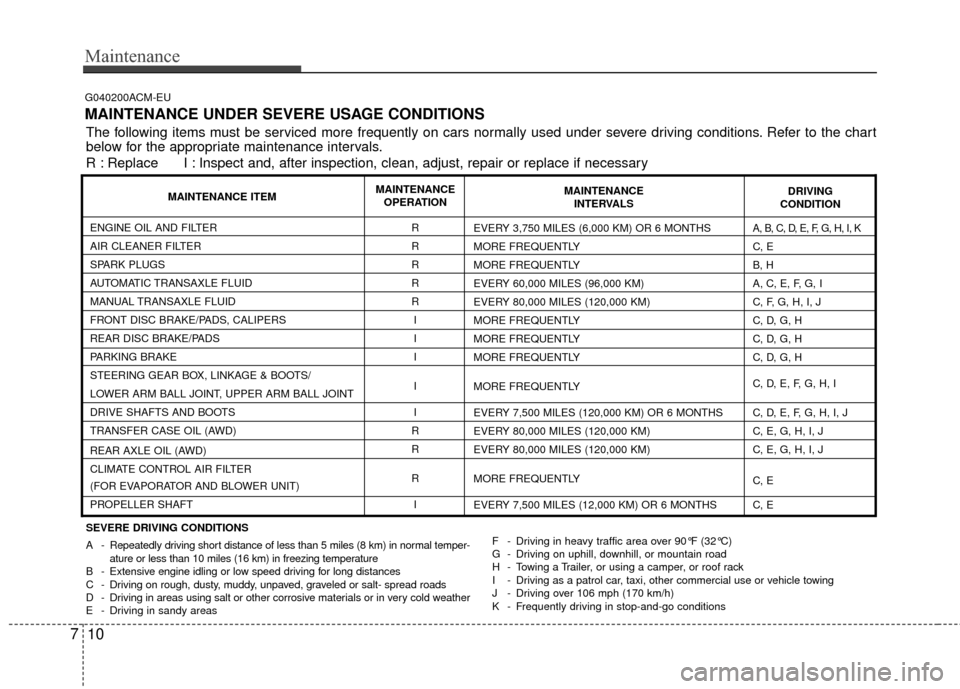
G040200ACM-EU
MAINTENANCE UNDER SEVERE USAGE CONDITIONS
SEVERE DRIVING CONDITIONS
A - Repeatedly driving short distance of less than 5 miles (8 km) in normal temper-
ature or less than 10 miles (16 km) in freezing temperature
B - Extensive engine idling or low speed driving for long distances
C - Driving on rough, dusty, muddy, unpaved, graveled or salt- spread roads
D - Driving in areas using salt or other corrosive materials or in very cold weather
E - Driving in sandy areas F - Driving in heavy traffic area over 90°F (32°C)
G - Driving on uphill, downhill, or mountain road
H - Towing a Trailer, or using a camper, or roof rack
I - Driving as a patrol car, taxi, other commercial use or vehicle towing
J - Driving over 106 mph (170 km/h)
K - Frequently driving in stop-and-go conditions
ENGINE OIL AND FILTER
AIR CLEANER FILTER
SPARK PLUGS
AUTOMATIC TRANSAXLE FLUID
MANUAL TRANSAXLE FLUID
FRONT DISC BRAKE/PADS, CALIPERS
REAR DISC BRAKE/PADS
PARKING BRAKE
STEERING GEAR BOX, LINKAGE & BOOTS/
LOWER ARM BALL JOINT, UPPER ARM BALL JOINT
DRIVE SHAFTS AND BOOTS
TRANSFER CASE OIL (AWD)
REAR AXLE OIL (AWD)
CLIMATE CONTROL AIR FILTER
(FOR EVAPORATOR AND BLOWER UNIT)
PROPELLER SHAFT
R
R
R
R
R
I
I
I
I
I
R
R
R
I EVERY 3,750 MILES (6,000 KM) OR 6 MONTHS
MORE FREQUENTLY
MORE FREQUENTLY
EVERY 60,000 MILES (96,000 KM)
EVERY 80,000 MILES (120,000 KM)
MORE FREQUENTLY
MORE FREQUENTLY
MORE FREQUENTLY
MORE FREQUENTLY
EVERY 7,500 MILES (120,000 KM) OR 6 MONTHS
EVERY 80,000 MILES (120,000 KM)
EVERY 80,000 MILES (120,000 KM)
MORE FREQUENTLY
EVERY 7,500 MILES (12,000 KM) OR 6 MONTHS
A, B, C, D, E, F, G, H, I, K
C, E
B, H
A, C, E, F, G, I
C, F, G, H, I, J
C, D, G, H
C, D, G, H
C, D, G, H
C, D, E, F, G, H, I
C, D, E, F, G, H, I, J
C, E, G, H, I, J
C, E, G, H, I, J
C, E
C, E
MAINTENANCE ITEM
MAINTENANCE
OPERATION MAINTENANCE
INTERVALS DRIVING
CONDITION
The following items must be serviced more frequently on cars normally used under severe driving conditions. Refer to the chart
below for the appropriate maintenance intervals.
R : Replace I : Inspect and, after inspection, clean, adjust, repair or replace if neces\
sary
Page 340 of 419
713
Maintenance
G051500AUN
Brake hoses and lines
Visually check for proper installation,
chafing, cracks, deterioration and any
leakage. Replace any deteriorated or
damaged parts immediately.
G051600AUN
Brake fluid
Check brake fluid level in the brake fluid
reservoir. The level should be between
“MIN” and “MAX” marks on the side of
the reservoir. Use only hydraulic brake
fluid conforming to DOT 3 or DOT 4
specification.
G051700AUN
Parking brake
Inspect the parking brake system includ-
ing the parking brake lever (or pedal) and
cables.
G051900AUN
Brake pads, calipers and rotors
Check the pads for excessive wear, discs
for run out and wear, and calipers for fluid
leakage.
G052100AUN
Suspension mounting bolts
Check the suspension connections for
looseness or damage. Retighten to the
specified torque.
G052200AUN
Steering gear box, linkage &
boots/lower arm ball joint
With the vehicle stopped and engine off,
check for excessive free-play in the
steering wheel.
Check the linkage for bends or damage.
Check the dust boots and ball joints for
deterioration, cracks, or damage.
Replace any damaged parts.
G052300AXM
Power steering pump, belt and
hoses
Check the power steering pump and
hoses for leakage and damage. Replace
any damaged or leaking parts immedi-
ately. Inspect the power steering belt (or
drive belt) for evidence of cuts, cracks,
excessive wear, oiliness and proper ten-
sion. Replace or adjust it if necessary.
G052400AUN
Drive shafts and boots
Check the drive shafts, boots and clamps
for cracks, deterioration, or damage.
Replace any damaged parts and, if nec-
essary, repack the grease.
G052500ACM
Air conditioning refrigerant/
compressor (if equipped)
Check the air conditioning lines and con-
nections for leakage and damage.
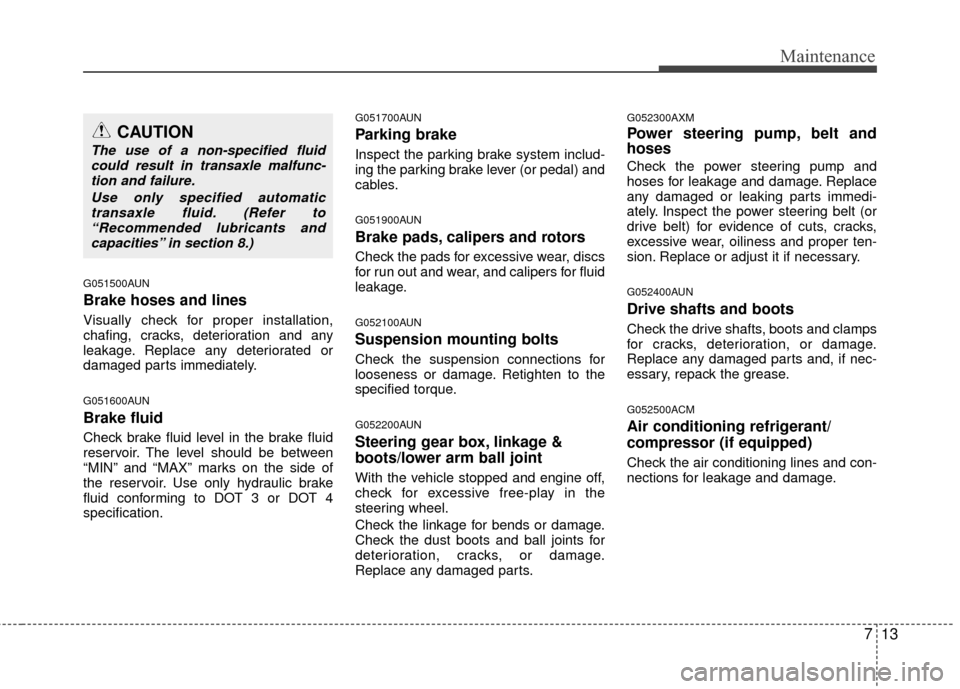
CAUTION
The use of a non-specified fluidcould result in transaxle malfunc-tion and failure.
Use only specified automatictransaxle fluid. (Refer to“Recommended lubricants andcapacities” in section 8.)
Page 362 of 419
735
Maintenance
G200400AXM
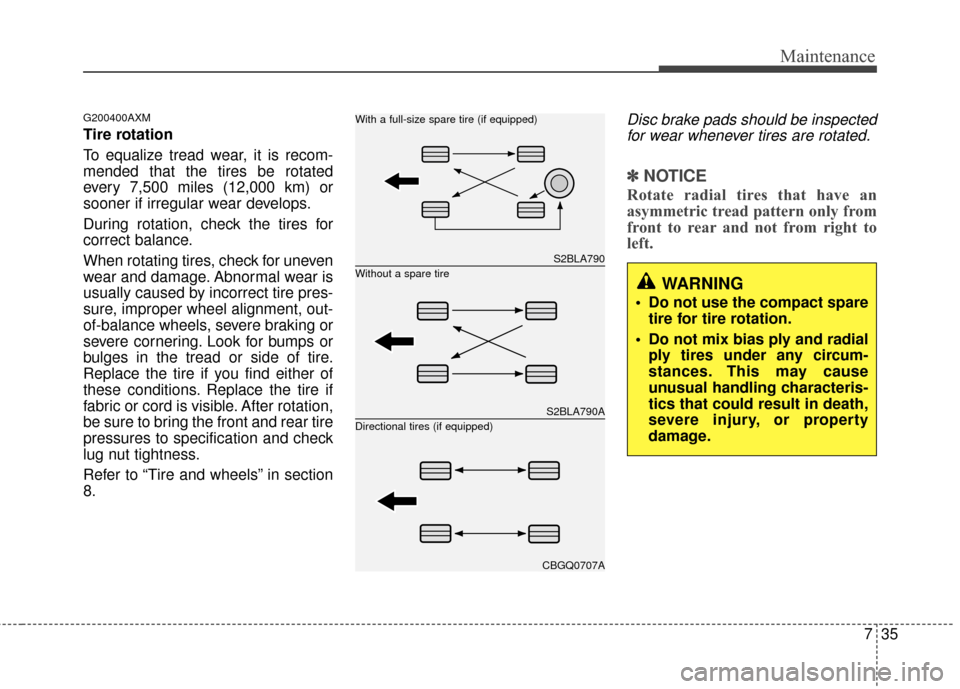
Tire rotation
To equalize tread wear, it is recom-
mended that the tires be rotated
every 7,500 miles (12,000 km) or
sooner if irregular wear develops.
During rotation, check the tires for
correct balance.
When rotating tires, check for uneven
wear and damage. Abnormal wear is
usually caused by incorrect tire pres-
sure, improper wheel alignment, out-
of-balance wheels, severe braking or
severe cornering. Look for bumps or
bulges in the tread or side of tire.
Replace the tire if you find either of
these conditions. Replace the tire if
fabric or cord is visible. After rotation,
be sure to bring the front and rear tire
pressures to specification and check
lug nut tightness.
Refer to “Tire and wheels” in section
8.Disc brake pads should be inspectedfor wear whenever tires are rotated.
✽ ✽ NOTICE
Rotate radial tires that have an
asymmetric tread pattern only from
front to rear and not from right to
left.
WARNING
Do not use the compact spare
tire for tire rotation.
Do not mix bias ply and radial ply tires under any circum-
stances. This may cause
unusual handling characteris-
tics that could result in death,
severe injury, or property
damage.
S2BLA790
S2BLA790A
CBGQ0707A
Without a spare tire With a full-size spare tire (if equipped)
Directional tires (if equipped)