engine Hyundai Santa Fe 2013 User Guide
[x] Cancel search | Manufacturer: HYUNDAI, Model Year: 2013, Model line: Santa Fe, Model: Hyundai Santa Fe 2013Pages: 711, PDF Size: 14.72 MB
Page 23 of 711
211
Your vehicle at a glance
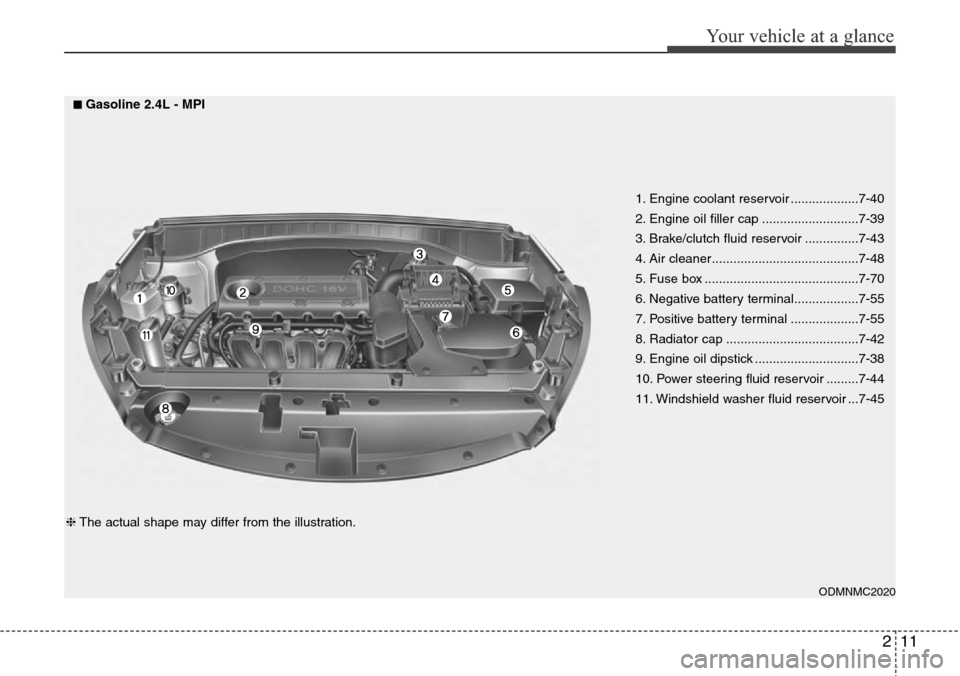
1. Engine coolant reservoir ...................7-40
2. Engine oil filler cap ...........................7-39
3. Brake/clutch fluid reservoir ...............7-43
4. Air cleaner.........................................7-48
5. Fuse box ...........................................7-70
6. Negative battery terminal..................7-55
7. Positive battery terminal ...................7-55
8. Radiator cap .....................................7-42
9. Engine oil dipstick .............................7-38
10. Power steering fluid reservoir .........7-44
11. Windshield washer fluid reservoir ...7-45
ODMNMC2020
■Gasoline 2.4L - MPI
❈The actual shape may differ from the illustration.
Page 24 of 711
Your vehicle at a glance
12 2
OXM079100
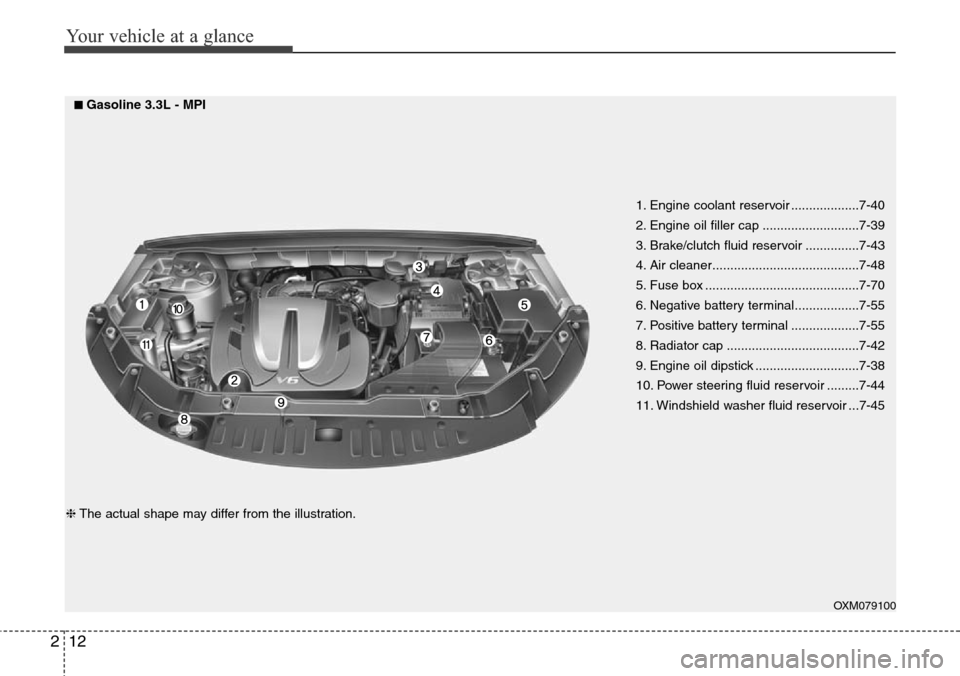
1. Engine coolant reservoir ...................7-40
2. Engine oil filler cap ...........................7-39
3. Brake/clutch fluid reservoir ...............7-43
4. Air cleaner.........................................7-48
5. Fuse box ...........................................7-70
6. Negative battery terminal..................7-55
7. Positive battery terminal ...................7-55
8. Radiator cap .....................................7-42
9. Engine oil dipstick .............................7-38
10. Power steering fluid reservoir .........7-44
11. Windshield washer fluid reservoir ...7-45
■Gasoline 3.3L - MPI
❈The actual shape may differ from the illustration.
Page 25 of 711
213
Your vehicle at a glance
ODM012005
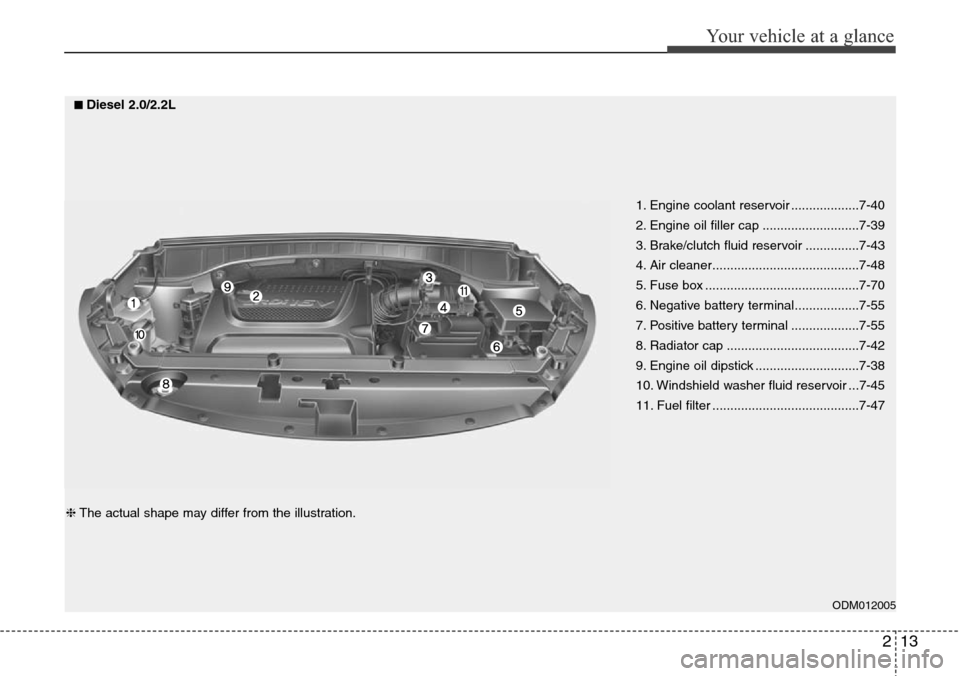
1. Engine coolant reservoir ...................7-40
2. Engine oil filler cap ...........................7-39
3. Brake/clutch fluid reservoir ...............7-43
4. Air cleaner.........................................7-48
5. Fuse box ...........................................7-70
6. Negative battery terminal..................7-55
7. Positive battery terminal ...................7-55
8. Radiator cap .....................................7-42
9. Engine oil dipstick .............................7-38
10. Windshield washer fluid reservoir ...7-45
11. Fuel filter .........................................7-47
■Diesel 2.0/2.2L
❈The actual shape may differ from the illustration.
Page 32 of 711
37
Safety features of your vehicle
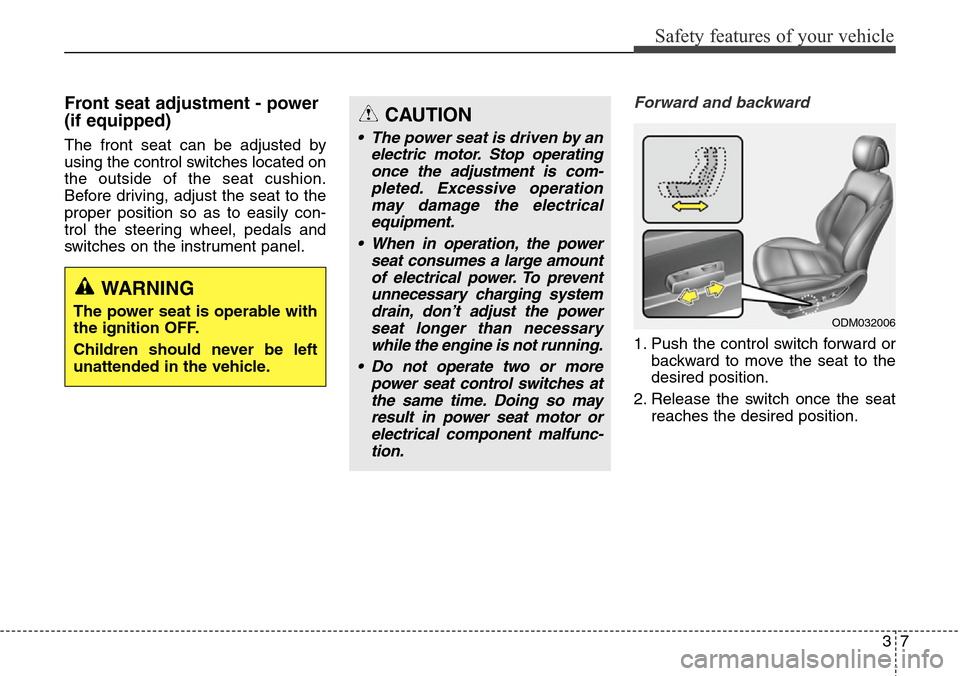
Front seat adjustment - power
(if equipped)
The front seat can be adjusted by
using the control switches located on
the outside of the seat cushion.
Before driving, adjust the seat to the
proper position so as to easily con-
trol the steering wheel, pedals and
switches on the instrument panel.
Forward and backward
1. Push the control switch forward or
backward to move the seat to the
desired position.
2. Release the switch once the seat
reaches the desired position.
CAUTION
• The power seat is driven by an
electric motor. Stop operating
once the adjustment is com-
pleted. Excessive operation
may damage the electrical
equipment.
• When in operation, the power
seat consumes a large amount
of electrical power. To prevent
unnecessary charging system
drain, don’t adjust the power
seat longer than necessary
while the engine is not running.
• Do not operate two or more
power seat control switches at
the same time. Doing so may
result in power seat motor or
electrical component malfunc-
tion.
WARNING
The power seat is operable with
the ignition OFF.
Children should never be left
unattended in the vehicle.ODM032006
Page 34 of 711
39
Safety features of your vehicle
Driver position memory system
(if equipped, for power seat)
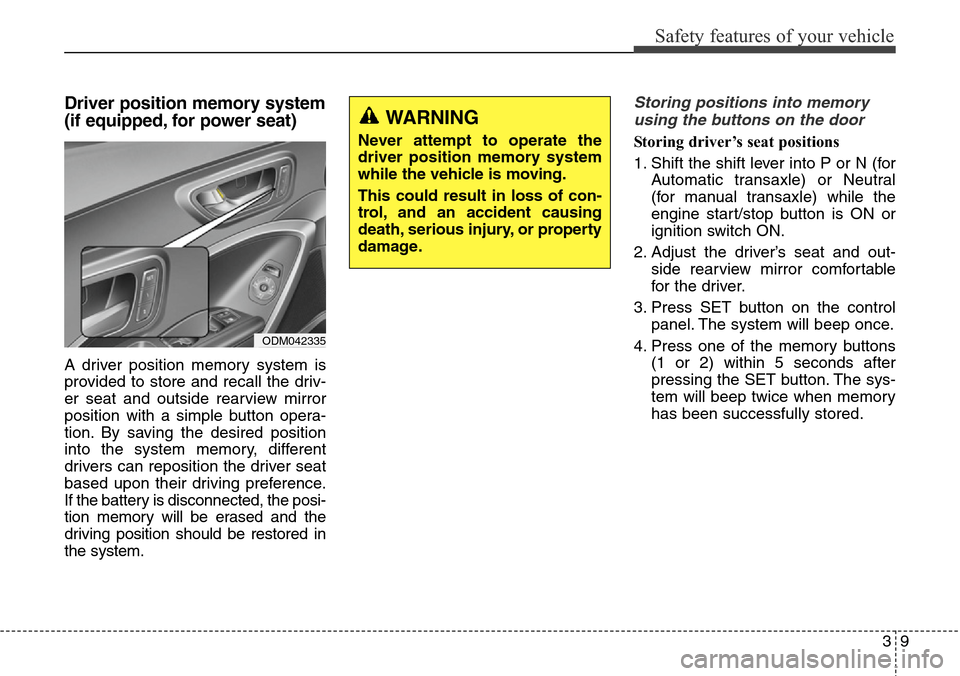
A driver position memory system is
provided to store and recall the driv-
er seat and outside rearview mirror
position with a simple button opera-
tion. By saving the desired position
into the system memory, different
drivers can reposition the driver seat
based upon their driving preference.
If the battery is disconnected, the posi-
tion memory will be erased and the
driving position should be restored in
the system.
Storing positions into memory
using the buttons on the door
Storing driver’s seat positions
1. Shift the shift lever into P or N (for
Automatic transaxle) or Neutral
(for manual transaxle) while the
engine start/stop button is ON or
ignition switch ON.
2. Adjust the driver’s seat and out-
side rearview mirror comfortable
for the driver.
3. Press SET button on the control
panel. The system will beep once.
4. Press one of the memory buttons
(1 or 2) within 5 seconds after
pressing the SET button. The sys-
tem will beep twice when memory
has been successfully stored.
WARNING
Never attempt to operate the
driver position memory system
while the vehicle is moving.
This could result in loss of con-
trol, and an accident causing
death, serious injury, or property
damage.
ODM042335
Page 35 of 711
Safety features of your vehicle
10 3
Recalling positions from memory
1. Shift the shift lever into P or N (for
Automatic transaxle) or Neutral
(for manual transaxle) while the
engine start/stop button is ON or
ignition switch ON.
2. To recall the position in the memo-
ry, press the desired memory but-
ton (1 or 2). The system will beep
once, then the driver’s seat will
automatically adjust to the stored
position.
Adjusting the control switch for the
driver’s seat while the system is
recalling the stored position will
cause the movement to stop and
move in the direction that the control
switch is moved.Easy access function
(if equipped)
The system will move the driver's
seat automatically as follows:
• Without smart key system
- It will move the driver’s seat rear-
ward when the ignition key is
removed and front driver’s door is
opened.
- It will move the driver’s seat for-
ward when the ignition key is
inserted.
• With smart key system
- It will move the driver’s seat rear-
ward when the engine start/stop
button is changed to the OFF
position and front driver’s door is
opened.
- It will move the driver’s seat for-
ward when the engine start/stop
button is changed to the ACC or
START position.
You can activate or deactivate this
feature. Refer to "User settings" in
section 4.
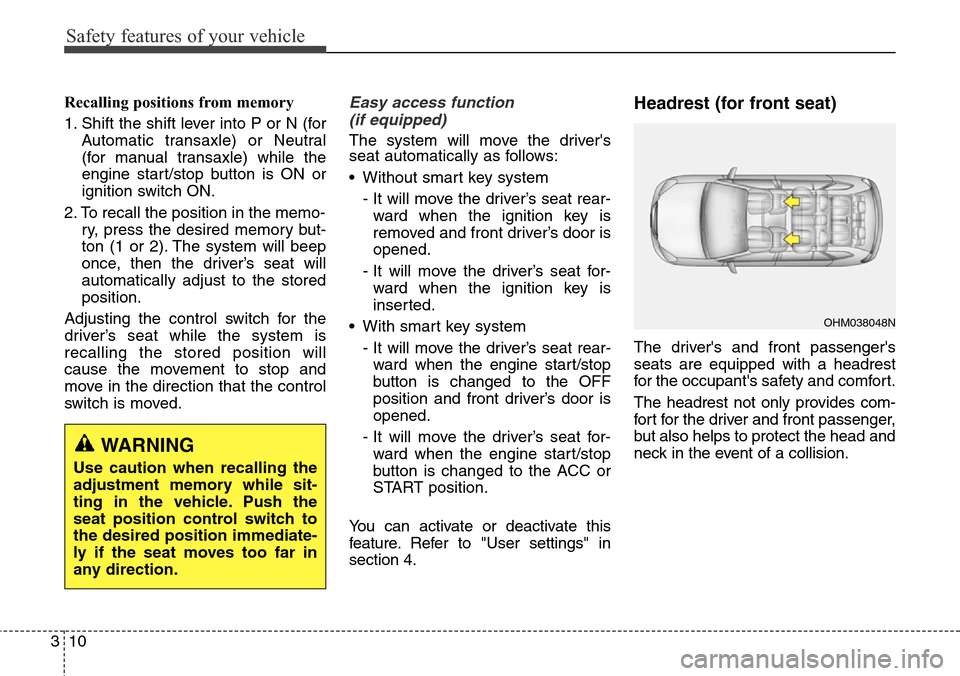
Headrest (for front seat)
The driver's and front passenger's
seats are equipped with a headrest
for the occupant's safety and comfort.
The headrest not only provides com-
fort for the driver and front passenger,
but also helps to protect the head and
neck in the event of a collision.
WARNING
Use caution when recalling the
adjustment memory while sit-
ting in the vehicle. Push the
seat position control switch to
the desired position immediate-
ly if the seat moves too far in
any direction.
OHM038048N
Page 47 of 711

Safety features of your vehicle
22 3
Headrest (for rear seat)
The rear seat(s) is equipped with
headrests in all the seating positions
for the occupant's safety and com-
for t.
The headrest not only provides com-
fort for passengers, but also helps
protect the head and neck in the
event of a collision.
WARNING- Cargo
Cargo should always be
secured to prevent it from being
thrown about the vehicle in a
collision and causing injury to
the vehicle occupants. Do not
place objects in the rear (2nd
and/or 3rd row) seats, since they
cannot be properly secured and
may hit the front seat occupants
in a collision.
WARNING - Cargo loading
Make sure the engine is off, the
automatic transaxle is in P (Park)
or the manual transaxle is in R
(Reverse) or 1st, and the parking
brake is securely applied when-
ever loading or unloading cargo.
Failure to take these steps may
allow the vehicle to move if the
shift lever is inadvertently
moved to another position.
OHM038049N
*
*
* if equipped
WARNING
• For maximum effectiveness in
case of an accident, the head-
rest should be adjusted so the
middle of the headrest is at
the same height as the center
of gravity of an occupant's
head. Generally, the center of
gravity of most people's head
is similar with the height of
the top of their eyes. Also
adjust the headrest as close
to your head as possible. For
this reason, the use of a cush-
ion that holds the body away
from the seatback is not rec-
ommended.
(Continued)
Page 83 of 711

Safety features of your vehicle
58 3
Driver's and passenger's front
air bag (if equipped)
Your vehicle is equipped with a
Supplemental Restraint (Air Bag)
System and lap/shoulder belts at
both the driver and passenger seat-
ing positions.
(Continued)
• The SRS can function only
when the ignition key is in the
"ON" position. If the SRS air
bag warning light does not
illuminate, or continuously
remains on after illuminating
for about 6 seconds when the
ignition key is turned to the
ON position, or after the
engine is started, comes on
while driving, the SRS is not
working properly.
If this occurs, we recommend
that the system be inspected
by an authorized HYUNDAI
dealer.
• Before you replace a fuse or
disconnect a battery terminal,
turn the ignition switch to the
LOCK position and remove
the ignition key. Never remove
or replace the air bag related
fuse(s) when the ignition
switch is in the ON position.
Failure to heed this warning
will cause the SRS air bag
warning light to illuminate.
ODM032040
ODM032041
■Driver’s front air bag
■Driver’s knee air bag
(Continued)
• When installing a container of
liquid air freshener inside the
vehicle, do not place it near
the instrument cluster nor on
the instrument panel surface.
It may become dangerous pro-
jectiles and cause injury if the
passenger's air bag inflates.
WARNING
• If an air bag deploys, there
may be a loud noise followed
by a fine dust released in the
vehicle. These conditions are
normal and are not hazardous
- the air bags are packed in this
fine powder. The dust generat-
ed during air bag deployment
may cause skin or eye irrita-
tion as well as aggravate asth-
ma for some persons. Always
wash all exposed skin areas
thoroughly with lukewarm
water and a mild soap after an
accident in which the air bags
were deployed.
(Continued)
Page 98 of 711
373
Safety features of your vehicle
Additional safety precautions
•Never let passengers ride in the
cargo area or on top of a folded-
down back seat.All occupants
should sit upright, fully back in their
seats with their seat belts on and
their feet on the floor.
•Passengers should not move
out of or change seats while the
vehicle is moving.A passenger
who is not wearing a seat belt dur-
ing a crash or emergency stop can
be thrown against the inside of the
vehicle, against other occupants,
or out of the vehicle.
•Each seat belt is designed to
restrain one occupant.If more
than one person uses the same
seat belt, they could be seriously
injured or killed in a collision.
•Do not use any accessories on
seat belts.Devices claiming to
improve occupant comfort or repo-
sition the seat belt can reduce the
protection provided by the seat belt
and increase the chance of serious
injury in a crash.•Passengers should not place
hard or sharp objects between
themselves and the air bags.
Carrying hard or sharp objects on
your lap or in your mouth can result
in injuries if an air bag inflates.
•Keep occupants away from the
air bag covers.All occupants
should sit upright, fully back in their
seats with their seat belts on and
their feet on the floor. If occupants
are too close to the air bag covers,
they could be injured if the air bags
inflate.
•Do not attach or place objects
on or near the air bag covers.
Any object attached to or placed
on the front or side impact air bag
covers could interfere with the
proper operation of the air bags.
•Do not modify the front seats.
Modification of the front seats
could interfere with the operation of
the supplemental restraint system
sensing components or side air
bags.(Continued)
• If components of the air bag
system must be discarded, or if
the vehicle must be scrapped,
certain safety precautions must
be observed. An authorized
HYUNDAI dealer knows these
precautions and can give you
the necessary information.
Failure to follow these precau-
tions and procedures could
increase the risk of personal
injury.
• If your car was flooded and has
soaked carpeting or water on
flooring, you shouldn't try to
start the engine; we recom-
mend that you contact an
authorized HYUNDAI dealer.
Page 106 of 711
45
Features of your vehicle
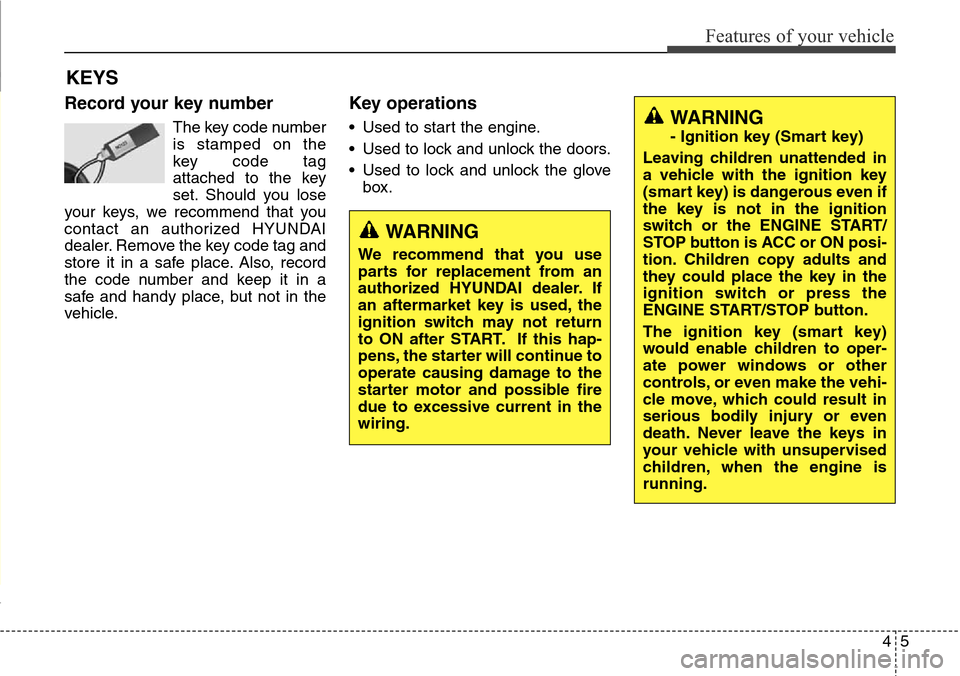
Record your key number
The key code number
is stamped on the
key code tag
attached to the key
set. Should you lose
your keys, we recommend that you
contact an authorized HYUNDAI
dealer. Remove the key code tag and
store it in a safe place. Also, record
the code number and keep it in a
safe and handy place, but not in the
vehicle.
Key operations
• Used to start the engine.
• Used to lock and unlock the doors.
• Used to lock and unlock the glove
box.
KEYS
WARNING
We recommend that you use
parts for replacement from an
authorized HYUNDAI dealer. If
an aftermarket key is used, the
ignition switch may not return
to ON after START. If this hap-
pens, the starter will continue to
operate causing damage to the
starter motor and possible fire
due to excessive current in the
wiring.
WARNING
- Ignition key (Smart key)
Leaving children unattended in
a vehicle with the ignition key
(smart key) is dangerous even if
the key is not in the ignition
switch or the ENGINE START/
STOP button is ACC or ON posi-
tion. Children copy adults and
they could place the key in the
ignition switch or press the
ENGINE START/STOP button.
The ignition key (smart key)
would enable children to oper-
ate power windows or other
controls, or even make the vehi-
cle move, which could result in
serious bodily injury or even
death. Never leave the keys in
your vehicle with unsupervised
children, when the engine is
running.