diesel Hyundai Santa Fe 2014 User Guide
[x] Cancel search | Manufacturer: HYUNDAI, Model Year: 2014, Model line: Santa Fe, Model: Hyundai Santa Fe 2014Pages: 711, PDF Size: 14.72 MB
Page 197 of 711
![Hyundai Santa Fe 2014 User Guide Features of your vehicle
96 4
AUTO HOLD Indicator
Light (if equipped)
This indicator light illuminates:
• [White] When you activate the auto
hold system by pressing the AUTO
HOLD button.
• [Green]](/img/35/16363/w960_16363-196.png "Hyundai Santa Fe 2014 User Guide Features of your vehicle
96 4
AUTO HOLD Indicator
Light (if equipped)
This indicator light illuminates:
• [White] When you activate the auto
hold system by pressing the AUTO
HOLD button.
• [Green]")
Features of your vehicle
96 4
AUTO HOLD Indicator
Light (if equipped)
This indicator light illuminates:
• [White] When you activate the auto
hold system by pressing the AUTO
HOLD button.
• [Green] When you stop the vehicle
completely by depressing the
brake pedal with the auto hold sys-
tem activated.
• [Yellow] When there is a malfunc-
tion with the auto hold system.
In this case, we recommend that
you have the vehicle inspected by
an authorized HYUNDAI dealer.
For more details, refer to “Auto Hold”
in chapter 5.
Glow Indicator Light
(Diesel Engine)
This indicator light illuminates:
• When the engine is being preheat-
ed with the ignition switch or
Engine Start/Stop Button in the ON
position.
- The engine can be started after
the glow indicator light goes off.
- The illumination time varies with
the engine coolant temperature,
air temperature, and battery con-
dition.
If the indicator light remains on or
blinks after the engine has warmed
up or while driving, there may a mal-
function with the engine preheating
system.
In this case, we recommend that you
have the vehicle inspected by an
authorized HYUNDAI dealer.
✽NOTICE - Engine Preheating
If the engine does not start within 10
seconds after the preheating is com-
pleted, set the ignition switch or
Engine Start/Stop Button to the
LOCK or OFF position for 10 sec-
onds and then to the ON position in
order to preheat the engine again.AUTO
HOLD
Page 458 of 711
59
Driving your vehicle
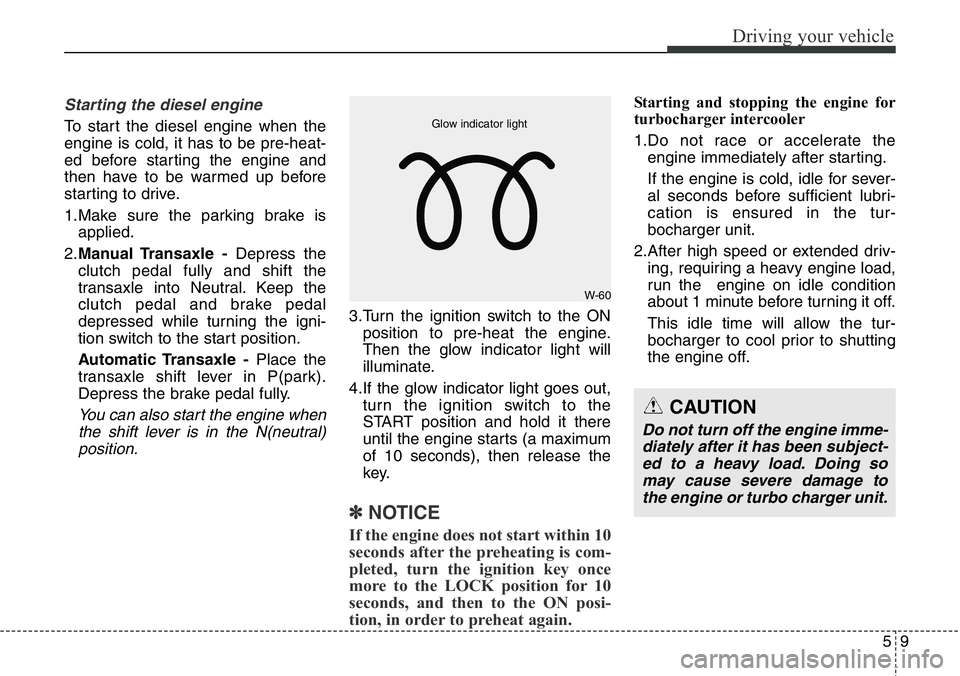
Starting the diesel engine
To start the diesel engine when the
engine is cold, it has to be pre-heat-
ed before starting the engine and
then have to be warmed up before
starting to drive.
1.Make sure the parking brake is
applied.
2.Manual Transaxle -Depress the
clutch pedal fully and shift the
transaxle into Neutral. Keep the
clutch pedal and brake pedal
depressed while turning the igni-
tion switch to the start position.
Automatic Transaxle -Place the
transaxle shift lever in P(park).
Depress the brake pedal fully.
You can also start the engine when
the shift lever is in the N(neutral)
position.
3.Turn the ignition switch to the ON
position to pre-heat the engine.
Then the glow indicator light will
illuminate.
4.If the glow indicator light goes out,
turn the ignition switch to the
START position and hold it there
until the engine starts (a maximum
of 10 seconds), then release the
key.
✽ NOTICE
If the engine does not start within 10
seconds after the preheating is com-
pleted, turn the ignition key once
more to the LOCK position for 10
seconds, and then to the ON posi-
tion, in order to preheat again.
Starting and stopping the engine for
turbocharger intercooler
1.Do not race or accelerate the
engine immediately after starting.
If the engine is cold, idle for sever-
al seconds before sufficient lubri-
cation is ensured in the tur-
bocharger unit.
2.After high speed or extended driv-
ing, requiring a heavy engine load,
run the engine on idle condition
about 1 minute before turning it off.
This idle time will allow the tur-
bocharger to cool prior to shutting
the engine off.
CAUTION
Do not turn off the engine imme-
diately after it has been subject-
ed to a heavy load. Doing so
may cause severe damage to
the engine or turbo charger unit.
W-60 Glow indicator light
Page 463 of 711
Driving your vehicle
14 5
Starting the gasoline engine
1.Carry the smart key or leave it
inside the vehicle.
2.Make sure the parking brake is
firmly applied.
3.Manual Transaxle -Depress the
clutch pedal fully and shift the
transaxle into Neutral. Keep the
clutch pedal and brake pedal
depressed while starting the
engine.
Automatic Transaxle -Place the
transaxle shift lever in P (Park).
Depress the brake pedal fully.
You can also start the engine when
the shift lever is in the N (Neutral)
position.
4.Press the engine start/stop button.
Whether the engine is cold or warm,
it should be started without depress-
ing the accelerator pedal.
5.Do not wait for the engine to warm
up while the vehicle remains sta-
tionary.
Start driving at moderate engine
speeds. (Steep accelerating and
decelerating should be avoided.)
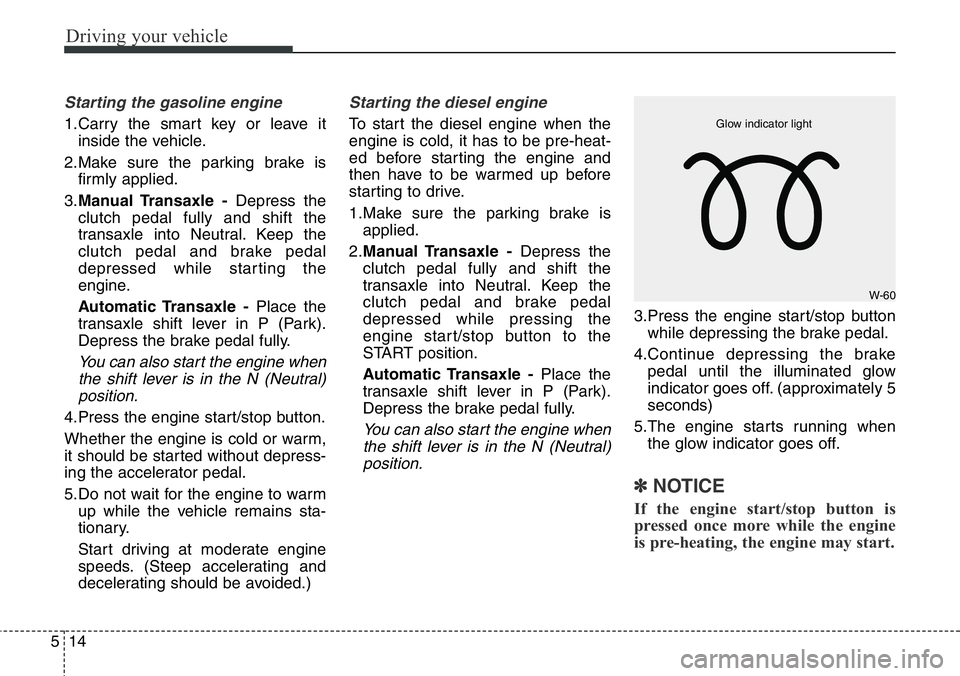
Starting the diesel engine
To start the diesel engine when the
engine is cold, it has to be pre-heat-
ed before starting the engine and
then have to be warmed up before
starting to drive.
1.Make sure the parking brake is
applied.
2.Manual Transaxle -Depress the
clutch pedal fully and shift the
transaxle into Neutral. Keep the
clutch pedal and brake pedal
depressed while pressing the
engine start/stop button to the
START position.
Automatic Transaxle -Place the
transaxle shift lever in P (Park).
Depress the brake pedal fully.
You can also start the engine when
the shift lever is in the N (Neutral)
position.
3.Press the engine start/stop button
while depressing the brake pedal.
4.Continue depressing the brake
pedal until the illuminated glow
indicator goes off. (approximately 5
seconds)
5.The engine starts running when
the glow indicator goes off.
✽ NOTICE
If the engine start/stop button is
pressed once more while the engine
is pre-heating, the engine may start.
W-60 Glow indicator light
Page 547 of 711
Driving your vehicle
98 5
If you do decide to pull a trail-
er
Here are some important points if
you decide to pull a trailer:
• Consider using a sway control. You
can ask a hitch dealer about sway
control.
• Do not do any towing with your car
during its first 2,000 km (1,200
miles) in order to allow the engine
to properly break in. Failure to
heed this caution may result in
serious engine or transaxle dam-
age.
• When towing a trailer, we recom-
mend that you consult an author-
ized HYUNDAI dealer on addition-
al requirements such as a towing
kit, etc.
• Always drive your vehicle at a mod-
erate speed (less than 100 km/h
(60 mph)).
• On a long uphill grade, do not
exceed 70 km/h (45 mph) or the
posted towing speed limit,
whichever is lower.
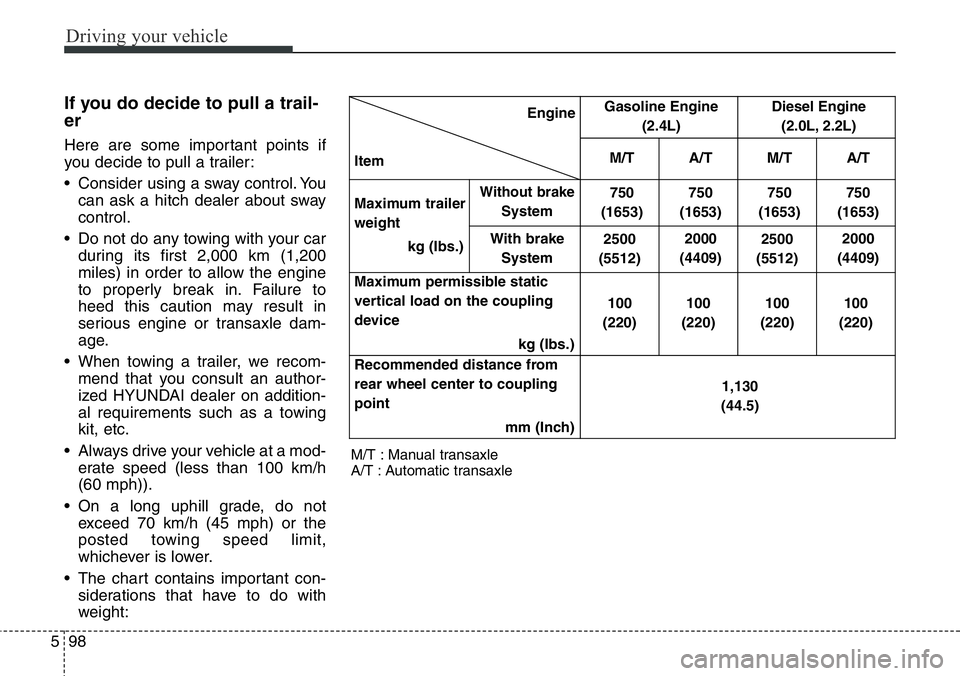
• The chart contains important con-
siderations that have to do with
weight:
M/T : Manual transaxle
A/T : Automatic transaxleEngine
ItemGasoline Engine
(2.4L)Diesel Engine
(2.0L, 2.2L)
M/T A/T M/T A/T
Maximum trailer
weight
kg (Ibs.)
Without brake
System750
(1653)750
(1653)750
(1653)750
(1653)
With brake
System2500
(5512)2000
(4409)2500
(5512)2000
(4409)
Maximum permissible static
vertical load on the coupling
device
kg (Ibs.)100
(220)100
(220)100
(220)100
(220)
Recommended distance from
rear wheel center to coupling
point
mm (Inch)1,130
(44.5)
Page 586 of 711
Maintenance
7
Engine compartment . . . . . . . . . . . . . . . . . . . . . . . . 7-3
Maintenance services . . . . . . . . . . . . . . . . . . . . . . . . 7-5
• Owner’s responsibility . . . . . . . . . . . . . . . . . . . . . . . . . 7-5
• Owner maintenance precautions . . . . . . . . . . . . . . . . . 7-5
• Engine compartment precautions (Diesel engine) . . . 7-7
Owner maintenance . . . . . . . . . . . . . . . . . . . . . . . . . 7-8
• Owner maintenance schedule. . . . . . . . . . . . . . . . . . . . 7-8
Scheduled maintenance service. . . . . . . . . . . . . . . 7-10
• For europe, Except Russia . . . . . . . . . . . . . . . . . . . . . 7-11
• Except europe, For Russia . . . . . . . . . . . . . . . . . . . . . 7-22
Explanation of scheduled maintenance items . . . 7-34
Engine oil. . . . . . . . . . . . . . . . . . . . . . . . . . . . . . . . . 7-38
• Checking the engine oil level . . . . . . . . . . . . . . . . . . . 7-38
• Changing the engine oil and filter . . . . . . . . . . . . . . . 7-39
Engine coolant . . . . . . . . . . . . . . . . . . . . . . . . . . . . 7-40
• Checking the coolant level . . . . . . . . . . . . . . . . . . . . . 7-40
• Changing the coolant . . . . . . . . . . . . . . . . . . . . . . . . . 7-42
Brake/clutch fluid . . . . . . . . . . . . . . . . . . . . . . . . . . 7-43
• Checking the brake/clutch fluid level . . . . . . . . . . . . 7-43
Power steering fluid . . . . . . . . . . . . . . . . . . . . . . . . 7-44
• Checking the power steering fluid level . . . . . . . . . 7-44
• Checking the power steering hose . . . . . . . . . . . . . . . 7-44
Washer fluid . . . . . . . . . . . . . . . . . . . . . . . . . . . . . . 7-45
• Checking the washer fluid level . . . . . . . . . . . . . . . . . 7-45
Parking brake . . . . . . . . . . . . . . . . . . . . . . . . . . . . . 7-46
• Checking the parking brake. . . . . . . . . . . . . . . . . . . . 7-46
Fuel filter (for Diesel) . . . . . . . . . . . . . . . . . . . . . . . 7-47
• Draining water from fuel filter . . . . . . . . . . . . . . . . . 7-47
Air cleaner. . . . . . . . . . . . . . . . . . . . . . . . . . . . . . . . 7-48
• Filter replacement . . . . . . . . . . . . . . . . . . . . . . . . . . . . 7-48
Climate control air filter . . . . . . . . . . . . . . . . . . . . 7-50
• Filter inspection . . . . . . . . . . . . . . . . . . . . . . . . . . . . . . 7-50
• Filter replacement . . . . . . . . . . . . . . . . . . . . . . . . . . . . 7-50
Wiper blades . . . . . . . . . . . . . . . . . . . . . . . . . . . . . . 7-52
• Blade inspection . . . . . . . . . . . . . . . . . . . . . . . . . . . . . . 7-52
• Blade replacement . . . . . . . . . . . . . . . . . . . . . . . . . . . . 7-52
Battery . . . . . . . . . . . . . . . . . . . . . . . . . . . . . . . . . . . 7-55
• For best battery service . . . . . . . . . . . . . . . . . . . . . . . 7-55
• Battery capacity label . . . . . . . . . . . . . . . . . . . . . . . . . 7-56
• Battery recharging . . . . . . . . . . . . . . . . . . . . . . . . . . . 7-57
• Reset items . . . . . . . . . . . . . . . . . . . . . . . . . . . . . . . . . . 7-58
Tires and wheels . . . . . . . . . . . . . . . . . . . . . . . . . . . 7-58
• Tire care . . . . . . . . . . . . . . . . . . . . . . . . . . . . . . . . . . . . 7-58
• Recommended cold tire inflation pressures . . . . . . . 7-58
• Checking tire inflation pressure. . . . . . . . . . . . . . . . . 7-60
• Tire rotation . . . . . . . . . . . . . . . . . . . . . . . . . . . . . . . . . 7-61
• Wheel alignment and tire balance . . . . . . . . . . . . . . . 7-62
• Tire replacement . . . . . . . . . . . . . . . . . . . . . . . . . . . . . 7-62
• Wheel replacement . . . . . . . . . . . . . . . . . . . . . . . . . . . 7-64
Page 589 of 711
Maintenance
4 7
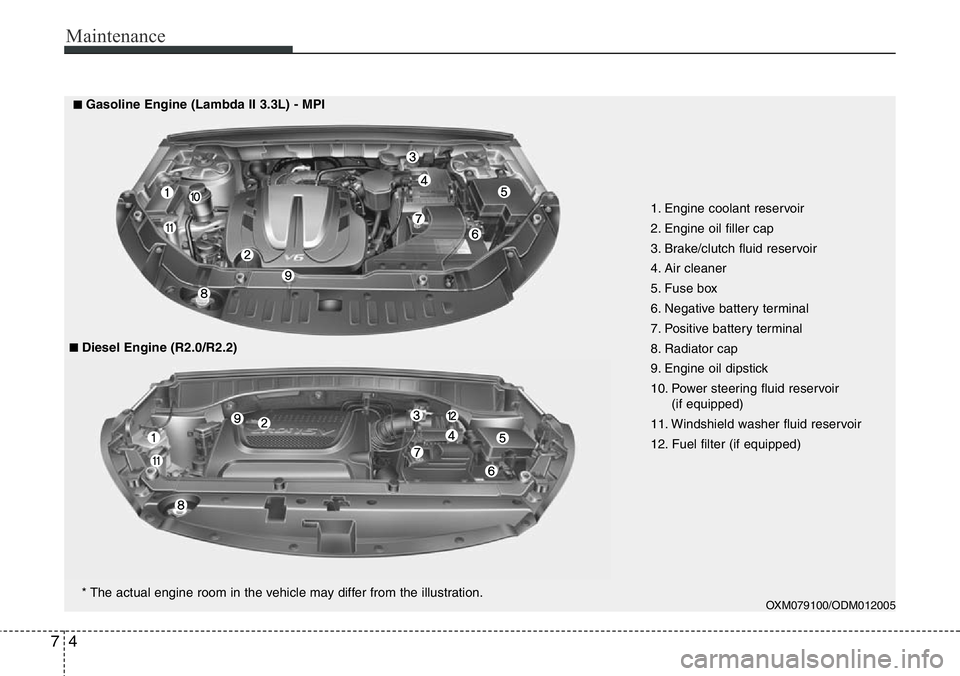
1. Engine coolant reservoir
2. Engine oil filler cap
3. Brake/clutch fluid reservoir
4. Air cleaner
5. Fuse box
6. Negative battery terminal
7. Positive battery terminal
8. Radiator cap
9. Engine oil dipstick
10. Power steering fluid reservoir
(if equipped)
11. Windshield washer fluid reservoir
12. Fuel filter (if equipped)
OXM079100/ODM012005
■Diesel Engine (R2.0/R2.2)
* The actual engine room in the vehicle may differ from the illustration.
■■Gasoline Engine (Lambda II 3.3L) - MPI
Page 592 of 711
77
Maintenance
Engine compartment precau-
tions (Diesel engine)
• The piezo injector operates at high
voltage (maximum 200v).
Therefore, the following accidents
may occur.
- Direct contact with the injector or
injector wiring may cause electric
shock or damage your muscle or
nerve system.
- The electromagnetic wave from
the operating injector may cause
the artificial heart pacemaker to
malfunction.
• Follow the safety tips provided
below, when you are checking the
engine room while the engine is
running.
- Do not touch the injector, injector
wirings, and the engine computer
while the engine is running.
- Do not remove the injector con-
nector while the engine is run-
ning.
- People using pacemakers must
not go near the engine while the
engine is starting or running.
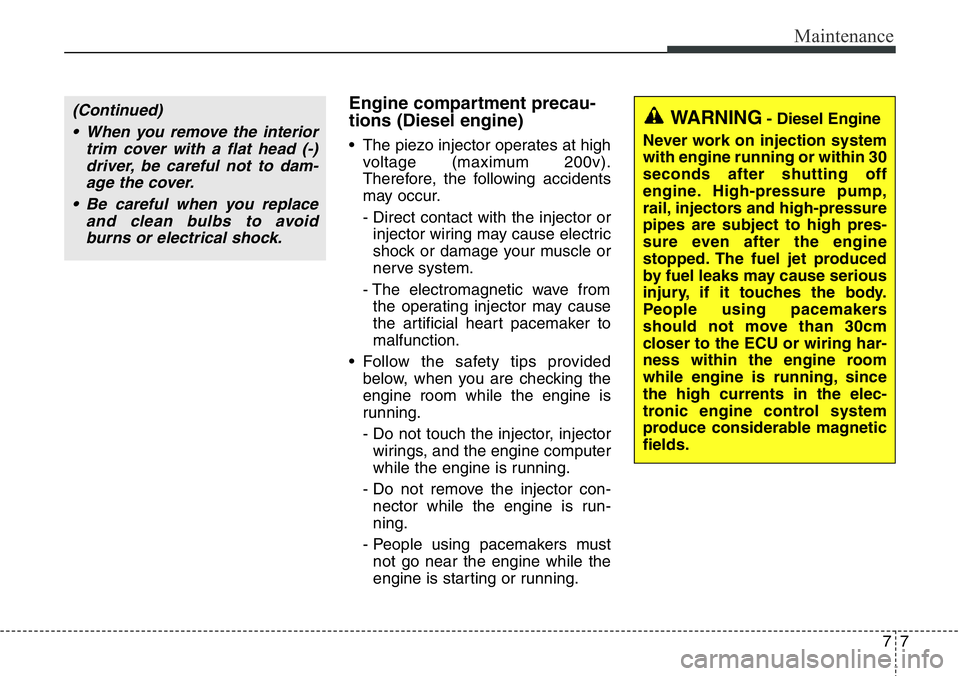
WARNING- Diesel Engine
Never work on injection system
with engine running or within 30
seconds after shutting off
engine. High-pressure pump,
rail, injectors and high-pressure
pipes are subject to high pres-
sure even after the engine
stopped. The fuel jet produced
by fuel leaks may cause serious
injury, if it touches the body.
People using pacemakers
should not move than 30cm
closer to the ECU or wiring har-
ness within the engine room
while engine is running, since
the high currents in the elec-
tronic engine control system
produce considerable magnetic
fields.(Continued)
• When you remove the interior
trim cover with a flat head (-)
driver, be careful not to dam-
age the cover.
• Be careful when you replace
and clean bulbs to avoid
burns or electrical shock.
Page 596 of 711
711
Maintenance
NORMAL MAINTENANCE SCHEDULE - FOR EUROPE, EXCEPT RUSSIA
The following maintenance services must be performed to ensure good emission control and performance. Keep receipts for all
vehicle emission services to protect your warranty. Where both mileage and time are shown, the frequency of service is deter-
mined by whichever occurs first.
*
1: Check the engine oil level and leak every 500 km (350
miles) or before starting a long trip.
*
2: This maintenance schedule depends on fuel quality. It is
applicable only when using a qualified fuel <"EN590 or
equivalent">. If the diesel fuel specifications don't meet the
EN590, it must be replaced according to the severe mainte-
nance schedule.
*
3: If the recommended oil is not available, replace engine oil
and engine oil filter every 20,000 km or 12 months.
*
4: If the recommended oil is not available, replace engine oil
and filter every 15,000 km or 12 months for 2.4L engine.
*
5: The engine oil level should be checked regularly and main-
tained properly. Operating with an insufficient amount of oil
can damage the engine, and such damage is not covered
by warranty.
*
6: This maintenance schedule depends on fuel quality. It is
applicable only when using a qualified fuel <"EN590 or
equivalent">. If the diesel fuel specifications don't meet the
EN590, it must be replaced more frequently. If there are
some important safety matters like fuel flow restriction,
surging, loss of power, hard starting problem etc., replace
the fuel filter immediately regardless of maintenance sched-
ule and we recommanded that you consult an authorized
HYUNDAI dealer for details.*
7: The fuel filter is considered to be maintenance free but peri-
odic inspection is recommended for this maintenance
schedule depends on fuel quality. If there are some impor-
tant matters like fuel flow restriction, surging, loss of power,
hard starting problem etc, replace the fuel filter immediately
regardless of maintenance schedule and we recommanded
that you consult an authorized HYUNDAI dealer for details.
*
8: Manual transaxle fluid, transfer case oil and differential oil
should be changed anytime they have been submerged in
water.
*
9: Inspect and if necessary correct or replace. Inspect drive
belt tensioner, idler and alternator pulley and if necessary
correct or replace.
*
10: When adding coolant, use only deionized water or soft
water for your vehicle and never mix hard water in the
coolant filled at the factory. An improper coolant mixture
can result in serious malfunction or engine damage.
*
11: Inspect for excessive valve noise and/or engine vibration
and adjust if necessary. We recommended that the system
should be checked by an authorized HYUNDAI dealer.
*
12: If good quality gasolines that meet Europe Fuel standards
(EN228) or equivalents including fuel additives is not avail-
able, one bottle of additive is recommended. Additives are
available from your authorized HYUNDAI dealer along with
information on how to use them. Do not mix other additives.
Page 597 of 711
Maintenance
12 7
NORMAL MAINTENANCE SCHEDULE - FOR EUROPE, EXCEPT RUSSIA (CONT.)
30,000 km (20,000 miles) or 24 months
❑ Inspect air cleaner filter
❑ Inspect air conditioner refrigerant/compressor (if equipped)
❑ Inspect battery condition
❑ Inspect brake lines, hoses and connections
❑ Inspect all electrical system
❑ Inspect disc brakes and pads
❑ Inspect drive shafts and boots
❑ Inspect exhaust system
❑ Inspect front suspension ball joints
❑ Inspect fuel filter cartridge (Diesel) *
6
❑ Inspect fuel lines, fuel hoses and connections (Diesel)
❑ Inspect parking brake (Foot/Hand type)
❑ Inspect power steering fluid and hoses (if equipped)
❑ Inspect propeller shaft (if equipped)
❑ Inspect steering gear rack, linkage and boots
❑ Inspect tire (pressure & tread wear)
❑ Inspect vacuum hose (for EGR & throttle body)
(Gasoline)
❑ Replace brake/clutch(if equipped) fluid
❑ Replace climate control air filter
❑ Replace engine oil and filter (Diesel - R) *
1 *2 *3*5
(Continued)
(Continued)
❑ Replace engine oil and filter (Gasoline - theta) *1 *4 *5
❑ Add fuel additives (Gasoline) *12
(Every 15,000 km or 12months)
❈Inspect : Inspect and if necessary, adjust, correct, clean or
replace.
Page 598 of 711
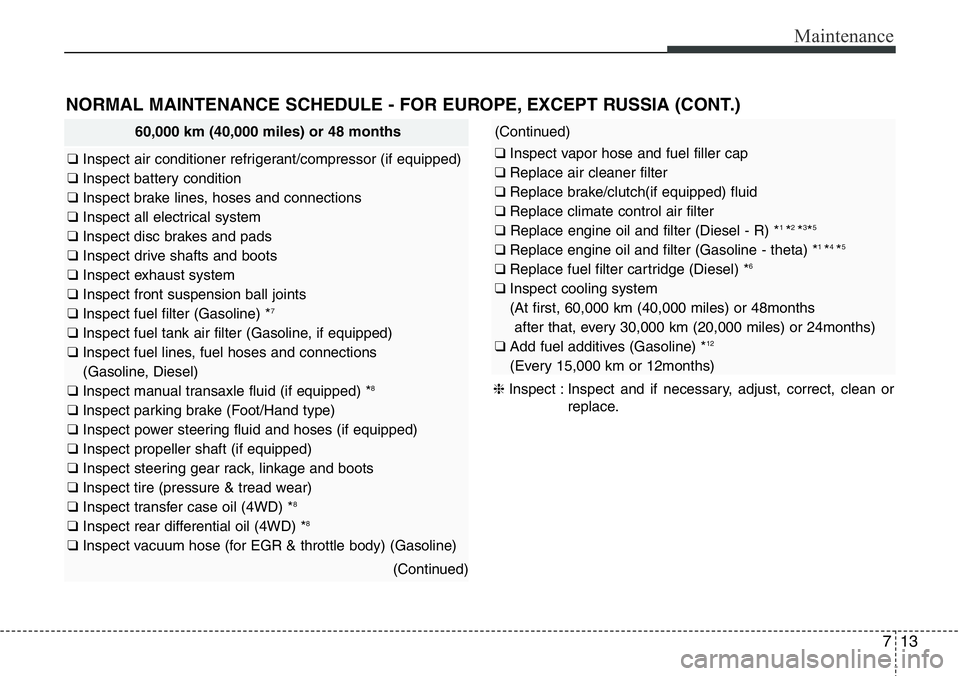
713
Maintenance
NORMAL MAINTENANCE SCHEDULE - FOR EUROPE, EXCEPT RUSSIA (CONT.)
60,000 km (40,000 miles) or 48 months
❑ Inspect air conditioner refrigerant/compressor (if equipped)
❑ Inspect battery condition
❑ Inspect brake lines, hoses and connections
❑ Inspect all electrical system
❑ Inspect disc brakes and pads
❑ Inspect drive shafts and boots
❑ Inspect exhaust system
❑ Inspect front suspension ball joints
❑ Inspect fuel filter (Gasoline) *
7
❑ Inspect fuel tank air filter (Gasoline, if equipped)
❑ Inspect fuel lines, fuel hoses and connections
(Gasoline, Diesel)
❑ Inspect manual transaxle fluid (if equipped) *
8
❑ Inspect parking brake (Foot/Hand type)
❑ Inspect power steering fluid and hoses (if equipped)
❑ Inspect propeller shaft (if equipped)
❑ Inspect steering gear rack, linkage and boots
❑ Inspect tire (pressure & tread wear)
❑ Inspect transfer case oil (4WD) *
8
❑ Inspect rear differential oil (4WD) *8
❑ Inspect vacuum hose (for EGR & throttle body) (Gasoline)
(Continued)
(Continued)
❑ Inspect vapor hose and fuel filler cap
❑ Replace air cleaner filter
❑ Replace brake/clutch(if equipped) fluid
❑ Replace climate control air filter
❑ Replace engine oil and filter (Diesel - R) *
1 *2 *3*5
❑ Replace engine oil and filter (Gasoline - theta) *1 *4 *5
❑ Replace fuel filter cartridge (Diesel) *6
❑ Inspect cooling system
(At first, 60,000 km (40,000 miles) or 48months
after that, every 30,000 km (20,000 miles) or 24months)
❑ Add fuel additives (Gasoline) *
12
(Every 15,000 km or 12months)
❈Inspect : Inspect and if necessary, adjust, correct, clean or
replace.