seats Hyundai Santa Fe 2014 Owner's Guide
[x] Cancel search | Manufacturer: HYUNDAI, Model Year: 2014, Model line: Santa Fe, Model: Hyundai Santa Fe 2014Pages: 711, PDF Size: 14.72 MB
Page 70 of 711
345
Safety features of your vehicle
Securing a child restraint system
with “ISOFIX” system and “Tether
Anchorage” system (if equipped)
ISOFIX is a standardised method of
fitting child seats that eliminates the
need to use the standard adult seat
belt to secure the seat in the vehicle.
This enables a much more secure
and positive location with the added
benefit of easier and quicker installa-
tion.
An ISOFIX-seat can only be installed
if it has vehicle-specific approval in
accordance with the requirements of
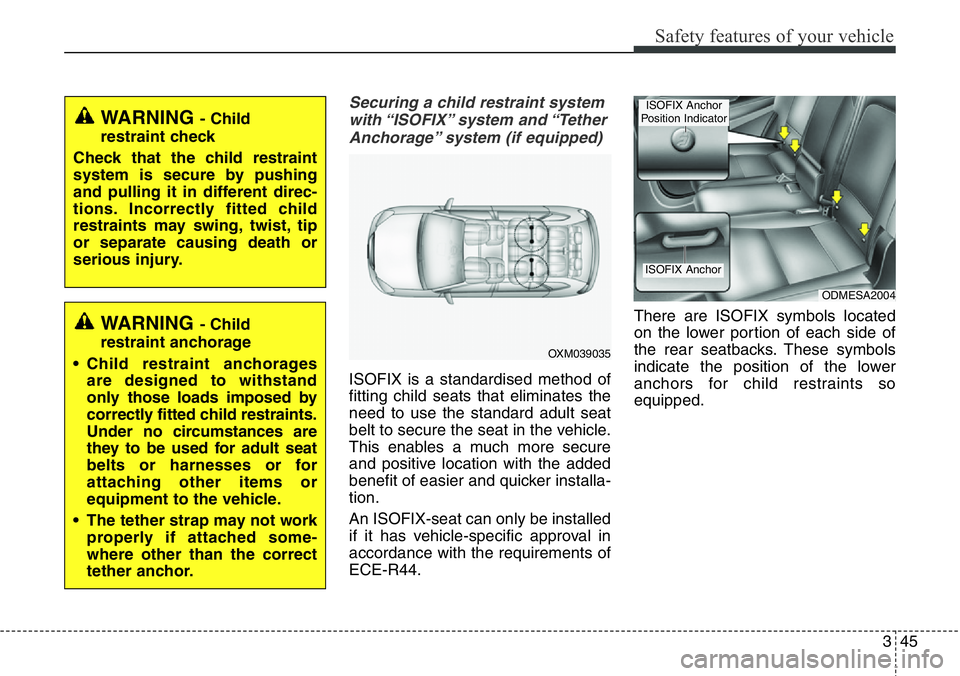
ECE-R44.There are ISOFIX symbols located
on the lower portion of each side of
the rear seatbacks. These symbols
indicate the position of the lower
anchors for child restraints so
equipped.
WARNING - Child
restraint check
Check that the child restraint
system is secure by pushing
and pulling it in different direc-
tions. Incorrectly fitted child
restraints may swing, twist, tip
or separate causing death or
serious injury.
WARNING - Child
restraint anchorage
• Child restraint anchorages
are designed to withstand
only those loads imposed by
correctly fitted child restraints.
Under no circumstances are
they to be used for adult seat
belts or harnesses or for
attaching other items or
equipment to the vehicle.
• The tether strap may not work
properly if attached some-
where other than the correct
tether anchor.
OXM039035
ODMESA2004
ISOFIX Anchor
ISOFIX Anchor
Position Indicator
Page 71 of 711
Safety features of your vehicle
46 3
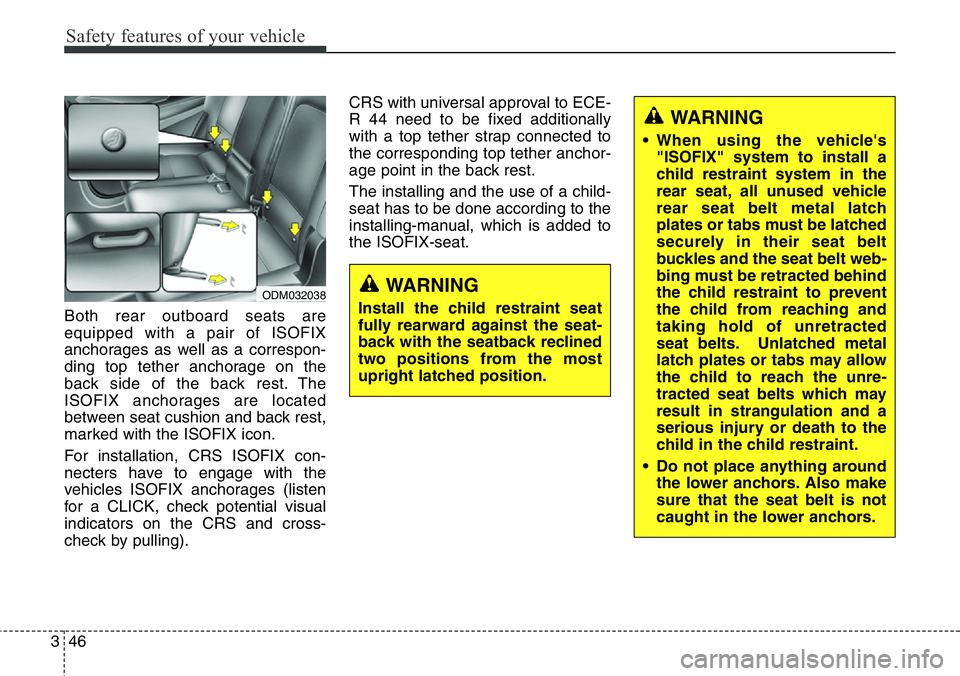
Both rear outboard seats are
equipped with a pair of ISOFIX
anchorages as well as a correspon-
ding top tether anchorage on the
back side of the back rest. The
ISOFIX anchorages are located
between seat cushion and back rest,
marked with the ISOFIX icon.
For installation, CRS ISOFIX con-
necters have to engage with the
vehicles ISOFIX anchorages (listen
for a CLICK, check potential visual
indicators on the CRS and cross-
check by pulling).CRS with universal approval to ECE-
R 44 need to be fixed additionally
with a top tether strap connected to
the corresponding top tether anchor-
age point in the back rest.
The installing and the use of a child-
seat has to be done according to the
installing-manual, which is added to
the ISOFIX-seat.
ODM032038WARNING
Install the child restraint seat
fully rearward against the seat-
back with the seatback reclined
two positions from the most
upright latched position.
WARNING
• When using the vehicle's
"ISOFIX" system to install a
child restraint system in the
rear seat, all unused vehicle
rear seat belt metal latch
plates or tabs must be latched
securely in their seat belt
buckles and the seat belt web-
bing must be retracted behind
the child restraint to prevent
the child from reaching and
taking hold of unretracted
seat belts. Unlatched metal
latch plates or tabs may allow
the child to reach the unre-
tracted seat belts which may
result in strangulation and a
serious injury or death to the
child in the child restraint.
• Do not place anything around
the lower anchors. Also make
sure that the seat belt is not
caught in the lower anchors.
Page 78 of 711
353
Safety features of your vehicle
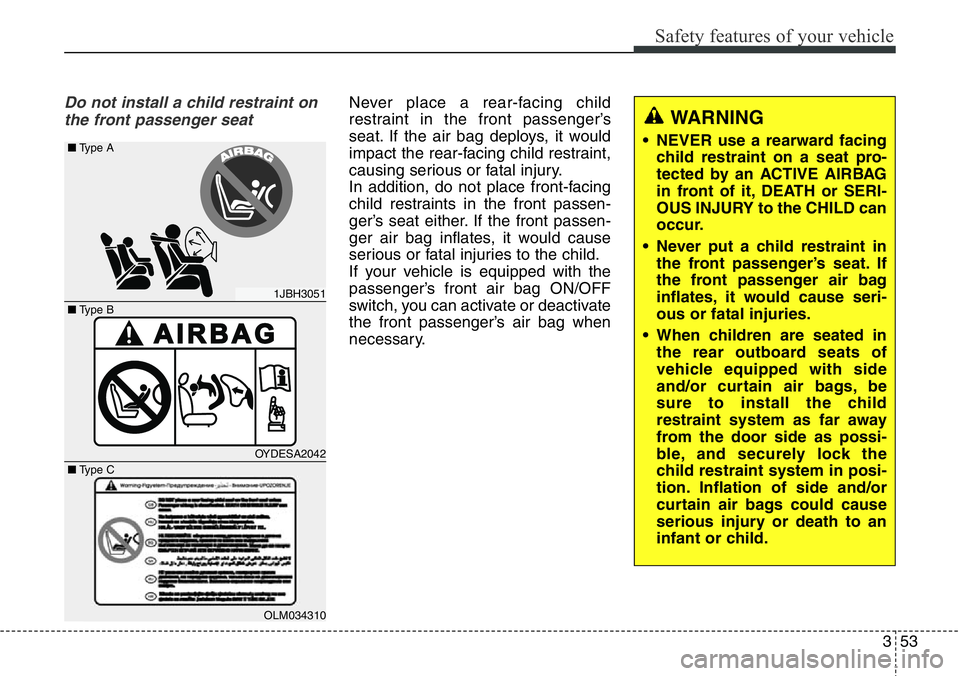
Do not install a child restraint on
the front passenger seatNever place a rear-facing child
restraint in the front passenger’s
seat. If the air bag deploys, it would
impact the rear-facing child restraint,
causing serious or fatal injury.
In addition, do not place front-facing
child restraints in the front passen-
ger’s seat either. If the front passen-
ger air bag inflates, it would cause
serious or fatal injuries to the child.
If your vehicle is equipped with the
passenger’s front air bag ON/OFF
switch, you can activate or deactivate
the front passenger’s air bag when
necessary.
WARNING
• NEVER use a rearward facing
child restraint on a seat pro-
tected by an ACTIVE AIRBAG
in front of it, DEATH or SERI-
OUS INJURY to the CHILD can
occur.
• Never put a child restraint in
the front passenger’s seat. If
the front passenger air bag
inflates, it would cause seri-
ous or fatal injuries.
• When children are seated in
the rear outboard seats of
vehicle equipped with side
and/or curtain air bags, be
sure to install the child
restraint system as far away
from the door side as possi-
ble, and securely lock the
child restraint system in posi-
tion. Inflation of side and/or
curtain air bags could cause
serious injury or death to an
infant or child.
1JBH3051
OYDESA2042
OLM034310
■Type B ■Type A
■Type C
Page 85 of 711
Safety features of your vehicle
60 3
(Continued)
• The SRS is designed to
deploy the front air bags only
when an impact is sufficiently
severe and when the impact
angle is less than 30° from the
forward longitudinal axis of
the vehicle. Additionally, the
air bags will only deploy once.
Seat belts must be worn at all
times.
• Front air bags are not intend-
ed to deploy in side-impact,
rear-impact or rollover crash-
es. In addition, front air bags
will not deploy in frontal
crashes below the deploy-
ment threshold.
• A child restraint system must
never be placed in the front
seat. The infant or child could
be severely injured or killed
by an air bag deployment in
case of an accident.
(Continued)(Continued)
• No objects should be placed
over or near the air bag mod-
ules on the steering wheel,
instrument panel, and the front
passenger's panel above the
glove box, because any such
object could cause harm if the
vehicle is in a crash severe
enough to cause the air bags
to deploy.
• Do not tamper with or discon-
nect SRS wiring or other com-
ponents of the SRS system.
Doing so could result in injury,
due to accidental deployment
of the air bags or by rendering
the SRS inoperative.
• If the SRS air bag warning light
remains illuminated while the
vehicle is being driven, we rec-
ommend that the system be
inspected by an authorized
HYUNDAI dealer.
• Air bags can only be used
once – we recommend that the
system be replaced by an
authorized HYUNDAI dealer.
(Continued)(Continued)
• Front and side air bags can
injure occupants improperly
positioned in the front seats.
• Move your seat as far back as
practical from the front air
bags, while still maintaining
control of the vehicle.
• You and your passengers
should never sit or lean
unnecessarily close to the air
bags. Improperly positioned
drivers and passengers can
be severely injured by inflat-
ing air bags.
• Never lean against the door or
center console – always sit in
an upright position.
• Do not allow a passenger to
ride in the front seat when the
passenger’s front air bag OFF
indicator is illuminated,
because the air bag will not
deploy in the event of a mod-
erate or severe frontal crash.
(Continued)
Page 89 of 711
Safety features of your vehicle
64 3
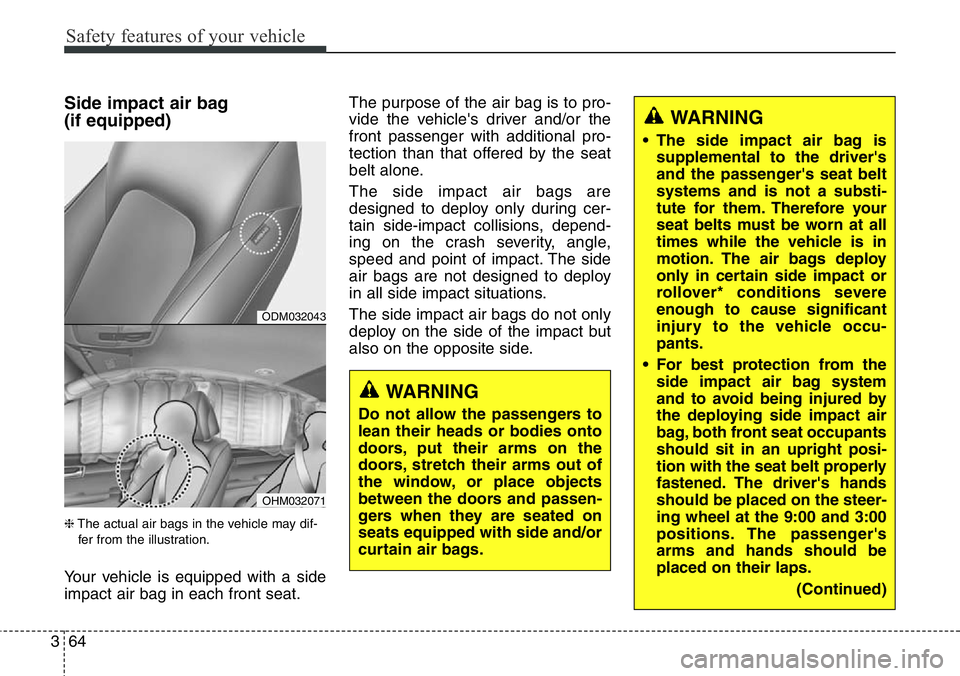
Side impact air bag
(if equipped)
❈The actual air bags in the vehicle may dif-
fer from the illustration.
Your vehicle is equipped with a side
impact air bag in each front seat.The purpose of the air bag is to pro-
vide the vehicle's driver and/or the
front passenger with additional pro-
tection than that offered by the seat
belt alone.
The side impact air bags are
designed to deploy only during cer-
tain side-impact collisions, depend-
ing on the crash severity, angle,
speed and point of impact. The side
air bags are not designed to deploy
in all side impact situations.
The side impact air bags do not only
deploy on the side of the impact but
also on the opposite side.
WARNING
• The side impact air bag is
supplemental to the driver's
and the passenger's seat belt
systems and is not a substi-
tute for them. Therefore your
seat belts must be worn at all
times while the vehicle is in
motion. The air bags deploy
only in certain side impact or
rollover* conditions severe
enough to cause significant
injury to the vehicle occu-
pants.
• For best protection from the
side impact air bag system
and to avoid being injured by
the deploying side impact air
bag, both front seat occupants
should sit in an upright posi-
tion with the seat belt properly
fastened. The driver's hands
should be placed on the steer-
ing wheel at the 9:00 and 3:00
positions. The passenger's
arms and hands should be
placed on their laps.
(Continued)
WARNING
Do not allow the passengers to
lean their heads or bodies onto
doors, put their arms on the
doors, stretch their arms out of
the window, or place objects
between the doors and passen-
gers when they are seated on
seats equipped with side and/or
curtain air bags.
ODM032043
OHM032071
Page 91 of 711
Safety features of your vehicle
66 3
They are designed to help protect
the heads of the front seat occupants
and the rear outboard seat occupants
in certain side impact collisions.
The curtain air bags are designed to
deploy during certain side impact col-
lisions, depending on the crash sever-
ity, angle, speed and point of impact.
The curtain air bags do not only
deploy on the side of the impact but
also on the opposite side.
✽NOTICE - if equipped with
rollover sensor
Also, both sides of the side impact
air bags and curtain air bags deploy
in certain rollover situations.
• The curtain air bags are not
designed to deploy in all side
impacts.
(Continued)
• Do not allow the passengers
to lean their heads or bodies
onto doors, put their arms on
the doors, stretch their arms
out of the window, or place
objects between the doors
and passengers when they are
seated on seats equipped with
side and/or curtain air bags.
• Never try to open or repair any
components of the side cur-
tain air bag system. We rec-
ommend that the system be
serviced by an authorized
HYUNDAI dealer.
Failure to follow the above men-
tioned instructions can result in
injury or death to the vehicle
occupants in an accident.WARNING
• In order for side impact and
curtain air bags to provide the
best protection, both front
seat occupants and both out-
board rear occupants should
sit in an upright position with
the seat belts properly fas-
tened.
Importantly, children should
sit in a proper child restraint
system in the rear seat.
• When children are seated in
the rear outboard seats, they
must be seated in the proper
child restraint system.
Make sure to put the child
restraint system as far away
from the door side as possible,
and secure the child restraint
system in a locked position.
(Continued)
Page 98 of 711
373
Safety features of your vehicle
Additional safety precautions
•Never let passengers ride in the
cargo area or on top of a folded-
down back seat.All occupants
should sit upright, fully back in their
seats with their seat belts on and
their feet on the floor.
•Passengers should not move
out of or change seats while the
vehicle is moving.A passenger
who is not wearing a seat belt dur-
ing a crash or emergency stop can
be thrown against the inside of the
vehicle, against other occupants,
or out of the vehicle.
•Each seat belt is designed to
restrain one occupant.If more
than one person uses the same
seat belt, they could be seriously
injured or killed in a collision.
•Do not use any accessories on
seat belts.Devices claiming to
improve occupant comfort or repo-
sition the seat belt can reduce the
protection provided by the seat belt
and increase the chance of serious
injury in a crash.•Passengers should not place
hard or sharp objects between
themselves and the air bags.
Carrying hard or sharp objects on
your lap or in your mouth can result
in injuries if an air bag inflates.
•Keep occupants away from the
air bag covers.All occupants
should sit upright, fully back in their
seats with their seat belts on and
their feet on the floor. If occupants
are too close to the air bag covers,
they could be injured if the air bags
inflate.
•Do not attach or place objects
on or near the air bag covers.
Any object attached to or placed
on the front or side impact air bag
covers could interfere with the
proper operation of the air bags.
•Do not modify the front seats.
Modification of the front seats
could interfere with the operation of
the supplemental restraint system
sensing components or side air
bags.(Continued)
• If components of the air bag
system must be discarded, or if
the vehicle must be scrapped,
certain safety precautions must
be observed. An authorized
HYUNDAI dealer knows these
precautions and can give you
the necessary information.
Failure to follow these precau-
tions and procedures could
increase the risk of personal
injury.
• If your car was flooded and has
soaked carpeting or water on
flooring, you shouldn't try to
start the engine; we recom-
mend that you contact an
authorized HYUNDAI dealer.
Page 99 of 711
Safety features of your vehicle
74 3
•Do not place items under the
front seats.Placing items under
the front seats could interfere with
the operation of the supplemental
restraint system sensing compo-
nents and wiring harnesses.
•Never hold an infant or child on
your lap.The infant or child could
be seriously injured or killed in the
event of a crash. All infants and
children should be properly
restrained in appropriate child
safety seats or seat belts in the
rear seat.Adding equipment to or modi-
fying your air bag-equipped
vehicle
If you modify your vehicle by chang-
ing your vehicle's frame, bumper sys-
tem, front end or side sheet metal or
ride height, this may affect the oper-
ation of your vehicle's air bag sys-
tem.
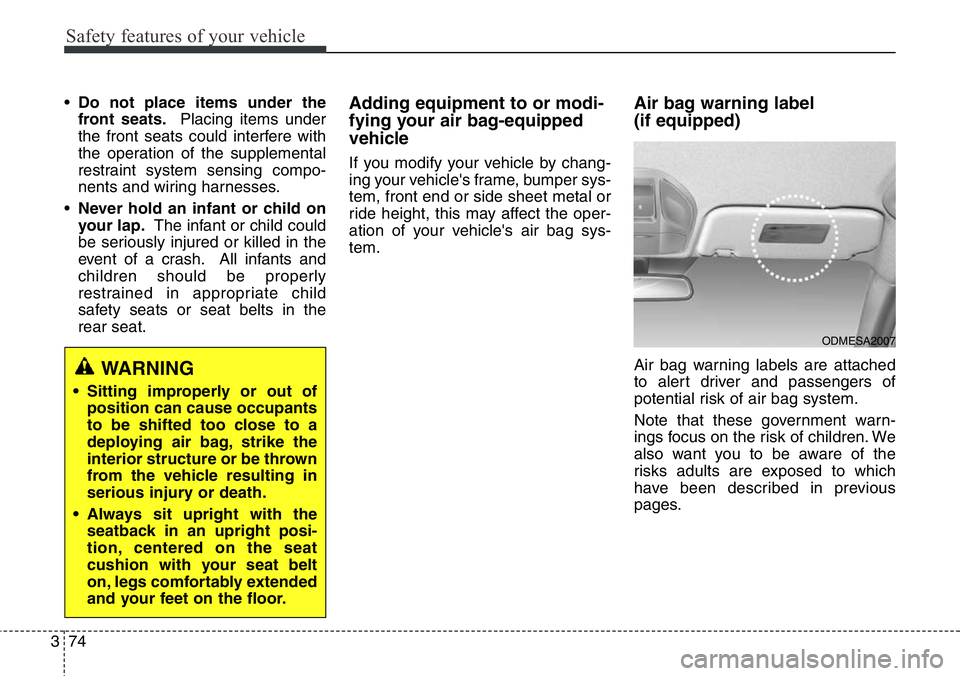
Air bag warning label
(if equipped)
Air bag warning labels are attached
to alert driver and passengers of
potential risk of air bag system.
Note that these government warn-
ings focus on the risk of children. We
also want you to be aware of the
risks adults are exposed to which
have been described in previous
pages.WARNING
• Sitting improperly or out of
position can cause occupants
to be shifted too close to a
deploying air bag, strike the
interior structure or be thrown
from the vehicle resulting in
serious injury or death.
• Always sit upright with the
seatback in an upright posi-
tion, centered on the seat
cushion with your seat belt
on, legs comfortably extended
and your feet on the floor.
ODMESA2007
Page 695 of 711
Maintenance
110 7
Cleaning the upholstery and inte-
rior trim
Vinyl
Remove dust and loose dirt from
vinyl with a whisk broom or vacuum
cleaner. Clean vinyl surfaces with a
vinyl cleaner.
Fabric
Remove dust and loose dirt from fab-
ric with a whisk broom or vacuum
cleaner. Clean with a mild soap solu-
tion recommended for upholstery or
carpets. Remove fresh spots imme-
diately with a fabric spot cleaner. If
fresh spots do not receive immediate
attention, the fabric can be stained
and its color can be affected. Also, its
fire-resistant properties can be
reduced if the material is not proper-
ly maintained.
Cleaning the lap/shoulder belt
webbing
Clean the belt webbing with any mild
soap solution recommended for
cleaning upholstery or carpet. Follow
the instructions provided with the
soap. Do not bleach or re-dye the
webbing because this may weaken
it.
Cleaning the interior window
glass
If the interior glass surfaces of the
vehicle become fogged (that is, cov-
ered with an oily, greasy or waxy
film), they should be cleaned with
glass cleaner. Follow the directions
on the glass cleaner container.
CAUTION
Using anything but recommend-
ed cleaners and procedures
may affect the fabric’s appear-
ance and fire-resistant proper-
ties.
CAUTION
Do not scrape or scratch the
inside of the rear window. This
may result in damage to the rear
window defroster grid.
CAUTION
When cleaning leather products
(steering wheel, seats etc.), use
neutral detergents or low alco-
hol content solutions. If you use
high alcohol content solutions
or acid/alkaline detergents, the
color of the leather may fade or
the surface may get stripped off.