shift release Hyundai Santa Fe 2014 Owner's Manual
[x] Cancel search | Manufacturer: HYUNDAI, Model Year: 2014, Model line: Santa Fe, Model: Hyundai Santa Fe 2014Pages: 711, PDF Size: 14.72 MB
Page 133 of 711
Features of your vehicle
32 4
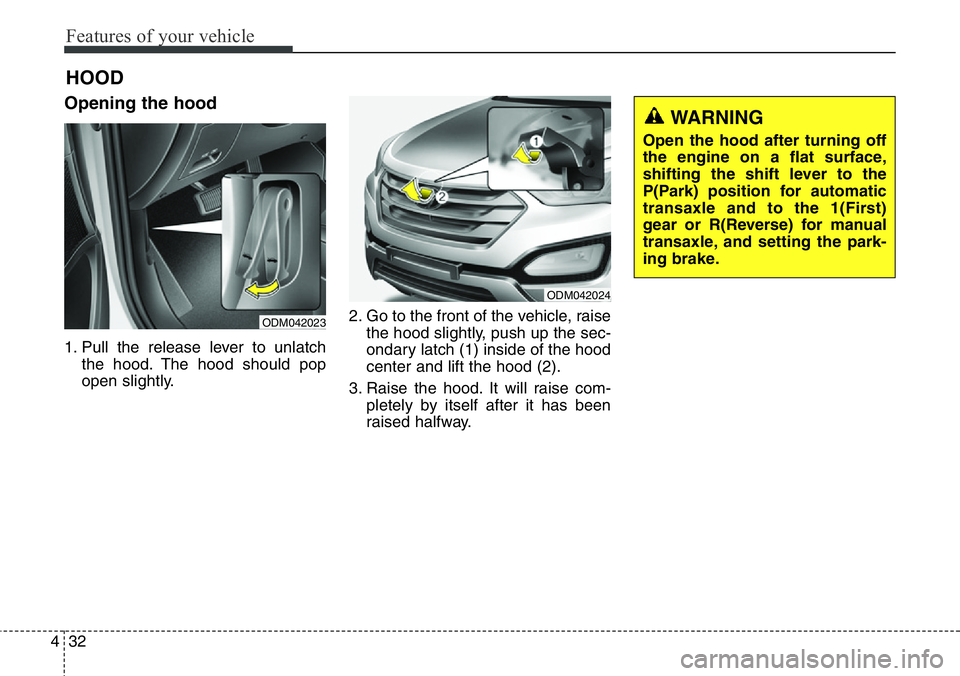
Opening the hood
1. Pull the release lever to unlatch
the hood. The hood should pop
open slightly.2. Go to the front of the vehicle, raise
the hood slightly, push up the sec-
ondary latch (1) inside of the hood
center and lift the hood (2).
3. Raise the hood. It will raise com-
pletely by itself after it has been
raised halfway.
HOOD
WARNING
Open the hood after turning off
the engine on a flat surface,
shifting the shift lever to the
P(Park) position for automatic
transaxle and to the 1(First)
gear or R(Reverse) for manual
transaxle, and setting the park-
ing brake.
ODM042023
ODM042024
Page 185 of 711
Features of your vehicle
84 4
Parking Brake & Brake
Fluid Warning Light
This warning light illuminates:
• Once you set the ignition switch or
Engine Start/Stop Button to the ON
position.
- It illuminates for approximately 3
seconds
- It remains on if the parking brake
is applied.
• When the parking brake is applied.
• When the brake fluid level in the
reservoir is low.
- If the warning light illuminates
with the parking brake released, it
indicates the brake fluid level in
reservoir is low.If the brake fluid level in the reservoir
is low:
1. Drive carefully to the nearest safe
location and stop your vehicle.
2. With the engine stopped, check
the brake fluid level immediately
and add fluid as required (For
more details, refer to “Brake Fluid”
in chapter 7). Then check all brake
components for fluid leaks. If any
leak on brake system is still found,
the warning light remains on, or
the brakes do not operate proper-
ly, do not drive the vehicle.
In this case, we recommend that
you have the vehicle towed to an
authorized HYUNDAI dealer and
inspected.Dual-diagonal braking system
Your vehicle is equipped with dual-
diagonal braking systems. This
means you still have braking on two
wheels even if one of the dual sys-
tems should fail.
With only one of the dual systems
working, more than normal pedal
travel and greater pedal pressure are
required to stop the vehicle.
Also, the vehicle will not stop in as
short a distance with only a portion
of the brake system working.
If the brakes fail while you are driv-
ing, shift to a lower gear for addition-
al engine braking and stop the vehi-
cle as soon as it is safe to do so.
Page 456 of 711
57
Driving your vehicle
Starting the engineWARNING - Ignition key
• Never turn the ignition switch
to LOCK or ACC while the
vehicle is moving. This would
result in loss of directional
control and braking function,
which could cause an acci-
dent.
• The anti-theft steering column
lock is not a substitute for the
parking brake. Before leaving
the driver’s seat, always make
sure the shift lever is engaged
in 1st gear for the manual
transaxle or P (Park) for the
automatic transaxle, set the
parking brake fully and shut
the engine off. Unexpected
and sudden vehicle movement
may occur if these precau-
tions are not taken.
(Continued)
(Continued)
• Never reach for the ignition
switch, or any other controls
through the steering wheel
while the vehicle is in motion.
The presence of your hand or
arm in this area could cause a
loss of vehicle control, an
accident and serious bodily
injury or death.
• Do not place any movable
objects around the driver’s
seat as they may move while
driving, interfere with the driv-
er and lead to an accident.
WARNING
• Always wear appropriate
shoes when operating your
vehicle. Unsuitable shoes
(high heels, ski boots,etc.)
may interfere with your ability
to use the brake, accelerator
and clutch pedal (if equipped).
• Do not start the vehicle with
the accelerator pedal
depressed. The vehicle can
move and lead to an accident.
• Wait until the engine rpm is
normal. The vehicle may sud-
denly move if the brake padel
is released when the rpm is
high.
Page 457 of 711
Driving your vehicle
8 5
✽ NOTICE - Kick down
mechanism
(if equipped)
If your vehicle is equipped with a
kick down mechanism in the accel-
erator pedal, it prevents you from
driving at full throttle unintention-
ally by making the driver require
increased effort to depress the accel-
erator pedal. However, if you
depress the pedal more than approx-
imately 80%, the vehicle can be at
full throttle and the accelerator
pedal will be easier to depress. This
is not a malfunction but a normal
condition.
Starting the gasoline engine
1.Make sure the parking brake is
applied.
2.Manual Transaxle -Depress the
clutch pedal fully and shift the
transaxle into Neutral. Keep the
clutch pedal and brake pedal
depressed while turning the igni-
tion switch to the start position.
Automatic Transaxle -Place the
transaxle shift lever in P (Park).
Depress the brake pedal fully.
You can also start the engine when
the shift lever is in the N (Neutral)
position.
3.Turn the ignition switch to START
and hold it there until the engine
starts (a maximum of 10 seconds),
then release the key.
Whether the engine is cold or warm,
it should be started without
depressing the accelerator pedal.
4.Do not wait for the engine to warm
up while the vehicle remains sta-
tionary.
Start driving at moderate engine
speeds. (Steep accelerating and
decelerating should be avoided.)
CAUTION
If the engine stalls while you are
in motion, do not attempt to
move the shift lever to the P
(Park) position. If traffic and
road conditions permit, you may
put the shift lever in the N
(Neutral) position while the
vehicle is still moving and turn
the ignition switch to the START
position in an attempt to restart
the engine.
CAUTION
• Do not engage the starter for
more than 10 seconds. If the
engine stalls or fails to start,
wait 5 to 10 seconds before re-
engaging the starter. Improper
use of the starter may damage
it.
• Do not turn the ignition switch
to the START position with the
engine running. It may dam-
age the starter.
Page 458 of 711
59
Driving your vehicle
Starting the diesel engine
To start the diesel engine when the
engine is cold, it has to be pre-heat-
ed before starting the engine and
then have to be warmed up before
starting to drive.
1.Make sure the parking brake is
applied.
2.Manual Transaxle -Depress the
clutch pedal fully and shift the
transaxle into Neutral. Keep the
clutch pedal and brake pedal
depressed while turning the igni-
tion switch to the start position.
Automatic Transaxle -Place the
transaxle shift lever in P(park).
Depress the brake pedal fully.
You can also start the engine when
the shift lever is in the N(neutral)
position.
3.Turn the ignition switch to the ON
position to pre-heat the engine.
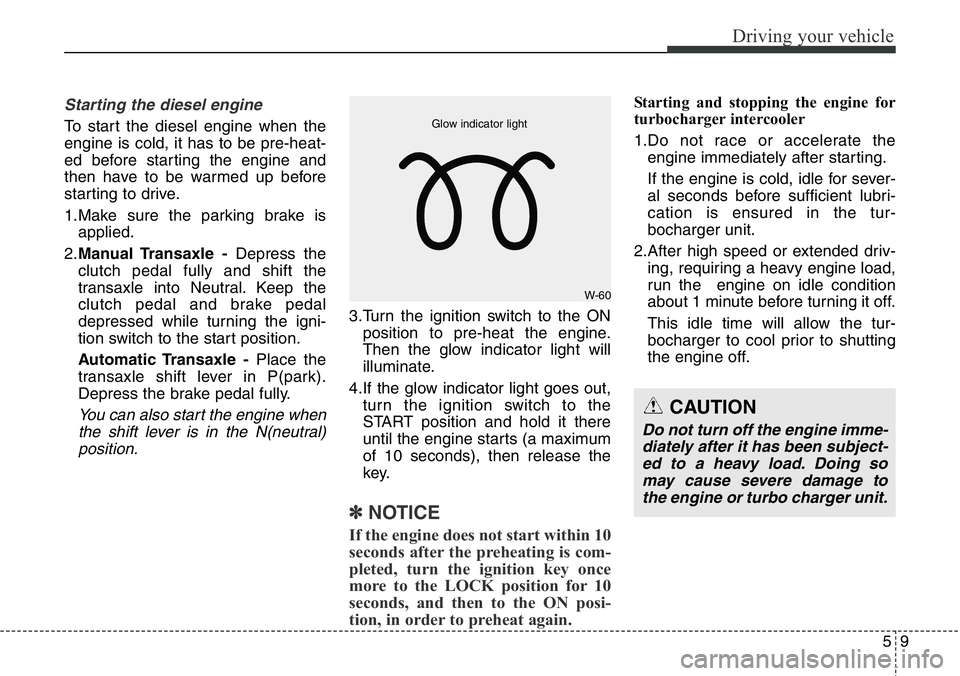
Then the glow indicator light will
illuminate.
4.If the glow indicator light goes out,
turn the ignition switch to the
START position and hold it there
until the engine starts (a maximum
of 10 seconds), then release the
key.
✽ NOTICE
If the engine does not start within 10
seconds after the preheating is com-
pleted, turn the ignition key once
more to the LOCK position for 10
seconds, and then to the ON posi-
tion, in order to preheat again.
Starting and stopping the engine for
turbocharger intercooler
1.Do not race or accelerate the
engine immediately after starting.
If the engine is cold, idle for sever-
al seconds before sufficient lubri-
cation is ensured in the tur-
bocharger unit.
2.After high speed or extended driv-
ing, requiring a heavy engine load,
run the engine on idle condition
about 1 minute before turning it off.
This idle time will allow the tur-
bocharger to cool prior to shutting
the engine off.
CAUTION
Do not turn off the engine imme-
diately after it has been subject-
ed to a heavy load. Doing so
may cause severe damage to
the engine or turbo charger unit.
W-60 Glow indicator light
Page 460 of 711
511
Driving your vehicle
✽ NOTICE
If the steering wheel doesn't unlock
properly, the engine start/stop but-
ton will not work. Press the engine
start/stop button while turning the
steering wheel right and left to
release the tension.
✽ NOTICE
You are able to turn off the engine
(START/RUN) or vehicle power
(ON), only when the vehicle is not in
motion.
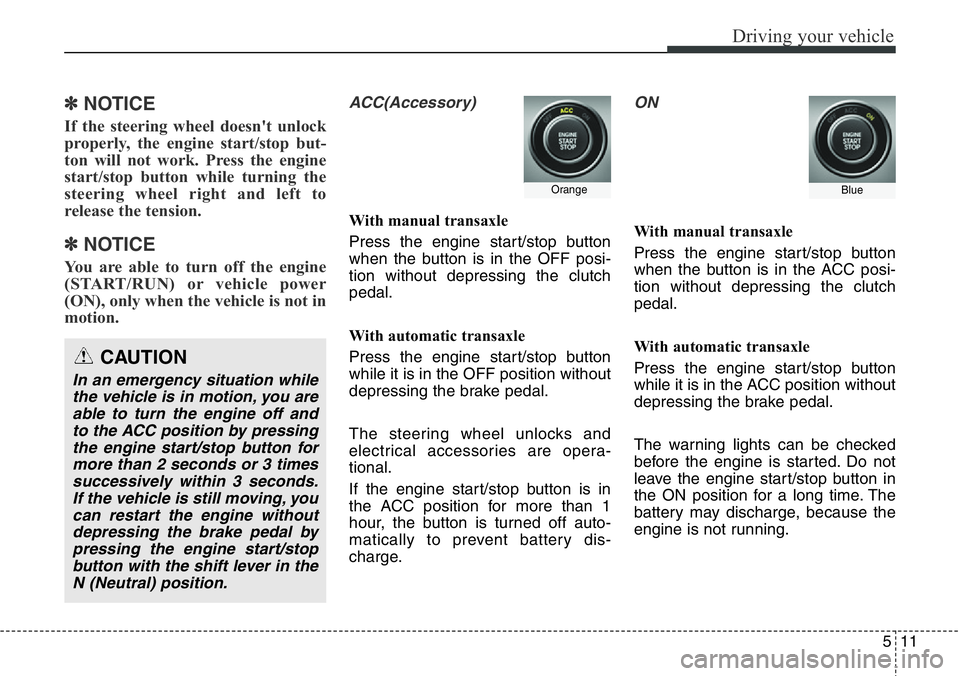
ACC(Accessory)
With manual transaxle
Press the engine start/stop button
when the button is in the OFF posi-
tion without depressing the clutch
pedal.
With automatic transaxle
Press the engine start/stop button
while it is in the OFF position without
depressing the brake pedal.
The steering wheel unlocks and
electrical accessories are opera-
tional.
If the engine start/stop button is in
the ACC position for more than 1
hour, the button is turned off auto-
matically to prevent battery dis-
charge.
ON
With manual transaxle
Press the engine start/stop button
when the button is in the ACC posi-
tion without depressing the clutch
pedal.
With automatic transaxle
Press the engine start/stop button
while it is in the ACC position without
depressing the brake pedal.
The warning lights can be checked
before the engine is started. Do not
leave the engine start/stop button in
the ON position for a long time. The
battery may discharge, because the
engine is not running.
Orange
CAUTION
In an emergency situation while
the vehicle is in motion, you are
able to turn the engine off and
to the ACC position by pressing
the engine start/stop button for
more than 2 seconds or 3 times
successively within 3 seconds.
If the vehicle is still moving, you
can restart the engine without
depressing the brake pedal by
pressing the engine start/stop
button with the shift lever in the
N (Neutral) position.
Blue
Page 466 of 711
517
Driving your vehicle
Manual transaxle operation
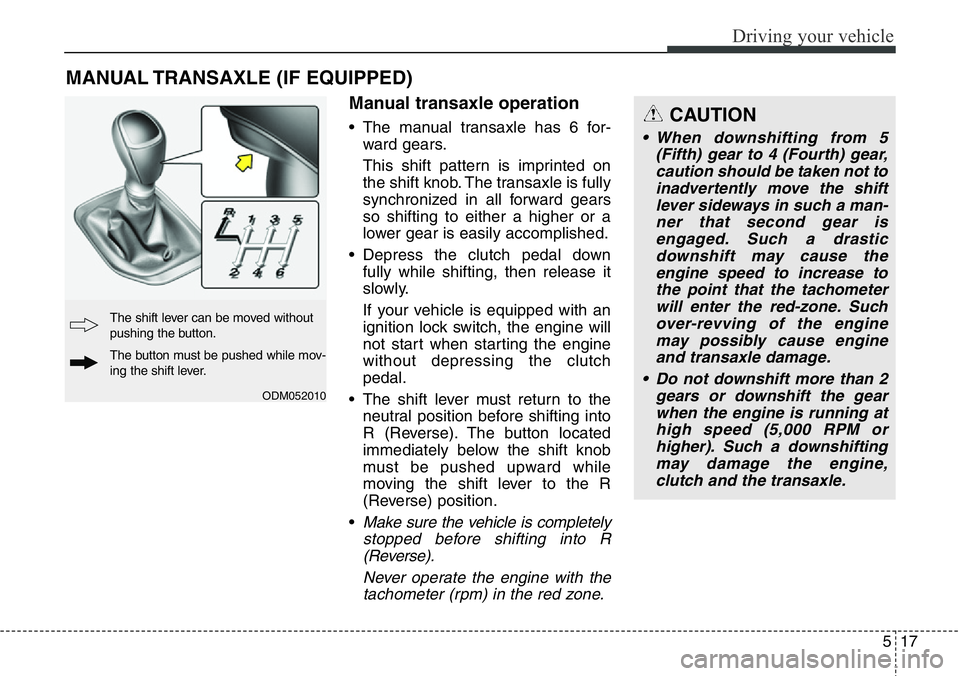
• The manual transaxle has 6 for-
ward gears.
This shift pattern is imprinted on
the shift knob. The transaxle is fully
synchronized in all forward gears
so shifting to either a higher or a
lower gear is easily accomplished.
• Depress the clutch pedal down
fully while shifting, then release it
slowly.
If your vehicle is equipped with an
ignition lock switch, the engine will
not start when starting the engine
without depressing the clutch
pedal.
• The shift lever must return to the
neutral position before shifting into
R (Reverse). The button located
immediately below the shift knob
must be pushed upward while
moving the shift lever to the R
(Reverse) position.
•
Make sure the vehicle is completely
stopped before shifting into R
(Reverse).
Never operate the engine with the
tachometer (rpm) in the red zone.
MANUAL TRANSAXLE (IF EQUIPPED)
ODM052010
The button must be pushed while mov-
ing the shift lever. The shift lever can be moved without
pushing the button.
CAUTION
• When downshifting from 5
(Fifth) gear to 4 (Fourth) gear,
caution should be taken not to
inadvertently move the shift
lever sideways in such a man-
ner that second gear is
engaged. Such a drastic
downshift may cause the
engine speed to increase to
the point that the tachometer
will enter the red-zone. Such
over-revving of the engine
may possibly cause engine
and transaxle damage.
• Do not downshift more than 2
gears or downshift the gear
when the engine is running at
high speed (5,000 RPM or
higher). Such a downshifting
may damage the engine,
clutch and the transaxle.
Page 467 of 711
Driving your vehicle
18 5
• During cold weather, shifting may
be difficult until the transaxle lubri-
cant has warmed up. This is nor-
mal and not harmful to the
transaxle.
• If you've come to a complete stop
and it's hard to shift into 1 (First) or
R (Reverse), put the shift lever in
neutral position and release the
clutch. Press the clutch pedal back
down, and then shift into 1 (First)
or R (Reverse) gear position.CAUTION
• To avoid premature clutch
wear and damage, do not
drive with your foot resting on
the clutch pedal. Also, don’t
use the clutch to hold the
vehicle stopped on an uphill
grade, while waiting for a traf-
fic light, etc.
• Do not use the shift lever as a
handrest during driving, as
this can result in premature
wear of the transaxle shift
forks.
• To prevent possible damage
to the clutch system, do not
start with the 2nd (second)
gear engaged except when
you start on a slippery road.
WARNING
• Before leaving the driver’s
seat, always set the parking
brake fully and shut the
engine off. Then make sure the
transaxle is shifted into 1
(First) gear when the vehicle is
parked on a level or uphill
grade, and shifted into R
(Reverse) on a downhill grade.
Unexpected and sudden vehi-
cle movement can occur if
these precautions are not fol-
lowed in the order identified.
• If your vehicle has a manual
transaxle not equipped with a
ignition lock switch, it may
move and cause a serious
accident when starting the
engine without depressing the
clutch pedal while the parking
brake is released and the shift
lever not in the neutral posi-
tion.
• Do not use the engine brake
(shifting from a high gear to
lower gear) rapidly on slippery
roads. The vehicle may slip
causing an accident.
Page 468 of 711
519
Driving your vehicle
Using the clutch
The clutch pedal should be
depressed all the way to the floor
before shifting, then released slowly.
The clutch pedal should always be
fully released while driving. Do not
rest your foot on the clutch pedal
while driving. This can cause unnec-
essary wear. Do not partially engage
the clutch to hold the vehicle on an
incline. This causes unnecessary
wear. Use the foot brake or parking
brake to hold the vehicle on an
incline. Do not operate the clutch
pedal rapidly and repeatedly.
Downshifting
When you must slow down in heavy
traffic or while driving up steep hills,
downshift before the engine starts to
labor. Downshifting reduces the
chance of stalling and gives better
acceleration when you again need to
increase your speed. When the vehi-
cle is traveling down steep hills,
downshifting helps maintain safe
speed and prolongs brake life.
Good driving practices
• Never take the vehicle out of gear
and coast down a hill. This is
extremely hazardous. Always leave
the vehicle in gear.
• Don't "ride" the brakes. This can
cause them to overheat and mal-
function. Instead, when you are
driving down a long hill, slow down
and shift to a lower gear. When you
do this, engine braking will help
slow down the vehicle.
• Slow down before shifting to a
lower gear. This will help avoid
over-revving the engine, which can
cause damage.
• Slow down when you encounter
cross winds. This gives you much
better control of your vehicle.
• Be sure the vehicle is completely
stopped before you attempt to shift
into R (Reverse). The transaxle can
be damaged if you do not. To shift
into R (Reverse), depress the
clutch, move the shift lever to neu-
tral, wait three seconds, then shift
to the R (Reverse) position.
CAUTION
When operating the clutch
pedal, depress the clutch pedal
down fully. If you don’t depress
the clutch pedal fully, the clutch
may be damaged or noise may
occur.
Page 470 of 711
521
Driving your vehicle
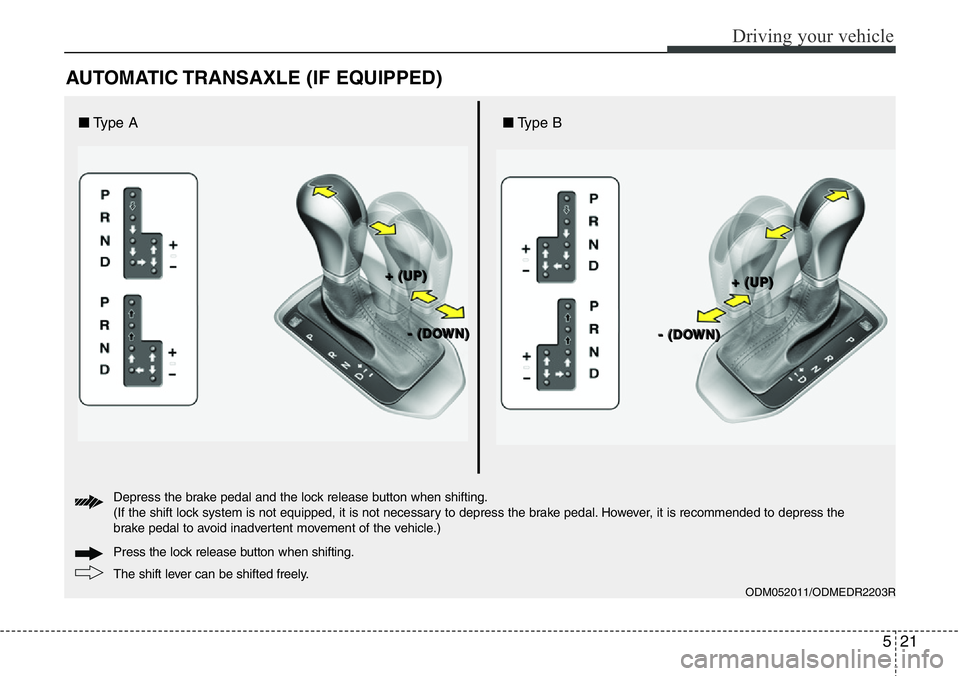
AUTOMATIC TRANSAXLE (IF EQUIPPED)
ODM052011/ODMEDR2203R
The shift lever can be shifted freely. Press the lock release button when shifting. Depress the brake pedal and the lock release button when shifting.
(If the shift lock system is not equipped, it is not necessary to depress the brake pedal. However, it is recommended to depress the
brake pedal to avoid inadvertent movement of the vehicle.)
■Type A■Type B
+ +
( (
U U
P P
) )
- -
( (
D D
O O
W W
N N
) )+ +
( (
U U
P P
) )
- -
( (
D D
O O
W W
N N
) )