ABS Hyundai Santa Fe 2016 - RHD (UK, Australia) User Guide
[x] Cancel search | Manufacturer: HYUNDAI, Model Year: 2016, Model line: Santa Fe, Model: Hyundai Santa Fe 2016Pages: 699, PDF Size: 15.65 MB
Page 508 of 699
Driving your vehicle
50 5
The ABS continuously senses the
speed of the wheels. If the wheels
are going to lock, the ABS system
repeatedly modulates the hydraulic
brake pressure to the wheels.
When you apply your brakes under
conditions which may lock the
wheels, you may hear a “tik-tik’’
sound from the brakes, or feel a cor-
responding sensation in the brake
pedal. This is normal and it means
your ABS is active.
In order to obtain the maximum ben-
efit from your ABS in an emergency
situation, do not attempt to modulate
your brake pressure and do not try to
pump your brakes. Press your brake
pedal as hard as possible or as hard
as the situation warrants and allow
the ABS to control the force being
delivered to the brakes.✽NOTICE
A click sound may be heard in the
engine compartment when the vehi-
cle begins to move after the engine is
started. These conditions are normal
and indicate that the anti-lock brake
system is functioning properly.
• Even with the anti-lock brake sys-
tem, your vehicle still requires suf-
ficient stopping distance. Always
maintain a safe distance from the
vehicle in front of you.
• Always slow down when cornering.
The anti-lock brake system cannot
prevent accidents resulting from
excessive speeds.
• On loose or uneven road surfaces,
operation of the anti-lock brake
system may result in a longer stop-
ping distance than for vehicles
equipped with a conventional
brake system.
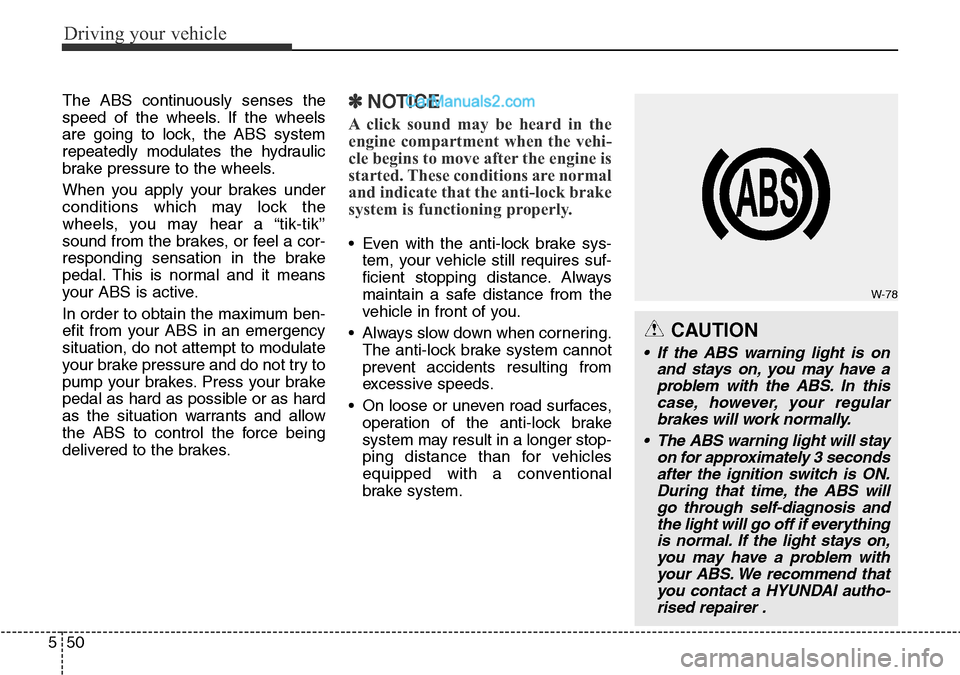
CAUTION
• If the ABS warning light is on
and stays on, you may have a
problem with the ABS. In this
case, however, your regular
brakes will work normally.
• The ABS warning light will stay
on for approximately 3 seconds
after the ignition switch is ON.
During that time, the ABS will
go through self-diagnosis and
the light will go off if everything
is normal. If the light stays on,
you may have a problem with
your ABS. We recommend that
you contact a HYUNDAI autho-
rised repairer .
W-78
Page 509 of 699
551
Driving your vehicle
✽NOTICE
When you jump start your vehicle
because of a drained battery, the
engine may not run as smoothly and
the ABS warning light may turn on
at the same time. This happens
because of the low battery voltage. It
does not mean your ABS is malfunc-
tioning.
• Do not pump your brakes!
• Have the battery recharged before
driving the vehicle.
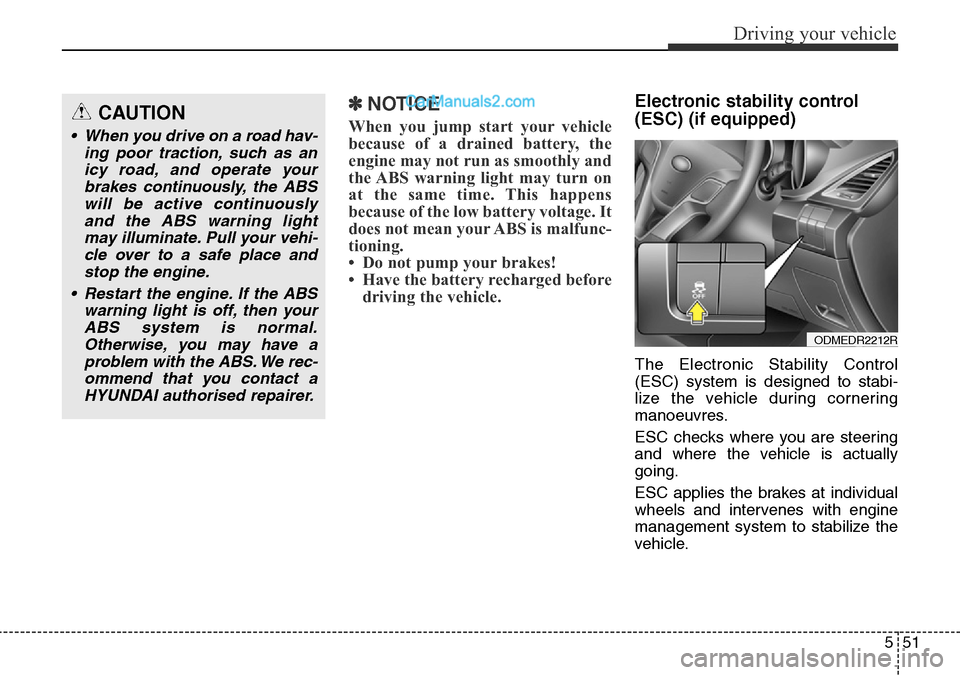
Electronic stability control
(ESC) (if equipped)
The Electronic Stability Control
(ESC) system is designed to stabi-
lize the vehicle during cornering
manoeuvres.
ESC checks where you are steering
and where the vehicle is actually
going.
ESC applies the brakes at individual
wheels and intervenes with engine
management system to stabilize the
vehicle.
CAUTION
• When you drive on a road hav-
ing poor traction, such as an
icy road, and operate your
brakes continuously, the ABS
will be active continuously
and the ABS warning light
may illuminate. Pull your vehi-
cle over to a safe place and
stop the engine.
• Restart the engine. If the ABS
warning light is off, then your
ABS system is normal.
Otherwise, you may have a
problem with the ABS. We rec-
ommend that you contact a
HYUNDAI authorised repairer.
ODMEDR2212R
Page 512 of 699
Driving your vehicle
54 5
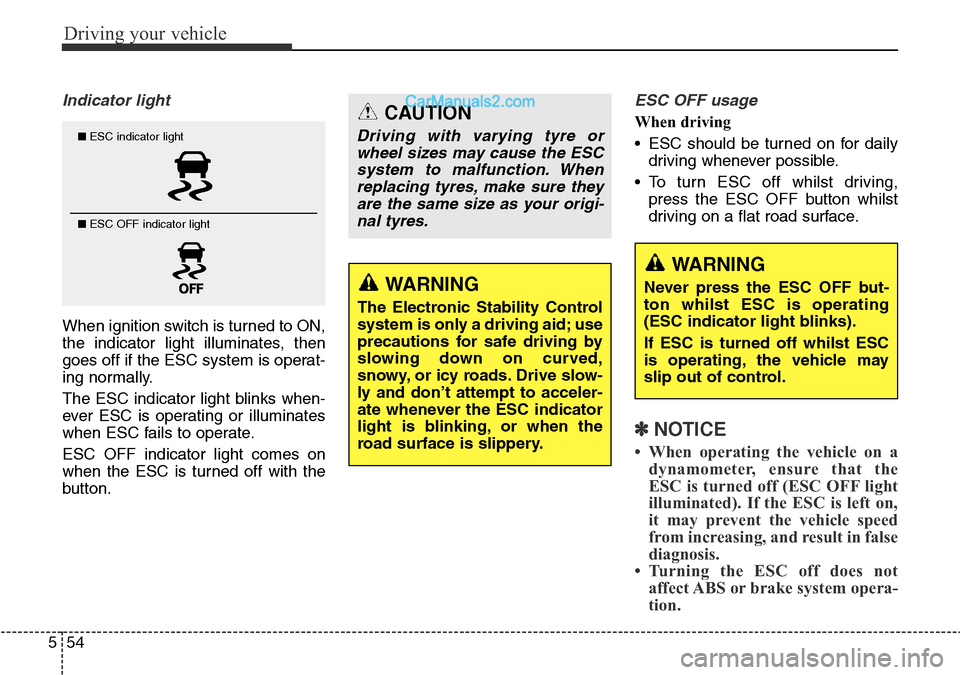
Indicator light
When ignition switch is turned to ON,
the indicator light illuminates, then
goes off if the ESC system is operat-
ing normally.
The ESC indicator light blinks when-
ever ESC is operating or illuminates
when ESC fails to operate.
ESC OFF indicator light comes on
when the ESC is turned off with the
button.
ESC OFF usage
When driving
• ESC should be turned on for daily
driving whenever possible.
• To turn ESC off whilst driving,
press the ESC OFF button whilst
driving on a flat road surface.
✽NOTICE
• When operating the vehicle on a
dynamometer, ensure that the
ESC is turned off (ESC OFF light
illuminated). If the ESC is left on,
it may prevent the vehicle speed
from increasing, and result in false
diagnosis.
• Turning the ESC off does not
affect ABS or brake system opera-
tion.
WARNING
Never press the ESC OFF but-
ton whilst ESC is operating
(ESC indicator light blinks).
If ESC is turned off whilst ESC
is operating, the vehicle may
slip out of control.
CAUTION
Driving with varying tyre or
wheel sizes may cause the ESC
system to malfunction. When
replacing tyres, make sure they
are the same size as your origi-
nal tyres.
WARNING
The Electronic Stability Control
system is only a driving aid; use
precautions for safe driving by
slowing down on curved,
snowy, or icy roads. Drive slow-
ly and don’t attempt to acceler-
ate whenever the ESC indicator
light is blinking, or when the
road surface is slippery.
■ESC indicator light
■ ESC OFF indicator light
Page 515 of 699
557
Driving your vehicle
Hill-start assist control (HAC)
(if equipped)
A vehicle has the tendency to slip
back on a steep hill when it starts to
go after stopping. The Hill-start
Assist Control (HAC) prevents the
vehicle from slipping back by operat-
ing the brakes automatically for
about 2 seconds. The brakes are
released when the accelerator pedal
is depressed or after about 2 sec-
onds.
✽NOTICE
• The HAC does not operate when
the transaxle shift lever is in the P
(Park) or N (Neutral) position.
• The HAC activates even though
the ESC is off but it does not acti-
vate when the ESC has malfunc-
tioned.
Emergency Stop Signal (ESS)
(if equipped)
The Emergency Stop Signal system
alerts the driver behind by blinking
the stop light when the vehicle is
braked rapidly and severely.
The system is activated when:
• The vehicle suddenly stops (vehi-
cle speed is over 35 mph (55 km/h)
and the vehicle deceleration at
greater than 7 m/s
2)
• The ABS is activating
When the vehicle speed is under 25
mph (40 km/h) and the ABS deacti-
vates or the sudden stop situation is
over, the stop light blinking will stop.
Instead, the hazard warning flasher
will turn on automatically.
The hazard warning flasher will turn
off when vehicle speed is over 6 mph
(10 km/h) after the vehicle has
stopped. Also, it will turn off when the
vehicle is driven at low speed for
some time. You can turn it off manu-
ally by pushing the hazard warning
flasher switch.
CAUTION
The Emergency Stop Signal
(ESS) system will not work if the
hazard warning flasher is
already on.
WARNING
The HAC is activated only for
about 2 seconds, so when the
vehicle is starting off always
depress the accelerator pedal.
Page 535 of 699
577
Driving your vehicle
Hazardous driving conditions
When hazardous driving conditions
are encountered such as water,
snow, ice, mud, sand, or similar haz-
ards, follow these suggestions:
• Drive cautiously and allow extra
distance for braking.
• Avoid sudden braking or steering.
• When braking with non-ABS
brakes pump the brake pedal with
a light up-and-down motion until
the vehicle is stopped.
• If stalled in snow, mud, or sand,
use second gear. Accelerate slow-
ly to avoid spinning the drive
wheels.
• Use sand, rock salt, tyre chains, or
other non-slip material under the
drive wheels to provide traction
when stalled in ice, snow, or mud.
Reducing the risk of a rollover
This multi-purpose passenger vehi-
cle is defined as a Sports Utility
Vehicle (SUV).
SUV’s have higher ground clearance
and a narrower track to make them
capable of performing in a wide vari-
ety of road applications. Specific
design characteristics give them a
higher centre of gravity than ordinary
vehicles. An advantage of the higher
ground clearance is a better view of
the road, which allows you to antici-
pate problems. They are not
designed for cornering at the same
speeds as conventional passenger
vehicles. Due to this risk, driver and
passengers are strongly recom-
mended to buckle their seat belts. In
a rollover crash, an unbelted person
is more likely to die than a person
wearing a seat belt. There are steps
that a driver can make to reduce the
risk of a rollover. If at all possible,
avoid sharp turns or abrupt manoeu-
vres, do not load your roof rack with
heavy cargo, and never modify your
vehicle in any way.
SPECIAL DRIVING CONDITIONS
WARNING
- Downshifting
Downshifting with an automatic
transaxle, whilst driving on slip-
pery surfaces can cause an
accident. The sudden change in
tyre speed could cause the
tyres to skid. Be careful when
downshifting on slippery sur-
faces.
WARNING - ABS
Do not pump the brake pedal on
a vehicle equipped with ABS.
Page 548 of 699
Driving your vehicle
90 5
Towbars
It's important to have the correct tow-
bar equipment. Crosswinds, large
trucks going by, and rough roads are
a few reasons why you’ll need the
right towbar. Here are some rules to
follow:
• Do you have to make any holes in
the body of your vehicle when you
install a trailer towbar? If you do,
then be sure to seal the holes later
when you remove the towbar.
If you do not seal them, deadly car-
bon monoxide (CO) from your
exhaust can get into your vehicle,
as well as dirt and water.
• The bumpers on your vehicle are
not intended for towbars. Do not
attach rental towbars or other
bumper-type towbars to them. Use
only a frame-mounted towbar that
does not attach to the bumper.
• HYUNDAI trailer towbar accessary
is available at a HYUNDAI autho-
rised repairer.
Safety cables
You should always attach cables
between your vehicle and your trail-
er. Cross the safety cables under the
nose of the trailer so that the nose
will not drop to the road if it becomes
separated from the towbar.
Instructions about safety cables may
be provided by the towbar manufac-
turer or by the trailer manufacturer.
Follow the manufacturer's recom-
mendation for attaching safety
cables. Always leave just enough
slack so you can turn with your trail-
er. And, never allow safety cables to
drag on the ground.
Trailer brakes
If your trailer is equipped with a brak-
ing system, make sure it conforms to
your country’s regulations and that it
is properly installed and operating
correctly.
If your trailer weight exceeds the
maximum allowed weight without
trailer brakes, then the trailer will also
require its own brakes as well. Be
sure to read and follow the instruc-
tions for the trailer brakes so you’ll be
able to install, adjust and maintain
them properly.
• Do not tap into or modify your vehi-
cle's brake system.
WARNING- Trailer
brakes
Do not use a trailer with its own
brakes unless you are absolute-
ly certain that you have proper-
ly set up the brake system. This
is not a task for amateurs. Use
an experienced, competent
trailer shop for this work.
Page 551 of 699
593
Driving your vehicle
Parking on hills
Generally, if you have a trailer
attached to your vehicle, you should
not park your vehicle on a hill. People
can be seriously or fatally injured,
and both your vehicle and the trailer
can be damaged if they unexpected-
ly roll down hill.
However, if you ever have to park
your trailer on a hill, here is how to do
it:
1.Pull the vehicle into the parking
space. Turn the steering wheel in
the direction of the kerb (left if
headed down hill, right if headed
up hill).2.If the vehicle has a manual
transaxle, place the car in neutral.
If the vehicle has an automatic
transaxle, place the car in P (Park).
3.Set the parking brake and shut off
the vehicle.
4.Place chocks under the trailer
wheels on the down hill side of the
wheels.
5.Start the vehicle, hold the brakes,
shift to neutral, release the parking
brake and slowly release the
brakes until the trailer chocks
absorb the load.
6.Reapply the brakes, reapply the
parking brake and shift the vehicle
to R (Reverse) for manual
transaxle or P (Park) for automatic
transaxle.
7.Shut off the vehicle and release the
vehicle brakes but leave the park-
ing brake set.CAUTION
• When towing a trailer on steep
grades (in excess of 6%) pay
close attention to the engine
coolant temperature gauge to
ensure the engine does not
overheat.
If the needle of the coolant
temperature gauge moves
across the dial towards “130/H
(HOT)”, pull over and stop as
soon as it is safe to do so, and
allow the engine to idle until it
cools down. You may proceed
once the engine has cooled
sufficiently.
• You must decide driving
speed depending on trailer
weight and uphill grade to
reduce the possibility of
engine and transaxle over-
heating.
WARNING- Parking on
a hill
Parking your vehicle on a hill
with a trailer attached could
cause serious injury or death,
should the trailer break loose or
the brake stops working.
Page 580 of 699
What to do in an emergency
24 6
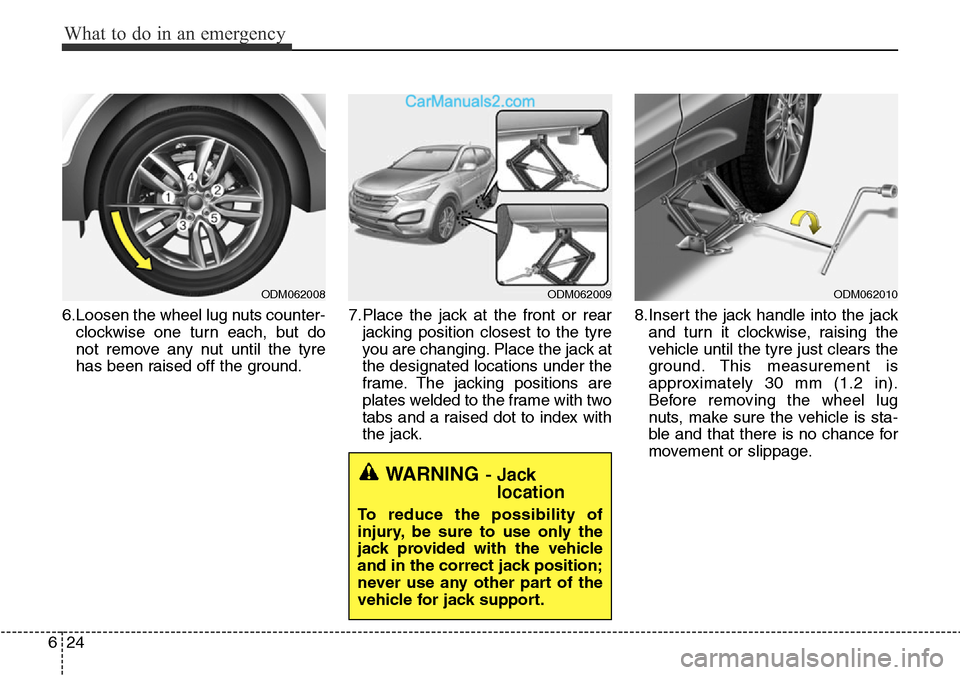
6.Loosen the wheel lug nuts counter-
clockwise one turn each, but do
not remove any nut until the tyre
has been raised off the ground.7.Place the jack at the front or rear
jacking position closest to the tyre
you are changing. Place the jack at
the designated locations under the
frame. The jacking positions are
plates welded to the frame with two
tabs and a raised dot to index with
the jack.8.Insert the jack handle into the jack
and turn it clockwise, raising the
vehicle until the tyre just clears the
ground. This measurement is
approximately 30 mm (1.2 in).
Before removing the wheel lug
nuts, make sure the vehicle is sta-
ble and that there is no chance for
movement or slippage.
WARNING- Jack
location
To reduce the possibility of
injury, be sure to use only the
jack provided with the vehicle
and in the correct jack position;
never use any other part of the
vehicle for jack support.
ODM062008ODM062009ODM062010
Page 637 of 699
Maintenance
40 7
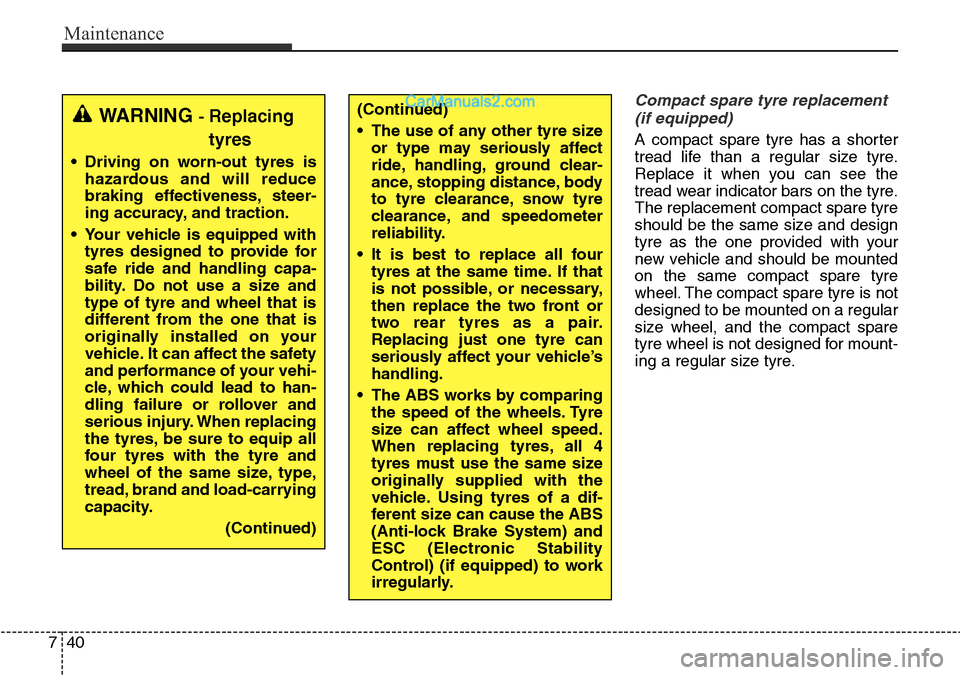
Compact spare tyre replacement
(if equipped)
A compact spare tyre has a shorter
tread life than a regular size tyre.
Replace it when you can see the
tread wear indicator bars on the tyre.
The replacement compact spare tyre
should be the same size and design
tyre as the one provided with your
new vehicle and should be mounted
on the same compact spare tyre
wheel. The compact spare tyre is not
designed to be mounted on a regular
size wheel, and the compact spare
tyre wheel is not designed for mount-
ing a regular size tyre.
(Continued)
• The use of any other tyre size
or type may seriously affect
ride, handling, ground clear-
ance, stopping distance, body
to tyre clearance, snow tyre
clearance, and speedometer
reliability.
• It is best to replace all four
tyres at the same time. If that
is not possible, or necessary,
then replace the two front or
two rear tyres as a pair.
Replacing just one tyre can
seriously affect your vehicle’s
handling.
• The ABS works by comparing
the speed of the wheels. Tyre
size can affect wheel speed.
When replacing tyres, all 4
tyres must use the same size
originally supplied with the
vehicle. Using tyres of a dif-
ferent size can cause the ABS
(Anti-lock Brake System) and
ESC (Electronic Stability
Control) (if equipped) to work
irregularly.WARNING - Replacing
tyres
• Driving on worn-out tyres is
hazardous and will reduce
braking effectiveness, steer-
ing accuracy, and traction.
• Your vehicle is equipped with
tyres designed to provide for
safe ride and handling capa-
bility. Do not use a size and
type of tyre and wheel that is
different from the one that is
originally installed on your
vehicle. It can affect the safety
and performance of your vehi-
cle, which could lead to han-
dling failure or rollover and
serious injury. When replacing
the tyres, be sure to equip all
four tyres with the tyre and
wheel of the same size, type,
tread, brand and load-carrying
capacity.
(Continued)
Page 655 of 699
Maintenance
58 7
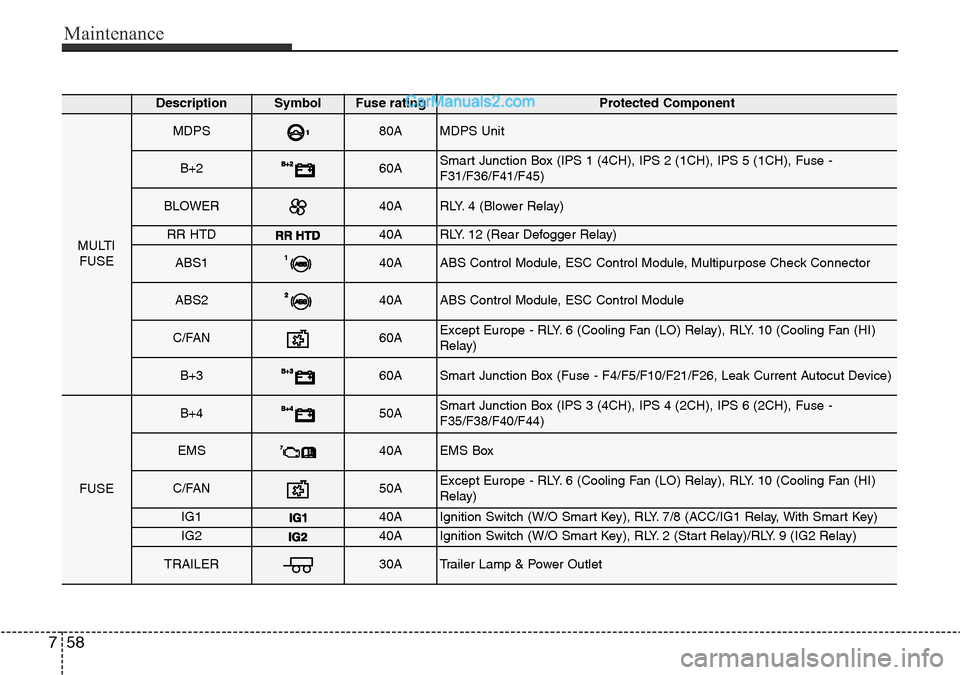
DescriptionSymbol Fuse ratingProtected Component
MULTI
FUSE
MDPS80AMDPS Unit
B+260ASmart Junction Box (IPS 1 (4CH), IPS 2 (1CH), IPS 5 (1CH), Fuse -
F31/F36/F41/F45)
BLOWER40ARLY. 4 (Blower Relay)
RR HTD40ARLY. 12 (Rear Defogger Relay)
ABS140AABS Control Module, ESC Control Module, Multipurpose Check Connector
ABS240AABS Control Module, ESC Control Module
C/FAN60AExcept Europe - RLY. 6 (Cooling Fan (LO) Relay), RLY. 10 (Cooling Fan (HI)
Relay)
B+360ASmart Junction Box (Fuse - F4/F5/F10/F21/F26, Leak Current Autocut Device)
FUSE
B+450ASmart Junction Box (IPS 3 (4CH), IPS 4 (2CH), IPS 6 (2CH), Fuse -
F35/F38/F40/F44)
EMS40AEMS Box
C/FAN50AExcept Europe - RLY. 6 (Cooling Fan (LO) Relay), RLY. 10 (Cooling Fan (HI)
Relay)
IG140AIgnition Switch (W/O Smart Key), RLY. 7/8 (ACC/IG1 Relay, With Smart Key)
IG240AIgnition Switch (W/O Smart Key), RLY. 2 (Start Relay)/RLY. 9 (IG2 Relay)
TRAILER30ATrailer Lamp & Power Outlet