ABS Hyundai Santa Fe 2016 Owner's Manual - RHD (UK, Australia)
[x] Cancel search | Manufacturer: HYUNDAI, Model Year: 2016, Model line: Santa Fe, Model: Hyundai Santa Fe 2016Pages: 699, PDF Size: 15.65 MB
Page 65 of 699
345
Safety features of your vehicle
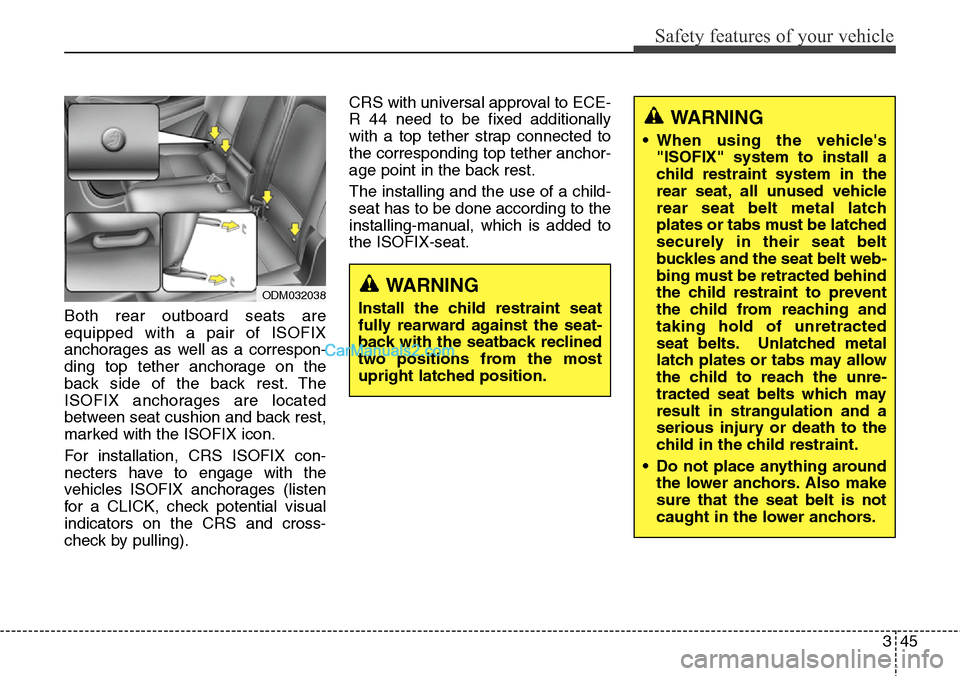
Both rear outboard seats are
equipped with a pair of ISOFIX
anchorages as well as a correspon-
ding top tether anchorage on the
back side of the back rest. The
ISOFIX anchorages are located
between seat cushion and back rest,
marked with the ISOFIX icon.
For installation, CRS ISOFIX con-
necters have to engage with the
vehicles ISOFIX anchorages (listen
for a CLICK, check potential visual
indicators on the CRS and cross-
check by pulling).CRS with universal approval to ECE-
R 44 need to be fixed additionally
with a top tether strap connected to
the corresponding top tether anchor-
age point in the back rest.
The installing and the use of a child-
seat has to be done according to the
installing-manual, which is added to
the ISOFIX-seat.
ODM032038WARNING
Install the child restraint seat
fully rearward against the seat-
back with the seatback reclined
two positions from the most
upright latched position.
WARNING
• When using the vehicle's
"ISOFIX" system to install a
child restraint system in the
rear seat, all unused vehicle
rear seat belt metal latch
plates or tabs must be latched
securely in their seat belt
buckles and the seat belt web-
bing must be retracted behind
the child restraint to prevent
the child from reaching and
taking hold of unretracted
seat belts. Unlatched metal
latch plates or tabs may allow
the child to reach the unre-
tracted seat belts which may
result in strangulation and a
serious injury or death to the
child in the child restraint.
• Do not place anything around
the lower anchors. Also make
sure that the seat belt is not
caught in the lower anchors.
Page 88 of 699
Safety features of your vehicle
68 3
WARNING - if equipped
with rollover sensor
If your vehicle is equipped with
side and curtain air bag, set the
ignition switch to OFF or ACC
position when the vehicle is
being towed.
The side and curtain air bag
may deploy when the ignition is
ON, and the rollover sensor
detects the situation as a rollover.WARNING
• Do not hit or allow any objects
to impact the locations where
air bag or sensors are installed.
This may cause unexpected
air bag deployment, which
could result in serious per-
sonal injury or death.
• If the installation location or
angle of the sensors is altered
in any way, the air bags may
deploy when they should not
or they may not deploy when
they should, causing severe
injury or death.
Therefore, do not try to per-
form maintenance on or
around the air bag sensors.
We recommend that the sys-
tem be serviced by a
HYUNDAI authorised repairer.
(Continued)
(Continued)
• Problems may arise if the sen-
sor installation angles are
changed due to the deforma-
tion of the front bumper, body,
front door or B pillar and C pil-
lars where side collision sen-
sors are installed. We recom-
mend that the system be serv-
iced by a HYUNDAI authorised
repairer.
•Y
our vehicle has been designed
to absorb impact and deploy the
air bag(s) in certain collisions.
Installing bumper guards or
replacing a bumper with non-
genuine parts may adversely
affect your vehicles collision
and air bag deployment per-
formance.
Page 98 of 699
Safety features of your vehicle
78 3
• The active bonnet lift system is not
designed to operate in side, rear
collisions and rollover accidents.
Because the vehicle can detect
only frontal collision.
• If the front bumper is damaged or
modified.
• If the vehicle have an angled
frontal collision with pedestrians.
• If a pedestrian, lies on the road.
• If the pedestrian have an object to
absorb the shock such as a suit
case, buggy or cart.Active bonnet lift system mal-
function
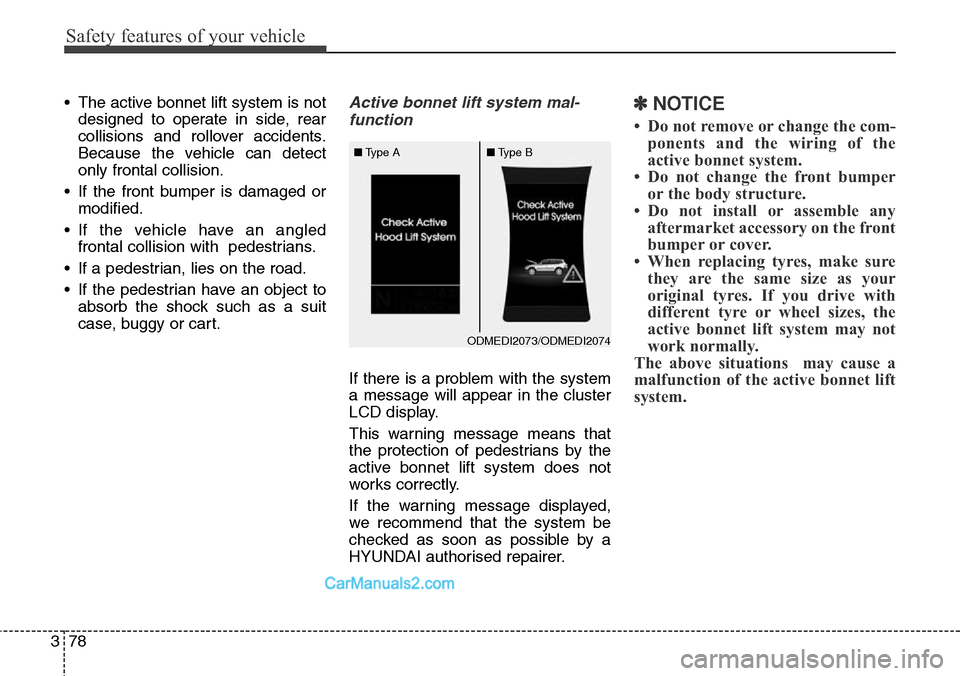
If there is a problem with the system
a message will appear in the cluster
LCD display.
This warning message means that
the protection of pedestrians by the
active bonnet lift system does not
works correctly.
If the warning message displayed,
we recommend that the system be
checked as soon as possible by a
HYUNDAI authorised repairer.
✽NOTICE
• Do not remove or change the com-
ponents and the wiring of the
active bonnet system.
• Do not change the front bumper
or the body structure.
• Do not install or assemble any
aftermarket accessory on the front
bumper or cover.
• When replacing tyres, make sure
they are the same size as your
original tyres. If you drive with
different tyre or wheel sizes, the
active bonnet lift system may not
work normally.
The above situations may cause a
malfunction of the active bonnet lift
system.
ODMEDI2073/ODMEDI2074 ■Type A■Type B
Page 193 of 699
495
Features of your vehicle
Anti-lock Brake System
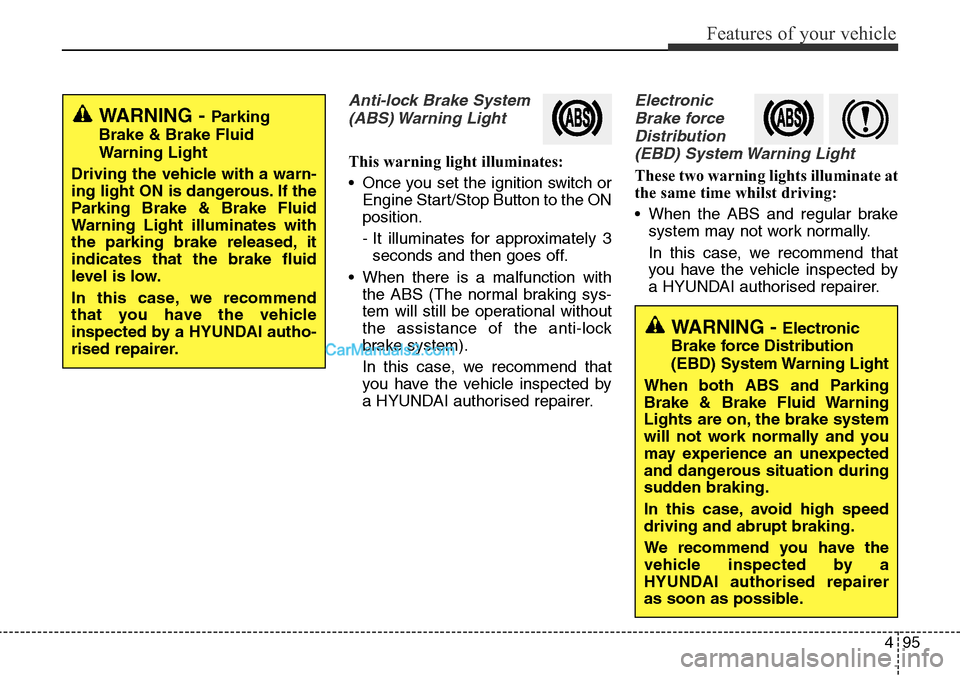
(ABS) Warning Light
This warning light illuminates:
• Once you set the ignition switch or
Engine Start/Stop Button to the ON
position.
- It illuminates for approximately 3
seconds and then goes off.
• When there is a malfunction with
the ABS (The normal braking sys-
tem will still be operational without
the assistance of the anti-lock
brake system).
In this case, we recommend that
you have the vehicle inspected by
a HYUNDAI authorised repairer.
Electronic
Brake force
Distribution
(EBD) System Warning Light
These two warning lights illuminate at
the same time whilst driving:
• When the ABS and regular brake
system may not work normally.
In this case, we recommend that
you have the vehicle inspected by
a HYUNDAI authorised repairer.
WARNING - Parking
Brake & Brake Fluid
Warning Light
Driving the vehicle with a warn-
ing light ON is dangerous. If the
Parking Brake & Brake Fluid
Warning Light illuminates with
the parking brake released, it
indicates that the brake fluid
level is low.
In this case, we recommend
that you have the vehicle
inspected by a HYUNDAI autho-
rised repairer.
WARNING - Electronic
Brake force Distribution
(EBD) System Warning Light
When both ABS and Parking
Brake & Brake Fluid Warning
Lights are on, the brake system
will not work normally and you
may experience an unexpected
and dangerous situation during
sudden braking.
In this case, avoid high speed
driving and abrupt braking.
We recommend you have the
vehicle inspected by a
HYUNDAI authorised repairer
as soon as possible.
Page 194 of 699
Features of your vehicle
96 4
✽NOTICE- Electronic Brake
force Distribution
(EBD) System
Warning Light
When the ABS Warning Light is on
or both ABS and Parking Brake &
Brake Fluid Warning Lights are on,
the speedometer, odometer, or trip-
meter may not work. Also, the EPS
Warning Light may illuminate and
the steering effort may increase or
decrease.
In this case, we recommend you
have the vehicle inspected by a
HYUNDAI authorised repairer as
soon as possible.
Electric Parking Brake
(EPB) Warning Light
(if equipped)
This warning light illuminates:
• Once you set the ignition switch or
Engine Start/Stop Button to the ON
position.
- It illuminates for approximately 3
seconds and then goes off.
• When there is a malfunction with
the EPB.
In this case, we recommend that
you have the vehicle inspected by
a HYUNDAI authorised repairer.
✽NOTICE- Electric Parking
Brake (EPB)
Warning Light
The Electric Parking Brake (EPB)
Warning Light may illuminates
when the Electronic Stability
Control (ESC) Indicator Light
comes on to indicates that the ESC is
not working properly (This does not
indicate malfunction of the EPB).
Electronic Power
Steering (EPS) Warning
Light (if equipped)
This warning light illuminates:
• Once you set the ignition switch or
Engine Start/Stop Button to the ON
position.
- It remains on until the engine is
started.
• When there is a malfunction with
the EPS.
In this case, we recommend that
you have the vehicle inspected by
a HYUNDAI authorised repairer.
EPB
Page 208 of 699
Features of your vehicle
110 4
• The sensing distance whilst the
rear parking assist system is in
operation is approximately 47 in.
(120 cm).
• When more than two objects are
sensed at the same time, the clos-
est one will be recognized first.
Types of warning sound
• When an object is 120 cm to 61 cm
(47 in. to 24 in.) from the rear
bumper: Buzzer beeps intermittently.
• When an object is 60 cm to 31 cm
(23 in. to 12 in.) from the rear
bumper: Buzzer beeps more fre-
quently.
• When an object is within 30 cm (11
in.) of the rear bumper:
Buzzer sounds continuously.
Non-operational conditions of
rear parking assist system
The rear parking assist system
may not operate properly when:
1. Moisture is frozen to the sensor. (It
will operate normally when the
moisture has been cleared.)
2. The sensor is covered with foreign
matter, such as snow or water, or
the sensor cover is blocked. (It will
operate normally when the materi-
al is removed or the sensor is no
longer blocked.)
3. Driving on uneven road surfaces
(unpaved roads, gravel, bumps,
gradient).
4. Objects generating excessive
noise (vehicle horns, loud motor-
cycle engines, or truck air brakes)
are within range of the sensor.
5. Heavy rain or water spray exists.
6. Wireless transmitters or mobile
phones are within range of the
sensor.
7. The sensor is covered with snow.
8. Trailer towingThe detecting range may decrease
when:
1. The sensor is stained with foreign
matter such as snow or water.
(The sensing range will return to
normal when removed.)
2. Outside air temperature is
extremely hot or cold.
The following objects may not be
recognized by the sensor:
1. Sharp or slim objects such as
ropes, chains or small poles.
2. Objects which tend to absorb the
sensor frequency such as clothes,
spongy material or snow.
3. Undetectable objects smaller than 1
m (40 in.) in height and narrower
than 14 cm (6 in.) in diameter.
Page 214 of 699
Features of your vehicle
116 4
Non-operational conditions of
parking assist system
Parking assist system may not
operate normally when:
1. Moisture is frozen to the sensor. (It
will operate normally when mois-
ture melts.)
2. Sensor is covered with foreign
matter, such as snow or water, or
the sensor cover is blocked. (It will
operate normally when the materi-
al is removed or the sensor is no
longer blocked.)
3. Sensor is stained with foreign mat-
ter such as snow or water.
(Sensing range will return to nor-
mal when removed.)
4.The parking assist button is off.
There is a possibility of parking
assist system malfunction when:
1. Driving on uneven road surfaces
such as unpaved roads, gravel,
bumps, or gradient.
2. Objects generating excessive
noise such as vehicle horns, loud
motorcycle engines, or truck air
brakes can interfere with the sen-
sor.
3. Heavy rain or water spray.
4. Wireless transmitters or mobile
phones present near the sensor.
5. Sensor is covered with snow.
Detecting range may decrease
when:
1. Outside air temperature is
extremely hot or cold.
2. Undetectable objects smaller than
1 m and narrower than 14 cm in
diameter.
The following objects may not be
recognized by the sensor:
1. Sharp or slim objects such as
ropes, chains or small poles.
2. Objects, which tend to absorb sen-
sor frequency such as clothes,
spongy material or snow.
Page 228 of 699
Features of your vehicle
130 4
Additional instructions
(messages)
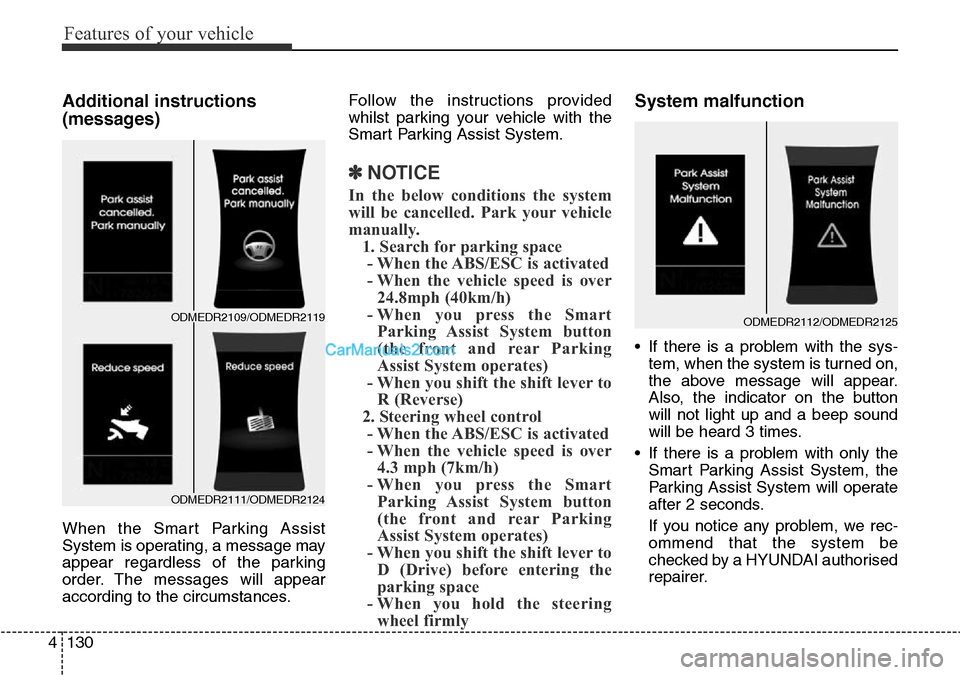
When the Smart Parking Assist
System is operating, a message may
appear regardless of the parking
order. The messages will appear
according to the circumstances.Follow the instructions provided
whilst parking your vehicle with the
Smart Parking Assist System.
✽NOTICE
In the below conditions the system
will be cancelled. Park your vehicle
manually.
1. Search for parking space
- When the ABS/ESC is activated
- When the vehicle speed is over
24.8mph (40km/h)
- When you press the Smart
Parking Assist System button
(the front and rear Parking
Assist System operates)
- When you shift the shift lever to
R (Reverse)
2. Steering wheel control
- When the ABS/ESC is activated
- When the vehicle speed is over
4.3 mph (7km/h)
- When you press the Smart
Parking Assist System button
(the front and rear Parking
Assist System operates)
- When you shift the shift lever to
D (Drive) before entering the
parking space
- When you hold the steering
wheel firmly
System malfunction
• If there is a problem with the sys-
tem, when the system is turned on,
the above message will appear.
Also, the indicator on the button
will not light up and a beep sound
will be heard 3 times.
• If there is a problem with only the
Smart Parking Assist System, the
Parking Assist System will operate
after 2 seconds.
If you notice any problem, we rec-
ommend that the system be
checked by a HYUNDAI authorised
repairer.
ODMEDR2112/ODMEDR2125
ODMEDR2111/ODMEDR2124
ODMEDR2109/ODMEDR2119
Page 459 of 699

Driving your vehicle
Before driving . . . . . . . . . . . . . . . . . . . . . . . . . . . . . . 5-4
Key . . . . . . . . . . . . . . . . . . . . . . . . . . . . . . . . . . . . . . . 5-6
Engine start/stop button . . . . . . . . . . . . . . . . . . . . 5-10
Manual transaxle . . . . . . . . . . . . . . . . . . . . . . . . . . 5-17
Automatic transaxle . . . . . . . . . . . . . . . . . . . . . . . . 5-21
• Automatic transaxle operation . . . . . . . . . . . . . . . . . . 5-21
Four wheel drive (4WD) . . . . . . . . . . . . . . . . . . . . 5-28
Brake system . . . . . . . . . . . . . . . . . . . . . . . . . . . . . . 5-36
• Power brakes . . . . . . . . . . . . . . . . . . . . . . . . . . . . . . . 5-36
• Parking brake . . . . . . . . . . . . . . . . . . . . . . . . . . . . . . . 5-38
• Electric parking brake (EPB) . . . . . . . . . . . . . . . . . . 5-40
• Auto hold . . . . . . . . . . . . . . . . . . . . . . . . . . . . . . . . . . . 5-46
• Anti-lock brake system (ABS) . . . . . . . . . . . . . . . . . . 5-49
• Electronic stability control (ESC) . . . . . . . . . . . . . . . 5-51
• Vehicle stability management (VSM) . . . . . . . . . . . . 5-55
• Trailer stability assist (TSA). . . . . . . . . . . . . . . . . . . . 5-56
• Hill-start assist control (HAC) . . . . . . . . . . . . . . . . . . 5-57
• Emergency stop signal (ESS) . . . . . . . . . . . . . . . . . . . 5-57
• Downhill brake control (DBC) . . . . . . . . . . . . . . . . . . 5-58
Cruise control system. . . . . . . . . . . . . . . . . . . . . . . 5-61
Speed limit control system. . . . . . . . . . . . . . . . . . . 5-66
Lane departure warning system (LDWS) . . . . . . 5-70
Active ECO system. . . . . . . . . . . . . . . . . . . . . . . . . 5-74
Economical operation . . . . . . . . . . . . . . . . . . . . . . 5-75
Special driving conditions . . . . . . . . . . . . . . . . . . . 5-77
• Hazardous driving conditions . . . . . . . . . . . . . . . . . . 5-77
• Rocking the vehicle . . . . . . . . . . . . . . . . . . . . . . . . . . . 5-78
• Smooth cornering . . . . . . . . . . . . . . . . . . . . . . . . . . . . 5-79
• Driving at night . . . . . . . . . . . . . . . . . . . . . . . . . . . . . . 5-80
• Driving in the rain . . . . . . . . . . . . . . . . . . . . . . . . . . . . 5-80
• Driving in flooded areas . . . . . . . . . . . . . . . . . . . . . . . 5-81
• Driving off-road . . . . . . . . . . . . . . . . . . . . . . . . . . . . . . 5-81
• Highway driving . . . . . . . . . . . . . . . . . . . . . . . . . . . . . 5-81
Winter driving . . . . . . . . . . . . . . . . . . . . . . . . . . . . 5-83
Trailer towing . . . . . . . . . . . . . . . . . . . . . . . . . . . . . 5-88
5
Page 507 of 699
549
Driving your vehicle
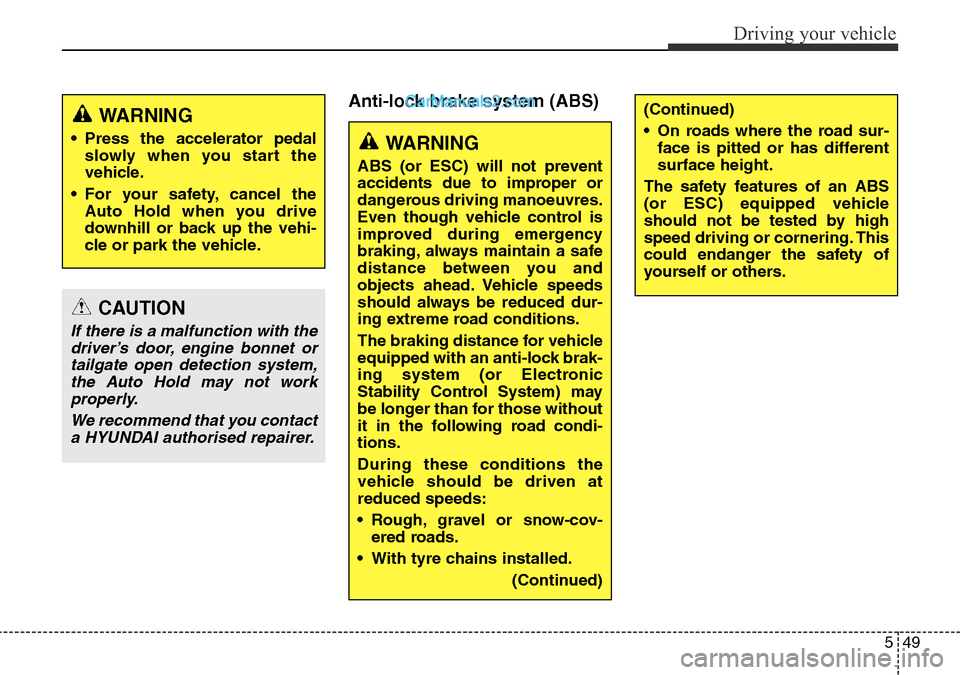
Anti-lock brake system (ABS) WARNING
• Press the accelerator pedal
slowly when you start the
vehicle.
• For your safety, cancel the
Auto Hold when you drive
downhill or back up the vehi-
cle or park the vehicle.
CAUTION
If there is a malfunction with the
driver’s door, engine bonnet or
tailgate open detection system,
the Auto Hold may not work
properly.
We recommend that you contact
a HYUNDAI authorised repairer.
(Continued)
• On roads where the road sur-
face is pitted or has different
surface height.
The safety features of an ABS
(or ESC) equipped vehicle
should not be tested by high
speed driving or cornering. This
could endanger the safety of
yourself or others.
WARNING
ABS (or ESC) will not prevent
accidents due to improper or
dangerous driving manoeuvres.
Even though vehicle control is
improved during emergency
braking, always maintain a safe
distance between you and
objects ahead. Vehicle speeds
should always be reduced dur-
ing extreme road conditions.
The braking distance for vehicle
equipped with an anti-lock brak-
ing system (or Electronic
Stability Control System) may
be longer than for those without
it in the following road condi-
tions.
During these conditions the
vehicle should be driven at
reduced speeds:
• Rough, gravel or snow-cov-
ered roads.
• With tyre chains installed.
(Continued)