fuel cap Hyundai Santa Fe 2016 - RHD (UK, Australia) User Guide
[x] Cancel search | Manufacturer: HYUNDAI, Model Year: 2016, Model line: Santa Fe, Model: Hyundai Santa Fe 2016Pages: 699, PDF Size: 15.65 MB
Page 601 of 699
Maintenance
4 7
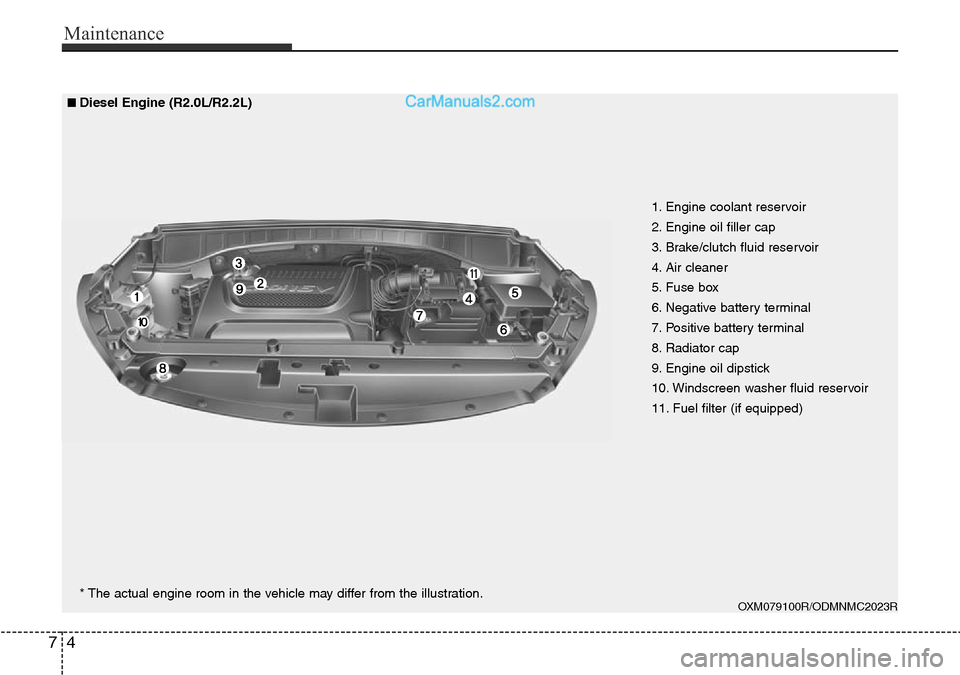
1. Engine coolant reservoir
2. Engine oil filler cap
3. Brake/clutch fluid reservoir
4. Air cleaner
5. Fuse box
6. Negative battery terminal
7. Positive battery terminal
8. Radiator cap
9. Engine oil dipstick
10. Windscreen washer fluid reservoir
11. Fuel filter (if equipped)
OXM079100R/ODMNMC2023R
■Diesel Engine (R2.0L/R2.2L)
* The actual engine room in the vehicle may differ from the illustration.
Page 609 of 699
Maintenance
12 7
Vapour hose and fuel filler cap
The vapour hose and fuel filler cap
should be inspected at those inter-
vals specified in the maintenance
schedule. Make sure that a new
vapour hose or fuel filler cap is cor-
rectly replaced.
Vacuum crankcase ventilation
hoses (if equipped)
Inspect the surface of hoses for evi-
dence of heat and/or mechanical
damage. Hard and brittle rubber,
cracking, tears, cuts, abrasions, and
excessive swelling indicate deterio-
ration. Particular attention should be
paid to examine those hose surfaces
nearest to high heat sources, such
as the exhaust manifold.
Inspect the hose routing to assure
that the hoses do not come in con-
tact with any heat source, sharp
edges or moving component which
might cause heat damage or
mechanical wear. Inspect all hose
connections, such as clamps and
couplings, to make sure they are
secure, and that no leaks are pres-
ent. Hoses should be replaced
immediately if there is any evidence
of deterioration or damage.
Air cleaner filter
We recommend that the air cleaner
filter be replaced by a HYUNDAI
authorised repairer.
Spark plugs
(for petrol engine)
Make sure to install new spark plugs
of the correct heat range.
Valve clearance
(for petrol engine)
Inspect excessive valve noise and/or
engine vibration and adjust if neces-
sary. We recommend that the system
be serviced by a HYUNDAI autho-
rised repairer.
WARNING
Do not disconnect and inspect
spark plugs when the engine is
hot. You may burn yourself.
Page 633 of 699
Maintenance
36 7
WARNING -
Tyre inflation
Overinflation or underinflation
can reduce tyre life, adversely
affect vehicle handling, and
lead to sudden tyre failure. This
could result in loss of vehicle
control and potential injury.
CAUTION - Tyre pres-
sure
Always observe the following:
• Check tyre pressure when the
tyres are cold. (After vehicle
has been parked for at least
three hours or hasn't been
driven more than 1 mile (1.6
km) since startup.)
• Check the pressure of your
spare tyre each time you
check the pressure of other
tyres.
• Never overload your vehicle.
Be careful not to overload a
vehicle luggage rack if your
vehicle is equipped with one.
• Worn, old tyres can cause
accidents. If your tread is
badly worn, or if your tyres
have been damaged, replace
them.
CAUTION
• Underinflation also results in
excessive wear, poor handling
and reduced fuel economy.
Wheel deformation also is
possible. Keep your tyre pres-
sures at the proper levels. If a
tyre frequently needs refilling,
we recommend that the sys-
tem be checked by a HYUNDAI
authorised repairer.
• Overinflation produces a
harsh ride, excessive wear at
the centre of the tyre tread,
and a greater possibility of
damage from road hazards.
CAUTION
• Warm tyres normally exceed
recommended cold tyre pres-
sures by 28 to 41 kPa (4 to 6
psi). Do not release air from
warm tyres to adjust the pres-
sure or the tyres will be under-
inflated.
• Be sure to reinstall the tyre
inflation valve caps. Without
the valve cap, dirt or moisture
could get into the valve core
and cause air leakage. If a
valve cap is missing, install a
new one as soon as possible.
Page 684 of 699
787
Maintenance
EMISSION CONTROL SYSTEM
The emission control system of your
vehicle is covered by a written limited
warranty. Please see the warranty
information contained in the
Warranty Booklet in your vehicle.
Your vehicle is equipped with an
emission control system to meet all
emission regulations.
There are three emission control
systems which are as follows.
(1) Crankcase emission control sys-
tem
(2) Evaporative emission control sys-
tem
(3) Exhaust emission control system
In order to assure the proper function
of the emission control systems, it is
recommended that you have your
car inspected and maintained by a
HYUNDAI authorised repairer in
accordance with the maintenance
schedule.Caution for the Inspection and
Maintenance Test (With Electronic
Stability Control (ESC) system)
• To prevent the vehicle from mis-
firing during dynamometer test-
ing, turn the Electronic Stability
Control (ESC) system off by
pressing the ESC switch.
• After dynamometer testing is
completed, turn the ESC system
back on by pressing the ESC
switch again.
1. Crankcase emission control
system
The positive crankcase ventilation
system is employed to prevent air
pollution caused by blow-by gases
being emitted from the crankcase.
This system supplies fresh filtered air
to the crankcase through the air
intake hose. Inside the crankcase,
the fresh air mixes with blow-by
gases, which then pass through the
PCV valve into the induction system.
2. Evaporative emission con-
trol system
The Evaporative Emission Control
System is designed to prevent fuel
vapours from escaping into the
atmosphere.
Canister
Fuel vapours generated inside the
fuel tank are absorbed and stored in
the onboard canister. When the
engine is running, the fuel vapours
absorbed in the canister are drawn
into the surge tank through the purge
control solenoid valve.
Purge Control Solenoid Valve
(PCSV)
The purge control solenoid valve is
controlled by the Engine Control
Module (ECM); when the engine
coolant temperature is low during
idling, the PCSV closes so that evap-
ourated fuel is not taken into the
engine. After the engine warms-up
during ordinary driving, the PCSV
opens to introduce evapourated fuel
to the engine.
Page 694 of 699
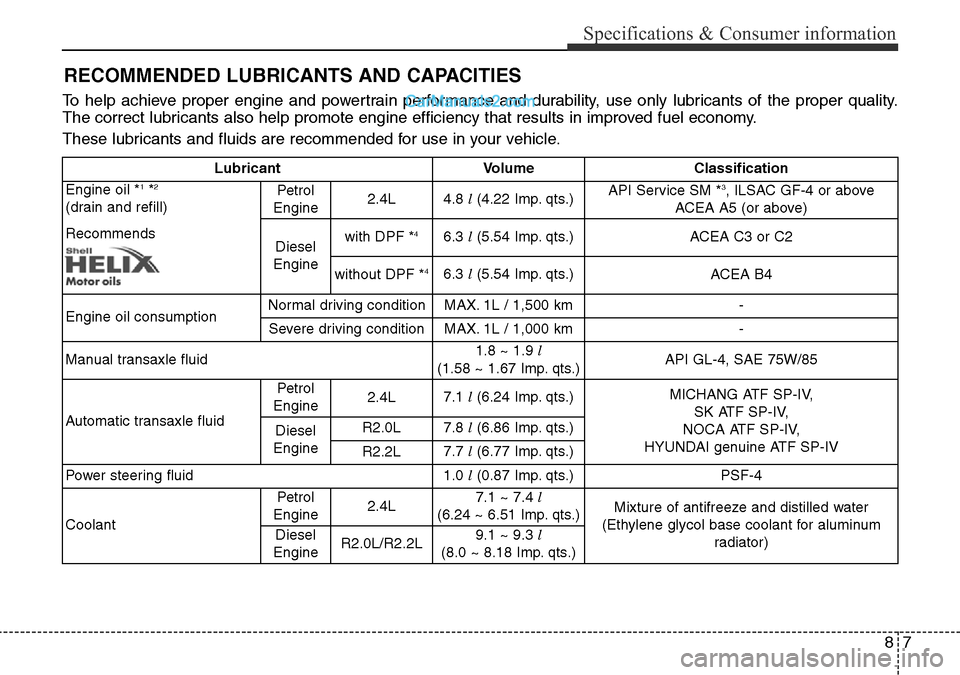
87
Specifications & Consumer information
RECOMMENDED LUBRICANTS AND CAPACITIES
To help achieve proper engine and powertrain performance and durability, use only lubricants of the proper quality.
The correct lubricants also help promote engine efficiency that results in improved fuel economy.
These lubricants and fluids are recommended for use in your vehicle.
Lubricant Volume Classification
Engine oil *
1*2
(drain and refill)
RecommendsPetrol
Engine2.4L4.8 l(4.22 Imp. qts.)API Service SM *
3, ILSAC GF-4 or above
ACEA A5 (or above)
Diesel
Enginewith DPF *
46.3 l(5.54 Imp. qts.)
ACEA C3 or C2
without DPF *
46.3 l(5.54 Imp. qts.)
ACEA B4
Engine oil consumption Normal driving condition MAX. 1L / 1,500 km -
Severe driving condition MAX. 1L / 1,000 km -
Manual transaxle fluid 1.8 ~ 1.9 l
(1.58 ~ 1.67 Imp. qts.)API GL-4, SAE 75W/85
Automatic transaxle fluid Petrol
Engine2.4L7.1 l(6.24 Imp. qts.)MICHANG ATF SP-IV,
SK ATF SP-IV,
NOCA ATF SP-IV,
HYUNDAI genuine ATF SP-IV
Diesel
EngineR2.0L7.8 l(6.86 Imp. qts.)
R2.2L7.7 l(6.77 Imp. qts.)
Power steering fluid 1.0 l(0.87 Imp. qts.)PSF-4
Coolant
Petrol
Engine2.4L7.1 ~ 7.4 l
(6.24 ~ 6.51 Imp. qts.)Mixture of antifreeze and distilled water
(Ethylene glycol base coolant for aluminum
radiator)
Diesel
EngineR2.0L/R2.2L9.1 ~ 9.3 l
(8.0 ~ 8.18 Imp. qts.)