parking brake Hyundai Santa Fe 2016 - RHD (UK, Australia) Owner's Guide
[x] Cancel search | Manufacturer: HYUNDAI, Model Year: 2016, Model line: Santa Fe, Model: Hyundai Santa Fe 2016Pages: 699, PDF Size: 15.65 MB
Page 471 of 699
513
Driving your vehicle
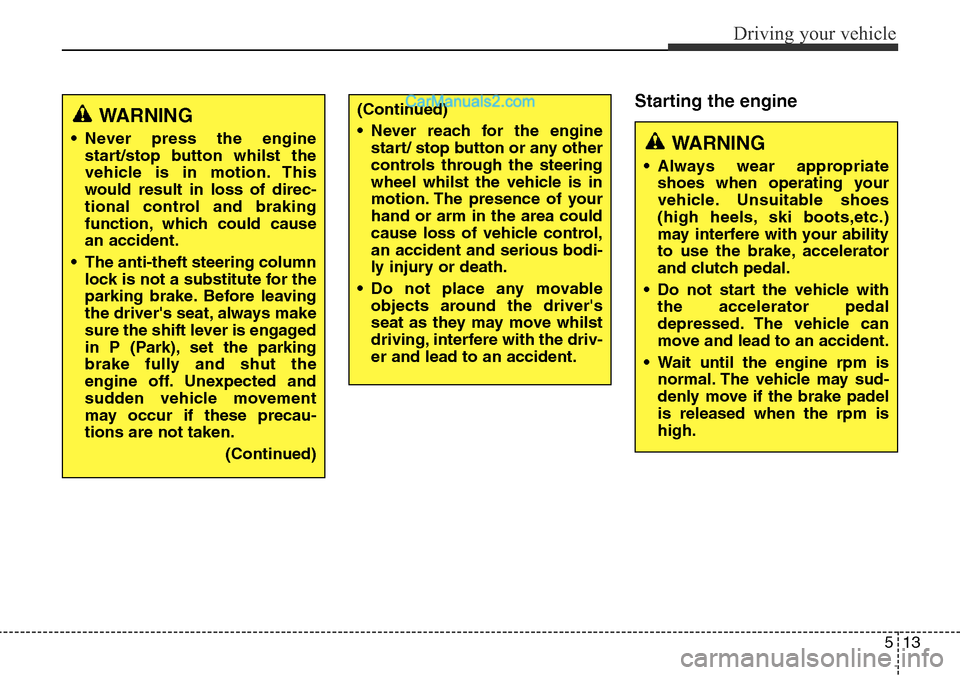
Starting the engineWARNING
• Never press the engine
start/stop button whilst the
vehicle is in motion. This
would result in loss of direc-
tional control and braking
function, which could cause
an accident.
• The anti-theft steering column
lock is not a substitute for the
parking brake. Before leaving
the driver's seat, always make
sure the shift lever is engaged
in P (Park), set the parking
brake fully and shut the
engine off. Unexpected and
sudden vehicle movement
may occur if these precau-
tions are not taken.
(Continued)
(Continued)
• Never reach for the engine
start/ stop button or any other
controls through the steering
wheel whilst the vehicle is in
motion. The presence of your
hand or arm in the area could
cause loss of vehicle control,
an accident and serious bodi-
ly injury or death.
• Do not place any movable
objects around the driver's
seat as they may move whilst
driving, interfere with the driv-
er and lead to an accident.
WARNING
• Always wear appropriate
shoes when operating your
vehicle. Unsuitable shoes
(high heels, ski boots,etc.)
may interfere with your ability
to use the brake, accelerator
and clutch pedal.
• Do not start the vehicle with
the accelerator pedal
depressed. The vehicle can
move and lead to an accident.
• Wait until the engine rpm is
normal. The vehicle may sud-
denly move if the brake padel
is released when the rpm is
high.
Page 472 of 699
Driving your vehicle
14 5
✽ NOTICE - Throttle resist-
ance mechanism
(if equipped)
If your vehicle is equipped with a
throttle resistance mechanism in the
accelerator pedal, it prevents you
from driving at full throttle uninten-
tionally by making the driver
require increased effort to depress
the accelerator pedal. However, if
you depress the pedal more than
approximately 80%, the vehicle can
be at full throttle and the accelerator
pedal will be easier to depress. This
is not a malfunction but a normal
condition.
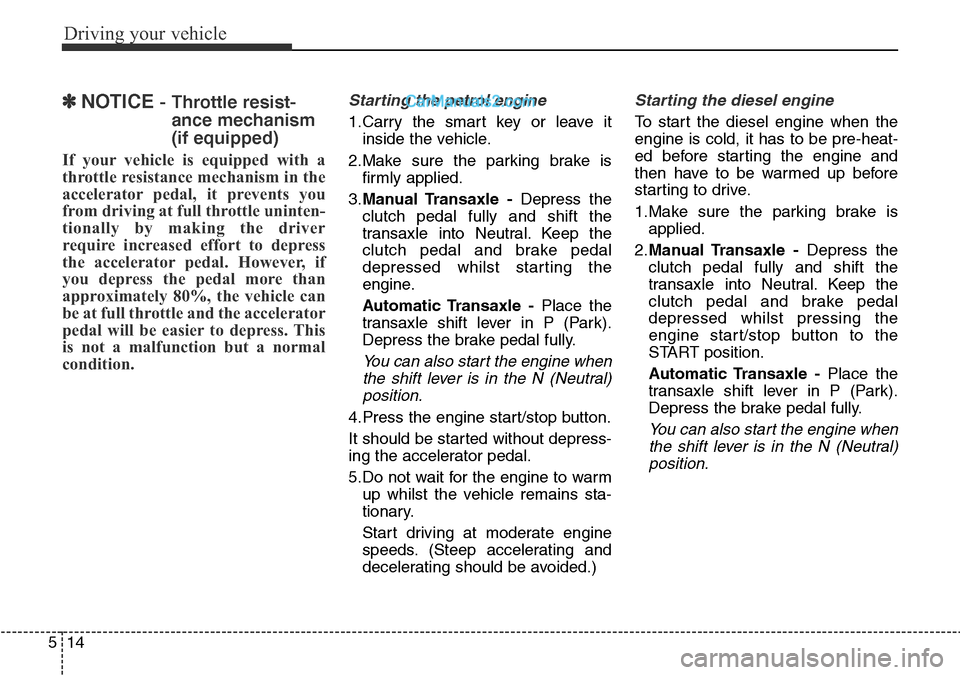
Starting the petrol engine
1.Carry the smart key or leave it
inside the vehicle.
2.Make sure the parking brake is
firmly applied.
3.Manual Transaxle -Depress the
clutch pedal fully and shift the
transaxle into Neutral. Keep the
clutch pedal and brake pedal
depressed whilst starting the
engine.
Automatic Transaxle -Place the
transaxle shift lever in P (Park).
Depress the brake pedal fully.
You can also start the engine when
the shift lever is in the N (Neutral)
position.
4.Press the engine start/stop button.
It should be started without depress-
ing the accelerator pedal.
5.Do not wait for the engine to warm
up whilst the vehicle remains sta-
tionary.
Start driving at moderate engine
speeds. (Steep accelerating and
decelerating should be avoided.)
Starting the diesel engine
To start the diesel engine when the
engine is cold, it has to be pre-heat-
ed before starting the engine and
then have to be warmed up before
starting to drive.
1.Make sure the parking brake is
applied.
2.Manual Transaxle -Depress the
clutch pedal fully and shift the
transaxle into Neutral. Keep the
clutch pedal and brake pedal
depressed whilst pressing the
engine start/stop button to the
START position.
Automatic Transaxle -Place the
transaxle shift lever in P (Park).
Depress the brake pedal fully.
You can also start the engine when
the shift lever is in the N (Neutral)
position.
Page 476 of 699
Driving your vehicle
18 5
• During cold weather, shifting may
be difficult until the transaxle lubri-
cant has warmed up. This is nor-
mal and not harmful to the
transaxle.
• If you've come to a complete stop
and it's hard to shift into 1 (First) or
R (Reverse), put the shift lever in
neutral position and release the
clutch. Press the clutch pedal back
down, and then shift into 1 (First)
or R (Reverse) gear position.CAUTION
• To avoid premature clutch
wear and damage, do not
drive with your foot resting on
the clutch pedal. Also, don’t
use the clutch to hold the
vehicle stopped on an uphill
grade, whilst waiting for a traf-
fic light, etc.
• Do not use the shift lever as a
handrest during driving, as
this can result in premature
wear of the transaxle shift
forks.
• When operating the clutch
pedal, press the clutch pedal
down fully. If you don't press
the clutch pedal fully, the
clutch may be damaged or
noise may occur.
• To prevent possible damage
to the clutch system, do not
start with the 2nd(second)
gear engaged except when
you start on a slippery road.
WARNING
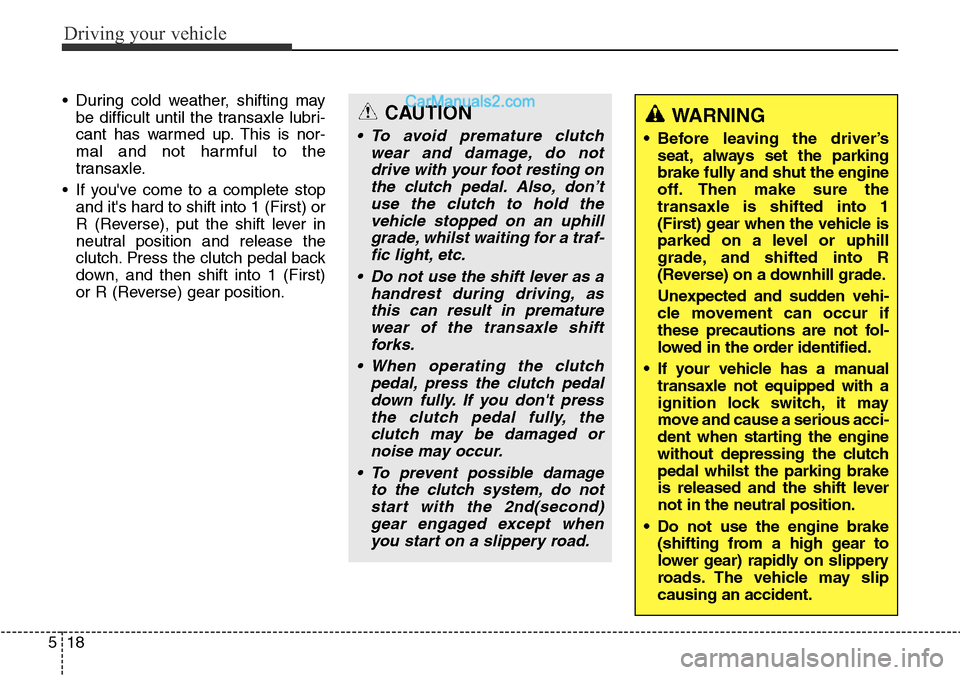
• Before leaving the driver’s
seat, always set the parking
brake fully and shut the engine
off. Then make sure the
transaxle is shifted into 1
(First) gear when the vehicle is
parked on a level or uphill
grade, and shifted into R
(Reverse) on a downhill grade.
Unexpected and sudden vehi-
cle movement can occur if
these precautions are not fol-
lowed in the order identified.
• If your vehicle has a manual
transaxle not equipped with a
ignition lock switch, it may
move and cause a serious acci-
dent when starting the engine
without depressing the clutch
pedal whilst the parking brake
is released and the shift lever
not in the neutral position.
• Do not use the engine brake
(shifting from a high gear to
lower gear) rapidly on slippery
roads. The vehicle may slip
causing an accident.
Page 477 of 699
519
Driving your vehicle
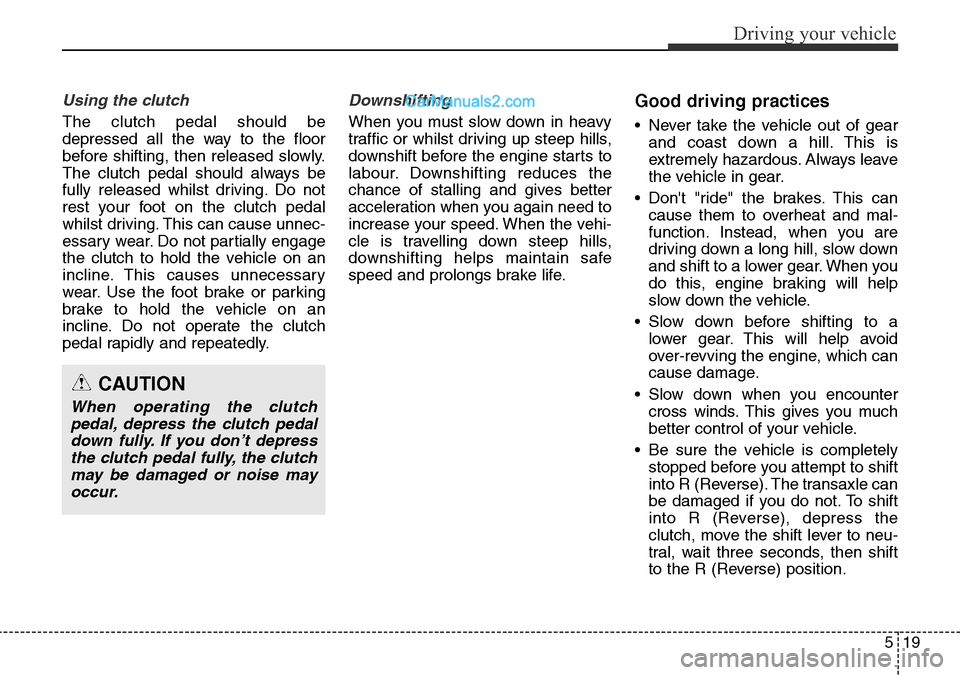
Using the clutch
The clutch pedal should be
depressed all the way to the floor
before shifting, then released slowly.
The clutch pedal should always be
fully released whilst driving. Do not
rest your foot on the clutch pedal
whilst driving. This can cause unnec-
essary wear. Do not partially engage
the clutch to hold the vehicle on an
incline. This causes unnecessary
wear. Use the foot brake or parking
brake to hold the vehicle on an
incline. Do not operate the clutch
pedal rapidly and repeatedly.
Downshifting
When you must slow down in heavy
traffic or whilst driving up steep hills,
downshift before the engine starts to
labour. Downshifting reduces the
chance of stalling and gives better
acceleration when you again need to
increase your speed. When the vehi-
cle is travelling down steep hills,
downshifting helps maintain safe
speed and prolongs brake life.
Good driving practices
• Never take the vehicle out of gear
and coast down a hill. This is
extremely hazardous. Always leave
the vehicle in gear.
• Don't "ride" the brakes. This can
cause them to overheat and mal-
function. Instead, when you are
driving down a long hill, slow down
and shift to a lower gear. When you
do this, engine braking will help
slow down the vehicle.
• Slow down before shifting to a
lower gear. This will help avoid
over-revving the engine, which can
cause damage.
• Slow down when you encounter
cross winds. This gives you much
better control of your vehicle.
• Be sure the vehicle is completely
stopped before you attempt to shift
into R (Reverse). The transaxle can
be damaged if you do not. To shift
into R (Reverse), depress the
clutch, move the shift lever to neu-
tral, wait three seconds, then shift
to the R (Reverse) position.
CAUTION
When operating the clutch
pedal, depress the clutch pedal
down fully. If you don’t depress
the clutch pedal fully, the clutch
may be damaged or noise may
occur.
Page 480 of 699
Driving your vehicle
22 5
For smooth operation, depress the
brake pedal when shifting from N
(Neutral) to a forward or reverse
gear.Transaxle ranges
The indicator lights in the instrument
cluster displays the shift lever posi-
tion when the ignition switch is in the
ON position.
P (Park)
Always come to a complete stop
before shifting into P (Park). This
position locks the transaxle and pre-
vents the front wheels from rotating.
WARNING- Automatic
transaxle
• Always check the surrounding
areas near your vehicle for
people, especially children,
before shifting a vehicle into
D (Drive) or R (Reverse).
• Before leaving the driver’s
seat, always make sure the
shift lever is in the P (Park)
position; then set the parking
brake fully and shut the
engine off. Unexpected and
sudden vehicle movement
can occur if these precautions
are not followed in the order
identified.
• Do not use the engine brake
(shifting from a high gear to
lower gear) rapidly on slip-
pery roads. The vehicle may
slip causing an accident.
CAUTION
• To avoid damage to your
transaxle, do not accelerate
the engine in R (Reverse) or
any forward gear position with
the brakes on.
• When stopped on an upgrade,
do not hold the vehicle sta-
tionary with engine power.
Use the service brake or the
parking brake.
• Do not shift from N (Neutral)
or P (Park) into D (Drive), or R
(Reverse) when the engine is
above idle speed.
WARNING
• Shifting into P (Park) whilst
the vehicle is in motion will
cause the drive wheels to lock
which will cause you to lose
control of the vehicle.
• Do not use the P (Park) posi-
tion in place of the parking
brake. Always make sure the
shift lever is latched in the P
(Park) position and set the
parking brake fully.
• Never leave a child unattend-
ed in a vehicle.
Page 481 of 699

523
Driving your vehicle
R (Reverse)
Use this position to drive the vehicle
backward.N (Neutral)
The wheels and transaxle are not
engaged. The vehicle will roll freely
even on the slightest incline unless
the parking brake or service brakes
are applied.D (Drive)
This is the normal forward driving
position. The transaxle will automati-
cally shift through a 6-gear
sequence, providing the best fuel
economy and power.
For extra power when passing anoth-
er vehicle or climbing grades,
depress the accelerator pedal fully
(more than 80%) until the throttle
resistance mechanism works with a
clicking noise, at which time the
transaxle will automatically downshift
to the next lower gear.
✽NOTICE
• Always come to a complete stop
before shifting into D (Drive).
• A clicking noise heard from the
kick down mechanism by depress-
ing the accelerator pedal fully is a
normal condition.
CAUTION
Always come to a complete stop
before shifting into or out of R
(Reverse); you may damage the
transaxle if you shift into R
(Reverse) whilst the vehicle is in
motion, except as explained in
“Rocking the vehicle”, in this
manual.
CAUTION
The transaxle may be damaged
if you shift into P (Park) whilst
the vehicle is in motion.
WARNING
Do not drive with the shift lever
in N (Neutral).
The engine brake will not work
and lead to an accident.
Page 484 of 699

Driving your vehicle
26 5
Good driving practices
• Never move the shift lever from P
(Park) or N (Neutral) to any other
position with the accelerator pedal
depressed.
• Never move the shift lever into P
(Park) when the vehicle is in
motion.
• Be sure the vehicle is completely
stopped before you attempt to shift
into R (Reverse) or D (Drive).
• Never take the vehicle out of gear
and coast down a hill. This may be
extremely hazardous. Always leave
the vehicle in gear when moving.
• Do not "ride" the brakes. This can
cause them to overheat and mal-
function. Instead, when you are
driving down a long hill, slow down
and shift to a lower gear. When you
do this, engine braking will help
slow down the vehicle.
• Slow down before shifting to a
lower gear. Otherwise, the lower
gear may not be engaged.• Always use the parking brake. Do
not depend on placing the
transaxle in P (Park) to keep the
vehicle from moving.
• Exercise extreme caution when
driving on a slippery surface. Be
especially careful when braking,
accelerating or shifting gears. On a
slippery surface, an abrupt change
in vehicle speed can cause the
drive wheels to lose traction and
the vehicle to go out of control.
• Optimum vehicle performance and
economy is obtained by smoothly
depressing and releasing the
accelerator pedal.WARNING
• Always buckle-up! In a colli-
sion, an unbelted occupant is
significantly more likely to be
seriously injured or killed than
a properly belted occupant.
• Avoid high speeds when cor-
nering or turning.
• Do not make quick steering
wheel movements, such as
sharp lane changes or fast,
sharp turns.
• The risk of rollover is greatly
increased if you lose control
of your vehicle at highway
speeds.
• Loss of control often occurs if
two or more wheels drop off
the roadway and the driver
oversteers to reenter the road-
way.
• In the event your vehicle
leaves the roadway, do not
steer sharply. Instead, slow
down before pulling back into
the travel lanes.
• Never exceed posted speed
limits.
Page 485 of 699

527
Driving your vehicle
Moving up a steep grade from a
standing start
To move up a steep grade from a
standing start, depress the brake
pedal, shift the shift lever to D
(Drive). Select the appropriate gear
depending on load weight and steep-
ness of the grade, and release the
parking brake. Depress the accelera-
tor gradually whilst releasing the
service brakes.
WARNING
If your vehicle becomes stuck in
snow, mud, sand, etc., then you
may attempt to rock the vehicle
free by moving it forward and
backward. Do not attempt this
procedure if people or objects
are anywhere near the vehicle.
During the rocking operation
the vehicle may suddenly move
forward of backward as it
becomes unstuck, causing
injury or damage to nearby peo-
ple or objects.
Page 492 of 699
Driving your vehicle
34 5
• Full-time 4WD vehicles must be
tested on a special four wheel
chassis dynamometer.
✽NOTICE
Never engage the parking brake
whilst performing these tests.
• A full-time 4WD vehicle should not
be tested on a 2WD roll tester. If a
2WD roll tester must be used, per-
form the following:
WARNING - Jacked
vehicle
Whilst a full-time 4WD vehicle is
being raised on a jack, never
start the engine or cause the
tyres to rotate.
There is a danger that rotating
tyres touching the ground could
cause the vehicle to fall off the
jack and to jump forward or
rearward.
WARNING
Your vehicle is equipped with
tyres designed to provide safe
ride and handling capability. Do
not use a size and type of tyre
and wheel that is different from
the one that is originally
installed on your vehicle. It can
affect the safety and perform-
ance of your vehicle, which
could lead to steering failure or
rollover and serious injury.
When replacing the tyres, be
sure to equip all four tyres with
the tyre and wheel of the same
size, type, tread, brand and
load-carrying capacity. If you
nevertheless decide to equip
your vehicle with any tyre/wheel
combination not recommended
by HYUNDAI for off road driv-
ing, you should not use these
tyres for highway driving.
Page 493 of 699
535
Driving your vehicle
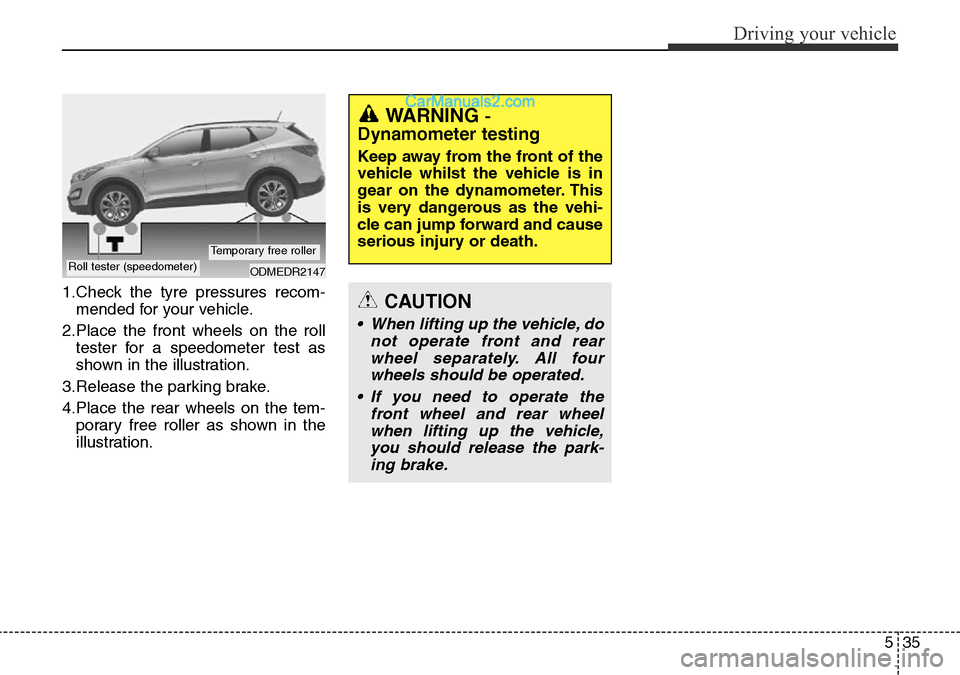
1.Check the tyre pressures recom-
mended for your vehicle.
2.Place the front wheels on the roll
tester for a speedometer test as
shown in the illustration.
3.Release the parking brake.
4.Place the rear wheels on the tem-
porary free roller as shown in the
illustration.
WARNING -
Dynamometer testing
Keep away from the front of the
vehicle whilst the vehicle is in
gear on the dynamometer. This
is very dangerous as the vehi-
cle can jump forward and cause
serious injury or death.
ODMEDR2147Roll tester (speedometer)Temporary free roller
CAUTION
• When lifting up the vehicle, do
not operate front and rear
wheel separately. All four
wheels should be operated.
• If you need to operate the
front wheel and rear wheel
when lifting up the vehicle,
you should release the park-
ing brake.