air condition Hyundai Santa Fe 2016 - RHD (UK, Australia) Repair Manual
[x] Cancel search | Manufacturer: HYUNDAI, Model Year: 2016, Model line: Santa Fe, Model: Hyundai Santa Fe 2016Pages: 699, PDF Size: 15.65 MB
Page 615 of 699
Maintenance
18 7
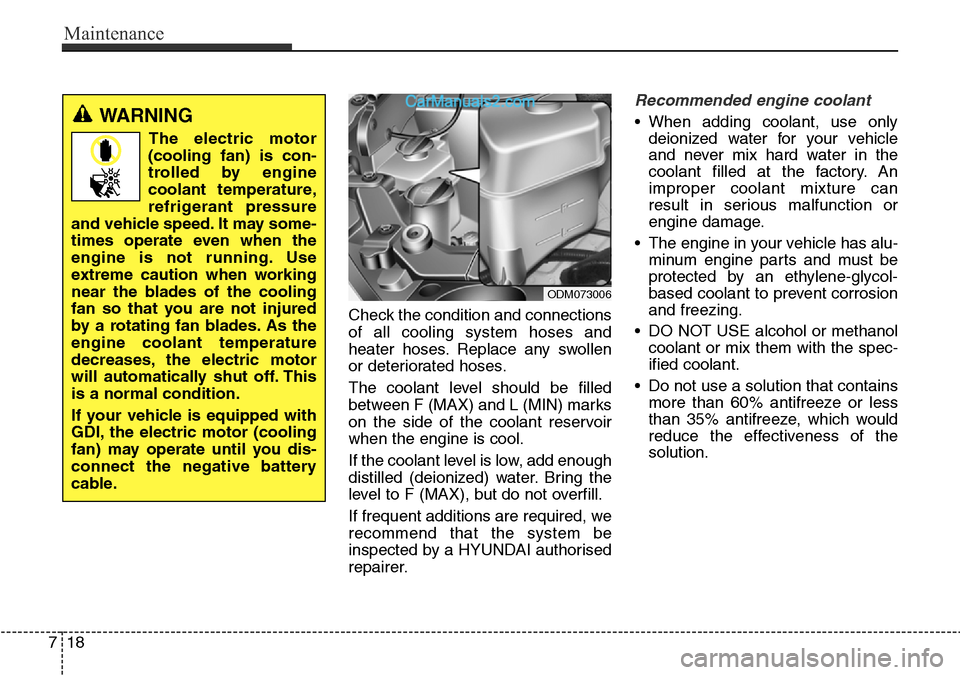
Check the condition and connections
of all cooling system hoses and
heater hoses. Replace any swollen
or deteriorated hoses.
The coolant level should be filled
between F (MAX) and L (MIN) marks
on the side of the coolant reservoir
when the engine is cool.
If the coolant level is low, add enough
distilled (deionized) water. Bring the
level to F (MAX), but do not overfill.
If frequent additions are required, we
recommend that the system be
inspected by a HYUNDAI authorised
repairer.
Recommended engine coolant
• When adding coolant, use only
deionized water for your vehicle
and never mix hard water in the
coolant filled at the factory. An
improper coolant mixture can
result in serious malfunction or
engine damage.
• The engine in your vehicle has alu-
minum engine parts and must be
protected by an ethylene-glycol-
based coolant to prevent corrosion
and freezing.
• DO NOT USE alcohol or methanol
coolant or mix them with the spec-
ified coolant.
• Do not use a solution that contains
more than 60% antifreeze or less
than 35% antifreeze, which would
reduce the effectiveness of the
solution.WARNING
The electric motor
(cooling fan) is con-
trolled by engine
coolant temperature,
refrigerant pressure
and vehicle speed. It may some-
times operate even when the
engine is not running. Use
extreme caution when working
near the blades of the cooling
fan so that you are not injured
by a rotating fan blades. As the
engine coolant temperature
decreases, the electric motor
will automatically shut off. This
is a normal condition.
If your vehicle is equipped with
GDI, the electric motor (cooling
fan) may operate until you dis-
connect the negative battery
cable.
ODM073006
Page 617 of 699
Maintenance
20 7
BRAKE/CLUTCH FLUID (IF EQUIPPED)
Checking the brake/clutch
fluid level
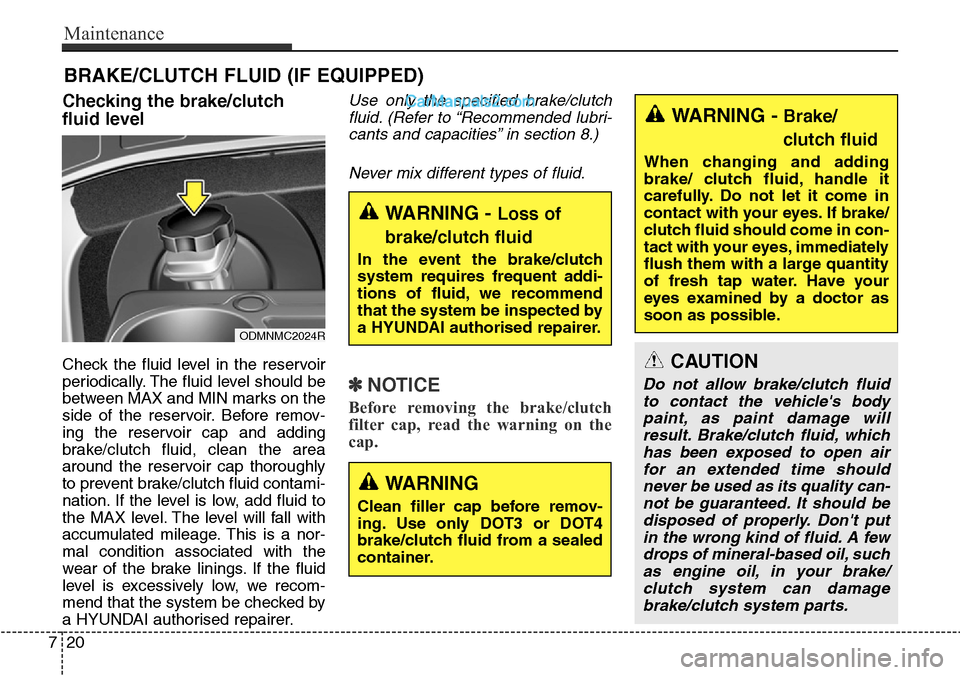
Check the fluid level in the reservoir
periodically. The fluid level should be
between MAX and MIN marks on the
side of the reservoir. Before remov-
ing the reservoir cap and adding
brake/clutch fluid, clean the area
around the reservoir cap thoroughly
to prevent brake/clutch fluid contami-
nation. If the level is low, add fluid to
the MAX level. The level will fall with
accumulated mileage. This is a nor-
mal condition associated with the
wear of the brake linings. If the fluid
level is excessively low, we recom-
mend that the system be checked by
a HYUNDAI authorised repairer.
Use only the specified brake/clutch
fluid. (Refer to “Recommended lubri-
cants and capacities” in section 8.)
Never mix different types of fluid.
✽NOTICE
Before removing the brake/clutch
filter cap, read the warning on the
cap.
WARNING -Brake/
clutch fluid
When changing and adding
brake/ clutch fluid, handle it
carefully. Do not let it come in
contact with your eyes. If brake/
clutch fluid should come in con-
tact with your eyes, immediately
flush them with a large quantity
of fresh tap water. Have your
eyes examined by a doctor as
soon as possible.
WARNING - Loss of
brake/clutch fluid
In the event the brake/clutch
system requires frequent addi-
tions of fluid, we recommend
that the system be inspected by
a HYUNDAI authorised repairer.
CAUTION
Do not allow brake/clutch fluid
to contact the vehicle's body
paint, as paint damage will
result. Brake/clutch fluid, which
has been exposed to open air
for an extended time should
never be used as its quality can-
not be guaranteed. It should be
disposed of properly. Don't put
in the wrong kind of fluid. A few
drops of mineral-based oil, such
as engine oil, in your brake/
clutch system can damage
brake/clutch system parts.
ODMNMC2024R
WARNING
Clean filler cap before remov-
ing. Use only DOT3 or DOT4
brake/clutch fluid from a sealed
container.
Page 641 of 699
Maintenance
44 7
4. Tyre ply composition and mate-
rial
The number of layers or plies of rub-
ber-coated fabric are in the tyre. Tyre
manufacturers also must indicate the
materials in the tyre, which include
steel, nylon, polyester, and others.
The letter "R" means radial ply con-
struction; the letter "D" means diago-
nal or bias ply construction; and the
letter "B" means belted-bias ply con-
struction.
5. Maximum permissible inflation
pressure
This number is the greatest amount
of air pressure that should be put in
the tyre. Do not exceed the maximum
permissible inflation pressure. Refer
to the Tyre and Loading Information
label for recommended inflation
pressure.
6. Maximum load rating
This number indicates the maximum
load in kilograms and pounds that
can be carried by the tyre. When
replacing the tyres on the vehicle,
always use a tyre that has the same
load rating as the factory installed
tyre.
7. Uniform tyre quality grading
Quality grades can be found where
applicable on the tyre sidewall
between tread shoulder and maxi-
mum section width.
For example:
TREADWEAR 200
TRACTION AA
TEMPERATURE ATread wear
The tread wear grade is a compara-
tive rating based on the wear rate of
the tyre when tested under controlled
conditions on a specified govern-
ment test course. For example, a tyre
graded 150 would wear one-and-a-
half times (1½) as well on the gov-
ernment course as a tyre graded
100.
The relative performance of tyres
depends upon the actual conditions
of their use, however, and may
depart significantly from the norm
because of variations in driving
habits, service practices and differ-
ences in road characteristics and cli-
mate.
These grades are molded on the
side-walls of passenger vehicle
tyres. The tyres available as standard
or optional equipment on your vehi-
cles may vary with respect to grade.
Page 643 of 699
Maintenance
46 7
Low aspect ratio tyre
(if equipped)
Low aspect ratio tyres, whose aspect
ratio is lower than 50, are provided
for sporty looks.
Because the low aspect ratio tyres
are optimized for handling and brak-
ing, it may be more uncomfortable to
ride in and there is more noise com-
pare with normal tyres.
CAUTION
Because the sidewall of the low
aspect ratio tyre is shorter than
the normal, the wheel and tyre
of the low aspect ratio tyre is
easier to be damaged. So, follow
the instructions below.
- When driving on a rough road
or off road, drive cautiously
because tyres and wheels may
be damaged. And after driving,
inspect tyres and wheels.
- When passing over a pothole,
speed bump, manhole, or curb
stone, drive slowly so that the
tyres and wheels are not dam-
aged.
- If the tyre is impacted, we rec-
ommend that you inspect the
tyre condition or contact a
HYUNDAI authorised repairer.
- To prevent damage to the tyre,
inspect the tyre condition and
pressure every 3,000km.
CAUTION
• It is not easy to recognize the
tyre damage with your own
eyes. But if there is the slight-
est hint of tyre damage, even
though you cannot see the
tyre damage with your own
eyes, have the tyre checked or
replaced because the tyre
damage may cause air leak-
age from the tyre.
• If the tyre is damaged by driv-
ing on a rough road, off road,
pothole, manhole, or curb
stone, it will not be covered by
the warranty.
• You can find out the tyre infor-
mation on the tyre sidewall.
Page 661 of 699
Maintenance
64 7
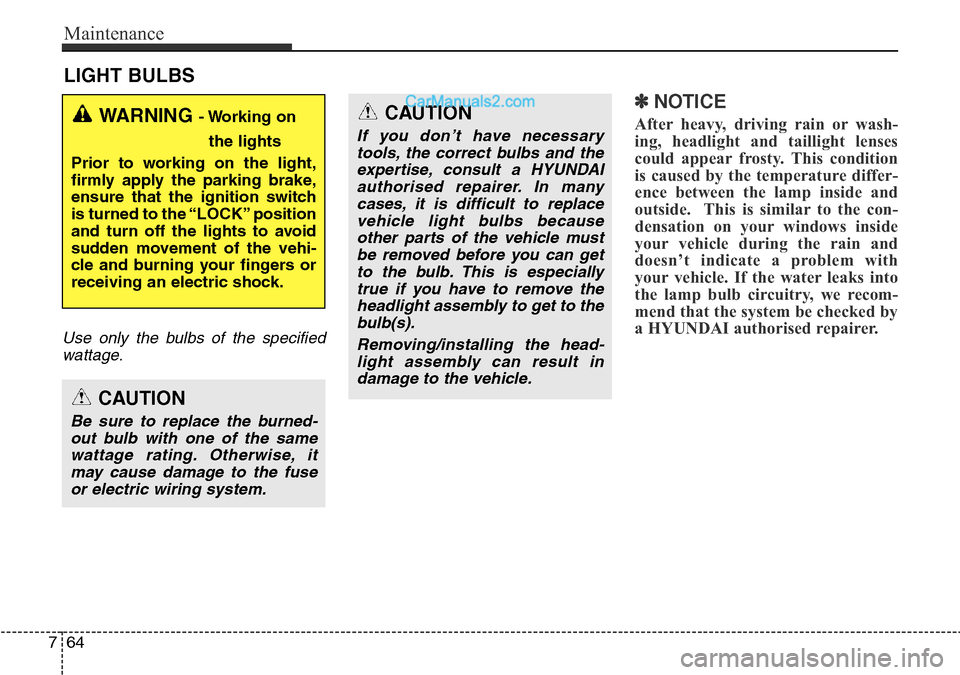
LIGHT BULBS
Use only the bulbs of the specified
wattage.
✽NOTICE
After heavy, driving rain or wash-
ing, headlight and taillight lenses
could appear frosty. This condition
is caused by the temperature differ-
ence between the lamp inside and
outside. This is similar to the con-
densation on your windows inside
your vehicle during the rain and
doesn’t indicate a problem with
your vehicle. If the water leaks into
the lamp bulb circuitry, we recom-
mend that the system be checked by
a HYUNDAI authorised repairer.WARNING - Working on
the lights
Prior to working on the light,
firmly apply the parking brake,
ensure that the ignition switch
is turned to the “LOCK” position
and turn off the lights to avoid
sudden movement of the vehi-
cle and burning your fingers or
receiving an electric shock.
CAUTION
Be sure to replace the burned-
out bulb with one of the same
wattage rating. Otherwise, it
may cause damage to the fuse
or electric wiring system.
CAUTION
If you don’t have necessary
tools, the correct bulbs and the
expertise, consult a HYUNDAI
authorised repairer. In many
cases, it is difficult to replace
vehicle light bulbs because
other parts of the vehicle must
be removed before you can get
to the bulb. This is especially
true if you have to remove the
headlight assembly to get to the
bulb(s).
Removing/installing the head-
light assembly can result in
damage to the vehicle.
Page 686 of 699
789
Maintenance
Operating precautions for catalyt-
ic converters (if equipped)Your vehicle is equipped with a cat-
alytic converter emission control
device.
Therefore, the following precautions
must be observed:
• Use only UNLEADED FUEL for
petrol engine.
• Do not operate the vehicle when
there are signs of engine malfunc-
tion, such as misfire or a noticeable
loss of performance.
• Do not misuse or abuse the
engine. Examples of misuse are
coasting with the ignition off and
descending steep grades in gear
with the ignition off.
• Do not operate the engine at high
idle speed for extended periods (5
minutes or more).
• Do not modify or tamper with any
part of the engine or emission con-
trol system. All inspections and
adjustments must be made by a
HYUNDAI authorised repairer.
• Avoid driving with a very low fuel
level. If you run out of petrol, it
could cause the engine to misfire
and result in excessive loading of
the catalytic converter.Failure to observe these precautions
could result in damage to the catalyt-
ic converter and to your vehicle.
Additionally, such actions could void
your warranties.
WARNING- Fire
• A hot exhaust system can
ignite flammable items under
your vehicle. Do not park,
idle, or drive the vehicle over
or near flammable objects,
such as dry grass, paper,
leaves, etc.
• The exhaust system and cat-
alytic system are very hot
whilst the engine is running or
immediately after the engine
is turned off. Keep away from
the exhaust system and cat-
alytic, you may get burned.
Also, do not remove the heat
sink around the exhaust sys-
tem, do not seal the bottom of
the vehicle or do not coat the
vehicle for corrosion control.
It may present a fire risk under
certain conditions.
Page 688 of 699
Specifications & Consumer information
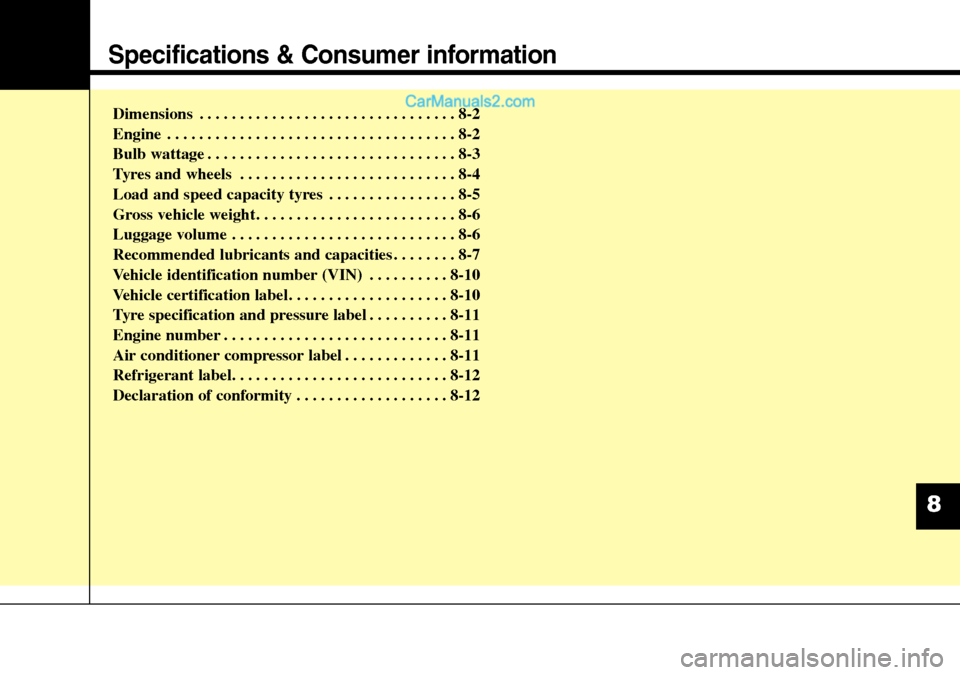
Dimensions . . . . . . . . . . . . . . . . . . . . . . . . . . . . . . . . 8-2
Engine . . . . . . . . . . . . . . . . . . . . . . . . . . . . . . . . . . . . 8-2
Bulb wattage . . . . . . . . . . . . . . . . . . . . . . . . . . . . . . . 8-3
Tyres and wheels . . . . . . . . . . . . . . . . . . . . . . . . . . . 8-4
Load and speed capacity tyres . . . . . . . . . . . . . . . . 8-5
Gross vehicle weight. . . . . . . . . . . . . . . . . . . . . . . . . 8-6
Luggage volume . . . . . . . . . . . . . . . . . . . . . . . . . . . . 8-6
Recommended lubricants and capacities . . . . . . . . 8-7
Vehicle identification number (VIN) . . . . . . . . . . 8-10
Vehicle certification label. . . . . . . . . . . . . . . . . . . . 8-10
Tyre specification and pressure label . . . . . . . . . . 8-11
Engine number . . . . . . . . . . . . . . . . . . . . . . . . . . . . 8-11
Air conditioner compressor label . . . . . . . . . . . . . 8-11
Refrigerant label. . . . . . . . . . . . . . . . . . . . . . . . . . . 8-12
Declaration of conformity . . . . . . . . . . . . . . . . . . . 8-12
8
Page 698 of 699
811
Specifications & Consumer information
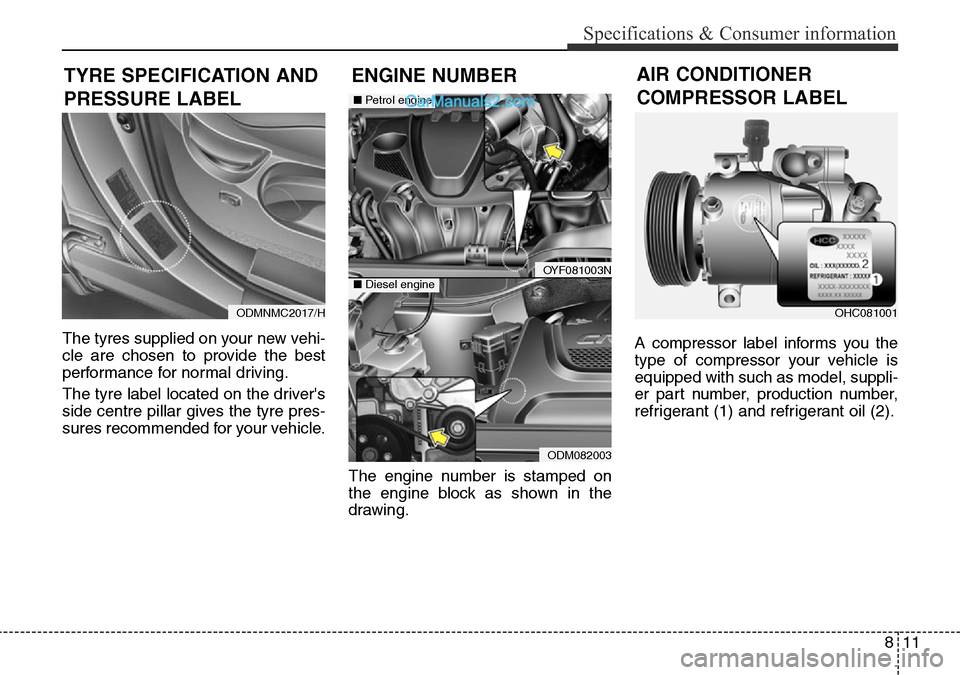
The tyres supplied on your new vehi-
cle are chosen to provide the best
performance for normal driving.
The tyre label located on the driver's
side centre pillar gives the tyre pres-
sures recommended for your vehicle.
The engine number is stamped on
the engine block as shown in the
drawing.A compressor label informs you the
type of compressor your vehicle is
equipped with such as model, suppli-
er part number, production number,
refrigerant (1) and refrigerant oil (2).
TYRE SPECIFICATION AND
PRESSURE LABELENGINE NUMBER
ODMNMC2017/H
OYF081003N
ODM082003
■ Diesel engine
■ Petrol engine
OHC081001
AIR CONDITIONER
COMPRESSOR LABEL