air con Hyundai Santa Fe 2016 Owner's Manual - RHD (UK, Australia)
[x] Cancel search | Manufacturer: HYUNDAI, Model Year: 2016, Model line: Santa Fe, Model: Hyundai Santa Fe 2016Pages: 699, PDF Size: 15.65 MB
Page 1 of 699
OWNER'S MANUAL
Operation
Maintenance
Specifications
The information in this Owner's Manual is current at the time of publication.
However, the right to amend specifications without notice or obligation to
incorporate such amendments into vehicles already produced is reserved.
This manual applies to all models of this vehicle and includes descriptions
and explanations of optional as well as standard equipment. As a result,
some of the equipment operating descriptions referred to may not apply to
the particular vehicle with which this manual is supplied.
We recommend that you contact a HYUNDAI authorised repairer for infor-
mation regarding current standard and optional equipment levels.
Page 2 of 699
F2
Modification to the original vehicle specification may invalidate the manufacturers warranty and may
adversely affect the safety and durability of the vehicle.
Components which are subject to modification or are added to the original vehicle specification with-
out the express approval of the manufacturer and result in consequential loss or damage are not cov-
ered by the vehicle manufacturers warranty.
Particular attention is drawn to the fitment of replacement road wheels having a different specification
to those installed in production. The electric power assisted steering system is specifically pro-
grammed to operate only with the road wheels fitted during production. The installation of alternative
specification road wheels may result in the replacement road wheels fouling the vehicle body result-
ing in tyre damage and compromised safety. The installation of after market wheels on vehicles
equipped with TPMS may result in wheel balancing difficulties or malfunction of the TPMS system.
We recommend that you contact a HYUNDAI authorised repairer before non original specification
road wheels are installed.
This vehicle is fitted with electronically controlled fuel injection or other micro processor controlled
equipment.
It is possible for incorrectly installed two way radio equipment including mobile telephones to adverse-
ly affect these systems.
Before radio equipment of this kind is installed, we recommend that you contact your Hyundai autho-
rised repairer for recommendation regarding the suitability of the particular radio equipment con-
cerned and the recommended method of installation and equipment location. Incorrectly installed or
unsuitable equipment which gives rise to incorrect functioning of or damage to electronic vehicle com-
ponents will not fall within the scope of the vehicle manufacturers warranty.
CAUTION: MODIFICATIONS TO ORIGINAL VEHICLE SPECIFICATION
TWO WAY RADIO INSTALLATION
Page 4 of 699
F4FOREWORD
Hyundai Motor Company wish to take this opportunity to thank you for purchasing a Hyundai product and to welcome you to the
ever increasing number of discriminating motorists who drive Hyundai vehicles. The advanced engineering and construction meth-
ods employed during both design and production of the Hyundai marque are something of which we are proud, and this commit-
ment to providing a high quality product is supported by a comprehensive after sales and warranty service of which we are equal-
ly proud.
This owner's manual will introduce the operating and maintenance requirements for the vehicle and it is recommended that it is
carefully read to ensure that the maximum performance and durability along with safe and satisfactory operation are obtained.
We recommend that service and maintenance on your by a Hyundai authorised repairer.
HYUNDAI MOTOR COMPANY
Note: This owners manual should be considered as part of the vehicle and should be kept in the vehicle at all times for ease of
reference.
In the event of the vehicle being sold please ensure that this manual is left in the vehicle for the reference of the new owner.
Copyright 2015 Hyundai Motor Company. All rights reserved. No part of this publication may be reproduced, stored in any retrieval
system or transmitted in any form or by any means without the prior written permission of Hyundai Motor Company.
CAUTION
Severe engine and transaxle damage may result from the use of poor quality fuels and lubricants that do not meet Hyundai
specifications. You must always use high quality fuels and lubricants that meet the specifications listed on Page 8-7 in the
Vehicle Specifications section of the Owner's Manual.
Page 8 of 699
13
Introduction
Petrol engine
Unleaded
For the optimal vehicle performance,
we recommend you to use unleaded
petrol which has an EN 228 and has
an octane rating of RON (Research
Octane Number) 95 / AKI (Anti
Knock Index) 91 or higher.(Do not
use methanol blended fuels.)
You may use unleaded petrol with an
octane rating of RON 91-94 / AKI 87-
90 but it may result in slight perform-
ance reduction of the vehicle.
Your new vehicle is designed to
obtain maximum performance with
UNLEADED FUEL, as well as min-
imise exhaust emissions and spark
plug fouling.
Petrol containing alcohol and
methanol
Gasohol, a mixture of petrol and
ethanol (also known as grain alco-
hol), and petrol or gasohol containing
methanol (also known as wood alco-
hol) are being marketed along with or
instead of leaded or unleaded petrol.
Do not use gasohol containing more
than 10% ethanol, and do not use
petrol or gasohol containing any
methanol. Either of these fuels may
cause drivability problems and dam-
age to the fuel system, engine control
system and emission control system.
Discontinue using gasohol of any
kind if drivability problems occur.
Vehicle damage or driveability prob-
lems may not be covered by the
manufacturer’s warranty if they result
from the use of:
1. Gasohol containing more than
10% ethanol.
2. Petrol or gasohol containing
methanol.
3. Leaded fuel or leaded gasohol.
FUEL REQUIREMENTS
CAUTION
NEVER USE LEADED FUEL. The
use of leaded fuel is detrimental
to the catalytic converter and
will damage the engine control
system’s oxygen sensor and
affect emission control.
Never add any fuel system
cleaning agents to the fuel tank
other than what has been speci-
fied (We recommend that you
consult a HYUNDAI authorised
repairer for details.)
WARNING
• Do not "top off" after the noz-
zle automatically shuts off
when refuelling.
• Always check that the fuel cap
is installed securely to pre-
vent fuel spillage in the event
of an accident.
Page 9 of 699
Introduction
4 1
Other fuels
Using fuels such as;
- Silicone (Si) contained fuel,
- MMT (Manganese, Mn) contained
fuel,
- Ferrocene (Fe) contained fuel, and
- Other metalic additives contained
fuels,
may cause vehicle and engine dam-
age or cause plugging, misfiring,
poor acceleration, engine stalling,
catalyst melting, abnormal corrosion,
life cycle reduction, etc.
Also, the Malfunction Indicator Lamp
(MIL) may illuminate.
✽NOTICE
Damage to the fuel system or per-
formance problem caused by the use
of these fuels may not be covered by
your New Vehicle Limited Warranty.
Use of MTBE
HYUNDAI recommends avoiding
fuels containing MTBE (Methyl
Tertiary Butyl Ether) over 15.0% vol.
(Oxygen Content 2.7% weight) in
your vehicle.
Fuel containing MTBE over 15.0%
vol. (Oxygen Content 2.7% weight)
may reduce vehicle performance and
produce vapour lock or hard starting.CAUTION
Never use gasohol which con-
tains methanol. Discontinue use
of any gasohol product which
impairs drivability.
CAUTION
Your New Vehicle Limited
Warranty may not cover damage
to the fuel system and any per-
formance problems that are
caused by the use of fuels con-
taining methanol or fuels con-
taining MTBE (Methyl Tertiary
Butyl Ether) over 15.0% vol.
(Oxygen Content 2.7% weight.)
Page 10 of 699
15
Introduction
Do not use methanol
Fuels containing methanol (wood
alcohol) should not be used in your
vehicle. This type of fuel can reduce
vehicle performance and damage
components of the fuel system,
engine control system and emission
control system.
Fuel Additives
HYUNDAI recommends that you use
unleaded gasoline which has an
octane rating of RON(Research
Octane Number) 95 / AKI (Anti Knock
Index) 91 or higher.
For customers who do not use good
quality petrols including fuel addi-
tives regularly, and have problems
starting or the engine does not run
smoothly, one bottle of additives
added to the fuel tank at every
10,000 miles (15,000 km).
Additives are available from your
HYUNDAI authorised repairer along
with information on how to use them.
Do not mix other additives.
Operation in foreign countries
If you are going to drive your vehicle
in another country, be sure to:
• Observe all regulations regarding
registration and insurance.
• Determine that acceptable fuel is
available.
Diesel engine
Diesel fuel
Diesel engine must be operated only
on commercially available diesel fuel
that complies with EN 590 or compa-
rable standard. (EN stands for
"European Norm"). Do not use
marine diesel fuel, heating oils, or
non-approved fuel additives, as this
will increase wear and cause dam-
age to the engine and fuel system.
The use of non-approved fuels and /
or fuel additives will result in a limita-
tion of your warranty rights.
Diesel fuel of above cetane 51 is
used in your vehicle. If two types of
diesel fuel are available, use summer
or winter fuel properly according to
the following temperature conditions.
• Above -5°C (23°F) ... Summer type
diesel fuel.
• Below -5°C (23°F) ... Winter type
diesel fuel.
Watch the fuel level in the tank very
carefully : If the engine stops through
fuel failure, the circuits must be com-
pletely purged to permit restarting.
Page 18 of 699
Your vehicle at a glance
6 2
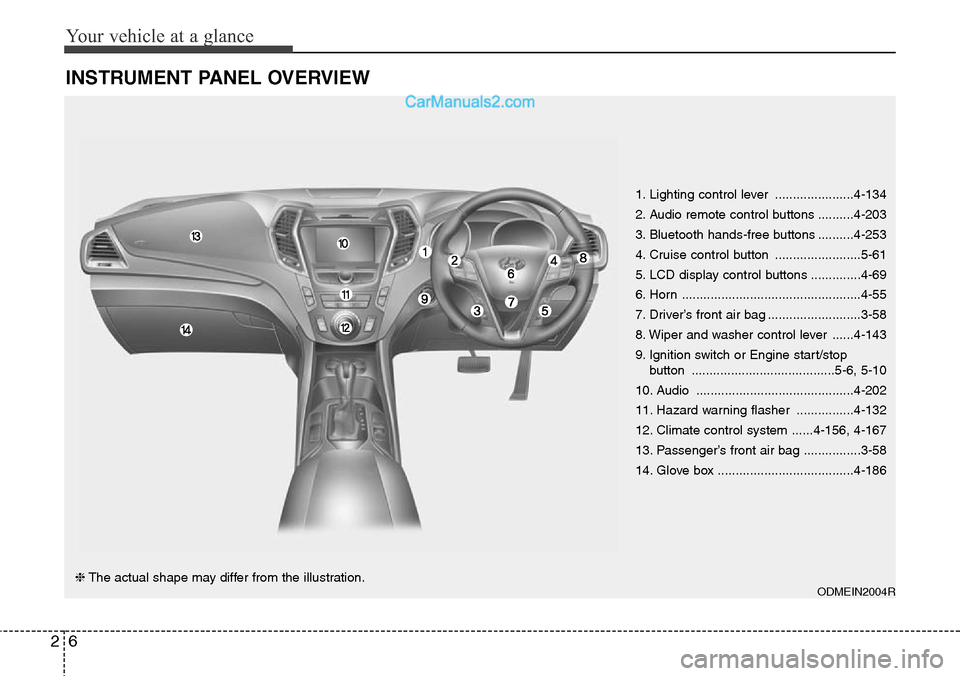
INSTRUMENT PANEL OVERVIEW
1. Lighting control lever ......................4-134
2. Audio remote control buttons ..........4-203
3. Bluetooth hands-free buttons ..........4-253
4. Cruise control button ........................5-61
5. LCD display control buttons ..............4-69
6. Horn ..................................................4-55
7. Driver’s front air bag ..........................3-58
8. Wiper and washer control lever ......4-143
9. Ignition switch or Engine start/stop
button ........................................5-6, 5-10
10. Audio ............................................4-202
11. Hazard warning flasher ................4-132
12. Climate control system ......4-156, 4-167
13. Passenger’s front air bag ................3-58
14. Glove box ......................................4-186
ODMEIN2004R❈The actual shape may differ from the illustration.
Page 24 of 699
Safety features of your vehicle
4 3
Front seat adjustment - Manual
(if equipped)
Forward and backward
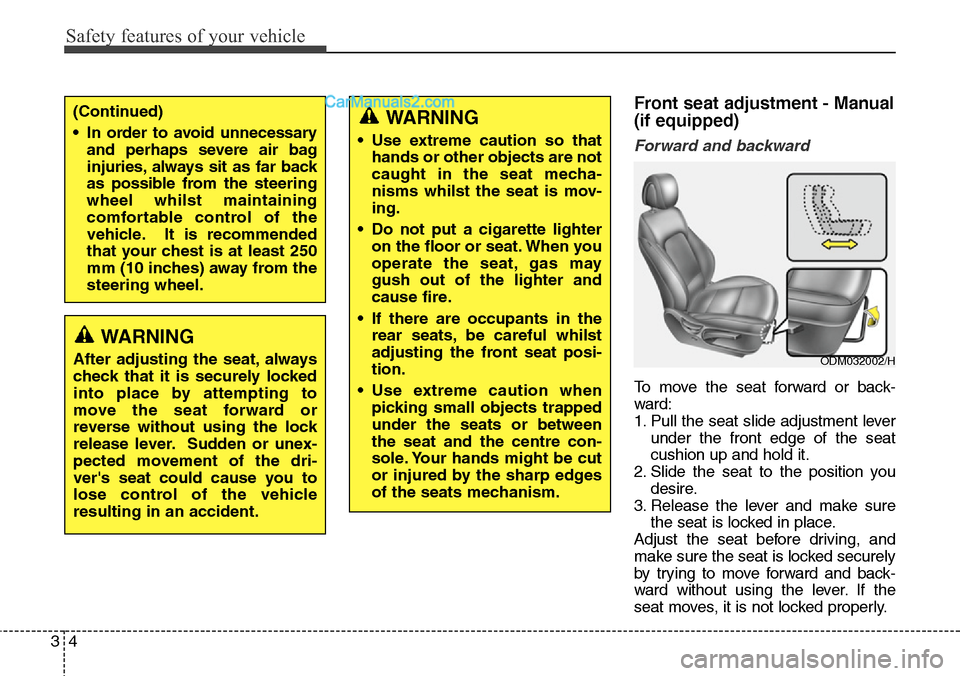
To move the seat forward or back-
ward:
1. Pull the seat slide adjustment lever
under the front edge of the seat
cushion up and hold it.
2. Slide the seat to the position you
desire.
3. Release the lever and make sure
the seat is locked in place.
Adjust the seat before driving, and
make sure the seat is locked securely
by trying to move forward and back-
ward without using the lever. If the
seat moves, it is not locked properly.
WARNING
After adjusting the seat, always
check that it is securely locked
into place by attempting to
move the seat forward or
reverse without using the lock
release lever. Sudden or unex-
pected movement of the dri-
ver's seat could cause you to
lose control of the vehicle
resulting in an accident.
(Continued)
• In order to avoid unnecessary
and perhaps severe air bag
injuries, always sit as far back
as possible from the steering
wheel whilst maintaining
comfortable control of the
vehicle. It is recommended
that your chest is at least 250
mm (10 inches) away from the
steering wheel.WARNING
• Use extreme caution so that
hands or other objects are not
caught in the seat mecha-
nisms whilst the seat is mov-
ing.
• Do not put a cigarette lighter
on the floor or seat. When you
operate the seat, gas may
gush out of the lighter and
cause fire.
• If there are occupants in the
rear seats, be careful whilst
adjusting the front seat posi-
tion.
• Use extreme caution when
picking small objects trapped
under the seats or between
the seat and the centre con-
sole. Your hands might be cut
or injured by the sharp edges
of the seats mechanism.
ODM032002/H
Page 51 of 699
331
Safety features of your vehicle
Pre-tensioner seat belt
(if equipped)
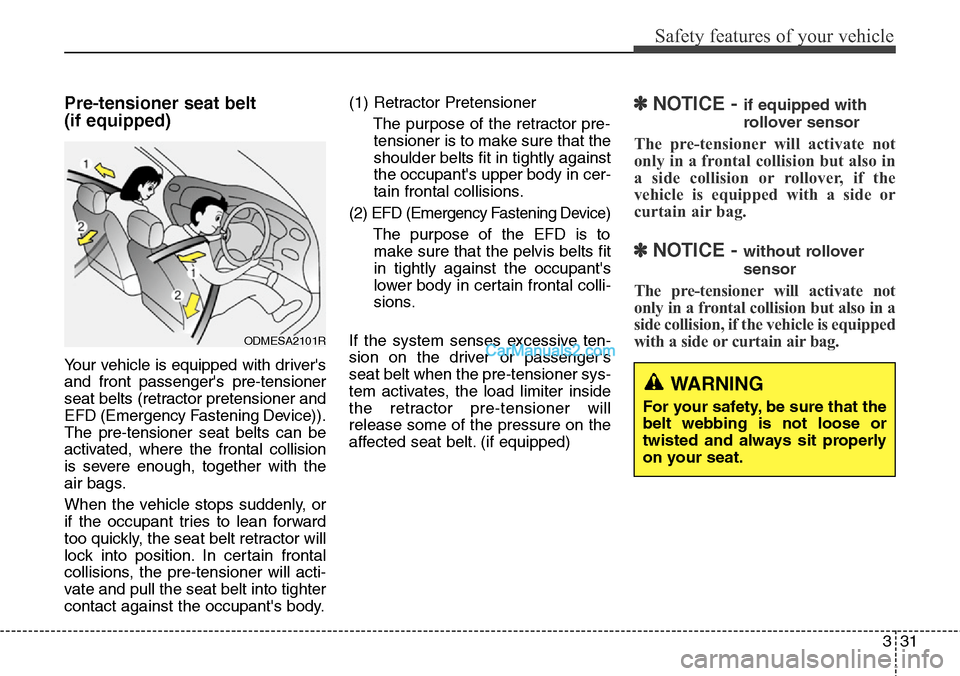
Your vehicle is equipped with driver's
and front passenger's pre-tensioner
seat belts (retractor pretensioner and
EFD (Emergency Fastening Device)).
The pre-tensioner seat belts can be
activated, where the frontal collision
is severe enough, together with the
air bags.
When the vehicle stops suddenly, or
if the occupant tries to lean forward
too quickly, the seat belt retractor will
lock into position. In certain frontal
collisions, the pre-tensioner will acti-
vate and pull the seat belt into tighter
contact against the occupant's body.(1) Retractor Pretensioner
The purpose of the retractor pre-
tensioner is to make sure that the
shoulder belts fit in tightly against
the occupant's upper body in cer-
tain frontal collisions.
(2) EFD (Emergency Fastening Device)
The purpose of the EFD is to
make sure that the pelvis belts fit
in tightly against the occupant's
lower body in certain frontal colli-
sions.
If the system senses excessive ten-
sion on the driver or passenger's
seat belt when the pre-tensioner sys-
tem activates, the load limiter inside
the retractor pre-tensioner will
release some of the pressure on the
affected seat belt. (if equipped)
✽NOTICE - if equipped with
rollover sensor
The pre-tensioner will activate not
only in a frontal collision but also in
a side collision or rollover, if the
vehicle is equipped with a side or
curtain air bag.
✽NOTICE - without rollover
sensor
The pre-tensioner will activate not
only in a frontal collision but also in a
side collision, if the vehicle is equipped
with a side or curtain air bag.
WARNING
For your safety, be sure that the
belt webbing is not loose or
twisted and always sit properly
on your seat.
ODMESA2101R
Page 52 of 699
Safety features of your vehicle
32 3
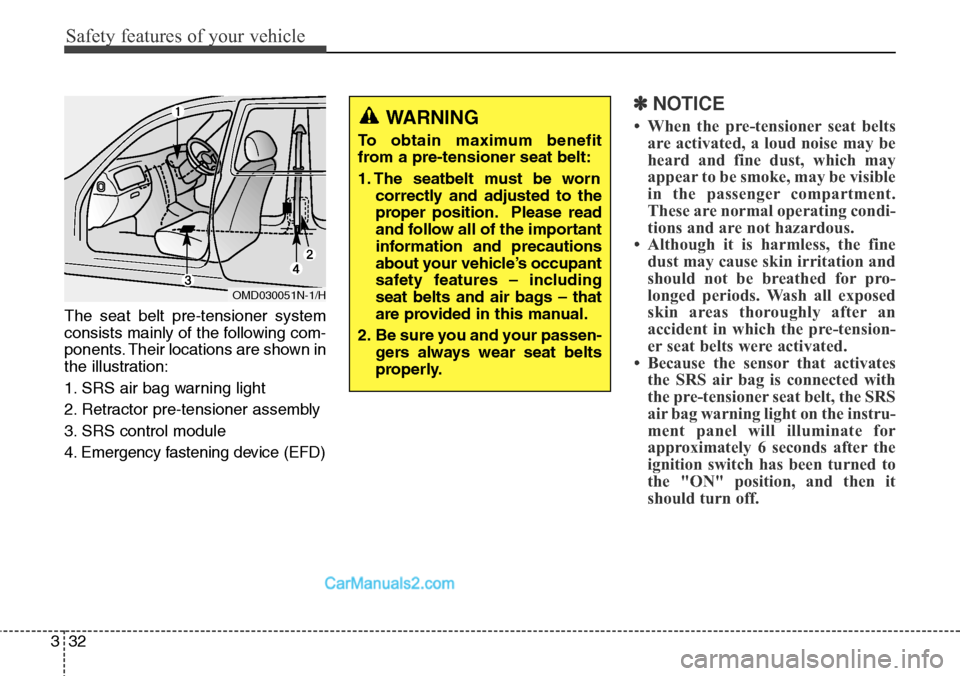
The seat belt pre-tensioner system
consists mainly of the following com-
ponents. Their locations are shown in
the illustration:
1. SRS air bag warning light
2. Retractor pre-tensioner assembly
3. SRS control module
4. Emergency fastening device (EFD)
✽NOTICE
• When the pre-tensioner seat belts
are activated, a loud noise may be
heard and fine dust, which may
appear to be smoke, may be visible
in the passenger compartment.
These are normal operating condi-
tions and are not hazardous.
• Although it is harmless, the fine
dust may cause skin irritation and
should not be breathed for pro-
longed periods. Wash all exposed
skin areas thoroughly after an
accident in which the pre-tension-
er seat belts were activated.
• Because the sensor that activates
the SRS air bag is connected with
the pre-tensioner seat belt, the SRS
air bag warning light on the instru-
ment panel will illuminate for
approximately 6 seconds after the
ignition switch has been turned to
the "ON" position, and then it
should turn off.WARNING
To obtain maximum benefit
from a pre-tensioner seat belt:
1. The seatbelt must be worn
correctly and adjusted to the
proper position. Please read
and follow all of the important
information and precautions
about your vehicle’s occupant
safety features – including
seat belts and air bags – that
are provided in this manual.
2. Be sure you and your passen-
gers always wear seat belts
properly.
OMD030051N-1/H