air condition Hyundai Santa Fe 2016 Owner's Manual - RHD (UK, Australia)
[x] Cancel search | Manufacturer: HYUNDAI, Model Year: 2016, Model line: Santa Fe, Model: Hyundai Santa Fe 2016Pages: 699, PDF Size: 15.65 MB
Page 10 of 699
15
Introduction
Do not use methanol
Fuels containing methanol (wood
alcohol) should not be used in your
vehicle. This type of fuel can reduce
vehicle performance and damage
components of the fuel system,
engine control system and emission
control system.
Fuel Additives
HYUNDAI recommends that you use
unleaded gasoline which has an
octane rating of RON(Research
Octane Number) 95 / AKI (Anti Knock
Index) 91 or higher.
For customers who do not use good
quality petrols including fuel addi-
tives regularly, and have problems
starting or the engine does not run
smoothly, one bottle of additives
added to the fuel tank at every
10,000 miles (15,000 km).
Additives are available from your
HYUNDAI authorised repairer along
with information on how to use them.
Do not mix other additives.
Operation in foreign countries
If you are going to drive your vehicle
in another country, be sure to:
• Observe all regulations regarding
registration and insurance.
• Determine that acceptable fuel is
available.
Diesel engine
Diesel fuel
Diesel engine must be operated only
on commercially available diesel fuel
that complies with EN 590 or compa-
rable standard. (EN stands for
"European Norm"). Do not use
marine diesel fuel, heating oils, or
non-approved fuel additives, as this
will increase wear and cause dam-
age to the engine and fuel system.
The use of non-approved fuels and /
or fuel additives will result in a limita-
tion of your warranty rights.
Diesel fuel of above cetane 51 is
used in your vehicle. If two types of
diesel fuel are available, use summer
or winter fuel properly according to
the following temperature conditions.
• Above -5°C (23°F) ... Summer type
diesel fuel.
• Below -5°C (23°F) ... Winter type
diesel fuel.
Watch the fuel level in the tank very
carefully : If the engine stops through
fuel failure, the circuits must be com-
pletely purged to permit restarting.
Page 77 of 699
357
Safety features of your vehicle
WARNING
• If an air bag deploys, there
may be a loud noise followed
by a fine dust released in the
vehicle. These conditions are
normal and are not hazardous
- the air bags are packed in
this fine powder. The dust
generated during air bag
deployment may cause skin
or eye irritation as well as
aggravate asthma for some
persons. Always wash all
exposed skin areas thorough-
ly with lukewarm water and a
mild soap after an accident in
which the air bags were
deployed.
(Continued)
(Continued)
• When installing a container of
liquid air freshener inside the
vehicle, do not place it near
the instrument cluster nor on
the instrument panel surface.
It may become dangerous pro-
jectiles and cause injury if the
passenger's air bag inflates.(Continued)
• The SRS can function only
when the ignition key is in the
"ON" position. If the SRS air
bag warning light does not
illuminate, or continuously
remains on after illuminating
for about 6 seconds when the
ignition key is turned to the
ON position, or after the
engine is started, comes on
whilst driving, the SRS is not
working properly.
If this occurs, we recommend
that the system be inspected
by a HYUNDAI authorised
repairer.
• Before you replace a fuse or
disconnect a battery terminal,
turn the ignition switch to the
LOCK position and remove
the ignition key. Never remove
or replace the air bag related
fuse(s) when the ignition
switch is in the ON position.
Failure to heed this warning
will cause the SRS air bag
warning light to illuminate.
Page 84 of 699
Safety features of your vehicle
64 3
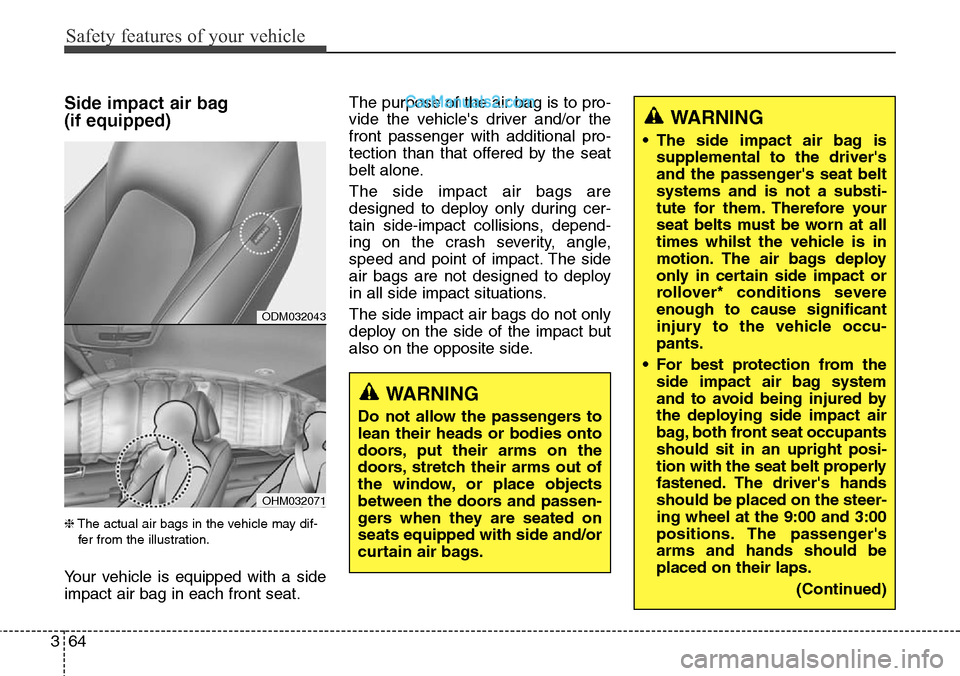
Side impact air bag
(if equipped)
❈The actual air bags in the vehicle may dif-
fer from the illustration.
Your vehicle is equipped with a side
impact air bag in each front seat.The purpose of the air bag is to pro-
vide the vehicle's driver and/or the
front passenger with additional pro-
tection than that offered by the seat
belt alone.
The side impact air bags are
designed to deploy only during cer-
tain side-impact collisions, depend-
ing on the crash severity, angle,
speed and point of impact. The side
air bags are not designed to deploy
in all side impact situations.
The side impact air bags do not only
deploy on the side of the impact but
also on the opposite side.
WARNING
• The side impact air bag is
supplemental to the driver's
and the passenger's seat belt
systems and is not a substi-
tute for them. Therefore your
seat belts must be worn at all
times whilst the vehicle is in
motion. The air bags deploy
only in certain side impact or
rollover* conditions severe
enough to cause significant
injury to the vehicle occu-
pants.
• For best protection from the
side impact air bag system
and to avoid being injured by
the deploying side impact air
bag, both front seat occupants
should sit in an upright posi-
tion with the seat belt properly
fastened. The driver's hands
should be placed on the steer-
ing wheel at the 9:00 and 3:00
positions. The passenger's
arms and hands should be
placed on their laps.
(Continued)
WARNING
Do not allow the passengers to
lean their heads or bodies onto
doors, put their arms on the
doors, stretch their arms out of
the window, or place objects
between the doors and passen-
gers when they are seated on
seats equipped with side and/or
curtain air bags.
ODM032043
OHM032071
Page 87 of 699
367
Safety features of your vehicle
Why didn’t my air bag go off in
a collision? (Inflation and non-
inflation conditions of the air
bag)
There are many types of accidents
in which the air bag would not be
expected to provide additional
protection.
These include rear impacts, sec-
ond or third collisions in multiple
impact accidents, as well as low
speed impacts.
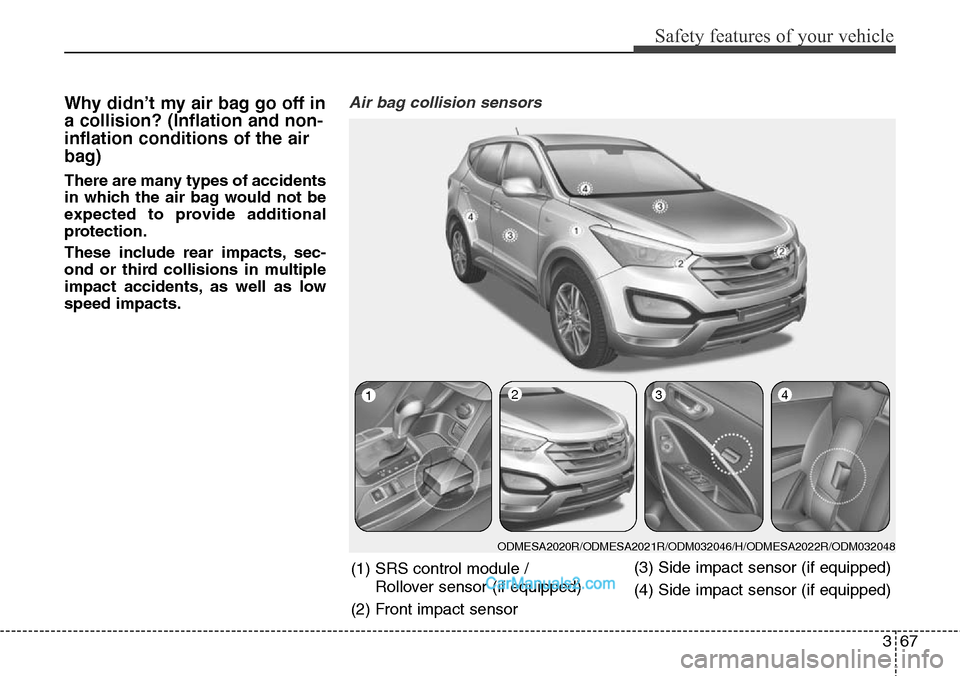
Air bag collision sensors
(1) SRS control module /
Rollover sensor (if equipped)
(2) Front impact sensor(3) Side impact sensor (if equipped)
(4) Side impact sensor (if equipped)
ODMESA2020R/ODMESA2021R/ODM032046/H/ODMESA2022R/ODM032048
1234
Page 89 of 699
369
Safety features of your vehicle
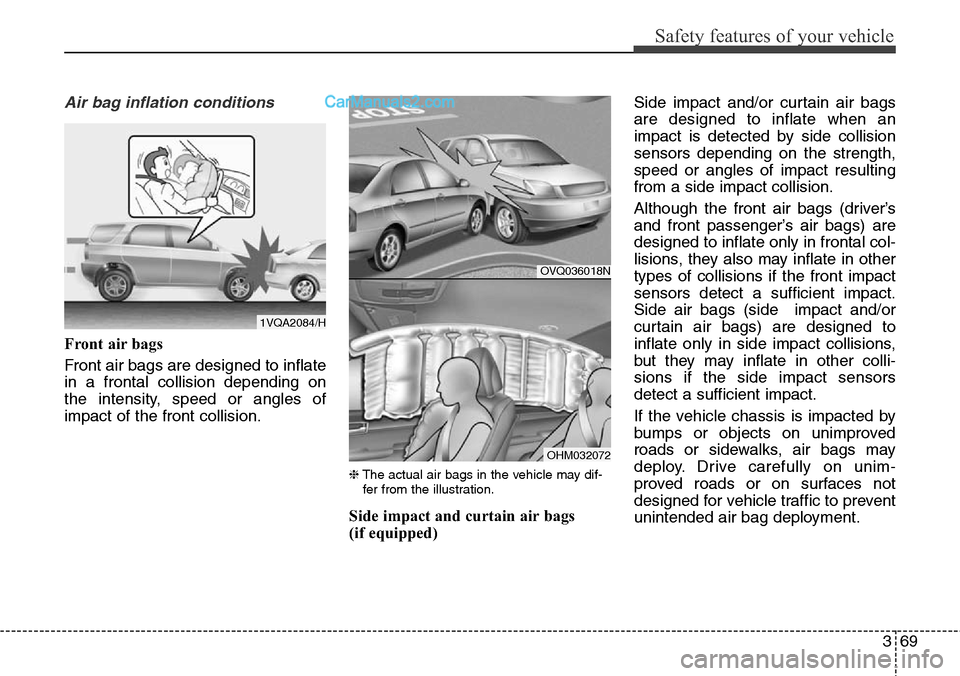
Air bag inflation conditions
Front air bags
Front air bags are designed to inflate
in a frontal collision depending on
the intensity, speed or angles of
impact of the front collision.
❈The actual air bags in the vehicle may dif-
fer from the illustration.
Side impact and curtain air bags
(if equipped)Side impact and/or curtain air bags
are designed to inflate when an
impact is detected by side collision
sensors depending on the strength,
speed or angles of impact resulting
from a side impact collision.
Although the front air bags (driver’s
and front passenger’s air bags) are
designed to inflate only in frontal col-
lisions, they also may inflate in other
types of collisions if the front impact
sensors detect a sufficient impact.
Side air bags (side impact and/or
curtain air bags) are designed to
inflate only in side impact collisions,
but they may inflate in other colli-
sions if the side impact sensors
detect a sufficient impact.
If the vehicle chassis is impacted by
bumps or objects on unimproved
roads or sidewalks, air bags may
deploy. Drive carefully on unim-
proved roads or on surfaces not
designed for vehicle traffic to prevent
unintended air bag deployment.
OVQ036018N
OHM032072
1VQA2084/H
Page 90 of 699
Safety features of your vehicle
70 3
✽NOTICE - if equipped with
rollover sensor
Also, the side impact and curtain air
bags are designed to inflate when a
rollover is detected by a rollover sen-
sor.
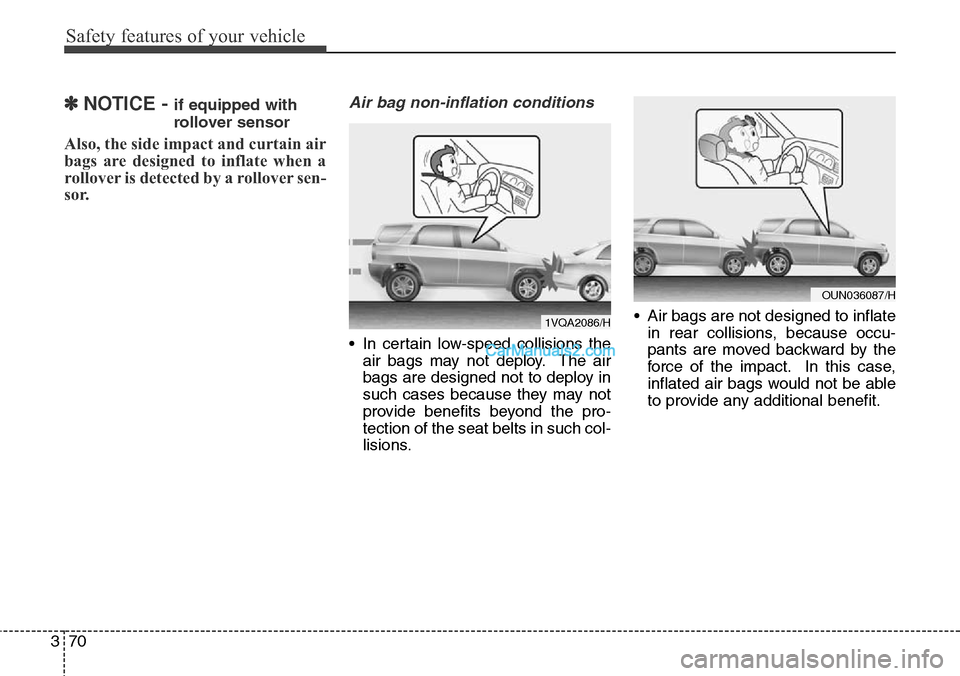
Air bag non-inflation conditions
• In certain low-speed collisions the
air bags may not deploy. The air
bags are designed not to deploy in
such cases because they may not
provide benefits beyond the pro-
tection of the seat belts in such col-
lisions.• Air bags are not designed to inflate
in rear collisions, because occu-
pants are moved backward by the
force of the impact. In this case,
inflated air bags would not be able
to provide any additional benefit.
OUN036087/H
1VQA2086/H
Page 101 of 699
• Adaptive Front Lighting System (AFLS) . . . . . . . . 4-142
Wipers and washers . . . . . . . . . . . . . . . . . . . . . . . 4-143
• Windscreen wipers (front) . . . . . . . . . . . . . . . . . . . . 4-144
• Windscreen washers (front) . . . . . . . . . . . . . . . . . . . 4-145
• Rear window wiper and washer switch . . . . . . . . . 4-147
Interior light . . . . . . . . . . . . . . . . . . . . . . . . . . . . . 4-148
• Interior lamp AUTO cut . . . . . . . . . . . . . . . . . . . . . . 4-148
• Map lamp . . . . . . . . . . . . . . . . . . . . . . . . . . . . . . . . . . 4-148
• Room lamp . . . . . . . . . . . . . . . . . . . . . . . . . . . . . . . . . 4-149
• Vanity mirror lamp . . . . . . . . . . . . . . . . . . . . . . . . . . 4-150
• Luggage room lamp . . . . . . . . . . . . . . . . . . . . . . . . . 4-150
• Glove box lamp . . . . . . . . . . . . . . . . . . . . . . . . . . . . . 4-151
• Door courtesy lamp . . . . . . . . . . . . . . . . . . . . . . . . . . 4-151
Welcome system . . . . . . . . . . . . . . . . . . . . . . . . . . 4-152
• Headlamp welcome . . . . . . . . . . . . . . . . . . . . . . . . . . 4-152
• Interior light. . . . . . . . . . . . . . . . . . . . . . . . . . . . . . . . 4-152
• Puddle lamp and pocket lamp . . . . . . . . . . . . . . . . . 4-152
Defroster . . . . . . . . . . . . . . . . . . . . . . . . . . . . . . . . 4-153
• Rear window defroster . . . . . . . . . . . . . . . . . . . . . . . 4-153
Manual climate control system . . . . . . . . . . . . . . 4-155
• Heating and air conditioning . . . . . . . . . . . . . . . . . . 4-156
• 3rd row air conditioning . . . . . . . . . . . . . . . . . . . . . . 4-161
• System operation . . . . . . . . . . . . . . . . . . . . . . . . . . . . 4-162
• Climate control air filter . . . . . . . . . . . . . . . . . . . . . . 4-164
• Air conditioning refrigerant label . . . . . . . . . . . . . . 4-165• Checking the amount of air conditioner
refrigerant and compressor lubricant . . . . . . . . . 4-166
Automatic climate control system. . . . . . . . . . . . 4-167
• Automatic heating and air conditioning . . . . . . . . . 4-169
• Manual heating and air conditioning . . . . . . . . . . . 4-170
• 3rd row air conditioning . . . . . . . . . . . . . . . . . . . . . . 4-176
• System operation . . . . . . . . . . . . . . . . . . . . . . . . . . . . 4-177
• Climate control air filter . . . . . . . . . . . . . . . . . . . . . . 4-179
• Air conditioning refrigerant label . . . . . . . . . . . . . . 4-180
• Checking the amount of air conditioner
refrigerant and compressor lubricant . . . . . . . . . 4-181
Windscreen defrosting and defogging . . . . . . . . 4-182
• Manual climate control system . . . . . . . . . . . . . . . . 4-182
• Automatic climate control system . . . . . . . . . . . . . . 4-183
Clean air . . . . . . . . . . . . . . . . . . . . . . . . . . . . . . . . 4-185
Storage compartment. . . . . . . . . . . . . . . . . . . . . . 4-186
• Centre console storage . . . . . . . . . . . . . . . . . . . . . . . 4-186
• Glove box . . . . . . . . . . . . . . . . . . . . . . . . . . . . . . . . . . 4-186
• Cool box . . . . . . . . . . . . . . . . . . . . . . . . . . . . . . . . . . . 4-187
• Multi box . . . . . . . . . . . . . . . . . . . . . . . . . . . . . . . . . . 4-188
• Sunglass holder . . . . . . . . . . . . . . . . . . . . . . . . . . . . . 4-188
• Luggage tray . . . . . . . . . . . . . . . . . . . . . . . . . . . . . . . 4-189
Interior features . . . . . . . . . . . . . . . . . . . . . . . . . . 4-190
• Cigarette lighter. . . . . . . . . . . . . . . . . . . . . . . . . . . . . 4-190
• Ashtray . . . . . . . . . . . . . . . . . . . . . . . . . . . . . . . . . . . . 4-190
4
Page 128 of 699
Features of your vehicle
30 4
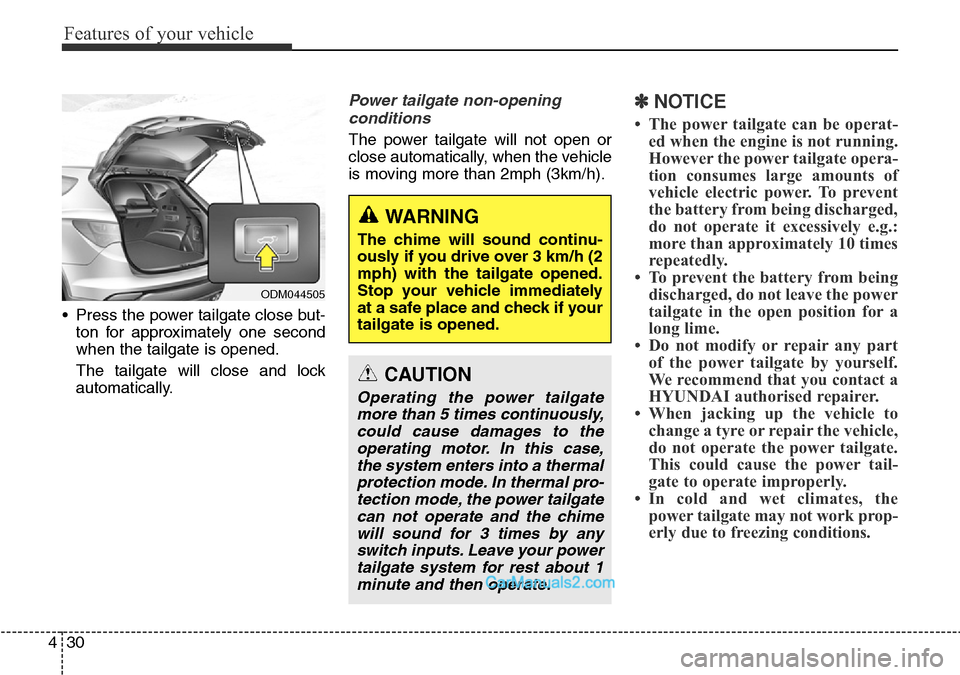
• Press the power tailgate close but-
ton for approximately one second
when the tailgate is opened.
The tailgate will close and lock
automatically.
Power tailgate non-opening
conditions
The power tailgate will not open or
close automatically, when the vehicle
is moving more than 2mph (3km/h).
✽NOTICE
• The power tailgate can be operat-
ed when the engine is not running.
However the power tailgate opera-
tion consumes large amounts of
vehicle electric power. To prevent
the battery from being discharged,
do not operate it excessively e.g.:
more than approximately 10 times
repeatedly.
• To prevent the battery from being
discharged, do not leave the power
tailgate in the open position for a
long lime.
• Do not modify or repair any part
of the power tailgate by yourself.
We recommend that you contact a
HYUNDAI authorised repairer.
• When jacking up the vehicle to
change a tyre or repair the vehicle,
do not operate the power tailgate.
This could cause the power tail-
gate to operate improperly.
• In cold and wet climates, the
power tailgate may not work prop-
erly due to freezing conditions.
ODM044505
WARNING
The chime will sound continu-
ously if you drive over 3 km/h (2
mph) with the tailgate opened.
Stop your vehicle immediately
at a safe place and check if your
tailgate is opened.
CAUTION
Operating the power tailgate
more than 5 times continuously,
could cause damages to the
operating motor. In this case,
the system enters into a thermal
protection mode. In thermal pro-
tection mode, the power tailgate
can not operate and the chime
will sound for 3 times by any
switch inputs. Leave your power
tailgate system for rest about 1
minute and then operate.
Page 150 of 699
Features of your vehicle
52 4
Electronic power steering
(if equipped)
Power steering uses the motor to
assist you in steering the vehicle. If
the engine is off or if the power steer-
ing system becomes inoperative, the
vehicle may still be steered, but it will
require increased steering effort.
The motor driven power steering is
controlled by the power steering con-
trol unit which senses the steering
wheel torque and vehicle speed to
command the motor.
The steering wheel becomes heavier
as the vehicle’s speed increases and
becomes lighter as the vehicle’s
speed decreases for better control of
the steering wheel.
Should you notice any change in the
effort required to steer during normal
vehicle operation, we recommend
that the system be checked by a
HYUNDAI authorised repairer.
✽NOTICE
The following symptoms may occur
during normal vehicle operation:
• The EPS warning light does not
illuminate.
• The steering effort is high immedi-
ately after turning the ignition
switch on. This happens as the sys-
tem performs the EPS system
diagnostics. When the diagnostics
is completed, the steering wheel
will return to its normal condition.
• A click noise may be heard from
the EPS relay after the ignition
switch is turned to the ON or
LOCK/OFF position.
• Motor noise may be heard when
the vehicle is at a stop or at a low
driving speed.
• The steering effort increases if the
steering wheel is rotated continu-
ously when the vehicle is not in
motion. However, after a few min-
utes, it will return to its normal
conditions.
(Continued)(Continued)
• If the Electronic Power Steering
System does not operate normally,
the warning light will illuminate on
the instrument cluster. The steer-
ing wheel may become difficult to
control or operate abnormally. We
recommend that you contact a
HYUNDAI authorised repairer.
• When you operate the steering
wheel in low temperature, abnor-
mal noise could occur. If tempera-
ture rises, the noise will disappear.
This is a normal condition.
STEERING WHEEL
Page 156 of 699
Features of your vehicle
58 4
Inside rearview mirror
Adjust the rearview mirror so that the
centre view through the rear window
is seen. Make this adjustment before
you start driving.
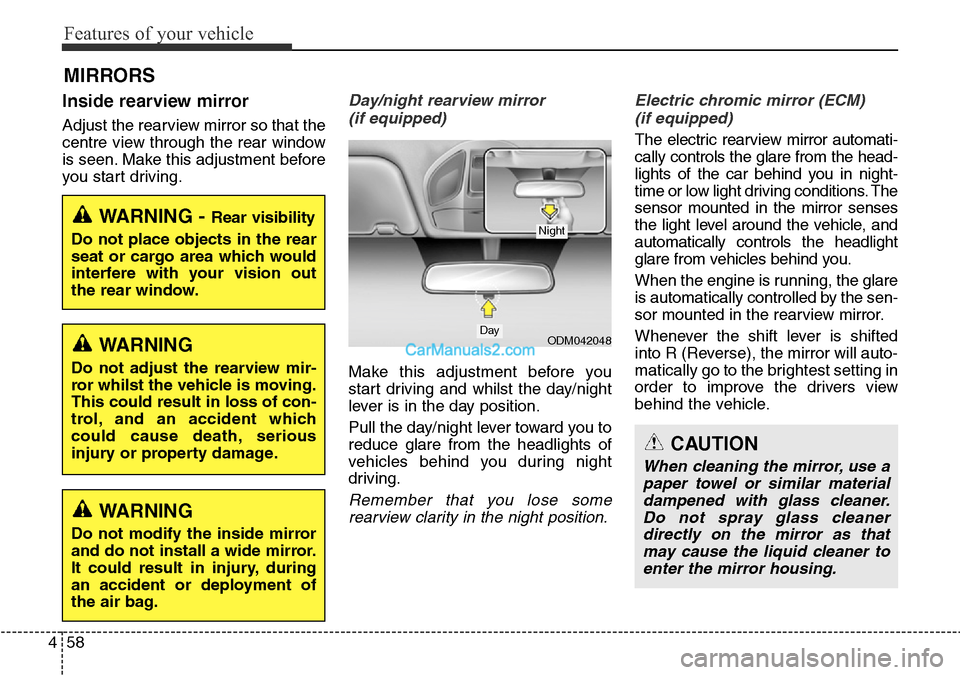
Day/night rearview mirror
(if equipped)
Make this adjustment before you
start driving and whilst the day/night
lever is in the day position.
Pull the day/night lever toward you to
reduce glare from the headlights of
vehicles behind you during night
driving.
Remember that you lose some
rearview clarity in the night position.Electric chromic mirror (ECM)
(if equipped)
The electric rearview mirror automati-
cally controls the glare from the head-
lights of the car behind you in night-
time or low light driving conditions. The
sensor mounted in the mirror senses
the light level around the vehicle, and
automatically controls the headlight
glare from vehicles behind you.
When the engine is running, the glare
is automatically controlled by the sen-
sor mounted in the rearview mirror.
Whenever the shift lever is shifted
into R (Reverse), the mirror will auto-
matically go to the brightest setting in
order to improve the drivers view
behind the vehicle.
MIRRORS
WARNING - Rear visibility
Do not place objects in the rear
seat or cargo area which would
interfere with your vision out
the rear window.
ODM042048
CAUTION
When cleaning the mirror, use a
paper towel or similar material
dampened with glass cleaner.
Do not spray glass cleaner
directly on the mirror as that
may cause the liquid cleaner to
enter the mirror housing.
Day
Night
WARNING
Do not adjust the rearview mir-
ror whilst the vehicle is moving.
This could result in loss of con-
trol, and an accident which
could cause death, serious
injury or property damage.
WARNING
Do not modify the inside mirror
and do not install a wide mirror.
It could result in injury, during
an accident or deployment of
the air bag.