drive Hyundai Santa Fe 2017 Owner's Manual
[x] Cancel search | Manufacturer: HYUNDAI, Model Year: 2017, Model line: Santa Fe, Model: Hyundai Santa Fe 2017Pages: 569, PDF Size: 16.88 MB
Page 529 of 569
781
Maintenance
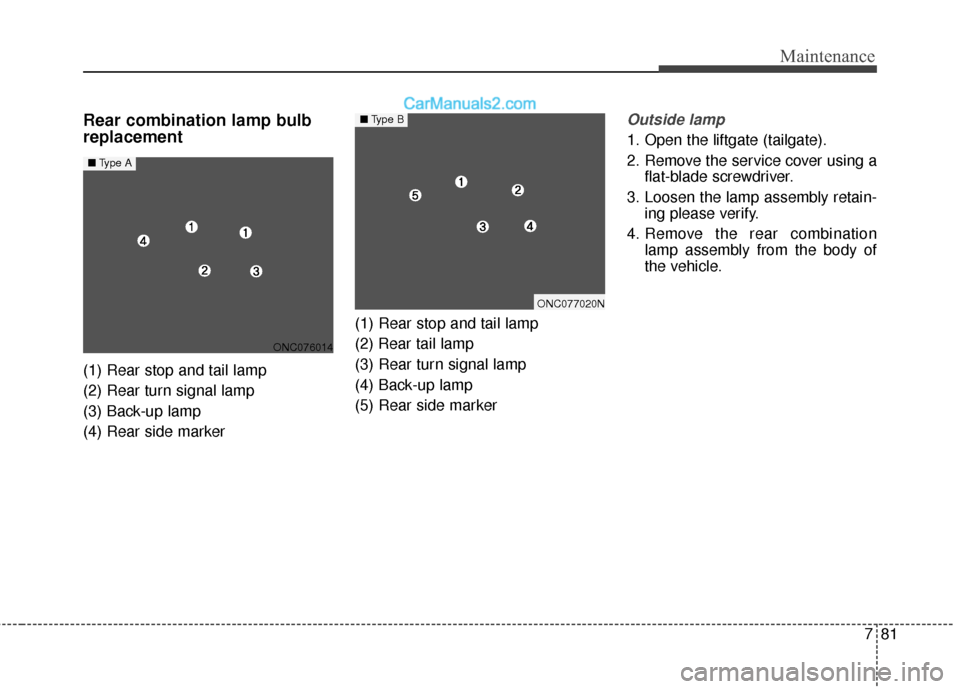
Rear combination lamp bulb
replacement
(1) Rear stop and tail lamp
(2) Rear turn signal lamp
(3) Back-up lamp
(4) Rear side marker(1) Rear stop and tail lamp
(2) Rear tail lamp
(3) Rear turn signal lamp
(4) Back-up lamp
(5) Rear side marker
Outside lamp
1. Open the liftgate (tailgate).
2. Remove the service cover using a
flat-blade screwdriver.
3. Loosen the lamp assembly retain- ing please verify.
4. Remove the rear combination lamp assembly from the body of
the vehicle.
ONC076014
ONC077020N
■Type B
■Type A
Page 530 of 569
Maintenance
82
7
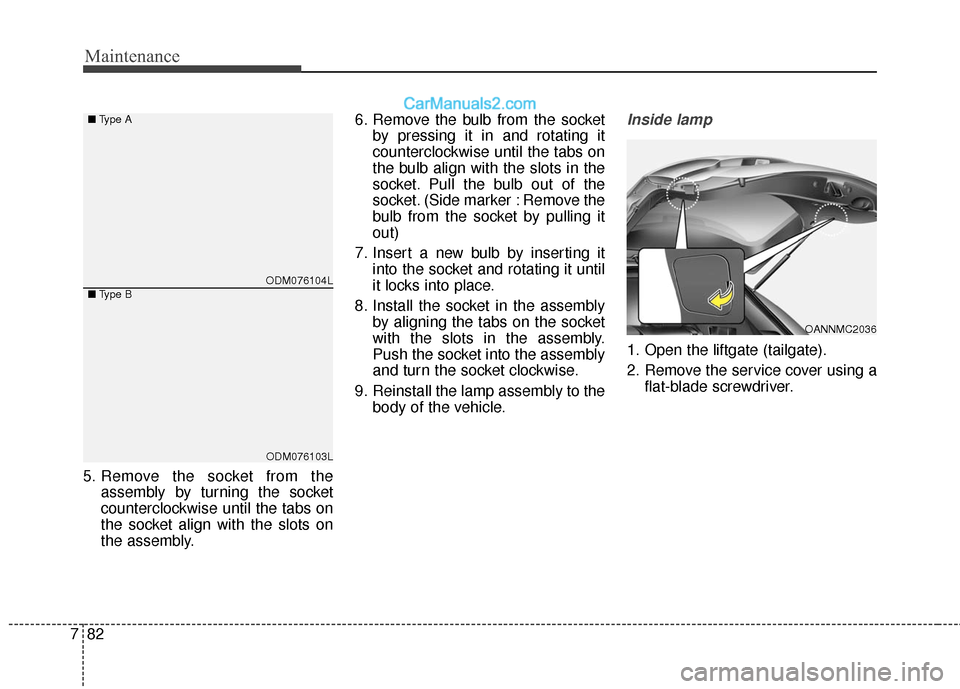
5. Remove the socket from the
assembly by turning the socket
counterclockwise until the tabs on
the socket align with the slots on
the assembly. 6. Remove the bulb from the socket
by pressing it in and rotating it
counterclockwise until the tabs on
the bulb align with the slots in the
socket. Pull the bulb out of the
socket. (Side marker : Remove the
bulb from the socket by pulling it
out)
7. Insert a new bulb by inserting it into the socket and rotating it until
it locks into place.
8. Install the socket in the assembly by aligning the tabs on the socket
with the slots in the assembly.
Push the socket into the assembly
and turn the socket clockwise.
9. Reinstall the lamp assembly to the body of the vehicle.
Inside lamp
1. Open the liftgate (tailgate).
2. Remove the service cover using aflat-blade screwdriver.
OANNMC2036
ODM076104L
ODM076103L
■
Type A
■ Type B
Page 533 of 569
785
Maintenance
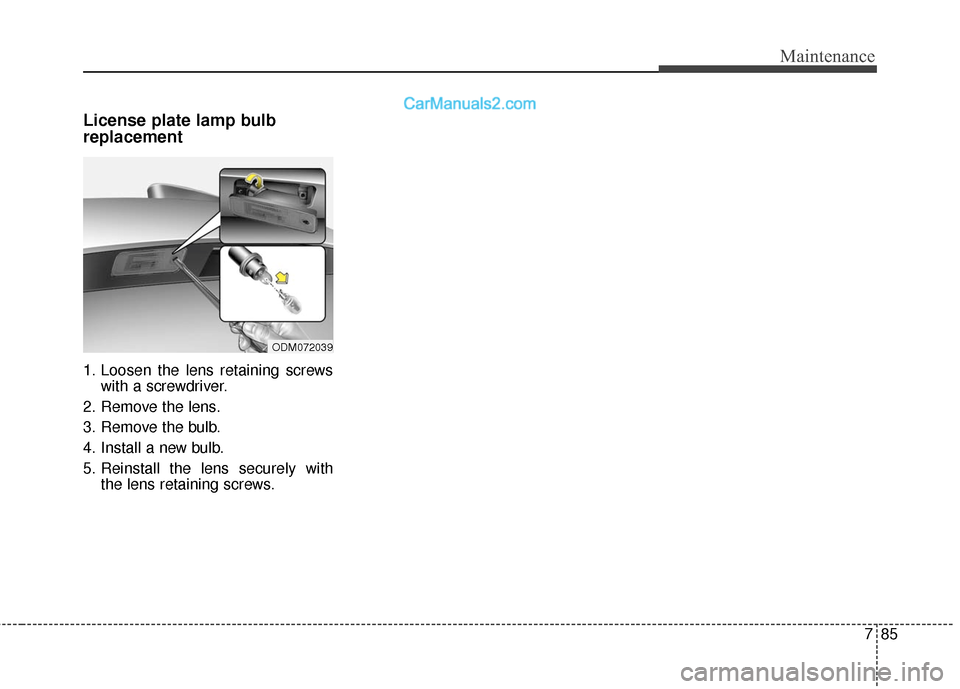
License plate lamp bulb
replacement
1. Loosen the lens retaining screwswith a screwdriver.
2. Remove the lens.
3. Remove the bulb.
4. Install a new bulb.
5. Reinstall the lens securely with the lens retaining screws.
ODM072039
Page 534 of 569
Maintenance
86
7
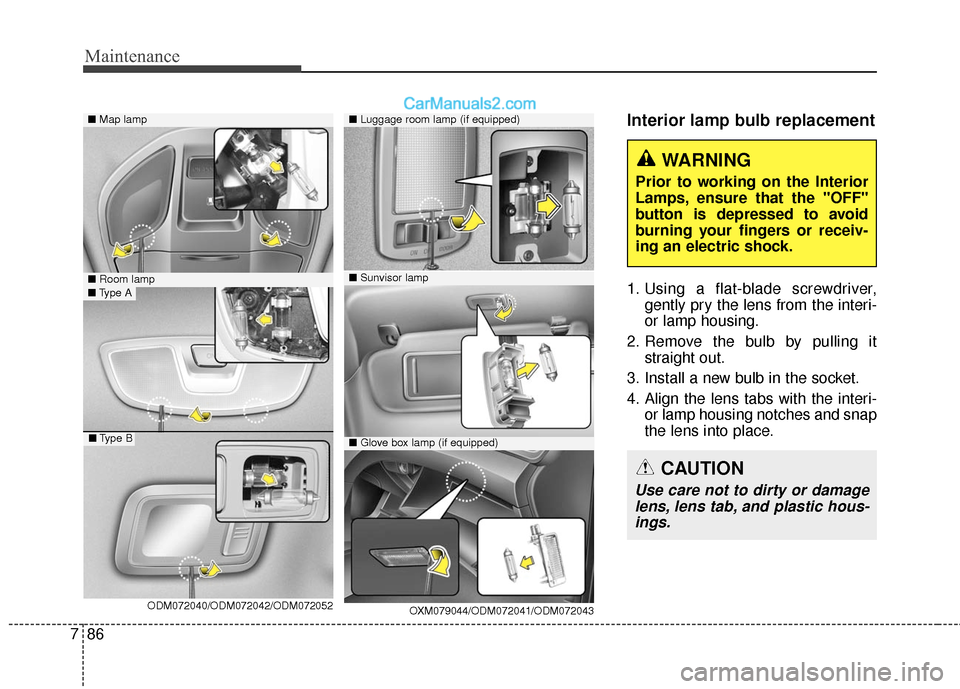
Interior lamp bulb replacement
1. Using a flat-blade screwdriver,
gently pry the lens from the interi-
or lamp housing.
2. Remove the bulb by pulling it straight out.
3. Install a new bulb in the socket.
4. Align the lens tabs with the interi- or lamp housing notches and snap
the lens into place.
■Map lamp
OXM079044/ODM072041/ODM072043
■Glove box lamp (if equipped)
■Luggage room lamp (if equipped)
■Room lamp
ODM072040/ODM072042/ODM072052■Type A
■Type B
WARNING
Prior to working on the Interior
Lamps, ensure that the "OFF"
button is depressed to avoid
burning your fingers or receiv-
ing an electric shock.
CAUTION
Use care not to dirty or damage
lens, lens tab, and plastic hous-ings.
■ Sunvisor lamp
Page 540 of 569
Maintenance
92
7
When cleaning lower door panels,
rocker panels and frame members,
be sure that drain holes are kept
open so that moisture can escape.
If these areas are not kept clear,
moisture could become trapped
and accelerate corrosion.
Keep your garage dry
Don't park your car in a damp or
poorly ventilated garage. This cre-
ates a favorable environment for cor-
rosion. This is particularly true if you
wash your car in the garage or drive
it into the garage when it is still wet or
covered with snow, ice or mud. Even
a heated garage can contribute to
corrosion unless it is well ventilated
so moisture can dispersed. Keep paint and trim in good con-
dition
Scratches or chips in the finish
should be covered with "touch-up"
paint as soon as possible to reduce
the possibility of corrosion. If bare
metal is showing, the attention of a
qualified body and paint shop is rec-
ommended.
Bird droppings : Bird droppings are
highly corrosive and may damage
painted surfaces in just a few hours.
Always remove bird droppings as
soon as possible.
Don't neglect the interior
Moisture can collect under the floor
mats and carpeting to cause corro-
sion. Check under the mats periodi-
cally to be sure the carpeting is dry.
Use particular care if you carry fertil-
izers, cleaning materials or chemi-
cals in the car.
These should be carried only in
proper containers and any spills or
leaks should be cleaned up, flushed
with clean water and thoroughly
dried.
Page 544 of 569
Maintenance
96
7
Engine exhaust gas precautions
(carbon monoxide)
Carbon monoxide can be present with other exhaust fumes.
Therefore, if you smell exhaust
fumes of any kind inside your vehi-
cle, have it inspected and repaired
immediately. If you ever suspect
exhaust fumes are coming into
your vehicle, drive it only with all
the windows fully open. Have your
vehicle checked and repaired
immediately. Do not operate the engine in con-
fined or closed areas (such as
garages) any more than what is
necessary to move the vehicle in or
out of the area.
When the vehicle is stopped in an open area for more than a short
time with the engine running,
adjust the ventilation system (as
needed) to draw outside air into the
vehicle.
Never sit in a parked or stopped vehicle for any extended time with
the engine running.
When the engine stalls or fails to start, excessive attempts to restart
the engine may cause damage to
the emission control system.
CALIFORNIA PROPO-
SITION 65 WARNING
Engine exhaust and a wide vari-
ety of automobile components
and parts, including compo-
nents found in the interior fur-
nishings in a vehicle, contain or
emit chemicals known to the
State of California to cause can-
cer and birth defects and repro-
ductive harm. In addition, cer-
tain fluids contained in vehicles
and certain products of compo-
nent wear contain or emit chem-
icals known to the State of
California to cause cancer and
birth defects or other reproduc-
tive harm.
WARNING - Exhaust
Engine exhaust gases contain
carbon monoxide (CO). Though
colorless and odorless, it is
dangerous and could be lethal if
inhaled. Follow the instructions
on this page to avoid CO poi-
soning.
Page 545 of 569
797
Maintenance
Operating precautions for catalytic converters (if equipped)Your vehicle is equipped with a cat-
alytic converter emission control
device.
Therefore, the following precautions
must be observed:
Use only UNLEADED FUEL for gasoline engine.
Do not operate the vehicle when there are signs of engine malfunc-
tion, such as misfire or a noticeable
loss of performance.
Do not misuse or abuse the engine. Examples of misuse are
coasting with the ignition off and
descending steep grades in gear
with the ignition off.
Do not operate the engine at high idle speed for extended periods (5
minutes or more).
Do not modify or tamper with any part of the engine or emission con-
trol system. All inspections and
adjustments must be made by an
authorized HYUNDAI dealer.
Avoid driving with a very low fuel level. If you run out of gasoline, it
could cause the engine to misfire
and result in excessive loading of
the catalytic converter. Failure to observe these precautions
could result in damage to the catalyt-
ic converter and to your vehicle.
Additionally, such actions could void
your warranties.
WARNING- Fire
A hot exhaust system can
ignite flammable items under
your vehicle. Do not park, idle,
or drive the vehicle over or
near flammable objects, such
as grass, vegetation, paper,
leaves, etc.
The exhaust system and cat- alytic system are very hot
while the engine is running or
immediately after the engine
is turned off. Keep away from
the exhaust system and cat-
alytic, you may get burned.
Also, do not remove the heat
sink around the exhaust sys-
tem, do not seal the bottom of
the vehicle or do not coat the
vehicle for corrosion control.
It may present a fire risk under
certain conditions.
Page 551 of 569
85
Specifications, Consumer information and Reporting safety defects
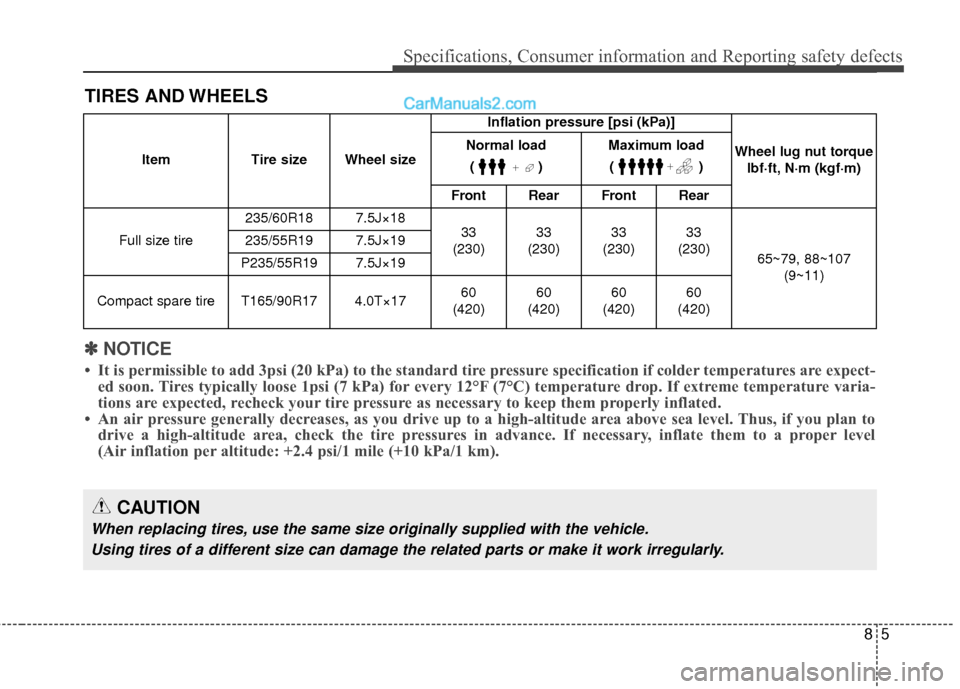
TIRES AND WHEELS
CAUTION
When replacing tires, use the same size originally supplied with the vehicle.Using tires of a different size can damage the related parts or make it work irregularly.
Item Tire size Wheel size Inflation pressure [psi (kPa)]
Wheel lug nut torque lbf·ft, N·m (kgf·m)
Normal load
()Maximum load()
Front Rear Front Rear
Full size tire 235/60R18 7.5J×18
33
(230) 33
(230) 33
(230) 33
(230) 65~79, 88~107
(9~11)
235/55R19 7.5J×19
P235/55R19 7.5J×19
Compact spare tire T165/90R17 4.0T×17 60
(420) 60
(420) 60
(420) 60
(420)
✽
✽ NOTICE
• It is permissible to add 3psi (20 kPa) to the standard tire pressure specification if colder temperatures are expect-
ed soon. Tires typically loose 1psi (7 kPa) for every 12°F (7°C) temperature drop. If extreme temperature varia-
tions are expected, recheck your tire pressure as necessary to keep them properly inflated.
• An air pressure generally decreases, as you drive up to a high-altitude area above sea level. Thus, if you plan to drive a high-altitude area, check the tire pressures in advance. If necessary, inflate them to a proper level
(Air inflation per altitude: +2.4 psi/1 mile (+10 kPa/1 km).
Page 555 of 569
89
Specifications, Consumer information and Reporting safety defects
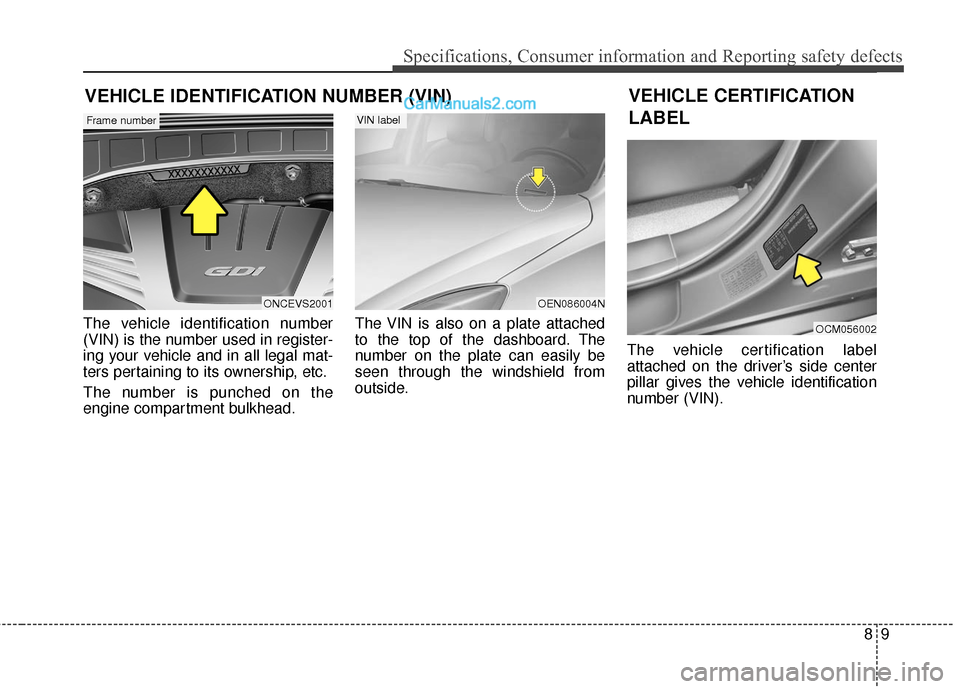
The vehicle identification number
(VIN) is the number used in register-
ing your vehicle and in all legal mat-
ters pertaining to its ownership, etc.
The number is punched on the
engine compartment bulkhead.The VIN is also on a plate attached
to the top of the dashboard. The
number on the plate can easily be
seen through the windshield from
outside.
The vehicle certification label
attached on the driver’s side center
pillar gives the vehicle identification
number (VIN).
VEHICLE IDENTIFICATION NUMBER (VIN)
ONCEVS2001
Frame number
VEHICLE CERTIFICATION
LABEL
OEN086004N
VIN label
OCM056002
Page 556 of 569
Specifications, Consumer information and Reporting safety defects
10
8
REFRIGERANT LABEL
TIRE SPECIFICATION AND
PRESSURE LABEL ENGINE NUMBER
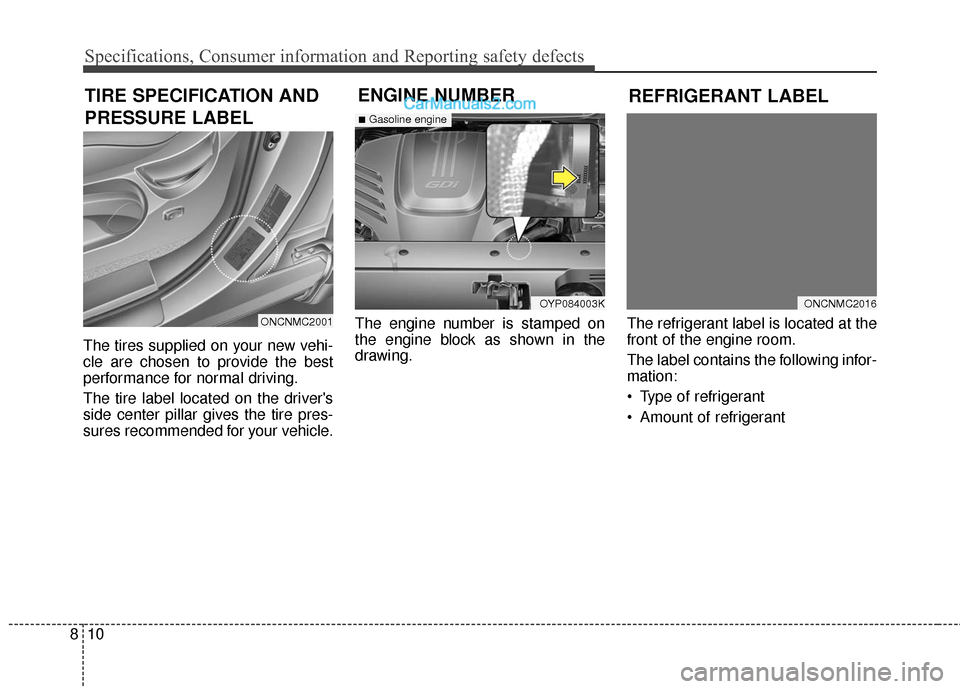
The tires supplied on your new vehi-
cle are chosen to provide the best
performance for normal driving.
The tire label located on the driver's
side center pillar gives the tire pres-
sures recommended for your vehicle. The engine number is stamped on
the engine block as shown in the
drawing.
The refrigerant label is located at the
front of the engine room.
The label contains the following infor-
mation:
Type of refrigerant
Amount of refrigerant
ONCNMC2016
ONCNMC2001
OYP084003K
■Gasoline engine