drive Hyundai Santa Fe 2017 Owner's Guide
[x] Cancel search | Manufacturer: HYUNDAI, Model Year: 2017, Model line: Santa Fe, Model: Hyundai Santa Fe 2017Pages: 569, PDF Size: 16.88 MB
Page 53 of 569
Safety features of your vehicle
32
3
*1Warning pattern repeats 11 times
with an interval of 24 seconds. If
the driver's seat belt is buckled, the
light will stop within 6 seconds and
chime will stop immediately.
*
2The light will stop within 6 seconds
and chime will stop immediately.
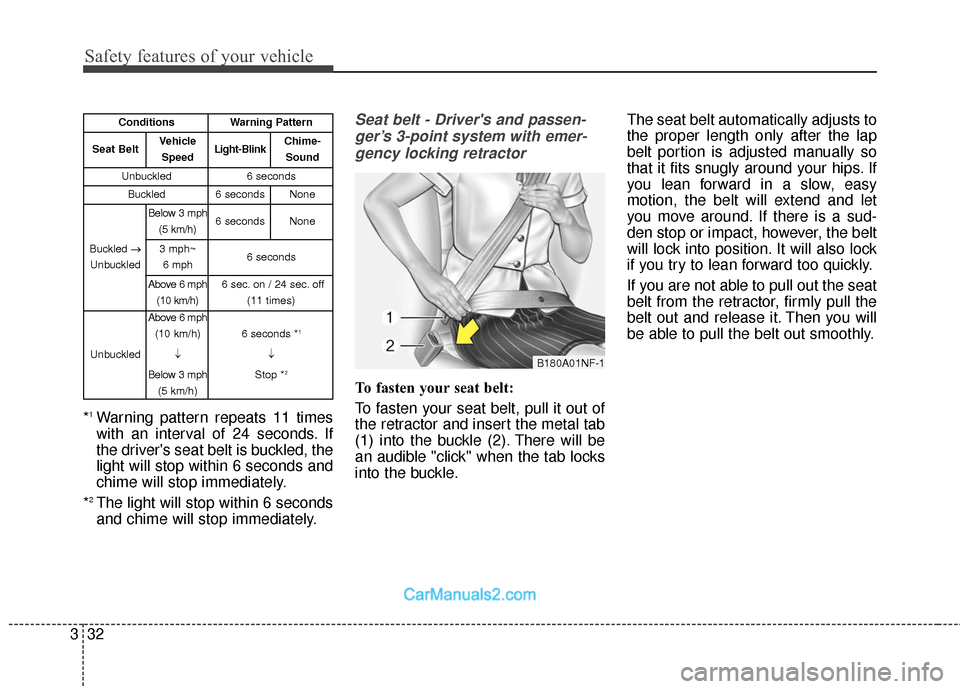
Seat belt - Driver's and passen- ger’s 3-point system with emer-gency locking retractor
To fasten your seat belt:
To fasten your seat belt, pull it out of
the retractor and insert the metal tab
(1) into the buckle (2). There will be
an audible "click" when the tab locks
into the buckle. The seat belt automatically adjusts to
the proper length only after the lap
belt portion is adjusted manually so
that it fits snugly around your hips. If
you lean forward in a slow, easy
motion, the belt will extend and let
you move around. If there is a sud-
den stop or impact, however, the belt
will lock into position. It will also lock
if you try to lean forward too quickly.
If you are not able to pull out the seat
belt from the retractor, firmly pull the
belt out and release it. Then you will
be able to pull the belt out smoothly.
B180A01NF-1
ConditionsWarning Pattern
Seat BeltVehicle
SpeedLight-BlinkChime-Sound
Unbuckled6 seconds
Buckled6 secondsNone
Buckled →
Unbuckled
Below 3 mph (5 km/h)6 secondsNone
3 mph~6 mph6 seconds
Above 6 mph (10 km/h)6 sec. on / 24 sec. off (11 times)
Unbuckled
Above 6 mph(10 km/h)
↓
Below 3 mph (5 km/h)
6 seconds *1
↓
Stop *
2
Page 55 of 569
Safety features of your vehicle
34
3
Seat belts - Rear seat 3-point sys-
tem with combination lockingretractor
To fasten your seat belt:
Combination retractor type seat belts
are installed in the rear seat positions
to help accommodate the installation
of child restraint systems. Although a
combination retractor is also installed
in the front passenger seat position, it
is strongly recommended that children
always be seated in the rear seat.
NEVER place any infant restraint sys-
tem in the front seat of the vehicle.
This type of seat belt combines the
features of both an emergency lock-
ing retractor seat belt and an auto-
matic locking retractor seat belt. To
fasten your seat belt, pull it out of the
retractor and insert the metal tab into
the buckle. There will be an audible
"click" when the tab locks into the
buckle. When not securing a child
restraint, the seat belt operates in the
same way as the driver's seat belt
(Emergency Locking Retractor Type).
It automatically adjusts to the proper
length only after the lap belt portion of
the seat belt is adjusted manually so
that it fits snugly around your hips. When the seat belt is fully extended
from the retractor to allow the instal-
lation of a child restraint system, the
seat belt operation changes to allow
the belt to retract, but not to extend
(Automatic Locking Retractor Type).
Refer to “Using a child restraint sys-
tem” in this section.
To convert from the automatic lock-
ing feature to the emergency locking
operation mode, allow the unbuckled
seat belt to fully retract.
(Continued)
Position one arm under the
shoulder belt and the other
over the belt, as shown in the
illustration.
Always position the shoulder belt anchor into the locked
position at the appropriate
height.
Never position the shoulder belt across your neck or face.
Page 57 of 569
Safety features of your vehicle
36
3
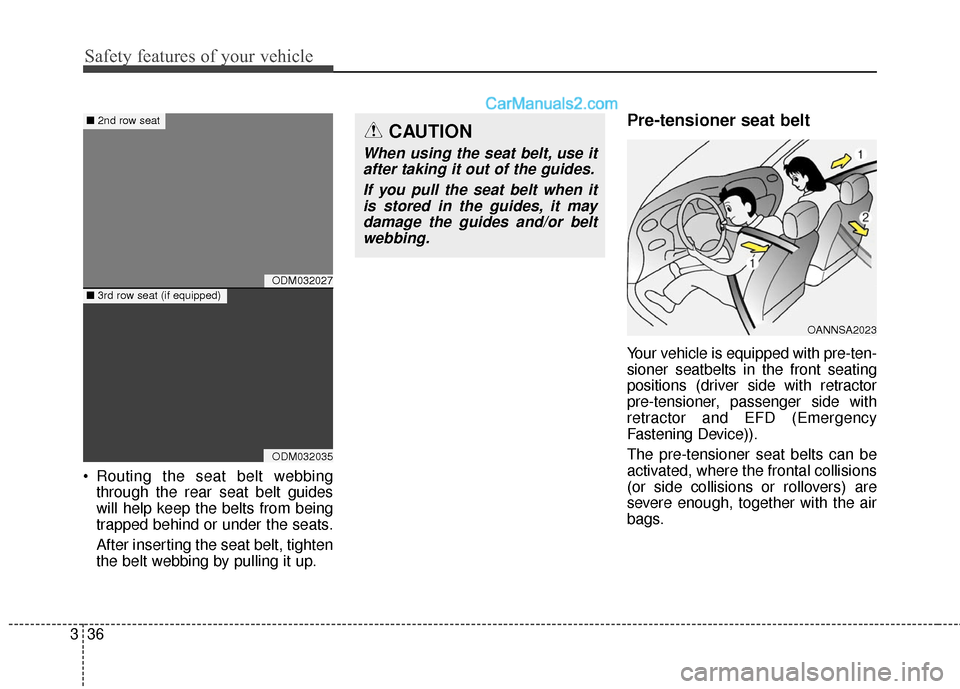
Routing the seat belt webbing
through the rear seat belt guides
will help keep the belts from being
trapped behind or under the seats.
After inserting the seat belt, tighten
the belt webbing by pulling it up.
Pre-tensioner seat belt
Your vehicle is equipped with pre-ten-
sioner seatbelts in the front seating
positions (driver side with retractor
pre-tensioner, passenger side with
retractor and EFD (Emergency
Fastening Device)).
The pre-tensioner seat belts can be
activated, where the frontal collisions
(or side collisions or rollovers) are
severe enough, together with the air
bags.
OANNSA2023
CAUTION
When using the seat belt, use itafter taking it out of the guides.
If you pull the seat belt when itis stored in the guides, it maydamage the guides and/or beltwebbing.
ODM032027
ODM032035
■ 2nd row seat
■3rd row seat (if equipped)
Page 58 of 569
337
Safety features of your vehicle
When the vehicle stops suddenly, or
if the occupant tries to lean forward
too quickly, the seat belt retractor will
lock into position. In certain frontal
collisions (or side collisions or
rollovers), the pre-tensioner will acti-
vate and pull the seat belt into tighter
contact against the occupant's body.
(1) Retractor PretensionerThe purpose of the retractor pre-tensioner is to make sure that the
shoulder belts fit in tightly against
the occupant's upper body in cer-
tain frontal collisions (or side colli-
sions or rollovers).
(2) EFD (Emergency Fastening Device)
The purpose of the EFD is to makesure that the pelvis belts fit in tight-
ly against the occupant's lower
body in certain frontal collisions (or
rollovers). (for passenger’s side)
If the system senses excessive ten-
sion on the driver or passenger's seat
belt when the pre-tensioner system
activates, the load limiter inside the
retractor pre-tensioner will release
some of the pressure on the affected
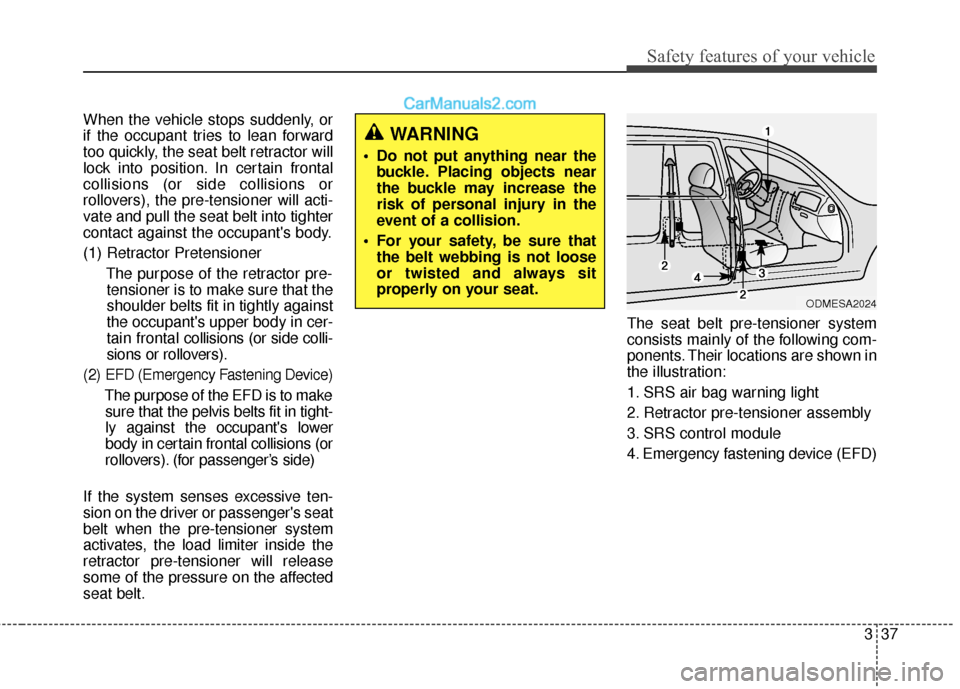
seat belt. The seat belt pre-tensioner system
consists mainly of the following com-
ponents. Their locations are shown in
the illustration:
1. SRS air bag warning light
2. Retractor pre-tensioner assembly
3. SRS control module
4. Emergency fastening device (EFD)
WARNING
Do not put anything near the
buckle. Placing objects near
the buckle may increase the
risk of personal injury in the
event of a collision.
For your safety, be sure that the belt webbing is not loose
or twisted and always sit
properly on your seat.
ODMESA2024
Page 59 of 569
Safety features of your vehicle
38
3
✽
✽
NOTICE
• Both the driver's and front pas-
senger's seat belt pre-tensioner
system may be activated not only
in certain frontal collision but also
in certain side collision or rollover,
if the vehicle is equipped with a
side or curtain air bag.
• When the pre-tensioner seat belts are activated, a loud noise may be
heard and fine dust, which may
appear to be smoke, may be visible
in the passenger compartment.
These are normal operating condi-
tions and are not hazardous.
• Although it is harmless, the fine dust may cause skin irritation and
should not be breathed for pro-
longed periods. Wash all exposed
skin areas thoroughly after an
accident in which the pre-tension-
er seat belts were activated.
• Because the sensor that activates the SRS air bag is connected with
the pre-tensioner seat belt, the
SRS air bag warning light on
the instrument panel will illumi-
nate for approximately 6 seconds
after the ignition switch has been
turned to the ON position, and
then it should turn off.CAUTION
If the pre-tensioner seat belt
system are not working proper-ly, this warning light will illumi-nate even if there is no malfunc-tion of the SRS air bag. If theSRS air bag warning light blinksor does not illuminate when theignition switch is turned ON, or ifit remains illuminated after illu-minating for approximately 6seconds, or if it illuminates whilethe vehicle is being driven, havean authorized HYUNDAI dealerinspect the pre-tensioner seatbelt and SRS air bag system assoon as possible.
WARNING
To obtain maximum benefit
from a pre-tensioner seat belt:
1. The seat belt must be worn correctly and adjusted to the
proper position. Please read
and follow all of the important
information and precautions
about your vehicle’s occupant
safety features – including
seat belts and air bags – that
are provided in this manual.
2. Be sure you and your passen- gers always wear seat belts
properly.
Page 63 of 569
Safety features of your vehicle
42
3
Care of seat belts
Seat belt systems should never be
disassembled or modified. In addi-
tion, care should be taken to assure
that seat belts and belt hardware are
not damaged by seat hinges, doors
or other abuse.
Periodic inspection
All seat belts should be inspected
periodically for wear or damage of
any kind. Any damaged parts should
be replaced as soon as possible.
Keep belts clean and dry
Seat belts should be kept clean and
dry. If belts become dirty, they can be
cleaned by using a mild soap solu-
tion and warm water. Bleach, dye,
strong detergents or abrasives
should not be used because they
may damage and weaken the fabric.
When to replace seat belts
Entire in-use seat belt assembly or
assemblies should be replaced if the
vehicle has been involved in an acci-
dent. This should be done even if no
damage is visible. Additional ques-
tions concerning seat belt operation
should be directed to an authorized
HYUNDAI dealer.
WARNING - Pinched
seat belt
Make sure that the webbing
and/or buckle does not get
caught or pinched in the rear
seat when returning the rear
seatback to its upright position.
A caught or pinched webbing/
buckle may become damaged
and could fail during a collision
or sudden stop resulting in seri-
ous injury or death.
WARNING
Riding with a reclined seatback
increases your chance of seri-
ous or fatal injuries in the event
of a collision or sudden stop.
The protection of your restraint
system (seat belts and air bags)
is greatly reduced by reclining
your seat. Seat belts must be
snug against your hips and
chest to work properly. The
more the seatback is reclined,
the greater the chance that an
occupant's hips will slide under
the lap belt causing serious
internal injuries or the occu-
pant's neck could strike the
shoulder belt. Drivers and pas-
sengers should always sit well
back in their seats, properly
belted, and with the seatbacks
upright.
Page 66 of 569
345
Safety features of your vehicle
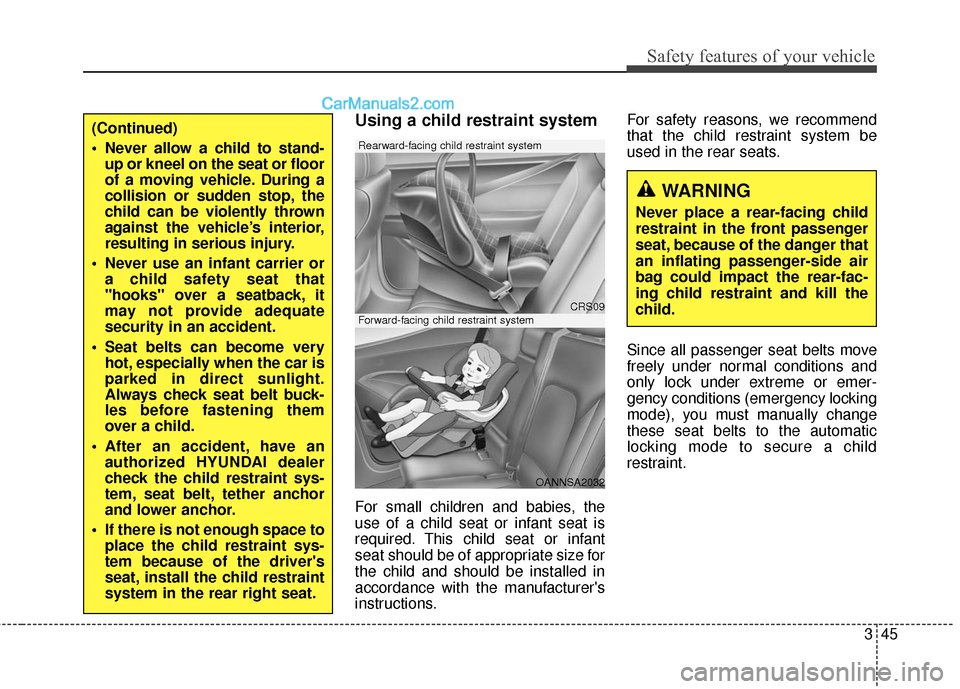
Using a child restraint system
For small children and babies, the
use of a child seat or infant seat is
required. This child seat or infant
seat should be of appropriate size for
the child and should be installed in
accordance with the manufacturer's
instructions.For safety reasons, we recommend
that the child restraint system be
used in the rear seats.
Since all passenger seat belts move
freely under normal conditions and
only lock under extreme or emer-
gency conditions (emergency locking
mode), you must manually change
these seat belts to the automatic
locking mode to secure a child
restraint.
WARNING
Never place a rear-facing child
restraint in the front passenger
seat, because of the danger that
an inflating passenger-side air
bag could impact the rear-fac-
ing child restraint and kill the
child.
CRS09
OANNSA2032
Forward-facing child restraint system
Rearward-facing child restraint system
(Continued)
Never allow a child to stand-
up or kneel on the seat or floor
of a moving vehicle. During a
collision or sudden stop, the
child can be violently thrown
against the vehicle’s interior,
resulting in serious injury.
Never use an infant carrier or a child safety seat that
"hooks" over a seatback, it
may not provide adequate
security in an accident.
Seat belts can become very hot, especially when the car is
parked in direct sunlight.
Always check seat belt buck-
les before fastening them
over a child.
After an accident, have an authorized HYUNDAI dealer
check the child restraint sys-
tem, seat belt, tether anchor
and lower anchor.
If there is not enough space to place the child restraint sys-
tem because of the driver's
seat, install the child restraint
system in the rear right seat.
Page 74 of 569
353
Safety features of your vehicle
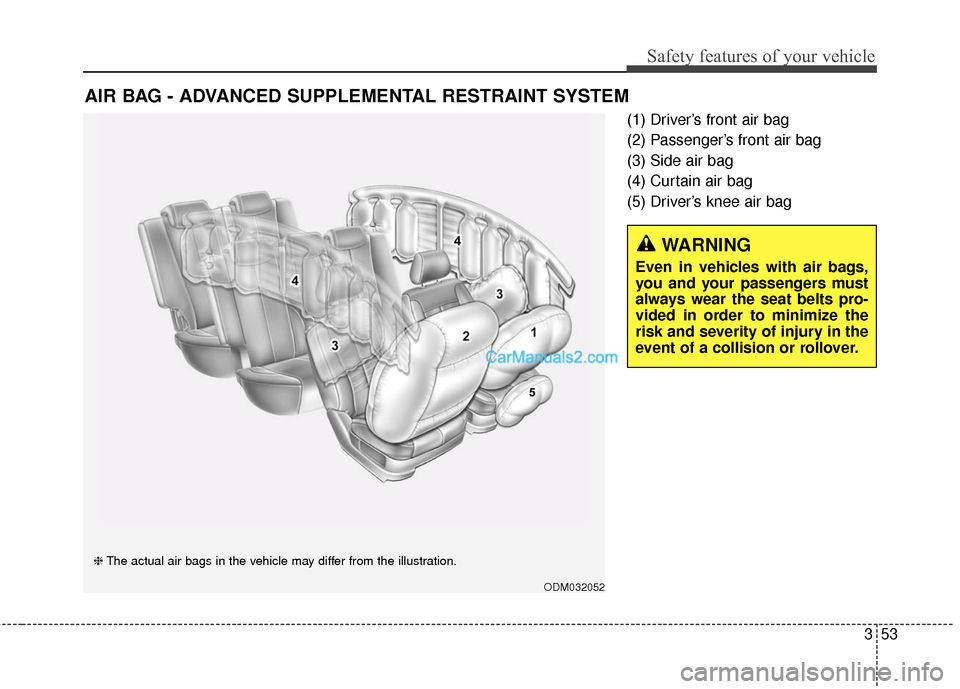
(1) Driver’s front air bag
(2) Passenger’s front air bag
(3) Side air bag
(4) Curtain air bag
(5) Driver’s knee air bag
AIR BAG - ADVANCED SUPPLEMENTAL RESTRAINT SYSTEM
WARNING
Even in vehicles with air bags,
you and your passengers must
always wear the seat belts pro-
vided in order to minimize the
risk and severity of injury in the
event of a collision or rollover.
ODM032052
❈The actual air bags in the vehicle may differ from the illustration.
Page 76 of 569
355
Safety features of your vehicle
Noise and smoke
When the air bags inflate, they make
a loud noise and they leave smoke
and powder in the air inside of the
vehicle. This is normal and is a result
of the ignition of the air bag inflator.
After the air bag inflates, you may
feel substantial discomfort in breath-
ing due to the contact of your chest
with both the seat belt and the air
bag, as well as from breathing the
smoke and powder.Open your
doors and/or windows as soon as
possible after impact in order to
reduce discomfort and prevent
prolonged exposure to the smoke
and powder.
Though the smoke and powder are
non-toxic, they may cause irritation
to the skin (eyes, nose and throat,
etc). If this is the case, wash and
rinse with cold water immediately
and consult a doctor if the symptom
persists.WARNING - Hot
components
Do not touch the air bag storage
area's internal components
immediately after air bag infla-
tion. The air bag related parts in
the steering wheel, instrument
panel and the roof rails above
the front and rear doors are
very hot. Hot components can
result in burn injuries.WARNING
To avoid severe personal injury or death caused by
deploying air bags in a colli-
sion, the driver should sit as
far back from the steering
wheel air bag as possible (at
least 10 inches (250 mm)
away). The front passengers
should always move their
seats as far back as possible
and sit back in their seat.
Air bags inflate instantly in the event of collision, and
passengers may be injured by
the air bag expansion force if
they are not in proper posi-
tion.
Air bag inflation may cause injuries which normally
include facial or bodily abra-
sions, injuries from broken
glasses or burns by the air
bag inflation gasses.
Page 78 of 569
357
Safety features of your vehicle
SRS components and functions
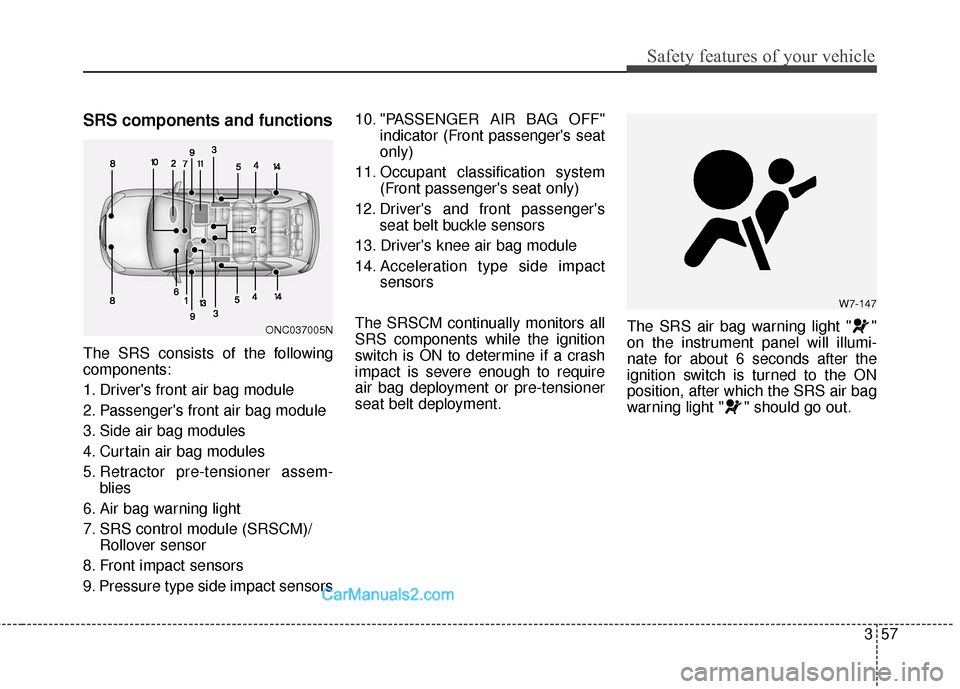
The SRS consists of the following
components:
1. Driver's front air bag module
2. Passenger's front air bag module
3. Side air bag modules
4. Curtain air bag modules
5. Retractor pre-tensioner assem-blies
6. Air bag warning light
7. SRS control module (SRSCM)/ Rollover sensor
8. Front impact sensors
9. Pressure type side impact sensors 10. "PASSENGER AIR BAG OFF"
indicator (Front passenger's seat
only)
11. Occupant classification system (Front passenger's seat only)
12. Driver's and front passenger's seat belt buckle sensors
13. Driver's knee air bag module
14. Acceleration type side impact sensors
The SRSCM continually monitors all
SRS components while the ignition
switch is ON to determine if a crash
impact is severe enough to require
air bag deployment or pre-tensioner
seat belt deployment. The SRS air bag warning light " "
on the instrument panel will illumi-
nate for about 6 seconds after the
ignition switch is turned to the ON
position, after which the SRS air bag
warning light " " should go out.
W7-147
ONC037005N