Lower Hyundai Santa Fe 2017 Manual PDF
[x] Cancel search | Manufacturer: HYUNDAI, Model Year: 2017, Model line: Santa Fe, Model: Hyundai Santa Fe 2017Pages: 569, PDF Size: 16.88 MB
Page 521 of 569
773
Maintenance
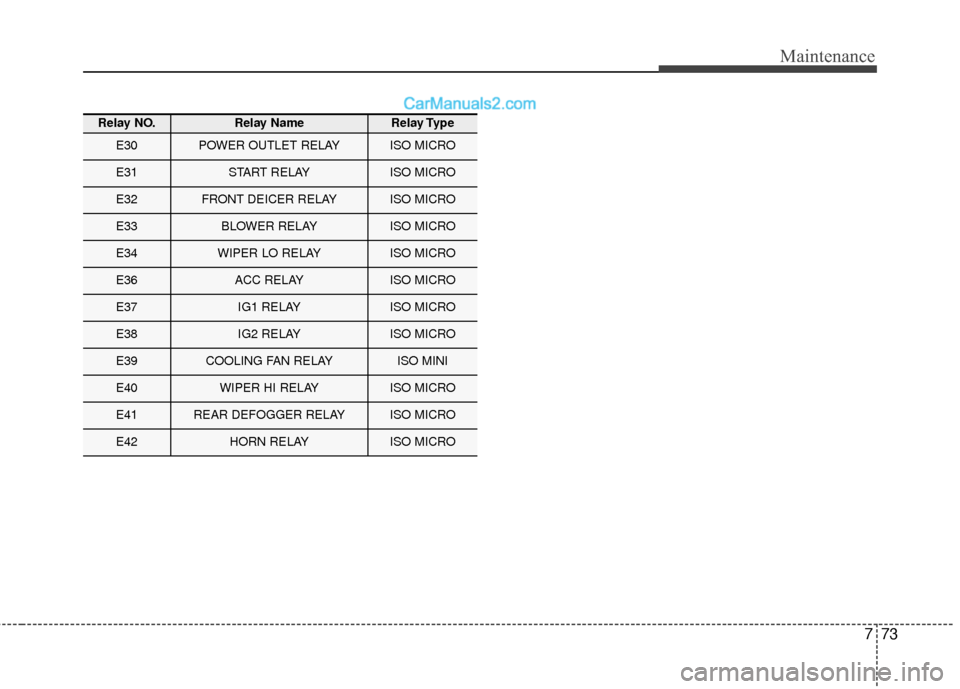
Relay NO.Relay NameRelay Type
E30POWER OUTLET RELAYISO MICRO
E31START RELAYISO MICRO
E32FRONT DEICER RELAYISO MICRO
E33BLOWER RELAYISO MICRO
E34WIPER LO RELAYISO MICRO
E36ACC RELAYISO MICRO
E37IG1 RELAYISO MICRO
E38IG2 RELAYISO MICRO
E39COOLING FAN RELAYISO MINI
E40WIPER HI RELAYISO MICRO
E41REAR DEFOGGER RELAYISO MICRO
E42HORN RELAYISO MICRO
Page 522 of 569
Maintenance
74
7
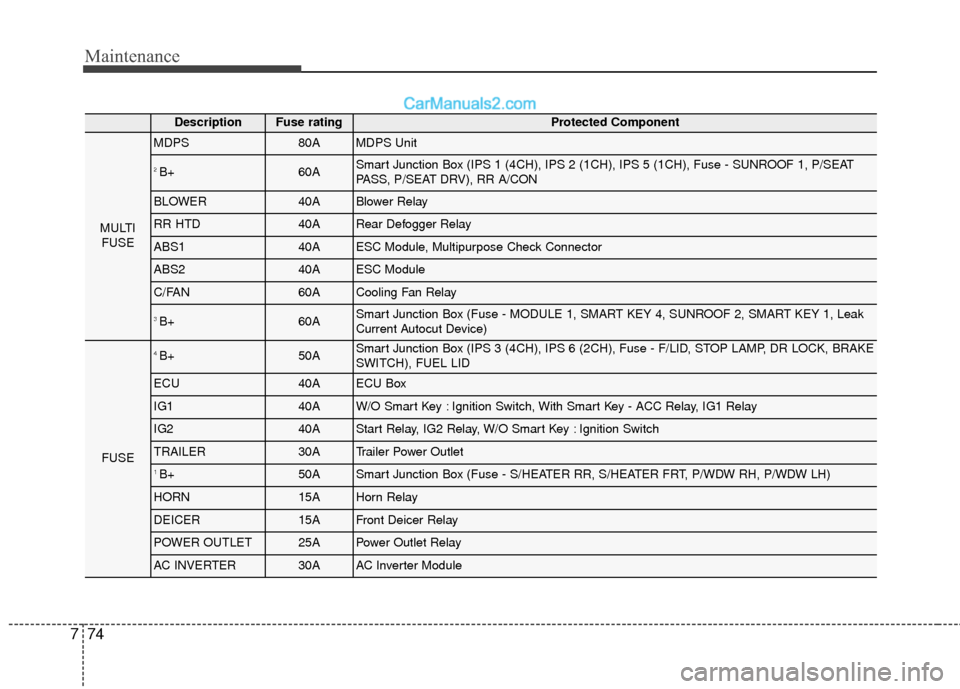
DescriptionFuse ratingProtected Component
MULTI
FUSE
MDPS80AMDPS Unit
2 B+60ASmart Junction Box (IPS 1 (4CH), IPS 2 (1CH), IPS 5 (1CH), Fuse - SUNROOF 1, P/SEAT
PASS, P/SEAT DRV), RR A/CON
BLOWER40ABlower Relay
RR HTD40ARear Defogger Relay
ABS140AESC Module, Multipurpose Check Connector
ABS240AESC Module
C/FAN60ACooling Fan Relay
3 B+60ASmart Junction Box (Fuse - MODULE 1, SMART KEY 4, SUNROOF 2, SMART KEY 1, Leak
Current Autocut Device)
FUSE
4 B+50ASmart Junction Box (IPS 3 (4CH), IPS 6 (2CH), Fuse - F/LID, STOP LAMP, DR LOCK, BRAKE
SWITCH), FUEL LID
ECU40AECU Box
IG140AW/O Smart Key : Ignition Switch, With Smart Key - ACC Relay, IG1 Relay
IG240AStart Relay, IG2 Relay, W/O Smart Key : Ignition Switch
TRAILER30ATrailer Power Outlet
1 B+50ASmart Junction Box (Fuse - S/HEATER RR, S/HEATER FRT, P/WDW RH, P/WDW LH)
HORN15AHorn Relay
DEICER15AFront Deicer Relay
POWER OUTLET25APower Outlet Relay
AC INVERTER30AAC Inverter Module
Page 535 of 569
787
Maintenance
APPEARANCE CARE
Exterior care
Exterior general caution
It is very important to follow the label
directions when using any chemical
cleaner or polish. Read all warning
and caution statements that appear
on the label.
High-pressure washing
When using high-pressure wash-ers, make sure to maintain suffi-
cient distance from the vehicle.
Insufficient clearance or excessive
pressure can lead to component
damage or water penetration.
Do not spray the camera, sensors or its surrounding area directly with
a high pressure washer. Shock
applied from high pressure water
may cause the device to not oper-
ate normally.
Do not bring the nozzle tip close to boots (rubber or plastic covers)or
connectors as they may be dam-
aged if they come into contact with
high pressure water.
Finish maintenance
Washing
To help protect your vehicle’s finish
from rust and deterioration, wash it
thoroughly and frequently at least
once a month with lukewarm or cold
water.
If you use your vehicle for off-road
driving, you should wash it after each
off-road trip. Pay special attention to
the removal of any accumulation of
salt, dirt, mud, and other foreign
materials. Make sure the drain holes
in the lower edges of the doors and
rocker panels are kept clear and
clean.
Insects, tar, tree sap, bird droppings,
industrial pollution and similar
deposits can damage your vehicle’s
finish if not removed immediately.
Even prompt washing with plain
water may not completely remove all
these deposits.
A mild soap, safe for use on painted
surfaces, may be used.
After washing, rinse the vehicle thor-
oughly with lukewarm or cold water.
Do not allow soap to dry on the fin-
ish.
WARNING - Wet brakes
After washing the vehicle, test
the brakes while driving slowly
to see if they have been affected
by water. If braking performance
is impaired, dry the brakes by
applying them lightly while main-
taining a slow forward speed.
CAUTION
Do not use strong soap, chem- ical detergents or hot water,and do not wash the vehicle indirect sunlight or when thebody of the vehicle is warm.
Be careful when washing the side windows of your vehicle.
Especially, with high-pressurewater, water may leak throughthe windows and wet the inte-rior.
To prevent damage to the plastic parts and lamps, donot clean with chemical sol-vents or strong detergents.
Page 537 of 569
789
Maintenance
Finish damage repair
Deep scratches or stone chips in the
painted surface must be repaired
promptly. Exposed metal will quickly
rust and may develop into a major
repair expense.
✽ ✽NOTICE
If your vehicle is damaged and
requires any metal repair or
replacement, be sure the body shop
applies anti-corrosion materials to
the parts repaired or replaced.
Bright-metal maintenance
To remove road tar and insects,
use a tar remover, not a scraper or
other sharp object.
To protect the surfaces of bright- metal parts from corrosion, apply a
coating of wax or chrome preser-
vative and rub to a high luster.
During winter weather or in coastal areas, cover the bright metal parts
with a heavier coating of wax or
preservative. If necessary, coat the
parts with non-corrosive petroleum
jelly or other protective compound.
Underbody maintenance
Corrosive materials used for ice and
snow removal and dust control may
collect on the underbody. If these
materials are not removed, acceler-
ated rusting can occur on underbody
parts such as the fuel lines, frame,
floor pan and exhaust system, even
though they have been treated with
rust protection.
Thoroughly flush the vehicle under-
body and wheel openings with luke-
warm or cold water once a month,
after off-road driving and at the end
of each winter. Pay special attention
to these areas because it is difficult
to see all the mud and dirt. It will do
more harm than good to wet down
the road grime without removing it.
The lower edges of doors, rocker
panels, and frame members have
drain holes that should not be
allowed to clog with dirt; trapped
water in these areas can cause rust-
ing.
Page 540 of 569
Maintenance
92
7
When cleaning lower door panels,
rocker panels and frame members,
be sure that drain holes are kept
open so that moisture can escape.
If these areas are not kept clear,
moisture could become trapped
and accelerate corrosion.
Keep your garage dry
Don't park your car in a damp or
poorly ventilated garage. This cre-
ates a favorable environment for cor-
rosion. This is particularly true if you
wash your car in the garage or drive
it into the garage when it is still wet or
covered with snow, ice or mud. Even
a heated garage can contribute to
corrosion unless it is well ventilated
so moisture can dispersed. Keep paint and trim in good con-
dition
Scratches or chips in the finish
should be covered with "touch-up"
paint as soon as possible to reduce
the possibility of corrosion. If bare
metal is showing, the attention of a
qualified body and paint shop is rec-
ommended.
Bird droppings : Bird droppings are
highly corrosive and may damage
painted surfaces in just a few hours.
Always remove bird droppings as
soon as possible.
Don't neglect the interior
Moisture can collect under the floor
mats and carpeting to cause corro-
sion. Check under the mats periodi-
cally to be sure the carpeting is dry.
Use particular care if you carry fertil-
izers, cleaning materials or chemi-
cals in the car.
These should be carried only in
proper containers and any spills or
leaks should be cleaned up, flushed
with clean water and thoroughly
dried.
Page 554 of 569
Specifications, Consumer information and Reporting safety defects
88
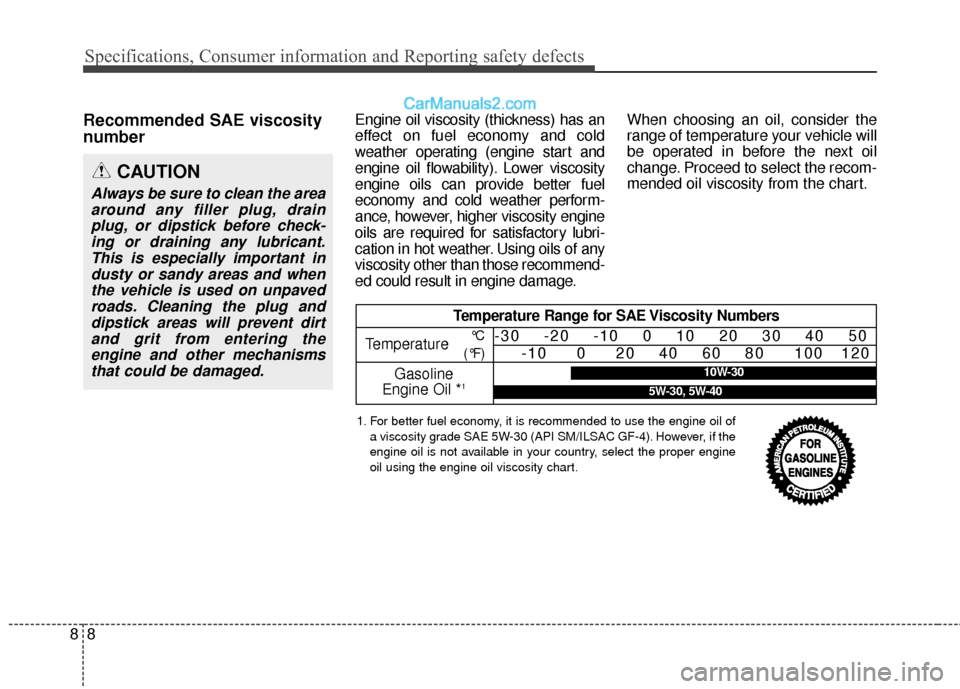
Recommended SAE viscosity
number Engine oil viscosity (thickness) has an
effect on fuel economy and cold
weather operating (engine start and
engine oil flowability). Lower viscosity
engine oils can provide better fuel
economy and cold weather perform-
ance, however, higher viscosity engine
oils are required for satisfactory lubri-
cation in hot weather. Using oils of any
viscosity other than those recommend-
ed could result in engine damage.When choosing an oil, consider the
range of temperature your vehicle will
be operated in before the next oil
change. Proceed to select the recom-
mended oil viscosity from the chart.
CAUTION
Always be sure to clean the area
around any filler plug, drainplug, or dipstick before check-ing or draining any lubricant.This is especially important industy or sandy areas and whenthe vehicle is used on unpavedroads. Cleaning the plug anddipstick areas will prevent dirtand grit from entering theengine and other mechanismsthat could be damaged.
Temperature Range for SAE Viscosity Numbers
Temperature
Gasoline
Engine Oil *
1
°C
(°F)-30 -20 -10 0 10 20 30 40 50 -10 0 20 40 60 80 100 120
10W-30
5W-30, 5W-40
1. For better fuel economy, it is recommended to use the engine oil of
a viscosity grade SAE 5W-30 (API SM/ILSAC GF-4). However, if the
engine oil is not available in your country, select the proper engine
oil using the engine oil viscosity chart.
Page 561 of 569
I3
Index
Hill-start Assist Control (HAC) ................................5-53
In the event of brake failure ......................................5-32
Parking brake ............................................................5-33
Power brakes .............................................................5-15
Vehicle Stability Management (VSM) ......................5-50
Bulb wattage ...................................................................8-3
California perchlorate notice ........................................7-98
Cargo security screen .................................................4-173
Center console storage................................................4-162
Central door lock switch...............................................4-23
Certification label .......................................................5-126
Changing tires ...............................................................6-18
Child restraint system ...................................................3-43 Securing a child restraint seat with child seat lower anchor system ..............................................3-51
Tether Anchor system................................................3-49
Using a child restraint system ...................................3-45
Child-protector rear door lock ......................................4-25
Cigarette lighter ..........................................................4-165
Climate control air filter ...............................................7-40
Clothes hanger ............................................................4-170
Consumer information ..................................................8-11
Cruise control system ...................................................5-67
Cup holder ..................................................................4-165
Curtain air bag ..............................................................3-72 Defroster .....................................................................4-1\
37
Front wiper deicer ...................................................4-138
Rear window defroster ............................................4-137
Dimensions .....................................................................8-2\
Door locks..............................................................\
.......4-21 Child-protector rear door lock ..................................4-25
Impact sensing door unlock system ..........................4-25
Operating door locks from inside the vehicle ...........4-23
Operating door locks from outside the vehicle .........4-21
Downhill Brake Control (DBC) ...................................5-51
Drive mode integrated control system .........................5-29
Driver assist system ....................................................4-113 Multi-view Camera System.....................................4-118
Rear parking assist system ......................................4-113
Rear View Camera ..................................................4-117
Driver position memory system ...................................3-16
Driver's and passenger's front air bag ..........................3-66
Driving conditions ......................................................5-103 Driving at night .......................................................5-106
Driving in flooded areas..........................................5-107
Driving in the rain ...................................................5-106
Driving off-road ......................................................5-107
Hazardous driving conditions .................................5-103
Highway driving......................................................5-107
Reducing the risk of a rollover ...............................5-103
C
D