tow Hyundai Santa Fe 2017 Owner's Manual
[x] Cancel search | Manufacturer: HYUNDAI, Model Year: 2017, Model line: Santa Fe, Model: Hyundai Santa Fe 2017Pages: 569, PDF Size: 16.88 MB
Page 7 of 569
1
2
3
4
5
6
7
8I
IntroductionHow to use this manual / Fuel requirements / Vehicle break-in process / Vehicle handling instructions /Vehicle data collection and event data recorders
Your vehicle at a glance
Exterior overview / Interior overview / Instrument panel overview / Engi\
ne compartment
Safety features of your vehicle
Seats / Seat belts / Child restraint system / Air bag
Features of your vehicleKeys / Door locks / Tailgate / Windows / Hood / Fuel filler lid / Panoramic sunroof / Steering wheel / Mirrors
/ Instrument cluster / Lighting / Wipers & Washers / Climate control system / Multimedia system / Etc.
Driving your vehicleBefore driving / Engine start/stop button / Transaxle / All Wheel Drive (AWD) / Brake system / Cruise con-
trol system / Blind Spot Detection System / Active ECO system / Winter driving / Vehicle load limit / Etc.
What to do in an emergencyRoad warning / Emergency while driving / Emergency starting / Engine overheat / TPMS / Flat tire / Towing / Etc.
MaintenanceEngine compartment / Maintenance service / Engine oil / Engine coolant /\
Brake fluid / Washer fluid /
Parking brake / Air cleaner / Wiper blades / Battery / Tire and wheels / Fuses / Light bulbs / Etc.
Specifications, Consumer information and Reporting safety defects
Index
table of contents
Page 17 of 569
23
Your vehicle at a glance
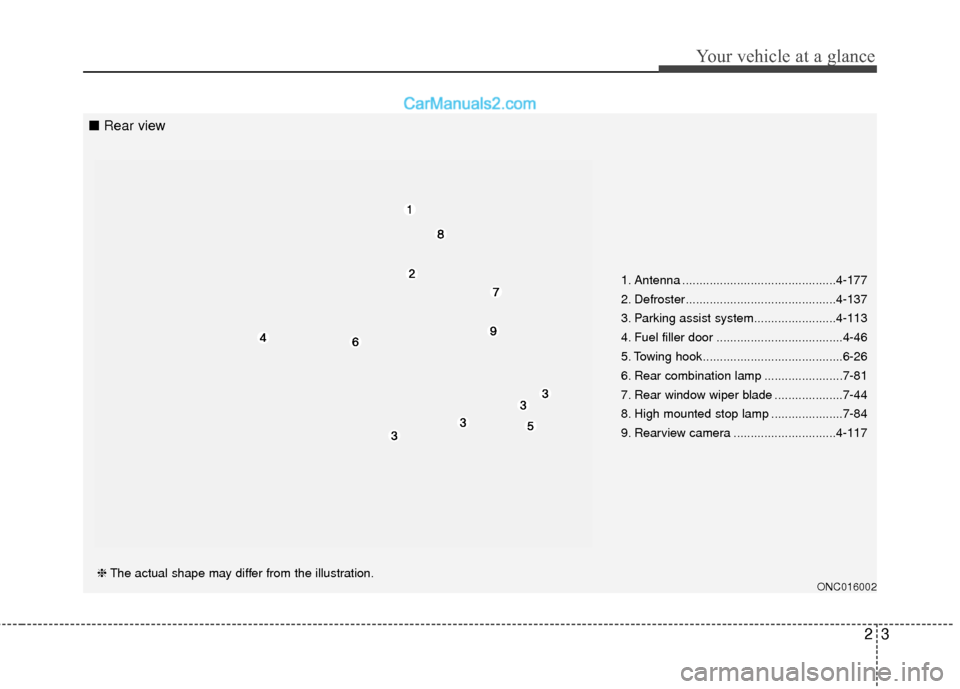
1. Antenna .............................................4-177
2. Defroster............................................4-137
3. Parking assist system........................4-113
4. Fuel filler door .....................................4-46
5. Towing hook.........................................6-26
6. Rear combination lamp .......................7-81
7. Rear window wiper blade ....................7-44
8. High mounted stop lamp .....................7-84
9. Rearview camera ..............................4-117
ONC016002❈The actual shape may differ from the illustration.
■ Rear view
Page 32 of 569
311
Safety features of your vehicle
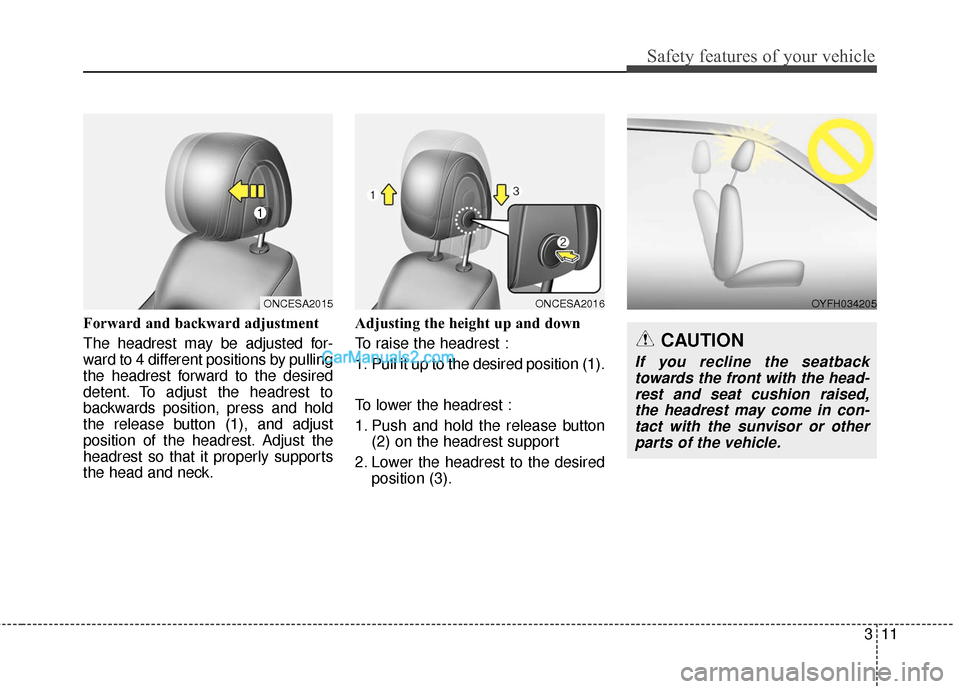
Forward and backward adjustment
The headrest may be adjusted for-
ward to 4 different positions by pulling
the headrest forward to the desired
detent. To adjust the headrest to
backwards position, press and hold
the release button (1), and adjust
position of the headrest. Adjust the
headrest so that it properly supports
the head and neck.Adjusting the height up and down
To raise the headrest :
1. Pull it up to the desired position (1).
To lower the headrest :
1. Push and hold the release button
(2) on the headrest support
2. Lower the headrest to the desired position (3).
ONCESA2016ONCESA2015OYFH034205
CAUTION
If you recline the seatbacktowards the front with the head-rest and seat cushion raised,the headrest may come in con-tact with the sunvisor or otherparts of the vehicle.
Page 47 of 569
Safety features of your vehicle
26
3
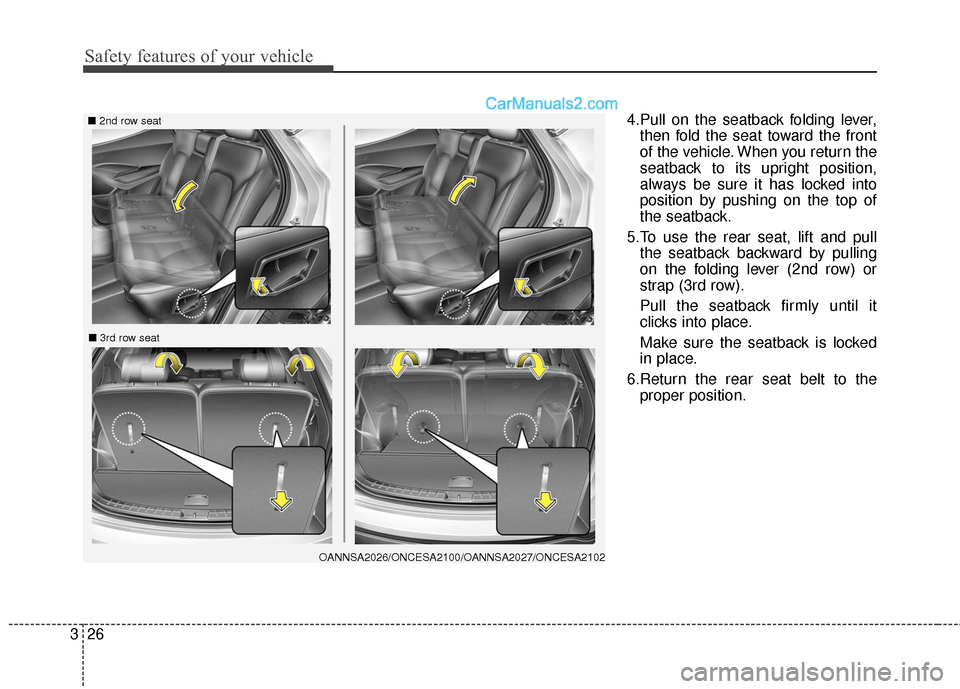
4.Pull on the seatback folding lever,
then fold the seat toward the front
of the vehicle. When you return the
seatback to its upright position,
always be sure it has locked into
position by pushing on the top of
the seatback.
5.To use the rear seat, lift and pull the seatback backward by pulling
on the folding lever (2nd row) or
strap (3rd row).
Pull the seatback firmly until it
clicks into place.
Make sure the seatback is locked
in place.
6.Return the rear seat belt to the proper position.■ 2nd row seat
■3rd row seat
OANNSA2026/ONCESA2100/OANNSA2027/ONCESA2102
Page 48 of 569
327
Safety features of your vehicle
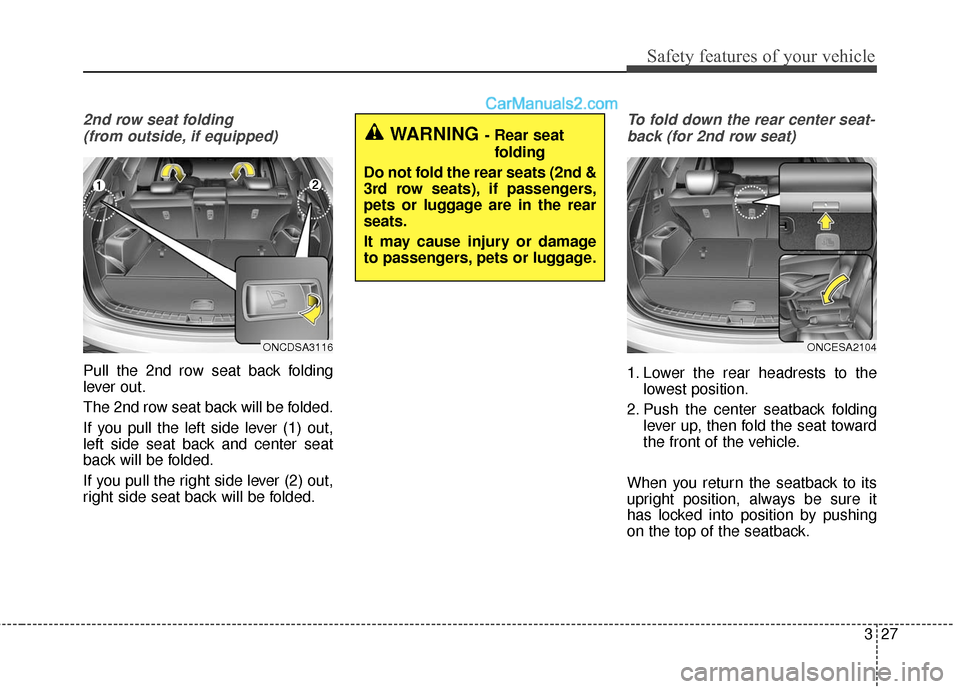
2nd row seat folding (from outside, if equipped)
Pull the 2nd row seat back folding
lever out.
The 2nd row seat back will be folded.
If you pull the left side lever (1) out,
left side seat back and center seat
back will be folded.
If you pull the right side lever (2) out,
right side seat back will be folded.
To fold down the rear center seat-back (for 2nd row seat)
1. Lower the rear headrests to the lowest position.
2. Push the center seatback folding lever up, then fold the seat toward
the front of the vehicle.
When you return the seatback to its
upright position, always be sure it
has locked into position by pushing
on the top of the seatback.
ONCDSA3116
WARNING - Rear seat folding
Do not fold the rear seats (2nd &
3rd row seats), if passengers,
pets or luggage are in the rear
seats.
It may cause injury or damage
to passengers, pets or luggage.
ONCESA2104
Page 56 of 569
335
Safety features of your vehicle
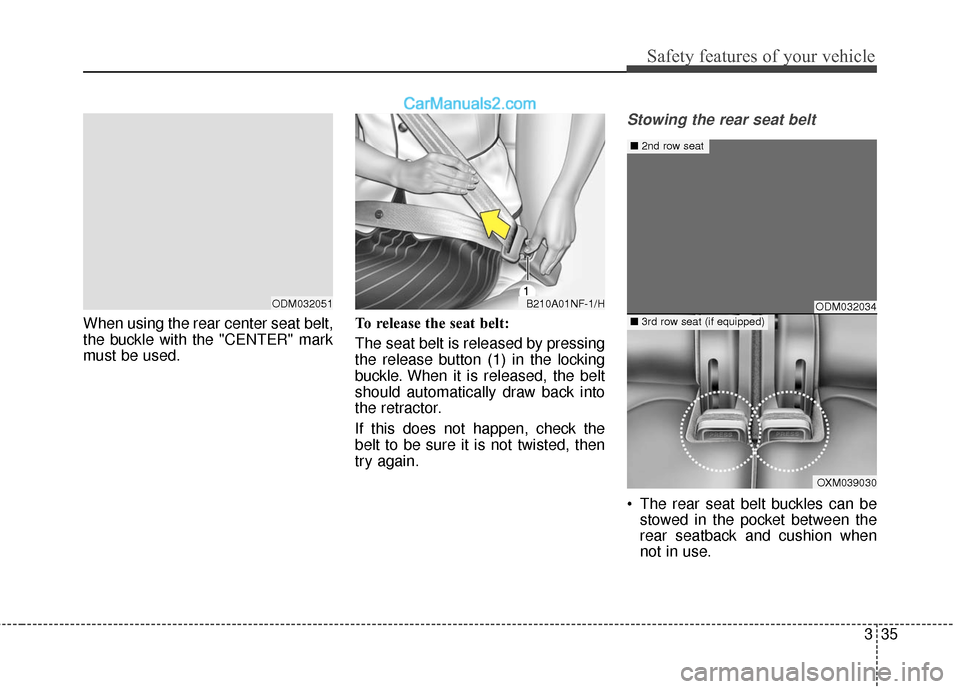
When using the rear center seat belt,
the buckle with the "CENTER" mark
must be used.To release the seat belt:
The seat belt is released by pressing
the release button (1) in the locking
buckle. When it is released, the belt
should automatically draw back into
the retractor.
If this does not happen, check the
belt to be sure it is not twisted, then
try again.
Stowing the rear seat belt
The rear seat belt buckles can be
stowed in the pocket between the
rear seatback and cushion when
not in use.
B210A01NF-1/HODM032034
OXM039030
■ 2nd row seat
■3rd row seat (if equipped)
ODM032051
Page 69 of 569
Safety features of your vehicle
48
3
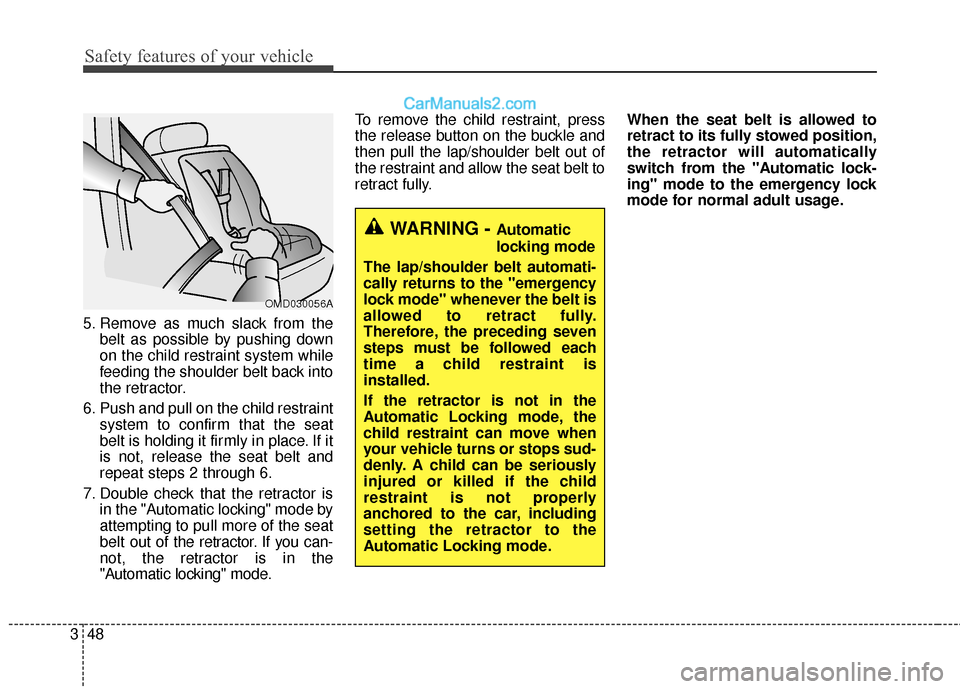
5. Remove as much slack from the
belt as possible by pushing down
on the child restraint system while
feeding the shoulder belt back into
the retractor.
6. Push and pull on the child restraint system to confirm that the seat
belt is holding it firmly in place. If it
is not, release the seat belt and
repeat steps 2 through 6.
7. Double check that the retractor is in the "Automatic locking" mode by
attempting to pull more of the seat
belt out of the retractor. If you can-
not, the retractor is in the
"Automatic locking" mode. To remove the child restraint, press
the release button on the buckle and
then pull the lap/shoulder belt out of
the restraint and allow the seat belt to
retract fully.
When the seat belt is allowed to
retract to its fully stowed position,
the retractor will automatically
switch from the "Automatic lock-
ing" mode to the emergency lock
mode for normal adult usage.
WARNING - Automatic
locking mode
The lap/shoulder belt automati-
cally returns to the "emergency
lock mode" whenever the belt is
allowed to retract fully.
Therefore, the preceding seven
steps must be followed each
time a child restraint is
installed.
If the retractor is not in the
Automatic Locking mode, the
child restraint can move when
your vehicle turns or stops sud-
denly. A child can be seriously
injured or killed if the child
restraint is not properly
anchored to the car, including
setting the retractor to the
Automatic Locking mode.
OMD030056A
Page 82 of 569
361
Safety features of your vehicle
Your vehicle is equipped with an
occupant classification system in the
front passenger's seat.
The occupant classification system
is designed to detect the presence of
a properly-seated front passenger
and determine if the passenger's
front air bag should be enabled (may
inflate) or not. The driver's front air
bag is not affected or controlled by
the occupant classification system.
Main components of occupant
classification system
A detection device located withinthe front passenger seat cushion.
Electronic system to determine whether the front passenger air
bag system should be activated or
deactivated.
An indicator light located on the instrument panel which illuminates
the words PASSENGER AIR BAG
"OFF" indicating the front passen-
ger air bag system is deactivated.
The instrument panel air bag indi- cator light is interconnected with
the occupant classification system. If the front passenger seat is occu-
pied by a person that the system
determines to be of adult size, and
he/she sits properly (sitting upright
with the seatback in an upright posi-
tion, centered on the seat cushion
with their seat belt on, legs comfort-
ably extended and their feet on the
floor), the PASSENGER AIR BAG
"OFF" indicator will be turned off and
the front passenger's air bag will be
able to inflate, if necessary, in frontal
crashes.
You will find the PASSENGER AIR
BAG "OFF" indicator on the center
facia panel. This system detects the
conditions 1~4 in the following table
and activates or deactivates the front
passenger air bag based on these
conditions.
Always be sure that you and all vehi-
cle occupants are seated and
restrained properly (sitting upright
with the seat in an upright position,
centered on the seat cushion, with
the person's legs comfortably
extended, feet on the floor, and wear-
ing the safety belt properly) for the
most effective protection by the air
bag and the safety belt. The OCS may not function proper-
ly if the passenger takes actions
which can affect the classification
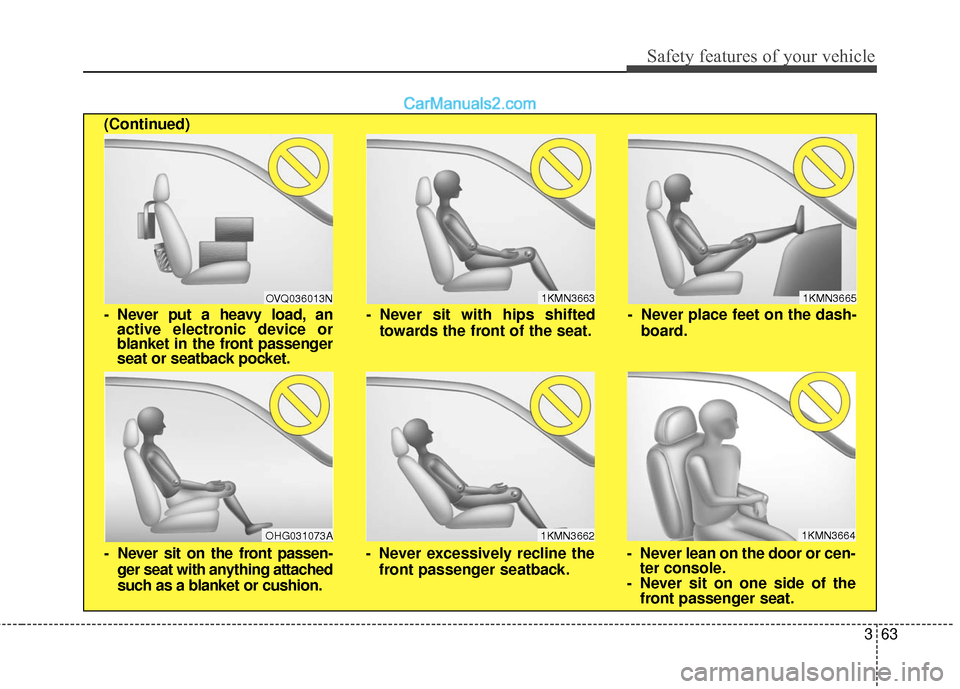
system. These include:
(1) Failing to sit in an upright posi- tion.
(2) Leaning against the door or center console.
(3) Sitting towards the sides or the front of the seat.
(4) Putting legs on the dashboard or resting them on other loca-
tions which reduce the passen-
ger weight on the front seat.
(5) Improperly wearing the safety belt.
(6) Reclining the seat back.
(7) Wearing a thick cloth like ski wear or hip protection wear.
(8) Put on the seat an additional thick cushion.
Page 84 of 569
363
Safety features of your vehicle
1KMN3663
1KMN3664
1KMN3665
- Never sit with hips shiftedtowards the front of the seat.
- Never lean on the door or cen-ter console.
- Never sit on one side of the front passenger seat.
- Never place feet on the dash-
board.
OVQ036013N
1KMN3662
- Never put a heavy load, anactive electronic device or
blanket in the front passenger
seat or seatback pocket.
- Never excessively recline thefront passenger seatback.
OHG031073A
- Never sit on the front passen-ger seat with anything attached
such as a blanket or cushion.
(Continued)
Page 90 of 569
369
Safety features of your vehicle
(Continued)
If the SRS air bag warninglight remains illuminated
while the vehicle is being driv-
en, have an authorized
HYUNDAI dealer inspect the
air bag system as soon as
possible.
Air bags can only be used once – have an authorized
HYUNDAI dealer replace the
air bag immediately after
deployment.
The SRS is designed to deploy the front air bags only
when frontal impact is suffi-
ciently severe and when the
impact angle is toward from
the forward longitudinal axis
of the vehicle. Additionally,
the air bags will only deploy
once. Seat belts must be worn
at all times.
(Continued)(Continued)
No objects should be placedover or near the air bag mod-
ules on the steering wheel,
instrument panel, and the
front passenger's panel above
the glove box, because any
such object could cause harm
if the vehicle is in a crash
severe enough to cause the
air bags to deploy.
Never place covers, blankets or seat warmers on the pas-
senger seat as these may
interfere with the occupant
classification system.
Do not tamper with or discon- nect SRS wiring or other com-
ponents of the SRS system.
Doing so could result in
injury, due to accidental
deployment of the air bags or
by rendering the SRS inopera-
tive.
(Continued)(Continued)
Front and side air bags caninjure occupants improperly
positioned in the front seats.
Move your seat as far back as practical from the front air
bags, while still maintaining
control of the vehicle.
You and your passengers should never sit or lean
unnecessarily close to the air
bags. Improperly positioned
driver and passengers can be
severely injured by inflating
air bags.
Never lean against the door or center console – always sit in
an upright position.
Do not allow a passenger to ride in the front seat when the
PASSENGER AIR BAG "OFF"
indicator is illuminated,
because the air bag will not
deploy in the event of a mod-
erate or severe frontal crash.
(Continued)