Engine cooling HYUNDAI SANTA FE 2021 User Guide
[x] Cancel search | Manufacturer: HYUNDAI, Model Year: 2021, Model line: SANTA FE, Model: HYUNDAI SANTA FE 2021Pages: 636, PDF Size: 81.2 MB
Page 526 of 636
Emergency situations
8-8
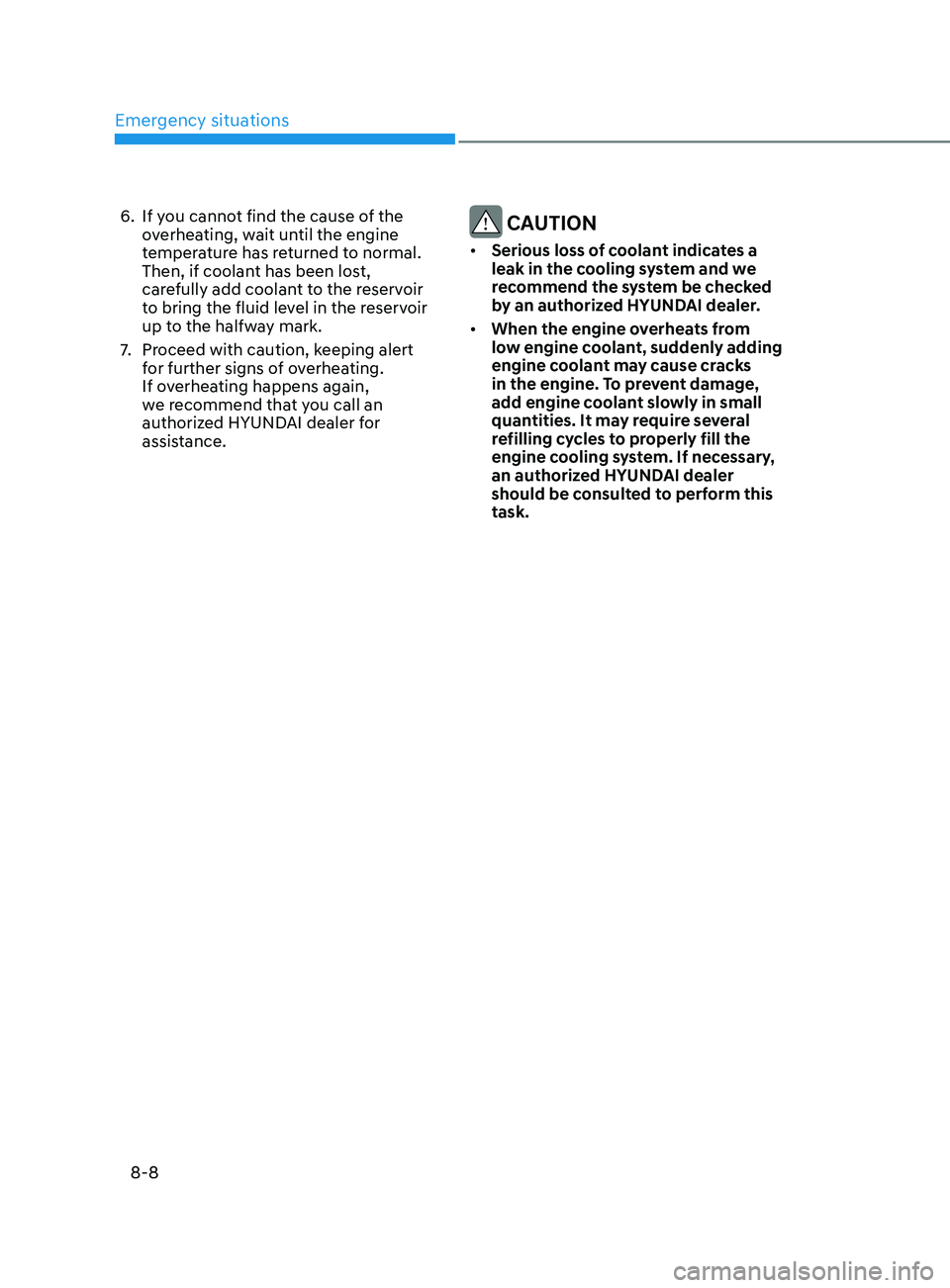
6. If you cannot find the cause of the
overheating, wait until the engine
temperature has returned to normal.
Then, if coolant has been lost,
carefully add coolant to the reservoir
to bring the fluid level in the reservoir
up to the halfway mark.
7.
Proceed with caution, k
eeping alert
for further signs of overheating.
If overheating happens again,
we recommend that you call an
authorized HYUNDAI dealer for
assistance. CAUTION
• Serious loss of coolant indicates a
leak in the cooling system and we
recommend the system be checked
by an authorized HYUNDAI dealer.
• When the engine overheats from
low engine coolant, suddenly adding
engine coolant may cause cracks
in the engine. To prevent damage,
add engine coolant slowly in small
quantities. It may require several
refilling cycles to properly fill the
engine cooling system. If necessary,
an authorized HYUNDAI dealer
should be consulted to perform this
task.
Page 560 of 636
Maintenance
9-10
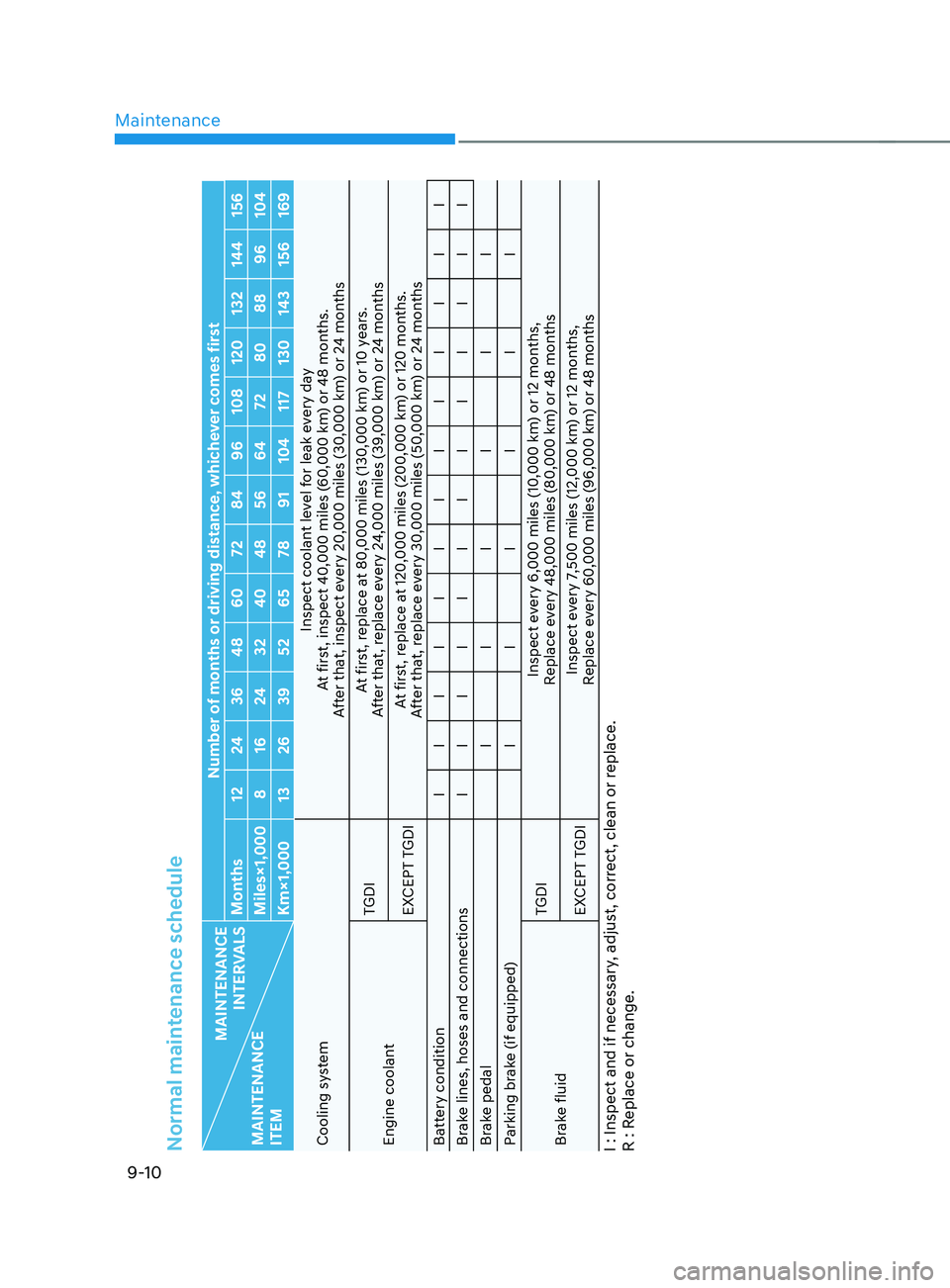
Normal maintenance schedule
MAINTENANCE INTERVALS
MAINTENANCE
ITEM Number of months or driving distance, whichever comes first
Months 12 24 36 48 60 72 84 96 108 120 132 144 156
Miles×1,000 8 16 24 32 40 48 56 64 72 80 88 96 104
Km×1,000 13 26 39 52 65 78 91 104 117 130 143 156 169
Cooling system Inspect coolant level for leak every day
At first, inspect 40,000 miles (60,000 km) or 48 months.
After that, inspect every 20,000 miles (30,000 km) or 24 months
Engine coolant TGDI
At first, replace at 80,000 miles (130,000 km) or 10 years.
After that, replace every 24,000 miles (39,000 km) or 24 months
EXCEPT TGDI At first, replace at 120,000 miles (200,000 km) or 120 months.
After that, replace every 30,000 miles (50,000 km) or 24 months
Battery condition I I I I I I I I I I I I I
Brake lines, hoses and connections I I I I I I I I I I I I I
Brake pedal IIIIII
Parking brake (if equipped) IIIIII
Brake fluid TGDI
Inspect every 6,000 miles (10,000 km) or 12 months,
Replace every 48,000 miles (80,000 km) or 48 months
EXCEPT TGDI Inspect every 7,500 miles (12,000 km) or 12 months,
Replace every 60,000 miles (96,000 km) or 48 monthsI : Inspect and if necessary, adjust, correct, clean or replace.
R : Replace or change.
Page 561 of 636
09
9-11
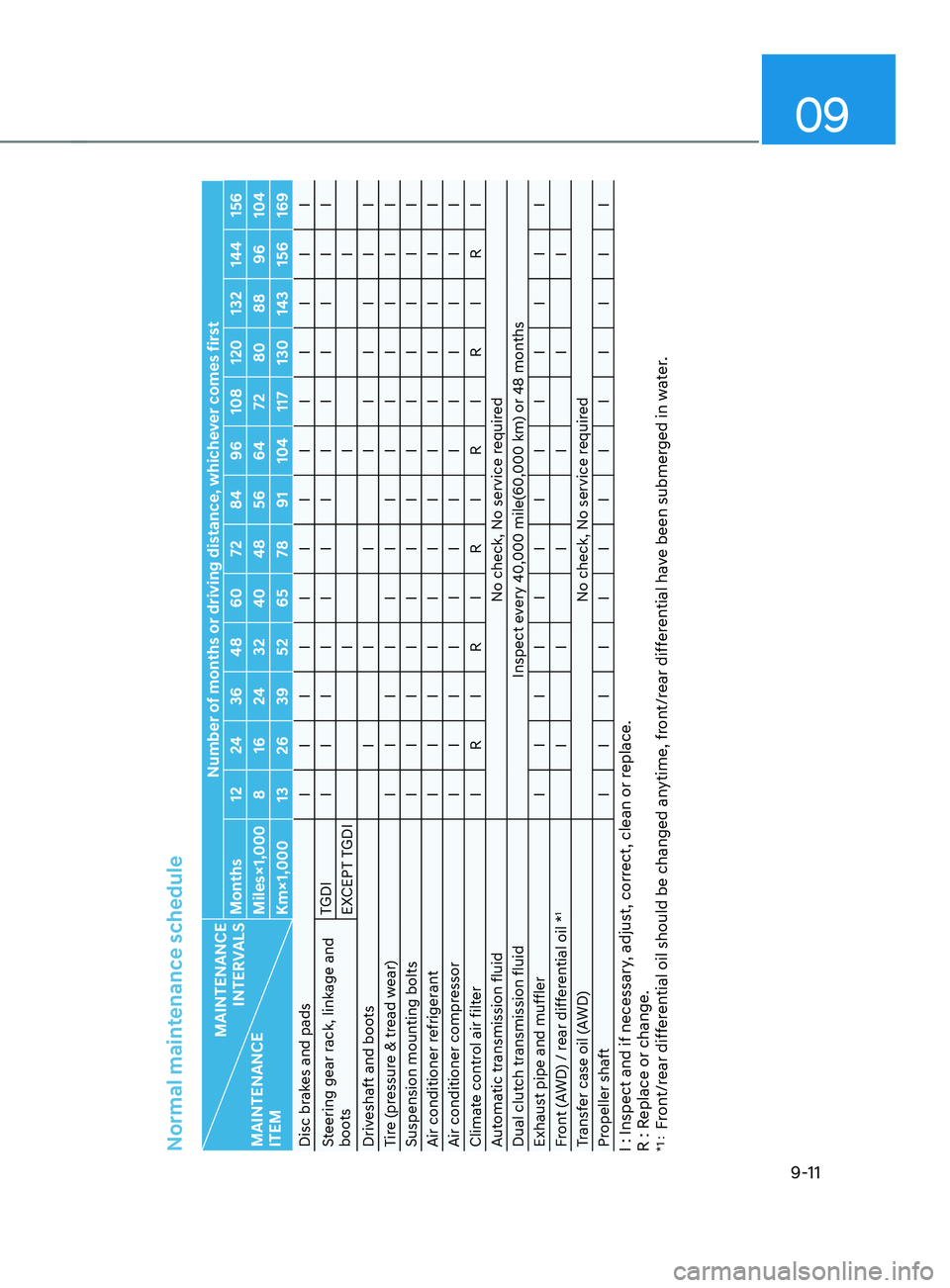
Normal maintenance schedule
MAINTENANCE INTERVALS
MAINTENANCE
ITEM Number of months or driving distance, whichever comes first
Months 12 24 36 48 60 72 84 96 108 120 132 144 156
Miles×1,000 8 16 24 32 40 48 56 64 72 80 88 96 104
Km×1,000 13 26 39 52 65 78 91 104 117 130 143 156 169
Cooling system Inspect coolant level for leak every day
At first, inspect 40,000 miles (60,000 km) or 48 months.
After that, inspect every 20,000 miles (30,000 km) or 24 months
Engine coolant TGDI
At first, replace at 80,000 miles (130,000 km) or 10 years.
After that, replace every 24,000 miles (39,000 km) or 24 months
EXCEPT TGDI At first, replace at 120,000 miles (200,000 km) or 120 months.
After that, replace every 30,000 miles (50,000 km) or 24 months
Battery condition I I I I I I I I I I I I I
Brake lines, hoses and connections I I I I I I I I I I I I I
Brake pedal IIIIII
Parking brake (if equipped) IIIIII
Brake fluid TGDI
Inspect every 6,000 miles (10,000 km) or 12 months,
Replace every 48,000 miles (80,000 km) or 48 months
EXCEPT TGDI Inspect every 7,500 miles (12,000 km) or 12 months,
Replace every 60,000 miles (96,000 km) or 48 monthsI : Inspect and if necessary, adjust, correct, clean or replace.
R : Replace or change.Normal maintenance schedule
MAINTENANCE
INTERVALS
MAINTENANCE
ITEM Number of months or driving distance, whichever comes first
Months 12 24 36 48 60 72 84 96 108 120 132 144 156
Miles×1,000 8 16 24 32 40 48 56 64 72 80 88 96 104
Km×1,000 13 26 39 52 65 78 91 104 117 130 143 156 169
Disc brakes and pads I I I I I I I I I I I I I
Steering gear rack, linkage and
boots TGDI
I I I I I I I I I I I I I
EXCEPT TGDI III
Driveshaft and boots IIII I I I I I
Tire (pressure & tread wear) I I I I I I I I I I I I I
Suspension mounting bolts I I I I I I I I I I I I I
Air conditioner refrigerant I I I I I I I I I I I I I
Air conditioner compressor I I I I I I I I I I I I I
Climate control air filter I R I R I R I R I R I R I
Automatic transmission fluid No check, No service required
Dual clutch transmission fluid Inspect every 40,000 mile(60,000 km) or 48 months
Exhaust pipe and muffler I I I I I I I I I I I I I
Front (AWD) / rear differential oil *
1
I IIIII
Transfer case oil (AWD) No check, No service required
Propeller shaft I I I I I I I I I I I I I
I : Inspect and if necessary, adjust, correct, clean or replace.
R : Replace or change.*1 : Front/rear differential oil should be changed anytime, front/rear differential have been submerged in water.
Page 565 of 636
09
9-15
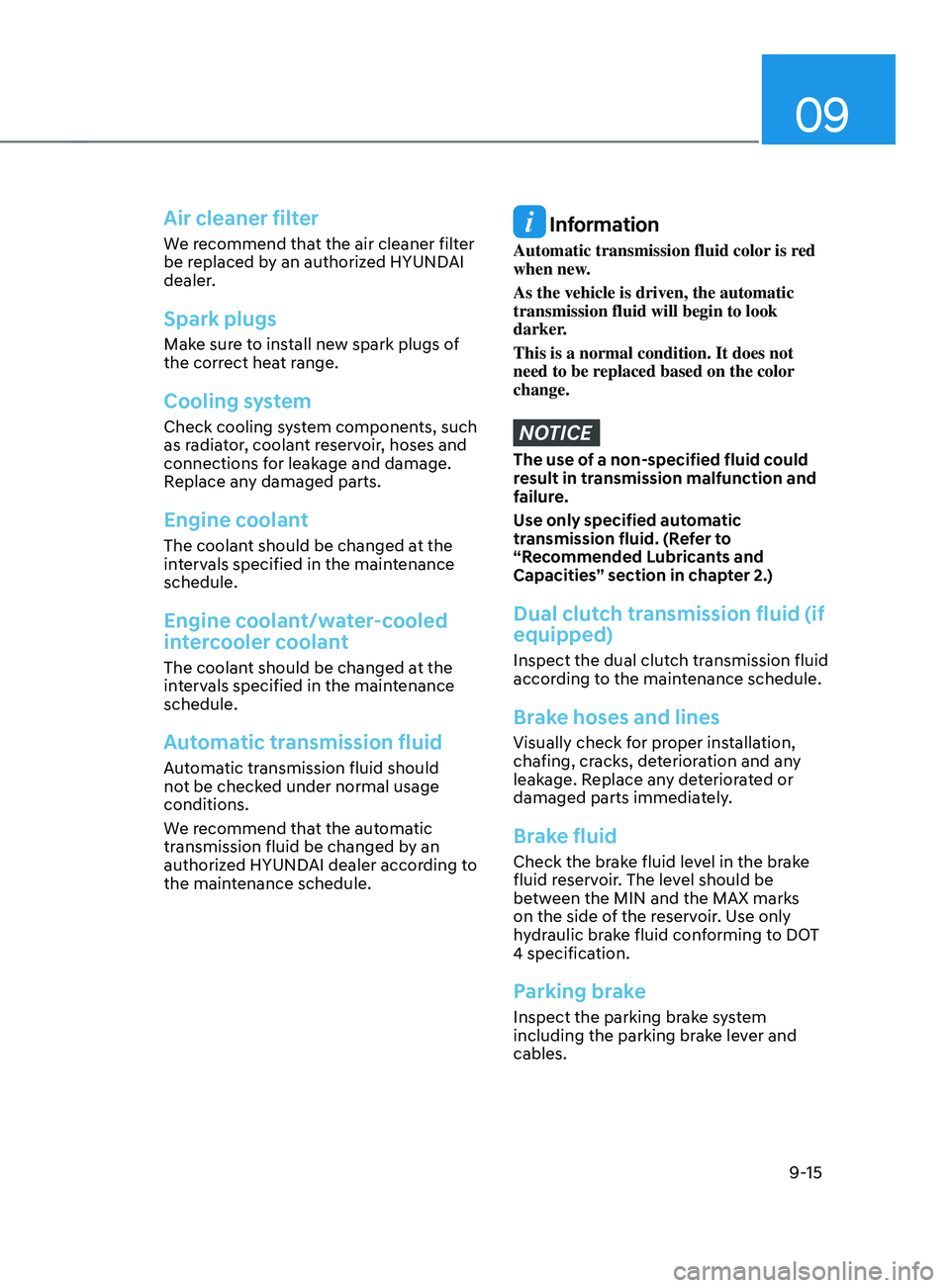
Air cleaner filter
We recommend that the air cleaner filter
be replaced by an authorized HYUNDAI
dealer.
Spark plugs
Make sure to install new spark plugs of
the correct heat range.
Cooling system
Check cooling system components, such
as radiator, coolant reservoir, hoses and
connections for leakage and damage.
Replace any damaged parts.
Engine coolant
The coolant should be changed at the
intervals specified in the maintenance
schedule.
Engine coolant/water-cooled
intercooler coolant
The coolant should be changed at the
intervals specified in the maintenance
schedule.
Automatic transmission fluid
Automatic transmission fluid should
not be checked under normal usage
conditions.
We recommend that the automatic
transmission fluid be changed by an
authorized HYUNDAI dealer according to
the maintenance schedule.
Information
Automatic transmission fluid color is red
when new.
As the vehicle is driven, the automatic
transmission fluid will begin to look
darker.
This is a normal condition. It does not
need to be replaced based on the color
change.
NOTICE
The use of a non-specified fluid could
result in transmission malfunction and
failure.
Use only specified automatic
transmission fluid. (Refer to
“Recommended Lubricants and
Capacities” section in chapter 2.)
Dual clutch transmission fluid (if
equipped)
Inspect the dual clutch transmission fluid
according to the maintenance schedule.
Brake hoses and lines
Visually check for proper installation,
chafing, cracks, deterioration and any
leakage. Replace any deteriorated or
damaged parts immediately.
Brake fluid
Check the brake fluid level in the brake
fluid reservoir. The level should be
between the MIN and the MAX marks
on the side of the reservoir. Use only
hydraulic brake fluid conforming to DOT
4 specification.
Parking brake
Inspect the parking brake system
including the parking brake lever and
cables.
Page 568 of 636
Maintenance
9-18
EngInE COOLAnT /LIQUID-COOLED InTERCOOLER
COOLANT
The high-pressure cooling system has a
reservoir filled with year-round antifreeze
coolant. The reservoir is filled at the
factory.
Check the antifreeze protection and
coolant level at least once a year, at
the beginning of the winter season and
before traveling to a colder climate.
Checking the coolant level
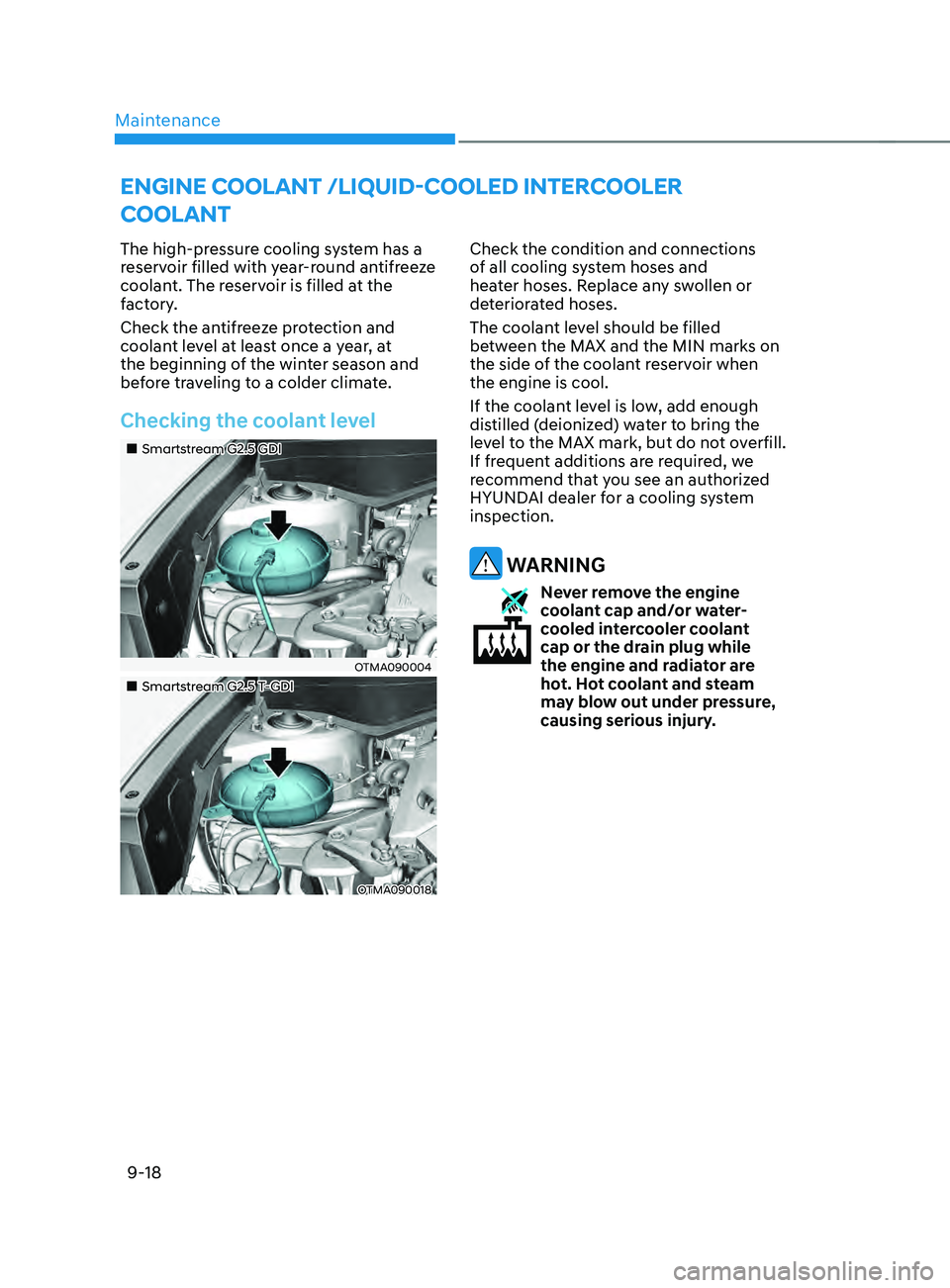
„„Smartstream G2.5 GDI
OTMA090004
„„Smartstream G2.5 T-GDI
OTMA090018
Check the condition and connections
of all cooling system hoses and
heater hoses. Replace any swollen or
deteriorated hoses.
The coolant level should be filled
between the MAX and the MIN marks on
the side of the coolant reservoir when
the engine is cool.
If the coolant level is low, add enough
distilled (deionized) water to bring the
level to the MAX mark, but do not overfill.
If frequent additions are required, we
recommend that you see an authorized
HYUNDAI dealer for a cooling system
inspection.
WARNING
Never remove the engine
coolant cap and/or water-
cooled intercooler coolant
cap or the drain plug while
the engine and radiator are
hot. Hot coolant and steam
may blow out under pressure,
causing serious injury.
Page 569 of 636
09
9-19
Turn the vehicle off and wait until the
engine cools down. Use extreme care
when removing the engine coolant
cap and/or water-cooled intercooler
coolant cap. Wrap a thick towel around
it, and turn it counterclockwise slowly
to the first stop. Step back while the
pressure is released from the cooling
system. When you are sure all the
pressure has been released, press down
on the cap, using a thick towel, and
continue turning counterclockwise to
remove it.
Information
The coolant level is influenced by the
engine temperature. Before checking or
refilling the coolant, turn the engine off.
WARNING
The electric motor for the cooling fan
may continue to operate or start up
when the engine is not running and
can cause serious injury. Keep hands,
clothing and tools away from the
rotating fan blades of the cooling fan.
Always turn off the vehicle unless the
vehicle has to be inspected with the
engine on. Be cautious as the cooling
fan may operate if the negative (-)
battery terminal is not disconnected.
WARNING
Make sure the coolant cap is properly
closed after refilling coolant. Otherwise
the engine could be overheated while
driving.
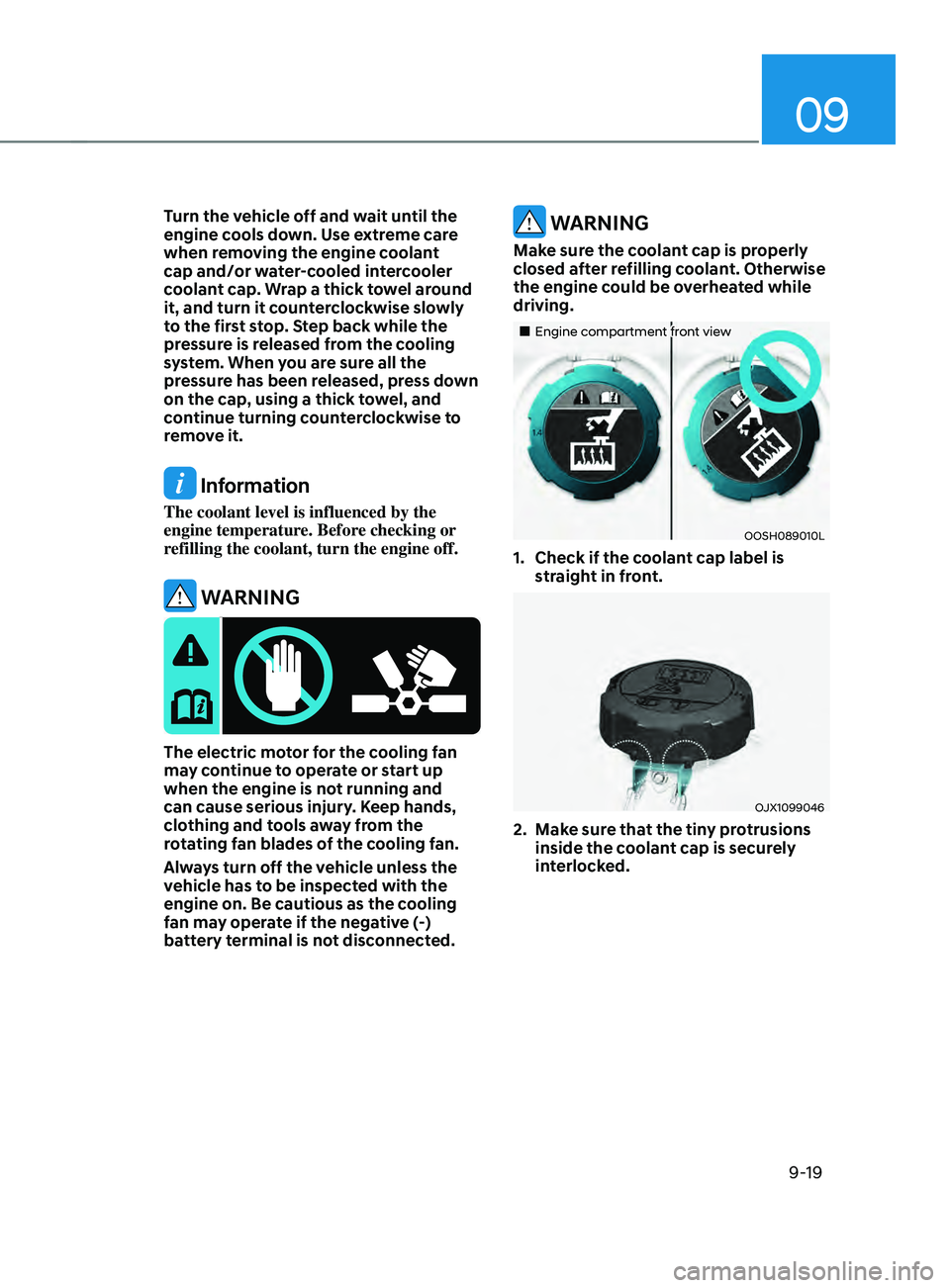
„„Engine compartment front view
OOSH089010L
1. Check if the coolant cap label is
straight in front.
OJX1099046
2. Make sure that the tiny protrusions
inside the c oolant cap is securely
interlocked.
Page 598 of 636
![HYUNDAI SANTA FE 2021 User Guide Maintenance
9-48
Engine compartment fuse panel (Engine room junction block)
Type Fuse NameFuse
Rating Circuit Protected
MULTI
FUSE 1 (10P) COOLING FAN1
80A
[BLDC 600W] Cooling Fan Controller
COOLIN](/img/35/41163/w960_41163-597.png "HYUNDAI SANTA FE 2021 User Guide Maintenance
9-48
Engine compartment fuse panel (Engine room junction block)
Type Fuse NameFuse
Rating Circuit Protected
MULTI
FUSE 1 (10P) COOLING FAN1
80A
[BLDC 600W] Cooling Fan Controller
COOLIN")
Maintenance
9-48
Engine compartment fuse panel (Engine room junction block)
Type Fuse NameFuse
Rating Circuit Protected
MULTI
FUSE 1 (10P) COOLING FAN1
80A
[BLDC 600W] Cooling Fan Controller
COOLING FAN2 60A
[BLDC 400W] Cooling Fan Controller
B+4 50AICU Junction Block (Fuse - MODULE8,
SUNROOF1, AMP, P/WINDOW RH, S/HEATER
DRV/PASS)
B+2 50AICU Junction Block (IPS 8 SPOC+/IPS 10/IPS 11/
IPS 13/IPS 14/IPS 15)
B+3 50AICU Junction Block (Fuse - E-SHIFTER1, P/
SEAT (DRV, P/SEAT (PASS), P/WINDOW LH, RR
SEAT(LH))
BLOWER 40A
Blower Relay
IG2 40A
Start Relay, PCB Block (PDM (IG2) Relay)
ABS 2 30A
ESC Module
MULTI
FUSE 2 (10P) MDPS
100A MDPS Unit
ABS 3 60A
ESC Module
B+6 60A
PCB Block (B+)
DCT 60A
TCM
E-CVVT1 50A
PCB Block (E-CVVT Relay)
REAR HEATED 40A
Rear Heated Relay
INVERTER 40A
AC Inverter Module
E-SHIFTER 1 40A
SCU
FUSE HEATED
MIRROR 10A
Rear Heated Relay, Driver/Passenger Outside
Mirror, Front A/C Control Module
E-CVVT3 20A
PCM, PCB Block (E-CVVT Relay)
E-CVVT2 20A
PCM, PCB Block (E-CVVT Relay)
A/C2 10A
Blower Relay, Front A/C Control Module
VACUUM PUMP2 10A
ESC Module, Vacuum Pump Relay, Vacuum Pump
B+5 50AICU Junction Block (Fuse - DOOR LOCK,
IBU1, IBU2, BRAKE SWITCH, CHILD LOCK, RR
SEAT(RH), SUNROOF2)
EOP2 60A
[G4KP] Electronic Oil Pump
Page 600 of 636
Maintenance
9-50
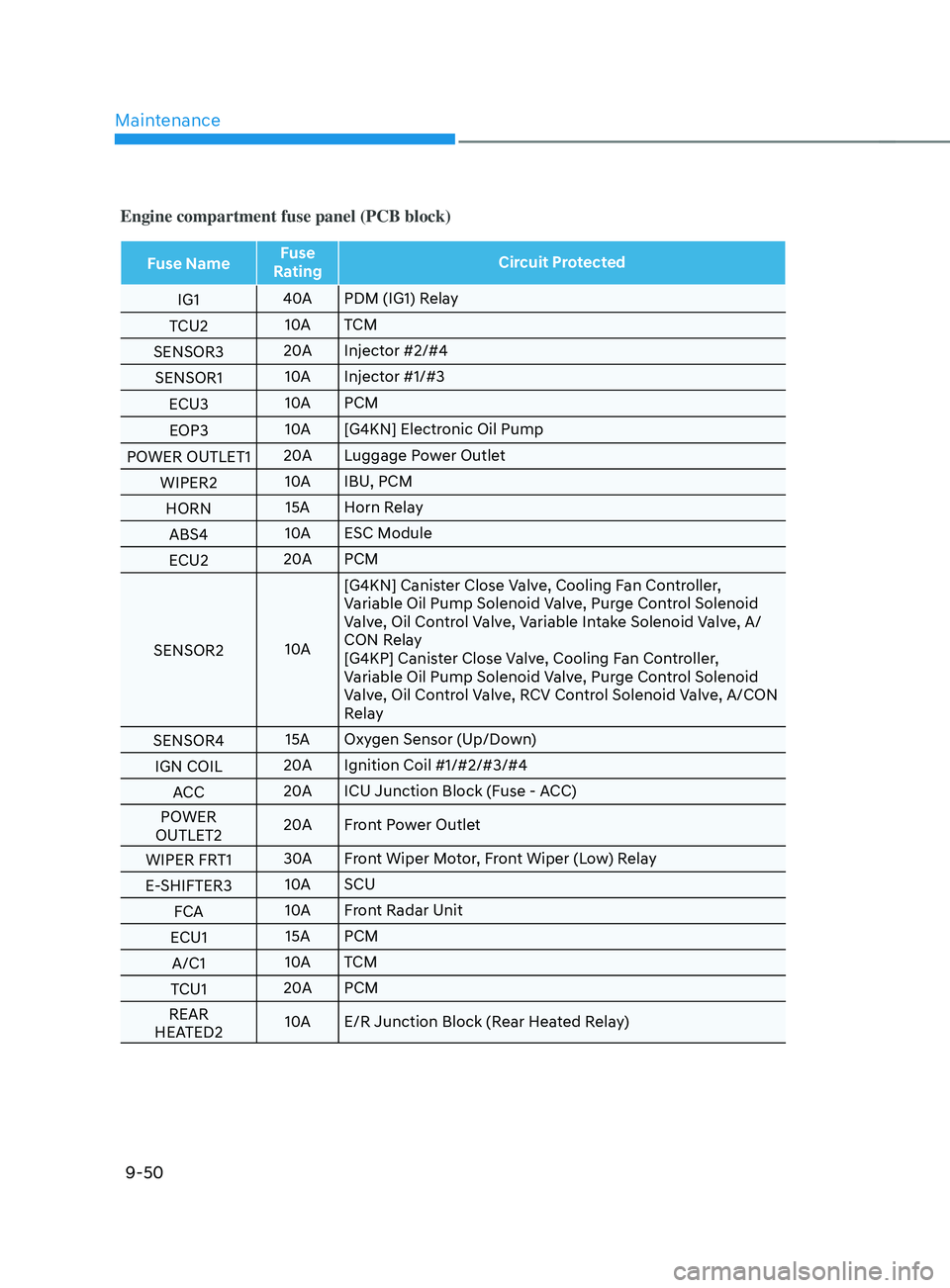
Engine compartment fuse panel (PCB block)
Fuse NameFuse
Rating Circuit Protected
IG1 40A
PDM (IG1) Relay
TCU2 10A
TCM
SENSOR3 20A
Injector #2/#4
SENSOR1 10A
Injector #1/#3
ECU3 10A
PCM
EOP3 10A
[G4KN] Electronic Oil Pump
POWER OUTLET1 20A
Luggage Power Outlet
WIPER2 10A
IBU, PCM
HORN 15A Horn Relay
ABS4 10A
ESC Module
ECU2 20A
PCM
SENSOR2 10A[G4KN] Canister Close Valve, Cooling Fan Controller,
Variable Oil Pump Solenoid Valve, Purge Control Solenoid
Valve, Oil Control Valve, Variable Intake Solenoid Valve, A/
CON Relay
[G4KP] Canister Close Valve, Cooling Fan Controller,
Variable Oil Pump Solenoid Valve, Purge Control Solenoid
Valve, Oil Control Valve, RCV Control Solenoid Valve, A/CON
Relay
SENSOR4 15A Oxygen Sensor (Up/Down)
IGN COIL 20A
Ignition Coil #1/#2/#3/#4
ACC 20A
ICU Junction Block (Fuse - ACC)
POWER
OUTLET2 20A
Front Power Outlet
WIPER FRT1 30A
Front Wiper Motor, Front Wiper (Low) Relay
E-SHIFTER3 10A
SCU
FCA 10A
Front Radar Unit
ECU1 15A PCM
A/C1 10A
TCM
TCU1 20A
PCM
REAR
HEATED2 10A
E/R Junction Block (Rear Heated Relay)