trailer HYUNDAI SANTA FE 2021 Owner's Guide
[x] Cancel search | Manufacturer: HYUNDAI, Model Year: 2021, Model line: SANTA FE, Model: HYUNDAI SANTA FE 2021Pages: 636, PDF Size: 81.2 MB
Page 503 of 636
07
7-121
WARNING
Take the following precautions when
using Reverse Parking Collision-
Avoidance Assist:
• Always pay extreme caution while
driving. The driver is responsible for
controlling the brake for safe driving.
• Always pay attention to road and
traffic conditions while driving,
whether or not there is a warning.
• Always look around your vehicle to
make sure there are no pedestrians
or objects before moving the vehicle.
• The performance of Reverse Parking
Collision-Avoidance Assist may
vary under certain conditions. If
vehicle speed is above 2 mph (4
km/h), the system will provide
collision avoidance assist only when
pedestrians are detected. Always
look around and pay attention when
backing up your vehicle.
• Some objects may not be detected
by the rear ultrasonic sensors due
to the objects distance, size or
material, all of which can limit the
effectiveness of the sensor.
• Reverse Parking Collision-Avoidance
Assist may not operate properly
or may operate unnecessarily
depending on the road conditions
and the surroundings.
• Do not solely rely on the system.
Doing so may lead to vehicle damage
or injuries.
CAUTION
• Noise may be heard when sudden
braking occurs to avoid a collision.
• If any other warning sound such
as the seat belt warning chime is
already generated, Reverse Parking
Collision-Avoidance Assist warning
may not sound.
• The system may not work properly
if the bumper has been damaged,
replaced or repaired.
• Reverse Parking Collision-Avoidance
Assist may not operate normally if
interfered by strong electromagnetic
waves.
• Playing the vehicle audio system at
high volume may prevent passengers
from hearing Reverse Parking
Collision-Avoidance Assist warning
sounds.
• Turn off Reverse Parking Collision-
Avoidance Assist when towing a
trailer. If towing and moving in
reverse, Reverse Parking Collision-
Avoidance Assist will activate as it
detects the trailer.
Page 514 of 636
Driver assistance system
7-132
OTM070221L
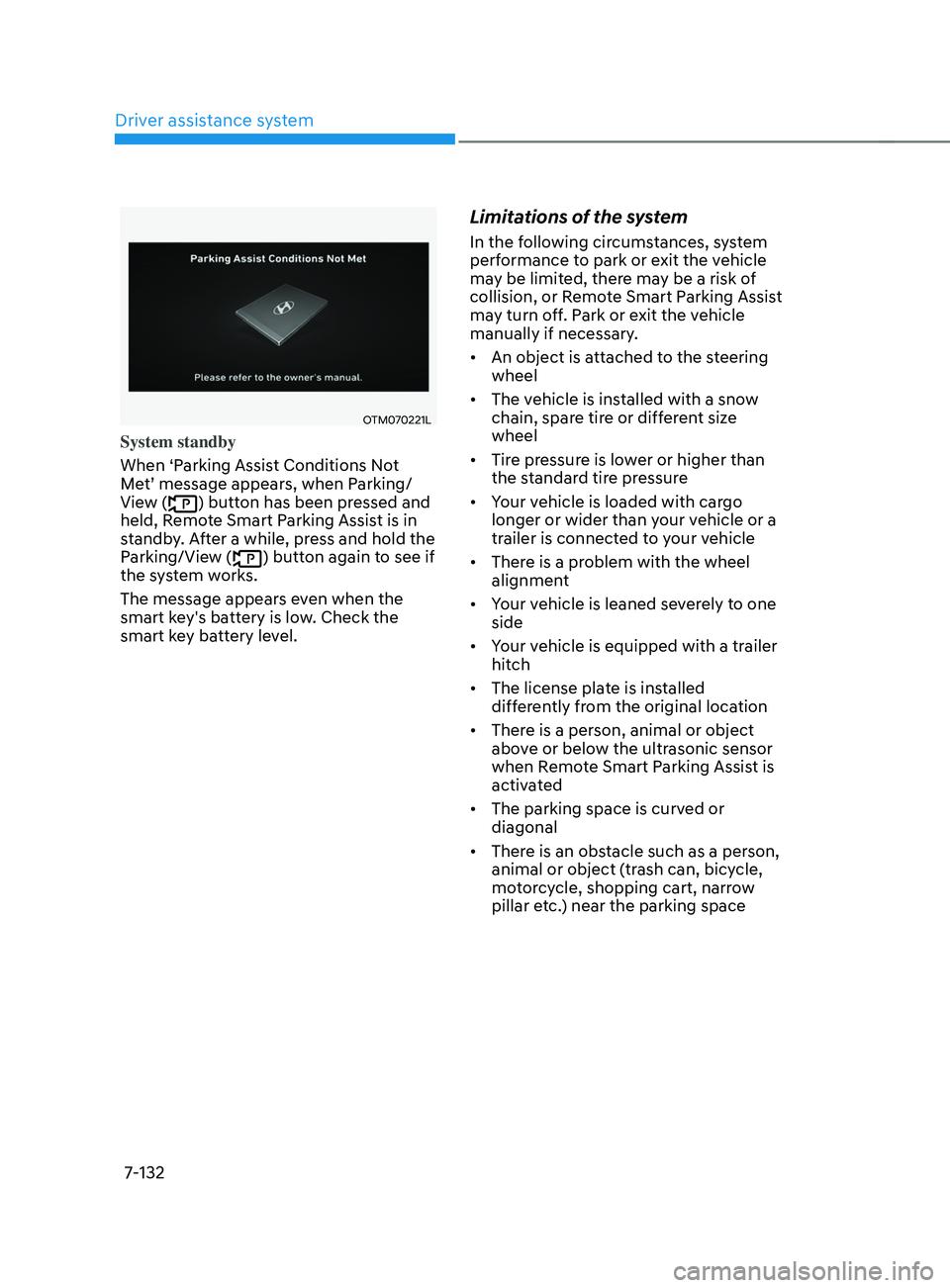
System standby
When ‘Parking Assist Conditions Not
Met’ message appears, when Parking/
View (
) button has been pressed and
held, Remote Smart Parking Assist is in
standby. After a while, press and hold the
Parking/View (
) button again to see if
the system works.
The message appears even when the
smart key's battery is low. Check the
smart key battery level.
Limitations of the system
In the following circumstances, system
performance to park or exit the vehicle
may be limited, there may be a risk of
collision, or Remote Smart Parking Assist
may turn off. Park or exit the vehicle
manually if necessary.
• An object is attached to the steering
wheel
• The vehicle is installed with a snow
chain, spare tire or different size
wheel
• Tire pressure is lower or higher than
the standard tire pressure
• Your vehicle is loaded with cargo
longer or wider than your vehicle or a
trailer is connected to your vehicle
• There is a problem with the wheel
alignment
• Your vehicle is leaned severely to one
side
• Your vehicle is equipped with a trailer
hitch
• The license plate is installed
differently from the original location
• There is a person, animal or object
above or below the ultrasonic sensor
when Remote Smart Parking Assist is
activated
• The parking space is curved or
diagonal
• There is an obstacle such as a person,
animal or object (trash can, bicycle,
motorcycle, shopping cart, narrow
pillar etc.) near the parking space
Page 538 of 636
Emergency situations
8-20
When driving with the compact spare tire
mounted to your vehicle:
• Check the tire pressure after installing
the compact spare tire. The compact
spare tire should be inflated to 420
kPa (60 psi).
• Do not take this vehicle through
an automatic car wash while the
compact spare tire is installed.
• Do not use the compact spare tire on
any other vehicle because this tire
has been designed especially for your
vehicle.
• The compact spare tire’s tread life is
shorter than a regular tire. Inspect
your compact spare tire regularly and
replace worn compact spare tires with
the same size and design, mounted on
the same wheel.
• Do not use more than one compact
spare tire at a time.
• Do not tow a trailer while the compact
spare tire is installed. Information
When the original tire and wheel are
repaired and reinstalled on the vehicle, the
wheel bolt torque must be set correctly.
The correct wheel bolt tightening torque is
79~94 lbf.ft (11~13 kgf.m).
NOTICE
To prevent damaging the compact
spare tire and your vehicle:
• Drive slowly enough for the road
conditions to avoid all hazards, such
as a potholes or debris.
• Avoid driving over obstacles. The
compact spare tire diameter is
smaller than the diameter of a
conventional tire and reduces the
ground clearance approximately 25
mm (1 inch).
• Do not use tire chains on the
compact spare tire. Because of the
smaller size, a tire chain will not fit
properly.
• Do not use the compact spare tire
on any other wheels, nor should
standard tires, snow tires, wheel
covers or trim rings be used with the
compact spare wheel.
Page 540 of 636
Emergency situations
8-22
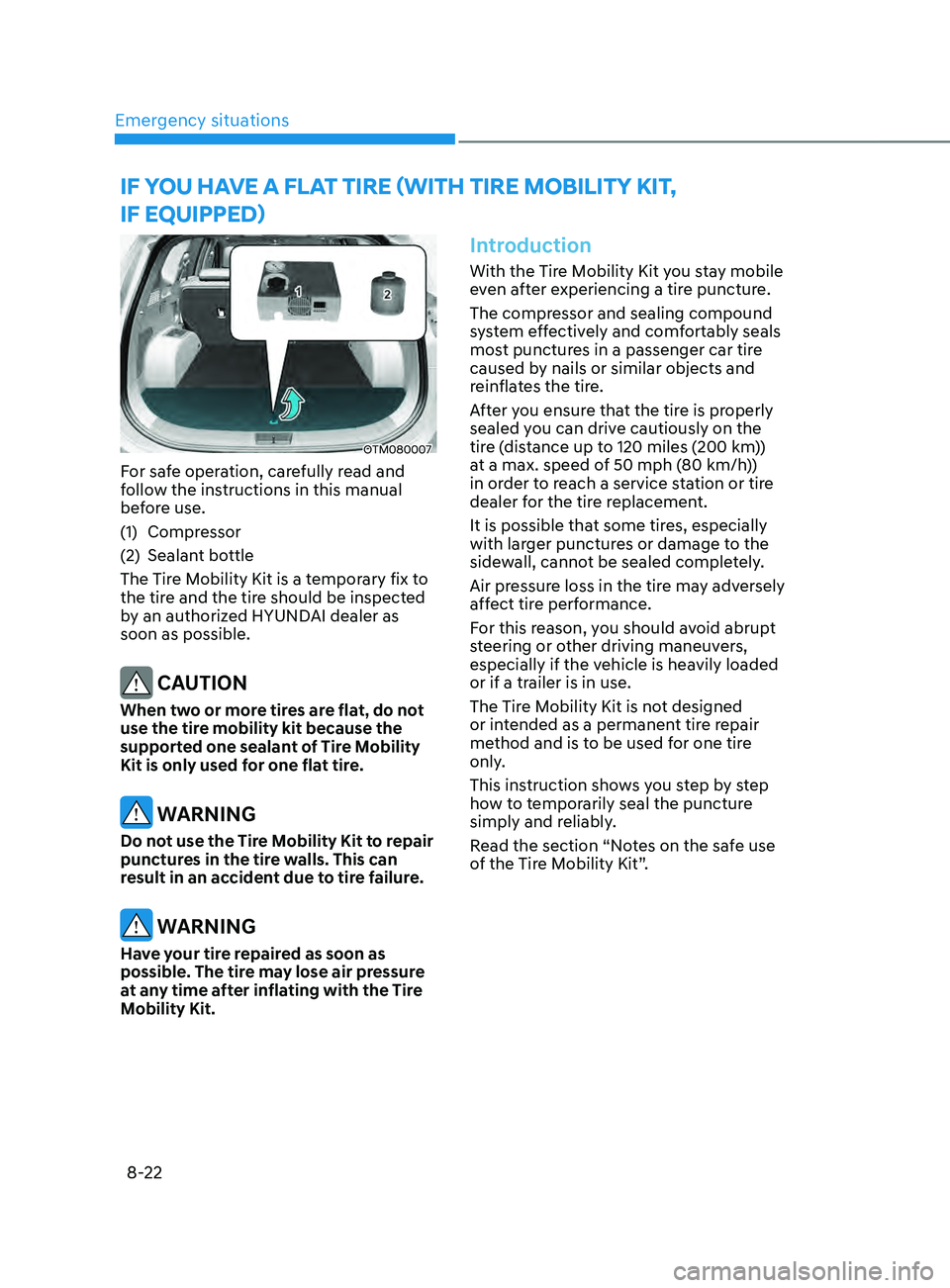
OTM080007
For safe operation, carefully read and
follow the instructions in this manual
before use.
(1)
Compressor
(2)
Sealant bo
ttle
The Tire Mobility Kit is a temporary fix to
the tire and the tire should be inspected
by an authorized HYUNDAI dealer as
soon as possible.
CAUTION
When two or more tires are flat, do not
use the tire mobility kit because the
supported one sealant of Tire Mobility
Kit is only used for one flat tire.
WARNING
Do not use the Tire Mobility Kit to repair
punctures in the tire walls. This can
result in an accident due to tire failure.
WARNING
Have your tire repaired as soon as
possible. The tire may lose air pressure
at any time after inflating with the Tire
Mobility Kit.
Introduction
With the Tire Mobility Kit you stay mobile
even after experiencing a tire puncture.
The compressor and sealing compound
system effectively and comfortably seals
most punctures in a passenger car tire
caused by nails or similar objects and
reinflates the tire.
After you ensure that the tire is properly
sealed you can drive cautiously on the
tire (distance up to 120 miles (200 km))
at a max. speed of 50 mph (80 km/h))
in order to reach a service station or tire
dealer for the tire replacement.
It is possible that some tires, especially
with larger punctures or damage to the
sidewall, cannot be sealed completely.
Air pressure loss in the tire may adversely
affect tire performance.
For this reason, you should avoid abrupt
steering or other driving maneuvers,
especially if the vehicle is heavily loaded
or if a trailer is in use.
The Tire Mobility Kit is not designed
or intended as a permanent tire repair
method and is to be used for one tire
only.
This instruction shows you step by step
how to temporarily seal the puncture
simply and reliably.
Read the section “Notes on the safe use
of the Tire Mobility Kit”.
IF YOU hAVE A FLAT TIRE (WITh TIRE mObILITY kIT,
IF E
QUI
ppED)
Page 557 of 636
09
9 -7
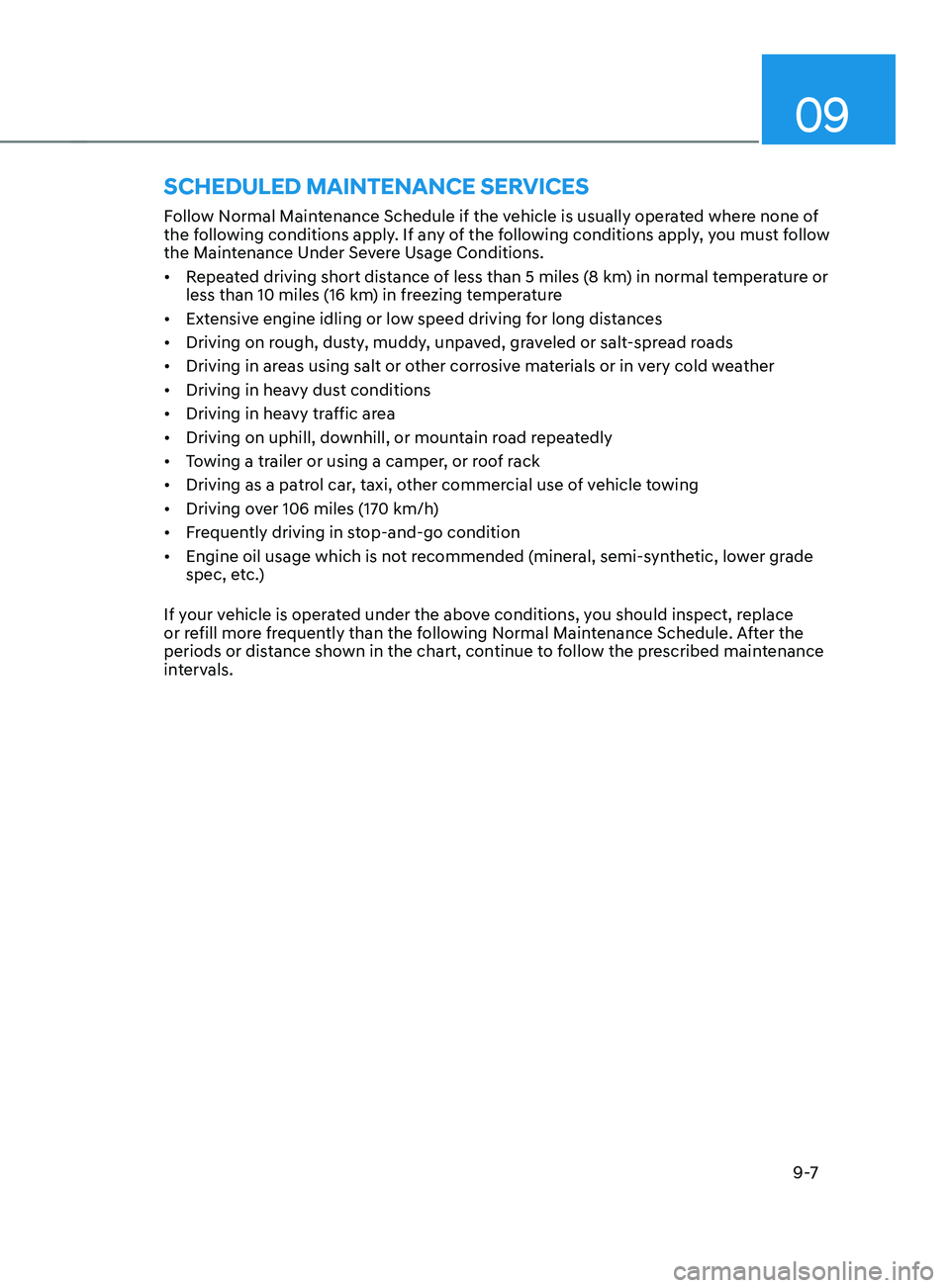
Follow Normal Maintenance Schedule if the vehicle is usually operated where none of
the following conditions apply. If any of the following conditions apply, you must follow
the Maintenance Under Severe Usage Conditions.
• Repeated driving short distance of less than 5 miles (8 km) in normal temperature or
less than 10 miles (16 km) in freezing temperature
• Extensive engine idling or low speed driving for long distances
• Driving on rough, dusty, muddy, unpaved, graveled or salt-spread roads
• Driving in areas using salt or other corrosive materials or in very cold weather
• Driving in heavy dust conditions
• Driving in heavy traffic area
• Driving on uphill, downhill, or mountain road repeatedly
• Towing a trailer or using a camper, or roof rack
• Driving as a patrol car, taxi, other commercial use of vehicle towing
• Driving over 106 miles (170 km/h)
• Frequently driving in stop-and-go condition
• Engine oil usage which is not recommended (mineral, semi-synthetic, lower grade
spec, etc.)
If your vehicle is operated under the above conditions, you should inspect, replace
or refill more frequently than the following Normal Maintenance Schedule. After the
periods or distance shown in the chart, continue to follow the prescribed maintenance
intervals.
SCHEDULED MAINTENANCE SERVICES
Page 563 of 636
09
9-13
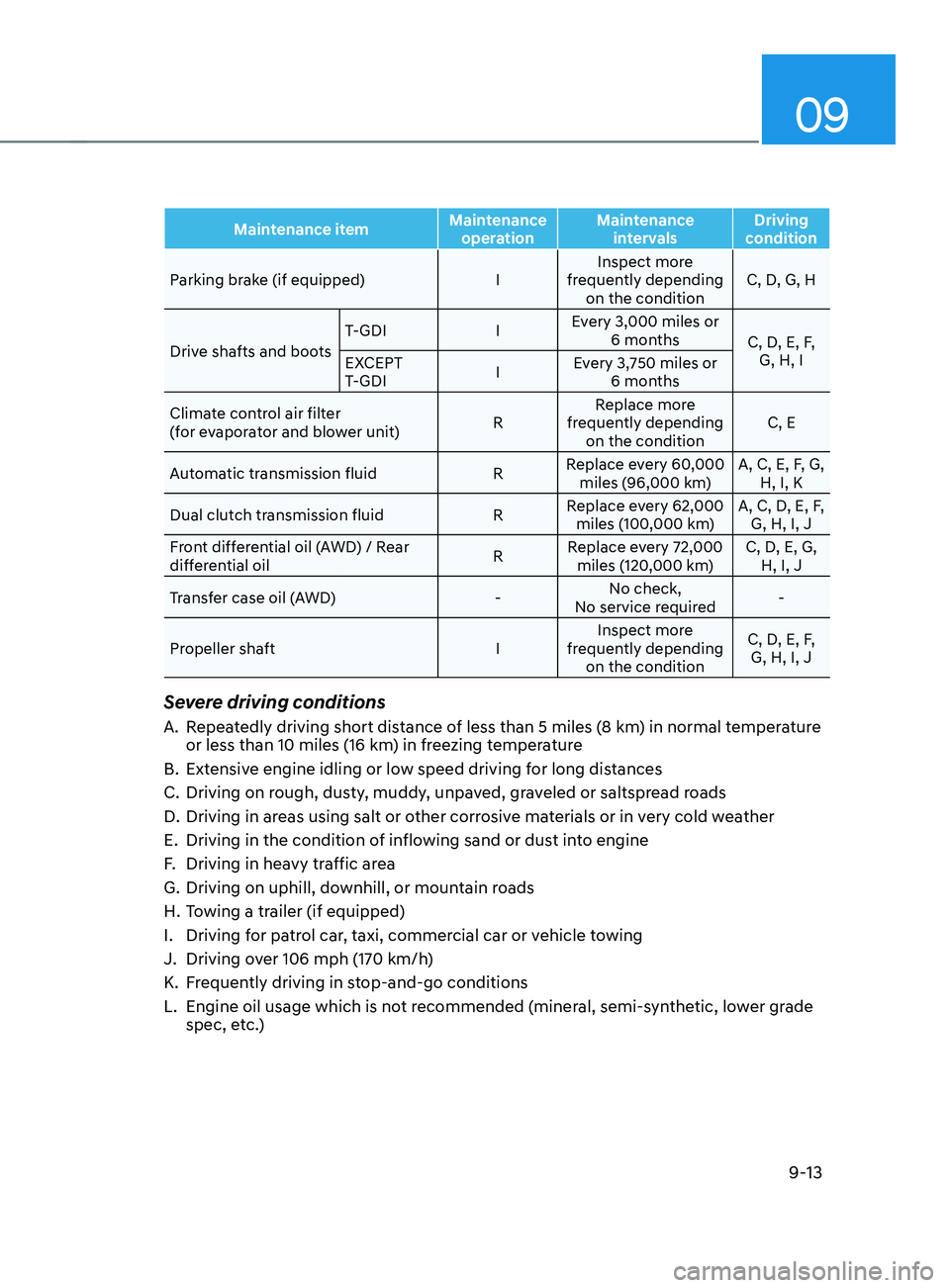
Maintenance itemMaintenance
operation Maintenance
intervals Driving
condition
Parking brake (if equipped) IInspect more
frequently depending on the condition C, D, G, H
Drive shafts and boots T-GDI
IEvery 3,000 miles or
6 months C, D, E, F,
G, H, I
EXCEPT
T-GDI IEvery 3,750 miles or
6 months
Climate control air filter
(for evaporator and blower unit) RReplace more
frequently depending on the condition C, E
Automatic transmission fluid RReplace every 60,000
miles (96,000 km) A, C, E, F, G,
H, I, K
Dual clutch transmission fluid RReplace every 62,000
miles (100,000 km) A, C, D, E, F,
G, H, I, J
Front differential oil (AWD) / Rear
differential oil RReplace every 72,000
miles (120,000 km) C, D, E, G,
H, I, J
Transfer case oil (AWD) -No check,
No service required -
Propeller shaft IInspect more
frequently depending on the condition C, D, E, F,
G, H, I, J
Severe driving conditions
A. Repeatedly driving short distance of less than 5 miles (8 km) in normal temperature
or less than 10 miles (16 km ) in freezing temperature
B.
Extensiv
e engine idling or low speed driving for long distances
C.
Driving on rough, dus
ty, muddy, unpaved, graveled or saltspread roads
D.
Driving in areas using salt or o
ther corrosive materials or in very cold weather
E.
Driving in the condition of in
flowing sand or dust into engine
F.
Driving in heavy tr
affic area
G.
Driving on uphill, downhill, or moun
tain roads
H.
To
wing a trailer (if equipped)
I.
Driving for pa
trol car, taxi, commercial car or vehicle towing
J.
Driving ov
er 106 mph (170 km/h)
K.
Fr
equently driving in stop-and-go conditions
L.
Engine oil usage which is no
t recommended (mineral, semi-synthetic, lower grade
spec, etc.)
Page 599 of 636
09
9-49
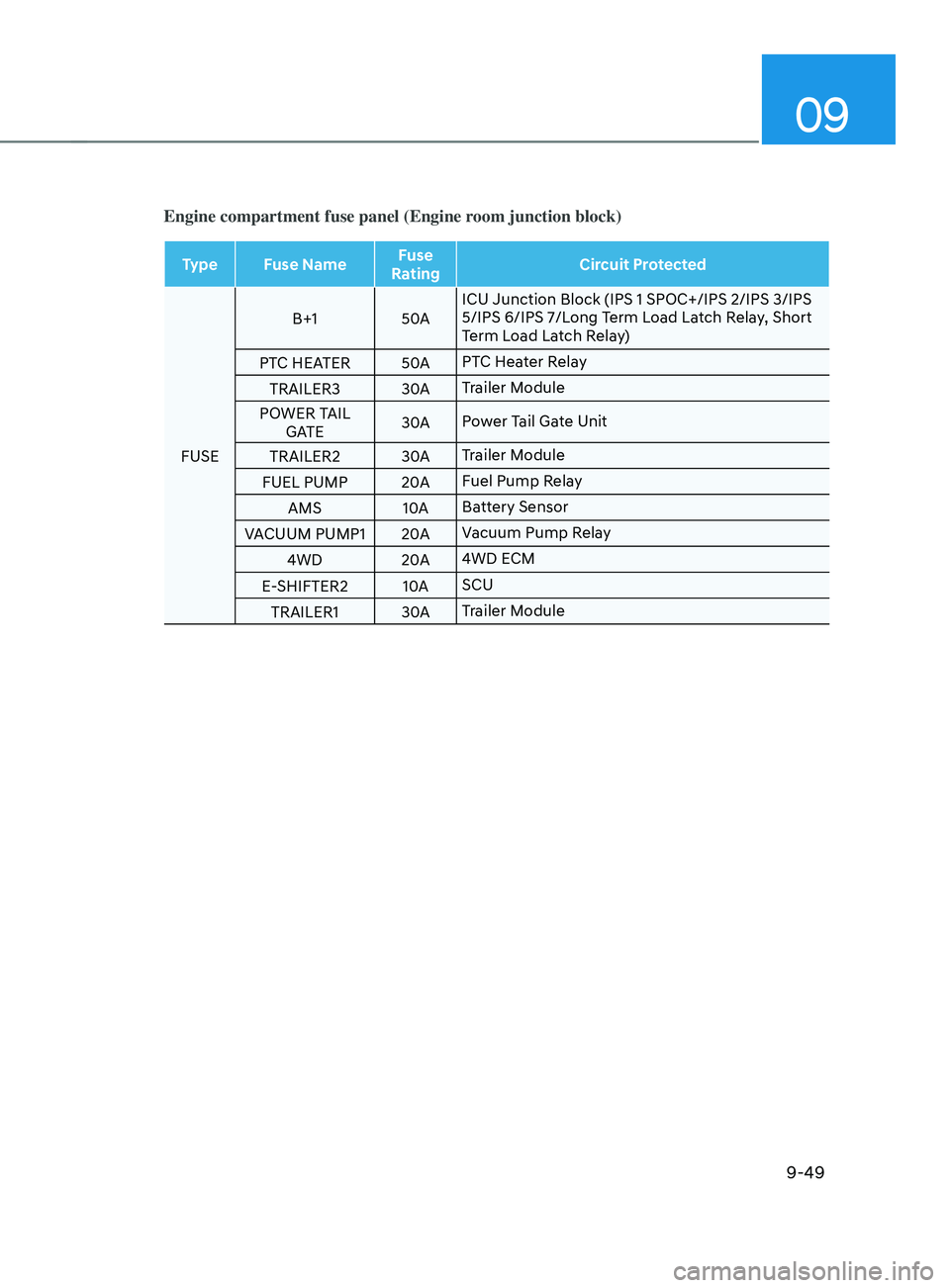
Engine compartment fuse panel (Engine room junction block)
Type Fuse NameFuse
Rating Circuit Protected
FUSE B+1
50AICU Junction Block (IPS 1 SPOC+/IPS 2/IPS 3/IPS
5/IPS 6/IPS 7/Long Term Load Latch Relay, Short
Term Load Latch Relay)
PTC HEATER 50APTC Heater Relay
TRAILER3 30ATrailer Module
POWER TAIL GATE 30A
Power Tail Gate Unit
TRAILER2 30ATrailer Module
FUEL PUMP 20AFuel Pump Relay
AMS 10ABattery Sensor
VACUUM PUMP1 20AVacuum Pump Relay
4WD 20A4WD ECM
E-SHIFTER2 10ASCU
TRAILER1 30ATrailer Module
Page 635 of 636
 ........................................................................\
..7-92
System malfunction and limitations ..............................................")
I
I-13
Surround View Monitor (SVM) ........................................................................\
..7-92
System malfunction and limitations ................................................................7-96
System operation ........................................................................\
..................... 7-94
System settings ........................................................................\
......................... 7-93
T
Theft-alarm system
........................................................................\
...................... 5-38
T
ire Pressure Monitoring System (TPMS)
............................................................ 8-9
Changing a tire with TPMS ........................................................................\
...... 8-12
Check tire pressure ........................................................................\
..................... 8-9
Low tire pressure position and tire pressure telltale .........................................8-1
1
Low tire pressure warning light .......................................................................8-1
1
Tire pressure monitoring system ......................................................................8-10
TPMS malfunction indicator ........................................................................\
.... 8-12
T
ire specification and pressure label
................................................................... 2-15
T
ires and wheels
........................................................................\
.......................... 2-10
T
ires and wheels
........................................................................\
.......................... 9-32
Check tire inflation pressure ........................................................................\
....9-33
Low aspect ratio tires ........................................................................\
............... 9-40
Recommended cold tire inflation pressures .....................................................9-32
Tire care ........................................................................\
.................................... 9-32
Tire maintenance ........................................................................\
......................9-36
Tire replacement ........................................................................\
....................... 9-35
Tire rotation ........................................................................\
.............................. 9-34
Tire sidewall labeling ........................................................................\
...............9-37
Tire traction ........................................................................\
.............................. 9-36
Wheel alignment and tire balance ....................................................................9-35
Wheel replacement ........................................................................\
................... 9-36
T
owing
........................................................................\
......................................... 8-30
Towing service ........................................................................\
.........................8-30
T
rademarks
........................................................................\
................................ 5-144
T
railer towing
........................................................................\
.............................. 6-79
Driving with a trailer ........................................................................\
................6-84
If you decide to pull a trailer? ........................................................................\
..6-80
Maintenance when towing a trailer ..................................................................6-87
Trailer towing equipment ........................................................................\
......... 6-83