engine HYUNDAI SANTA FE 2022 Owners Manual
[x] Cancel search | Manufacturer: HYUNDAI, Model Year: 2022, Model line: SANTA FE, Model: HYUNDAI SANTA FE 2022Pages: 637, PDF Size: 11.89 MB
Page 525 of 637
Emergency situations
8-10
Tire pressure monitoring system
WARNING
Over-inflation or under-inflation can
reduce tire life, adversely affect vehicle
handling, and lead to sudden tire failure
that may cause loss of vehicle control
resulting in an accident.
Each tire, including the spare (if
provided), should be checked monthly
when cold and inflated to the inflation
pressure recommended by the vehicle
manufacturer on the vehicle placard
or tire inflation pressure label. (If your
vehicle has tires of a different size than
the size indicated on the vehicle placard
or tire inflation pressure label, you should
determine the proper tire inflation
pressure for those tires.)
As an added safety feature, your
vehicle has been equipped with a tire
pressure monitoring system (TPMS)
that illuminates a low tire pressure
telltale when one or more of your tires is
significantly under-inflated. Accordingly,
when the low tire pressure telltale
illuminates, you should stop and check
your tires as soon as possible, and inflate
them to the proper pressure. Driving on
a significantly under-inflated tire causes
the tire to overheat and can lead to tire
failure.
Under-inflation also reduces fuel
efficiency and tire tread life, and may
affect the vehicle’s handling and
stopping ability.
Please note that the TPMS is not a
substitute for proper tire maintenance,
and it is the driver’s responsibility to
maintain correct tire pressure, even if
under-inflation has not reached the level
to trigger illumination of the TPMS low
tire pressure telltale.
Your vehicle has also been equipped with
a TPMS malfunction indicator to indicate
when the system is not operating
properly. The TPMS malfunction
indicator is combined with the low
tire pressure telltale. When the system
detects a malfunction, the telltale will
flash for approximately one minute and
then remain continuously illuminated.
This sequence will continue upon
subsequent vehicle start-ups as long as
the malfunction exists.
When the malfunction indicator is
illuminated, the system may not be able
to detect or signal low tire pressure as
intended. TPMS malfunctions may occur
for a variety of reasons, including the
installation of replacement or alternate
tires or wheels on the vehicle that
prevent the TPMS from functioning
properly.
Always check the TPMS malfunction
telltale after replacing one or more tires
or wheels on your vehicle to ensure that
the replacement or alternate tires and
wheels allow the TPMS to continue to
function properly.
NOTICE
If any of the below happens, have
the system checked by an authorized
HYUNDAI dealer.
1. The Low Tire Pressure Telltale/ TPMS
Malfunction Indicator does not
illuminate for 3 seconds when the
Engine Start/Stop button is pressed
to the ON position or when the
engine is running.
2. The TPMS Malfunction Indicator
remains illuminated after blinking for
approximately 1 minute.
3. The Low Tire Pressure Position
Telltale remains illuminated.
008_TMa_HMA.indd 8-102021-08-27 1:44:02
Page 531 of 637
Emergency situations
8-16
Changing tires
WARNING
A vehicle can slip or roll off of a jack
causing serious injury or death to you or
those nearby. Take the following safety
precautions:
• Do not get under a vehicle that is
supported by a jack.
• NEVER attempt to change a tire in
the lane of traffic. ALWAYS move the
vehicle completely off the road on
level, firm ground away from traffic
before trying to change a tire. If you
cannot find a level, firm place off
the road, call a towing service for
assistance.
• Be sure to use the jack provided with
the vehicle.
• ALWAYS place the jack on the
designated jacking positions on the
vehicle and NEVER on the bumpers
or any other part of the vehicle for
jacking support.
• Do not start or run the engine while
the vehicle is on the jack.
• Do not allow anyone to remain in the
vehicle while it is on the jack.
• Keep children away from the road
and the vehicle.Follow these steps to change your
vehicle’s tire:
1. Park on a level, firm surface.
2. Shift the gear to P (Park), apply the
parking brake, and press the Engine
Start/Stop button to the OFF position.
3. Press the hazard warning flasher
button.
4. Remove the wheel lug wrench, jack,
jack handle, and spare tire from the
vehicle.
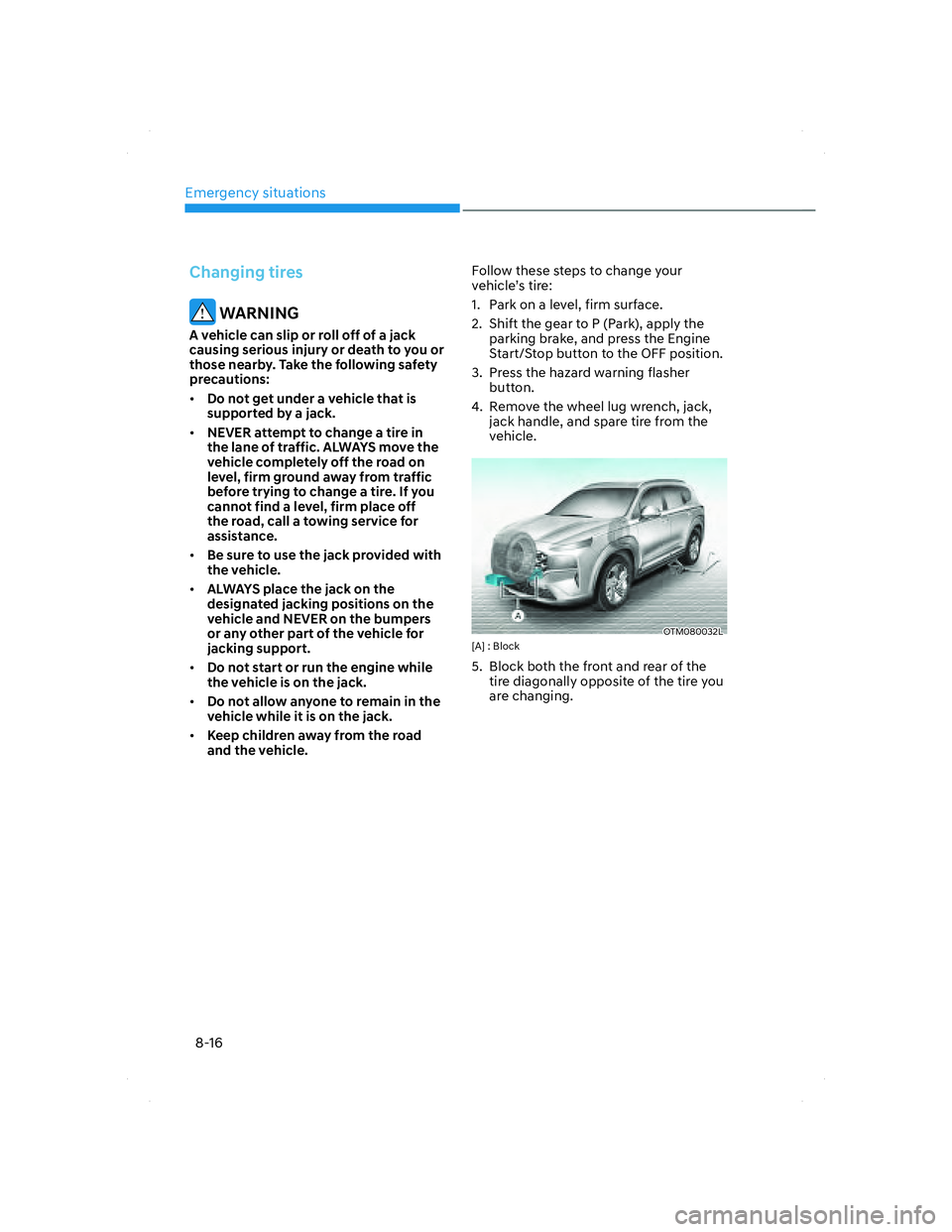
OTM080032LOTM080032L[A] : Block
5. Block both the front and rear of the
tire diagonally opposite of the tire you
are changing.
008_TMa_HMA.indd 8-162021-08-27 1:44:04
Page 536 of 637
08
8-21
Jack label
OOS067043OOS067043
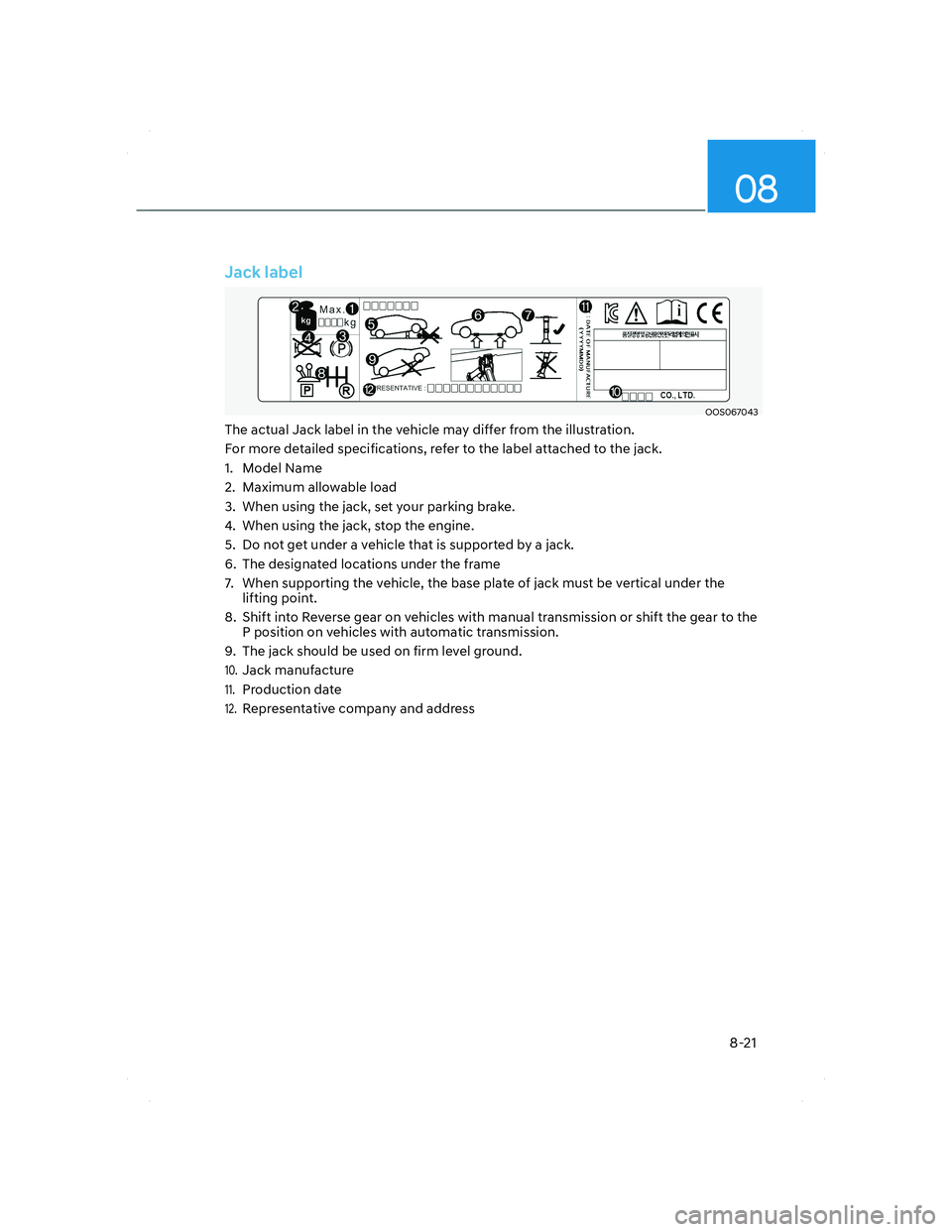
The actual Jack label in the vehicle may differ from the illustration.
For more detailed specifications, refer to the label attached to the jack.
1. Model Name
2. Maximum allowable load
3. When using the jack, set your parking brake.
4. When using the jack, stop the engine.
5. Do not get under a vehicle that is supported by a jack.
6. The designated locations under the frame
7. When supporting the vehicle, the base plate of jack must be vertical under the
lifting point.
8. Shift into Reverse gear on vehicles with manual transmission or shift the gear to the
P position on vehicles with automatic transmission.
9. The jack should be used on firm level ground.
10. Jack manufacture
11. Production date
12. Representative company and address
008_TMa_HMA.indd 8-212021-08-27 1:44:07
Page 538 of 637
08
8-23
WARNING
Do not use the TMK if a tire is severely
damaged by driving run flat or with
insufficient air pressure.
Only punctured areas located within the
tread region of the tire can be sealed
using the TMK.
Notes on the safe use of the Tire
Mobility Kit
• Park your car at the side of the road
so that you can work with the Tire
Mobility Kit away from moving traffic.
• To be sure your vehicle will not move,
even when you’re on fairly level
ground, always set your parking brake.
• Only use the Tire Mobility Kit for
sealing/inflation passenger car tires.
Only punctured areas located within
the tread region of the tire can be
sealed using the tire mobility kit.
• Do not use on motorcycles, bicycles
or any other type of tires.
• When the tire and wheel are
damaged, do not use Tire Mobility Kit
for your safety.
• Use of the Tire Mobility Kit may not be
effective for tire damage larger than
approximately 4 mm (16 inch).
Please contact the nearest HYUNDAI
dealer if the tire cannot be made
roadworthy with the Tire Mobility Kit.• Do not use the Tire Mobility Kit if a tire
is severely damaged by driving run flat
or with insufficient air pressure.
• Do not remove any foreign objects
such as nails or screws that have
penetrated the tire.
• Provided the car is outdoors, leave the
engine running. Otherwise operating
the compressor may eventually drain
the car battery.
• Never leave the Tire Mobility Kit
unattended while it is being used.
• Do not leave the compressor running
for more than 10 minutes at a time or
it may overheat.
• Do not use the Tire Mobility Kit if the
ambient temperature is below -22°F
(30°C).
• In case of skin contact with the
sealant, wash the area thoroughly
with plenty of water. If the irritation
persists, seek medical attention.
• In case of eye contact with the
sealant, flush your eyes for at least 15
minutes. If the irritation persists, seek
medical attention.
• In case of swallowing the sealant,
rinse the mouth and drink plenty of
water. However, never give anything
to an unconscious person and seek
medical attention immediately.
• Long time exposure to the sealant
may cause damage to bodily tissue
such as kidney, etc.
008_TMa_HMA.indd 8-232021-08-27 1:44:07
Page 541 of 637
Emergency situations
8-26
OTM080009OTM080009
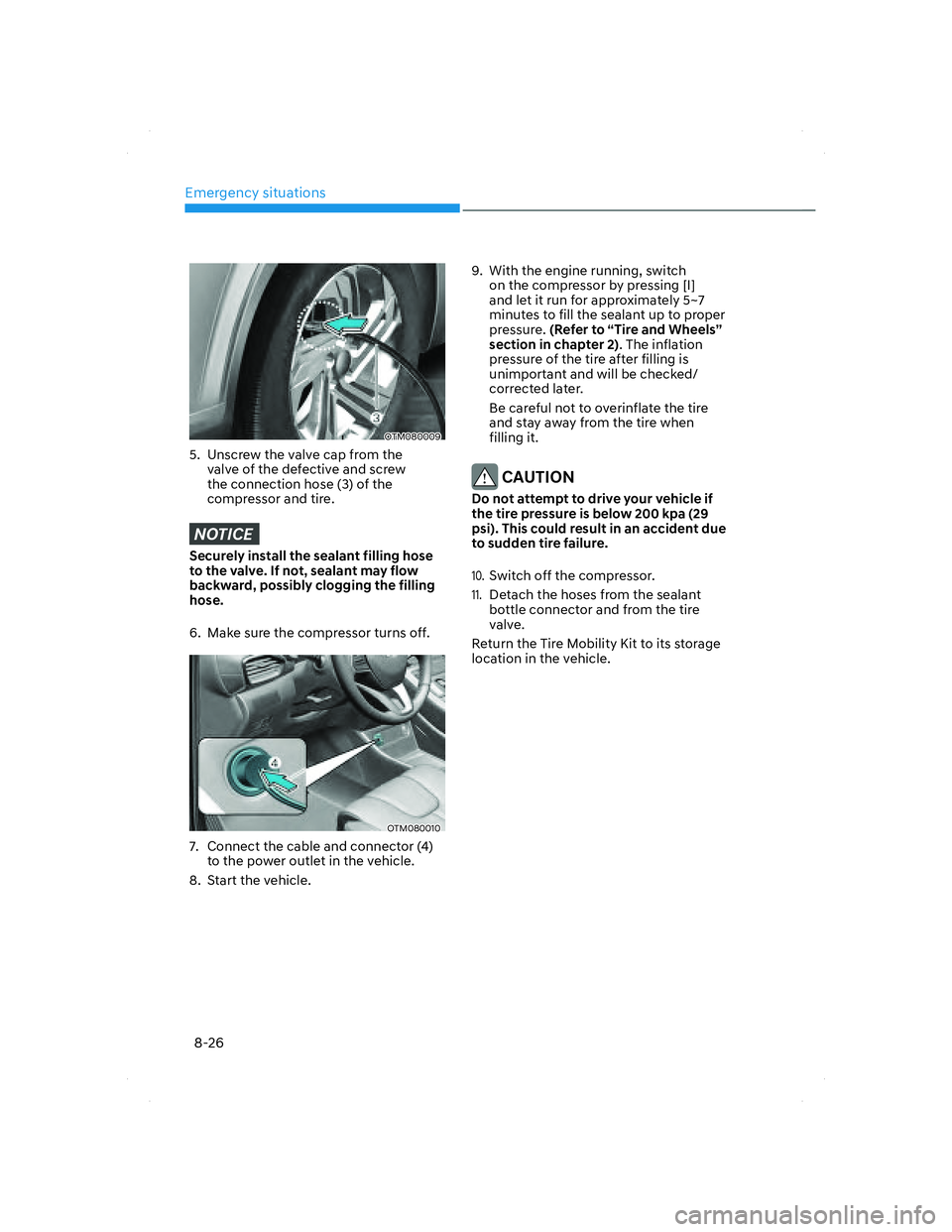
5. Unscrew the valve cap from the
valve of the defective and screw
the connection hose (3) of the
compressor and tire.
NOTICE
Securely install the sealant filling hose
to the valve. If not, sealant may flow
backward, possibly clogging the filling
hose.
6. Make sure the compressor turns off.
OTM080010OTM080010
7. Connect the cable and connector (4)
to the power outlet in the vehicle.
8. Start the vehicle.9. With the engine running, switch
on the compressor by pressing [I]
and let it run for approximately 5~7
minutes to fill the sealant up to proper
pressure. (Refer to “Tire and Wheels”
section in chapter 2). The inflation
pressure of the tire after filling is
unimportant and will be checked/
corrected later.
Be careful not to overinflate the tire
and stay away from the tire when
filling it.
CAUTION
Do not attempt to drive your vehicle if
the tire pressure is below 200 kpa (29
psi). This could result in an accident due
to sudden tire failure.
10. Switch off the compressor.
11. Detach the hoses from the sealant
bottle connector and from the tire
valve.
Return the Tire Mobility Kit to its storage
location in the vehicle.
008_TMa_HMA.indd 8-262021-08-27 1:44:09
Page 542 of 637
08
8-27
WARNING
Do not leave your vehicle running in
a poorly ventilated area for extended
periods of time. Carbon monoxide
poisoning and suffocation can occur.
Distributing the sealant
OOSH079022LOOSH079022L
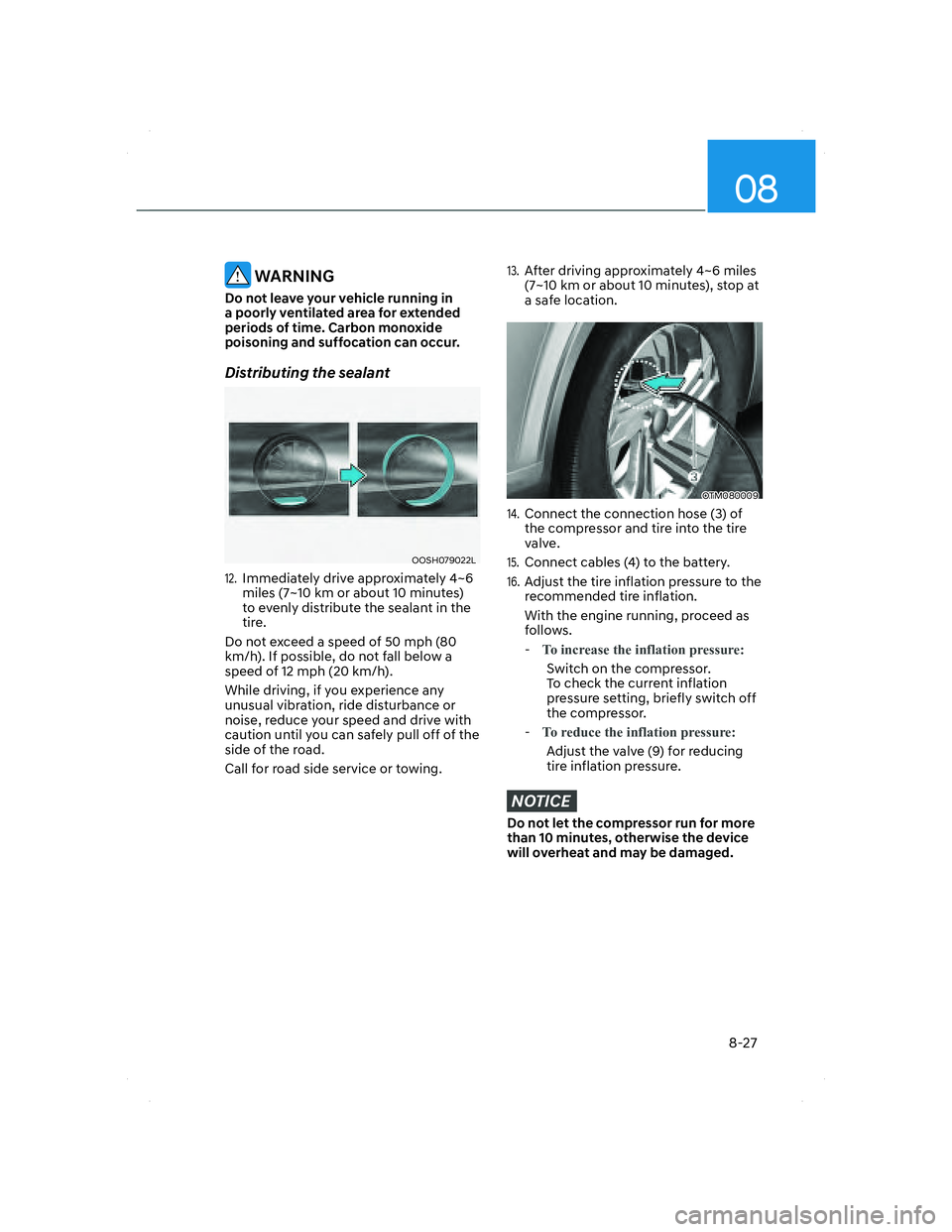
12. Immediately drive approximately 4~6
miles (7~10 km or about 10 minutes)
to evenly distribute the sealant in the
tire.
Do not exceed a speed of 50 mph (80
km/h). If possible, do not fall below a
speed of 12 mph (20 km/h).
While driving, if you experience any
unusual vibration, ride disturbance or
noise, reduce your speed and drive with
caution until you can safely pull off of the
side of the road.
Call for road side service or towing.
13. After driving approximately 4~6 miles
(7~10 km or about 10 minutes), stop at
a safe location.
OTM080009OTM080009
14. Connect the connection hose (3) of
the compressor and tire into the tire
valve.
15. Connect cables (4) to the battery.
16. Adjust the tire inflation pressure to the
recommended tire inflation.
With the engine running, proceed as
follows.
-
To increase the inflation pressure:
Switch on the compressor.
To check the current inflation
pressure setting, briefly switch off
the compressor.
-
To reduce the inflation pressure:
Adjust the valve (9) for reducing
tire inflation pressure.
NOTICE
Do not let the compressor run for more
than 10 minutes, otherwise the device
will overheat and may be damaged.
008_TMa_HMA.indd 8-272021-08-27 1:44:12
Page 543 of 637
Emergency situations
8-28
Information
The pressure gauge may show higher than
actual reading when the compressor is
running. To get an accurate tire pressure,
the compressor needs to be turned off.
CAUTION
If the inflation pressure is not
maintained, drive the vehicle a second
time, refer to Distributing the sealant.
Then repeat steps 1 to 16.
Use of the TMK may be ineffectual for
tire damage larger than approximately
4 mm (0.16 in).
Contact an authorized HYUNDAI dealer
if the tire cannot be made roadworthy
with the Tire Mobility Kit.
WARNING
The tire inflation pressure must be
inflated to the proper pressure (Refer to
“Tire and Wheels” section in chapter 2).
If it is not, do not continue driving.
Call for road side service or towing.
CAUTION
Tire pressure sensor
The sealant on the tire pressure sensor
and wheel should be removed when
you replace the tire with a new one and
inspect the tire pressure sensors. We
recommend that you get this done at an
authorized dealer.
Information
When reinstalling the repaired or replaced
tire and wheel on the vehicle, tighten the
wheel bolt to 79~94 lbf.ft (11~13 kgf.m).
How to adjust tire pressure
1. After driving approximately 4~6 miles
(7~10 km or about 10 minutes), stop at
a safe location.
OTM080009OTM080009
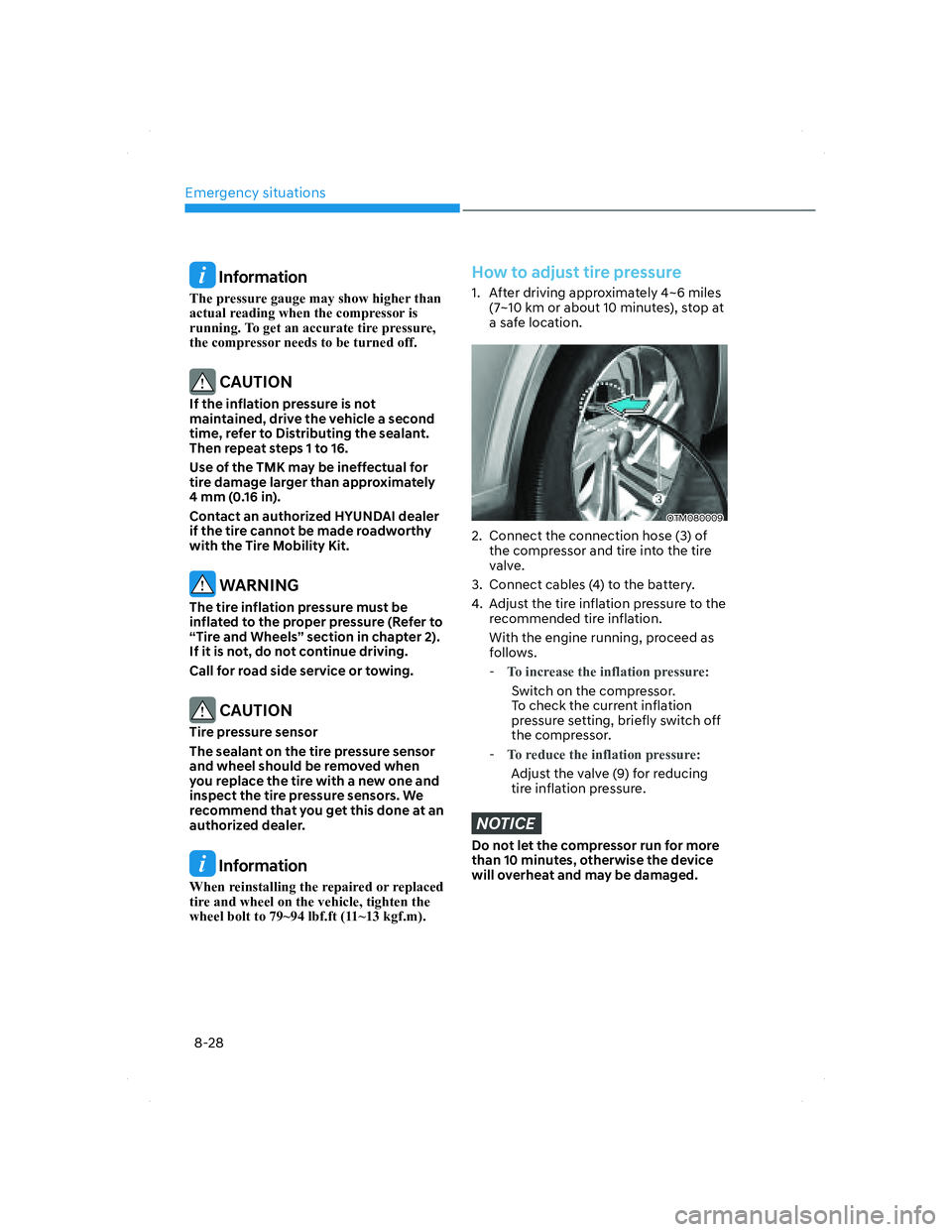
2. Connect the connection hose (3) of
the compressor and tire into the tire
valve.
3. Connect cables (4) to the battery.
4. Adjust the tire inflation pressure to the
recommended tire inflation.
With the engine running, proceed as
follows.
-
To increase the inflation pressure:
Switch on the compressor.
To check the current inflation
pressure setting, briefly switch off
the compressor.
-
To reduce the inflation pressure:
Adjust the valve (9) for reducing
tire inflation pressure.
NOTICE
Do not let the compressor run for more
than 10 minutes, otherwise the device
will overheat and may be damaged.
008_TMa_HMA.indd 8-282021-08-27 1:44:12
Page 545 of 637
Emergency situations
8-30
If any of the loaded wheels or suspension
components are damaged or the vehicle
is being towed with the front wheels on
the ground, use a towing dolly under the
front wheels.
When being towed by a commercial tow
truck and wheel dollies are not used,
the front of the vehicle should always be
lifted, not the rear.
For 4WD vehicles, it must be towed
with a wheel lift and dollies or flatbed
equipment with all the wheels off the
ground.
NOTICE
Do not lift the vehicle by the tow fitting
or body and chassis parts. Otherwise
the vehicle may be damaged.
CAUTION
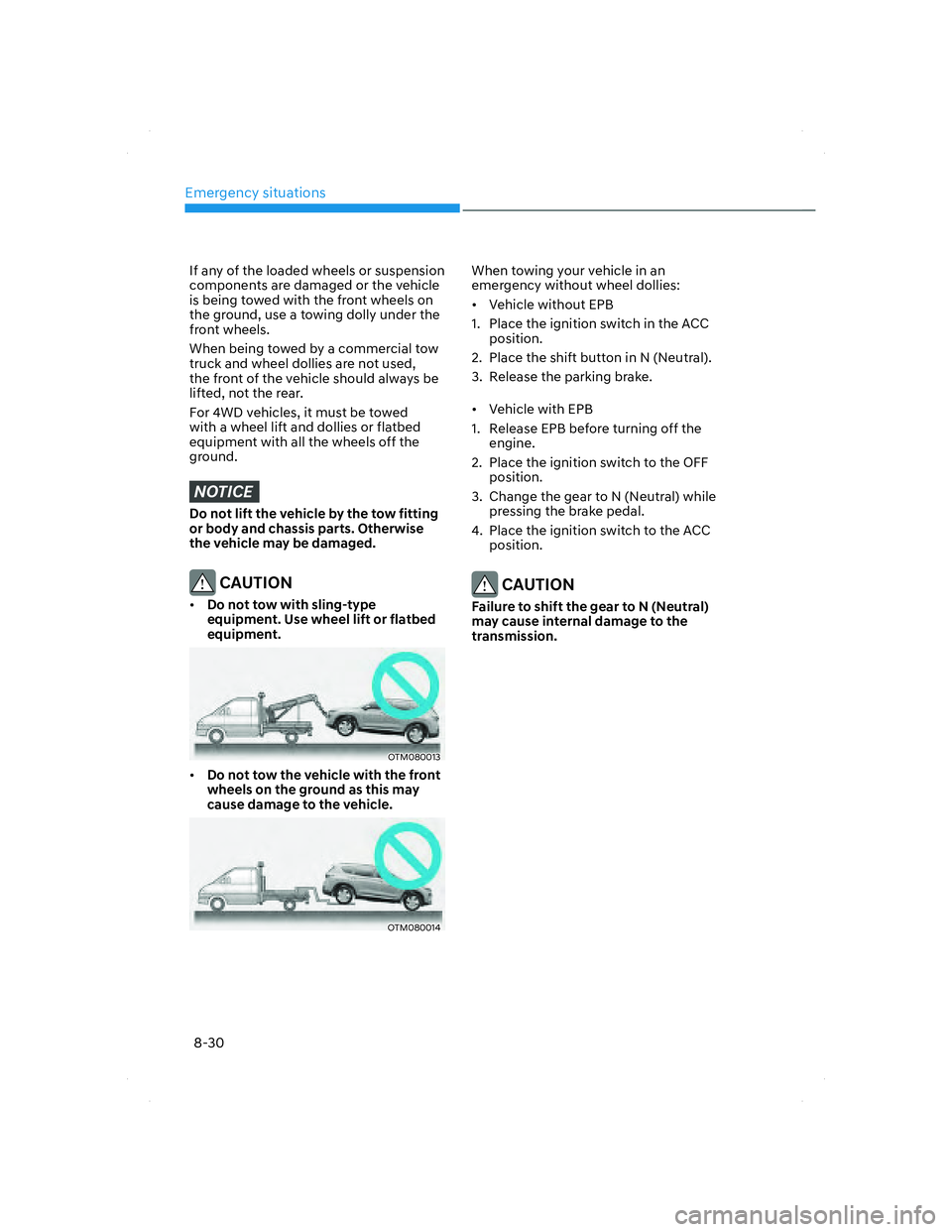
• Do not tow with sling-type
equipment. Use wheel lift or flatbed
equipment.
OTM080013OTM080013
• Do not tow the vehicle with the front
wheels on the ground as this may
cause damage to the vehicle.
OTM080014OTM080014
When towing your vehicle in an
emergency without wheel dollies:
• Vehicle without EPB
1. Place the ignition switch in the ACC
position.
2. Place the shift button in N (Neutral).
3. Release the parking brake.
• Vehicle with EPB
1. Release EPB before turning off the
engine.
2. Place the ignition switch to the OFF
position.
3. Change the gear to N (Neutral) while
pressing the brake pedal.
4. Place the ignition switch to the ACC
position.
CAUTION
Failure to shift the gear to N (Neutral)
may cause internal damage to the
transmission.
008_TMa_HMA.indd 8-302021-08-27 1:44:14
Page 546 of 637
9
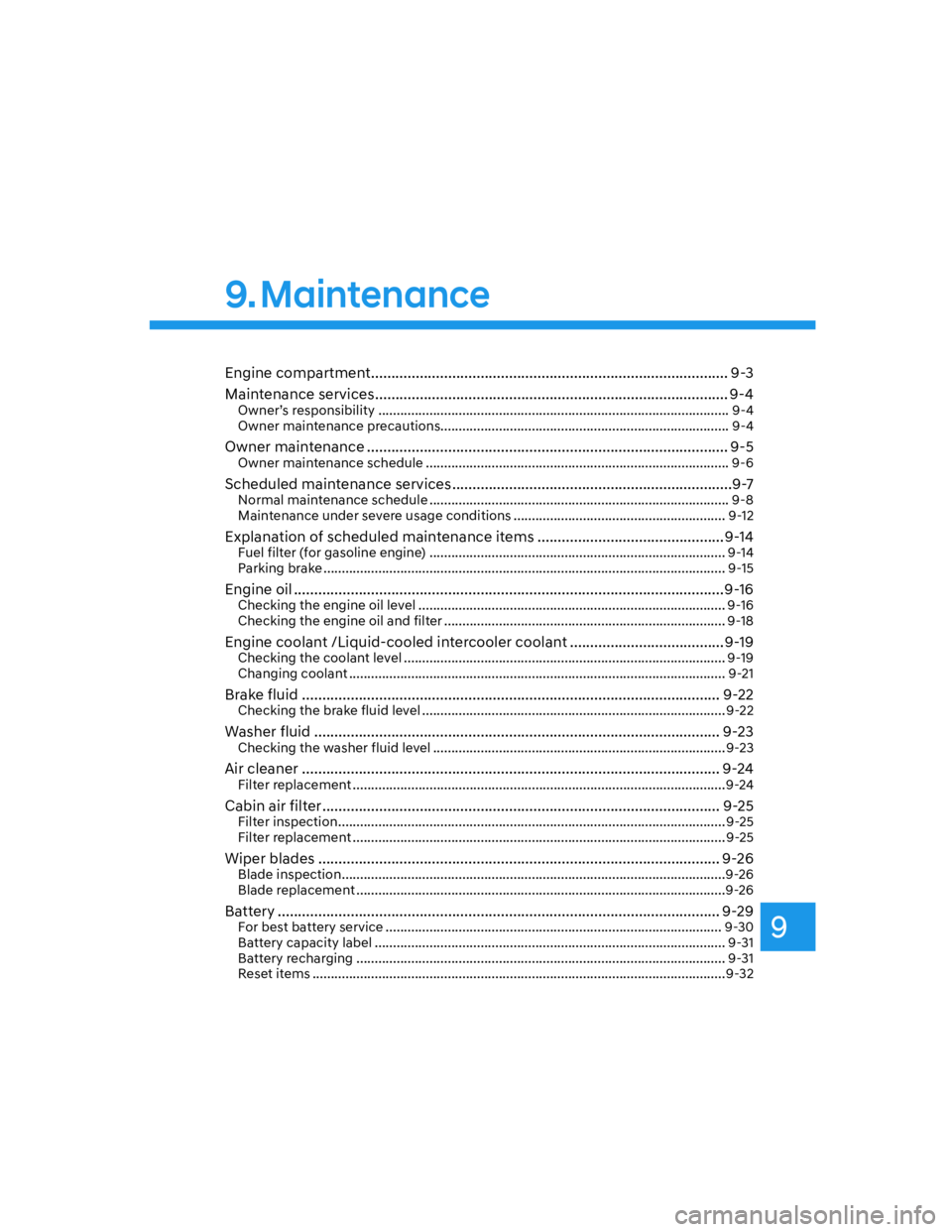
9. Maintenance
Engine compartment ........................................................................................ 9-3
Maintenance services
....................................................................................... 9-4
Owner’s responsibility ................................................................................................ 9-4
Owner maintenance precautions............................................................................... 9-4
Owner maintenance ......................................................................................... 9-5Owner maintenance schedule ................................................................................... 9-6
Scheduled maintenance services .....................................................................9-7
Normal maintenance schedule .................................................................................. 9-8
Maintenance under severe usage conditions
.......................................................... 9-12
Explanation of scheduled maintenance items .............................................. 9-14Fuel filter (for gasoline engine) ................................................................................. 9-14
Parking brake
.............................................................................................................. 9-15
Engine oil ..........................................................................................................9-16Checking the engine oil level .................................................................................... 9-16
Checking the engine oil and filter
............................................................................. 9-18
Engine coolant /Liquid-cooled intercooler coolant ......................................9-19
Checking the coolant level ........................................................................................ 9-19
Changing coolant
....................................................................................................... 9-21
Brake fluid ....................................................................................................... 9-22Checking the brake fluid level ................................................................................... 9-22
Washer fluid .................................................................................................... 9-23Checking the washer fluid level ................................................................................ 9-23
Air cleaner ....................................................................................................... 9-24Filter replacement ......................................................................................................9-24
Cabin air filter .................................................................................................. 9-25Filter inspection .......................................................................................................... 9-25
Filter replacement
...................................................................................................... 9-25
Wiper blades ................................................................................................... 9-26Blade inspection .........................................................................................................9-26
Blade replacement
.....................................................................................................9-26
Battery ............................................................................................................. 9-29
For best battery service ............................................................................................ 9-30
Battery capacity label
................................................................................................ 9-31
Battery recharging
..................................................................................................... 9-31
Reset items
................................................................................................................. 9-32
Page 547 of 637
9
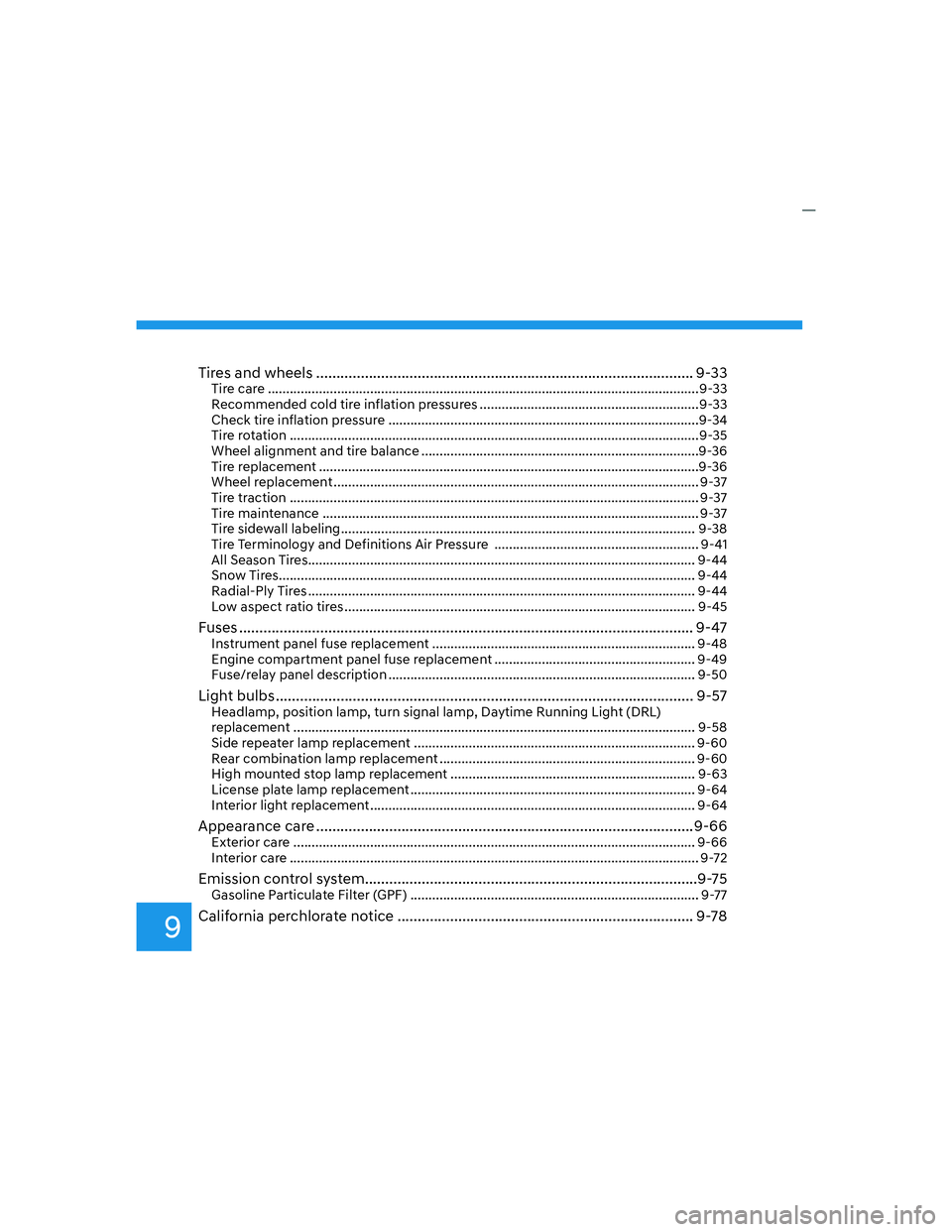
Tires and wheels ............................................................................................. 9-33Tire care ......................................................................................................................9-33
Recommended cold tire inflation pressures
............................................................9-33
Check tire inflation pressure
.....................................................................................9-34
Tire rotation
................................................................................................................9-35
Wheel alignment and tire balance
............................................................................9-36
Tire replacement
........................................................................................................9-36
Wheel replacement
.................................................................................................... 9-37
Tire traction
................................................................................................................ 9-37
Tire maintenance
....................................................................................................... 9-37
Tire sidewall labeling
................................................................................................. 9-38
Tire Terminology and Definitions Air Pressure
........................................................ 9-41
All Season Tires
.......................................................................................................... 9-44
Snow Tires.................................................................................................................. 9-44
Radial-Ply Tires
.......................................................................................................... 9-44
Low aspect ratio tires
................................................................................................ 9-45
Fuses ................................................................................................................ 9-47Instrument panel fuse replacement ........................................................................ 9-48
Engine compartment panel fuse replacement
....................................................... 9-49
Fuse/relay panel description
.................................................................................... 9-50
Light bulbs ....................................................................................................... 9-57Headlamp, position lamp, turn signal lamp, Daytime Running Light (DRL)
replacement
.............................................................................................................. 9-58
Side repeater lamp replacement
............................................................................. 9-60
Rear combination lamp replacement
...................................................................... 9-60
High mounted stop lamp replacement
................................................................... 9-63
License plate lamp replacement
.............................................................................. 9-64
Interior light replacement
......................................................................................... 9-64
Appearance care .............................................................................................9-66
Exterior care .............................................................................................................. 9-66
Interior care
................................................................................................................ 9-72
Emission control system..................................................................................9-75Gasoline Particulate Filter (GPF) ............................................................................... 9-77
California perchlorate notice ......................................................................... 9-78