ignition HYUNDAI SANTA FE HYBRID 2021 Repair Manual
[x] Cancel search | Manufacturer: HYUNDAI, Model Year: 2021, Model line: SANTA FE HYBRID, Model: HYUNDAI SANTA FE HYBRID 2021Pages: 598, PDF Size: 66.6 MB
Page 506 of 598
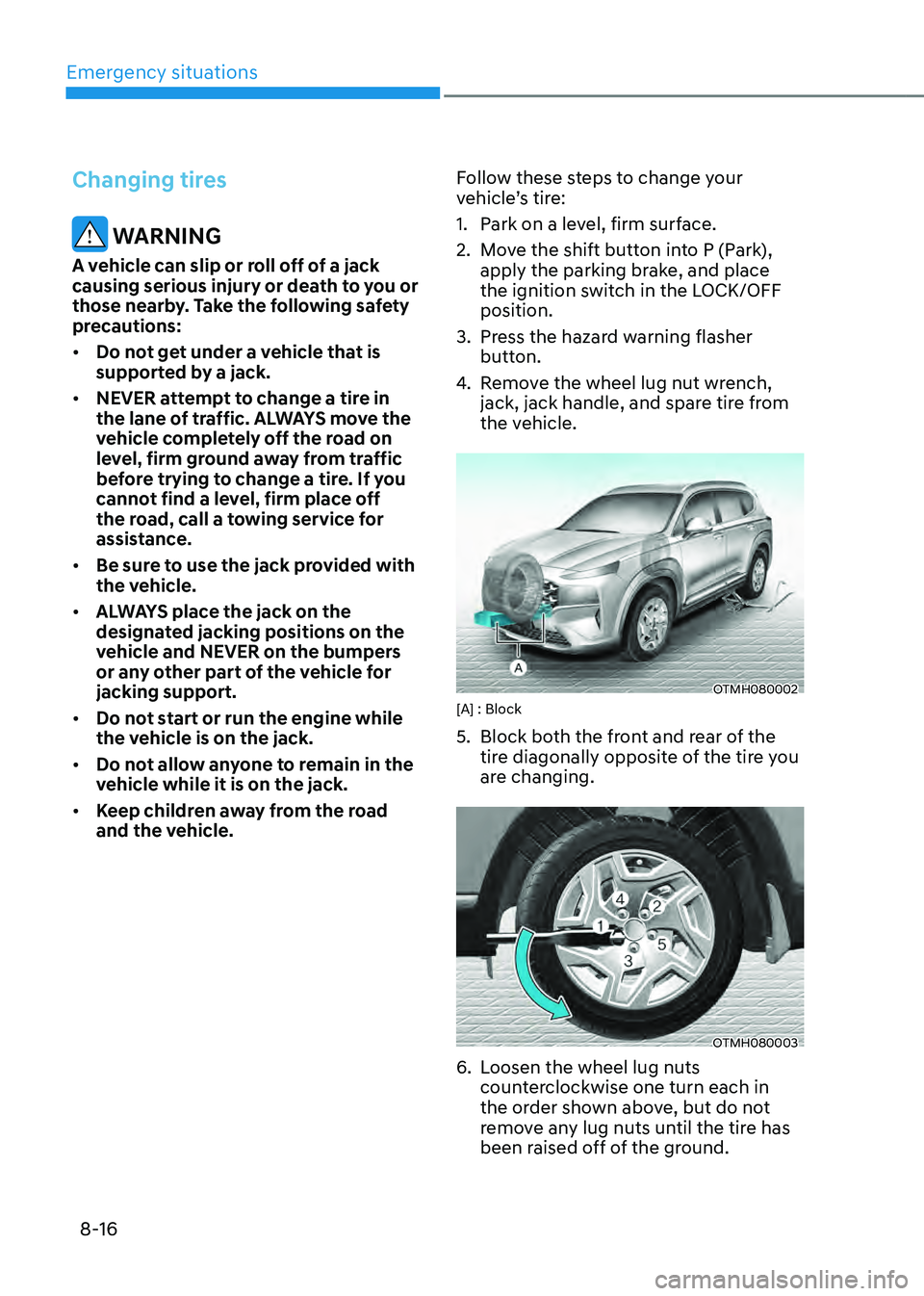
Emergency situations
8-16
Changing tires
WARNING
A vehicle can slip or roll off of a jack
causing serious injury or death to you or
those nearby. Take the following safety
precautions:
• Do not get under a vehicle that is
supported by a jack.
• NEVER attempt to change a tire in
the lane of traffic. ALWAYS move the
vehicle completely off the road on
level, firm ground away from traffic
before trying to change a tire. If you
cannot find a level, firm place off
the road, call a towing service for
assistance.
• Be sure to use the jack provided with
the vehicle.
• ALWAYS place the jack on the
designated jacking positions on the
vehicle and NEVER on the bumpers
or any other part of the vehicle for
jacking support.
• Do not start or run the engine while
the vehicle is on the jack.
• Do not allow anyone to remain in the
vehicle while it is on the jack.
• Keep children away from the road
and the vehicle. Follow these steps to change your
vehicle’s tire:
1. Park on a level, firm surface.
2. Move the shift button into P (Park),
apply the parking brake, and place
the ignition switch in the LOCK/OFF
position.
3. Press the hazard warning flasher
button.
4. Remove the wheel lug nut wrench,
jack, jack handle, and spare tire from
the vehicle.
OTMH080002[A] : Block
5. Block both the front and rear of the
tire diagonally opposite of the tire you
are changing.
OTMH080003
6. Loosen the wheel lug nuts
counterclockwise one turn each in
the order shown above, but do not
remove any lug nuts until the tire has
been raised off of the ground.
Page 511 of 598
![HYUNDAI SANTA FE HYBRID 2021 Repair Manual 08
8-21
Towing service
OTMH080014[A] : Dollies
If emergency towing is necessary,
we recommend having it done by
an authorized HYUNDAI dealer or a
commercial tow-truck service.
Proper lifting and to](/img/35/56184/w960_56184-510.png "HYUNDAI SANTA FE HYBRID 2021 Repair Manual 08
8-21
Towing service
OTMH080014[A] : Dollies
If emergency towing is necessary,
we recommend having it done by
an authorized HYUNDAI dealer or a
commercial tow-truck service.
Proper lifting and to")
08
8-21
Towing service
OTMH080014[A] : Dollies
If emergency towing is necessary,
we recommend having it done by
an authorized HYUNDAI dealer or a
commercial tow-truck service.
Proper lifting and towing procedures
are necessary to prevent damage to
the vehicle. The use of wheel dollies or
flatbed is recommended.
It is acceptable to tow the vehicle with
the rear wheels on the ground (without
dollies) and the front wheels off the
ground.
If any of the loaded wheels or suspension
components are damaged or the vehicle
is being towed with the front wheels on
the ground, use a towing dolly under the
front wheels.
When being towed by a commercial tow
truck and wheel dollies are not used,
the front of the vehicle should always be
lifted, not the rear.
CAUTION
OTM080013
• Do not tow with sling-type
equipment. Use wheel lift or flatbed
equipment.
OTMH080009
• Do not tow the vehicle with the front
wheels on the ground as this may
cause damage to the vehicle.
When towing your vehicle in an
emergency without wheel dollies:
• Vehicle without EPB
1. Place the ignition switch in the ACC
position.
2. Place the shift button in N (Neutral).
3. Release the parking brake.
• Vehicle with EPB
1. Release EPB before turning off the
engine.
2. Place the ignition switch to the OFF
position.
3. Change the gear to N (Neutral) while
pressing the brake pedal.
4. Place the ignition switch to the ACC
position.
CAUTION
Failure to place the shift button in N
(Neutral) may cause internal damage to
the transmission.
TOWING
Page 513 of 598
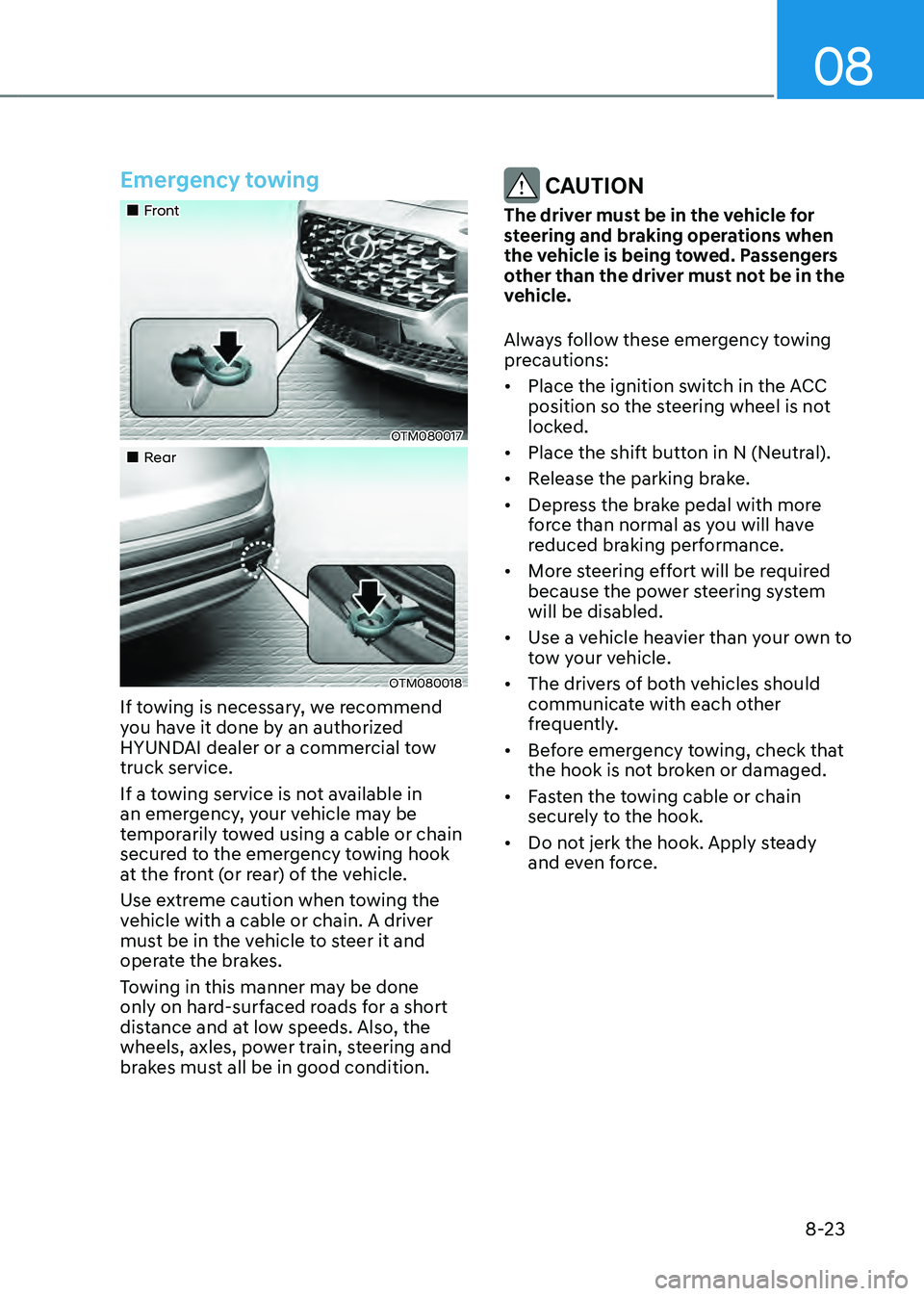
08
8-23
Emergency towing
„„Front
OTM080017
„„Rear
OTM080018
If towing is necessary, we recommend
you have it done by an authorized
HYUNDAI dealer or a commercial tow
truck service.
If a towing service is not available in
an emergency, your vehicle may be
temporarily towed using a cable or chain
secured to the emergency towing hook
at the front (or rear) of the vehicle.
Use extreme caution when towing the
vehicle with a cable or chain. A driver
must be in the vehicle to steer it and
operate the brakes.
Towing in this manner may be done
only on hard-surfaced roads for a short
distance and at low speeds. Also, the
wheels, axles, power train, steering and
brakes must all be in good condition.
CAUTION
The driver must be in the vehicle for
steering and braking operations when
the vehicle is being towed. Passengers
other than the driver must not be in the
vehicle.
Always follow these emergency towing
precautions:
• Place the ignition switch in the ACC
position so the steering wheel is not
locked.
• Place the shift button in N (Neutral).
• Release the parking brake.
• Depress the brake pedal with more
force than normal as you will have
reduced braking performance.
• More steering effort will be required
because the power steering system
will be disabled.
• Use a vehicle heavier than your own to
tow your vehicle.
• The drivers of both vehicles should
communicate with each other
frequently.
• Before emergency towing, check that
the hook is not broken or damaged.
• Fasten the towing cable or chain
securely to the hook.
• Do not jerk the hook. Apply steady
and even force.
Page 520 of 598
09
9-5
WARNING
Performing maintenance work on a
vehicle can be dangerous. If you lack
sufficient knowledge and experience or
the proper tools and equipment to do
the work, we recommend that having it
done by an authorized HYUNDAI dealer.
ALWAYS follow these precautions for
performing maintenance work:
• Park your vehicle on level ground,
move the shift button into the P
(Park) position, apply the parking
brake, and place the ignition switch
in the LOCK/OFF position.
• Block the tires (front and back) to
prevent the vehicle from moving.
Remove loose clothing or jewelry
that can become entangled in
moving parts.
• If you must run the engine during
maintenance, do so out doors or in
an area with plenty of ventilation.
• Keep flames, sparks, or smoking
materials away from the battery and
fuel-related parts. The following lists are vehicle checks and
inspections that should be performed
by the owner or an authorized HYUNDAI
dealer at the frequencies indicated to
help ensure safe, dependable operation
of your vehicle.
Any adverse conditions should be
brought to the attention of your dealer as
soon as possible.
These Owner Maintenance vehicle
checks are generally not covered by
warranties and you may be charged for
labor, parts and lubricants used.
Owner maintenance schedule
When you stop for fuel:
•
Check the engine oil level.
• Check the coolant level in the engine
coolant reservoir.
• Check the windshield washer fluid
level.
• Check for low or under-inflated tires.
WARNING
Be careful when checking your engine
coolant/inverter coolant level when the
engine is hot. This may result in coolant
being blown out of the opening and
cause serious burns and other injuries.
OWNER MAINTENANCE
Page 528 of 598
09
9-13
Engine oil and filter
The engine oil and filter should be
changed at the intervals specified in the
maintenance schedule. If the vehicle
is being driven in severe conditions,
more frequent oil and filter changes are
required.
HSG (Hybrid Starter & Generator)
belt
The HSG belt should be changed at the
intervals specified in the maintenance
schedule.
Fuel lines, fuel hoses and
connections
Check the fuel lines, fuel hoses and
connections for leakage and damage.
We recommend an authorized HYUNDAI
dealer replace any damaged or leaking
parts immediately.
Fuel filter
A clogged filter can limit the speed
at which the vehicle may be driven,
damage the emission system and cause
multiple issues such as hard starting. If
an excessive amount of foreign matter
accumulates in the fuel tank, the
filter may require replacement more
frequently. After installing a new filter,
run the engine for several minutes,
and check for leaks at the connections.
Fuel filters should be installed by an
authorized HYUNDAI dealer.
Vapor hose and fuel filler cap
The vapor hose and fuel filler cap should
be inspected at those intervals specified
in the maintenance schedule. Make sure
a new vapor hose or fuel filler cap is
correctly replaced.
Air cleaner filter
A genuine HYUNDAI air cleaner filter
is recommended when the filter is
replaced.
Spark plugs
Make sure to install new spark plugs of
the correct heat range.
When assembling parts, be sure to
wipe the inside and outside of the boot
bottom of the ignition coil and the
insulator of the spark plug with a soft
cloth to prevent contamination of the
spark plug insulator.
Cooling system
Check cooling system components, such
as radiator, coolant reservoir, hoses and
connections for leakage and damage.
Replace any damaged parts.
Engine coolant/inverter coolant
The coolant should be changed at the
intervals specified in the maintenance
schedule.
Automatic transmission fluid
Automatic transmission fluid should
not be checked under normal usage
conditions.
We recommend that the automatic
transmission fluid is changed by an
authorized HYUNDAI dealer according to
the maintenance schedule.
Engine clutch actuator fluid
The engine clutch actuator fluid level
should be inspected or replaced to the
intervals specified in the maintenance
schedule.
EXPLANATION OF SCHEDULED MAINTENANCE ITEMS
Page 542 of 598
09
9-27
BATTERY
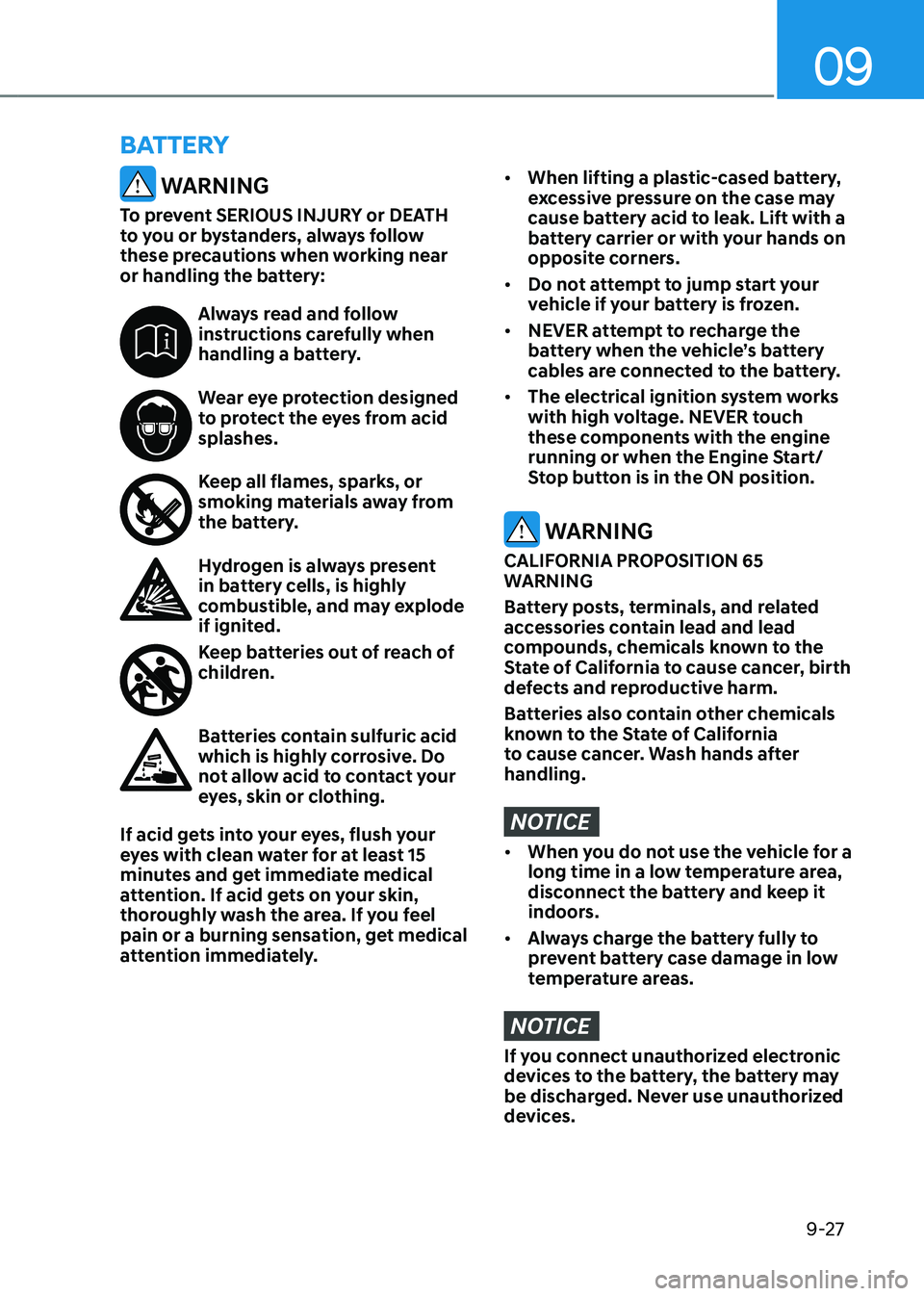
WARNING
To prevent SERIOUS INJURY or DEATH
to you or bystanders, always follow
these precautions when working near
or handling the battery:
Always read and follow instructions carefully when
handling a battery.
Wear eye protection designed to protect the eyes from acid
splashes.
Keep all flames, sparks, or smoking materials away from
the battery.
Hydrogen is always present in battery cells, is highly
combustible, and may explode
if ignited.
Keep batteries out of reach of children.
Batteries contain sulfuric acid which is highly corrosive. Do
not allow acid to contact your
eyes, skin or clothing.
If acid gets into your eyes, flush your
eyes with clean water for at least 15
minutes and get immediate medical
attention. If acid gets on your skin,
thoroughly wash the area. If you feel
pain or a burning sensation, get medical
attention immediately.
• When lifting a plastic-cased battery,
excessive pressure on the case may
cause battery acid to leak. Lift with a
battery carrier or with your hands on
opposite corners.
• Do not attempt to jump start your
vehicle if your battery is frozen.
• NEVER attempt to recharge the
battery when the vehicle’s battery
cables are connected to the battery.
• The electrical ignition system works
with high voltage. NEVER touch
these components with the engine
running or when the Engine Start/
Stop button is in the ON position.
WARNING
CALIFORNIA PROPOSITION 65
WARNING
Battery posts, terminals, and related
accessories contain lead and lead
compounds, chemicals known to the
State of California to cause cancer, birth
defects and reproductive harm.
Batteries also contain other chemicals
known to the State of California
to cause cancer. Wash hands after
handling.
NOTICE
• When you do not use the vehicle for a
long time in a low temperature area,
disconnect the battery and keep it
indoors.
• Always charge the battery fully to
prevent battery case damage in low
temperature areas.
NOTICE
If you connect unauthorized electronic
devices to the battery, the battery may
be discharged. Never use unauthorized
devices.
Page 565 of 598
Maintenance
9-50
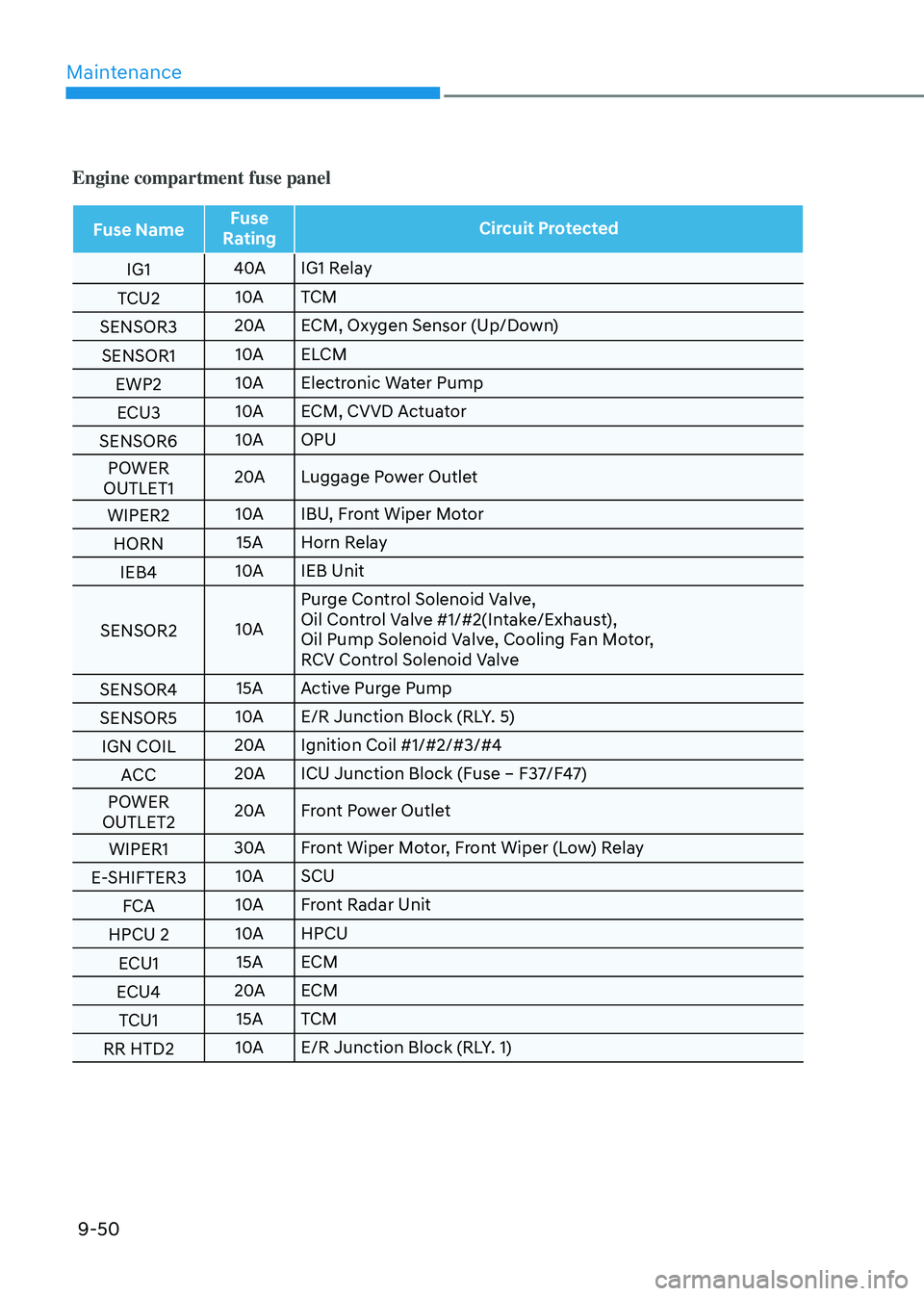
Engine compartment fuse panel
Fuse NameFuse
Rating Circuit Protected
IG1 40A
IG1 Relay
TCU2 10A
TCM
SENSOR3 20A
ECM, Oxygen Sensor (Up/Down)
SENSOR1 10A
ELCM
EWP2 10A
Electronic Water Pump
ECU3 10A
ECM, CVVD Actuator
SENSOR6 10A
OPU
POWER
OUTLET1 20A
Luggage Power Outlet
WIPER2 10A
IBU, Front Wiper Motor
HORN 15A
Horn Relay
IEB4 10A
IEB Unit
SENSOR2 10APurge Control Solenoid Valve,
Oil Control Valve #1/#2(Intake/Exhaust),
Oil Pump Solenoid Valve, Cooling Fan Motor,
RCV Control Solenoid Valve
SENSOR4 15A
Active Purge Pump
SENSOR5 10A
E/R Junction Block (RLY. 5)
IGN COIL 20A
Ignition Coil #1/#2/#3/#4
ACC 20A
ICU Junction Block (Fuse – F37/F47)
POWER
OUTLET2 20A
Front Power Outlet
WIPER1 30A
Front Wiper Motor, Front Wiper (Low) Relay
E-SHIFTER3 10A
SCU
FCA 10A
Front Radar Unit
HPCU 2 10A
HPCU
ECU1 15A
ECM
ECU4 20A
ECM
TCU1 15A
TCM
RR HTD2 10A
E/R Junction Block (RLY. 1)
Page 566 of 598
09
9-51
We recommend that you consult an
authorized HYUNDAI dealer to replace
most vehicle light bulbs. It is difficult
to replace vehicle light bulbs because
other parts of the vehicle must be
removed before you can get to the bulb.
This is especially true for removing the
headlamp assembly to get to the bulb(s).
Removing/installing the headlamp
assembly can result in damage to the
vehicle.
WARNING
• Prior to working on a light, depress
the foot brake, shift to P (Park), apply
the parking brake, set the ignition
switch to the LOCK/OFF position
and take the key with you when
leaving the vehicle to avoid sudden
movement of the vehicle and to
prevent possible electric shock.
• Be aware the bulbs may be hot and
may burn your fingers.
NOTICE
Be sure to replace the burned-out bulb
with one of the same wattage rating.
Otherwise, it may cause damage to the
fuse or electrical wiring system.
NOTICE
To prevent damage, do not clean the
headlamp lens with chemical solvents
or strong detergents.
Information
The headlamp and tail lamp lenses could
appear frosty if the vehicle is washed after
driving or the vehicle is driven at night
in wet weather. This condition is caused
by temperature difference between the
lamp inside and outside and, it does not
indicate a problem with your vehicle.
When moisture condenses in the lamp,
it will be removed after driving with the
headlamp on. The removable level may
differ depending on lamp size, lamp
position and environmental condition.
However, if moisture is not removed, we
recommend that your vehicle is inspected
by an authorized HYUNDAI dealer.
Information
• A normally functioning lamp may
flicker momentarily to stabilize the
vehicle’s electrical control system.
However, if the lamp goes out after
flickering momentarily, or continues to
flicker, we recommend the system be
checked by an authorized HYUNDAI
dealer.
• The position lamp may not turn on
when the position lamp switch is turned
on, but the position lamp and headlamp
switch may turn on when the headlamp
switch is turned on. This may be caused
by network failure or vehicle electrical
control system malfunction. If this
occurs, we recommend the system be
checked by an authorized HYUNDAI
dealer.
Information
The headlamp aiming should be adjusted
after an accident or after the headlamp
assembly is reinstalled at an authorized
HYUNDAI dealer.
LIGHT BULBS
Page 591 of 598
 ........................................................................\
.............6-37
Emergency precautions ...................................................")
Index
I-6
Four wheel drive (4WD) ........................................................................\
.............6-37
Emergency precautions ........................................................................\
............6-42
Four Wheel Drive (4WD) operation ................................................................6-38
Reducing the risk of a rollover ........................................................................\
.6-44
Fuses
........................................................................\
............................................9-40
Engine compartment panel fuse replacement ...................................................9-42
Fuse/relay panel description ........................................................................\
.....9-43
Instrument panel fuse replacement ...................................................................9-41
H
Hazard warning flasher
........................................................................\
..................8-2
Head-Up Display (HUD)
........................................................................\
............5-76
Head-up display information ........................................................................\
....5-76
Head-up display settings ........................................................................\
..........5-76
Precautions while using the head-up display ...................................................5-77
High Beam Assist (HBA)
........................................................................\
...........5-82
System malfunction and limitations .................................................................5-83
System operation ........................................................................\
......................5-83
System settings ........................................................................\
.........................5-82
Highway Driving Assist (HDA)
........................................................................\
.7-81
System malfunction and limitations .................................................................7-85
System operation ........................................................................\
......................7-83
System settings ........................................................................\
.........................7-82
Hybrid Starter & Generator (HSG) belt ............................................................... 9-20
Checking the Hybrid Starter & Generator (HSG) belt .....................................9-20
I
If the engine overheats
........................................................................\
...................8-7
If the engine will not start
........................................................................\
..............8-3
If you have a flat tire (with spare tire)
.................................................................8-14
Changing tires ........................................................................\
..........................8-16
Jack and tools ........................................................................\
...........................8-14
Jack label ........................................................................\
..................................8-20
Removing and storing the spare tire .................................................................8-14
Ignition switch
........................................................................\
...............................6-5
Engine Start/Stop button ........................................................................\
............6-5
Remote start ........................................................................\
................................6-9