brake HYUNDAI SANTA FE LIMITED 2021 Owners Manual
[x] Cancel search | Manufacturer: HYUNDAI, Model Year: 2021, Model line: SANTA FE LIMITED, Model: HYUNDAI SANTA FE LIMITED 2021Pages: 636, PDF Size: 81.2 MB
Page 595 of 636
09
9-45
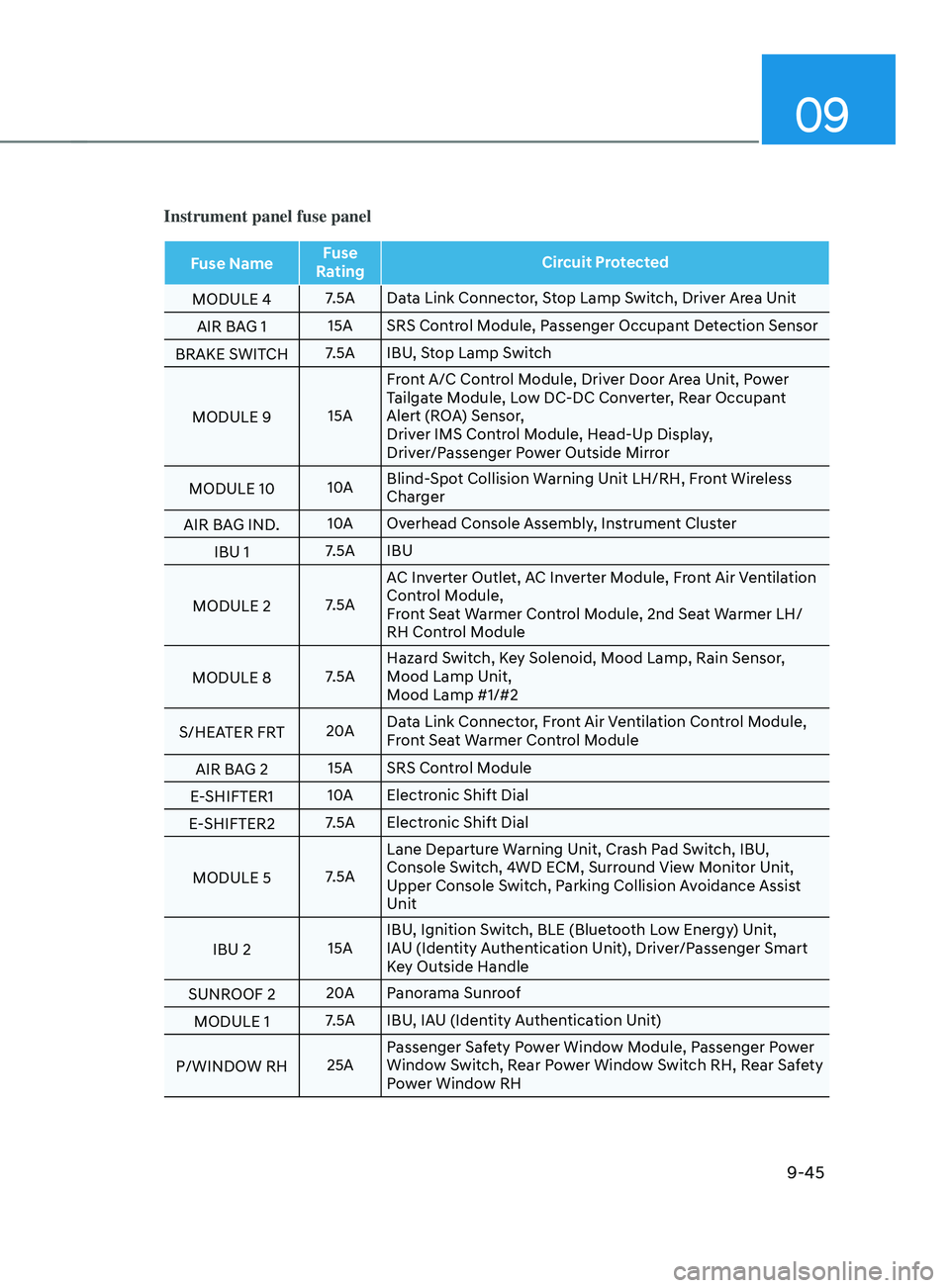
Instrument panel fuse panel
Fuse NameFuse
Rating Circuit Protected
MODULE 4 7.5A Data Link Connector, Stop Lamp Switch, Driver Area Unit
AIR BAG 1 15A SRS Control Module, Passenger Occupant Detection Sensor
BRAKE SWITCH 7.5A IBU, Stop Lamp Switch
MODULE 9 15AFront A/C Control Module, Driver Door Area Unit, Power
Tailgate Module, Low DC-DC Converter, Rear Occupant
Alert (ROA) Sensor,
Driver IMS Control Module, Head-Up Display,
Driver/Passenger Power Outside Mirror
MODULE 10 10ABlind-Spot Collision Warning Unit LH/RH, Front Wireless
Charger
AIR BAG IND. 10A
Overhead Console Assembly, Instrument Cluster
IBU 1 7.5A IBU
MODULE 2 7.5AAC Inverter Outlet, AC Inverter Module, Front Air Ventilation
Control Module,
Front Seat Warmer Control Module, 2nd Seat Warmer LH/
RH Control Module
MODULE 8 7.5AHazard Switch, Key Solenoid, Mood Lamp, Rain Sensor,
Mood Lamp Unit,
Mood Lamp #1/#2
S/HEATER FRT 20AData Link Connector, Front Air Ventilation Control Module,
Front Seat Warmer Control Module
AIR BAG 2 15A SRS Control Module
E-SHIFTER1 10A
Electronic Shift Dial
E-SHIFTER2 7.5A Electronic Shift Dial
MODULE 5 7.5ALane Departure Warning Unit, Crash Pad Switch, IBU,
Console Switch, 4WD ECM, Surround View Monitor Unit,
Upper Console Switch, Parking Collision Avoidance Assist
Unit
IBU 2 15AIBU, Ignition Switch, BLE (Bluetooth Low Energy) Unit,
IAU (Identity Authentication Unit), Driver/Passenger Smart
Key Outside Handle
SUNROOF 2 20A
Panorama Sunroof
MODULE 1 7.5A IBU, IAU (Identity Authentication Unit)
P/WINDOW RH 25APassenger Safety Power Window Module, Passenger Power
Window Switch, Rear Power Window Switch RH, Rear Safety
Power Window RH
Page 598 of 636
![HYUNDAI SANTA FE LIMITED 2021 Owners Manual Maintenance
9-48
Engine compartment fuse panel (Engine room junction block)
Type Fuse NameFuse
Rating Circuit Protected
MULTI
FUSE 1 (10P) COOLING FAN1
80A
[BLDC 600W] Cooling Fan Controller
COOLIN](/img/35/56182/w960_56182-597.png "HYUNDAI SANTA FE LIMITED 2021 Owners Manual Maintenance
9-48
Engine compartment fuse panel (Engine room junction block)
Type Fuse NameFuse
Rating Circuit Protected
MULTI
FUSE 1 (10P) COOLING FAN1
80A
[BLDC 600W] Cooling Fan Controller
COOLIN")
Maintenance
9-48
Engine compartment fuse panel (Engine room junction block)
Type Fuse NameFuse
Rating Circuit Protected
MULTI
FUSE 1 (10P) COOLING FAN1
80A
[BLDC 600W] Cooling Fan Controller
COOLING FAN2 60A
[BLDC 400W] Cooling Fan Controller
B+4 50AICU Junction Block (Fuse - MODULE8,
SUNROOF1, AMP, P/WINDOW RH, S/HEATER
DRV/PASS)
B+2 50AICU Junction Block (IPS 8 SPOC+/IPS 10/IPS 11/
IPS 13/IPS 14/IPS 15)
B+3 50AICU Junction Block (Fuse - E-SHIFTER1, P/
SEAT (DRV, P/SEAT (PASS), P/WINDOW LH, RR
SEAT(LH))
BLOWER 40A
Blower Relay
IG2 40A
Start Relay, PCB Block (PDM (IG2) Relay)
ABS 2 30A
ESC Module
MULTI
FUSE 2 (10P) MDPS
100A MDPS Unit
ABS 3 60A
ESC Module
B+6 60A
PCB Block (B+)
DCT 60A
TCM
E-CVVT1 50A
PCB Block (E-CVVT Relay)
REAR HEATED 40A
Rear Heated Relay
INVERTER 40A
AC Inverter Module
E-SHIFTER 1 40A
SCU
FUSE HEATED
MIRROR 10A
Rear Heated Relay, Driver/Passenger Outside
Mirror, Front A/C Control Module
E-CVVT3 20A
PCM, PCB Block (E-CVVT Relay)
E-CVVT2 20A
PCM, PCB Block (E-CVVT Relay)
A/C2 10A
Blower Relay, Front A/C Control Module
VACUUM PUMP2 10A
ESC Module, Vacuum Pump Relay, Vacuum Pump
B+5 50AICU Junction Block (Fuse - DOOR LOCK,
IBU1, IBU2, BRAKE SWITCH, CHILD LOCK, RR
SEAT(RH), SUNROOF2)
EOP2 60A
[G4KP] Electronic Oil Pump
Page 601 of 636
09
9-51
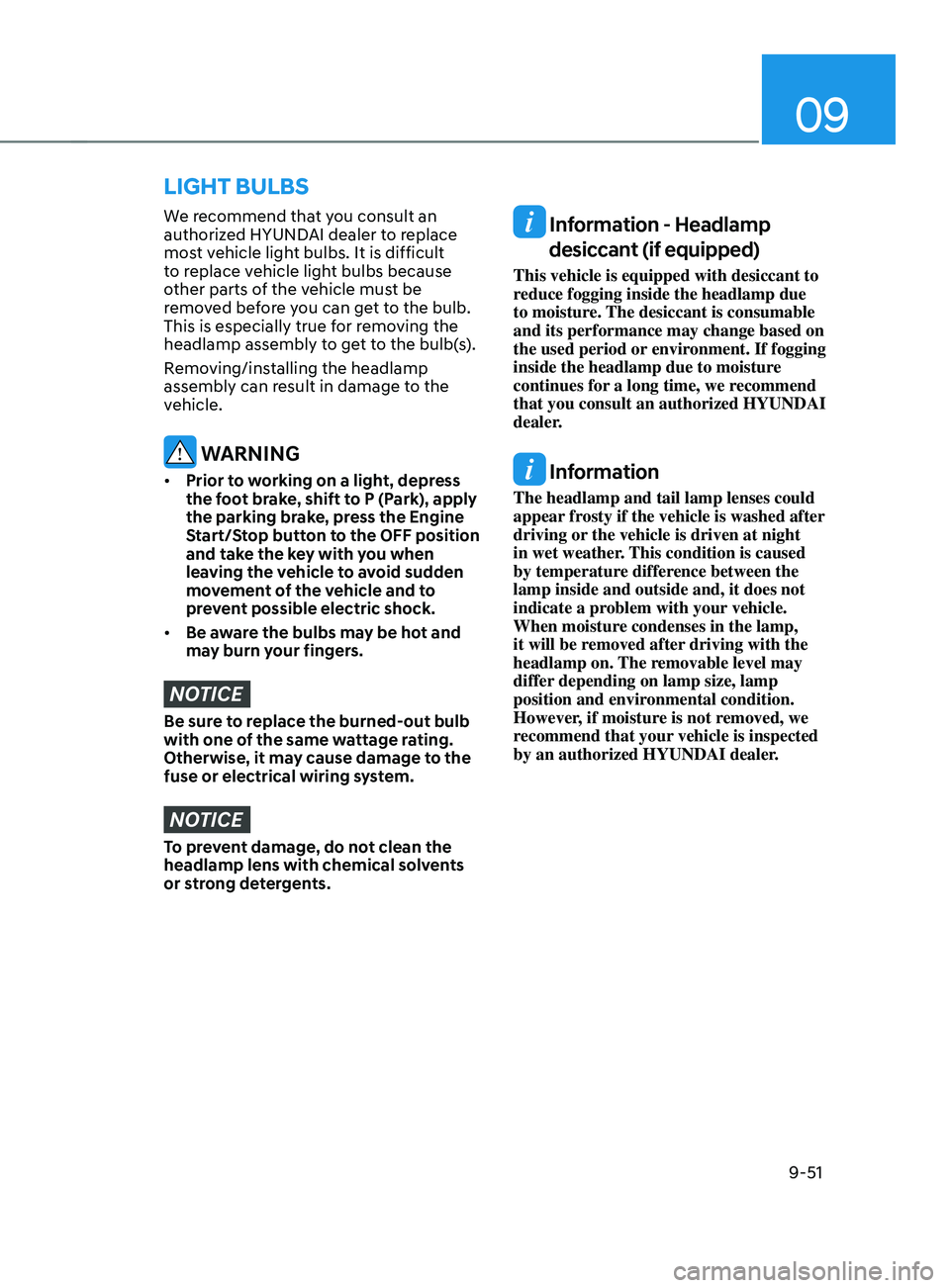
We recommend that you consult an
authorized HYUNDAI dealer to replace
most vehicle light bulbs. It is difficult
to replace vehicle light bulbs because
other parts of the vehicle must be
removed before you can get to the bulb.
This is especially true for removing the
headlamp assembly to get to the bulb(s).
Removing/installing the headlamp
assembly can result in damage to the
vehicle.
WARNING
• Prior to working on a light, depress
the foot brake, shift to P (Park), apply
the parking brake, press the Engine
Start/Stop button to the OFF position
and take the key with you when
leaving the vehicle to avoid sudden
movement of the vehicle and to
prevent possible electric shock.
• Be aware the bulbs may be hot and
may burn your fingers.
NOTICE
Be sure to replace the burned-out bulb
with one of the same wattage rating.
Otherwise, it may cause damage to the
fuse or electrical wiring system.
NOTICE
To prevent damage, do not clean the
headlamp lens with chemical solvents
or strong detergents.
Information - Headlamp
desiccant (if equipped)
This vehicle is equipped with desiccant to
reduce fogging inside the headlamp due
to moisture. The desiccant is consumable
and its performance may change based on
the used period or environment. If fogging
inside the headlamp due to moisture
continues for a long time, we recommend
that you consult an authorized HYUNDAI
dealer.
Information
The headlamp and tail lamp lenses could
appear frosty if the vehicle is washed after
driving or the vehicle is driven at night
in wet weather. This condition is caused
by temperature difference between the
lamp inside and outside and, it does not
indicate a problem with your vehicle.
When moisture condenses in the lamp,
it will be removed after driving with the
headlamp on. The removable level may
differ depending on lamp size, lamp
position and environmental condition.
However, if moisture is not removed, we
recommend that your vehicle is inspected
by an authorized HYUNDAI dealer.
LIGHT BULBS
Page 610 of 636
Maintenance
9-60
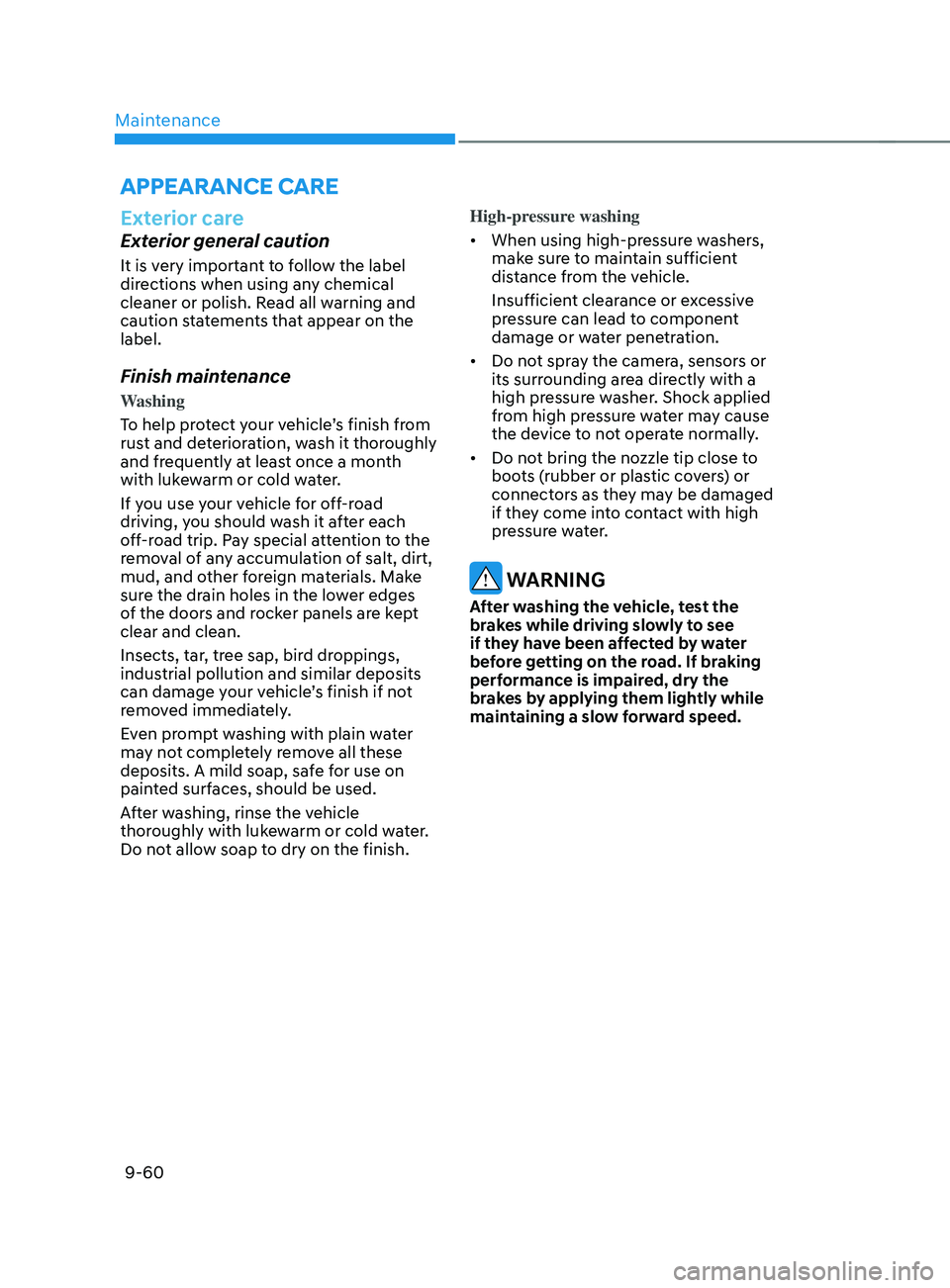
Exterior care
Exterior general caution
It is very important to follow the label
directions when using any chemical
cleaner or polish. Read all warning and
caution statements that appear on the
label.
Finish maintenance
Washing
To help protect your vehicle’s finish from
rust and deterioration, wash it thoroughly
and frequently at least once a month
with lukewarm or cold water.
If you use your vehicle for off-road
driving, you should wash it after each
off-road trip. Pay special attention to the
removal of any accumulation of salt, dirt,
mud, and other foreign materials. Make
sure the drain holes in the lower edges
of the doors and rocker panels are kept
clear and clean.
Insects, tar, tree sap, bird droppings,
industrial pollution and similar deposits
can damage your vehicle’s finish if not
removed immediately.
Even prompt washing with plain water
may not completely remove all these
deposits. A mild soap, safe for use on
painted surfaces, should be used.
After washing, rinse the vehicle
thoroughly with lukewarm or cold water.
Do not allow soap to dry on the finish.High-pressure washing
•
When using high-pressure washers,
make sure to maintain sufficient
distance from the vehicle.
Insufficient clearance or excessive
pressure can lead to component
damage or water penetration.
• Do not spray the camera, sensors or
its surrounding area directly with a
high pressure washer. Shock applied
from high pressure water may cause
the device to not operate normally.
• Do not bring the nozzle tip close to
boots (rubber or plastic covers) or
connectors as they may be damaged
if they come into contact with high
pressure water.
WARNING
After washing the vehicle, test the
brakes while driving slowly to see
if they have been affected by water
before getting on the road. If braking
performance is impaired, dry the
brakes by applying them lightly while
maintaining a slow forward speed.
APPEARANCE CARE
Page 613 of 636
09
9-63
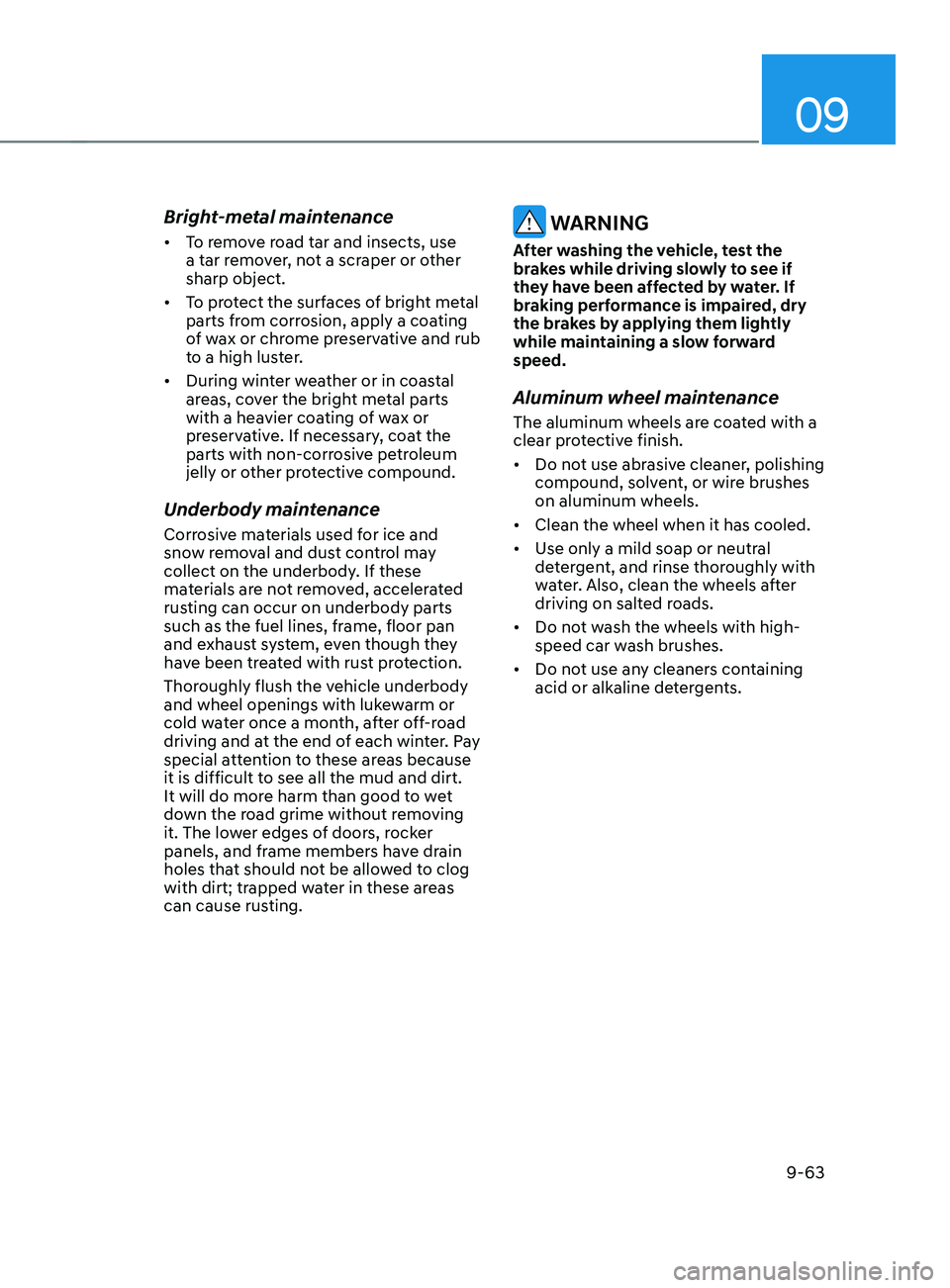
Bright-metal maintenance
• To remove road tar and insects, use
a tar remover, not a scraper or other
sharp object.
• To protect the surfaces of bright metal
parts from corrosion, apply a coating
of wax or chrome preservative and rub
to a high luster.
• During winter weather or in coastal
areas, cover the bright metal parts
with a heavier coating of wax or
preservative. If necessary, coat the
parts with non-corrosive petroleum
jelly or other protective compound.
Underbody maintenance
Corrosive materials used for ice and
snow removal and dust control may
collect on the underbody. If these
materials are not removed, accelerated
rusting can occur on underbody parts
such as the fuel lines, frame, floor pan
and exhaust system, even though they
have been treated with rust protection.
Thoroughly flush the vehicle underbody
and wheel openings with lukewarm or
cold water once a month, after off-road
driving and at the end of each winter. Pay
special attention to these areas because
it is difficult to see all the mud and dirt.
It will do more harm than good to wet
down the road grime without removing
it. The lower edges of doors, rocker
panels, and frame members have drain
holes that should not be allowed to clog
with dirt; trapped water in these areas
can cause rusting.
WARNING
After washing the vehicle, test the
brakes while driving slowly to see if
they have been affected by water. If
braking performance is impaired, dry
the brakes by applying them lightly
while maintaining a slow forward
speed.
Aluminum wheel maintenance
The aluminum wheels are coated with a
clear protective finish.
• Do not use abrasive cleaner, polishing
compound, solvent, or wire brushes
on aluminum wheels.
• Clean the wheel when it has cooled.
• Use only a mild soap or neutral
detergent, and rinse thoroughly with
water. Also, clean the wheels after
driving on salted roads.
• Do not wash the wheels with high-
speed car wash brushes.
• Do not use any cleaners containing
acid or alkaline detergents.
Page 625 of 636

I
I-3
B
Battery
........................................................................\
.........................................9-28
Battery capacity label ........................................................................\
...............9-30
Battery recharging ........................................................................\
.................... 9-30
For best battery service ........................................................................\
............9-29
Reset items ........................................................................\
............................... 9-31
Before driving
........................................................................\
................................ 6-4
Before entering the vehicle ........................................................................\
........6-4
Before starting ........................................................................\
............................ 6-4
Blind-Spot Collision-Avoidance
Assist (BCA)
..................................................7-25
System malfunction and limitations ................................................................. 7-34
System operation ........................................................................\
...................... 7-29
System settings ........................................................................\
......................... 7-27
Blind-Spot
View Monitor (BVM)
...................................................................... 7-51
System malfunction ........................................................................\
.................. 7-52
System operation ........................................................................\
...................... 7-51
System settings ........................................................................\
......................... 7-51
Brake fluid
........................................................................\
................................... 9-21
Checking the brake fluid level ........................................................................\
.9-21
Braking system
........................................................................\
............................ 6-34
Anti-lock Brake System (ABS) ........................................................................\
6-43
Auto Hold (if equipped) ........................................................................\
........... 6-39
Disc brakes wear indicator ........................................................................\
.......6-34
Downhill Brake Control (DBC) ......................................................................6-48
Electronic Parking Brake (EPB) .....................................................................6-35
Electronic Stability Control (ESC) ...................................................................6-44
Good braking practices ........................................................................\
............. 6-51
Hill-Start Assist Control (HAC) ......................................................................6-48
Power-assist brakes ........................................................................\
.................. 6-34
Vehicle Stability Management (VSM) ............................................................6-47
Bulb wattage
........................................................................\
.................................. 2-9
Page 627 of 636

I
I-5
Dual clutch transmission........................................................................\
.............. 6-23
Dual clutch transmission operation ..................................................................6-23
Good driving practices ........................................................................\
............ 6-33
LCD display message (button type) .................................................................6-30
Paddle shifter (Manual shifter mode) ...............................................................6-32
Parking ........................................................................\
..................................... 6-30
E
Emer
gency commodity
........................................................................\
................ 8-32
Fire extinguisher ........................................................................\
....................... 8-32
First aid kit ........................................................................\
............................... 8-32
Tire pressure gauge ........................................................................\
..................8-32
Triangle reflector ........................................................................\
...................... 8-32
Emission control system
........................................................................\
.............. 9-69
Gasoline Particulate Filter (GPF) .....................................................................9-72
Engine
........................................................................\
............................................ 2-8
Engine compartment
........................................................................\
...................... 2-7
Engine compartment
........................................................................\
...................... 9-3
Engine coolant /liquid-cooled intercooler coolant
............................................... 9-18
Changing coolant ........................................................................\
...................... 9-20
Checking the coolant level ........................................................................\
.......9-18
Engine number
........................................................................\
............................. 2-16
Engine oil
........................................................................\
..................................... 9-16
Checking the engine oil and filter ....................................................................9-17
Checking the engine oil level ........................................................................\
... 9-16
Engine Start/Stop button
........................................................................\
................ 6-9
Engine Stop/Start button positions ...................................................................6-10
Remote start ........................................................................\
.............................. 6-13
Starting the engine ........................................................................\
....................6-1
1
Turning of
f the engine
........................................................................\
.............. 6-12
Explanation of scheduled maintenance items
...................................................... 9-14
Fuel filter (for gasoline engine) ........................................................................\
9-14
Parking brake ........................................................................\
............................ 9-15
Exterior features
........................................................................\
........................... 5-67
Fuel filler door ........................................................................\
.......................... 5-77
Hood ........................................................................\
......................................... 5-67
Liftgate ........................................................................\
.....................................5-68
Power liftgate ........................................................................\
...........................5-70
Smart liftgate ........................................................................\
............................ 5-75