stop start Hyundai Santa Fe Sport 2017 Repair Manual
[x] Cancel search | Manufacturer: HYUNDAI, Model Year: 2017, Model line: Santa Fe Sport, Model: Hyundai Santa Fe Sport 2017Pages: 614, PDF Size: 18.99 MB
Page 460 of 614

5119
Driving your vehicle
When you are ready to leave after
parking on a hill
1. With the automatic transaxle in P(Park), apply your brakes and hold
the brake pedal down while you:
and
2. Slowly remove your foot from the brake pedal.
3. Drive slowly until the trailer is clear of the chocks.
4. Stop and have someone pick up and store the chocks.
Maintenance when trailer towing
Your vehicle will need service more
often when you regularly pull a trail-
er. Important items to pay particular
attention to include engine oil, auto-
matic transaxle fluid, axle lubricant
and cooling system fluid. Brake con-
dition is another important item to
frequently check. Each item is cov-
ered in this manual, and the Index
will help you find them quickly. If
you’re trailering, it’s a good idea to
review these sections before you
start your trip.
Don’t forget to also maintain your
trailer and hitch. Follow the mainte-
nance schedule that accompanied
your trailer and check it periodically.
Preferably, conduct the check at the
start of each day’s driving. Most
importantly, all hitch nuts and bolts
should be tight.WARNING- Parking
brake
It can be dangerous to get out
of your vehicle if the parking
brake is not firmly set.
If you have left the engine run-
ning, the vehicle can move sud-
denly. You or others could be
seriously or fatally injured.CAUTION
Due to higher load during trailer usage, overheatingmight occur in hot days orduring uphill driving. If thecoolant gauge indicates over-heating, switch off the A/C andstop the vehicle in a safe areato cool down the engine.
When towing check transaxle fluid more frequently.
Page 472 of 614

63
What to do in an emergency
IN CASE OF AN EMERGENCY WHILE DRIVING
If the engine stalls at a cross-
road or crossing
If the engine stalls at a crossroad or
crossing, set the shift lever in the N
(Neutral) position and then push the
vehicle to a safe place.
If you have a flat tire while
driving
If a tire goes flat while you are driving:
1. Take your foot off the acceleratorpedal and let the car slow down
while driving straight ahead. Do
not apply the brakes immediately
or attempt to pull off the road as
this may cause a loss of control.
When the car has slowed to such
a speed that it is safe to do so,
brake carefully and pull off the
road. Drive off the road as far as
possible and park on firm, level
ground. If you are on a divided
highway, do not park in the median
area between the two traffic lanes.
2. When the vehicle is stopped, turn on your emergency hazard flashers,
set the parking brake and put the
transaxle in P.
3. Have all passengers get out of the car. Be sure they all get out on the
side of the car that is away from
traffic.
4. When repairing a flat tire, follow the instruction provided later in
this section.
If engine stalls while driving
1. Reduce your speed gradually,keeping a straight line. Move cau-
tiously off the road to a safe place.
2. Turn on your emergency flashers.
3. Try to start the engine again. If your vehicle will not start, contact
an authorized HYUNDAI dealer or
seek other qualified assistance.
✽ ✽NOTICE
If there was a check engine light and
loss of power or stall, it is best if safe
to do so to wait at least 10 seconds to
restart a vehicle after it stalls. This
may reset the car so it will no longer
run at low power (limp home) condi-
tion.
Page 479 of 614

What to do in an emergency
10
6
Tire pressure monitoring sys-
tem
Each tire, including the spare (if pro-
vided), should be checked monthly
when cold and inflated to the inflation
pressure recommended by the vehi-
cle manufacturer on the vehicle plac-
ard or tire inflation pressure label. (If
your vehicle has tires of a different
size than the size indicated on the
vehicle placard or tire inflation pres-
sure label, you should determine the
proper tire inflation pressure for
those tires.) As an added safety feature, your
vehicle has been equipped with a tire
pressure monitoring system (TPMS)
that illuminates a low tire pressure
telltale when one or more of your
tires is significantly under-inflated.
Accordingly, when the low tire pres-
sure telltale illuminates, you should
stop and check your tires as soon as
possible, and inflate them to the
proper pressure. Driving on a signifi-
cantly under-inflated tire causes the
tire to overheat and can lead to tire
failure. Under-inflation also reduces
fuel efficiency and tire tread life, and
may affect the vehicle’s handling and
stopping ability.
Please note that the TPMS is not a
substitute for proper tire mainte-
nance, and it is the driver’s responsi-
bility to maintain correct tire pres-
sure, even if under-inflation has not
reached the level to trigger illumina-
tion of the TPMS low tire pressure
telltale.Your vehicle has also been equipped
with a TPMS malfunction indicator to
indicate when the system is not
operating properly. The TPMS mal-
function indicator is combined with
the low tire pressure telltale. When
the system detects a malfunction,
the telltale will flash for approximate-
ly one minute and then remain con-
tinuously illuminated. This sequence
will continue upon subsequent vehi-
cle start-ups as long as the malfunc-
tion exists. When the malfunction
indicator is illuminated, the system
may not be able to detect or signal
low tire pressure as intended.
TPMS malfunctions may occur for a
variety of reasons, including the
installation of replacement or alter-
nate tires or wheels on the vehicle
that prevent the TPMS from function-
ing properly. Always check the TPMS
malfunction telltale after replacing
one or more tires or wheels on your
vehicle to ensure that the replace-
ment or alternate tires and wheels
allow the TPMS to continue to func-
tion properly.
WARNING
Over-inflation or under-inflation
can reduce tire life, adversely
affect vehicle handling, and
lead to sudden tire failure that
may cause loss of vehicle con-
trol resulting in an accident.
Page 480 of 614

611
What to do in an emergency
✽
✽NOTICE
If any of the below happens, we rec-
ommend that the system be checked
by an authorized HYUNDAI dealer.
1.The low tire pressure telltale/
TPMS malfunction indicator does
not illuminate for 3 seconds when
Engine Start/Stop button is turned
to the ON or engine is running.
2. The TPMS malfunction indicator remains illuminated after blinking
for approximately 1 minute.
3. The Low tire pressure position telltale remains illuminated.
Low tire pressure
telltale
Low tire pressure position tell-
tale and tire pressure telltale
When the tire pressure monitoring
system warning indicators are illumi-
nated and warning message dis-
played on the cluster LCD display,
one or more of your tires is signifi-
cantly under-inflated. The low tire
pressure position telltale light will
indicate which tire is significantly
under-inflated by illuminating the cor-
responding position light. If either telltale illuminates, immedi-
ately reduce your speed, avoid hard
cornering and anticipate increased
stopping distances. You should stop
and check your tires as soon as pos-
sible. Inflate the tires to the proper
pressure as indicated on the vehi-
cle’s placard or tire inflation pressure
label located on the driver’s side cen-
ter pillar outer panel. If you cannot
reach a service station or if the tire
cannot hold the newly added air,
replace the low pressure tire with a
spare tire.
If you drive the vehicle for about 10
minutes at speeds above 15.5 mph
(25 km/h) after replacing the low
pressure tire with the spare tire, the
below will happen:
The TPMS malfunction indicator
may blink for approximately 1
minute and then remain continu-
ously illuminated because the
TPMS sensor is not mounted on
the spare wheel.
OAN067005N
Page 562 of 614
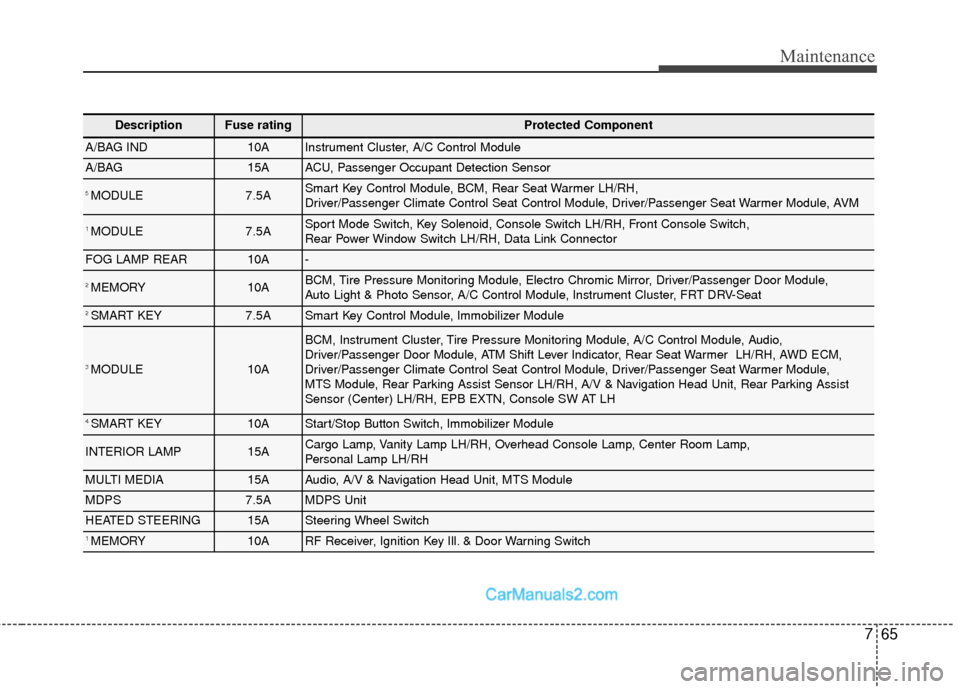
765
Maintenance
DescriptionFuse ratingProtected Component
A/BAG IND10AInstrument Cluster, A/C Control Module
A/BAG15AACU, Passenger Occupant Detection Sensor
5 MODULE7.5ASmart Key Control Module, BCM, Rear Seat Warmer LH/RH,
Driver/Passenger Climate Control Seat Control Module, Driver/Passenger Seat Warmer Module, AVM
1 MODULE7.5ASport Mode Switch, Key Solenoid, Console Switch LH/RH, Front Console Switch,
Rear Power Window Switch LH/RH, Data Link Connector
FOG LAMP REAR10A-
2 MEMORY10ABCM, Tire Pressure Monitoring Module, Electro Chromic Mirror, Driver/Passenger Door Module,
Auto Light & Photo Sensor, A/C Control Module, Instrument Cluster, FRT DRV-Seat
2 SMART KEY7.5ASmart Key Control Module, Immobilizer Module
3 MODULE10A
BCM, Instrument Cluster, Tire Pressure Monitoring Module, A/C Control Module, Audio,
Driver/Passenger Door Module, ATM Shift Lever Indicator, Rear Seat Warmer LH/RH, AWD ECM,
Driver/Passenger Climate Control Seat Control Module, Driver/Passenger Seat Warmer Module,
MTS Module, Rear Parking Assist Sensor LH/RH, A/V & Navigation Head Unit, Rear Parking Assist
Sensor (Center) LH/RH, EPB EXTN, Console SW AT LH
4 SMART KEY10AStart/Stop Button Switch, Immobilizer Module
INTERIOR LAMP15ACargo Lamp, Vanity Lamp LH/RH, Overhead Console Lamp, Center Room Lamp,
Personal Lamp LH/RH
MULTI MEDIA15AAudio, A/V & Navigation Head Unit, MTS Module
MDPS7.5AMDPS Unit
HEATED STEERING15ASteering Wheel Switch
1 MEMORY10ARF Receiver, Ignition Key Ill. & Door Warning Switch
Page 563 of 614
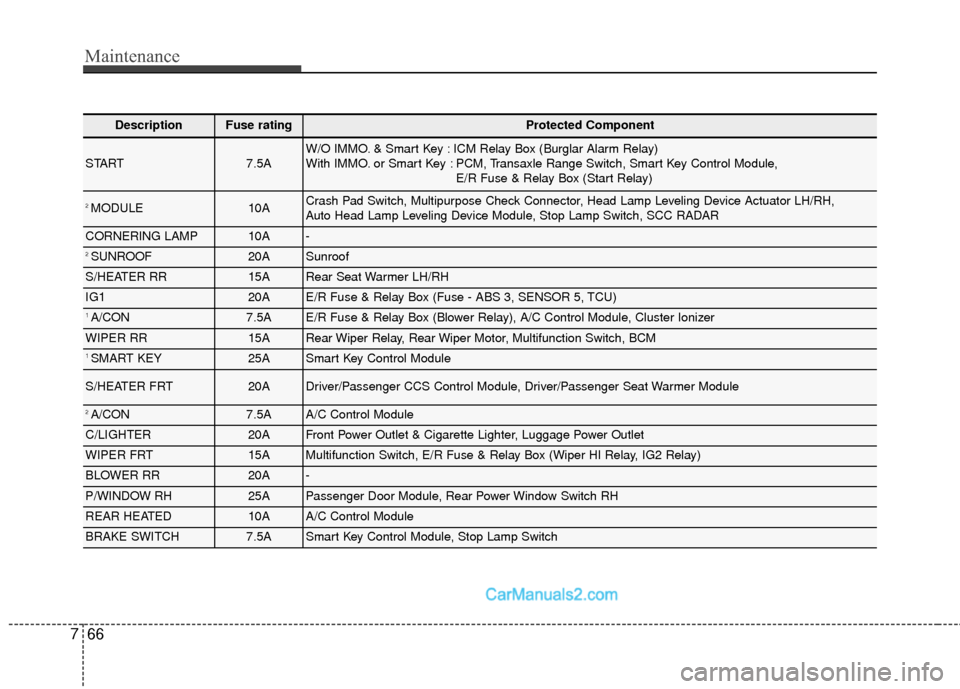
Maintenance
66
7
DescriptionFuse ratingProtected Component
START7.5AW/O IMMO. & Smart Key : ICM Relay Box (Burglar Alarm Relay)
With IMMO. or Smart Key : PCM, Transaxle Range Switch, Smart Key Control Module,
E/R Fuse & Relay Box (Start Relay)
2 MODULE10ACrash Pad Switch, Multipurpose Check Connector, Head Lamp Leveling Device Actuator LH/RH,
Auto Head Lamp Leveling Device Module, Stop Lamp Switch, SCC RADAR
CORNERING LAMP10A-
2 SUNROOF20ASunroof
S/HEATER RR15ARear Seat Warmer LH/RH
IG120AE/R Fuse & Relay Box (Fuse - ABS 3, SENSOR 5, TCU)
1 A/CON7.5AE/R Fuse & Relay Box (Blower Relay), A/C Control Module, Cluster Ionizer
WIPER RR15ARear Wiper Relay, Rear Wiper Motor, Multifunction Switch, BCM
1 SMART KEY25ASmart Key Control Module
S/HEATER FRT20ADriver/Passenger CCS Control Module, Driver/Passenger Seat Warmer Module
2 A/CON7.5AA/C Control Module
C/LIGHTER20AFront Power Outlet & Cigarette Lighter, Luggage Power Outlet
WIPER FRT15AMultifunction Switch, E/R Fuse & Relay Box (Wiper HI Relay, IG2 Relay)
BLOWER RR20A-
P/WINDOW RH 25APassenger Door Module, Rear Power Window Switch RH
REAR HEATED10AA/C Control Module
BRAKE SWITCH7.5ASmart Key Control Module, Stop Lamp Switch
Page 567 of 614
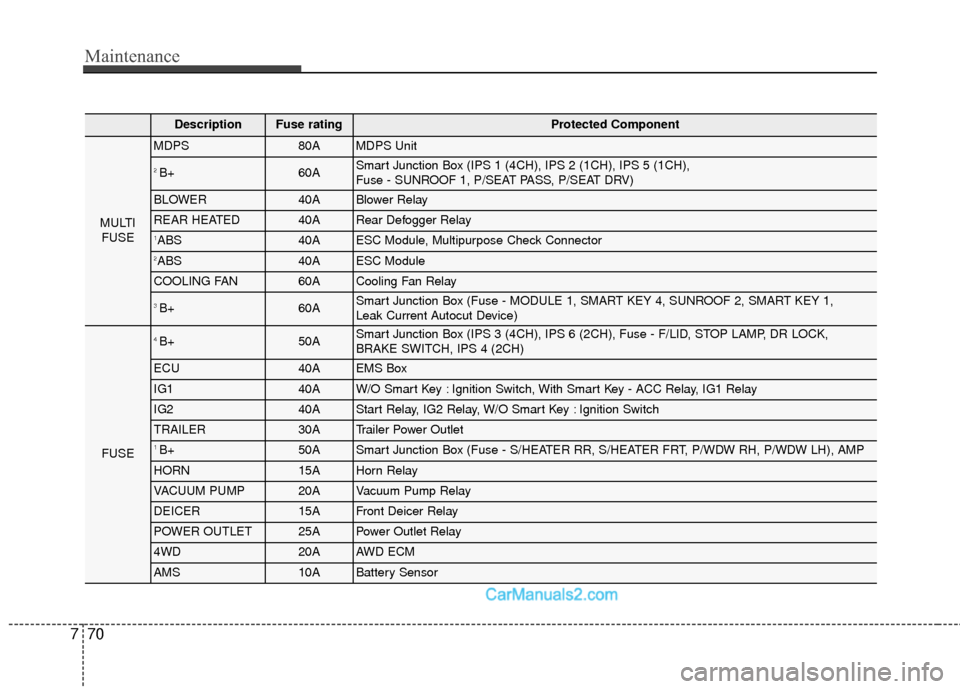
Maintenance
70
7
DescriptionFuse ratingProtected Component
MULTI
FUSE
MDPS80AMDPS Unit
2 B+60ASmart Junction Box (IPS 1 (4CH), IPS 2 (1CH), IPS 5 (1CH),
Fuse - SUNROOF 1, P/SEAT PASS, P/SEAT DRV)
BLOWER40ABlower Relay
REAR HEATED40ARear Defogger Relay
1ABS 40AESC Module, Multipurpose Check Connector
2ABS 40AESC Module
COOLING FAN60ACooling Fan Relay
3 B+60ASmart Junction Box (Fuse - MODULE 1, SMART KEY 4, SUNROOF 2, SMART KEY 1,
Leak Current Autocut Device)
FUSE
4 B+50ASmart Junction Box (IPS 3 (4CH), IPS 6 (2CH), Fuse - F/LID, STOP LAMP, DR LOCK,
BRAKE SWITCH, IPS 4 (2CH)
ECU40AEMS Box
IG140AW/O Smart Key : Ignition Switch, With Smart Key - ACC Relay, IG1 Relay
IG240AStart Relay, IG2 Relay, W/O Smart Key : Ignition Switch
TRAILER30ATrailer Power Outlet
1 B+50ASmart Junction Box (Fuse - S/HEATER RR, S/HEATER FRT, P/WDW RH, P/WDW LH), AMP
HORN15AHorn Relay
VACUUM PUMP20AVacuum Pump Relay
DEICER15AFront Deicer Relay
POWER OUTLET25APower Outlet Relay
4WD20AAWD ECM
AMS10ABattery Sensor
Page 588 of 614

791
Maintenance
Engine exhaust gas precautions(carbon monoxide)
Carbon monoxide can be present with other exhaust fumes.
Therefore, if you smell exhaust
fumes of any kind inside your vehi-
cle, have it inspected and repaired
immediately. If you ever suspect
exhaust fumes are coming into
your vehicle, drive it only with all
the windows fully open. Have your
vehicle checked and repaired
immediately. Do not operate the engine in con-
fined or closed areas (such as
garages) any more than what is
necessary to move the vehicle in or
out of the area.
When the vehicle is stopped in an open area for more than a short
time with the engine running, adjust
the ventilation system (as needed)
to draw outside air into the vehicle.
Never sit in a parked or stopped vehicle for any extended time with
the engine running.
When the engine stalls or fails to start, excessive attempts to restart
the engine may cause damage to
the emission control system.
CALIFORNIA PROPO-
SITION 65 WARNING
Engine exhaust and a wide vari-
ety of automobile components
and parts, including compo-
nents found in the interior fur-
nishings in a vehicle, contain or
emit chemicals known to the
State of California to cause can-
cer and birth defects and repro-
ductive harm. In addition, cer-
tain fluids contained in vehicles
and certain products of compo-
nent wear contain or emit chem-
icals known to the State of
California to cause cancer and
birth defects or other reproduc-
tive harm.
WARNING - Exhaust
Engine exhaust gases contain
carbon monoxide (CO). Though
colorless and odorless, it is
dangerous and could be lethal if
inhaled. Follow the instructions
on this page to avoid CO poi-
soning.
Page 605 of 614

I3
Index
Battery ........................................................................\
....7-41
Battery saver function ..................................................4-127
Before driving ..................................................................5-3
Blind spot detection system (BSD) ................................5-88
Blind spot mirror ............................................................4-78
Bottle holder, see cup holder ........................................4-172
Brake fluid ......................................................................7-\
31
Brake system ..................................................................5-30Anti-lock brake system (ABS) ....................................5-43
Auto hold ....................................................................5-40\
Downhill brake control (DBC)....................................5-51
Electronic parking brake (EPB) ..................................5-34
Electronic stability control (ESC) ..............................5-46
Emergency braking......................................................5-39
Hill-start assist control (HAC) ..................................5-53
Parking brake ..............................................................5-32
Power brakes ..............................................................5-30
Vehicle stability management (VSM) ........................5-50
Bulb replacement ............................................................7-73
Bulb wattage ....................................................................8-3
Button start/stop, see Engine start/stop button ................5-9 California perchlorate notice ..........................................7-93
Camera (Rear view) ......................................................4-124
Capacities (Lubricants) ....................................................8-6
Care
Exterior care ................................................................7-82
Interior care ................................................................7-87
Tire care ......................................................................7-\
44
Care of seat belts ............................................................3-37
Cargo security screen ....................................................4-177
Center console storage ..................................................4-169
Central door lock switch ................................................4-23
Certification label ............................................................8-9
Chain, See Tire chains ..................................................5-110
Checking the tire inflation pressure ................................7-45
Child restraint system ....................................................3-38 Lower anchor ..............................................................3-45
Tether Anchor ..............................................................3-43
Child-protector rear door lock ........................................4-25
Climate control air filter ......................................4-155, 7-36
Clothes hanger ..............................................................4-175
Combined instrument, see Instrument cluster ................4-79
Compact spare tire ..........................................................6-15
Consumer information ....................................................8-11
Coolant, see Engine coolant ..........................................7-28
Crankcase emission control system ................................7-89
BC
Page 607 of 614

I5
Index
Engine number ................................................................8-10
Engine oil ........................................................................\
7-26
Engine overheat ................................................................6-8
Engine start/stop button ....................................................5-9
Engine will no start ..........................................................6-4
Explanation of scheduled maintenance items ................7-23
Interior care ....................................................................7-87\
Exterior features............................................................4-180
Exterior overview (front) ..................................................2-2
Exterior overview (rear) ..................................................2-3
Flat tire (with spare tire) ................................................6-15Changing tires..............................................................6-18
Compact spare tire ......................................................6-22
Jack and tools ..............................................................6-15
Jack label ....................................................................6-24\
Floor mat anchor(s) ......................................................4-175
Fluid Brake fluid ..................................................................7-31
Washer fluid ................................................................7-33
Folding key ......................................................................4-\
4
Folding the rear seat ......................................................3-22
Front fog light ..............................................................4-132
Front seat adjustment - Manual ........................................3-7
Front seat adjustment - Power ..........................................3-8 Front wiper deicer ........................................................4-146
Fuel Economy ..............................................................4-103
Fuel filler door ................................................................4-46
Fuel filler door manual release....................................4-49
Fuel gauge ......................................................................4-\
82
Fuel requirements ............................................................1-2
Fuses switch ....................................................................7-62\
Fuses ........................................................................\
......7-60 Engine compartment panel fuse ..................................7-62
Fuse/relay panel description ........................................7-64
Fuses switch ................................................................7-62
Instrument panel fuse ..................................................7-61
Multi fuse ....................................................................7-63\
Gauges ........................................................................\
....4-80
Glove box......................................................................4-\
169
Good braking practices ..................................................5-54
Good driving practices....................................................5-19
Gross vehicle weight ........................................................8-5
F
G