warning Hyundai Sonata
[x] Cancel search | Manufacturer: HYUNDAI, Model Year: , Model line: , Model:Pages: 285, PDF Size: 9.38 MB
Page 26 of 285
1
FEATURES OF YOUR HYUNDAI
13
!
!
WARNING:
o Passengers can be injured if their
head, hands or other body parts are
trapped by a closing window. Always
check for obstructions before raising
any window.
o NEVER leave the ignition key in the
vehicle.
o NEVER leave any child unattended in
the vehicle. Even very young children
may inadvertently cause the vehicle
to move, entangle themselves in the
windows, or otherwise injure
themselves or others.
o Do not attempt to operate the main
switch on the driver's door and a
switch on another door in opposing
directions at the same time. If this is
done, the window will stop and cannot
be opened or closed.
WARNING:
o The automatic reverse feature for the
driver’s window is only active when
the “auto up” feature is used by fully
pulling up the switch. The automatic
reverse feature will not operate if the
window is raised using the halfway
position on the power window switch.
o Always check for obstructions before
raising any window to avoid injuries or
vehicle damage. If an object less than
0.16 in. (4 mm) in diameter is caught
between the window glass and the
upper window channel, the automatic
reverse window may not detect the
resistance and will not stop and
reverse direction.B060C02NF-AATAutomatic Reverse Window
(Driver's side)If the upward movement of the window is
blocked by an object or part of the body, the
window will detect the resistance and will
stop upward movement. The window will
then lower approximately 11.8 in.(30cm)
to allow the object to be cleared.
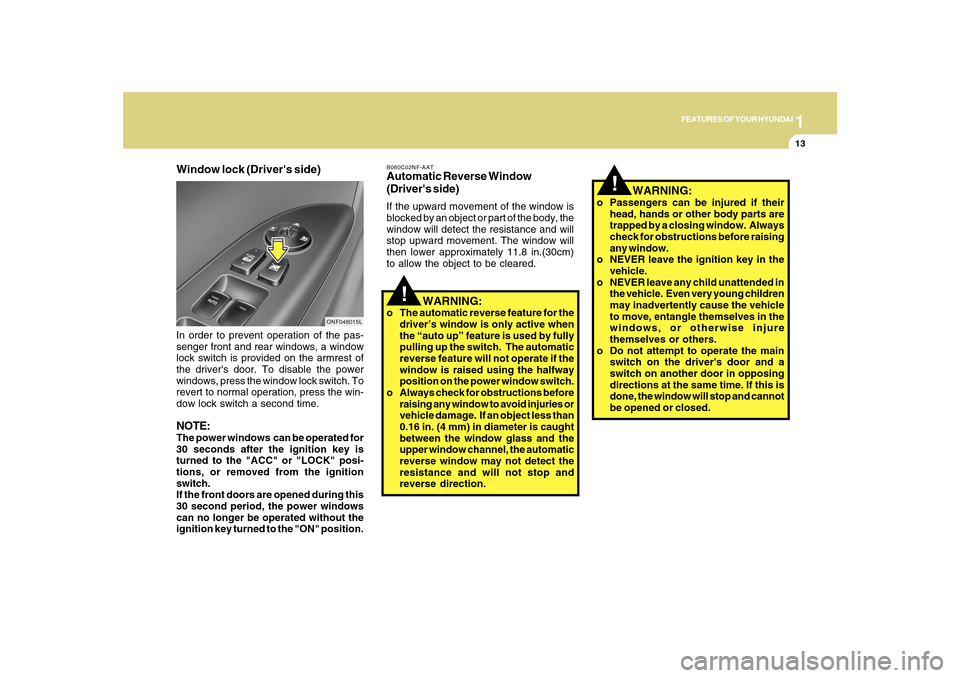
Window lock (Driver's side)
ONF048015L
In order to prevent operation of the pas-
senger front and rear windows, a window
lock switch is provided on the armrest of
the driver's door. To disable the power
windows, press the window lock switch. To
revert to normal operation, press the win-
dow lock switch a second time.NOTE:The power windows can be operated for
30 seconds after the ignition key is
turned to the "ACC" or "LOCK" posi-
tions, or removed from the ignition
switch.
If the front doors are opened during this
30 second period, the power windows
can no longer be operated without the
ignition key turned to the "ON" position.
Page 27 of 285
1FEATURES OF YOUR HYUNDAI14
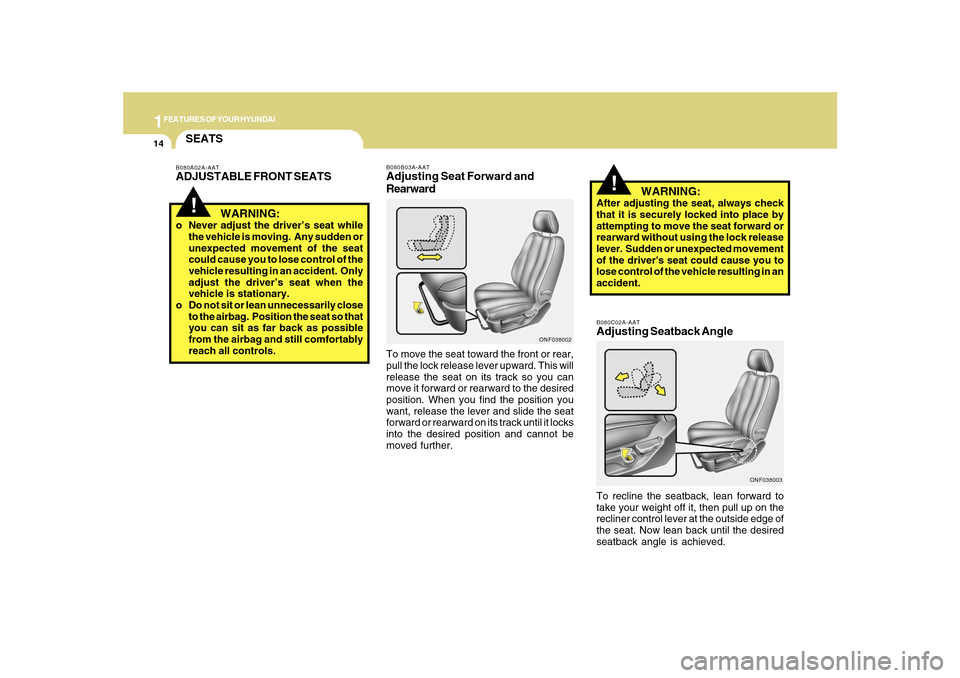
B080C02A-AATAdjusting Seatback AngleTo recline the seatback, lean forward to
take your weight off it, then pull up on the
recliner control lever at the outside edge of
the seat. Now lean back until the desired
seatback angle is achieved.
ONF038003
!
B080B03A-AATAdjusting Seat Forward and
RearwardTo move the seat toward the front or rear,
pull the lock release lever upward. This will
release the seat on its track so you can
move it forward or rearward to the desired
position. When you find the position you
want, release the lever and slide the seat
forward or rearward on its track until it locks
into the desired position and cannot be
moved further.
WARNING:
After adjusting the seat, always check
that it is securely locked into place by
attempting to move the seat forward or
rearward without using the lock release
lever. Sudden or unexpected movement
of the driver's seat could cause you to
lose control of the vehicle resulting in an
accident.
ONF038002
SEATSB080A02A-AATADJUSTABLE FRONT SEATS
!
WARNING:
o Never adjust the driver’s seat while
the vehicle is moving. Any sudden or
unexpected movement of the seat
could cause you to lose control of the
vehicle resulting in an accident. Only
adjust the driver’s seat when the
vehicle is stationary.
o Do not sit or lean unnecessarily close
to the airbag. Position the seat so that
you can sit as far back as possible
from the airbag and still comfortably
reach all controls.
Page 28 of 285
1
FEATURES OF YOUR HYUNDAI
15
!
WARNING:
Riding with a reclined seatback in-
creases your chance of serious or fatal
injuries in the event of a collision or
sudden stop. The protection of your
restraint system (seat belts and airbags)
is greatly reduced by reclining your seat.
Seat belts must be snug against your
hips and chest to work properly. The
more the seatback is reclined, the greater
the chance that an occupant's hips will
slide under the lap belt or the occupant's
neck will strike the shoulder belt. Drivers
and passengers should always sit well
back in their seats, properly belted, and
with the seatbacks upright.
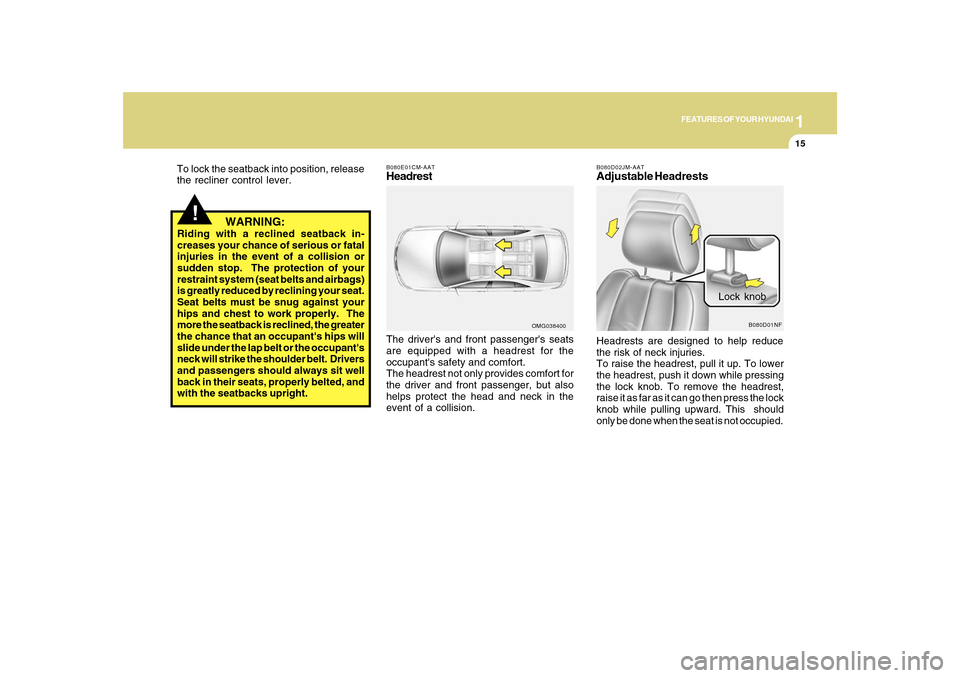
B080E01CM-AATHeadrestThe driver's and front passenger's seats
are equipped with a headrest for the
occupant's safety and comfort.
The headrest not only provides comfort for
the driver and front passenger, but also
helps protect the head and neck in the
event of a collision.
OMG038400
To lock the seatback into position, release
the recliner control lever.
B080D02JM-AATAdjustable HeadrestsHeadrests are designed to help reduce
the risk of neck injuries.
To raise the headrest, pull it up. To lower
the headrest, push it down while pressing
the lock knob. To remove the headrest,
raise it as far as it can go then press the lock
knob while pulling upward. This should
only be done when the seat is not occupied.
B080D01NF
Lock knob
Page 29 of 285
1FEATURES OF YOUR HYUNDAI16
o Do not operate the vehicle with the
headrests removed as injury to the
occupants may occur in the event of
an accident. Headrests may provide
protection against neck injuries when
properly adjusted.
o Do not adjust the headrest position of
the driver's seat while the vehicle is in
motion.
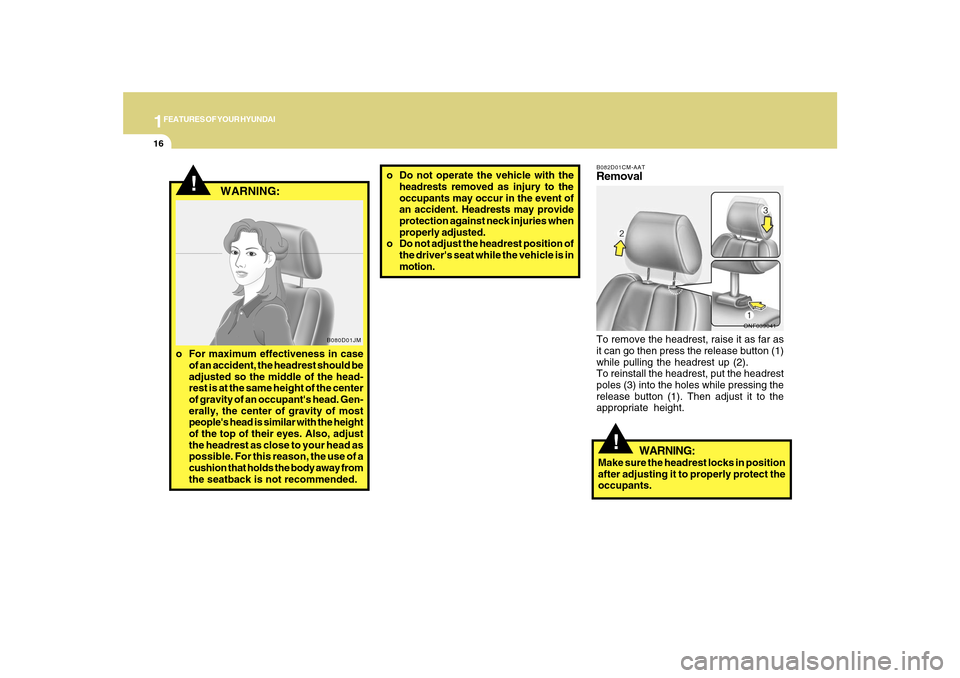
B082D01CM-AATRemovalTo remove the headrest, raise it as far as
it can go then press the release button (1)
while pulling the headrest up (2).
To reinstall the headrest, put the headrest
poles (3) into the holes while pressing the
release button (1). Then adjust it to the
appropriate height.
ONF039041
WARNING:
Make sure the headrest locks in position
after adjusting it to properly protect the
occupants.
!
!
WARNING:
o For maximum effectiveness in case
of an accident, the headrest should be
adjusted so the middle of the head-
rest is at the same height of the center
of gravity of an occupant's head. Gen-
erally, the center of gravity of most
people's head is similar with the height
of the top of their eyes. Also, adjust
the headrest as close to your head as
possible. For this reason, the use of a
cushion that holds the body away from
the seatback is not recommended.
B080D01JM
Page 31 of 285
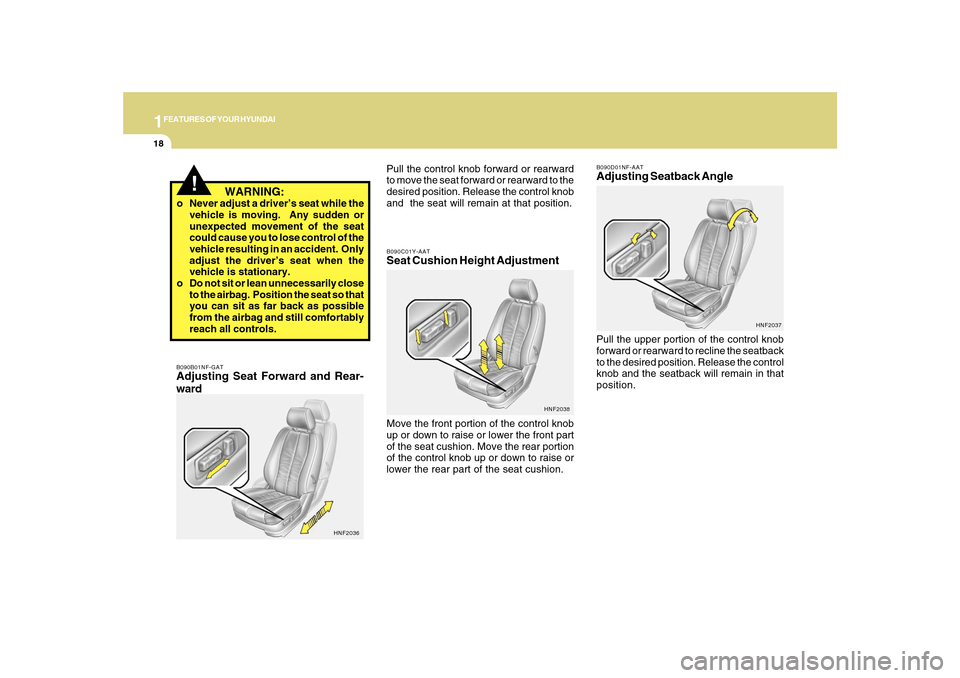
1FEATURES OF YOUR HYUNDAI18
B090D01NF-AATAdjusting Seatback AnglePull the upper portion of the control knob
forward or rearward to recline the seatback
to the desired position. Release the control
knob and the seatback will remain in that
position.
B090C01Y-AATSeat Cushion Height AdjustmentMove the front portion of the control knob
up or down to raise or lower the front part
of the seat cushion. Move the rear portion
of the control knob up or down to raise or
lower the rear part of the seat cushion.
HNF2038
HNF2037
Pull the control knob forward or rearward
to move the seat forward or rearward to the
desired position. Release the control knob
and the seat will remain at that position.
!
WARNING:
o Never adjust a driver’s seat while the
vehicle is moving. Any sudden or
unexpected movement of the seat
could cause you to lose control of the
vehicle resulting in an accident. Only
adjust the driver’s seat when the
vehicle is stationary.
o Do not sit or lean unnecessarily close
to the airbag. Position the seat so that
you can sit as far back as possible
from the airbag and still comfortably
reach all controls.B090B01NF-GATAdjusting Seat Forward and Rear-
ward
HNF2036
Page 32 of 285
1
FEATURES OF YOUR HYUNDAI
19
!
WARNING:
Riding with a reclined seatback
increases your chance of serious or
fatal injuries in the event of a collision or
sudden stop. The protection of your
restraint system (seat belts and airbags)
is greatly reduced by reclining your seat.
Seat belts must be snug against your
hips and chest to work properly. The
more the seatback is reclined, the greater
the chance that an occupant's hips will
slide under the lap belt or the occupant's
neck will strike the shoulder belt. Drivers
and passengers should always sit well
back in their seats, properly belted, and
with the seatbacks upright.
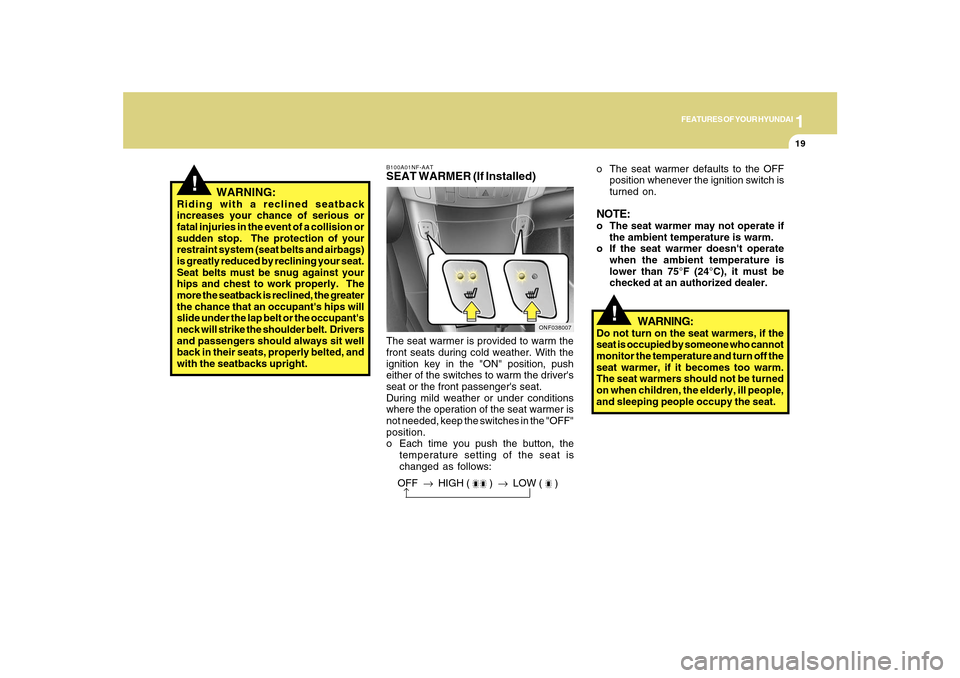
B100A01NF-AATSEAT WARMER (If Installed)The seat warmer is provided to warm the
front seats during cold weather. With the
ignition key in the "ON" position, push
either of the switches to warm the driver's
seat or the front passenger's seat.
During mild weather or under conditions
where the operation of the seat warmer is
not needed, keep the switches in the "OFF"
position.
o Each time you push the button, the
temperature setting of the seat is
changed as follows:
ONF038007
o The seat warmer defaults to the OFF
position whenever the ignition switch is
turned on.NOTE:o The seat warmer may not operate if
the ambient temperature is warm.
o If the seat warmer doesn't operate
when the ambient temperature is
lower than 75°F (24°C), it must be
checked at an authorized dealer.
OFF → HIGH (
) → LOW (
)
→
!
WARNING:
Do not turn on the seat warmers, if the
seat is occupied by someone who cannot
monitor the temperature and turn off the
seat warmer, if it becomes too warm.
The seat warmers should not be turned
on when children, the elderly, ill people,
and sleeping people occupy the seat.
Page 33 of 285
1FEATURES OF YOUR HYUNDAI20
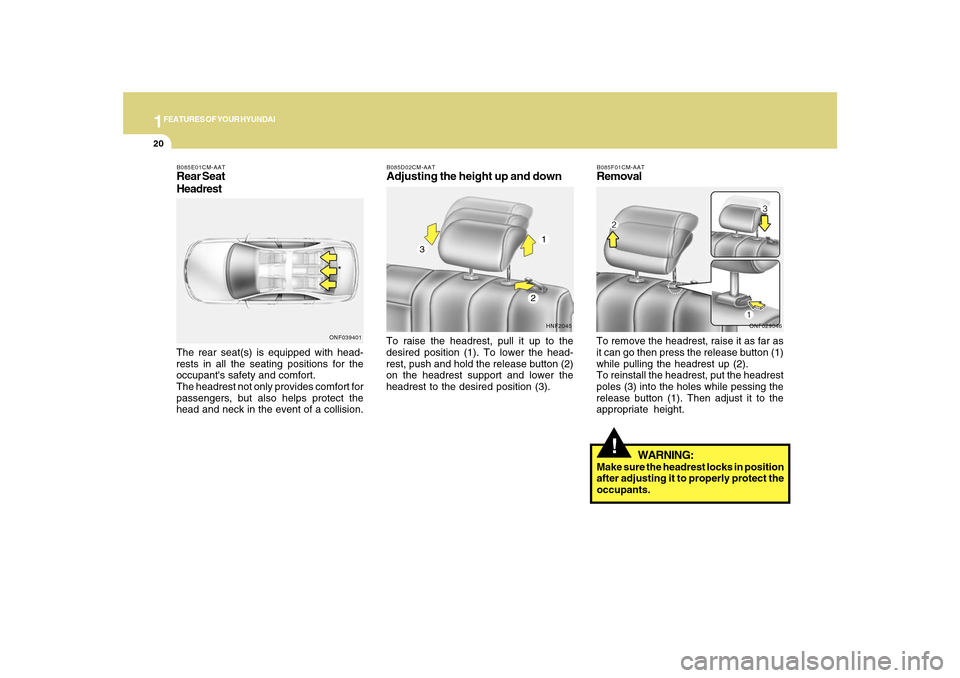
B085D02CM-AATAdjusting the height up and downTo raise the headrest, pull it up to the
desired position (1). To lower the head-
rest, push and hold the release button (2)
on the headrest support and lower the
headrest to the desired position (3).
B085E01CM-AATRear Seat
HeadrestThe rear seat(s) is equipped with head-
rests in all the seating positions for the
occupant's safety and comfort.
The headrest not only provides comfort for
passengers, but also helps protect the
head and neck in the event of a collision.
ONF039401
!
WARNING:
Make sure the headrest locks in position
after adjusting it to properly protect the
occupants.B085F01CM-AATRemovalTo remove the headrest, raise it as far as
it can go then press the release button (1)
while pulling the headrest up (2).
To reinstall the headrest, put the headrest
poles (3) into the holes while pessing the
release button (1). Then adjust it to the
appropriate height.
ONF029046
*
HNF204512
3
Page 34 of 285
1
FEATURES OF YOUR HYUNDAI
21
!
WARNING:
The purpose of the folding rear
seatbacks is to allow you to carry longer
objects than could otherwise be
accommodated. Do not allow
passengers to sit on top of the folded
down seatback, while the car is moving
as this is not a proper seating position
and no seat belts are available for use.
This could result in serious injury or
death in case of an accident or sudden
stop. Objects carried on the folded down
seatback should not extend higher than
the top of the front seats. This could allow
cargo to slide forward and cause injury
or damage during sudden stops.
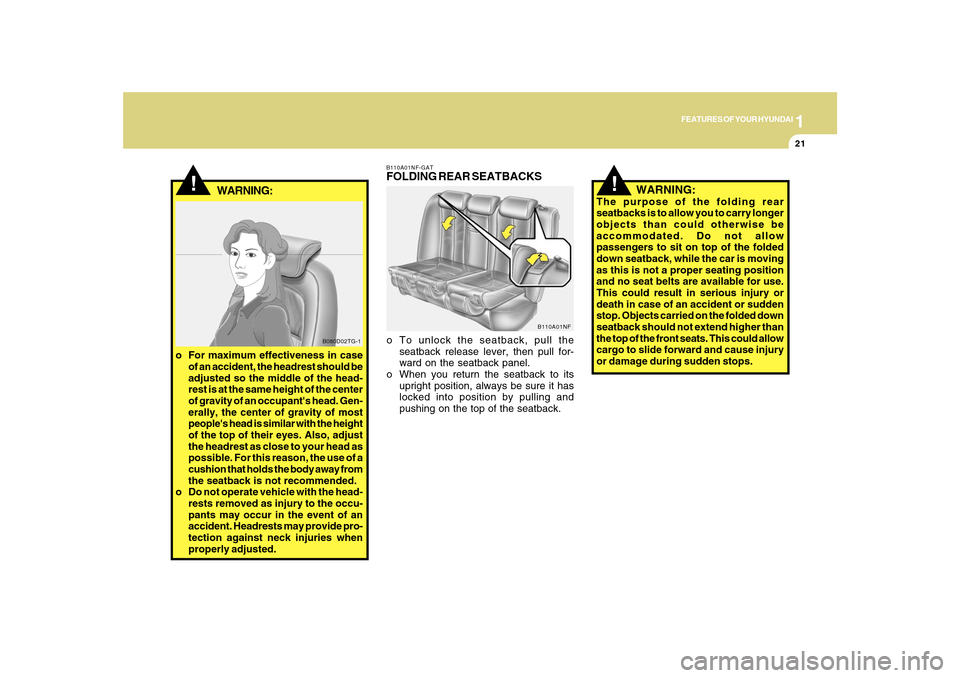
B110A01NF-GATFOLDING REAR SEATBACKSo To unlock the seatback, pull the
seatback release lever, then pull for-
ward on the seatback panel.
o When you return the seatback to its
upright position, always be sure it has
locked into position by pulling and
pushing on the top of the seatback.
B110A01NF
!
WARNING:
B080D02TG-1
o For maximum effectiveness in case
of an accident, the headrest should be
adjusted so the middle of the head-
rest is at the same height of the center
of gravity of an occupant's head. Gen-
erally, the center of gravity of most
people's head is similar with the height
of the top of their eyes. Also, adjust
the headrest as close to your head as
possible. For this reason, the use of a
cushion that holds the body away from
the seatback is not recommended.
o Do not operate vehicle with the head-
rests removed as injury to the occu-
pants may occur in the event of an
accident. Headrests may provide pro-
tection against neck injuries when
properly adjusted.
Page 35 of 285
1FEATURES OF YOUR HYUNDAI22
SEAT BELTSB150B04Y-AATInfant or Small ChildAll 50 states have child restraint laws. You
should be aware of the specific
requirements in your state. Child and/or
infant safety seats must be properly placed
and installed in the rear seat. Information
about the use of these restraints begins on
page 1-27.
!
B150A02S-AATSEAT BELT PRECAUTIONS
WARNING:All occupants of the vehicle must wear
their seat belts at all times. Seat belts
and child restraints reduce the risk of
serious or fatal injuries for all occupants
in the event of a collision or sudden stop.
Without a seat belt, occupants could be
shifted too close to a deploying airbag,
strike the interior structure or be thrown
from the vehicle. Properly worn seat
belts greatly reduce these hazards. Even
with advanced airbags, unbelted
occupants can be severely injured by a
deploying airbag. Always follow the
precautions about seat belts, airbags
and occupant safety contained in this
manual.
!
WARNING:
Every person in your vehicle needs to be
properly restrained at all times, including
infants and children. Never hold a child
in your arms or lap when riding in a
vehicle. The violent forces created
during a crash will tear the child from
your arms and throw the child against
the interior. Always use a child restraint
appropriate for your child's height and
weight, see page 1-27.NOTE:Small children are best protected from
injury in an accident when properly re-
strained in the rear seat by a child
restraint system that meets the
requirements of the Federal Motor
Vehicle Safety Standards. Before buying
any child restraint system, make sure
that it has a label certifying that it meets
Federal Motor Vehicle Safety Standard
213. The restraint must be appropriate
for your child's height and weight. Check
the label on the child restraint for this
information. See information beginning
on page 1-29.
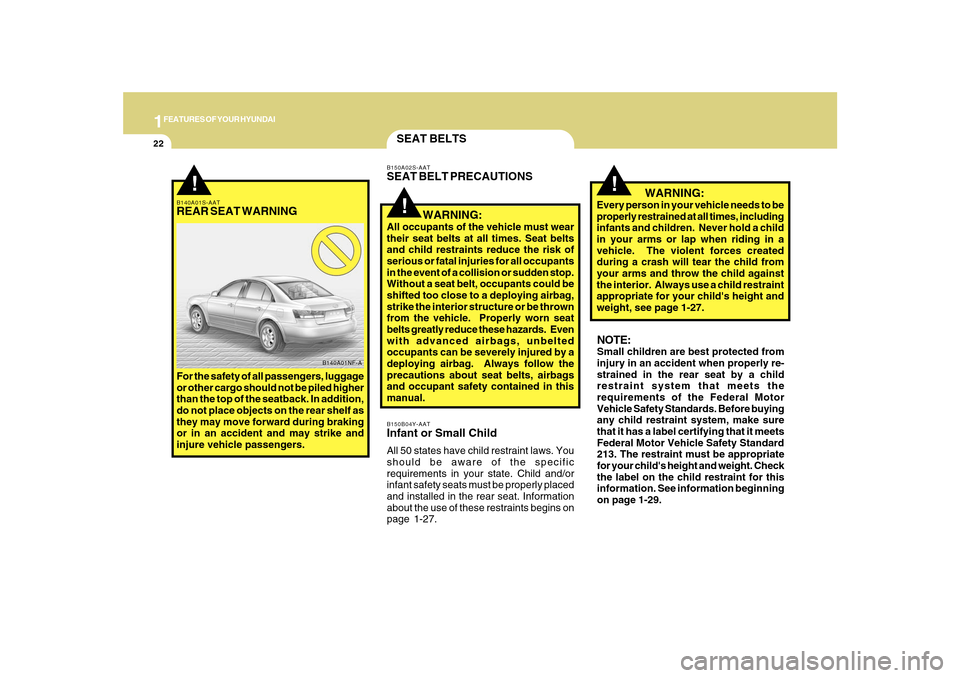
!
B140A01S-AATREAR SEAT WARNINGFor the safety of all passengers, luggage
or other cargo should not be piled higher
than the top of the seatback. In addition,
do not place objects on the rear shelf as
they may move forward during braking
or in an accident and may strike and
injure vehicle passengers.
B140A01NF-A
Page 36 of 285
1
FEATURES OF YOUR HYUNDAI
23
WARNING:
Riding with a reclined seatback in-
creases your chance of serious or fatal
injuries in the event of a collision or
sudden stop. The protection of your
restraint system (seat belts and airbags)
is greatly reduced by reclining your seat.
Seat belts must be snug against your
hips and chest to work properly. The
more the seatback is reclined, the greater
the chance that an occupant's hips will
slide under the lap belt causing serious
internal injuries or the occupant's neck
could strike the shoulder belt. Drivers
and passengers should always sit well
back in their seats, properly belted (see
page 1-25), and with the seatbacks up-
right.
!
B150E01A-AATInjured PersonA seat belt should be used when an injured
person is being transported. When this is
necessary, you should consult a physician
for recommendations.B150F01A-AATOne Person Per BeltTwo people (including children) should
never attempt to use a single seat belt. This
could increase the severity of injuries in
case of an accident.B150G02A-AATDo Not Lie DownTo reduce the chance of injuries in the
event of an accident and to achieve
maximum effectiveness of the restraint
system, all passengers should be sitting
up and the front seats should be in an
upright position when the car is moving. A
seat belt cannot provide proper protection
if the person is lying down in the rear seat
or if the front seat is in a reclined position.
B150D01A-AATPregnant WomenThe use of a seat belt is recommended for
pregnant women to lessen the chance of
injury in an accident. When a seat belt is
used, the lap belt portion should be placed
as low and snugly as possible on the hips,
not across the abdomen. For specific
recommendations, consult a physician.B150C02A-AATLarger ChildrenChildren who are too large for child restraint
systems should always occupy the rear
seat and use the available lap/shoulder
belts. The lap portion should be fastened
snug on the hips and as low as possible.
Check belt fit periodically. A child's
squirming could put the belt out of position.
Children are afforded the most safety in the
event of an accident when they are
restrained by a proper restraint system in
the rear seat. If a larger child (over age 13)
must be seated in the front seat, the child
should be securely restrained by the
available lap/shoulder belt and the seat
should be placed in the rearmost position.
Children under the age of 13 should be
restrained securely in the rear seat. NEVER
place a child under the age of 13 in the front
seat. NEVER place a rear facing child seat
in the front seat of a vehicle.