warning Hyundai Sonata
[x] Cancel search | Manufacturer: HYUNDAI, Model Year: , Model line: , Model:Pages: 286, PDF Size: 9.58 MB
Page 38 of 286
1
FEATURES OF YOUR HYUNDAI
25
B190A02NF-AATSEAT BELTS-Front Passenger and
Rear Seat 3-Point System with
Combination Locking Retractor
To Fasten Your BeltCombination retractor type seat belts are
installed in the rear seat positions to help
accommodate the installation of child
restraint systems. Although a combination
retractor is also installed in the front
passenger seat position, Hyundai strongly
recommends that children always be seated
in the rear seat. NEVER place any infant
restraint system in the front seat of the
vehicle.
This type of seat belt combines the features
of both an emergency locking retractor seat
belt and an automatic locking retractor seat
belt. To fasten your seat belt, pull it out of the
retractor and insert the metal tab into the
buckle. There will be an audible "click"
when the tab locks into the buckle. When
not securing a child restraint, the seat belt
operates in the same way as the driver's
seat belt (Emergency Locking Retractor
Type). It automatically adjusts to the proper
length only after the lap belt portion of the
seat belt is adjusted manually so that it fits
snugly around your hips. When the seat belt
is fully extended from the retractor to allow
the installation of a child restraint system,
the seat belt operation changes to allow the
belt to retract, but not to extend (Automatic
Locking Retractor Type). See page 1-33.
NOTE:o Although the combination retractor
provides the same level of protection
for seated passengers in either
emergency or automatic locking
modes, it is recommended that seated
passengers use the emergency
locking feature for improved
convenience. The automatic locking
function is intended to facilitate child
restraint installation. To convert from
the automatic locking feature to the
emergency locking operation mode,
allow the unbuckled seat belt to fully
retract.
o The front passenger's seat belt
warning light on the center fascia
panel blinks until the front passenger's
seat belt is fastened to remind the
front passenger to fasten the front
passenger's seat belt, when the
ignition key is turned from the "OFF"
position to "the "ON" or "START"
position.
WARNING:
o For maximum restraint system pro-
tection, the seat belts must always be
used whenever the car is moving.
o Seat belts are most effective when
seatbacks are in the upright position.
o Children age 12 and younger must
always be properly restrained in the
rear seat. Never allow children to ride
in the front passenger seat. If a child
over 13 must be seated in the front
seat, he/she must be properly belted
and the seat should be moved as far
back as possible.
o Never wear the shoulder belt under
your arm or behind your back. An
improperly positioned shoulder belt
can cause serious injuries in a crash.
The shoulder belt should be positioned
midway over your shoulder across
your collarbone.
o Avoid wearing twisted seat belts. A
twisted belt can't do its job as well. In a
collision, it could even cut into you. Be
sure the belt webbing is straight and
not twisted.
o Be careful not to damage the belt web-
bing or hardware. If the belt webbing or
hardware is damaged, replace it.
!
Page 39 of 286
1FEATURES OF YOUR HYUNDAI26
CHILD RESTRAINT SYSTEMB230A01NF-AATChildren riding in the car should sit in the
rear seat and must always be properly
restrained to minimize the risk of injury in
an accident, sudden stop or sudden
maneuver. According to accident statistics
provided by the National Highway Traffic
Safety Administration (NHTSA), children
are safer when properly restrained in the
rear seats than in the front seat. Larger
children not in a child restraint should use
one of the seat belts provided.
All 50 states have child restraint laws. You
should be aware of the specific
requirements in your state. Child and/or
infant safety seats must be properly placed
and installed in the rear seat. You must use
a commercially available child restraint
system that meets the requirements of the
Federal Motor Vehicle Safety Standards
(FMVSS). Child restraint systems are
designed to be secured in vehicle seats by
lap belts or the lap belt portion of a lap/
shoulder belt, or by a tether anchor and/or
ISOFIX anchors (if installed).
Children could be injured or killed in a
crash if their restraints are not properly
secured. For small children and babies, a
child seat or infant seat must be used.
Before buying a particular child restraint
system, make sure it fits your car seat and
seat belts, and fits your child. Follow all the
instructions provided by the manufacturer
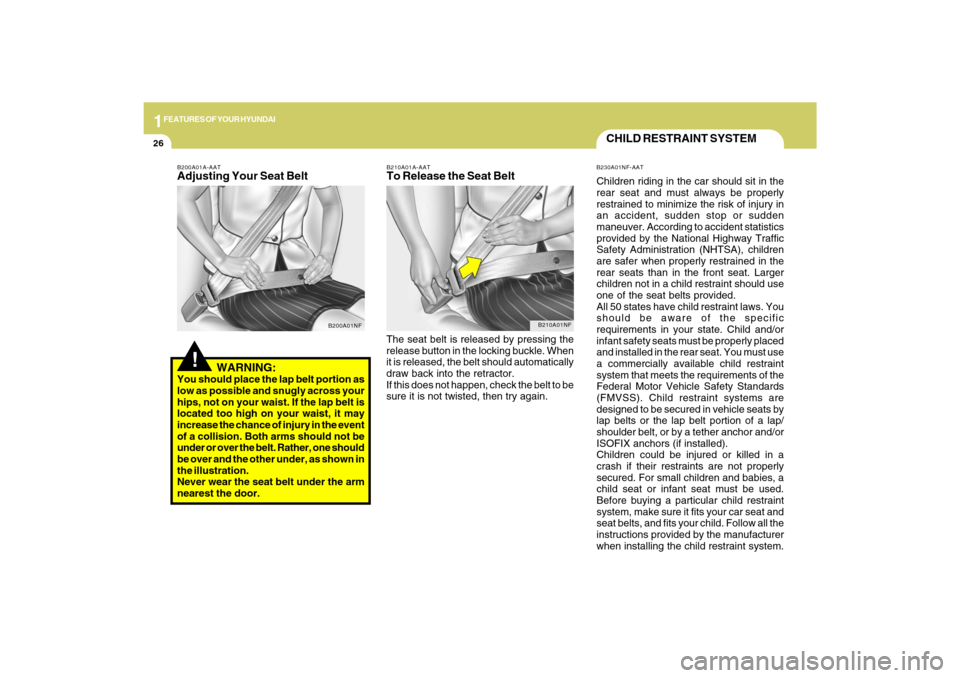
when installing the child restraint system. The seat belt is released by pressing the
release button in the locking buckle. When
it is released, the belt should automatically
draw back into the retractor.
If this does not happen, check the belt to be
sure it is not twisted, then try again.
B210A01A-AATTo Release the Seat Belt
B210A01NF
WARNING:
You should place the lap belt portion as
low as possible and snugly across your
hips, not on your waist. If the lap belt is
located too high on your waist, it may
increase the chance of injury in the event
of a collision. Both arms should not be
under or over the belt. Rather, one should
be over and the other under, as shown in
the illustration.
Never wear the seat belt under the arm
nearest the door.
!
B200A01A-AATAdjusting Your Seat Belt
B200A01NF
Page 40 of 286
1
FEATURES OF YOUR HYUNDAI
27
!
WARNING:
o A child restraint system must be
placed in the rear seat. Never install a
child or infant seat on the front
passenger's seat. Should an accident
occur and cause the passenger side
airbag to deploy, it could severely
injure or kill an infant or child seated in
an infant or child seat. Thus only use
a child restraint in the rear seat of your
vehicle.
o A safety belt or child restraint system
can become very hot if it is left in a
closed vehicle on a sunny day, even if
the outside temperature does not feel
hot. Be sure to check the seat cover
and buckles before placing a child
there.
o When the child restraint system is not
in use, store it in the trunk or fasten it
with a safety belt so that it will not be
thrown forward in the case of a sudden
stop or an accident.
o Children may be seriously injured or
killed by an inflating airbag. All
children, even those too large for child
restraints, must ride in the rear seat.
!
WARNING:
To reduce the chance or serious or fatal
injuries:
o Children of all ages are safer when re-
strained in the rear seat. A child riding in
the front passenger seat can be force-
fully struck by an inflating airbag result-
ing in serious or fatal injuries.
o Always follow the instructions for instal-
lation and use of the child restraint maker.
o Always make sure the child seat is se-
cured properly in the car and your child
is securely restrained in the child seat.
o Never hold a child in your arms or lap
when riding in a vehicle. The violent
forces created during a crash will tear
the child from your arms and throw the
child against the car’s interior.
o Never put a seat belt over yourself and
a child. During a crash, the belt could
press deep into the child causing seri-
ous internal injuries.
o Never leave children unattended in a
vehicle – not even for a short time. The
car can heat up very quickly, resulting in
serious injuries to children inside. Even
very young children may inadvertently
cause the vehicle to move, entangle
themselves in the windows, or lock them-
selves or others inside the vehicle.o Never allow two children, or any two
persons, to use the same seat belt.
o Children often squirm and reposition
themselves improperly. Never let a
child ride with the shoulder belt under
their arm or behind their back. Always
properly position and secure children
in rear seat.
o Never allow a child to stand-up or
kneel on the seat or floor of a moving
vehicle. During a collision or sudden
stop, the child can be violently thrown
against the vehicle's interior, resulting
in serious injury.
o Never use an infant carrier or a child
safety seat that "hooks" over a
seatback, it may not provide adequate
security in an accident.
o Seat belts can become very hot, es-
pecially when the car is parked in
direct sunlight. Always check seat
belt buckles before fastening them
over a child.
o Always store or secure a child seat,
even when it is not in use. During a
collision or sudden stop, the child seat
could be thrown inside the vehicle.
!
WARNING:
Page 42 of 286
1
FEATURES OF YOUR HYUNDAI
29
!For vehicles with adjustable headrests,
route the tether strap under the head-
rest and between the headrest posts,
otherwise route the tether strap over the
top of the seatback.
3. Connect the tether strap hook to the
child restraint hook holder and tighten
to secure the seat.
WARNING:
o A child can be seriously injured or
killed in a collision if the child restraint
is not properly anchored. Always
follow the child seat manufacturer’s
instructions for installation and use.
o Never mount more than one child re-
straint to a single tether or to a single
lower anchorage point. The increased
load caused by multiple seats may
cause the tethers or anchorage points
to break, causing serious injury or
death.
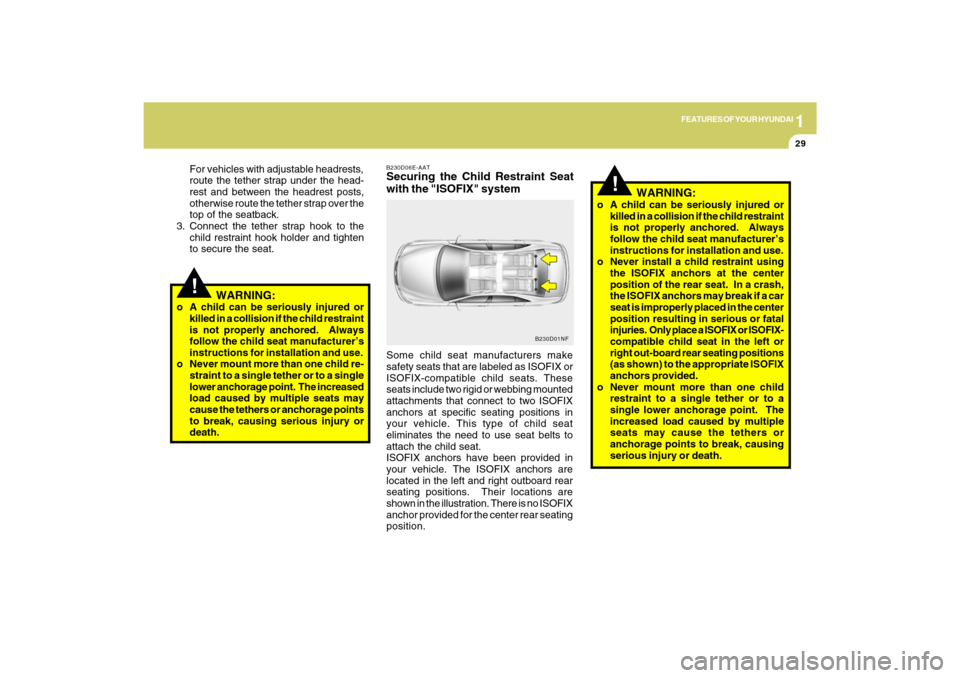
B230D06E-AATSecuring the Child Restraint Seat
with the "ISOFIX" systemSome child seat manufacturers make
safety seats that are labeled as ISOFIX or
ISOFIX-compatible child seats. These
seats include two rigid or webbing mounted
attachments that connect to two ISOFIX
anchors at specific seating positions in
your vehicle. This type of child seat
eliminates the need to use seat belts to
attach the child seat.
ISOFIX anchors have been provided in
your vehicle. The ISOFIX anchors are
located in the left and right outboard rear
seating positions. Their locations are
shown in the illustration. There is no ISOFIX
anchor provided for the center rear seating
position.
B230D01NF
!
WARNING:
o A child can be seriously injured or
killed in a collision if the child restraint
is not properly anchored. Always
follow the child seat manufacturer’s
instructions for installation and use.
o Never install a child restraint using
the ISOFIX anchors at the center
position of the rear seat. In a crash,
the ISOFIX anchors may break if a car
seat is improperly placed in the center
position resulting in serious or fatal
injuries. Only place a ISOFIX or ISOFIX-
compatible child seat in the left or
right out-board rear seating positions
(as shown) to the appropriate ISOFIX
anchors provided.
o Never mount more than one child
restraint to a single tether or to a
single lower anchorage point. The
increased load caused by multiple
seats may cause the tethers or
anchorage points to break, causing
serious injury or death.
Page 43 of 286
1FEATURES OF YOUR HYUNDAI30
!
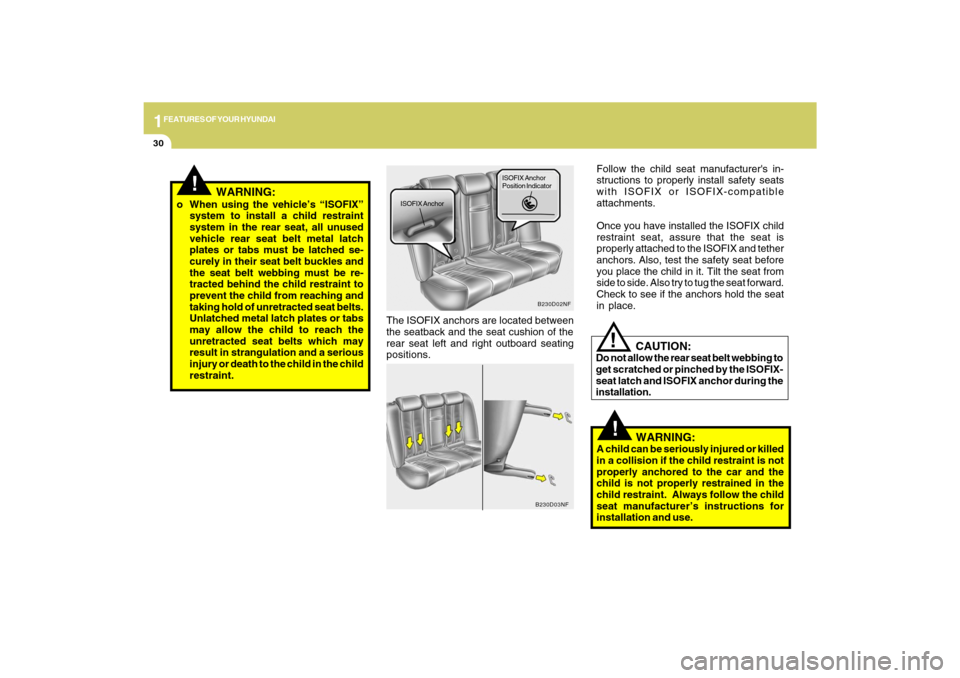
The ISOFIX anchors are located between
the seatback and the seat cushion of the
rear seat left and right outboard seating
positions.
B230D02NF
ISOFIX AnchorISOFIX Anchor
Position Indicator
B230D03NF
Follow the child seat manufacturer's in-
structions to properly install safety seats
with ISOFIX or ISOFIX-compatible
attachments.
Once you have installed the ISOFIX child
restraint seat, assure that the seat is
properly attached to the ISOFIX and tether
anchors. Also, test the safety seat before
you place the child in it. Tilt the seat from
side to side. Also try to tug the seat forward.
Check to see if the anchors hold the seat
in place.
!
o When using the vehicle’s “ISOFIX”
system to install a child restraint
system in the rear seat, all unused
vehicle rear seat belt metal latch
plates or tabs must be latched se-
curely in their seat belt buckles and
the seat belt webbing must be re-
tracted behind the child restraint to
prevent the child from reaching and
taking hold of unretracted seat belts.
Unlatched metal latch plates or tabs
may allow the child to reach the
unretracted seat belts which may
result in strangulation and a serious
injury or death to the child in the child
restraint.
WARNING:
WARNING:
A child can be seriously injured or killed
in a collision if the child restraint is not
properly anchored to the car and the
child is not properly restrained in the
child restraint. Always follow the child
seat manufacturer’s instructions for
installation and use.
!
CAUTION:
Do not allow the rear seat belt webbing to
get scratched or pinched by the ISOFIX-
seat latch and ISOFIX anchor during the
installation.
Page 44 of 286
1
FEATURES OF YOUR HYUNDAI
31
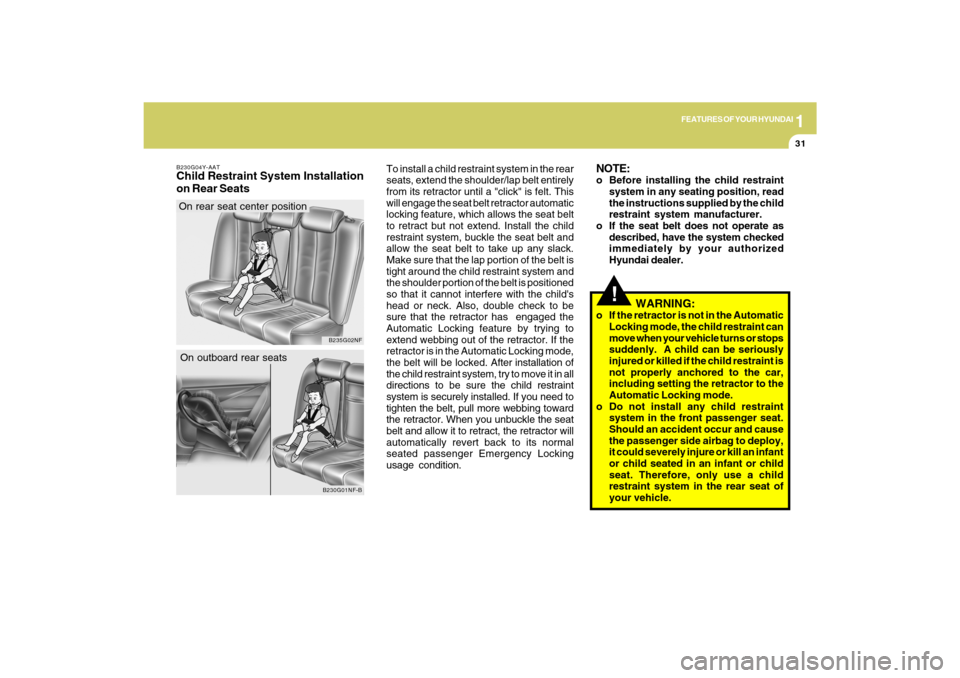
B230G04Y-AATChild Restraint System Installation
on Rear Seats
B230G01NF-B
On outboard rear seats
B235G02NF
On rear seat center positionTo install a child restraint system in the rear
seats, extend the shoulder/lap belt entirely
from its retractor until a "click" is felt. This
will engage the seat belt retractor automatic
locking feature, which allows the seat belt
to retract but not extend. Install the child
restraint system, buckle the seat belt and
allow the seat belt to take up any slack.
Make sure that the lap portion of the belt is
tight around the child restraint system and
the shoulder portion of the belt is positioned
so that it cannot interfere with the child's
head or neck. Also, double check to be
sure that the retractor has engaged the
Automatic Locking feature by trying to
extend webbing out of the retractor. If the
retractor is in the Automatic Locking mode,
the belt will be locked. After installation of
the child restraint system, try to move it in all
directions to be sure the child restraint
system is securely installed. If you need to
tighten the belt, pull more webbing toward
the retractor. When you unbuckle the seat
belt and allow it to retract, the retractor will
automatically revert back to its normal
seated passenger Emergency Locking
usage condition.
!
WARNING:
o If the retractor is not in the Automatic
Locking mode, the child restraint can
move when your vehicle turns or stops
suddenly. A child can be seriously
injured or killed if the child restraint is
not properly anchored to the car,
including setting the retractor to the
Automatic Locking mode.
o Do not install any child restraint
system in the front passenger seat.
Should an accident occur and cause
the passenger side airbag to deploy,
it could severely injure or kill an infant
or child seated in an infant or child
seat. Therefore, only use a child
restraint system in the rear seat of
your vehicle.NOTE:o Before installing the child restraint
system in any seating position, read
the instructions supplied by the child
restraint system manufacturer.
o If the seat belt does not operate as
described, have the system checked
immediately by your authorized
Hyundai dealer.
Page 45 of 286
1FEATURES OF YOUR HYUNDAI32
!
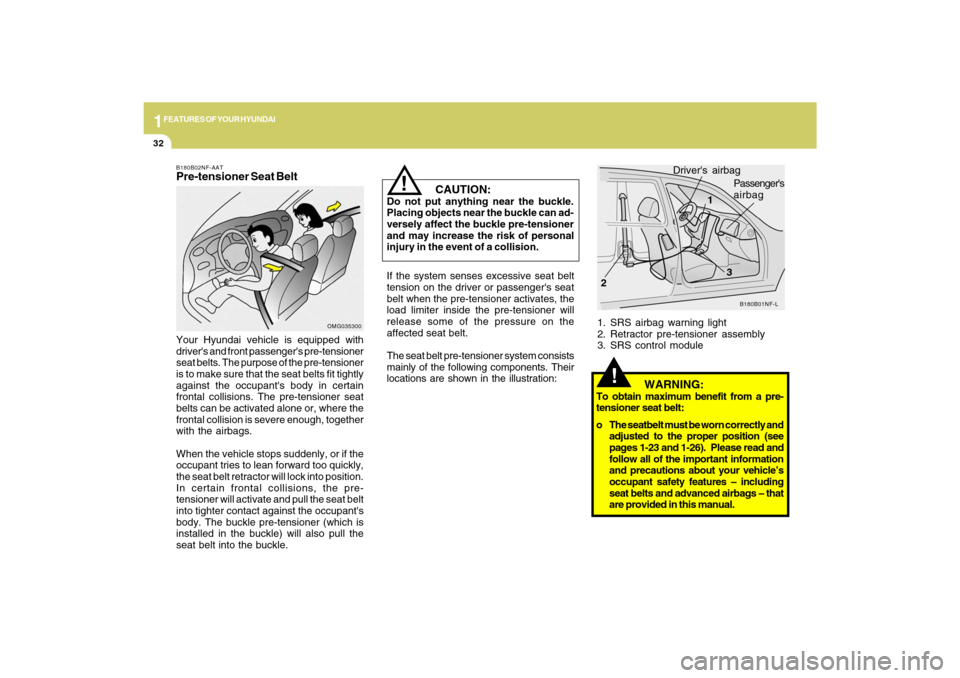
1. SRS airbag warning light
2. Retractor pre-tensioner assembly
3. SRS control module
B180B01NF-L
1
23 Driver's airbag
Passenger's
airbag
WARNING:
To obtain maximum benefit from a pre-
tensioner seat belt:
o The seatbelt must be worn correctly and
adjusted to the proper position (see
pages 1-23 and 1-26). Please read and
follow all of the important information
and precautions about your vehicle’s
occupant safety features – including
seat belts and advanced airbags – that
are provided in this manual.
!
CAUTION:
Do not put anything near the buckle.
Placing objects near the buckle can ad-
versely affect the buckle pre-tensioner
and may increase the risk of personal
injury in the event of a collision.
If the system senses excessive seat belt
tension on the driver or passenger's seat
belt when the pre-tensioner activates, the
load limiter inside the pre-tensioner will
release some of the pressure on the
affected seat belt.
The seat belt pre-tensioner system consists
mainly of the following components. Their
locations are shown in the illustration:
B180B02NF-AATPre-tensioner Seat BeltYour Hyundai vehicle is equipped with
driver's and front passenger's pre-tensioner
seat belts. The purpose of the pre-tensioner
is to make sure that the seat belts fit tightly
against the occupant's body in certain
frontal collisions. The pre-tensioner seat
belts can be activated alone or, where the
frontal collision is severe enough, together
with the airbags.
When the vehicle stops suddenly, or if the
occupant tries to lean forward too quickly,
the seat belt retractor will lock into position.
In certain frontal collisions, the pre-
tensioner will activate and pull the seat belt
into tighter contact against the occupant's
body. The buckle pre-tensioner (which is
installed in the buckle) will also pull the
seat belt into the buckle.
OMG035300
Page 46 of 286
1
FEATURES OF YOUR HYUNDAI
33
!
o Be sure you and your passengers
always wear seat belts and wear them
properly.NOTE:o Both the driver's and front
passenger's pre-tensioner seat belts
will be activated in certain frontal col-
lisions. The pre-tensioner seat belts
can be activated alone or, where the
frontal collision is severe enough,
together with the airbags.
The pre-tensioners will not be
activated if the seat belts are not being
worn at the time of the collision.
o When the pre-tensioner seat belts are
activated, a loud noise may be heard
and fine dust, which may appear to be
smoke, may be visible in the
passenger compartment. These are
normal operating conditions and are
not hazardous.
o Although it is harmless, the fine dust
may cause skin irritation and should
not be breathed for prolonged periods.
Wash all exposed skin areas thor-
oughly after an accident in which the
pre-tensioner seat belts were acti-
vated.
WARNING:
!
CAUTION:
o Because the sensor that activates
the SRS airbag is connected with the
pre-tensioner seat belt, the SRS airbag
warning light
on the instrument
panel will illuminate for approximately
6 seconds after the ignition key has
been turned to the "ON" position, and
then it should turn off.
o If the pre-tensioner seat belt is not
working properly, this warning light
will illuminate even if there is no
malfunction of the SRS airbag. If the
SRS airbag warning light does not
illuminate when the ignition key is
turned to "ON", or if it blinks for a
second and remains illuminated after
illuminating for approximately 6 sec-
onds, or if it illuminates while the ve-
hicle is being driven, please have an
authorized Hyundai dealer inspect the
pre-tensioner seat belt or SRS airbag
system as soon as possible.
!
WARNING:
o Pre-tensioners are designed to oper-
ate only one time. After activation,
pre-tensioner seat belts must be re-
placed. All seat belts, of any type,
should always be replaced after they
have been worn during a collision.
o The pre-tensioner seat belt assembly
mechanisms become hot during acti-
vation. Do not touch the pre-tensioner
seat belt assemblies for several min-
utes after they have been activated.
o Do not attempt to inspect or replace
the pre-tensioner seat belts yourself.
This must be done by an authorized
Hyundai dealer.
o Do not strike the pre-tensioner seat
belt assemblies.
o Do not attempt to service or repair the
pre-tensioner seat belt system in any
manner.
o Improper handling of the pre-tensioner
seat belt assemblies, and failure to
heed the warnings not to strike, modify,
inspect, replace, service or repair the
pre-tensioner seat belt assemblies
may lead to improper operation or
inadvertent activation and serious
injury.
o Always wear the seat belts when driv-
ing or riding in a motor vehicle.
Page 48 of 286
1
FEATURES OF YOUR HYUNDAI
35
The SRS uses sensors to gather
information about the driver's and front
passenger's seat position, the driver's and
front passenger's seat belt usage and
impact severity.
The driver's and front passenger's seat
track position sensors, which are installed
on the seat track, determine if the seats are
fore or aft of a reference position. The seat
belt buckle sensors determine if the driver
and front passenger's seat belts are
fastened. These sensors provide the ability
to control the SRS deployment based on
how close the driver's seat is to the steering
wheel, how close the passenger's seat is
to the instrument panel, whether or not the
seat belts are fastened, and how severe
the impact is.
The advanced SRS offers the ability to
control the airbag inflation with two levels.
A first stage level is provided for moderate-
severity impacts. A second stage level is
provided for more severe impacts.
According to the impact severity, seating
position and seat belt usage, the
SRSCM(SRS Control Module) controls the
airbag inflation. Failure to properly wear
seat belts can increase the risk or severity
of injury in an accident.
CAUTION:
If a seat track position sensor or an
occupant classification system is not
working properly, the SRS airbag warning
light
on the instrument panel will
illuminate because the SRS airbag
warning light is connected with the seat
track position sensor and the occupant
classification system. If the SRS airbag
warning light does not illuminate when
the ignition key is turned to the "ON"
position, remains illuminated after
approximately 6 seconds when the igni-
tion key is turned to the "ON" position, or
if it illuminates while the vehicle is being
driven, have an authorized Hyundai
dealer inspect the advanced SRS airbag
system as soon as possible.
!
Additionally, your Hyundai is equipped
with an occupant classification system in
the front passenger's seat. The occupant
classification system detects the presence
of a passenger in the front passenger's
seat and will turn off the front passenger's
airbag under certain conditions. For more
detail, see "Occupant Classification
System" later in this section.
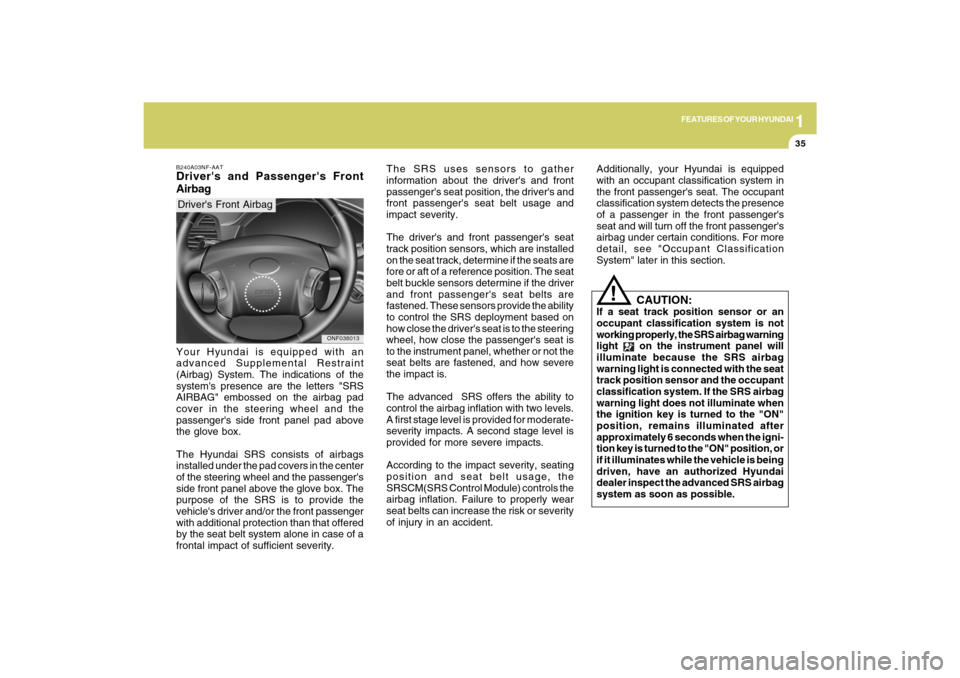
B240A03NF-AATDriver's and Passenger's Front
AirbagYour Hyundai is equipped with an
advanced Supplemental Restraint
(Airbag) System. The indications of the
system's presence are the letters "SRS
AIRBAG" embossed on the airbag pad
cover in the steering wheel and the
passenger's side front panel pad above
the glove box.
The Hyundai SRS consists of airbags
installed under the pad covers in the center
of the steering wheel and the passenger's
side front panel above the glove box. The
purpose of the SRS is to provide the
vehicle's driver and/or the front passenger
with additional protection than that offered
by the seat belt system alone in case of a
frontal impact of sufficient severity.Driver's Front Airbag
ONF038013
Page 49 of 286
1FEATURES OF YOUR HYUNDAI36
!
!
WARNING:
Always use seat belts and child restraints
– every trip, every time, everyone!
Airbags inflate with considerable force
and in the blink of an eye. Seat belts help
keep occupants in proper position to
obtain maximum benefit from the airbag.
Even with advanced airbags, improperly
belted and unbelted occupants can be
severely injured when the airbag inflates.
Always follow the precautions about seat
belts, airbags and occupant safety
contained in this manual.
To reduce the chance of serious or fatal
injuries and receive the maximum safety
benefit from your restraint system:
o Never place a child in any child or
booster seat in the front seat (see
child restraints 1-26).
o ABC – Always Buckle Children in the
back seat. It is the safest place for
children of any age to ride.
o Front and side impact airbags can
injure occupants improperly
positioned in the front seats.
o Move your seat as far back as
practical from the front airbags, while
still maintaining control of the vehicle.
o Never sit or lean unnecessarily close
to the front or side airbags.
!
WARNING:
o Modification to the seat structure can
adversely affect the seat track position
sensor and cause the airbag to deploy
at a different level than should be pro-
vided.
o Do not place any objects underneath
the front seats as they could damage
the seat track position sensor or
interfere with the occupant
classification system.
o Do not place any objects that may cause
magnetic fields near the front seat.
These may cause a malfunction of the
seat track position sensor.NOTE:o Be sure to read information about the
SRS on the labels provided on the back-
side of the sun visor.
o Advanced airbags are combined with
pre-tensioner seat belts to help provide
enhanced occupant protection in frontal
crashes. Front airbags are not intended
to deploy in collisions in which sufficient
protection can be provided by the pre-
tensioner seat belt.
o If you are considering modification of
your vehicle due to a disability, please
contact the Hyundai Customer Assis-
tance Center at 1-800-633-5151.o Never lean against the door or center
console – always sit in an upright posi-
tion.
o Do not allow an adult passenger to ride
in the front seat when the “Passenger
Airbag OFF” indicator is illuminated,
because the airbag will not deploy in the
event of a moderate or severe frontal
crash.
o Never place objects over or near any
airbag module (front or side impact
airbags), because these objects can
injure passengers in a crash.
o Never place covers, blankets or after-
market seat warmers on the passenger
seat as these may interfere with the
occupant classification system.
o Do not tamper or disconnect SRS wiring
or other components. Injuries could
result from inadvertent deployment or
failure of the airbag to deploy in a crash.
o If the SRS airbag warning light (see pg
1-50) remains illuminated while the
vehicle is being driven, have an
authorized Hyundai dealer inspect the
airbag system as soon as possible.
o Airbags can only be used once – have
an authorized Hyundai dealer replace
the airbag immediately after
deployment.
WARNING: