weight Hyundai Sonata
[x] Cancel search | Manufacturer: HYUNDAI, Model Year: , Model line: , Model:Pages: 340, PDF Size: 18.45 MB
Page 222 of 340
545
Driving your vehicle
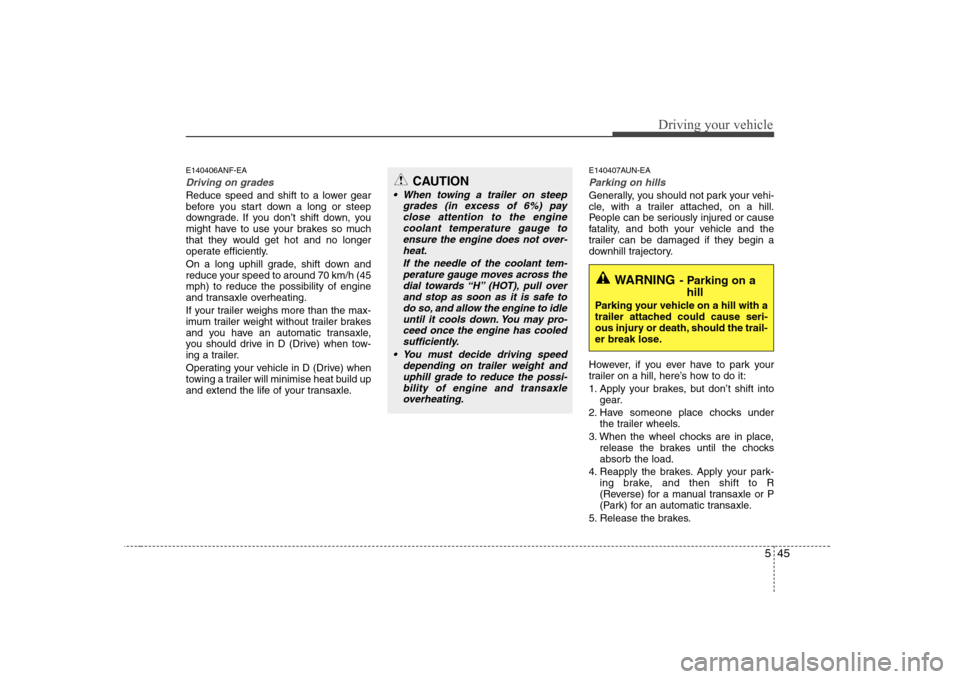
E140406ANF-EA
Driving on grades
Reduce speed and shift to a lower gear
before you start down a long or steep
downgrade. If you don’t shift down, you
might have to use your brakes so much
that they would get hot and no longer
operate efficiently.
On a long uphill grade, shift down and
reduce your speed to around 70 km/h (45mph) to reduce the possibility of engine
and transaxle overheating.
If your trailer weighs more than the max-
imum trailer weight without trailer brakes
and you have an automatic transaxle,
you should drive in D (Drive) when tow-
ing a trailer.
Operating your vehicle in D (Drive) when
towing a trailer will minimise heat build up
and extend the life of your transaxle.E140407AUN-EA
Parking on hills
Generally, you should not park your vehi-
cle, with a trailer attached, on a hill.
People can be seriously injured or cause
fatality, and both your vehicle and the
trailer can be damaged if they begin a
downhill trajectory.
However, if you ever have to park your
trailer on a hill, here’s how to do it:
1. Apply your brakes, but don’t shift into
gear.
2. Have someone place chocks under the trailer wheels.
3. When the wheel chocks are in place, release the brakes until the chocks absorb the load.
4. Reapply the brakes. Apply your park- ing brake, and then shift to R
(Reverse) for a manual transaxle or P
(Park) for an automatic transaxle.
5. Release the brakes.
CAUTION
When towing a trailer on steep grades (in excess of 6%) payclose attention to the enginecoolant temperature gauge to
ensure the engine does not over- heat.
If the needle of the coolant tem-perature gauge moves across thedial towards “H” (HOT), pull over
and stop as soon as it is safe to do so, and allow the engine to idleuntil it cools down. You may pro-
ceed once the engine has cooledsufficiently.
You must decide driving speed depending on trailer weight anduphill grade to reduce the possi-
bility of engine and transaxle overheating.
WARNING - Parking on a
hill
Parking your vehicle on a hill with a
trailer attached could cause seri-
ous injury or death, should the trail-
er break lose.
Page 224 of 340
547
Driving your vehicle
E140600ANF-EA
If you do decide to pull a trailer
Here are some important points if you
decide to pull a trailer:
Consider using a sway control. You canask a towbar dealer about sway con- trol.
Do not do any towing with your car dur- ing its first 2,000 km (1,200 miles) in
order to allow the engine to properly
break in. Failure to heed this caution
may result in serious engine or
transaxle damage.
When towing a trailer, be sure to con- sult an authorised HYUNDAI dealer for
further information on additional
requirements such as a towing kit, etc.
Always drive your vehicle at a moder- ate speed (less than 100 km/h (60mph)).
On a long uphill grade, do not exceed 70 km/h (45 mph) or the posted towing
speed limit, whichever is lower.
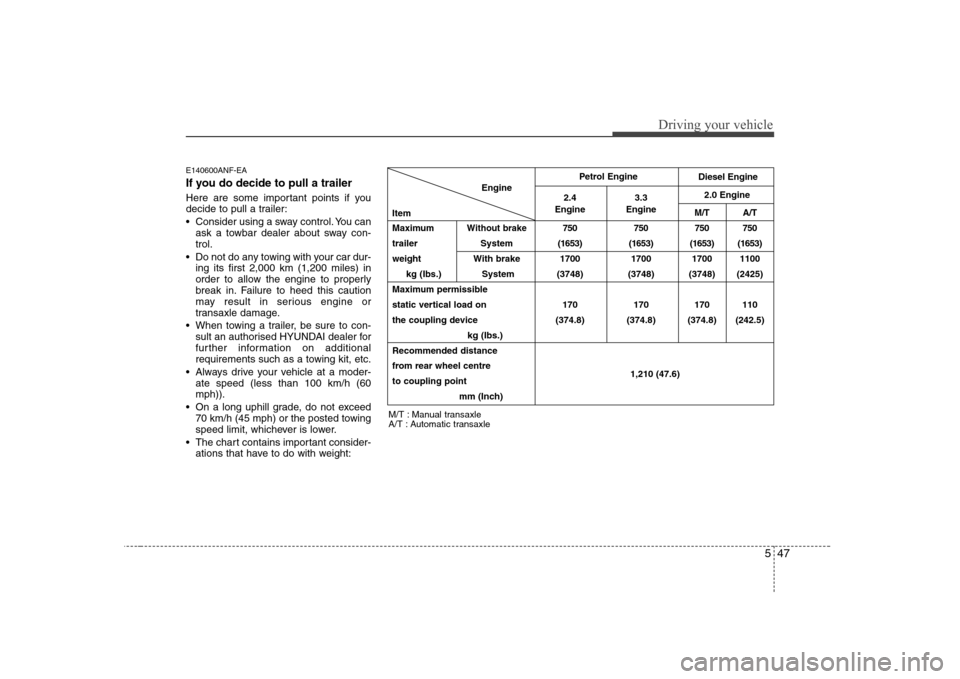
The chart contains important consider- ations that have to do with weight:
Engine 2.4 3.3 2.0 Engine
Item Engine Engine
M/T A/T
Maximum Without brake750 750 750 750
trailer System (1653) (1653) (1653) (1653)
weight With brake 1700 1700 1700 1100 kg (Ibs.) System (3748) (3748) (3748) (2425)
Maximum permissible
static vertical load on 170 170 170 110
the coupling device (374.8) (374.8) (374.8) (242.5) kg (Ibs.)
Recommended distance
from rear wheel centre 1,210 (47.6)
to coupling point
mm (Inch)
M/T : Manual transaxle
A/T : Automatic transaxle
Petrol Engine Diesel Engine
Page 225 of 340
Driving your vehicle
48
5
E140601AUN
Weight of the trailer
How heavy can a trailer safely be? It
should never weigh more than the maxi-
mum trailer weight with trailer brakes. But
even that can be too heavy.
It depends on how you plan to use your
trailer. For example, speed, altitude, road
grades, outside temperature and how
often your vehicle is used to pull a trailer
are all important. The ideal trailer weight
can also depend on any special equip-
ment that you have on your vehicle. E140602AEN-EA
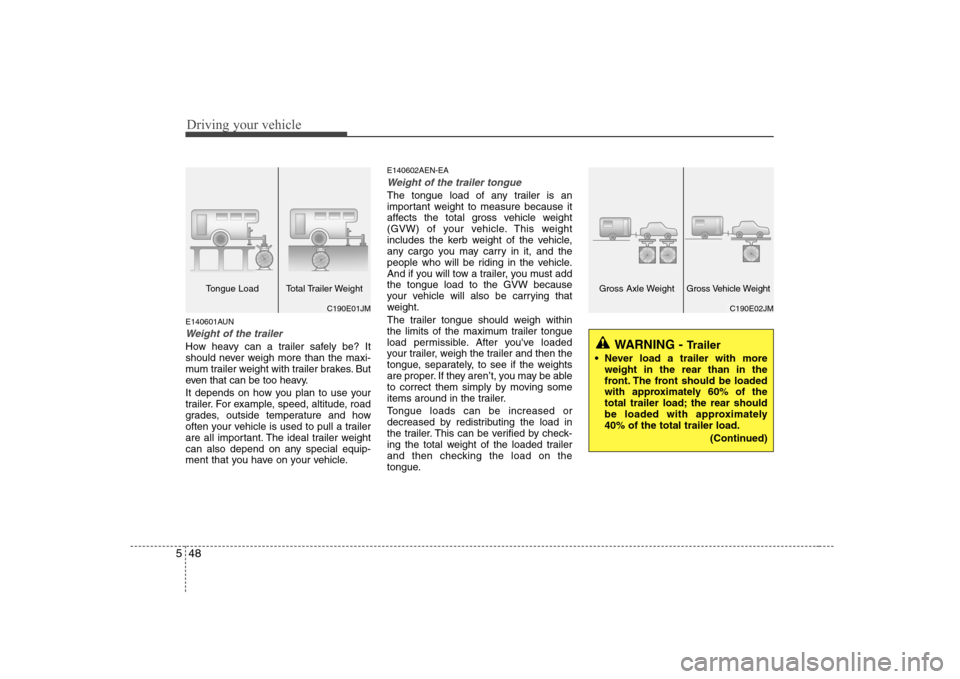
Weight of the trailer tongue
The tongue load of any trailer is an
important weight to measure because it
affects the total gross vehicle weight
(GVW) of your vehicle. This weight
includes the kerb weight of the vehicle,
any cargo you may carry in it, and the
people who will be riding in the vehicle.
And if you will tow a trailer, you must addthe tongue load to the GVW because
your vehicle will also be carrying that
weight.
The trailer tongue should weigh within
the limits of the maximum trailer tongue
load permissible. After you've loaded
your trailer, weigh the trailer and then the
tongue, separately, to see if the weights
are proper. If they aren’t, you may be able
to correct them simply by moving some
items around in the trailer.
Tongue loads can be increased or
decreased by redistributing the load in
the trailer. This can be verified by check-
ing the total weight of the loaded trailer
and then checking the load on the
tongue.
WARNING -
Trailer
Never load a trailer with more weight in the rear than in the
front. The front should be loaded
with approximately 60% of the
total trailer load; the rear should
be loaded with approximately40% of the total trailer load.
(Continued)
C190E02JM
Gross Axle WeightGross Vehicle Weight
C190E01JM
Tongue Load Total Trailer Weight
Page 226 of 340
549
Driving your vehicle
(Continued)
Never exceed the maximumweight limits of the trailer or trail-
er towing equipment. Improper
loading can result in damage to
your vehicle and/or personal
injury. Check weights and loading
at a commercial scale or highway
patrol office equipped withscales.
An improperly loaded trailer can cause loss of vehicle control.
Page 227 of 340
Driving your vehicle
50
5
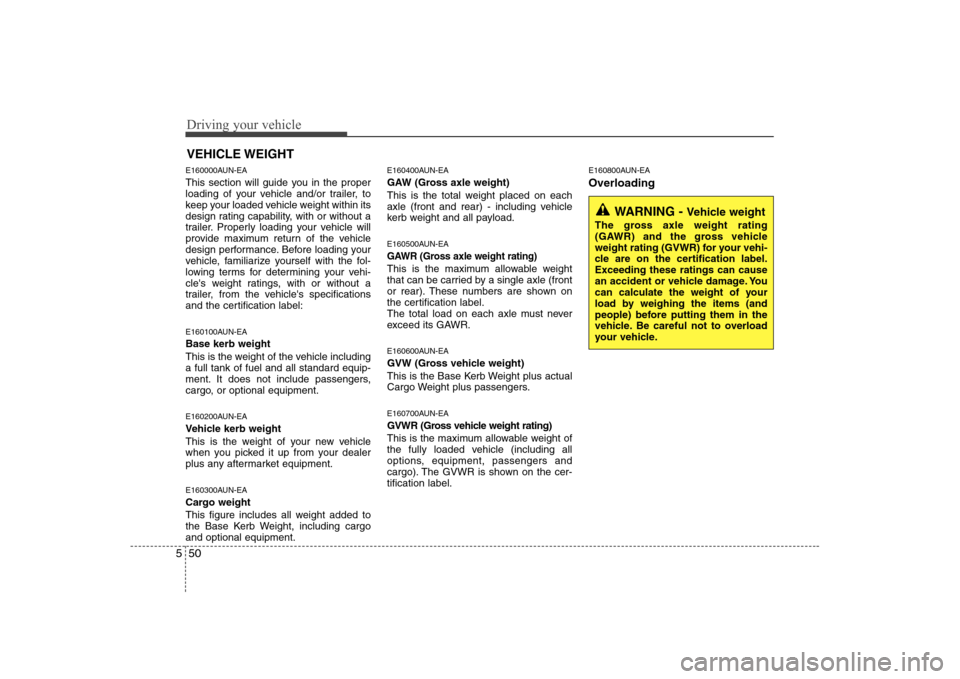
E160000AUN-EA
This section will guide you in the proper
loading of your vehicle and/or trailer, to
keep your loaded vehicle weight within its
design rating capability, with or without a
trailer. Properly loading your vehicle will
provide maximum return of the vehicle
design performance. Before loading your
vehicle, familiarize yourself with the fol-
lowing terms for determining your vehi-
cle's weight ratings, with or without a
trailer, from the vehicle's specifications
and the certification label:
E160100AUN-EA Base kerb weight
This is the weight of the vehicle including a full tank of fuel and all standard equip-
ment. It does not include passengers,
cargo, or optional equipment.
E160200AUN-EA
Vehicle kerb weight
This is the weight of your new vehicle
when you picked it up from your dealer
plus any aftermarket equipment.
E160300AUN-EA
Cargo weight
This figure includes all weight added to
the Base Kerb Weight, including cargoand optional equipment. E160400AUN-EA
GAW (Gross axle weight)
This is the total weight placed on each
axle (front and rear) - including vehicle
kerb weight and all payload.
E160500AUN-EA
GAWR (Gross axle weight rating)
This is the maximum allowable weight
that can be carried by a single axle (front
or rear). These numbers are shown on
the certification label.
The total load on each axle must never
exceed its GAWR.
E160600AUN-EA
GVW (Gross vehicle weight)
This is the Base Kerb Weight plus actual
Cargo Weight plus passengers.
E160700AUN-EA
GVWR (Gross vehicle weight rating)
This is the maximum allowable weight of
the fully loaded vehicle (including all
options, equipment, passengers and
cargo). The GVWR is shown on the cer-tification label.
E160800AUN-EA Overloading
VEHICLE WEIGHT
WARNING -
Vehicle weight
The gross axle weight rating
(GAWR) and the gross vehicle
weight rating (GVWR) for your vehi-
cle are on the certification label.Exceeding these ratings can cause
an accident or vehicle damage. You
can calculate the weight of your
load by weighing the items (and
people) before putting them in the
vehicle. Be careful not to overload
your vehicle.
Page 286 of 340
743
Maintenance
TYRES AND WHEELS
G200100AUN-EA
Tyre care
For proper maintenance, safety, and
maximum fuel economy, you must
always maintain recommended tyre
inflation pressures and stay within
the load limits and weight distribution
recommended for your vehicle. G200200AFD-EA Recommended cold tyre inflation pressures All tyre pressures (including the
spare) should be checked when the
tyres are cold. “Cold Tyres” means
the vehicle has not been driven for at
least three hours or driven less than1.6 km (one mile).
Recommended pressures must be
maintained for the best ride, top vehi-
cle handling, and minimum tyre
wear.
For recommended inflation pressure
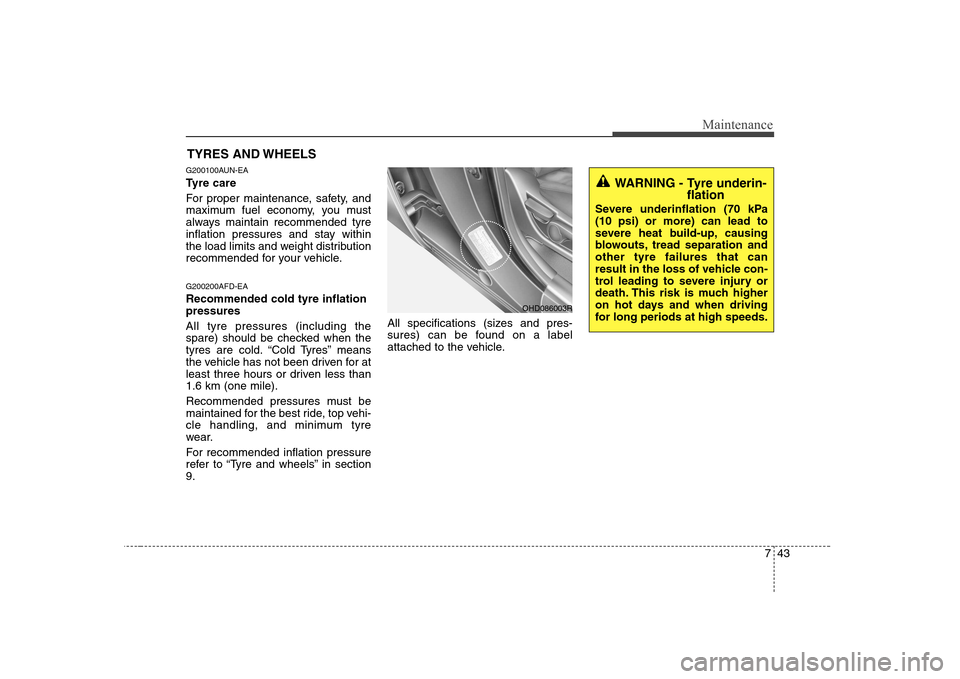
refer to “Tyre and wheels” in section9. All specifications (sizes and pres-
sures) can be found on a label
attached to the vehicle.
WARNING - Tyre underin-
flation
Severe underinflation (70 kPa (10 psi) or more) can lead to
severe heat build-up, causing
blowouts, tread separation andother tyre failures that can
result in the loss of vehicle con-
trol leading to severe injury or
death. This risk is much higher
on hot days and when driving
for long periods at high speeds.
OHD086003R
Page 290 of 340
747
Maintenance
G200500AUN-EA Wheel alignment and tyre balance
The wheels on your vehicle were aligned and balanced carefully at the
factory to give you the longest tyre
life and best overall performance.
In most cases, you will not need to
have your wheels aligned again.
However, if you notice unusual tyre
wear or your vehicle pulling one way
or the other, the alignment may needto be reset.
If you notice your vehicle vibrating
when driving on a smooth road, your
wheels may need to be rebalanced.G200600BFD-EA
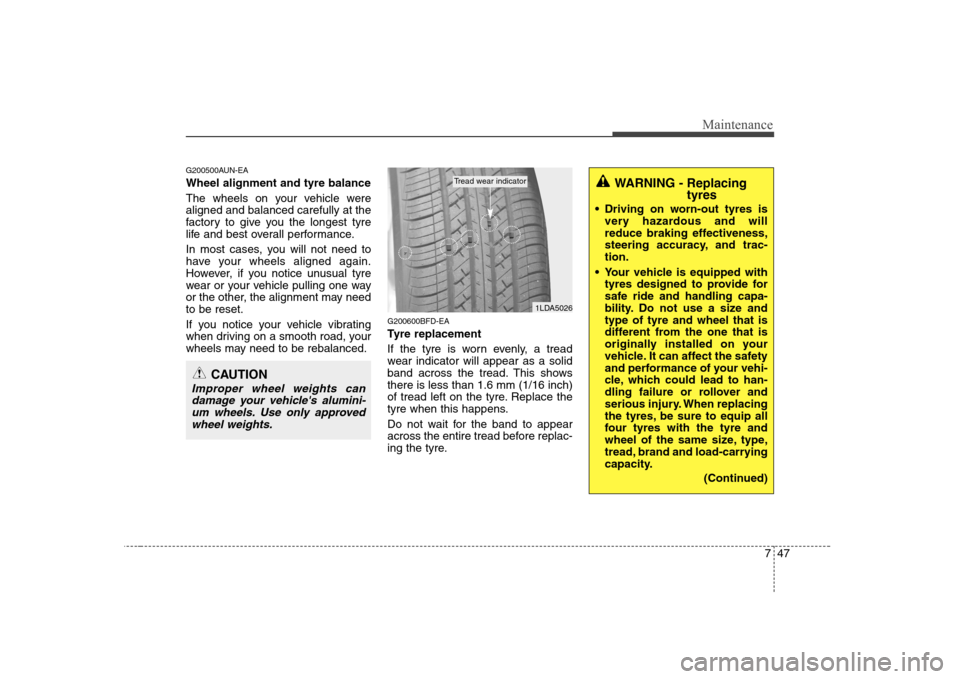
Tyre replacement
If the tyre is worn evenly, a tread
wear indicator will appear as a solid
band across the tread. This showsthere is less than 1.6 mm (1/16 inch)
of tread left on the tyre. Replace the
tyre when this happens.
Do not wait for the band to appear
across the entire tread before replac-
ing the tyre.
CAUTION
Improper wheel weights can
damage your vehicle's alumini- um wheels. Use only approvedwheel weights.
1LDA5026
Tread wear indicatorWARNING - Replacing tyres
Driving on worn-out tyres is very hazardous and will
reduce braking effectiveness,
steering accuracy, and trac-tion.
Your vehicle is equipped with tyres designed to provide for
safe ride and handling capa-
bility. Do not use a size andtype of tyre and wheel that is
different from the one that is
originally installed on your
vehicle. It can affect the safety
and performance of your vehi-
cle, which could lead to han-
dling failure or rollover and
serious injury. When replacing
the tyres, be sure to equip all
four tyres with the tyre and
wheel of the same size, type,
tread, brand and load-carrying
capacity.
(Continued)
Page 311 of 340
Maintenance
68
7
G221000ANF-EA Headlight aiming adjustment
Before performing aiming adjustment,
make sure of the following.
1. Keep all tyres inflated to the correct
pressure.
2. Place the vehicle on level ground and press the front bumper & rear bumper
down several times. Place vehicle at adistance of 3m (118 in.) from the test
wall.
3. See that the vehicle is unloaded (except for full levels of coolant, engine
oil and fuel, and spare tyre, jack, and
tools). Have the driver or equivalent
weight placed in driver's seat.
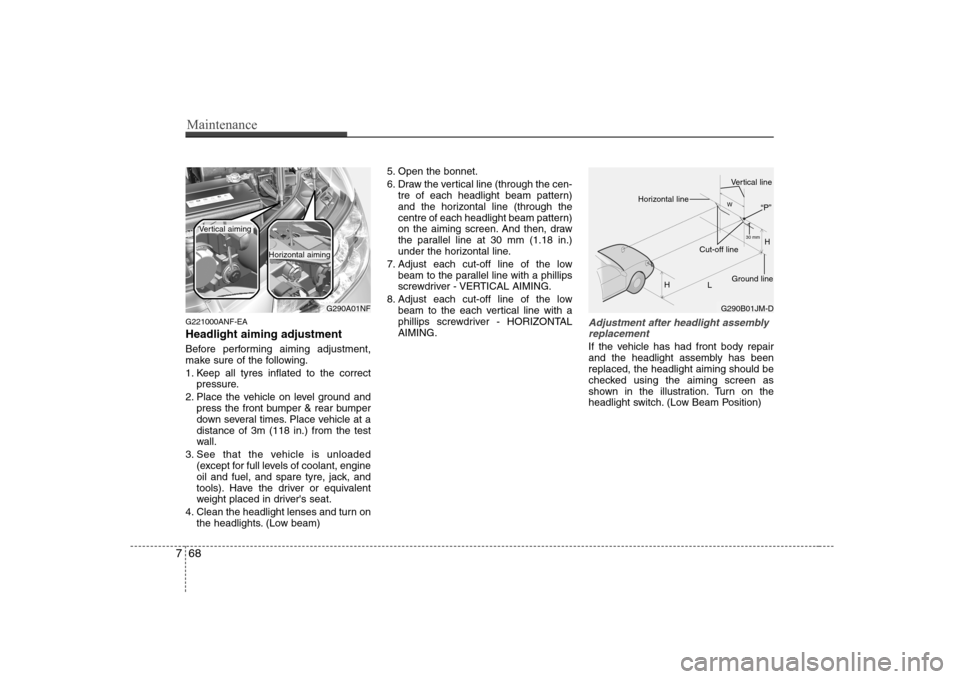
4. Clean the headlight lenses and turn on the headlights. (Low beam) 5. Open the bonnet.
6. Draw the vertical line (through the cen-
tre of each headlight beam pattern)
and the horizontal line (through the
centre of each headlight beam pattern)
on the aiming screen. And then, draw
the parallel line at 30 mm (1.18 in.)
under the horizontal line.
7. Adjust each cut-off line of the low beam to the parallel line with a phillips
screwdriver - VERTICAL AIMING.
8. Adjust each cut-off line of the low beam to the each vertical line with a
phillips screwdriver - HORIZONTALAIMING.Adjustment after headlight assembly
replacement
If the vehicle has had front body repair
and the headlight assembly has beenreplaced, the headlight aiming should be
checked using the aiming screen as
shown in the illustration. Turn on the
headlight switch. (Low Beam Position)
G290A01NF
Vertical aiming
Horizontal aiming
G290B01JM-D H
H L30 mm
W
Horizontal line
Vertical line
“P”
Ground line
Cut-off line
Page 340 of 340
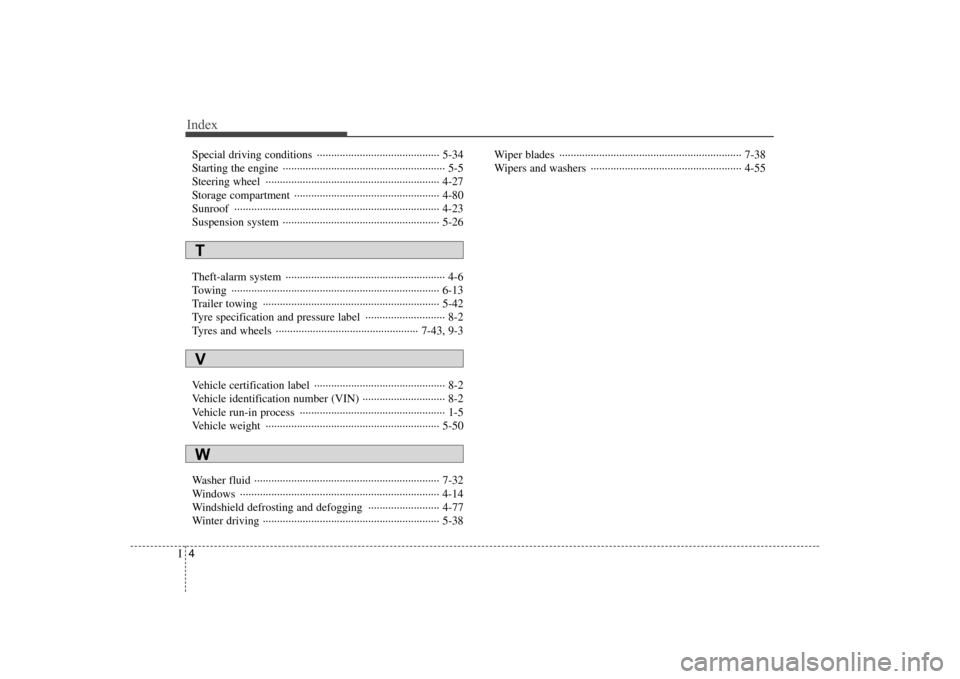
Index
4
I
Special driving conditions ··········································· 5-34
Starting the engine ························································· 5-5
Steering wheel ····························································· 4-27
Storage compartment ··················································· 4-80
Sunroof ········································································ 4-23
Suspension system ······················································· 5-26
Theft-alarm system ························································ 4-6
Towing ········································································· 6-13
Trailer towing ······························································ 5-42
Tyre specification and pressure label ···························· 8-2
Tyres and wheels ·················································· 7-43, 9-3
Vehicle certification label ·············································· 8-2
Vehicle identification number (VIN) ····························· 8-2
Vehicle run-in process ··················································· 1-5
Vehicle weight ····························································· 5-50
Washer fluid ································································· 7-32
Windows ······································································ 4-14
Windshield defrosting and defogging ························· 4-77
Winter driving ······························································ 5-38 Wiper blades ································································ 7-38
Wipers and washers ····················································· 4-55
V
W
T