oil Hyundai Sonata
[x] Cancel search | Manufacturer: HYUNDAI, Model Year: , Model line: , Model:Pages: 340, PDF Size: 18.45 MB
Page 306 of 340
763
Maintenance
G220100AUN
Headlight, position light, turn sig-
nal light, front fog light bulbreplacement
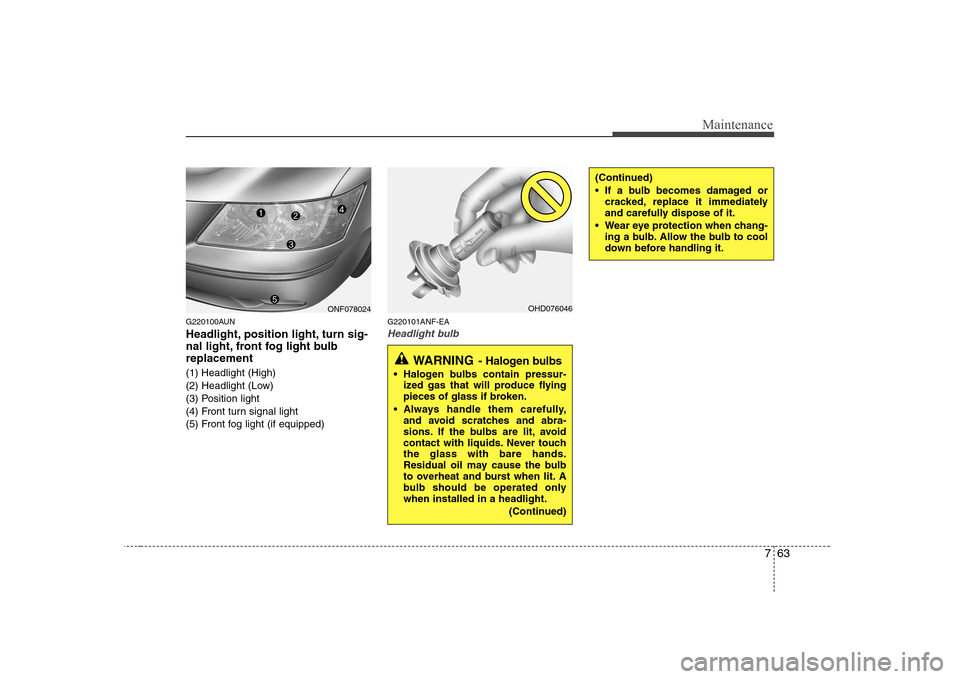
(1) Headlight (High)
(2) Headlight (Low)
(3) Position light
(4) Front turn signal light
(5) Front fog light (if equipped)G220101ANF-EA
Headlight bulb
OHD076046
WARNING
- Halogen bulbs
Halogen bulbs contain pressur-
ized gas that will produce flying
pieces of glass if broken.
Always handle them carefully, and avoid scratches and abra-
sions. If the bulbs are lit, avoid
contact with liquids. Never touchthe glass with bare hands.
Residual oil may cause the bulb
to overheat and burst when lit. A
bulb should be operated onlywhen installed in a headlight.
(Continued)
(Continued)
If a bulb becomes damaged orcracked, replace it immediately
and carefully dispose of it.
Wear eye protection when chang- ing a bulb. Allow the bulb to cool
down before handling it.
ONF078024
Page 311 of 340
Maintenance
68
7
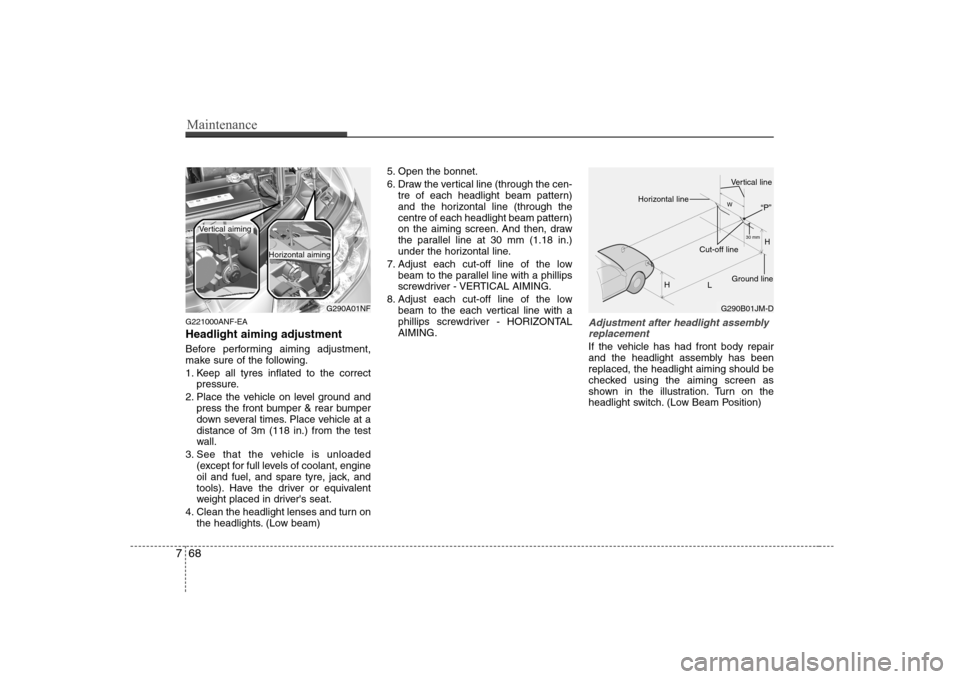
G221000ANF-EA Headlight aiming adjustment
Before performing aiming adjustment,
make sure of the following.
1. Keep all tyres inflated to the correct
pressure.
2. Place the vehicle on level ground and press the front bumper & rear bumper
down several times. Place vehicle at adistance of 3m (118 in.) from the test
wall.
3. See that the vehicle is unloaded (except for full levels of coolant, engine
oil and fuel, and spare tyre, jack, and
tools). Have the driver or equivalent
weight placed in driver's seat.
4. Clean the headlight lenses and turn on the headlights. (Low beam) 5. Open the bonnet.
6. Draw the vertical line (through the cen-
tre of each headlight beam pattern)
and the horizontal line (through the
centre of each headlight beam pattern)
on the aiming screen. And then, draw
the parallel line at 30 mm (1.18 in.)
under the horizontal line.
7. Adjust each cut-off line of the low beam to the parallel line with a phillips
screwdriver - VERTICAL AIMING.
8. Adjust each cut-off line of the low beam to the each vertical line with a
phillips screwdriver - HORIZONTALAIMING.Adjustment after headlight assembly
replacement
If the vehicle has had front body repair
and the headlight assembly has beenreplaced, the headlight aiming should be
checked using the aiming screen as
shown in the illustration. Turn on the
headlight switch. (Low Beam Position)
G290A01NF
Vertical aiming
Horizontal aiming
G290B01JM-D H
H L30 mm
W
Horizontal line
Vertical line
“P”
Ground line
Cut-off line
Page 314 of 340
771
Maintenance
Waxing
Wax the vehicle when water will no longer bead on the paint.
Always wash and dry the vehicle before
waxing. Use a good quality liquid or
paste wax, and follow the manufacturer’s
instructions. Wax all metal trim to protect
it and to maintain its luster.
Removing oil, tar, and similar materials
with a spot remover will usually strip the
wax from the finish. Be sure to re-wax
these areas even if the rest of the vehicle
does not yet need waxing.G230103AUN
Finish damage repair
Deep scratches or stone chips in the
painted surface must be repaired
promptly. Exposed metal will quickly rust
and may develop into a major repair
expense.
✽✽
NOTICE
If your vehicle is damaged and requires
any metal repair or replacement, be sure
the body shop applies anti-corrosion
materials to the parts repaired or
replaced.
B230104AUN
Bright-metal maintenance
To remove road tar and insects, use a tar remover, not a scraper or other
sharp object.
To protect the surfaces of bright-metal parts from corrosion, apply a coating of
wax or chrome preservative and rub to
a high luster.
During winter weather or in coastal areas, cover the bright metal parts with
a heavier coating of wax or preserva-
tive. If necessary, coat the parts with
non-corrosive petroleum jelly or other
protective compound.
CAUTION
Wiping dust or dirt off the body
with a dry cloth will scratch thefinish.
Do not use steel wool, abrasive cleaners, or strong detergentscontaining high alkaline or caus- tic agents on chrome-plated oranodized aluminium parts. This
may result in damage to the pro- tective coating and cause discol-oration or paint deterioration.
Page 318 of 340
775
Maintenance
Interior care
G230201AUN
Interior general precautions
Prevent caustic solutions such as per- fume and cosmetic oil from contacting
the dashboard because they may cause
damage or discoloration. If they do con-tact the dashboard, wipe them off imme-
diately. See the instructions that follow for
the proper way to clean vinyl.G230202AUN-EA
Cleaning the upholstery and interior
trim
Vinyl
Remove dust and loose dirt from vinyl
with a whisk broom or vacuum cleaner.
Clean vinyl surfaces with a vinyl cleaner. Fabric
Remove dust and loose dirt from fabric
with a whisk broom or vacuum cleaner.Clean with a mild soap solution recom-
mended for upholstery or carpets.
Remove fresh spots immediately with a
fabric spot cleaner. If fresh spots do not
receive immediate attention, the fabriccan be stained and its colour can be
affected. Also, its fire-resistant properties
can be reduced if the material is not
properly maintained. G230203AUN
Cleaning the lap/shoulder belt web-
bing
Clean the belt webbing with any mild
soap solution recommended for cleaning
upholstery or carpet. Follow the instruc-
tions provided with the soap. Do not
bleach or re-dye the webbing because
this may weaken it.
G230204AUN
Cleaning the interior window glass
If the interior glass surfaces of the vehi-
cle become fogged (that is, covered with
an oily, greasy or waxy film), they should
be cleaned with glass cleaner. Follow the
directions on the glass cleaner container.CAUTION
Never allow water or other liquidsto come in contact with electrical/electronic components
inside the vehicle as this may dam-age them.
CAUTION
Using anything but recommendedcleaners and procedures may affect
the fabric’s appearance and fire-resistant properties.
CAUTION
Do not scrape or scratch the inside of the rear window. This may resultin damage to the rear window defroster grid.
Page 328 of 340
Specifications
4
9
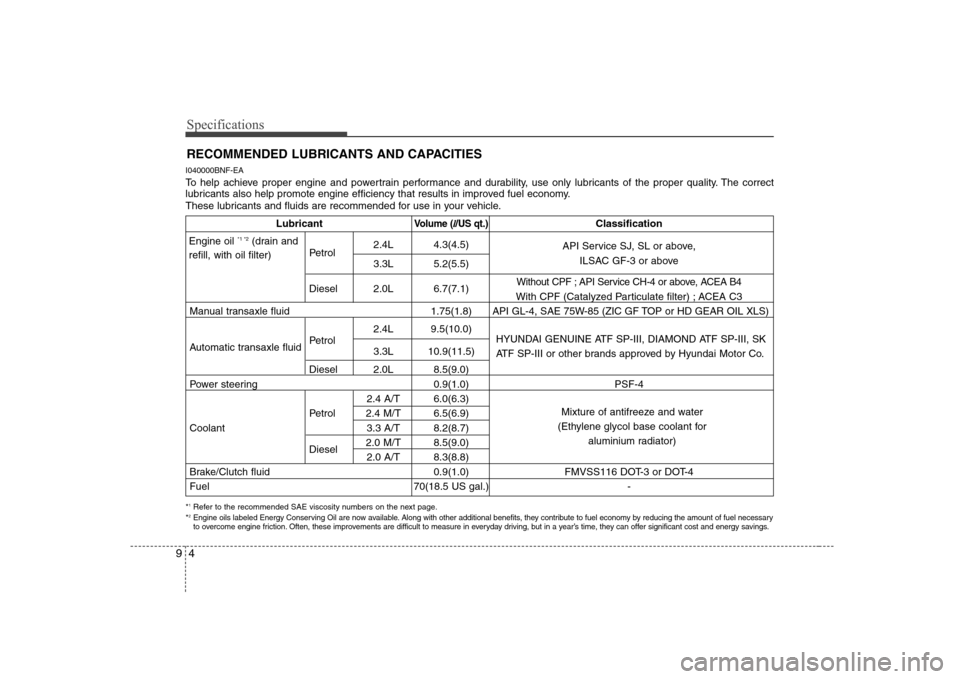
RECOMMENDED LUBRICANTS AND CAPACITIES
I040000BNF-EA
To help achieve proper engine and powertrain performance and durability, use only lubricants of the proper quality. The correct
lubricants also help promote engine efficiency that results in improved fuel economy.
These lubricants and fluids are recommended for use in your vehicle.
LubricantVolume ( l/US qt.)Classification
API Service SJ, SL or above,
Petrol 2.4L 4.3(4.5)
ILSAC GF-3 or above
3.3L 5.2(5.5)
Diesel 2.0L 6.7(7.1)
Without CPF ; API Service CH-4 or above, ACEA B4
With CPF (Catalyzed Particulate filter) ; ACEA C3
Manual transaxle fluid 1.75(1.8) API GL-4, SAE 75W-85 (ZIC GF TOP or HD GEAR OIL XLS)
Automatic transaxle fluid Petrol2.4L 9.5(10.0)
3.3L 10.9(11.5)
Diesel 2.0L 8.5(9.0)
Power steering 0.9(1.0) PSF-4
2.4 A/T 6.0(6.3)
Petrol 2.4 M/T 6.5(6.9)
Coolant 3.3 A/T 8.2(8.7)
Diesel2.0 M/T 8.5(9.0)
2.0 A/T 8.3(8.8)
Brake/Clutch fluid 0.9(1.0) FMVSS116 DOT-3 or DOT-4 Fuel 70(18.5 US gal.) -
Engine oil *1 *2
(drain and
refill, with oil filter)
HYUNDAI GENUINE ATF SP-III, DIAMOND ATF SP-III, SK
ATF SP-III or other brands approved by Hyundai Motor Co.
Mixture of antifreeze and water
(Ethylene glycol base coolant for aluminium radiator)
* 1
Refer to the recommended SAE viscosity numbers on the next page.
* 2
Engine oils labeled Energy Conserving Oil are now available. Along with other additional benefits, they contribute to fuel econo
my by reducing the amount of fuel necessary
to overcome engine friction. Often, these improvements are difficult to measure in everyday driving, but in a year’s time, they can offer significant cost and energy savings.
Page 329 of 340
95
Specifications
I040100ANF-EA Recommended SAE viscosity
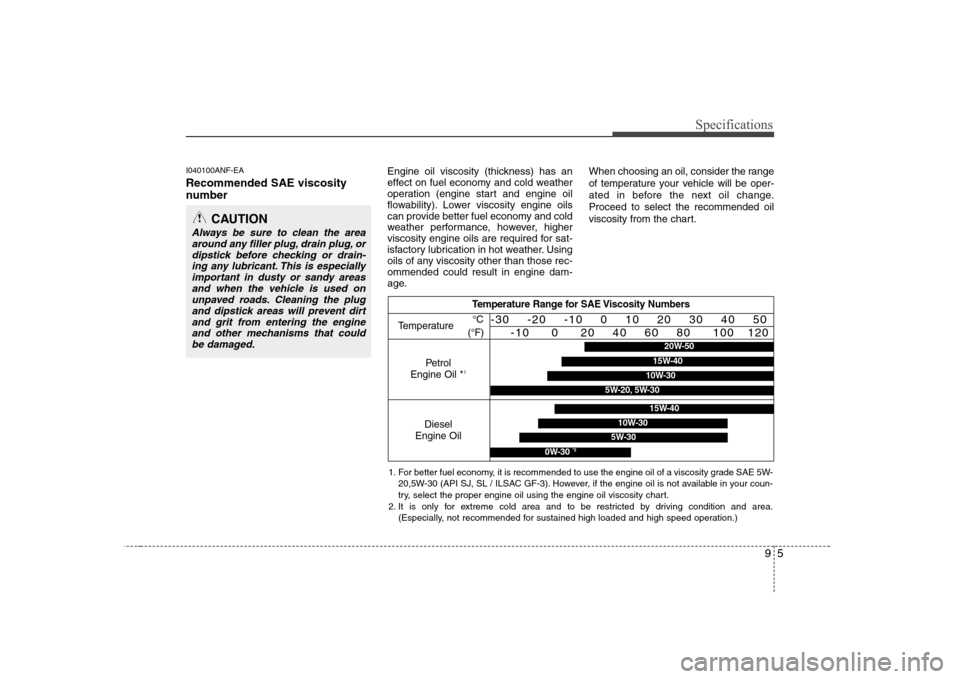
number Engine oil viscosity (thickness) has an
effect on fuel economy and cold weather
operation (engine start and engine oil
flowability). Lower viscosity engine oils
can provide better fuel economy and cold
weather performance, however, higher
viscosity engine oils are required for sat-
isfactory lubrication in hot weather. Using
oils of any viscosity other than those rec-ommended could result in engine dam-
age.When choosing an oil, consider the range
of temperature your vehicle will be oper-
ated in before the next oil change.Proceed to select the recommended oil
viscosity from the chart.
CAUTION
Always be sure to clean the area
around any filler plug, drain plug, ordipstick before checking or drain-
ing any lubricant. This is especiallyimportant in dusty or sandy areas and when the vehicle is used onunpaved roads. Cleaning the plug
and dipstick areas will prevent dirtand grit from entering the engineand other mechanisms that could
be damaged.
Temperature Range for SAE Viscosity Numbers
Temperature
Petrol
Engine Oil *
1
°C
(°F)-30 -20 -10 0 10 20 30 40 50 -10 0 20 40 60 80 100 120
Diesel
Engine Oil
5W-30
15W-40
10W-30
0W-30 *2
1. For better fuel economy, it is recommended to use the engine oil of a viscosity grade SAE 5W-
20,5W-30 (API SJ, SL / ILSAC GF-3). However, if the engine oil is not available in your coun-
try, select the proper engine oil using the engine oil viscosity chart.
2. It is only for extreme cold area and to be restricted by driving condition and area. (Especially, not recommended for sustained high loaded and high speed operation.)
20W-50
10W-30
15W-40
5W-20, 5W-30
Page 338 of 340
Index
2
I
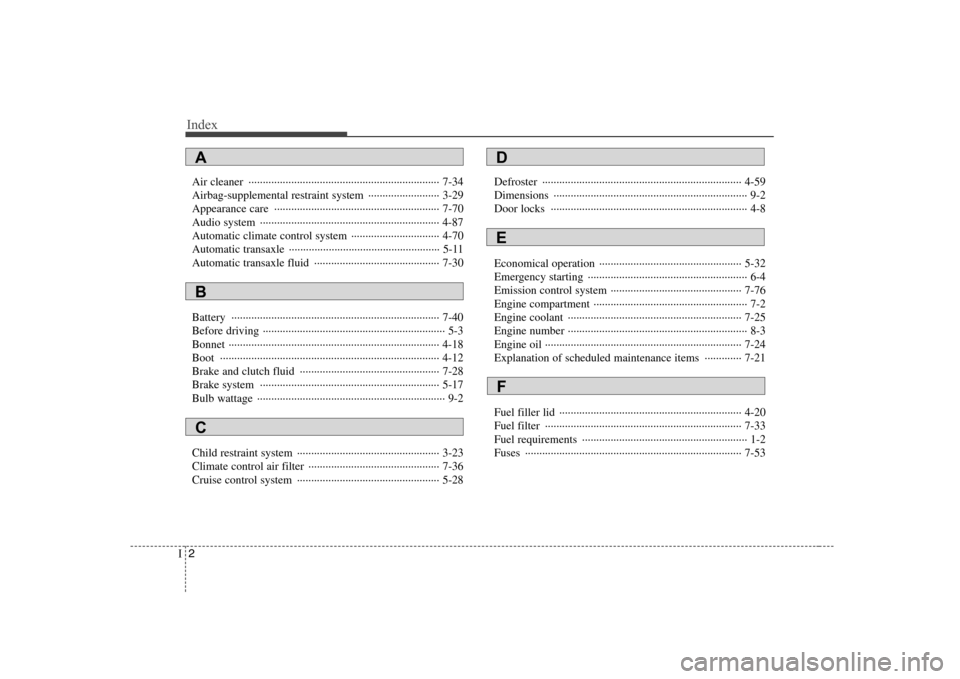
Air cleaner ··································································· 7-34
Airbag-supplemental restraint system ························· 3-29
Appearance care ·························································· 7-70
Audio system ······························································· 4-87
Automatic climate control system ······························· 4-70
Automatic transaxle ····················································· 5-11
Automatic transaxle fluid ············································ 7-30
Battery ········································································· 7-40
Before driving ································································ 5-3
Bonnet ·········································································· 4-18
Boot ············································································· 4-12
Brake and clutch fluid ················································· 7-28
Brake system ······························································· 5-17
Bulb wattage ·································································· 9-2
Child restraint system ·················································· 3-23
Climate control air filter ·············································· 7-36
Cruise control system ·················································· 5-28 Defroster ······································································ 4-59
Dimensions ···································································· 9-2
Door locks ····································································· 4-8
Economical operation ·················································· 5-32
Emergency starting ························································ 6-4
Emission control system ·············································· 7-76
Engine compartment ······················································ 7-2
Engine coolant ····························································· 7-25
Engine number ······························································· 8-3
Engine oil ····································································· 7-24
Explanation of scheduled maintenance items ············· 7-21
Fuel filler lid ································································ 4-20
Fuel filter ····································································· 7-33
Fuel requirements ·························································· 1-2
Fuses ············································································ 7-53
A
B
C
D
E
F