airbag Hyundai Sonata
[x] Cancel search | Manufacturer: HYUNDAI, Model Year: , Model line: , Model:Pages: 283, PDF Size: 13.5 MB
Page 43 of 283
1
FEATURES OF YOUR HYUNDAI
29
!
WARNING:
o A child restraint system must be placed
in the rear seat. Never install a child or
infant seat on the front passenger's seat.
Should an accident occur and cause the
passenger side airbag to deploy, it could
severely injure or kill an infant or child
seated in an infant or child seat. Thus
only use a child restraint in the rear seat
of your vehicle.
o A safety belt or child restraint system
can become very hot if it is left in a closed
vehicle on a sunny day, even if the out-
side temperature does not feel hot. Be
sure to check the seat cover and buckles
before placing a child there.
o When the child restraint system is not in
use, store it in the trunk or fasten it with
a safety belt so that it will not be thrown
forward in the case of a sudden stop or
an accident.
o Children may be seriously injured or
killed by an inflating airbag. All children,
even those too large for child restraints,
must ride in the rear seat.
!
WARNING:
To reduce the chance or serious or fatal
injuries:
o Children of all ages are safer when re-
strained in the rear seat. A child riding in
the front passenger seat can be force-
fully struck by an inflating airbag result-
ing in serious or fatal injuries.
o Always follow the instructions for in-
stallation and use of the child restraint
maker.
o Always make sure the child seat is se-
cured properly in the car and your child
is securely restrained in the child seat.
o Never hold a child in your arms or lap
when riding in a vehicle. The violent
forces created during a crash will tear the
child from your arms and throw the child
against the car’s interior.
o Never put a seat belt over yourself and a
child. During a crash, the belt could
press deep into the child causing seri-
ous internal injuries.
o Never leave children unattended in a
vehicle – not even for a short time. The
car can heat up very quickly, resulting in
serious injuries to children inside. Even
very young children may inadvertently
cause the vehicle to move, entangle them-
selves in the windows, or lock them-
selves or others inside the vehicle.o Never allow two children, or any two
persons, to use the same seat belt.
o Children often squirm and reposition
themselves improperly. Never let a child
ride with the shoulder belt under their
arm or behind their back. Always prop-
erly position and secure children in rear
seat.
o Never allow a child to stand-up or kneel
on the seat or floorboard of a moving
vehicle. During a collision or sudden
stop, the child can be violently thrown
against the vehicles interior, resulting in
serious injury.
o Never use an infant carrier or a child
safety seat that "hooks" over a seatback,
it may not provide adequate security in
an accident.
o Seat belts can become very hot, espe-
cially when the car is parked in direct
sunlight. Always check seat belt buck-
les before fastening them over a child.
o Always store or secure a child seat, even
when it is not in use. During a collision
or sudden stop, the child seat could be
thrown inside the vehicle.
!
WARNING:
Page 47 of 283
1
FEATURES OF YOUR HYUNDAI
33
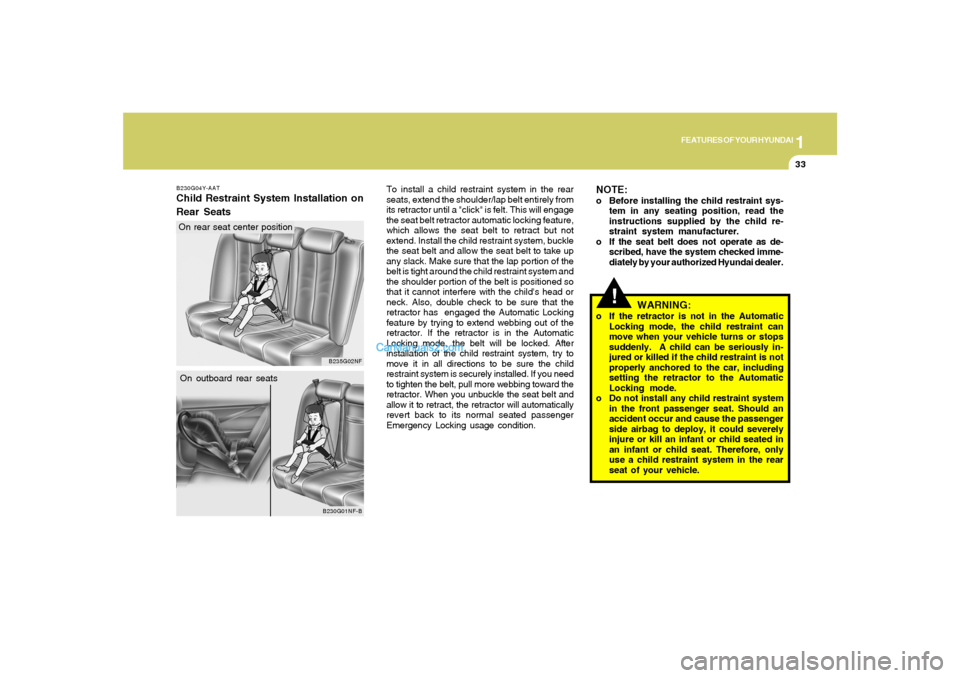
B230G04Y-AATChild Restraint System Installation on
Rear Seats
B230G01NF-B
On outboard rear seats
B235G02NF
On rear seat center positionTo install a child restraint system in the rear
seats, extend the shoulder/lap belt entirely from
its retractor until a "click" is felt. This will engage
the seat belt retractor automatic locking feature,
which allows the seat belt to retract but not
extend. Install the child restraint system, buckle
the seat belt and allow the seat belt to take up
any slack. Make sure that the lap portion of the
belt is tight around the child restraint system and
the shoulder portion of the belt is positioned so
that it cannot interfere with the child's head or
neck. Also, double check to be sure that the
retractor has engaged the Automatic Locking
feature by trying to extend webbing out of the
retractor. If the retractor is in the Automatic
Locking mode, the belt will be locked. After
installation of the child restraint system, try to
move it in all directions to be sure the child
restraint system is securely installed. If you need
to tighten the belt, pull more webbing toward the
retractor. When you unbuckle the seat belt and
allow it to retract, the retractor will automatically
revert back to its normal seated passenger
Emergency Locking usage condition.
!
WARNING:
o If the retractor is not in the Automatic
Locking mode, the child restraint can
move when your vehicle turns or stops
suddenly. A child can be seriously in-
jured or killed if the child restraint is not
properly anchored to the car, including
setting the retractor to the Automatic
Locking mode.
o Do not install any child restraint system
in the front passenger seat. Should an
accident occur and cause the passenger
side airbag to deploy, it could severely
injure or kill an infant or child seated in
an infant or child seat. Therefore, only
use a child restraint system in the rear
seat of your vehicle.NOTE:o Before installing the child restraint sys-
tem in any seating position, read the
instructions supplied by the child re-
straint system manufacturer.
o If the seat belt does not operate as de-
scribed, have the system checked imme-
diately by your authorized Hyundai dealer.
Page 48 of 283
1FEATURES OF YOUR HYUNDAI34
!
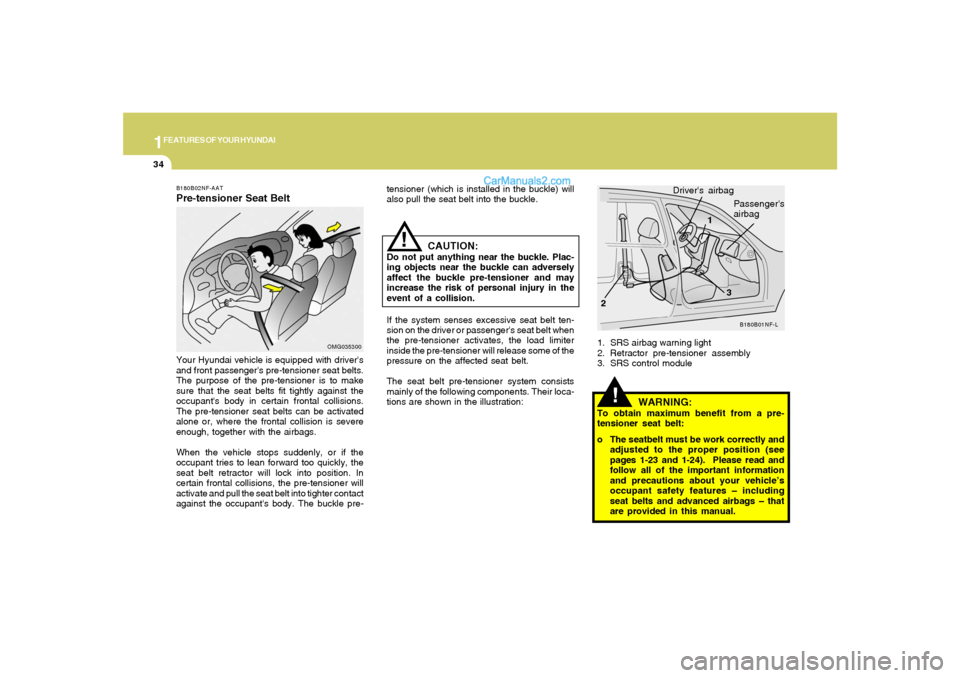
1. SRS airbag warning light
2. Retractor pre-tensioner assembly
3. SRS control module
B180B01NF-L
1
23 Driver's airbag
Passenger's
airbag
WARNING:
To obtain maximum benefit from a pre-
tensioner seat belt:
o The seatbelt must be work correctly and
adjusted to the proper position (see
pages 1-23 and 1-24). Please read and
follow all of the important information
and precautions about your vehicle’s
occupant safety features – including
seat belts and advanced airbags – that
are provided in this manual.
!
CAUTION:
Do not put anything near the buckle. Plac-
ing objects near the buckle can adversely
affect the buckle pre-tensioner and may
increase the risk of personal injury in the
event of a collision.
If the system senses excessive seat belt ten-
sion on the driver or passenger's seat belt when
the pre-tensioner activates, the load limiter
inside the pre-tensioner will release some of the
pressure on the affected seat belt.
The seat belt pre-tensioner system consists
mainly of the following components. Their loca-
tions are shown in the illustration: tensioner (which is installed in the buckle) will
also pull the seat belt into the buckle.
B180B02NF-AATPre-tensioner Seat BeltYour Hyundai vehicle is equipped with driver's
and front passenger's pre-tensioner seat belts.
The purpose of the pre-tensioner is to make
sure that the seat belts fit tightly against the
occupant's body in certain frontal collisions.
The pre-tensioner seat belts can be activated
alone or, where the frontal collision is severe
enough, together with the airbags.
When the vehicle stops suddenly, or if the
occupant tries to lean forward too quickly, the
seat belt retractor will lock into position. In
certain frontal collisions, the pre-tensioner will
activate and pull the seat belt into tighter contact
against the occupant's body. The buckle pre-
OMG035300
Page 49 of 283
1
FEATURES OF YOUR HYUNDAI
35
!
o Be sure you and your passengers always
wear seat belts and wear them properly.NOTE:o Both the driver's and front passenger's
pre-tensioner seat belts will be activated
in certain frontal collisions. The pre-
tensioner seat belts can be activated
alone or, where the frontal collision is
severe enough, together with the
airbags.
The pre-tensioners will not be activated
if the seat belts are not being worn at the
time of the collision.
o When the pre-tensioner seat belts are
activated, a loud noise may be heard and
fine dust, which may appear to be smoke,
may be visible in the passenger com-
partment. These are normal operating
conditions and are not hazardous.
o Although it is harmless, the fine dust
may cause skin irritation and should not
be breathed for prolonged periods. Wash
all exposed skin areas thoroughly after
an accident in which the pre-tensioner
seat belts were activated.
WARNING:
!
AIR
BAG
CAUTION:
o Because the sensor that activates the
SRS airbag is connected with the pre-
tensioner seat belt, the SRS airbag warn-
ing light on the instrument panel will
illuminate for approximately 6 seconds
after the ignition key has been turned to
the "ON" position, and then it should
turn off.
o If the pre-tensioner seat belt is not work-
ing properly, this warning light will illu-
minate even if there is no malfunction of
the SRS airbag. If the SRS airbag warning
light does not illuminate when the igni-
tion key is turned to "ON", or if it blinks
for a second and remains illuminated
after illuminating for approximately 6
seconds, or if it illuminates while the
vehicle is being driven, please have an
authorized Hyundai dealer inspect the
pre-tensioner seat belt or SRS airbag
system as soon as possible.
!
WARNING:
o Pre-tensioners are designed to operate
only one time. After activation, pre-
tensioner seat belts must be replaced.
All seat belts, of any type, should always
be replaced after they have been worn
during a collision.
o The pre-tensioner seat belt assembly
mechanisms become hot during activa-
tion. Do not touch the pre-tensioner seat
belt assemblies for several minutes after
they have been activated.
o Do not attempt to inspect or replace the
pre-tensioner seat belts yourself. This
must be done by an authorized Hyundai
dealer.
o Do not strike the pre-tensioner seat belt
assemblies.
o Do not attempt to service or repair the
pre-tensioner seat belt system in any
manner.
o Improper handling of the pre-tensioner
seat belt assemblies, and failure to heed
the warnings not to strike, modify, in-
spect, replace, service or repair the pre-
tensioner seat belt assemblies may lead
to improper operation or inadvertent
activation and serious injury.
o Always wear the seat belts when driving
or riding in a motor vehicle.
Page 50 of 283
1FEATURES OF YOUR HYUNDAI36
B240D01NF-AATADVANCED SUPPLEMENTAL RESTRAINT (AIRBAG) SYSTEM (SRS)
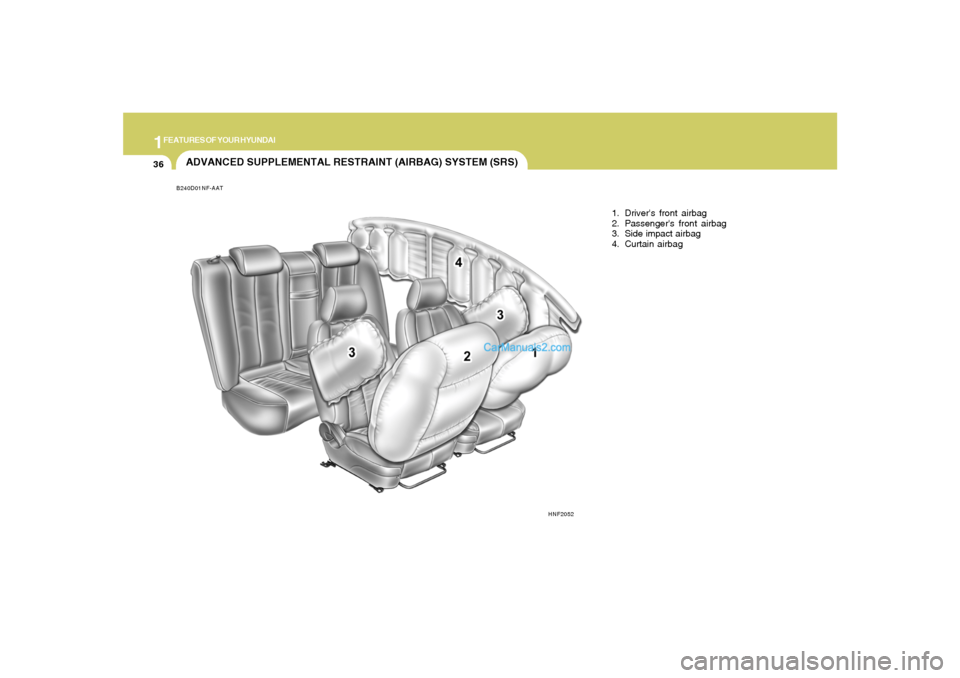
1. Driver's front airbag
2. Passenger's front airbag
3. Side impact airbag
4. Curtain airbag
HNF2052
Page 51 of 283
1
FEATURES OF YOUR HYUNDAI
37
B240A01NF
The SRS uses sensors to gather information
about the driver's and front passenger's seat
position, the driver's and front passenger's seat
belt usage and impact severity.
The driver's and front passenger's seat track
position sensors, which are installed on the seat
track, determine if the seats are fore or aft of a
reference position. The seat belt buckle sen-
sors determine if the driver and front passenger's
seat belts are fastened. These sensors provide
the ability to control the SRS deployment based
on how close the driver's seat is to the steering
wheel, how close the passenger's seat is to the
instrument panel, whether or not the seat belts
are fastened, and how severe the impact is.
The advanced SRS offers the ability to control
the airbag inflation with two levels. A first stage
level is provided for moderate-severity impacts.
A second stage level is provided for more
severe impacts.
According to the impact severity, seating posi-
tion and seat belt usage, the SRSCM(SRS
Control Module) controls the airbag inflation.
Failure to properly wear seat belts can increase
the risk or severity of injury in an accident.
CAUTION:
If a seat track position sensor or an occu-
pant classification system is not working
properly, the SRS airbag warning light on
the instrument panel will illuminate be-
cause the SRS airbag warning light is con-
nected with the seat track position sensor
and the occupant classification system. If
the SRS airbag warning light does not illu-
minate when the ignition key is turned to
the "ON" position, remains illuminated af-
ter approximately 6 seconds when the igni-
tion key is turned to the "ON" position, or
if it illuminates while the vehicle is being
driven, have an authorized Hyundai dealer
inspect the advanced SRS airbag system as
soon as possible.
!
AIR
BAG
Additionally, your Hyundai is equipped with an
occupant classification system in the front
passenger's seat. The occupant classification
system detects the presence of a passenger in
the front passenger's seat and will turn off the
front passenger's airbag under certain condi-
tions. For more detail, see "Occupant Classifi-
cation System" later in this section.
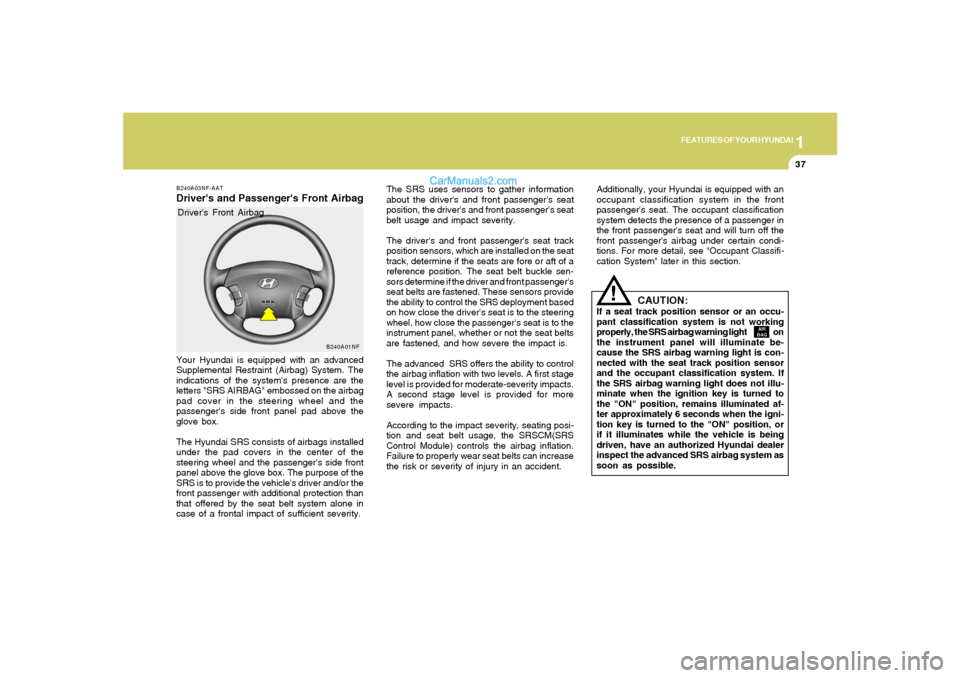
B240A03NF-AATDriver's and Passenger's Front AirbagYour Hyundai is equipped with an advanced
Supplemental Restraint (Airbag) System. The
indications of the system's presence are the
letters "SRS AIRBAG" embossed on the airbag
pad cover in the steering wheel and the
passenger's side front panel pad above the
glove box.
The Hyundai SRS consists of airbags installed
under the pad covers in the center of the
steering wheel and the passenger's side front
panel above the glove box. The purpose of the
SRS is to provide the vehicle's driver and/or the
front passenger with additional protection than
that offered by the seat belt system alone in
case of a frontal impact of sufficient severity.Driver's Front Airbag
Page 52 of 283
1FEATURES OF YOUR HYUNDAI38
!
!
WARNING:
Always use seat belts and child restraints –
every trip, every time, everyone! Airbags
inflate with considerable force and in the
blink of an eye. Seat belts help keep occu-
pants in proper position to obtain maxi-
mum benefit from the airbag. Even with
advanced airbags, improperly and unbelted
occupants can be severely injured when
the airbag inflates. Always follow the pre-
cautions about seat belts, airbags and oc-
cupant safety contained in this manual.
To reduce the chance of serious or fatal
injuries and receive the maximum safety
benefit from your restraint system:
o Never place a child in any child or booster
seat in the front seat (see child restraints
1-28).
o ABC – Always Buckle Children in the
back seat. It is the safest place for
children of any age to ride.
o Front and side impact airbags can injure
occupants improperly positioned in the
front seats.
o Move your seat as far back as practical
from the front airbags, while still main-
taining control of the vehicle.
o Never sit or lean unnecessarily close to
the front or side airbags.
!
WARNING:
o Modification to the seat structure can
adversely affect the seat track position
sensor and cause the airbag to deploy at
a different level than should be pro-
vided.
o Do not place any objects underneath the
front seats as they could damage the
seat track position sensor or interfere
with the occupant classification sys-
tem.
o Do not place any objects that may cause
magnetic fields near the front seat. These
may cause a malfunction of the seat
track position sensor.NOTE:o Be sure to read information about the
SRS on the labels provided on the back-
side of the sun visor.
o Advanced airbags are combined with
pre-tensioner seat belts to help provide
enhanced occupant protection in fron-
tal crashes. Front airbags are not in-
tended to deploy in collisions in which
sufficient protection can be provided by
the pre-tensioner seat belt.
o If you are considering modification of
your vehicle due to a disability, please
contact the Hyundai Customer Assis-
tance Center at 1-800-633-5151.o Never lean against the door or center
console – always sit in an upright posi-
tion.
o Do not allow an adult passenger to ride
in the front seat when the “Passenger
Airbag OFF” indicator is illuminated,
because the airbag will not deploy in the
event of a moderate or severe frontal
crash.
o Never place objects over or near any
airbag module (front or side impact
airbags), because these objects can in-
jure passengers in a crash.
o Never place covers, blankets or after-
market seat warmers on the passenger
seat as these may interfere with the
occupant classification system.
o Do not tamper or disconnect SRS wiring
or other components. Injuries could
result from inadvertent deployment or
failure of the airbag to deploy in a crash.
o If the SRS airbag warning light (see pg 1-
52) remains illuminated while the vehicle
is being driven, have an authorized
Hyundai dealer inspect the airbag sys-
tem as soon as possible.
o Airbags can only be used once – have an
authorized Hyundai dealer replace the
airbag immediately after deployment.
WARNING:
Page 53 of 283
1
FEATURES OF YOUR HYUNDAI
39
!
WARNING:
o Move your seat as far back as practical
from the front airbags, while still main-
taining control of the vehicle. You and
your passengers should never sit or lean
unnecessarily close to the airbags. Im-
properly positioned drivers and passen-
gers can be severely injured by inflating
airbags.
o No objects should be placed over or near
the airbag modules on the steering
wheel, instrument panel, and the front
passenger's panel above the glove box,
because any such object could cause
harm if the vehicle is in a crash severe
enough to cause the airbags to deploy.
o If the airbags deploy, they must be re-
placed by an authorized Hyundai dealer.
Deployed airbags WILL NOT inflate again
and will provide no protection in subse-
quent collisions.
o Do not tamper with or disconnect SRS
wiring or other components of the SRS
system. Doing so could result in injury,
due to accidental deployment of the
airbags or by rendering the SRS inopera-
tive.
!
WARNING:
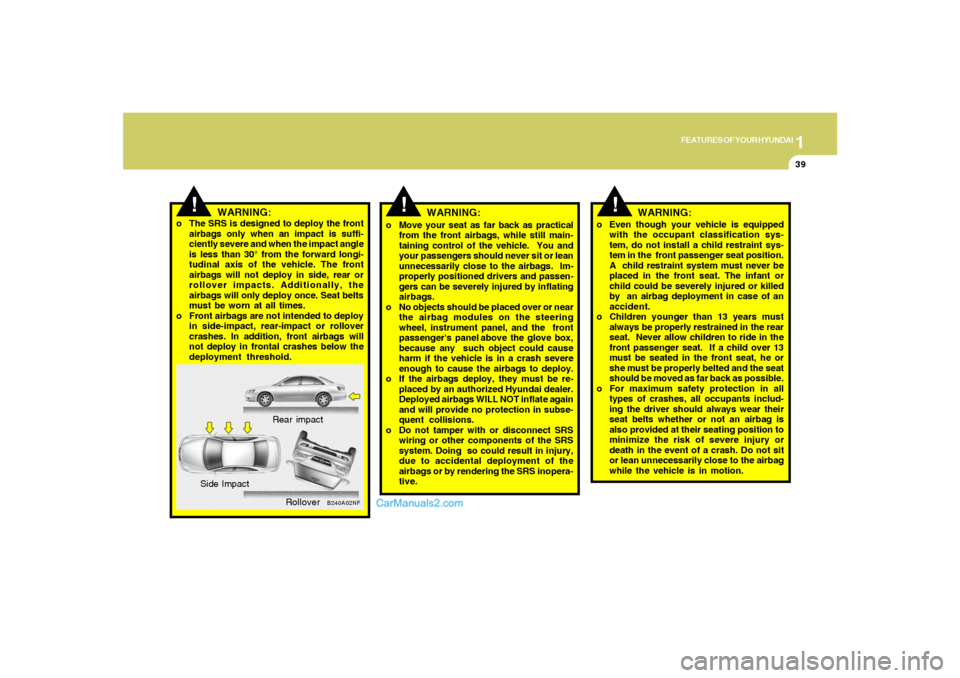
o The SRS is designed to deploy the front
airbags only when an impact is suffi-
ciently severe and when the impact angle
is less than 30° from the forward longi-
tudinal axis of the vehicle. The front
airbags will not deploy in side, rear or
rollover impacts. Additionally, the
airbags will only deploy once. Seat belts
must be worn at all times.
o Front airbags are not intended to deploy
in side-impact, rear-impact or rollover
crashes. In addition, front airbags will
not deploy in frontal crashes below the
deployment threshold.
B240A02NF
Rear impact
Side Impact
Rollover
!
WARNING:
o Even though your vehicle is equipped
with the occupant classification sys-
tem, do not install a child restraint sys-
tem in the front passenger seat position.
A child restraint system must never be
placed in the front seat. The infant or
child could be severely injured or killed
by an airbag deployment in case of an
accident.
o Children younger than 13 years must
always be properly restrained in the rear
seat. Never allow children to ride in the
front passenger seat. If a child over 13
must be seated in the front seat, he or
she must be properly belted and the seat
should be moved as far back as possible.
o For maximum safety protection in all
types of crashes, all occupants includ-
ing the driver should always wear their
seat belts whether or not an airbag is
also provided at their seating position to
minimize the risk of severe injury or
death in the event of a crash. Do not sit
or lean unnecessarily close to the airbag
while the vehicle is in motion.
Page 54 of 283
1FEATURES OF YOUR HYUNDAI40
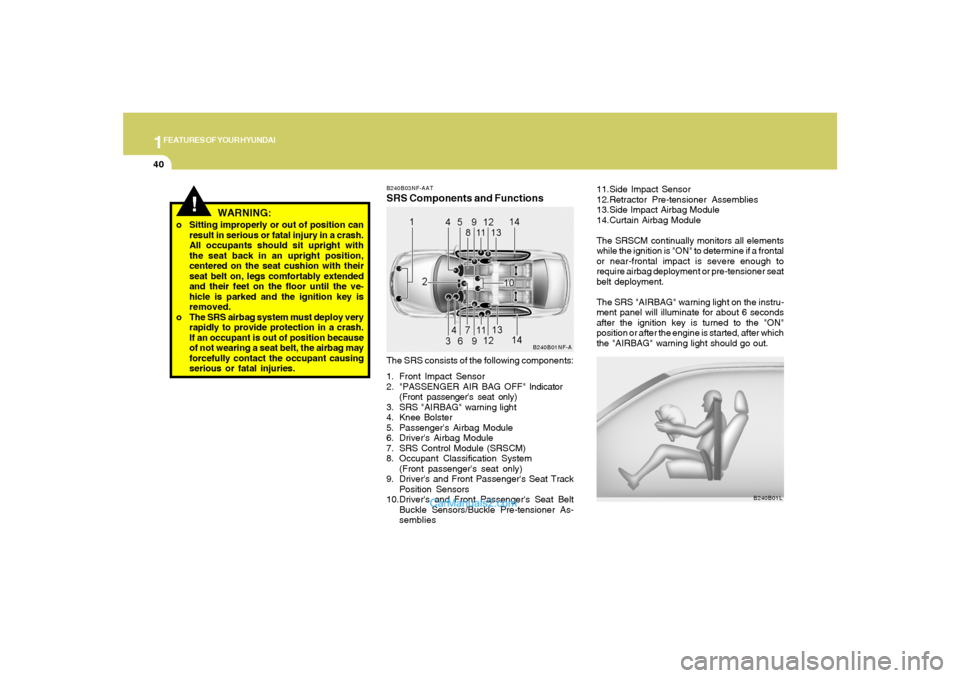
11.Side Impact Sensor
12.Retractor Pre-tensioner Assemblies
13.Side Impact Airbag Module
14.Curtain Airbag Module
The SRSCM continually monitors all elements
while the ignition is "ON" to determine if a frontal
or near-frontal impact is severe enough to
require airbag deployment or pre-tensioner seat
belt deployment.
The SRS "AIRBAG" warning light on the instru-
ment panel will illuminate for about 6 seconds
after the ignition key is turned to the "ON"
position or after the engine is started, after which
the "AIRBAG" warning light should go out.
B240B01L
!
WARNING:
o Sitting improperly or out of position can
result in serious or fatal injury in a crash.
All occupants should sit upright with
the seat back in an upright position,
centered on the seat cushion with their
seat belt on, legs comfortably extended
and their feet on the floor until the ve-
hicle is parked and the ignition key is
removed.
o The SRS airbag system must deploy very
rapidly to provide protection in a crash.
If an occupant is out of position because
of not wearing a seat belt, the airbag may
forcefully contact the occupant causing
serious or fatal injuries.
B240B03NF-AATSRS Components and FunctionsThe SRS consists of the following components:
1. Front Impact Sensor
2. "PASSENGER AIR BAG OFF" Indicator
(Front passenger's seat only)
3. SRS "AIRBAG" warning light
4. Knee Bolster
5. Passenger's Airbag Module
6. Driver's Airbag Module
7. SRS Control Module (SRSCM)
8. Occupant Classification System
(Front passenger's seat only)
9. Driver's and Front Passenger's Seat Track
Position Sensors
10.Driver's and Front Passenger's Seat Belt
Buckle Sensors/Buckle Pre-tensioner As-
semblies
B240B01NF-A
Page 55 of 283
1
FEATURES OF YOUR HYUNDAI
41
B240B02L
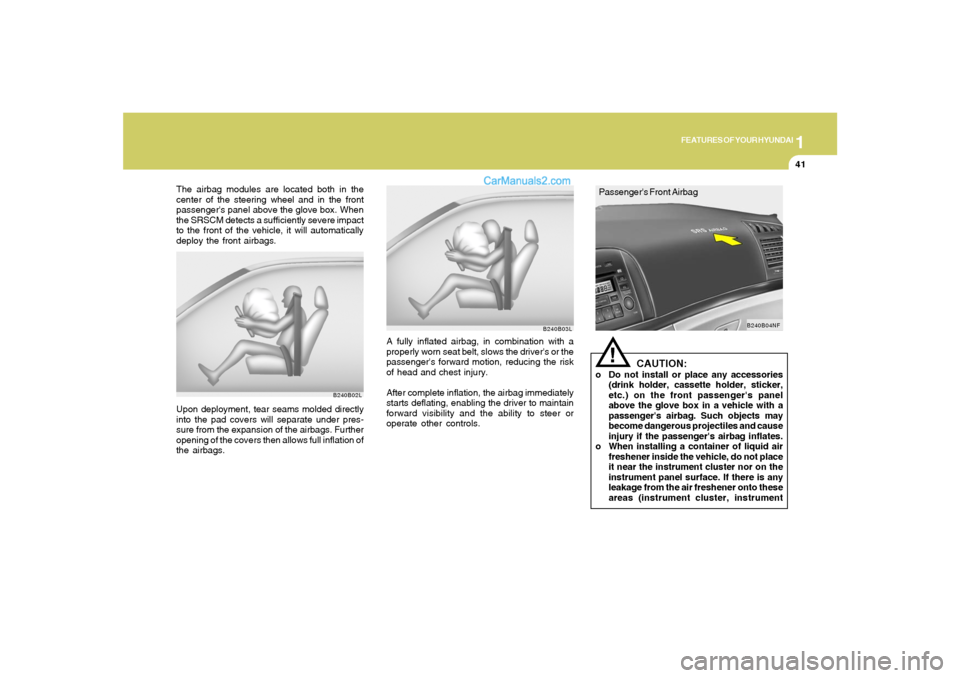
Upon deployment, tear seams molded directly
into the pad covers will separate under pres-
sure from the expansion of the airbags. Further
opening of the covers then allows full inflation of
the airbags.A fully inflated airbag, in combination with a
properly worn seat belt, slows the driver's or the
passenger's forward motion, reducing the risk
of head and chest injury.
After complete inflation, the airbag immediately
starts deflating, enabling the driver to maintain
forward visibility and the ability to steer or
operate other controls.
B240B03L
The airbag modules are located both in the
center of the steering wheel and in the front
passenger's panel above the glove box. When
the SRSCM detects a sufficiently severe impact
to the front of the vehicle, it will automatically
deploy the front airbags.
Passenger's Front Airbag
CAUTION:
o Do not install or place any accessories
(drink holder, cassette holder, sticker,
etc.) on the front passenger's panel
above the glove box in a vehicle with a
passenger's airbag. Such objects may
become dangerous projectiles and cause
injury if the passenger's airbag inflates.
o When installing a container of liquid air
freshener inside the vehicle, do not place
it near the instrument cluster nor on the
instrument panel surface. If there is any
leakage from the air freshener onto these
areas (instrument cluster, instrument
!
B240B04NF