Floor Hyundai Sonata 2009 User Guide
[x] Cancel search | Manufacturer: HYUNDAI, Model Year: 2009, Model line: Sonata, Model: Hyundai Sonata 2009Pages: 286, PDF Size: 9.58 MB
Page 116 of 286
1
FEATURES OF YOUR HYUNDAI
103103
ONF048093 ONF048095N
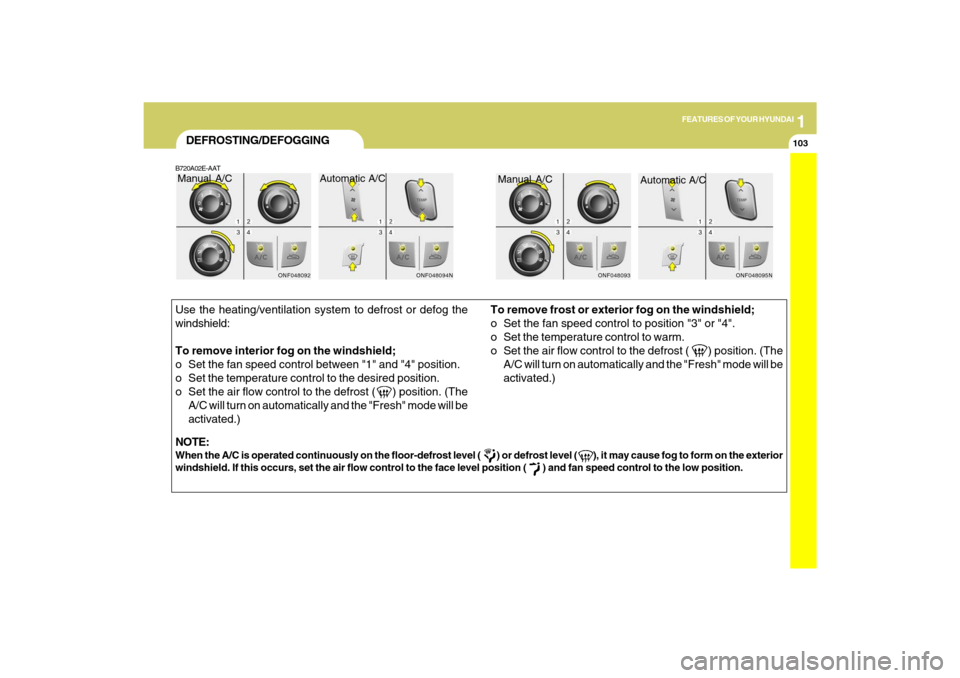
DEFROSTING/DEFOGGINGB720A02E-AATUse the heating/ventilation system to defrost or defog the
windshield:
To remove interior fog on the windshield;
o Set the fan speed control between "1" and "4" position.
o Set the temperature control to the desired position.
o Set the air flow control to the defrost ( ) position. (The
A/C will turn on automatically and the "Fresh" mode will be
activated.)To remove frost or exterior fog on the windshield;
o Set the fan speed control to position "3" or "4".
o Set the temperature control to warm.
o Set the air flow control to the defrost ( ) position. (The
A/C will turn on automatically and the "Fresh" mode will be
activated.)
NOTE:When the A/C is operated continuously on the floor-defrost level ( ) or defrost level ( ), it may cause fog to form on the exterior
windshield. If this occurs, set the air flow control to the face level position ( ) and fan speed control to the low position.
ONF048092
Manual A/C Automatic A/C
Manual A/C
Automatic A/C
ONF048094N
Page 118 of 286
1
FEATURES OF YOUR HYUNDAI
105105
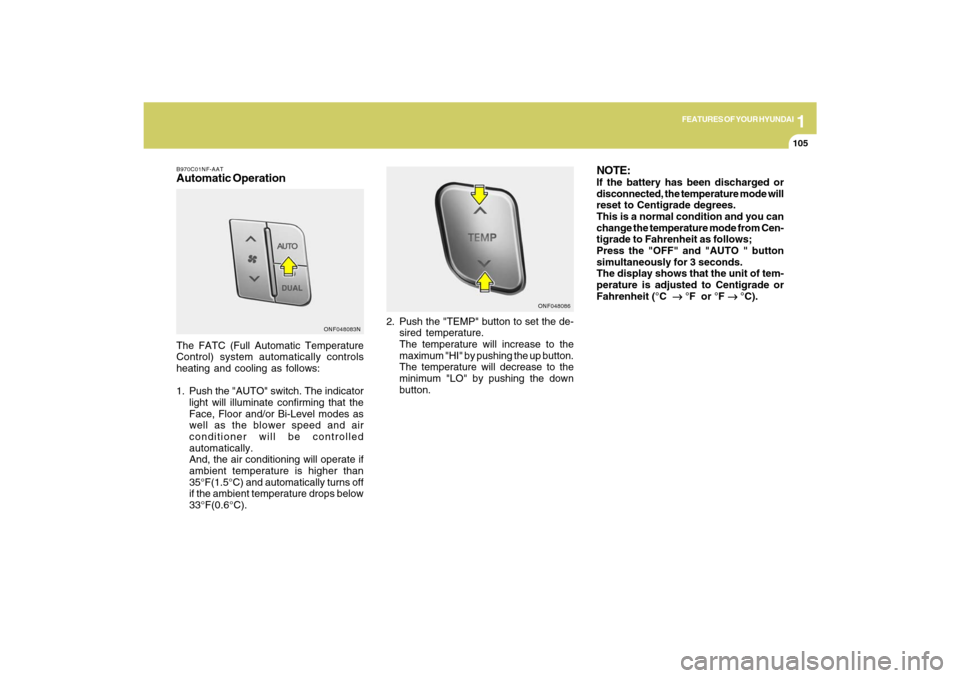
B970C01NF-AATAutomatic OperationThe FATC (Full Automatic Temperature
Control) system automatically controls
heating and cooling as follows:
1. Push the "AUTO" switch. The indicator
light will illuminate confirming that the
Face, Floor and/or Bi-Level modes as
well as the blower speed and air
conditioner will be controlled
automatically.
And, the air conditioning will operate if
ambient temperature is higher than
35°F(1.5°C) and automatically turns off
if the ambient temperature drops below
33°F(0.6°C).2. Push the "TEMP" button to set the de-
sired temperature.
The temperature will increase to the
maximum "HI" by pushing the up button.
The temperature will decrease to the
minimum "LO" by pushing the down
button.
NOTE:If the battery has been discharged or
disconnected, the temperature mode will
reset to Centigrade degrees.
This is a normal condition and you can
change the temperature mode from Cen-
tigrade to Fahrenheit as follows;
Press the "OFF" and "AUTO " button
simultaneously for 3 seconds.
The display shows that the unit of tem-
perature is adjusted to Centigrade or
Fahrenheit (°C
→ →→ →
→ °F or °F
→ →→ →
→ °C).
ONF048083NONF048086
Page 121 of 286
1FEATURES OF YOUR HYUNDAI
108
Face-Level (B, D) *
1
When selecting the "Face-Level" mode,
the indicator light will come on, causing air
to be discharged through the face level
vents.
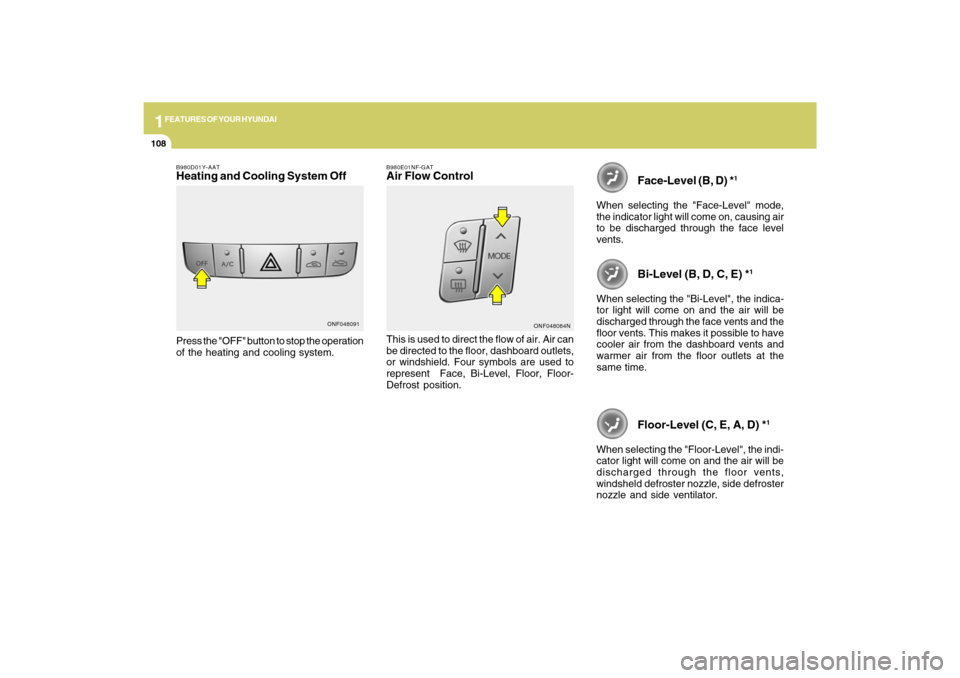
B980D01Y-AATHeating and Cooling System OffPress the "OFF" button to stop the operation
of the heating and cooling system.
ONF048091B980E01NF-GAT
Air Flow ControlThis is used to direct the flow of air. Air can
be directed to the floor, dashboard outlets,
or windshield. Four symbols are used to
represent Face, Bi-Level, Floor, Floor-
Defrost position.
ONF048084N
Floor-Level (C, E, A, D) *
1
When selecting the "Floor-Level", the indi-
cator light will come on and the air will be
discharged through the floor vents,
windsheld defroster nozzle, side defroster
nozzle and side ventilator.
Bi-Level (B, D, C, E) *
1
When selecting the "Bi-Level", the indica-
tor light will come on and the air will be
discharged through the face vents and the
floor vents. This makes it possible to have
cooler air from the dashboard vents and
warmer air from the floor outlets at the
same time.
Page 122 of 286
1
FEATURES OF YOUR HYUNDAI
109109
Floor-Defrost Level (A, C, E, D) *
1
When selecting the "Floor-Defrost" mode,
the indicator light will come on and the air
will be discharged through the windshield
defroster nozzle, the floor vents, side
defroster nozzle and side ventilator.
If any of the temperature control switch, the
blower fan control switch, or the defrost
switch is selected in "Floor-Defrost" mode,
the A/C will turn on automatically and
"Fresh" mode will be activated.
*1 : See page 1-96
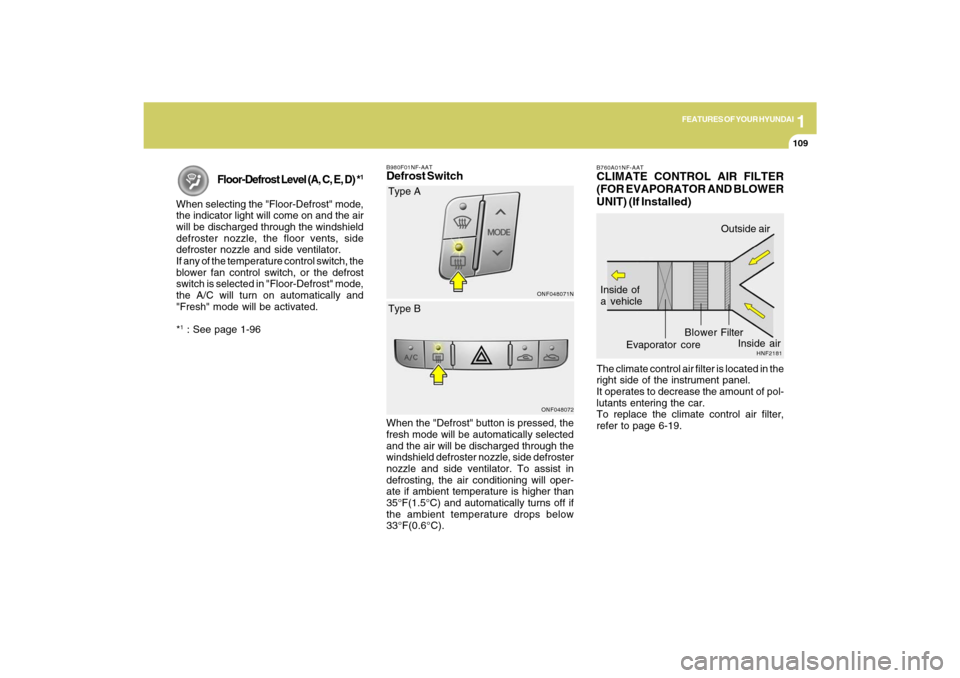
B980F01NF-AATDefrost Switch
ONF048071NONF048072
Type A
When the "Defrost" button is pressed, the
fresh mode will be automatically selected
and the air will be discharged through the
windshield defroster nozzle, side defroster
nozzle and side ventilator. To assist in
defrosting, the air conditioning will oper-
ate if ambient temperature is higher than
35°F(1.5°C) and automatically turns off if
the ambient temperature drops below
33°F(0.6°C).Type B
B760A01NF-AATCLIMATE CONTROL AIR FILTER
(FOR EVAPORATOR AND BLOWER
UNIT) (If Installed)The climate control air filter is located in the
right side of the instrument panel.
It operates to decrease the amount of pol-
lutants entering the car.
To replace the climate control air filter,
refer to page 6-19.
HNF2181
Inside of
a vehicle
Evaporator coreFilter BlowerOutside air
Inside air
Page 155 of 286
2
DRIVING YOUR HYUNDAI
2
WARNING: ENGINE EXHAUST CAN BE DANGEROUS!
C010A03A-AATEngine exhaust fumes can be extremely dangerous. If, at any time, you smell exhaust fumes inside the vehicle, open the
windows immediately.
o Do not inhale exhaust fumes.
Exhaust fumes contain carbon monoxide, a colorless, odorless gas that can cause unconsciousness and death by
asphyxiation.
o Be sure the exhaust system does not leak.
The exhaust system should be checked whenever the vehicle is raised to change the oil or for any other purpose. If you
hear a change in the sound of the exhaust or if you drive over something that strikes the underneath side of the car, have
the exhaust system checked as soon as possible by your Hyundai dealer.
o Do not run the engine in an enclosed area.
Letting the engine idle in your garage, even with the garage door open, is a hazardous practice. Never run the engine
in your garage any longer than it takes to start the engine and back the car out.
o Avoid idling the engine for prolonged periods with people inside the car.
If it is necessary to idle the engine for a prolonged period with people inside the car, be sure to do so only in an open area
with the air intake set at "Fresh" and fan operating at one of the higher speeds so fresh air is drawn into the interior.
If you must drive with the trunk lid open because you are carrying objects that make this necessary:
1. Close all windows.
2. Open side vents.
3. Set the air intake control at "Fresh", the air flow control at "Floor" or "Face" and the fan at one of the higher speeds.
To assure proper operation of the ventilation system, be sure the ventilation air intakes located just in front of the windshield
are kept clear of snow, ice, leaves or other obstructions.
!!
PROPOSITION 65 WARNING:
Engine exhaust and a wide variety of automobile components and parts, including components found in the interior
furnishings in a vehicle, contain or emit chemicals known to the State of California to cause cancer and birth defects
and reproductive harm. In addition, certain fluids contained in vehicles and certain products of component wear contain
or emit chemicals known to the State of California to cause cancer and birth defects or other reproductive harm.
Page 160 of 286
2
DRIVING YOUR HYUNDAI
7
!
C070B02A-AATUsing the ClutchThe clutch should be pressed all the way
to the floor before shifting, then released
slowly. The clutch pedal should always be
fully released while driving. Do not rest
your foot on the clutch pedal while driving.
This can cause unnecessary wear. Do not
partially engage the clutch to hold the car
on an incline. This causes unnecessary
wear. Use the foot brake or parking brake
to hold the car on an incline. Do not operate
the clutch pedal rapidly and repeatedly.
WARNING:
o Always buckle-up! In a collision, an
unbelted occupant is significantly
more likely to be seriously injured or
killed than a properly belted occupant.
o Avoid high speeds when cornering or
turning.
o Do not make quick steering wheel
movements, such as sharp lane
changes or fast, sharp turns.
o The risk of rollover is greatly
increased if you lose control of your
vehicle at highway speeds.
o Loss of control often occurs if two or
more wheels drop off the roadway
and the driver oversteers to reenter
the roadway.
o In the event your vehicle leaves the
roadway, do not steer sharply. Instead,
slow down before pulling back into the
travel lanes.
o Never exceed posted speed limits.
C070D03O-AATGood Driving Practiceso Never take the car out of gear and coast
down a hill. This is extremely hazardous.
Always leave the car in gear.
o Don't "ride" the brakes. This can cause
them to overheat and malfunction.
Instead, when you are driving down a
long hill, slow down and shift to a lower
gear. When you do this, engine braking
will help slow the car.
o Slow down before shifting to a lower
gear. This will help avoid over-revving
the engine, which can cause damage.
o Slow down when you encounter cross
winds. This gives you much better control
of your car.
o Be sure the car is completely stopped
before you attempt to shift into reverse.
The transaxle can be damaged if you do
not. To shift into reverse, depress the
clutch, move the shift lever to neutral,
wait three seconds, then shift to the
reverse position.
o Exercise extreme caution when driving
on a slippery surface. Be especially
careful when braking, accelerating or
shifting gears. On a slippery surface, an
abrupt change in vehicle speed can
cause the drive wheels to lose traction
and the vehicle to go out of control.
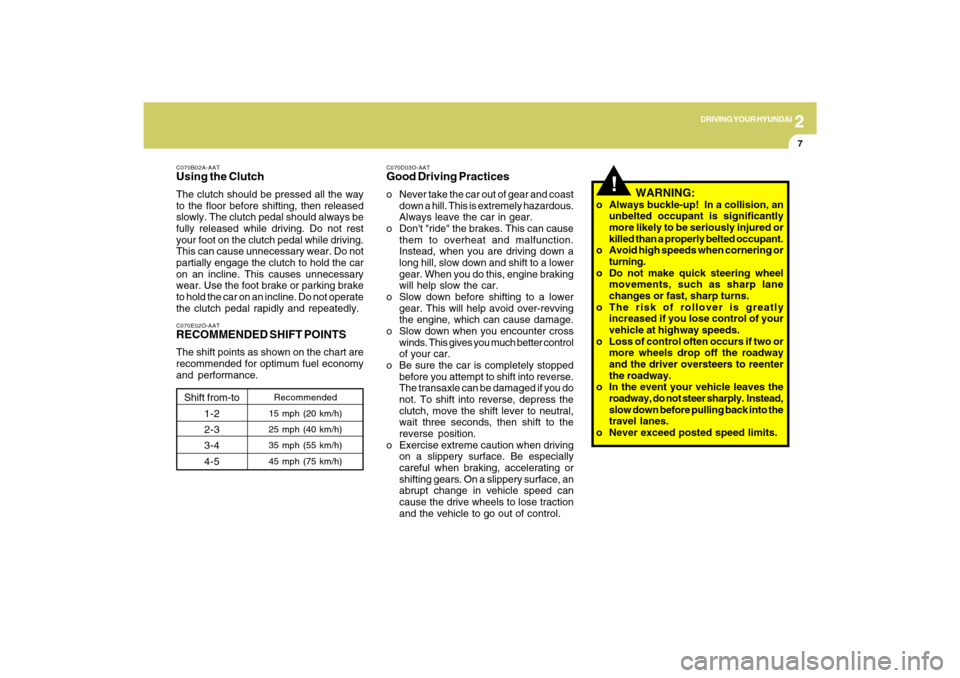
C070E02O-AATRECOMMENDED SHIFT POINTSThe shift points as shown on the chart are
recommended for optimum fuel economy
and performance.
Shift from-to
1-2
2-3
3-4
4-5
Recommended
15 mph (20 km/h)
25 mph (40 km/h)
35 mph (55 km/h)
45 mph (75 km/h)
Page 202 of 286
4
CORROSION PREVENTION AND APPEARANCE CARE
3
WASHING AND WAXING
E020E01A-AATDon't Neglect the InteriorMoisture can collect under the floor mats
and carpeting to cause corrosion. Check
under the mats periodically to be sure the
carpeting is dry. Use particular care if you
carry fertilizers, cleaning materials or
chemicals in the car.
These should be carried only in proper
containers and any spills or leaks should
be cleaned up, flushed with clean water
and thoroughly dried.
E020C01A-AATKeep Your Garage DryDon't park your car in a damp, poorly
ventilated garage. This creates a favorable
environment for corrosion. This is
particularly true if you wash your car in the
garage or drive it into the garage when it is
still wet or covered with snow, ice or mud.
Even a heated garage can contribute to
corrosion unless it is well ventilated so
moisture is dispersed.
E030A02A-AATWashing Your HyundaiNever wash your car when the surface is
hot from being in the sun. Always wash
your car in the shade.
Wash your car frequently. Dirt is abrasive
and can scratch the paint if it is not removed.
Air pollution or acid rain may damage the
paint and trim through chemical action if
pollutants are allowed to remain in contact
with the surface. If you live near the ocean
or in an area where road salts or dust
control chemicals are used, you should
pay particular attention to the underside of
the car. Start by rinsing the car to remove
dust and loose dirt. In winter, or if you have
driven through mud or muddy water, be
sure to thoroughly clean the underside as
well. Use a hard direct stream of water to
remove accumulations of mud or corrosive
materials. Use a good quality car-washing
solution and follow the manufacturer's
directions on the package. These are
available at your Hyundai dealer or auto
parts outlet. Don't use strong household
detergents, gasoline, strong solvents or
abrasive cleaning powders as these may
damage the finish.
Use a clean sponge or cloth, rinse it
frequently and don't damage the finish by
rubbing too hard. For stubborn spots,
dampen them frequently and remove them
a little at a time. o When cleaning lower door panels,
rocker panels and frame members, be
sure that drain holes are kept open
so that moisture can escape and not
be trapped inside to ac-celerate
corrosion.
E020D02A-AATKeep Paint and Trim in Good
ConditionScratches or chips in the finish should be
covered with "touch-up" paint as soon as
possible to reduce the possibility of
corrosion. If bare metal is showing through,
the attention of a qualified body and paint
shop is recommended.
Bird droppings : Bird droppings are highly
corrosive and may damage painted
surfaces in just a few hours. Always remove
bird droppings as soon as possible.
Page 236 of 286
6
DO-IT-YOURSELF MAINTENANCE
21
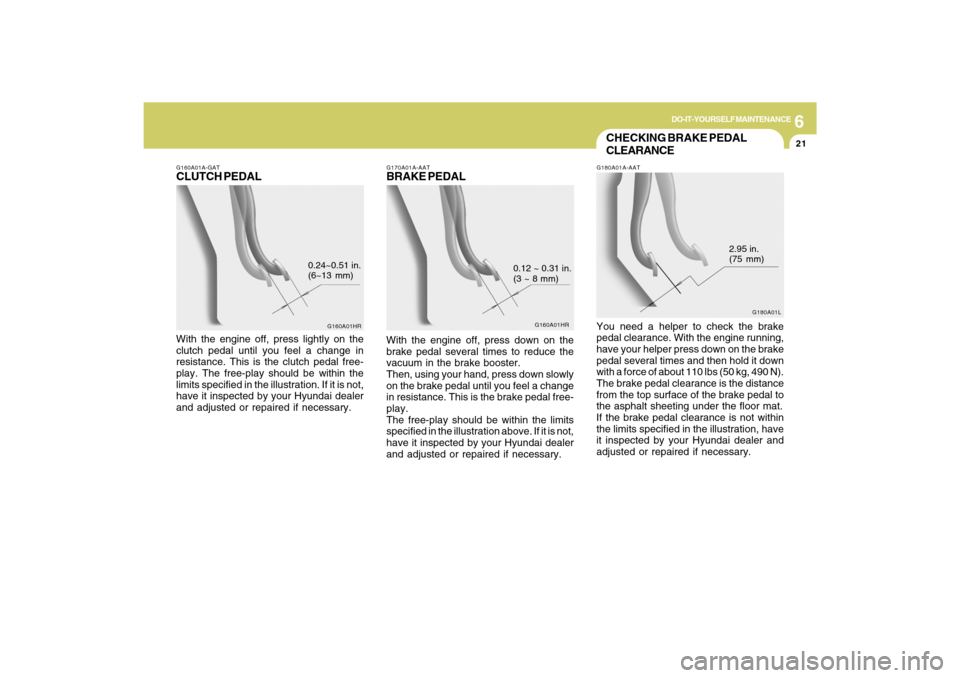
G170A01A-AATBRAKE PEDALWith the engine off, press down on the
brake pedal several times to reduce the
vacuum in the brake booster.
Then, using your hand, press down slowly
on the brake pedal until you feel a change
in resistance. This is the brake pedal free-
play.
The free-play should be within the limits
specified in the illustration above. If it is not,
have it inspected by your Hyundai dealer
and adjusted or repaired if necessary.
G160A01HR
0.12 ~ 0.31 in.
(3 ~ 8 mm)
CHECKING BRAKE PEDAL
CLEARANCEG180A01A-AATYou need a helper to check the brake
pedal clearance. With the engine running,
have your helper press down on the brake
pedal several times and then hold it down
with a force of about 110 lbs (50 kg, 490 N).
The brake pedal clearance is the distance
from the top surface of the brake pedal to
the asphalt sheeting under the floor mat.
If the brake pedal clearance is not within
the limits specified in the illustration, have
it inspected by your Hyundai dealer and
adjusted or repaired if necessary.
G180A01L
2.95 in.
(75 mm)
G160A01A-GATCLUTCH PEDALWith the engine off, press lightly on the
clutch pedal until you feel a change in
resistance. This is the clutch pedal free-
play. The free-play should be within the
limits specified in the illustration. If it is not,
have it inspected by your Hyundai dealer
and adjusted or repaired if necessary.
G160A01HR
0.24~0.51 in.
(6~13 mm)