Seat Hyundai Sonata 2009 Owner's Manual
[x] Cancel search | Manufacturer: HYUNDAI, Model Year: 2009, Model line: Sonata, Model: Hyundai Sonata 2009Pages: 286, PDF Size: 9.58 MB
Page 5 of 286

F4
A110A01A-AAT
VEHICLE DATA COLLECTION AND EVENT DATA RECORDERS
Your Hyundai vehicle is equipped with many high technology, electronically controlled systems
that help to ensure your vehicle operates properly and provides the performance that you
expect. These systems utilize computers to monitor the operation of various systems and
components and help to control their operation. These computerized system operations are
wide-ranging and involve components to reduce emissions, to continuously evaluate the
readiness of the airbag and seat belt pretensioner systems, to determine when the airbag and
seat belt pre-tensioner systems should be deployed and then to activate the deployment, and
if equipped, to operate anti-lock braking, traction control and electronic stability control to assist
the driver to control the vehicle in difficult driving situations. These systems electronically store
information that is useful to service technicians when they need to diagnose and repair these
systems. Additional information is stored only when a crash occurs that results in the
deployment of the airbags or seat belt pre-tensioners. This type of data storage is done by
devices called event data recorders(EDR).
After a crash event, the airbag and seat belt pre-tensioner computer system, known as the
Supplemental Restraint System Control Module (SRSCM) or Airbag Control Unit (ACU), may
record some information about the condition of the vehicle and how it was being operated. This
information consists of data related to seat belt usage and if there was diagnostic information
in the airbag or seat belt systems at the time that a crash occurred, and if the ACU sensed that
a crash of sufficient severity occurred to require seat belt pre-tensioner or airbag deployment.
To retrieve this information, special equipment is needed and access to the vehicle or the device
that stores the data is required. Hyundai will not access information about a crash event or share
it with others except:
o in response to an official request of police or similar government office, or
o with the consent of the vehicle owner or, if the vehicle is leased, with the consent of the lessee,
or
o as part of Hyundai’s defense of litigation, or
o as required by law.
Page 12 of 286
F11
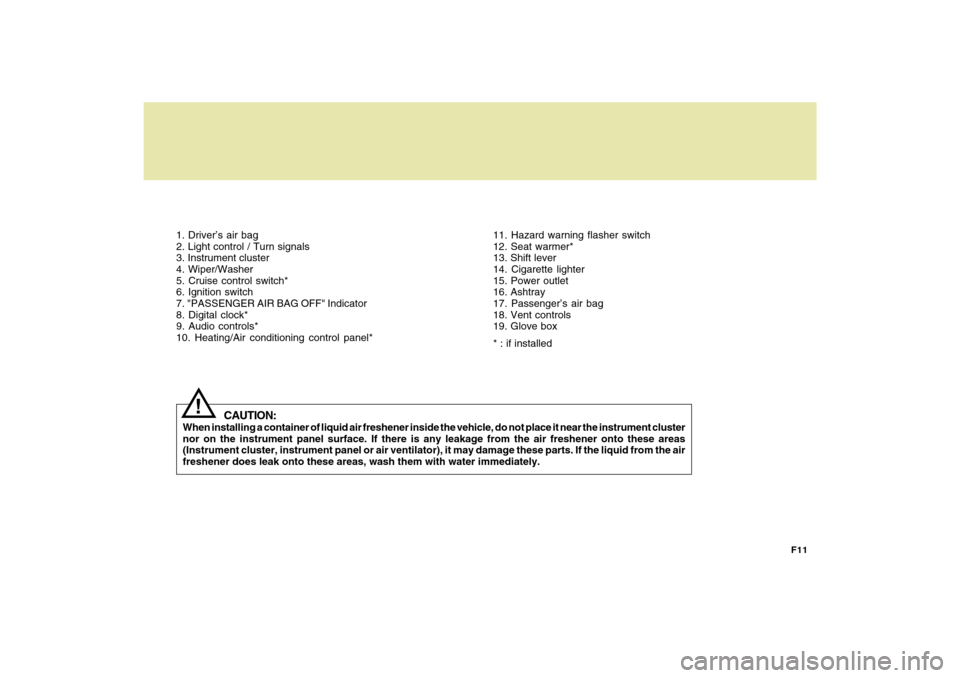
1. Driver’s air bag
2. Light control / Turn signals
3. Instrument cluster
4. Wiper/Washer
5. Cruise control switch*
6. Ignition switch
7. "PASSENGER AIR BAG OFF" Indicator
8. Digital clock*
9. Audio controls*
10. Heating/Air conditioning control panel*
CAUTION:
When installing a container of liquid air freshener inside the vehicle, do not place it near the instrument cluster
nor on the instrument panel surface. If there is any leakage from the air freshener onto these areas
(Instrument cluster, instrument panel or air ventilator), it may damage these parts. If the liquid from the air
freshener does leak onto these areas, wash them with water immediately.
!
11. Hazard warning flasher switch
12. Seat warmer*
13. Shift lever
14. Cigarette lighter
15. Power outlet
16. Ashtray
17. Passenger’s air bag
18. Vent controls
19. Glove box
* : if installed
Page 13 of 286
YOUR VEHICLE AT A GLANCE
F12
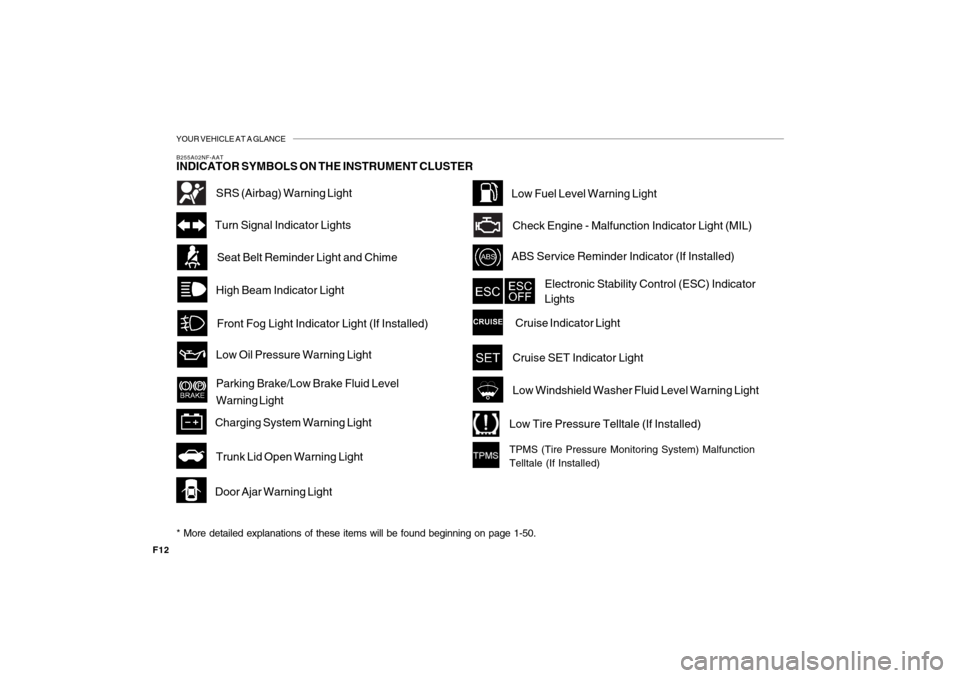
B255A02NF-AATINDICATOR SYMBOLS ON THE INSTRUMENT CLUSTER
High Beam Indicator Light
Door Ajar Warning LightSeat Belt Reminder Light and ChimeTurn Signal Indicator Lights
ABS Service Reminder Indicator (If Installed)
Low Oil Pressure Warning Light
Parking Brake/Low Brake Fluid Level
Warning Light
Charging System Warning Light
SRS (Airbag) Warning Light
Cruise Indicator Light Check Engine - Malfunction Indicator Light (MIL)
Electronic Stability Control (ESC) Indicator
Lights
Low Windshield Washer Fluid Level Warning LightFront Fog Light Indicator Light (If Installed)
Cruise SET Indicator LightLow Fuel Level Warning Light
Trunk Lid Open Warning Light
* More detailed explanations of these items will be found beginning on page 1-50.
Low Tire Pressure Telltale (If Installed)TPMS (Tire Pressure Monitoring System) Malfunction
Telltale (If Installed)
Page 14 of 286
1
Fuel Recommendations ................................................ 1-2
Breaking in Your New Hyundai ..................................... 1-3
Keys.............................................................................. 1-3
Door Locks ................................................................... 1-4
Theft-Alarm System ...................................................... 1-8
Windows.....................................................................1-11
Seats...........................................................................1-14
Seat Belts....................................................................1-21
Child Restraint System ...............................................1-26
Advanced Supplemental Restraint (AIRBAG)
System (SRS) ...........................................................1-34
Instrument Cluster and Indicator Lights...................... 1-48
Warning and Indicator Lights......................................1-50
Trip Computer.............................................................1-58
Multi-Function Light Switch .........................................1-60
Windshield Wiper and Washer Switch ........................1-63
Sunroof.......................................................................1-69
Mirror...........................................................................1-75
Homelink Mirror...........................................................1-77
Hood Release .............................................................1-87
Cruise Control.............................................................1-91
Heating and Cooling Control .......................................1-96
Antenna.....................................................................1-110
Stereo Sound System...............................................1-112
Audio System............................................................1-115
FEATURES OF YOUR HYUNDAI
1
Page 16 of 286
1
FEATURES OF YOUR HYUNDAI
3
KEYS
BREAKING IN YOUR NEW
HYUNDAI
B010F01A-AATOperation in Foreign CountriesIf you are going to drive your Hyundai in
another country, be sure to:
o Observe all regulations regarding reg-
istration and insurance.
o Determine that acceptable fuel is
available.B010E01A-AATGasolines for Cleaner AirTo help contribute to cleaner air, Hyundai
recommends that you use gasolines
treated with detergent additives, which
help prevent deposit formation in the
engine. These gasolines will help the
engine run cleaner and enhance perfor-
mance of the Emission Control System.
B020A01S-AATDuring the First 1,200 Miles (2,000
Km)No formal "break-in" procedure is required
with your new Hyundai. However, you can
contribute to the economical operation
and durability of your Hyundai by observing
the following recommendations during the
first 1,200 miles (2,000 km).
o Don't drive faster than 55 MPH (88 km/
h).
o While driving, keep your engine speed
(rpm, or revolutions per minute) between
2,000 rpm and 4,000 rpm.
o Use moderate acceleration. Don't start
quickly or depress the accelerator pedal
fully.
o For the first 200 miles (300 km), try to
avoid hard stops.
o Don't lug the engine (in other words,
don't drive so slowly in too high a gear
that the engine "bucks":shift to a lower
gear).
o Whether going fast or slow, vary your
speed from time to time.
o Don't let the engine idle longer than 3
minutes at one time.
o Don't tow a trailer during the first 1,200
miles (2,000 km) of operation.
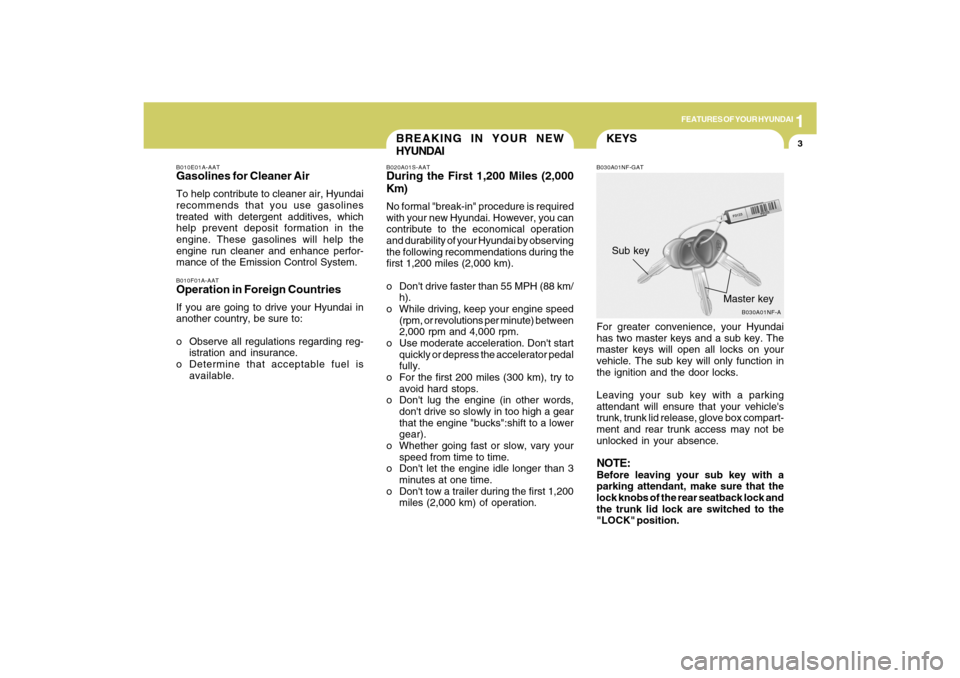
B030A01NF-GATFor greater convenience, your Hyundai
has two master keys and a sub key. The
master keys will open all locks on your
vehicle. The sub key will only function in
the ignition and the door locks.
Leaving your sub key with a parking
attendant will ensure that your vehicle's
trunk, trunk lid release, glove box compart-
ment and rear trunk access may not be
unlocked in your absence.NOTE:Before leaving your sub key with a
parking attendant, make sure that the
lock knobs of the rear seatback lock and
the trunk lid lock are switched to the
"LOCK" position.
B030A01NF-A
Master key Sub key
Page 17 of 286
1FEATURES OF YOUR HYUNDAI4
DOOR LOCKS!
B040A01A-AAT B030C01JM-AAT
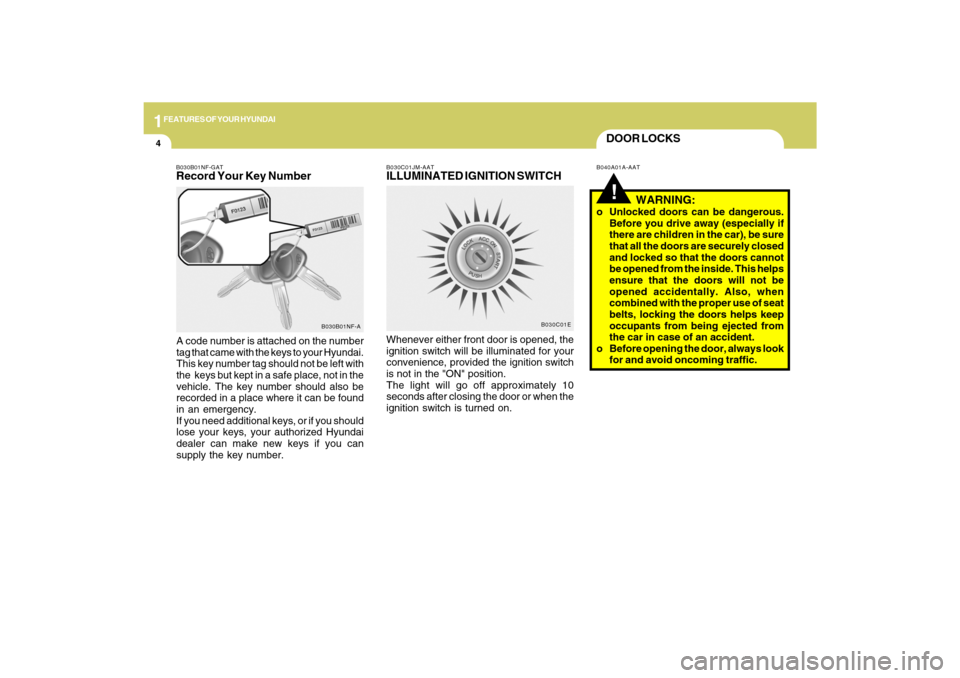
ILLUMINATED IGNITION SWITCHWhenever either front door is opened, the
ignition switch will be illuminated for your
convenience, provided the ignition switch
is not in the "ON" position.
The light will go off approximately 10
seconds after closing the door or when the
ignition switch is turned on.
WARNING:
o Unlocked doors can be dangerous.
Before you drive away (especially if
there are children in the car), be sure
that all the doors are securely closed
and locked so that the doors cannot
be opened from the inside. This helps
ensure that the doors will not be
opened accidentally. Also, when
combined with the proper use of seat
belts, locking the doors helps keep
occupants from being ejected from
the car in case of an accident.
o Before opening the door, always look
for and avoid oncoming traffic.
B030B01NF-GATRecord Your Key NumberA code number is attached on the number
tag that came with the keys to your Hyundai.
This key number tag should not be left with
the keys but kept in a safe place, not in the
vehicle. The key number should also be
recorded in a place where it can be found
in an emergency.
If you need additional keys, or if you should
lose your keys, your authorized Hyundai
dealer can make new keys if you can
supply the key number.
B030B01NF-A
B030C01E
Page 19 of 286
1FEATURES OF YOUR HYUNDAI6
ONF048008N-2ONF048008N-1
Driver's sideFront passenger's side
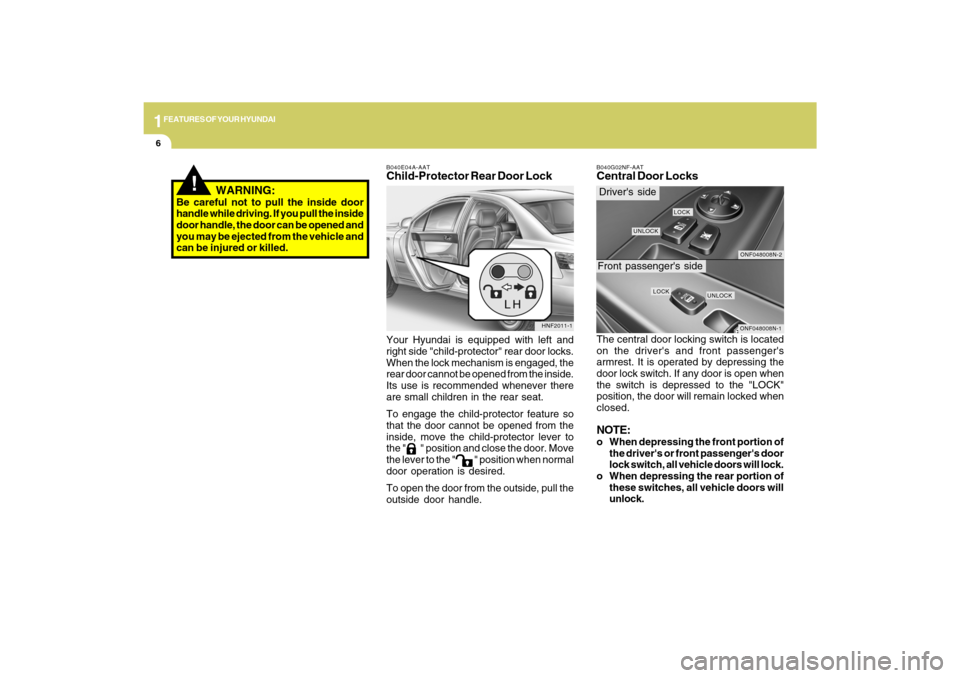
B040E04A-AATChild-Protector Rear Door LockYour Hyundai is equipped with left and
right side "child-protector" rear door locks.
When the lock mechanism is engaged, the
rear door cannot be opened from the inside.
Its use is recommended whenever there
are small children in the rear seat.
To engage the child-protector feature so
that the door cannot be opened from the
inside, move the child-protector lever to
the " " position and close the door. Move
the lever to the " " position when normal
door operation is desired.
To open the door from the outside, pull the
outside door handle.
B040G02NF-AATCentral Door LocksThe central door locking switch is located
on the driver's and front passenger's
armrest. It is operated by depressing the
door lock switch. If any door is open when
the switch is depressed to the "LOCK"
position, the door will remain locked when
closed.NOTE:o When depressing the front portion of
the driver's or front passenger's door
lock switch, all vehicle doors will lock.
o When depressing the rear portion of
these switches, all vehicle doors will
unlock.
WARNING:
Be careful not to pull the inside door
handle while driving. If you pull the inside
door handle, the door can be opened and
you may be ejected from the vehicle and
can be injured or killed.
!
LOCK
UNLOCK
UNLOCK
LOCK
HNF2011-1
Page 27 of 286
1FEATURES OF YOUR HYUNDAI14
!
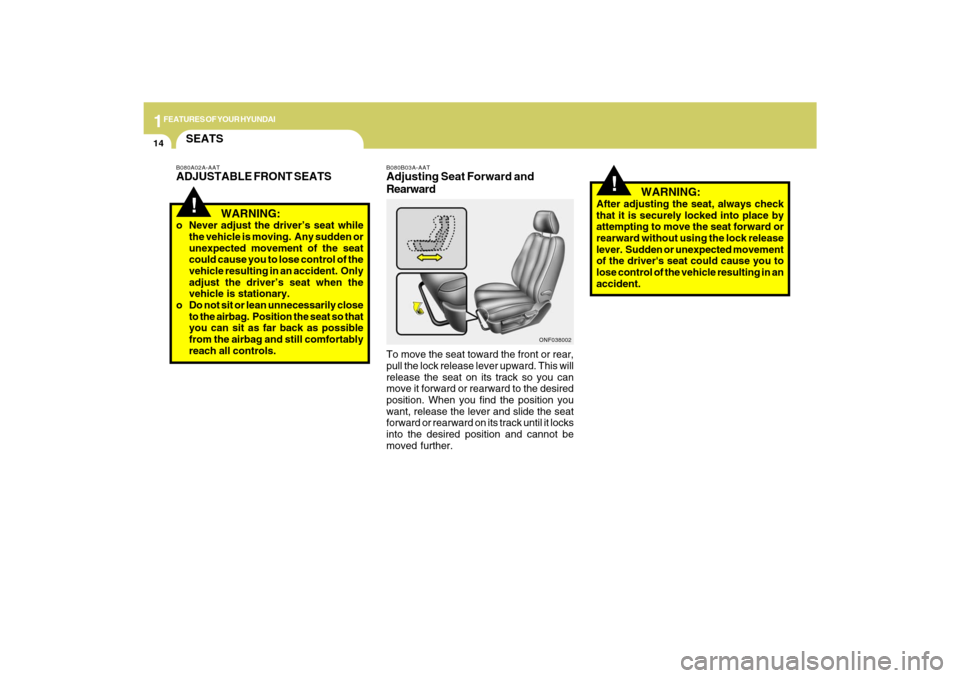
B080B03A-AATAdjusting Seat Forward and
RearwardTo move the seat toward the front or rear,
pull the lock release lever upward. This will
release the seat on its track so you can
move it forward or rearward to the desired
position. When you find the position you
want, release the lever and slide the seat
forward or rearward on its track until it locks
into the desired position and cannot be
moved further.
WARNING:
After adjusting the seat, always check
that it is securely locked into place by
attempting to move the seat forward or
rearward without using the lock release
lever. Sudden or unexpected movement
of the driver's seat could cause you to
lose control of the vehicle resulting in an
accident.
SEATSB080A02A-AATADJUSTABLE FRONT SEATS
!
WARNING:
o Never adjust the driver’s seat while
the vehicle is moving. Any sudden or
unexpected movement of the seat
could cause you to lose control of the
vehicle resulting in an accident. Only
adjust the driver’s seat when the
vehicle is stationary.
o Do not sit or lean unnecessarily close
to the airbag. Position the seat so that
you can sit as far back as possible
from the airbag and still comfortably
reach all controls.
ONF038002
Page 28 of 286
1
FEATURES OF YOUR HYUNDAI
15
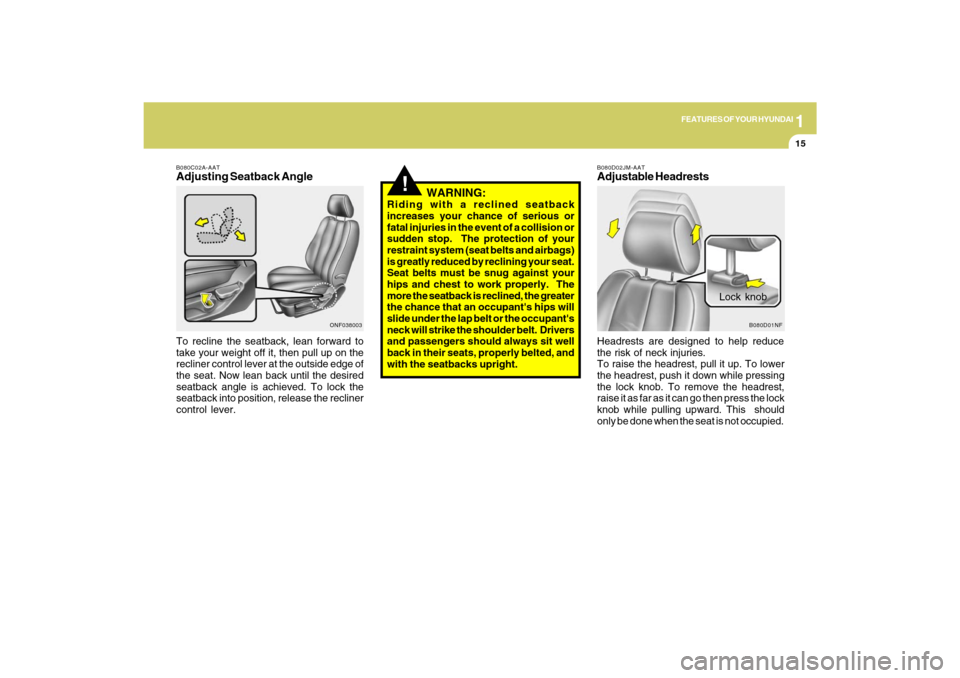
B080C02A-AATAdjusting Seatback AngleTo recline the seatback, lean forward to
take your weight off it, then pull up on the
recliner control lever at the outside edge of
the seat. Now lean back until the desired
seatback angle is achieved. To lock the
seatback into position, release the recliner
control lever.
ONF038003
!
WARNING:
Riding with a reclined seatback
increases your chance of serious or
fatal injuries in the event of a collision or
sudden stop. The protection of your
restraint system (seat belts and airbags)
is greatly reduced by reclining your seat.
Seat belts must be snug against your
hips and chest to work properly. The
more the seatback is reclined, the greater
the chance that an occupant's hips will
slide under the lap belt or the occupant's
neck will strike the shoulder belt. Drivers
and passengers should always sit well
back in their seats, properly belted, and
with the seatbacks upright.
B080D02JM-AATAdjustable HeadrestsHeadrests are designed to help reduce
the risk of neck injuries.
To raise the headrest, pull it up. To lower
the headrest, push it down while pressing
the lock knob. To remove the headrest,
raise it as far as it can go then press the lock
knob while pulling upward. This should
only be done when the seat is not occupied.
B080D01NF
Lock knob
Page 29 of 286
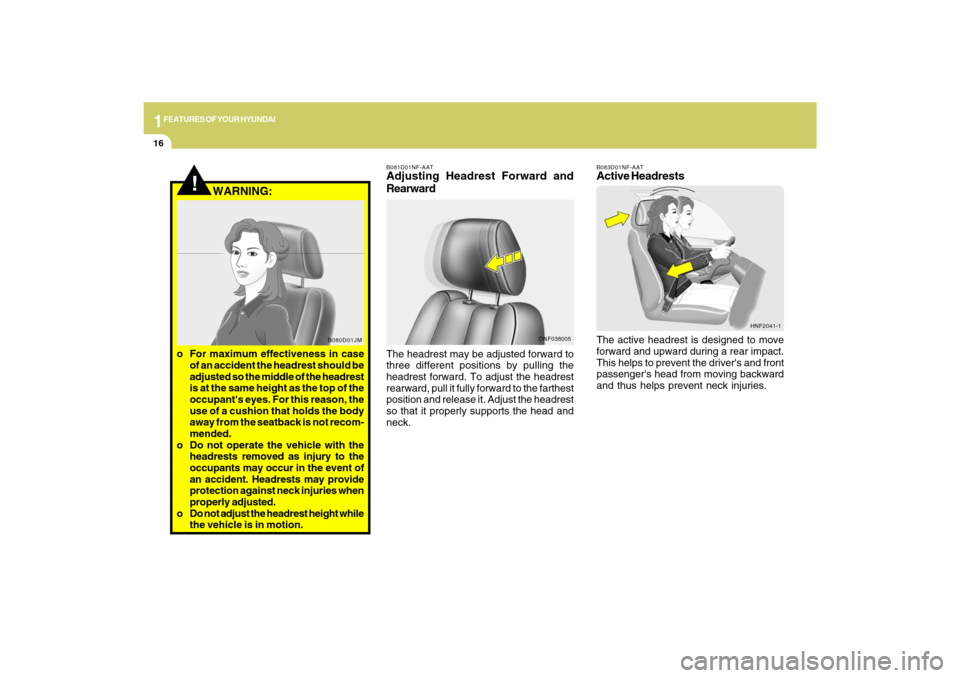
1FEATURES OF YOUR HYUNDAI16
B083D01NF-AATActive HeadrestsThe active headrest is designed to move
forward and upward during a rear impact.
This helps to prevent the driver's and front
passenger's head from moving backward
and thus helps prevent neck injuries.
B081D01NF-AATAdjusting Headrest Forward and
RearwardThe headrest may be adjusted forward to
three different positions by pulling the
headrest forward. To adjust the headrest
rearward, pull it fully forward to the farthest
position and release it. Adjust the headrest
so that it properly supports the head and
neck.
ONF038005HNF2041-1
!
WARNING:
o For maximum effectiveness in case
of an accident the headrest should be
adjusted so the middle of the headrest
is at the same height as the top of the
occupant's eyes. For this reason, the
use of a cushion that holds the body
away from the seatback is not recom-
mended.
o Do not operate the vehicle with the
headrests removed as injury to the
occupants may occur in the event of
an accident. Headrests may provide
protection against neck injuries when
properly adjusted.
o Do not adjust the headrest height while
the vehicle is in motion.
B080D01JM